Fortuitous Hormonal Ablation of Adrenal
Aldosteronoma due toa Complication, Adrenal
Venous Infarction by Adrenal Venographyduring
Adrenal Vein Sampling: Case Report
著者
IKENOUE Aya, BABA Yasutaka, HAYASHI Sadao,
TANABE Hiroaki, NAKAJO Masayuki
journal or
publication title
Medical journal of Kagoshima University
volume
60
number
3
page range
65-71
year
2009
Introduction
Primary aldosteronism, one of the causes of secondary hypertension, occurs in up to 3−15% of hypertensive patients1). The major subtypes of primary aldosteronism
are aldosterone-producing adenoma (aldosteronoma), the frequency of which is nearly 60%, and that of idiopathic hyperaldosteronism (IHA) is 30% and the proportion with IHA has increased2). Treatment differs between these
two major subtypes, as the former is typically removed
in a surgical procedure, while the latter is treated with medication. Therefore, it is important to distinguish between aldosteronoma and IHA3). In general, after
establishing primary aldosteronism by biochemical and hormonal findings, non-invasive imaging modalities such as computed tomography (CT), magnetic resonance imaging (MRI), and radionuclide imaging (RI) have been used for differential diagnosis. When results of those are indeterminate, adrenal vein sampling (AVS) is the most accurate method of indicating hormonal localization and
Fortuitous Hormonal Ablation of Adrenal Aldosteronoma due to
a Complication, Adrenal Venous Infarction by Adrenal Venography
during Adrenal Vein Sampling: Case Report
Aya IKENOUE, MD, Yasutaka BABA, MD, PhD, Sadao HAYASHI, MD, PhD,
Hiroaki TANABE, MD, Masayuki NAKAJO, MD, PhD
Department of Radiology, Kagoshima University Graduate School of Medical and Dental Sciences, Kagoshima 890-8520, Japan
(Accepted 7 October 2008)
Abstract
A 61-year-old woman was admitted to our Department for examination of uncontrollable hypertension. An aldosterone-producing adenoma (aldosteronomas) was suspected based on her hypertension, low plasma renin activity and a right adrenal mass on CT, although plasma and urinary aldosterone levels were within normal ranges. Because of the ambiguous hormonal results, we performed adrenal vein sampling including bilateral adrenal veins and the inferior vena cava. The results of aldosterone and cortisol levels of the blood samples reported later confirmed an aldosteronomas in the right adrenal gland. Immediately after the second right adrenal venography after successful sampling followed by the first uneventful right venography, the patient complained of back pain and CT revealed the swollen right adrenal gland with high density, suggesting a complication of intra-adrenal hemorrhagic venous infarction. Thereafter, her hypertension improved, plasma aldosterone levels decreased to a lower normal limit, and plasma renin activity returned to a normal range. CT obtained 3 months later and adrenocortical scintigraphy performed 6 months later revealed that most of the aldosteronoma was necrotic. During the 9-months follow-up period, hormonal ablation of the aldosteronoma was maintained. Although hormonal ablation of the aldosteronoma was fortuitously obtained in our case, adrenal venography should be performed with meticulous care and after confirmation of smooth blood flow into the syringe connected with the catheter by pulling the plunger. Manual injection of the contrast medium into the adrenal vein should be made as gentle and slow as possible to avoid complications, especially in case of prolonged wedge of the catheter tip in the adrenal vein.
Key words: adrenal gland, adrenal vein sampling, aldosteronoma, complication, primary aldosteronism, venography
Correspondence to: Dr. Yasutaka Baba, MD, PhD, Depar tment of Radiology, Kagoshima University Graduate School of Medical and Dental Sciences, 8-35-1
Sakuragaoka, Kagoshima 890-8544, Japan Tel.: +81-99-275-5417 Fax.: +81-99-265-1106 E-mail: yasutaka@m3.kufm.kagoshima-u.ac.jp
〔66〕 Med. J. Kagoshima Univ., Vol. 60, No. 3, January, 2009 function. However, complications such as intra- or extra-
adrenal venous thrombosis and adrenal infarction are not rare4). In this report, we describe a case of aldosteronoma,
in which adrenal venous infarction occurred by adrenal venography after successful vein sampling and caused fortuitously hormonal ablation of the aldosteronoma.
Case Report
A 61-year-old woman with hypertension was referred to our Department. Her past history included poorly controlled hyper tension for 30 years and cerebral infarction at the age of 50. The patient had been treated with antihyper tensive medications, including an
angiotensin-converting enzyme (ACE) inhibitor, a beta-blocker, a calcium-channel beta-blocker, and an aldosterone antagonist. Primary aldosteronism was suspected based on her hyper tension and suppressed plasma renin activity (0.1 - 0.2 ng/ml/h, normal range, 0.3−2.9 ng/ml/ h). However, the concentrations of plasma aldosterone (215 pg/ml, normal range 35.7−240 pg/ml), and urinary aldosterone (9.9 μg/day, normal range 10μg/day) were in the upper normal limits, and serum potassium level was also within a normal range. Her blood pressure was high in a range of 170−220/70−110 mmHg.
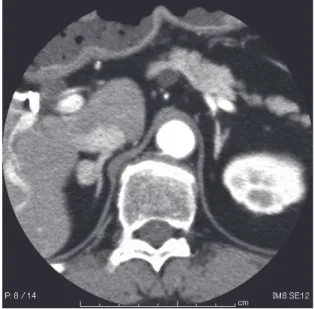
CT scanning demonstrated a right adrenal lipid-rich mass that was 15 mm × 11 mm in size on unenhanced CT images (Fig. 1A). The mass demonstrated marked
Fig. 1. Dynamic CT scanning. A : Unenhanced CT image shows a low density (9HU) mass (arrow), 15mm×11mm in size, in the right adrenal gland. B: Contrast-enhanced30-second CT image shows marked enhancement (127HU) of the mass (arrow). C: Contrast-enhanced 300-second CT image shows rapid washout of contrast medium from the mass (47HU) (arrow).
Fig. 1A
Fig. 1C
enhancement 30 seconds after star ting injection of contrast medium (Fig. 1B) and rapid washout of the medium at 300 seconds (Fig. 1C). An 131I-adosterol
adrenocortical scan demonstrated intense uptake in the right mass-bearing adrenal gland (Fig. 2). These CT and RI examinations suggested that the right adrenal mass was an adenoma. Because of the equivocal results in hormonal examinations, AVS was per formed to differentiate an aldosteronoma from a silent adenoma after obtaining written informed consent from her. The sampling was first performed for the left adrenal vein and the inferior vena cava. Seven ml of blood was sampled each through the 5 Fr. modified cobra shaped catheter (Hanako Med. Co., Saitama, Japan ) from the left adrenal vein and the inferior vena cava. It took about 5 minutes
each. Then the right adrenal vein was catheterized with the 5 Fr. shepherd hook catheter (Hanako Med. Co., Saitama, Japan) and its venous blood was sampled successfully after confirmation of the catheter tip in the right adrenal vein by the first adrenal venography with manual injection of 3 ml of contrast medium. After venography, 2 ml of heparinized physiological saline was infused into the catheter to prevent blood coagulation. Then the 7 ml of blood from the right adrenal vein dripped for sampling. It took about 15 minutes. The hormonal (aldosterone and cortisol) results of AVS including bilateral adrenal veins and the inferior vena cava reported later confirmed an aldosteronoma in the right adrenal gland (Table 1). When manual injection of 1 cc of contrast medium was made again into the right Fig. 2. 131I-adosterol adrenocortical scintigraphy performed before the adrenal vein sampling. Posterior view
〔68〕 Med. J. Kagoshima Univ., Vol. 60, No. 3, January, 2009 adrenal vein to reconfirm whether the catheter tip was
placed in the right position after dripping the venous blood for sampling and pulling a small amount of blood through the catheter by a syringe, the patient complained of back pain. We performed CT examination 5 minutes after the back pain occurred, which showed swelling of the entire right adrenal gland with high density (Fig. 3).
The pain was controlled by an anodyne. The patient was observed and followed carefully. Ten days after the AVS procedure, the plasma aldosterone level was remarkably decreased to the lower normal range and plasma renin activity rose to a normal level (Table 2). Further, her blood pressure was decreased to a range of
100-150/70-90mmHg by administration of reduced doses of a calcium-channel blocker and an angiotensin II type 1 (AT1) receptor blocker. Three months later, CT showed that the enhancement of the adenoma clearly decreased (Fig. 4), suggesting that most of the adenoma was necrotic. Improvement in hypertension, hormonal normalization and CT findings suggested that the adrenal venous infarction led to hormonal ablation of the aldosteronoma. Adrenal ablation was also demonstrated by adrenocortical imaging (Fig. 5). At the time of writing, hormonal ablation of the aldosteronoma has been continued for more than 9 months after the AVS.
Fig. 4. Contrast-enhanced 30-second CT scan 3 months after the adrenal vein sampling. The right aldosteronoma-bearing adrenal gland has decreased to the untreated size and the adenoma enhances slightly (22HU), suggesting that most part of the adenoma has become necrotic (arrow).
Fig. 3. Unhanced CT scanning immediately after the adrenal venography. The entire right adrenal gland (arrow) is swollen with high density (67 HU).
Discussion
AVS is useful to differentiate between an aldosteronoma and IHA, as well as to localize an aldosteronoma. Treatment for these subtypes differs and it is essential to accurately diagnose the lesion. A recent study has shown that 21.7% of patients would have missed an appropriate adrenalectomy and 24.7% would have had an unnecessary adrenalectomy on the basis of CT findings alone5). In
addition, CT scanning cannot reliably detect an adrenal adenoma with a diameter of less than 1 cm6). To avoid an
unnecessary and inappropriate adrenalectomy, AVS is performed as a direct hormonal assessment for patients with negative or equivocal CT findings6).
The accuracy of AVS has been reported to be greater than 90%7). However, it is an invasive procedure with
more potential complications as compared with other procedures, such as CT scanning, MRI, and RI. In addition, catheterization of the adrenal veins requires a highly skilled technique, especially for the right adrenal vein. Complications such as intra- or extra- adrenal venous thrombosis and adrenal infarction have been reported to occur in some 5% of patients that undergo adrenal
venography4). If both adrenal glands are infarcted
completely, adrenal insufficiency may occur, whereas if the tumor- bearing gland is infarcted, hormonal ablation may occur 8).
Surgical removal is commonly recommended as treatment for an aldosteronoma. Transcatheter arterial embolization and CT-guided radiofrequency ablation are non-surgical alternative for therapy of aldosteronomas9, 10).
Although there have been several reports of fortuitous remission of primar y aldosteronism and Cushing’s syndrome following adrenal venography 11−14), the attempts
using vigorous retrograde injection of contrast material into the adrenal vein failed to infarct the aldosteronoma-containing gland in 4 systemically heparinized patients 8).
Systemic heparinization is not generally performed for AVS 1, 4−6, 11). Heparinized physiological saline is usually
infused into the catheter to prevent blood coagulation. We also performed AVS in our patient without systemic heparinization.
The venous blood from the right adrenal gland enters the inferior vena cava at an acute angle either as a single or as multiple channels, whereas the left adrenal vein enters the left renal vein. Therefore catheterization is Fig. 5. 131I-adosterol adrenocortical scintigraphy 6 months after the adrenal vein sampling. The right adrenal
〔70〕 Med. J. Kagoshima Univ., Vol. 60, No. 3, January, 2009 more difficult into the right adrenal vein than into the
left adrenal vein. In addition, the catheter tip is apt to be wedged tightly in the right adrenal vein because of a small caliber. In our case, the catheter was successfully wedged in the right adrenal vein. Although, after dripping of the venous blood for sampling, the blood in the catheter was confirmed to flow into the syringe connected with the catheter by pulling the plunger, this confirmation might be insufficient for assessment of smooth blood flow from the right adrenal vein. Venous congestion might occur by the prolonged (15 minutes) wedge of the catheter tip. Under this condition, the injected contrast material might cause hemorrhagic infarction in the right adrenal gland. This assumption is supported by the initial success in the right adrenal venography and the CT findings that the right adrenal gland was swollen and the density of the entire adrenal gland increased on CT performed 5 minutes after injection of the contrast medium. The over-distension of the capillaries and the veins in the cortico - medullary plexus by the injection of contrast medium might rupture their thin walls and lead to hemorrhagic infarction or extravasation of contrast medium into the adrenal tissue4). However, as shown in the previous
report8), vigorous retrograde injection of contrast medium
alone could not always produce adrenal infarction,. Preformed adrenal vein tiny thrombi might also be responsible for adrenal infarction in our case. If quick measurement of aldosterone and cortisol in the blood samples were possible on site in future, reconfirmation of the catheter tip by venography could be omitted.
Although hormonal ablation of the aldosteronoma was fortuitously obtained in our case, adrenal venography should be performed with meticulous care and after confirmation of smooth blood flow into the syringe connected with the catheter by pulling the plunger. Manual injection of the contrast medium into the adrenal vein should be also made as gentle and slow as possible to avoid complications, especially in case of prolonged wedge of the catheter tip in the adrenal vein.
References
1.Ishibashi T, Satoh F, Yamada T, Sato A, Matsuhashi T, Takase K. Primary aldosteronism: a pictorial essay. Abdom Imaging 2007; 32: 504-14.
2.Fehaily MA, Duh QY. Clinical manifestation of aldosteronoma. Surg Clin N Am 2004; 84: 887-905.
3.Tan YY, Ogilvie JB, Triponez F, Caron NR, Kebebew EK, Clark OH, et al. Selective use of adrenal venous sampling in the lateralization of aldosterone-producing adenomas. World J Surg 2006; 30: 879-85.
4.Bayliss RIS, Edwards OM, Starer F. Complications of adrenal venography. Br J Radiol 1970; 43: 531-3. 5.Young WF, Stanson AW, Thompson GB, Grant CS,
Farley DR, van Heerden JA. Role for adrenal venous sampling in primary aldosteronism. Surgery 2004; 136: 1227-35.
6.Toniato A, Bernante P, Rossi GP, Pelizzo MR. The role of adrenal venous sampling in the surgical management of primary aldosteronism. World J Surg 2006; 30: 624-7. 7.Doppman JL, Gill JR, Miller DL, Chang R, Gupta
R , F r i e d m a n T C , e t a l . D i s t i n c t i o n b e t w e e n hyperaldosteronism due to bilateral hyperplasia and unilateral aldosteronoma: reliability of CT. Radiology 1992; 184: 677-82.
8.Dunnick NR, Doppman JL, Gill JR Jr. Failure to ablate the adrenal gland by injection of contrast material. Radiology 1982; 142: 67-9.
9.Hokotate H, Inoue H, Baba Y, Tsuchimochi S, Nakajo M. Aldosteronomas: experience with superselective adrenal arterial embolization in 33 Cases. Radiology 2003; 227: 401-6.
10.Mayo-Smith WW, Dupuy DE. Adrenal neoplasms: CT-guided radiofrequency ablation-preliminary results. Radiology 2004; 231: 225-30.
11.Fisher CE, Turner FA, Horton R. Remission of primary hyperaldosteronism after adrenal venography. N Eng J Med 1971; 285: 334-6.
12.Fellerman H, Dalakos TG, Streeten DHP. Remission of Cushing’s syndrome after unilateral adrenal phlebography. apparent destruction of adrenal adenoma. Ann Intern Med 1970; 73: 585-9.
13.Melby JC. Identifying the adrenal lesion in primary aldosteronism. Ann Intern Med 1972; 76: 1039-41. 14.Taylor HC, Sachs CR. Primary aldosteronism: Remission
and development of adrenal insufficiency after adrenal venography. Ann Intern Med 1976; 85: 207-9.