Muroran-IT Academic Resources Archive
See also Muroran-IT Academic Resources Archive Copyright Policy
Title
Study on Trace Elements of Water in Xiaolangdi
Reservoir,China
Author(s)
LIU, Qiaoli; TANG, Shunlin; XU, Junmiao; WANG, Tao
Citation
室蘭工業大学紀要 Vol.59, pp.161-164, 2010
Issue Date
2010-03
URL
http://hdl.handle.net/10258/470
Rights
Study on Trace Elements of Water in Xiaolangdi Reservoir,China
Qiaoli LIU*, Shunlin TANG*, Junmiao XU* and TaoWANG*
(Received 27 May 2009, Accepted 20 November 2009 )
As one of the strategic projects, Xiaolangdi Dam Project has many functions, including flood control, water supply for municipal and irrigation, etc. And water quality of Xiaolangdi reservoir will directly affects industrial and agricultural production and health of residents in the reservoir area and downstream areas. So the fate of toxic heavy metals in water of the Xiaolangdi is highly concerned. Samples of surface water from Mingzhudao and Zhangling in the Xiaolangdi reservoir,were analyzed to assess the water quality. Nine trace elements, including Hg, Se, Cd,Cr, Cu, Zn, Fe, Mn and F were determined. Concentrations of As, Cr, Cu, and Zn were lower than the detection limit in the Xiaolangdi water. The mean concentration of mercury in the studied areas was higher than the III class of Chinese surface water quality standards limit, while other elements were lower than the limit. And the concentration of mercury increases as water depth increases,it may be due to sedimentation of mercury micro-organisms or biogeochemical cycle of mercury. Se and Cd in the Xiaolangdi Reservoir were distributed evenly, and their contents changed little with water depth.
Keywords : Xiaolangdi, Trace elements, Water quality
1 INTRODUCTION
Xiaolangdi Multipurpose Dam located at the Jiyuan conty, Henan province,China. The reservoir, with a capacity of 12.65 billion m3 at the elevation of 275 m,
extends to the dam toe of Sanmenxia dam which is away from 130 km upstream of Xiaolangdi in the middle reached of the Yellow River. The downstream area is the Huang-Huai-Hai plain. It can provide many functions, such as flood control, water supply for municipal, power generation and irrigation, etc.
So the water quality of Xiaolangdi reservoir will directly affect industrial and agricultural production and health of residents in the reservoir area and downstream areas. And the fate of toxic heavy metals in water of the Xiaolangdi is highly concerned.
Yan Gui-Yun [1] has studied the status of water
quality in Xiaolangdi reservoir. Results show the major pollution indicators in the reservoir are petroleum, NH3-N, Hg, CODMnand NO2-N. Water quality between
the Sanmenxia and the Xiaolangdi is IV~V. In 2003 Zhou Binglee and others according to Xiaolangdi Reservoir monitoring results throughout the year, found that the main pollution factors are chemical oxygen demand, permanganate index, dissolved oxygen. And in the same year monitoring result of heavy metals (Cu, Pb, Zn, Cd) in the water of the Yellow River studied by He Jiang, showed that Pb, Cd and other heavy metals in the sediment of the Baotou Section of the Yellow River have greater potential environmental hazard. Niu Yongsheng and other pairs had a comprehensive analysis on the Yellow River Basin water quality status and found that the concentrations of Hg, As, Cd, Cr+6 had
been higher than the limit in the Yellow River Basin water, and the large areas were influenced by Hg, Cd, * Institute of Resources and Environment, Henan
Qiaoli LIU, Shunlin TANG, Junmiao XU and TaoWANG
As, and Cr+6. Numerous scholars have done a great deal
of research on the water of Huanghe and Xiaolangdi, while study on trace elements in the water of Xiaolangdi reservoir is less. Therefore, the thesis Xiaolangdi vertical distribution of trace elements, spatial distribution and toxic and hazardous trace elements in biogeochemical cycles has a certain theoretical and practical significance.
The purpose of this study is to examine the concentration of trace element with depth in Xiaolangdi reservoir, and access the water quality and providing a basis for improving the ecological environment.
2 METHODS
2.1 Sampling and preservation
Two sites (Fig. 1), which are Mingzhu Island and Zhangling, were selected to sample the surface water using SCD-1 sampler for deep water. Mingzhu sample site is located in the interchang of main watercourse and Longfeng tributaries. Zhang Ling is located about 5 km upstream of dam. The distance between two sampling sites is about 30 km. We sampled the first sample in the depth of one meter and then sampled next water sample every 2m to the depth of 41m. The total water depth of the sample site is about 140m. We only collected water samples to a depth of 41 meters due to limitation of sampler.
Fig. 1. The location of the sampling stations in Xiaolangdi reservoir
The water samples were acidified using superior grade pure concentrated HCl, glass containers were soaked in Aqua regia for more than 24h and washed with distilled water twice during the sampling and analysis process.
2.2 Sample analysis
An atomic fluorescence detector (AFS) was employed for mercury, arsenic and selenium determination in water samples from Xiaolangdi reservoir. The apparatus was equipped with two independent peristaltic pumps for the continuous fluorescence measurements; a drier unit, a gas–liquid separation chamber, a photomultiplier tube and a data acquisition system . The limit of detection was
Fig. 2. The concentration of trace elements in Xiaolangdi water column with water depth
0.04ug/L for Hg in the original sample. The cadmium in water was measured by a graphite furnace atomic absorption spectrometry. A flame atomic absorption spectrometry was used for the analysis of iron,
Mingzhu iland 1:1500000 Longfeng gorge Zhangling Xiaolangdi reservoir Xiaolangdi Dam 0.46 0.48 0.5 0.52 0.54 0.56 0.58 0.6 1 3 5 7 9 11131517192123252729313335373941 water depth(m) t h e c o n c e n t r a t i o n o f F ( m g / l ) Zhangling Mingzhu iland 0 0.01 0.02 0.03 0.04 0.05 0.06 0.07 0.08 0.09 1 3 5 7 9 11 13 15 17 19 21 23 25 27 29 31 33 35 37 39 41 depth(m) co n ce nt ra t io n of Fe (m g/ l ) Zhangling Mingzhu iland 0 0.01 0.02 0.03 0.04 0.05 0.06 0.07 1 4 7 10 13 16 19 22 25 28 31 34 37 40 water depth(m) t h e c o n c e n t ra t i o n o f M n ( m g/ l )
Mingzhu iland Zhangling
0.0006 0.0008 0.001 0.0012 0.0014 0.0016 0.0018 1 3 5 7 9 11 13 15 17 19 21 23 25 27 29 31 33 35 37 39 41 water depth(m) c o n c e n t r a t i o n o f S e ( m g / l
) Zhangling Mingzhu iland
0.0008 0.00085 0.0009 0.00095 0.001 0.00105 0.0011 0.00115 1 3 5 7 9 111315171921232527293133353739 water depth(m) t h e c o n c e n t r a t i o n o f C d ( m g / l ) 张岭码头 明珠岛
manganese, copper and zinc in water. A spectrophotometer was used for the analysis of total chromium in water.
3 RESULTS AND ANALYSIS
3.1 Trace element concentration in surface
water
The mean concentrations of Se, Cd, Fe, Mn and F were shown in Fig. 2. Concentrations of Hg, Se, Cd, Fe, Mn and F ranged between 0.3 and 0.5µg l-1(mean
0.49±0.058µg l-1), 0.9 and 1.5µg l-1(1.41±0.15µg l-1),
0.9 and 1.1µg l-1(0.999±0.062µg l-1),0.03 and 0.08mg
l-1(0.05±0.012mg l-1 ),0.04 and 0.06µg
l-1(0.05±0.006µg l-1) and < 0.05 and 0.57mg
l-1(0.51±0.01µg l-1), respectively, in the Mingzhudao
water. Concentrations of Hg, Se, Cd, Fe, Mn and F ranged between 0.0 and 0.3µg l-1(mean 0.19±0.08µg
l-1), 1.0 and 1.6µg l-1(1.33±0.15µgl-1),
0.93and1.12µgl-1(1.00±0.05µgl-1), 0.0 and 0.07µg
l-1( 0.04±0.015µg l-1),0.02 and 0.04µg l-1(0.03±0.006µg
l-1) and 0.52 and 0.59mg l-1(0.56±0.01 mg l-1),
respectively, in the Zhangling water column.
3.2 Variable concentration of mercury with
water depth
(1) The mean concentration of mercury in Zhang Ling water column is higher than that of Mingzhu Island(Fig. 3). From the sampling map we know that there is a tributary at the Mingzhu Island - Longfeng gorge, while without tributaries at Zhang Ling. Higher content of mercury in the Mingzhu Island water column can be explained by water column of Longfeng gorge which is likely rich in mercury.
Fig. 3. Water depth vs content of Hg in Xiaolangdi water column
(2) The mercury content in Xiaolangdi reservoir increased with the increase of water depth. It may be due to geochemistry of mercury, or due to mercury-containing micro-organisms deposition.
(3) In Mingzhu Island, content of mercury in water depth of 1m was the lowest (0.0003mg/L), at 27m the highest (0.0005mg/L), mean content( 0.00049mg/L).
(4) Concentration of mercury in Zhang Ling at a
depth of 1m was the lowest (0.0001mg/L), at a depth of 31m was the maximum (0.0003mg/L), mean concentration was 0.00019mg/L.
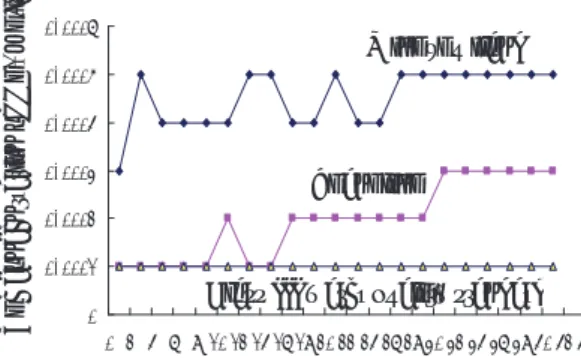
(5) Zhang Ling terminal is without tributaries. The tributaries do not impact on the mercury content, but it has been impacted by the water flow. With the increase of water depth, mercury content layered increased. The sampling area is divided into three layers: within a depth of 1-15m, the mercury content was 0.0001 mg/L; within a depth of 17-29m, the mercury content was 0.0002mg/L; within a depth of 31-41m, the mercury content was 0.0003mg/L.
(6) Comparing with the drinking water standard, surface water environmental quality standards for Class III - the standard set forth in mercury content is not higher than 0.0001mg/L [10]. From Fig. 3 we can see
that mercury content in Mingzhu Island has been excessive, therefore, it can not serve as drinking water source; Zhang Ling terminal compliance mercury content in water depth of 15m or more, the water of more than this depth can be used as drinking water.
4 CONCLUSION
(1)The mean concentration of mercury in the studied areas was higher than the “surface water environmental quality standards” III class, while the others were lower than the limit.
(2)The concentration of mercury increased with water depth. It may be due to sedimentation of mercury micro-organisms or to geochemical properties of mercury. Se and Cd in the Xiaolangdi Reservoir were distributed evenly, and thoes concentrations changed little with water depth.
ACKNOWLEDGMENT
The authors appreciate the help of Ziqiang Li, Sa Wang, and the surveyors of the environment inspection station in Jiao Zuo, in experimenting
REFERENCES
(1) Yan Gui-Yun,etc., Analysis and Countermeasures on Xiaolangdi Reservoir Water Pollution situations, Water Resources Protection,Vol.2,(2004),p39-40.
(2) He Jiang,Wang Xinwei,Li Chaosheng, study on the pollution characteristics of heavy metal in the Baotou reach of the Yellow River Water-Sediment system, Vol.23,
No.1(2003), p53-57.
(3) Bingli ZHOU,Zongwei WU,Wanxiang WANG, Impact on water quality of water and sand diversion experiment in Xiaolangdi Reservoir, china water resources, No.11(2005), p32-33.
(4) Yongsheng NIU, Shubin CUI, The Yellow River Water Quality Assessment, Pollution Trends and Countermeasures, environmental protection, No.3(1995), p37-39. 0 0.0001 0.0002 0.0003 0.0004 0.0005 0.0006 0 2 4 6 8 10 12 14 16 18 20 22 24 26 28 30 32 34 36 38 40 42 44 水深( ) Water depth(m) Mingzhu iland Zhangling
Class III water quality standard
Th e co nc en tra tio n of H g( m g/ l)
Qiaoli LIU, Shunlin TANG, Junmiao XU and TaoWANG
Xiaolangdi 貯水池の水中の微量物質に関する研究 Qiaoli LIU*, Shunlin TANG*, Junmiao XU* and TaoWANG*
概要
戦略的なプロジェクトの一つとして,Xialoangdi ダムプロジェクトは洪水調整,都市の水供
給,かんがいなど多くの機能を持っている。Xiaolangdi 貯水池の水質は産業および農業製品
や貯水池,さらにその下流域の住民の健康等に影響を与える可能性がある。それゆえ, Xiaolangdi 貯水池の Mingzhudao および Zhangling での表流水のサンプルを分析し,水質を評
価した。9 つの微量物質,水銀,セレン,カドミウム,クロム,銅,亜鉛,鉄,マンガン, フッ素,を特定した。ヒ素,クロム,銅,亜鉛の濃度は検出限界以下であった。水銀の平均 濃度は中国の表流水の環境基準のクラスIII よりも高かったが,他の微量物質の濃度は低く なっていた。水銀濃度は水面が深くなるにつれて高くなっており,これは水銀の微生物への 沈着あるいは水銀の生物・地球化学的循環によると思われる。セレンとカドミウムは広く分 布しており,水面の深さにはほとんど影響を受けていなかった。 キーワード : Xiaolangdi,微量物質,水質