A
Continuum Dynamics
on
Vector Bundle
理化学研究所 山岡英孝 (Hidetaka Yamaoka)1
Computational Cell Biomechanics Team,
VCAD System Research Program,
RIKEN
Abstract
The Cosserat theory for continua with microstructure can be geometrically
inter-preted as a continuum dynamics on vector bundle. In this talk, we begin with
ge-ometrical settings for the continua with microstructure and construct its dynamics
as continuum dynamics on vector bundle. As an example, we deal with a Cosserat
rod, which is considered as a one-dimensional continuum with microstructure. In
addition, we suggest thatwe can describelowermicrostructure ofthe elasticrods, by
extending the base manifold of the vector bundle to athree-dimensional continuum.
Such rodmodel well represents biomolecules involvingvarious interacting factors, so
that the model can be applied to analysis ofdeformation behavior ofbiomolecules.
We expect that our geometrical method would contribute to development of the
molecular biomechanics.
1
Introduction
We attempt to
construct
geometrical foundations and dynamical frameworks ofa
directedmedium based
on
the fiber bundle theory. The directed medium isa
continuum withmicrostructures that is described by a deformable vector, called
a
director. Studieson
thedirected medium were actively pursued in the $1960s$, for example, by Ericksen [1], Toupin
[2], and Eringen and
\S uhubi
[3] and in recent years, have been investigated from manypoint of views such
as
elast-plasticity [4, 5], advanced materials [6], and biomechanics[7, 8]. In contrast, since about the $1960s$, the elastic theory has been reconstructed using
differential geometry, for example, by Green and Rivilin [9], Noll [10], and Wang [11].
A modern text by Marsden and Hughes [12] helps us to consider geometrical settings of
elasticity (see also
an
early textbook [13]). In this study, we develop the dynamics of thedirected medium based
on
the fiber bundle theory in differential geometry.In geometric continuum mechanics,
an
elastic body is viewed asa
differentiablemani-fold, while
a
directed medium is viewedas a
vector bundle whose fiber denotesa
collectionof the deformable directors. Hence, the mechanical behaviors of the directed medium
should be described
as
the continuum dynamics on a tangent bundle ofa
vector bundle.Thus, we begin with a geometrical setting ofthe continuum dynamics on a vector bundle,
and derive
a
weak form and equations of motion for the directed medium. For futureapplications,
we use
elasticity notations to providea
framework of continuum dynamicson the vector bundle and present
some
figures for better understanding. Moreover,we
apply
our
resultant equations toa
Cosserat rod,as
an
example, and find that the derivedequations of motion coincide with the balance laws of large deformable rods. It is simple
to prove such
a
coincidence if the equations of motionare
restricted to the special Cosseratrod with undeformed cross-section.
We
can use our
description to examine such macro-microinteractive
mechanisms, ifwe
have to consider only the geometrical structures of objects using the mechanisms,i. e., the corresponding base manifolds and fiber spaces. Such geometrical considerations
help
us
to improveour
understanding of the complicated mechanical behaviors ofvariousstructures associated with the macro-micro interactive mechanisms.
2
Geometry and
kinematics
In the geometric continuum mechanics,
an
elastic body is viewedas
an
m-dimen-sionalRiemannian manifold $\mathcal{B}$, and deforms in
an
ambient space $S$,an
n-dimen-sional Rieman-nian manifold $(m\leq n)[12]$.
In contrast, whenwe
considera deformation
ofa
continuumwith microstructure,
we
must
replacethese manifolds
with principalfiber
bundles, de-noting by $\mathcal{P}$ and2,
respectively,over
the manifolds $\mathcal{B}$ and $S$. The
microstructure
is often expressed by a r-dimensional vector $(r\leq n)$, called director. In this case, the space
consisting of the directors, 7, is exactly the fiber of the bundle $\mathcal{P}arrow \mathcal{B}$, and then $\mathcal{P}$
can
be consideredas
the real vector bundle $g\simeq \mathcal{B}\cross 7$.
A configuration of the continuum with
microstructure
is given bya
smooth embedding$\Phi$ : $\mathcal{P}arrow 2$, then the configuration space is
a
space of all embeddings,$=$
{
$\Phi$ : $\mathcal{P}arrow 2$, smoothembedding}.
(2.1)Indeed, for
an
arbitrary point$p=(b, v)\in \mathcal{P}\simeq \mathcal{B}\cross\gamma/(b\in \mathcal{B}$ and $v\in\gamma)$,we can
definethe embedding $\Phi$ through embedding of the
base
manifold $\phi$ : $\mathcal{B}arrow S$ and projectiononto the fiber $\varphi$ : $\mathcal{B}\cross 7arrow \mathbb{R}^{r}$;
$\Phi(p)=(\phi(b), \varphi(b, v))$. (2.2)
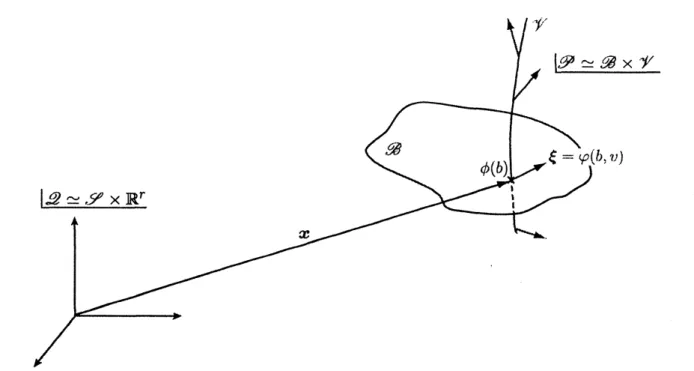
It is easy to verify that this map is the embedding. We note here that the ambient bundle
J2 is the vector bundle $9arrow S$ with fiber $\mathbb{R}^{r}$, i. e., $9arrow S\cross \mathbb{R}^{r}$
,
as
shown in Fig. 1.For sake of simplicity, we take the ambient space
as
the n-dimensional Euclideanspace; $S\simeq \mathbb{R}^{n}$, and
we
embed the fiber space $\mathbb{R}^{r}$ into thesame
Euclidean space $\mathbb{R}^{n}$.Then
we
denote position vectors of points in the reference body $\mathcal{B}_{0}$ and current body$\mathcal{B}$ by
$X=\phi_{0}(b_{0})(b_{0}\in \mathcal{B}_{0})$ and $x=\phi(b)(b\in \mathcal{B})$, respectively. Also,
we
denotereference and current directors associated with their points by $\Xi=\varphi_{0}(b_{0}, v_{0})(v_{0}\in 7_{0}’)$
and $\xi=\varphi(b, v)(v\in Y)$,
as
shown Fig. 1. Accordingly, three deformation gradient tensorscan
be definedas
$F= \frac{\partial x}{\partial X}$, $\mathfrak{F}=\frac{\partial\xi}{\partial X}$, $\mathcal{F}=\frac{\partial\xi}{\partial_{-}^{-}-}$,
(2.3)
Figure 1: Illustration ofthe continuum with microstructure, $\mathcal{P}\simeq \mathcal{B}\cross 7$, embedded into
the ambient bundle, $\ovalbox{\tt\small REJECT}\simeq S\cross \mathbb{R}^{r}$, and its local coordinates in
2.
Since the trivialization of bundle 2 is expressed as
$9\simeq S\cross \mathbb{R}^{r}$, (2.4)
the flat connection is defined
on
the bundle2.
Accordingly, the tangent bundleT.2
isdecomposed into the tangent bundles $TS$ and $T\mathbb{R}^{r}$;
$T2\simeq TS\oplus T\mathbb{R}^{r}$
.
(2.5)Also, the cotangent bundle $T^{*}9$ is decomposed by the flat connection,
so
that one-form$dq\in T_{q}^{*}2$ is put in the form
$dq=dx+d\xi$, (2.6)
and expressed, in terms of the reference coordinates $q_{0}=(X, \Xi)$,
as
$dq=(F+\mathfrak{F})dX+\mathcal{F}d\Xi$
.
(2.7)From Eq. (2.7), the quadratic form $dq^{2}$ is calculated
as
$dq^{2}=dX^{T}(F+\mathfrak{F})^{T}(F+\mathfrak{F})dX$
$+dX^{T}(F+\mathfrak{F})^{T}\mathcal{F}d\Xi+d\Xi^{T}\mathcal{F}^{T}(F+\mathfrak{F})dX$
$+d\Xi^{T}\mathcal{F}^{T}\mathcal{F}d\Xi$, (2.8)
where $T$ denotes the transposition of tensors. Here,
we
set$C=(F+\mathfrak{F})^{T}(F+\mathfrak{F})$, (2.9a)
$C=\mathcal{F}^{T}\mathcal{F}$, (2.9b) $C=\mathcal{F}^{T}(F+\mathfrak{F})$, (2.9c)
called
macro
deformation, micro deformation, and (macro-micro) mixture deformation,respectively. The reference deformations put in the form
$C_{0}=(I+\mathfrak{F}_{0})^{T}(I+\mathfrak{F}_{0})$, (2.10a)
$C_{0}=I$, (2.10b)
$C_{0}=I^{T}(I+\mathfrak{F}_{0})$, (2.10c)
where $I$ is n-th order identity tensor, and where $\mathfrak{F}_{0}=\partial\Xi/\partial X$,
as
well. Thus,we
havethe difference of the current and reference quadratic forms,
$dq^{2}-dq_{0}^{2}=dX^{T}(C-C_{0})dX$
$+dX^{T}(C-C_{0})^{T}d\Xi+d\Xi^{T}(C-C_{0})dX$
$+d\Xi^{T}(C-C_{0})d\Xi$, (2.11)
so that we define the strains as
$E= \frac{1}{2}(C-C_{0})$, (2.12a)
$\mathcal{E}=\frac{1}{2}(C-C_{0})$, (2.12b) $\not\subset=\frac{1}{2}(C-C_{0})$. (2.12c)
Then we call them macro strain, micro strain, and (macro-micro) mixture strain,
re-spectively. Here, we comment
on
the terminologies used by Eringen’s textbook for themicrocontinuum [14]. In the textbook, our mixture deformation $C$ is decomposed into
$\mathcal{F}^{T}F$ and $\mathcal{F}^{T}\mathfrak{F}$, called the Cosserats deformation tensor, when the director is deformed
rigidly, “micropolar continua” according to the textbook, and the wryness tensor,
respec-tively. Additionally, the micro deformation tensor is defined in the
same
manner, whilethe
macro
deformation tensor is linearized to $F^{T}F$.3
Dynamics
Now, we consider a Lagrangian$\mathcal{L}=\mathcal{T}-\mathcal{W}$, where $\mathcal{T}$ is the kinetic energy,
defined through
a metric on , and $\mathcal{W}$ is a potential function on . Then the dynamics of the continuum
with microstructure is described
on
the tangent bundle $T$ of the configuration space ,that is, the Lagrangian $\mathcal{L}$ is defined
as
a function of the tangent bundle $T$ to $\mathbb{R}$,$\mathcal{L}(\Phi,\dot{\Phi})=\mathcal{T}(\Phi,\dot{\Phi})-\mathcal{W}(\Phi)$. (3.1)
Usually, the strain energy $\mathcal{W}(\Phi)$ is expressed
as
a functional of $\psi$, which is difined as afunction of the deformation gradient tensors $F_{:}\mathfrak{F}$, and $\mathcal{F}$:
$\mathcal{W}(\Phi)=\int_{p}\psi(F, \mathfrak{F}, \mathcal{F})dV$. (3.2)
We also denote the Lagrangian and kinetic enegy densities by $\mathcal{L}$ and ,9, respectively,
i.e., $\mathcal{L}=\int \mathcal{L}dV$ and $\mathcal{T}=\int\ovalbox{\tt\small REJECT} dV$, and, for simplicity, we consider those densities as
functions of the local coordinates $(x, \xi,\dot{x},\dot{\xi})$ on the tangent bundle $T\ovalbox{\tt\small REJECT}$. In this case, the
Hamilton’s principle for any time interval $[t_{0}, t_{1}]$ is expressed
as
follows:$\int_{t_{0}}^{t_{1}}\int_{\Phi(\mathcal{P})}(\frac{\partial \mathcal{L}}{\partial x}$
.
$\delta x+\frac{\partial \mathcal{L}}{\partial\dot{x}}$ . $\delta\dot{x}+\frac{\partial \mathcal{L}}{\partial\xi}$ . $\delta\xi+\frac{\partial \mathcal{L}}{\partial\dot{\xi}}$ . $\delta\dot{\xi}$$+ \frac{\partial \mathcal{L}}{\partial F}$ : $\delta F+\frac{\partial \mathcal{L}}{\partial \mathfrak{F}}$ : $\delta \mathfrak{F}+\frac{\partial \mathcal{L}}{\partial \mathcal{F}}$ : $\delta \mathcal{F})\Phi(dV)dt=0$, (3.3)
where
we
have denoted, by. and :, the inner product of vectors and double contractionof tensors, respectively,
or
equivalently the simple-dot and double-dot products in thedyadics. Then, by performing partial integration and using the divergence theorem,
we
obtain the weak form for the continuum with microstructure,
$\int_{t_{0}}^{t_{1}}\int_{\Phi(9)}[(\frac{\partial}{\partial t}(\frac{\partial ff}{\partial\dot{x}})-\frac{\partial F}{\partial x}-\frac{\partial}{\partial X}\cdot(\frac{\partial\Psi}{\partial F}))\cdot\delta x$
$+( \frac{\partial}{\partial t}(\frac{\partial F}{\partial\dot{\xi}})-\frac{\partial\ovalbox{\tt\small REJECT}}{\partial\xi}-\frac{\partial}{\partial X}\cdot(\frac{\partial\psi}{\partial \mathfrak{F}})-\frac{\partial}{\partial_{-}^{-}-}\cdot(\frac{\partial\psi}{\partial \mathcal{F}}))\cdot\delta\xi]\Phi(dV)dt$
$+ \int_{t_{0}}^{t_{1}}\int_{\Phi(\partial 9)}[N\cdot\frac{\partial\Psi}{\partial F}\cdot\delta x+N\cdot(\frac{\partial\psi}{\partial \mathfrak{F}}+\frac{\partial\psi}{\partial \mathcal{F}})\cdot\delta\xi]\Phi(dA)dt=0$, (3.4)
where $\partial \mathcal{P}$ denotes the boundary of the material bundle $\mathcal{P}$, and $N$ and $dA$
are
the unitnormal to $\partial \mathcal{P}$ and the area form of $\partial \mathcal{P}$, respectively.
Finally, we assume that the Lagrangian density $\mathcal{L}=\ovalbox{\tt\small REJECT}-\psi$ has a compact support
and that the variations
are
fixed at the end points, $\delta x=\delta\xi=0(t=t_{0}, t_{1})$. Thenwe
have equations of motion for the continuum with microstructure
$\frac{\partial}{\partial t}(\frac{\partial F}{\partial\dot{x}})=\frac{\partial ff}{\partial x}+\frac{\partial}{\partial X}\cdot(\frac{\partial\Psi}{\partial F})$ , (3.5a)
$\frac{\partial}{\partial t}(\frac{\partial ff}{\partial\dot{\xi}})=\frac{\partial ff}{\partial\xi}+\frac{\partial}{\partial X}\cdot(\frac{\partial\Psi}{\partial \mathfrak{F}})+\frac{\partial}{\partial_{-}^{-}-}\cdot(\frac{\partial\Psi}{\partial \mathcal{F}})$. (3.5b)
By introducing the generalized Piola-Kirchhoff stress tensors,
$P= \frac{\partial\psi}{\partial F}$, $\mathfrak{P}=\frac{\partial\Psi}{\partial \mathfrak{F}}$, $\mathcal{P}=\frac{\partial\psi}{\partial \mathcal{F}}$, (3.6)
we obtain the equations of motion, in terms of the generalized stress tensors,
$\frac{\partial}{\partial t}(\frac{\partial g}{\partial\dot{x}})=\frac{\partial ff}{\partial x}+P\cdot(\frac{\partial}{\partial X})$ , (3.7a)
$\frac{\partial}{\partial t,}(\frac{\partial ff}{\partial\dot{\xi}})=\frac{\partial F}{\partial\xi}+\mathfrak{P}\cdot(\frac{\partial}{\partial X})+\mathcal{P}\cdot(\frac{\partial}{\partial_{-}^{--}})$. (3.7b)
4
An
example:
Cosserat
rods
As
an
example,we
consider a Cossrat rod laid in the three-dimensional Euclidean space$\mathbb{R}^{3}(n=3)$. In this case, the bundle $\mathcal{P}$ is the Cosserat rod,
a one-dimensional continuum
$\mathcal{B}$ expresses the center axis of
rod, and the director attached to each point of $\mathcal{B}$ is the
three-dimensional
vector to describe points in the cross-section at each pointon
the axis$(m=1, r=3)$. Then, it is enough that the vector bundle $e2$ is taken
as
$\mathbb{R}^{3}\cross \mathbb{R}^{3}$.We parameterize a position vector $r(s, t)$ of an arbitrary point
on
$\phi(\mathcal{B})$ by thearc-length parameter $s$ and the time parameter $t$. We define
a
right-handed orthonormalbasis, $\{d_{1}(s, t), d_{2}(s, t), d_{3}(s, t)\}$, along $\phi(\mathcal{B})$ at $s$ with $d_{1}=\partial r/\partial s$, and introduce the
curvature vector $\kappa(s, t)$ in the current body through
$\frac{\partial d_{k}}{\partial s}=\kappa\cross d_{k}$.
(4.1)
The component $\kappa^{1}=\langle d_{1},$$\kappa\}$ of $\kappa$ gives the torsion of $\phi(\mathcal{B})$ in the current configuration;
the two components, $\kappa^{\alpha}=\langle d_{\alpha},$ $\kappa\rangle,$ $\alpha=2,3$,
are
components of thecurrent curvature of
$\phi(\mathcal{B})$ and
are
related to the geometric curvature $\tilde{\kappa}$of the current axial
curve
through theformula
$(\tilde{\kappa})^{2}=(\kappa^{2})^{2}+(\kappa^{3})^{2}$. Then theCosserat
rod is providedas
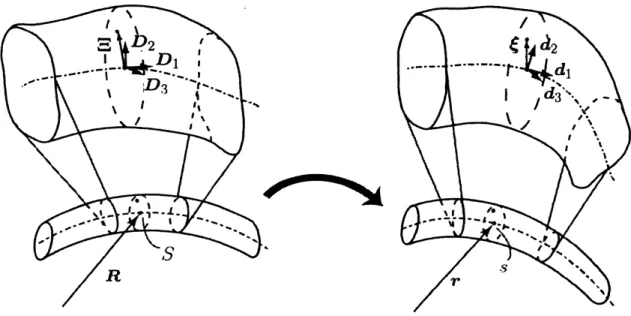
$x(s, t)=r(s, t)$, $\xi(s, t)=\xi^{k}d_{k}(s, t)$. (4.2)
It is illustrated
as
Fig. 2. Weuse
curvilinear coordinates with respect to $\{d_{k}\}$. Throughoutthis article, the summation convention is used for repeated indices, with
Latin
indicestaking the values
{1,
2,3}
and Greek indices taking the values{2,
3}.
Figure 2: Illustration of the reference and current configurations of the Cosserat rod.
Additionally,
we
denote quantities for reference body by the capital letters of thecorresponding
ones
for current body, that is, $R(S, 0)$ is the position vector ofan
ar-bitrary point
on
$\phi_{0}(\mathcal{B}_{0})$ by the arc-length parameter $S$$\{D_{1}(S,$ $0),$$D_{2}(S, 0),$ $D_{3}(S, 0)\}$ is aright-handed orthonormal basis along $\phi_{0}(\mathcal{B}_{0})$ at $S$ such
that $D_{1}=\partial R/\partial S$. Then, the reference curvature vector $\mathcal{K}_{0}(S, 0)$ is similarly defined by
$\frac{\partial D_{k}}{\partial S}=\mathcal{K}_{0}\cross D_{k}$. (4.3)
The component $\mathcal{K}_{0}^{1}=\langle D_{1},$ $\mathcal{K}_{0}\}$ of $\mathcal{K}_{0}$ gives the torsion of $\phi_{0}(\mathcal{B}_{0})$ in the reference
config-uration; the two components, $\mathcal{K}_{0}^{\alpha}=\langle D_{\alpha},$ $\mathcal{K}_{0}\rangle,$ $\alpha=2,3$, are components of the reference
curvature of $\phi_{0}(\mathcal{B}_{0})$ and
are
related to the geometric curvature$\tilde{\mathcal{K}}_{0}$ of the reference axial
curve
through the formula $(\tilde{\mathcal{K}}_{0})^{2}=(\mathcal{K}_{0}^{2})^{2}+(\mathcal{K}_{0}^{3})^{2}$. Thus, the reference configuration isprovide
as
$X(S, 0)=R(S, 0)$, $\Xi(S, 0)=\Xi^{\alpha}D_{\alpha}(S, 0)$. (4.4)
It is shown
as
Fig. 2. Here,we
consider that the reference configuration is unstressedstate, and then the cross-sections of the reference filament is
as
sumed to be normal to itsaxial
curve.
If the cross-sections of the current filament remain normal to the current axialcurve,
we
may constrain $\xi^{1}=0$. When we suppose the special Cosserat rod, in which itis assumed that the cross-sections of the current filament remain plane, undeformed, and
normal to the current axial curve,
we
have to append the constraints $\xi^{1}=0$ and $\xi^{\alpha}=\Xi^{\alpha}$.Further, the extension $\epsilon(s, t)$ of the axial
curve
can
be defined through$\frac{\partial s}{\partial S}=(1+\epsilon)$. (4.5)
Using the above the deference relation, we obtain the deformation gradients
$F=(1+\epsilon)d_{1}\otimes D^{1}$, (4.6a)
$\mathfrak{F}=(1+\epsilon)(\frac{\partial\xi^{k}}{\partial s}+\xi^{k}R(\kappa))d_{k}\otimes D^{1}$ , (4.6b)
$\mathcal{F}=\frac{\partial\xi^{k}}{\partial_{-}^{-\alpha}-}d_{k}\otimes D^{\alpha}$, (4.6c)
where $R(a)$ is the skew symmetric tensor associated with
a
polar vector $a$. Then thecurrent and reference deformations
are
calculated as, respectively,$C=(1+ \epsilon)^{2}\Vert\frac{\partial}{\partial s}(r+\xi)\Vert^{2}D^{1}\otimes D^{1}$, (4.7a)
$\not\subset=\langle\frac{\partial\xi}{\partial_{-}^{-\alpha}-},$ $(1+ \epsilon)\frac{\partial}{\partial s}(r+\xi)\rangle D^{\alpha}\otimes D^{1}$ , (4.7b) $C= \langle\frac{\partial\xi}{\partial_{-}^{-\alpha}-},$ $\frac{\partial\xi}{\partial_{-}^{-\beta}-}\}D^{\alpha}\otimes D^{\beta}$, (4.7c)
and
$C_{0}= \Vert\frac{\partial}{\partial S}(R+\Xi)\Vert^{2}D^{1}\otimes D^{1}$ , (4.8a)
Co
$=\langle D_{\alpha},$ $\frac{\partial}{\partial S}(R+\Xi)\}D^{\alpha}\otimes D^{1}=\epsilon_{1\alpha\beta}\mathcal{K}_{0}^{1}\Xi^{\alpha}D^{\beta}\otimes D^{1}$ , (4.8b) $C_{0}=\delta_{\alpha\beta}D^{\alpha}\otimes D^{\beta}$, (4.8c)where $\epsilon_{klm}$ is the Edinton’s epsilon, and $\Vert\cdot\Vert$ denotes the standard inner product on the
Euclidean spaces. Thus, we obtain the strains as follows:
$E= \frac{1}{2}[(1+\epsilon)^{2}\Vert d_{1}+\xi^{\alpha}R(\kappa)d_{\alpha}\Vert^{2}-\Vert D_{1}+\Xi^{\alpha}R(\mathcal{K}_{0})D_{\alpha}\Vert^{2}]D^{1}\otimes D^{1}$ , (4.9a)
$\not\subset=\frac{1}{2}[\langle\frac{\partial\xi}{\partial_{-}^{-\alpha}-},$$(1+ \epsilon)\frac{\partial}{\partial s}(r+\xi)\rangle-\langle D_{\alpha},$ $\frac{\partial}{\partial S}(R+\Xi)\rangle]D^{\beta}\otimes D^{1}$, (4.9b)
$\mathcal{E}=\frac{1}{2}[\langle\frac{\partial\xi}{\partial_{-}^{-\alpha}-},$$\frac{\partial\xi}{\partial_{-}^{-\beta}-}\}-\delta_{\alpha\beta}]D^{\alpha}\otimes D^{\beta}$. (4.9c)
Because of using the moving frame, we must rewrite the variational formulation. To
this end, we begin with defining the variation $\delta k$, associated with the orthonomal basis,
through
$\delta d_{k}=\delta k\cross d_{k}$, (4.10)
so
that the variation of the director $\xi$ is expressedas
$\delta\xi=\delta k\cross\xi$, (4.11)
and the variations of the deformation gradients $F,$ $\mathfrak{F}$, and $\mathcal{F}$ become
$\delta F=\frac{\partial}{\partial R}(\delta r)+R(\delta k)F$, (4.12a)
$\delta \mathfrak{F}=\frac{\partial}{\partial R}(\delta\xi)+R(\delta k)\mathfrak{F}$, (4.12b) $\delta \mathcal{F}=\frac{\partial}{\partial_{-}^{-}-}(\delta\xi)+R(\delta k)\mathcal{F}$. (4.12c)
Then the weak form is rewretten
as
$\int_{t_{0}}^{t_{1}}\int_{\Phi(9)}[(\frac{\partial}{\partial t}(\frac{\partial F}{\partial\dot{r}})-\frac{\partial ff}{\partial r}-\frac{\partial}{\partial R}\cdot(\frac{\partial\psi}{\partial F}))\cdot\delta r$
$-( \frac{\partial\psi}{\partial F}$ : $R( \delta k)F+\frac{\partial\Psi}{\partial \mathfrak{F}}$ : $R( \delta k)\mathfrak{F}+\frac{\partial\Psi}{\partial \mathcal{F}}$ : $R(\delta k)\mathcal{F})$
$+( \xi\cross(\frac{\partial}{\partial t}(\frac{\partial ff}{\partial\dot{\xi}})-\frac{\partial ff}{\partial\xi}-\frac{\partial}{\partial R}\cdot(\frac{\partial\Psi}{\partial \mathfrak{F}})-\frac{\partial}{\partial_{-}^{-}-}\cdot(\frac{\partial\Psi}{\partial \mathcal{F}})))\cdot\delta k]\Phi(dV)dt$
$+ \int_{t_{0}}^{t_{1}}\int_{\Phi(\partial p)}[N\cdot\frac{\partial\psi}{\partial F}\cdot\delta r+\xi\cross(N\cdot(\frac{\partial\psi}{\partial \mathfrak{F}}+\frac{\partial\ovalbox{\tt\small REJECT}’}{\partial \mathcal{F}}))\cdot\delta k]\Phi(dA)dt=0$. (4.13)
Hence, under the fixed end points conditons, $\delta r=\delta k=0$, the equations of motion for
the Cosserat rod is derived
as
$\frac{\partial}{\partial t}(\frac{\partial F}{\partial\dot{r}})=\frac{\partial\ovalbox{\tt\small REJECT}}{\partial r}+\frac{\partial}{\partial R}\cdot(\frac{\partial\psi}{\partial F})$ , (4.14a)
$\xi\cross\frac{\partial}{\partial t}(\frac{\partial F}{\partial\dot{\xi}})=\xi\cross(\frac{\partial\ovalbox{\tt\small REJECT}}{\partial\xi}+\frac{\partial}{\partial R}\cdot(\frac{\partial\Psi}{\partial \mathfrak{F}}I+\frac{\partial}{\partial_{-}^{-}-}\cdot(\frac{\partial\psi}{\partial \mathcal{F}}))$
where $\cross$
denotes the cross-dot product in the dyadics, and it is defined
as
$(a_{1}\otimes a_{2})^{\cross}(a_{3}\otimes a_{4})=(a_{1}\cross a_{3})(a_{2}\cdot a_{4})$, (4.15)
for any vectors $a_{i}\in \mathbb{R}^{3}$.
In terms of the local coordinates, the kinetic enegy density is expressed
as
$eZ(r, \xi,\dot{r},\dot{\xi})=\frac{1}{2}\rho(r)(\Vert\dot{r}\Vert^{2}+\Vert\dot{\xi}\Vert^{2})$ , (4.16)
where $\rho(r)$ is
a
mass
density of the body at $r$ in the current configuration $\phi(\mathcal{B})$. Thus,we obtain the equations of motion for the special Cosserat rods expressed in terms of the
generalized stress tensors,
$\frac{\partial}{\partial t}(\rho\dot{r})=\frac{1}{2}\frac{\partial\rho}{\partial r}\Vert\dot{r}\Vert^{2}+\frac{\partial}{\partial S}(P\cdot D^{1})$ , (4.17a)
$\xi\cross\frac{\partial}{\partial t}(\rho\dot{\xi})=\xi\cross(\frac{\partial}{\partial S}(\mathfrak{P}\cdot D^{1}+\mathcal{P}\cdot\Xi^{\alpha}R(\mathcal{K}_{0})^{T}D^{\alpha})+\frac{\partial}{\partial_{-}^{-\alpha}-}(\mathcal{P}\cdot D^{\alpha}))$
$+ \frac{\partial r}{\partial S}\cross(P\cdot D^{1})+\frac{\partial\xi}{\partial S}\cross(\mathfrak{P}\cdot D^{1}+\mathcal{P}\cdot D^{\alpha})+\frac{\partial\xi}{\partial_{-}^{-\alpha}-}\cross(\mathcal{P}\cdot D^{\alpha})$.
(4.17b)
By these expressions, it is well to reconstruct the balance laws for the Cosserat rod.
At the last in this section,
we
reduce the above equations to those for the specialCosserat rod, that is, we impose the constraints $\xi^{1}=0$ and $\xi^{\alpha}=\Xi^{\alpha}$. In this case, the
micro deformation gradient becomes
$\mathcal{F}=\delta_{\beta}^{\alpha}d_{\alpha}\otimes D^{\beta}$, (4.18)
so
that the generalized micro stress tensor vanishes; $\mathcal{P}=0$, because of the assumptionabout the undeformation of the cross-sections. Indeed, the micro strain vanishes, i. e.,
$\mathcal{E}=0$. Here, we note that the linearlized macro and mixture strains become
$E_{1inear}=\epsilon D^{1}\otimes D^{1}$, (4.19a) $C_{linear}=\frac{1}{2}\epsilon_{1\alpha\beta}(\kappa^{1}-\mathcal{K}_{0}^{1})\Xi^{\alpha}D^{\beta}\otimes D^{1}$. (4.19b)
Thenwe obtain the well-known equationsofmotion for the special Cosserat rods expressed
in terms of the generalized stress tensors,
$\frac{\partial}{\partial t}(\rho\dot{r})=\frac{1}{2}\frac{\partial\rho}{\partial r}\Vert\dot{r}\Vert^{2}+\frac{\partial}{\partial S}(P\cdot D^{1})$ , (4.20a)
$\xi\cross\frac{\partial}{\partial t}(\rho\dot{\xi})=\frac{\partial}{\partial S}(\xi\cross(\mathfrak{P}\cdot D^{1}))+\frac{\partial r}{\partial S}\cross(P\cdot D^{1})$ . (4.20b)
We comment that $P\cdot D^{1}$ and $\xi\cross(\mathfrak{P}\cdot D^{1})$ is exactly the stress and couple-stress along
5
Summary
In this study,
we
developedformulations
for continuum dynamicson a
tangent bundle ofa vector bundle that accurately describes the mechanical behavior of a directed medium.
Indeed, the dynamics of the one-dimensional continuum with a director are well expressed
as one
of the Cosserat rod, in which the cross-sectional structure is considered as themicrostructure
oftherod. For futuredevelopments, it is important to examinegeometricalstructures
of various continua withmicrostructures.
Especially, in thecase
wherewe
consider
a
classification of microcontinua, it is necessary to investigate group actionson
the bodies andmicrostructures.
For example, the group structures correspond toEringen’s classification, i.e., micromorphic, microstretch, and micropolar continua [14].
Moreover,
we
can
extend the Cosserat rod to a model describing smallermicrostruc-ture of the elastic rod. Then the expressions for the smaller
microstructure
to analyzedeformation behavior of filaments including biopolymers. When a biopolymer expresses
a
certain function within a living organism, its conformation is an important factor that
de-termes the function. Therefore,
we
believe to obtaina new
knowledge of theinteractions
between the dynamical situations and the biological
circumstances
of biopolymers, whichhave been investigated recently by considering the
deformation
behavior of biopolymerstogether with their
microstructures.
References
[1] J. L. Ericksen,
“Conservation
laws for liquid crystals,” Trans. Soc. Rheol., 5,23-34
(1961).
[2] R. A. Toupin, “Theories of elasticity with couple-stress,” Arch. Ration. Mech. Anal.,
17,
85-112
(1964).[3] A. C. Eringen and E. S.
\S uhubi,
“Nonlinear theory of simple micro-elastic solids-I,”Int. J. Eng. Sci., 2,
189-203
(1964).[4] A. Riahi and J. H. Curran, Fu113D finite element
Cosserat formulation
withappli-cation in layered structures,” Appl. Math. Model., 33,
3450-3464
(2009).[5] S. Forest and R. Sievert, “Elastoviscoplastic constitutive
frameworks
for generalizedcontinua,” Acta Mechanica, 160, 71-111 (2003).
[6] D. A. Burton and T. Gould, “Dynamical model of Cosserat nanotubes,” J. Phys.,
62,
23-33
(2007).[7] J. Rosenberg and R. Cirmrman,
”Microcontinuum
approach inbiomechanical
mod-eling,” Math. Comput. Simul., 61,
249-260
(2003).[8] K. A. Hohhman, R. S. Manning and J. H. Maddocks, “Link, twist, enegy and the
stability of DNA minicircles,” Biopolymers, 70,
145-157
(2003).[9] A. E. Green and R. S. Rivilin, “The mechanics ofnon-linear materials with memory,”
[10] W. Noll, “A mathematical theory of the mechanical behavior of continuous media,”
Arch. Ration. Mech. Anal., 2, 197-226 (1958).
[11] C.-C. Wang, “On the geometric structures of simple bodies,
a
mathematical founda-tion for the theory of continuous distributions of dislocations,” Arch. Ration. Mech.Anal., 27, 33-94 (1967).
[12] J. E. Marsden and T. J.R. Hughes, Mathematical
foundations of
elasticity,Prentice-Hall, New York, 1983 (reprinted by Dover, New York, 1994).
[13] C.-C. Wang and C. Thruesdell, introduction to rational elasticity, Noordhoff
Interna-tional Publishing, Leyden, 1973.
[14] A. C. Eringen, Microcontinuum Field Theories: Foundations and Solids,