On the
complete description
of
the
Stokes
geometry
for
the first
Painlev\’e
hierarchy
1京都大学数理解析研究所 河合隆裕 (KAWAI, Takahiro)
RIMS, Kyoto University
京都大学理学研究科 小池達也 (KOIKE, Tatsuya)
Department of Mathematics, Kyoto University
京都大学数理解析研究所 西川享宏2 (NISHIKAWA, Yukihiro)
RIMS, Kyoto University
京都大学数理解析研究所 竹井義次 (TAKEI, Yoshitsugu)
RIMS, Kyoto University
We dedicate this paper to
Professor
Louis Boutet de Monvelwith
our
sincerest congratulationson
his being awarded Prix deVEtat (Academie desScience).
One
of
the central issuesof
this article is the introductionof
the notionof
virtualtu rning points
for
higher order Painlevi equations, and trvoof
the authors (Kawaiand $Takei)_{f}$ together with T. Aoki, fondly remember the stimula tlng and
comfort-able
conference
(Algebraic analysisof
singular perturbations, 1991), whichProfes-sor Boutet de Monvel, together with
Professor
M. Sato, organized, and where thenotion
of
a
$v\dot{z}\hslash ual$ turning pointfor
linear ordinarydifferential
equationswas
first
made public (underthe modest
name
‘lanew
turning point”). The notionof
virtualturning points is
one
of
the most important gifts to the exact $WKB$ analysisfrom
microlocal andysis, and hence
we
believe this article to be most appropriate toded-icate to
Professor
Boutet de $Monvel_{\mathit{3}}$ who has made substantial contributions to thedevelopment
of
microlocal analysis and asymptotic analysis.1
Introduction
As
was
first discovered numerically by Nishikawa [Nl, N2], Stokescurves
of higherorder Painlev6 equations
cross
in general andsome
degeneracy ofStokes geometryof the underlying Lax pair is often observed along
a
curved ray emanating fromsuch
a
crossing point of Stokes curves (”Nishikawaphenomenon ). To analyze thisintriguing phenomenon
we
investigated in [KKNT] several properties of the curvedthis paperis in final form andnoversion of it will be submitted for publication elsewhere.
Current address: Government & Public Corporation Information Systems Division, Hitachi
ray, which
we
nameda
“new Stokescurves
, bymaking fulluse
of the underlyingLaxpair. The analysisdone in [KKNT] tells
us
that introduction ofnew
Stokescurves
isinevitable to obtain a complete description ofthe global Stokes geometry of higher
order Painlev6 equations. In this report, using the results of [KKNT],
we
discusshow to obtain the “complete Stokes geometry” ofhigher order Painleve’ equations.
Similar phenomena, that is, crossing of Stokes
curves
and the necessity ofin-troducing
new
Stokes curves,were
first observed by Berk-Nevins-Roberts [BNR] fora
third order linear ordinary differential equation. Later Aoki-Kawai-Takei [AKT]pointed out that such
a new
Stokescurve
fora
higher order linear equationcan
beinterpreted
as a
Stokescurve
emanatingfroma
“virtual turningpoint” (itwas
calleda
“newturning point” in [AKT]$)$.
In this reportwe
introduce thenotionofa
virtualturning point for
a
higher order Painlev6 equation and, using virtualturning pointsand
new
Stokescurves
emanating from them,we
presentan
explicit procedure fordetermining the complete Stokes geometry of higher order Painleve’ equations.
For thesake of definiteness
we
restrictour
consideration hereto the first Painlev\’ehierarchy (“Painlev\’e-I hierarchy”
or
“Pj-hierarchy”): We recall the formulation ofthe $7_{\mathrm{I}^{-}}$hierarchy in
52
and review the definition of its Stokes geometry in\S 3.
In\S 4
we
explain (an example of) the Nishikawa phenomenon in thecase
ofthe fourthorder Painlev\’e-Iequation. After these preparations
we
definea
virtualturning pointin \S 5 and finally in \S 6 we discuss the complete description of the Stokes geometry
for the $P_{\mathrm{I}}$ hierarchy
2
$P_{\mathrm{I}}$hierarchy
The $P_{\mathrm{I}}$-hierarchywith alarge parameter
$\eta$ is the followingfamilyofsystems of first
order nonlinear differential equations:
Definition 1. Pi-hierarchy with
a
large parameter q)$(ffl)_{m}$ $\{$
$\frac{du_{j}}{d\mathrm{t}}=2\eta v_{j}$ (1.a)
$\frac{dv_{j}}{dt}=27(u_{\mathrm{j}+1}+u_{1}u_{j}\mathit{4}w_{j})$ (1.b)
$(j=1, \ldots,m)$, where $n_{j}$ and )$j$
are
unknown functions (we conventionallyassume
$u_{m+1}\equiv 0)$ and $w_{j}$ is
a
polynomial of $u_{k}$ and $v_{l}(1\leq k, l\leq j)$ determined by thefollowingrecursion formula:
(2) $w_{j}= \frac{1}{2}(\sum_{k=1}^{j}u_{k}u_{j+1-k})+\sum_{k=1}^{j-1}u_{k}w_{j-k}-\frac{1}{2}(\sum_{k=1}^{j-1}v_{k}v_{j-k})+c_{j}+\delta_{jm}t$
The $P_{\mathrm{I}}$-hierarchy
was
first introduced by Kudryashov ([K], [KS]) through thereduction of the $\mathrm{K}\mathrm{d}\mathrm{V}$ hierarchy, and studied by Gordoa and Pickering ($[\mathrm{G}\mathrm{P}]\mathrm{J}$ and
by Shimomura ([SI, S2, S3]) from different points of view respectively. The above
expression is
a
slight modification of the formulation of Shimomura [S2, S3], wherethe $P_{\mathrm{I}}$-hierarchy is derived from the most degenerate Gamier system.
Remark 1. (i) $(P_{\mathrm{I}})_{1}$ is equivalent to the followingequation that $u_{1}$ satisfies:
(3) $u_{1}’=\eta^{2}(6u_{1}^{2}+4c_{1}+4t)$.
Thus $(P_{\mathrm{I}})_{1}$
can
be reduced to the traditional Painlev6 I equation witha
largepa-rameter $\eta$ (in the notation of [KT1, $\mathrm{K}\mathrm{T}2]$ etc.).
(ii) $(P_{\mathrm{I}})_{2}$ is equivalent to
(4) $u_{1}^{\prime\prime//}=\eta^{2}(20u_{1}u_{1}’+10(u_{1}’)^{2})-\eta^{4}(40u_{1}^{3}+16c_{1}u_{1}-16c_{2}-16t)$
.
(iii) $(ffl)_{3}$ is equivalent to
(5) $t_{1}=\eta^{2}((6)28u_{1}u_{1}^{(4)}+ 56\mathrm{t}\mathrm{z}7u_{1}^{(3)}+42(u_{1}’)^{2})$ $-\eta^{4}(280u_{1}^{2}u_{1}’+$ $280u_{1}(u_{1}’)^{2}$
$+16c_{1}u_{1}^{\prime/})+\eta^{6}(280u_{1}^{4}+96c_{1}u_{1}^{2}-64c_{2}u_{1}-32c_{1}^{2}+64c_{3}+64t)$
.
As is confirmed in [KKNT], $(P_{\mathrm{I}})_{m}$ describes the compatibility condition of the
following 2 $\mathrm{x}2$ system of linear differential equations (“Lax pair”):
$(L_{\mathrm{I}})_{m}$ $\{\begin{array}{l}\psi=0\psi=0\end{array}$ $(6.\mathrm{b})(6.\mathrm{a})$
with
(7) $A=(_{(2x^{m+1}-xU(x)+2W(x))/4}V(x)/2$ $-V(x)U(x)/2)$ ,
(8) $B=(_{u_{1}+}0x[2$ $02)$
Here $U(x)$ etc. denote the followingpolynomials in $x$ with coefficients $u_{j}$ etc.
(9) $U(x)=x^{m}- \sum_{j=1}^{m}u_{j}x^{m-j}$,
(10) $V(x)= \sum_{j=1}^{m}v_{j}x^{m-j}$,
3
Stokes
geometry
of
$(fl)_{m}$Each member $(ffl)_{m}$ ofthe Painlev\’e-I hierarchy admits thefollowingformal solution
$(\hat{u}_{j},\hat{v},\cdot)$ called “0-parametersolution”:
(12)
\^u,
$\cdot$(t,$\eta$) $=\hat{u}_{j}$,o(t) $+\eta^{-1}\hat{u}_{j,1}(t)+\cdot$
.
$\mathrm{f}$ .,(13) $\hat{v}_{j}(t,\eta)=\hat{v}_{j}$,$\mathrm{o}(t)+\eta^{-1}ti_{j,1}$$(t)+\cdot\cdot$$1$ ,
where $\hat{v}_{j,0}\equiv 0(1\leq j\leq m),\hat{u}_{1}$,0 is algebraically determined, and the other $\hat{u}_{j}$
,)’s
($k=0$ and $2\leq j\leq m,$
or
$k\geq 1$) and $\hat{v}_{j}$,)’s $(k\geq 1)$are
uniquely determined ina
recursive
manner once
(the branch of) $\hat{u}_{1}$,0 is fixed. (See [KKNT] for the details.)
Usingthis 0-parametersolution,
we
define the Stokes geometry (i.e.,a
turning pointand a Stokes curve) of $(P_{\mathrm{I}})_{m}$ in the following way (cf. [KKNT, Section 2.1]): We
first consider the linearized equation of $(ffl)_{m}$ at $(\hat{u}_{j},\hat{v}_{j})$ (sometimes called $” \mathrm{F}\mathrm{r}6\mathrm{c}\mathrm{h}\mathrm{e}\mathrm{t}$
derivative” for short), that is, the linear part in $(\Delta u_{j}, \Delta \mathrm{z},\cdot)$ after the substitution
uj=\^uj $+\Delta uj$ and $vj=\hat{v}j+\Delta vj$ in $(ffl)_{m}$
.
$(\Delta P_{\mathrm{I}})_{m}$ $\{$
$\frac{d}{dt}Au_{j}$ $=2\eta\Delta v_{j}$, (14 a)
$\frac{d}{dt}\Delta v:$. $=27(\Delta u_{j+1}+\hat{u}_{1}\Delta u_{j}+\hat{u}_{j}\Delta \mathrm{u}_{1}+\Delta w_{j})$, (14.b)
$(j=1, \ldots, m)$, where $\Delta w_{\mathrm{j}}$ denotes
(15) $\Delta w_{j}=\sum_{k=1}^{j}(\frac{\partial w_{j}}{\partial u_{k}}|_{\mathrm{u}=\hat{\mathrm{u}},v=\hat{v}}\Delta u_{k}+\frac{\partial w_{j}}{\partial v_{k}}|_{\mathrm{u}=\mathrm{f}\mathrm{i}_{2}v=\hat{v}}\Delta v_{k})$
Note that $(\Delta P_{\mathrm{I}})_{m}$ is
a
system offirst order linear ordinary differential equations for$(\Delta u_{j}, \Delta v_{j})$
.
The Stokes geometry of $(P_{\mathrm{I}})_{m}$ is then definedas
follows:Definition
2. A turning point (resp., Stokes curve) of $(P_{\mathrm{I}})_{m}$ is, by definition,a
turning point (resp., Stokes curve) of $(\Delta P_{\mathrm{I}})_{m}$
.
If
we
write $(\Delta ffl)_{m}$as
(16) $\frac{d}{dt}$
$(\begin{array}{l}\Delta u\Delta v\end{array})=\eta C$(t,$\eta$) $(\begin{array}{l}\Delta u\Delta v\end{array})$
(where $\Delta u=t(\Delta u_{1}, . . . , \Delta u_{m})$ and $\Delta v$
are
$m$-vectors and $C(t, \eta)$ is
a
formal powerseries (in $\eta^{-1}$) with coefficients of $(2m)\mathrm{x}(2m)$ matrices), and if
we
let $C_{0}(t)$ denotethe top order part (i.e., the part oforder 0 in q) of$C(t, \eta)$, Definition 2
means
thata
turning point of $(P_{\mathrm{I}})_{m}$ isa
zero
of the discriminant ofthe characteristic equation$\det(\nu-C_{0}(t))=0,$ i.e., a turning point is
a
point where two characteristic roots $\nu_{k}(t)$ and $\nu_{k’}(t)$ of $C_{0}(t)$merge,
and thata
Stokescurve
of $(P_{\mathrm{I}})_{m}$ emanating froma
turning point $\mathrm{r}$ is given by
where $\nu_{k}(t)$ and $\nu_{k’}(t)$ are two characteristic roots of $C_{0}(t)$ that merge at $t=\tau$.
To $\mathrm{s}\mathrm{p}\mathrm{e}\mathrm{c}\mathrm{i}6^{r}$which characteristic roots
are
relevant,we
sometimes calla
Stokescurve
defined by (17) “Stokes
curve
oftype $(k, k’)$” and, furthermore, it is called $\zeta$‘oftype
$k>k’$” when ${\rm Re}$ $7_{\tau}{}^{t}(\nu_{k}-\nu_{k’})dt>0$ holds on it.
Itisproved in [KKNT, Proposition2.1.3]thatthe characteristicequation$\det(\nu-$
$C_{0}(t))=0$ is always
a
polynomial of $\nu^{2}$ i$\mathrm{n}$ $\nu$, i.e., it is of the form $f(\nu^{2}, t)$ where
$f=f(z, t)$ is
a
polynomial of degree $m$ in 2. Hence thereare
two kinds of turningpoints for $(ffl)_{m}$:
(i) A turning point where the degree 0 part (in $z$) of$f$ vanishes.
(ii) A turning point where the discriminant (with respect to $z$) of $f$ vanishes.
We call the former
one a
“turning point of the first kind”, and the latterone a
“turning point of the second kind”.
As isverified in [KKNT, Section 2.1], the Stokes geometry of $(P_{\mathrm{I}})_{m}$ thus defined
has close relationship with that of its underlying Lax pair $(L_{\mathrm{I}})_{m}$ (particularly of
its first equation (6.a)$)$. Since this relationship between the two Stokes geometries
plays
a
crucially important role in the following discussions, letus
review itscore
part here.
We first substitute
a
0-parameter solution $(\hat{u}_{j},\hat{v}_{j})$ of $(P_{\mathrm{I}})_{m}$ into the coefficients$A$ and $B$ ofits underlying Lax pair $(L_{\mathrm{I}})_{m}$
.
Then theyare
accordingly expanded inpowers of$\eta^{-1}$ like
(18) $A=A_{0}+\eta^{-1}A_{1}+\cdots$ :
(19) $B=B_{0}+\eta^{-1}B_{1}+\cdot\cdot \mathrm{r}$
Similarly $U(x)$, $V(x)$ and $W(x)$ given respectively by (9), (10) and (11)
are
alsoexpanded inpowersof$\eta^{-1}$;
we
let$U_{l}(x, t)$, $V_{l}(x, t)$ and $W_{l}(x, t)$ denote the coefficientsof$\mathrm{r}\mathrm{y}^{-1}$ in the expansion. After substituting the 0-parametersolution
we now
considerthe Stokes geometry ofthe underlying Lax pair $(L_{\mathrm{I}})_{m}$, which is defined in terms of
the top order parts of these expansions. In particular, for the Stokes geometry of
the first equation (6.a) of $(L_{\mathrm{I}})_{m}$ we find the following
Proposition 1. (Cf. [KKNT, Proposition 2.1.1])
If
we write the characteristic equationof
$A_{0}$ as $\det$(A $-A_{0}$) $=\lambda^{2}-Q_{0}(x, t)$, thenthe following holds
(20) $Q_{0}(x,t)(=- \det A_{0})=\frac{1}{4}(x+2\hat{u}_{1,0}(t))U_{0}(x,\mathrm{t})^{2}$
.
Proposition 1 implies that (the first equation of) the Lax pair $(L_{\mathrm{I}})_{m}$ has the
following two types of turning points;
$\mathrm{r}$
one
simple turning point $x=-2\hat{u}_{1,0}(t)$, which will be denoted by $r=a$(t) in$\mathrm{o}$ $m$ double turning points given by roots of $U_{0}(x, t)$ $=x^{m}$ $-\text{\^{u}}_{1}$
,$\mathrm{o}(t)x^{m-1}-\cdots-$ $\hat{u}_{m}$
,$\mathrm{o}(t)=0,$ which will be denoted by$x=b_{1}(l)$, ..., $x=b_{m}(t)$ inwhat follows.
These turning points $x=a(t)$ and $x=b_{j}(\mathrm{t})$ of $(L_{\mathrm{I}})_{m}$ relate its Stokes geometry to
thatof$(P_{\mathrm{I}})_{m}$ inthe following
manner:
First,we can
verifythat$\pm 2\sqrt{x+2\hat{u}_{1,0}(t)}|_{x=b_{j}(t)}$
gives
a
characteristic root of $C_{0}$, the top order part of the coefficient matrix of$(\Delta P_{\mathrm{I}})_{m}$, for $j=1,$
. .
.
,$m$ (cf. [KKNT, Proposition 2.1.3]). In what followswe
labelthe characteristic roots of $C_{0}$ by $(j, \pm)$, i.e., a combination of the index 7 and the
sign, so that the relations
(21) $\nu_{j,\pm}=\pm 2\sqrt{x+2\hat{u}_{1,0}(t)}|_{ae=b_{j}(t)}$
maybesatisfied. Notethat $\nu_{j,+}+\nu_{j,-}=0$holds for every $j$
.
Then the mainrelationsbetween the two Stokes geometries
can
be stated in the following propositions.Proposition 2. ([KKNT, Proposition 2.1.4])
(i) Let $t=\tau^{\mathrm{I}}$ $be$ a turningpoint
of
thefirst
kindof
$(ffl)_{m}$.
Then at$t=\tau^{\mathrm{I}}$ a doubletrrrning point$x$ $=b_{j}(t)$ merges with the simple turning point $x=a$(t) in the Stokes
geometry
of
(6.a). Consequently the two characteristic roots $\nu_{j,\pm}$of
$C_{0}$ merge andvanish at $t=\tau^{\mathrm{I}}$
.
$h\hslash hermore$ the following relation holds:(22) $\frac{1}{2}\int_{\tau^{1}}^{t}(\nu_{j,+}-\nu_{j,-})dt=2\int_{a}’ \mathrm{j}_{)}^{(}$
’
$\sqrt{Q_{0}(x,t)}$dx.
(ii) Let $t$ $=\tau^{\mathrm{I}\mathrm{I}}$ $be$ a
tu ning point
of
the second kindof
$(ffl)_{m}$. Then at $t=\tau^{\mathrm{I}\mathrm{I}}a$double tu ning point $x=b_{j}(t)$ merges with another double rurning point $x$ $=b_{j^{l}}(t)$.
Consequently two characteristic roots $\nu_{j,+}$ and $\nu_{j’,+}$
of
$C_{0}$ merge at$t$$=\tau^{\mathrm{I}\mathrm{I}}$, and so
do $\nu_{j}$,-and $l_{j’,-}$. Furthermore the following relation holds:
(23) $\int_{\tau^{\mathrm{I}1}}^{t}(\nu_{j,+}-\nu_{j’,+})d\mathrm{t}=-\int_{\tau^{\mathrm{I}1}}^{t}(\nu_{j,-}-\nu_{j’,-})dt=2\int_{b_{j}}^{b}$
,:is
$)\sqrt{Q_{0}(x,t)}$
dx.
As
an
immediate consequence of the relations (22) and (23) we also obtainProposition 3. ([KKNT, Proposition 2.1.5])
If
$t$ lies on a Stokescurve
of
$(P_{\mathrm{I}})_{m}$ emanatingfrom
a turning point $t=\tau^{\mathrm{I}}$ (resp.$\mathrm{t}=\tau^{\mathrm{I}\mathrm{I}})$
of
thefirst
(resp. second) kind, trno turning points$x=b_{j}$(t) and$x=a(t)$
(resp. $x=b_{j}(t)$ and$x=b_{j’}(t)$)
are
connected by a Stokescurve
of
(6.a).4
Nishikawa
phenomena
and
new
Stokes
curves
Inthissection, taking the fourth order Painleve-I equation $(P_{\mathrm{I}})_{2}$
as
an
example,we
Example 1. (4th order Painlev&I equation)
$(ffl)_{2}$ $u^{\prime/\prime/}=\eta^{2}(20uu’’+10(u’)^{2})-\eta^{4}(40u^{3}+16cu-16t)$.
(In (4)
we
put $c_{2}=0$ and omit the suffix of$u_{1}$ and $c_{1}$ for the sake ofsimplicity.) Inthis
case
the Fr\’echet derivative is given by$(\Delta P_{\mathrm{I}})_{2}$ $(\Delta u)^{\prime//\prime}=20\eta^{2}(\text{\^{u}}(\Delta \mathrm{t}\mathrm{t})" + \mathrm{i}’(\Delta \mathrm{t}\mathrm{z})’ + \text{\^{u}}’’\Delta \mathrm{t}\mathrm{g})$$-\eta^{4}(120\hat{u}^{2}+16c)\Delta \mathrm{t}\mathrm{Z}$
.
Hence the characteristic equation (of the top order part with respect to $\eta^{-1}$) of
$(\Delta ffl)_{2}$ becomes
(24) $\nu^{4}-20\hat{u}_{0}\nu^{2}+(120\hat{u}_{0}^{2}+16c)=0$
where $\hat{u}_{0}$ satisfies
an
algebraic equation(25) $40\hat{u}_{0}^{3}+16c\hat{u}_{0}-16t=0.$
Turning points and Stokes
curves
of $(P_{\mathrm{I}})_{2}$can
be computed by using (24) and (25)with the aid of
a
computer. Figure 1 describes the configuration of Stokescurves
of $(ffl)_{2}$ for $c=1-$ 1.7i. Note that the coefficients of (24) contain the algebraic
function $\hat{u}_{0}$ and hence such configuration should be drawn
on
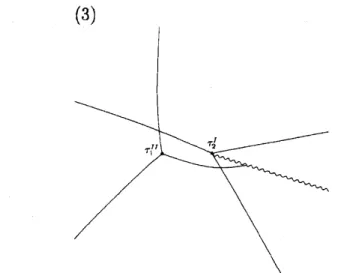
the Riemann surface$R$ of $\mathrm{j}_{0}$: Figure $1(j)(j= 1, 2, 3)$ shows the configuration
on
the $\mathrm{j}$-th sheet of 72.(The wiggly lines in Figure 1 designate the cuts to describe the global structure of
$/\mathrm{Z}$
.
The branch points of $\mathrm{Z}$are
coincident with the turning points ofthe first kind,$\ovalbox{\tt\small REJECT}$
Figure 1: Stokes
curves
of $(l*)_{2}$on
the first sheet (1),on
the second sheet (2),and
on
the third sheet (3) of 72.In this case, if
we
take $u=\hat{u}_{0}$ itselfas a
local parameter of 72,we
then readilyfind that this choice of parameters globally uniformizes $R$ (cf [NT]). Thus all of
the three figures Figure 1(j) $(j=1,2, 3)$ can be drawn just in
one
sheet, i.e., inthe $u$-plane: Figure 2 describes the configuration of Stokes curves of $(ffl)_{2}$ in the
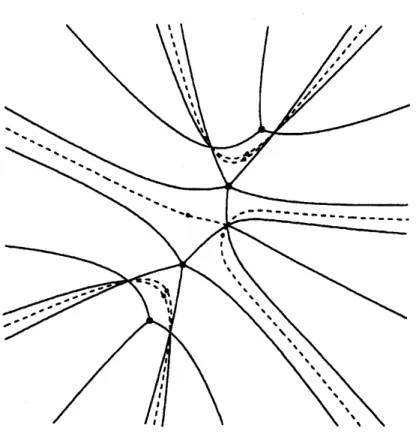
tz-plane.
Figure 2: Stokes
curves
of $(P_{\mathrm{I}})_{2}$ in the w-plane:One
can
observe that thereare
several crossing points of Stokescurves
in Figure1 (or equivalently in Figure 2). As is discussed in [KKNT, Sections 3 and 4],
a new
Stokes
curve
emanates from each crossing point of Stokescurves
(since in thecase
of$(ffl)_{2}$ every crossing pointis “Lax-adjacent” in the terminology of [KKNT]$)$: This
In [KKNT]
we
interpreted the Nishikawa phenomenonas
theoccurrence
ofde-generacy
of Stokes geometry ofthe underlying Lax pairon
thenew
Stokescurve
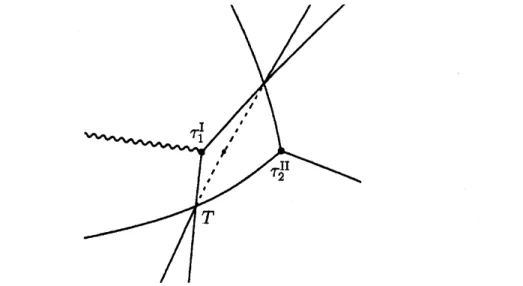
inquestion. For example, let
us
takea
crossing point $T$ ofa
Stokescurve
emanatingffom $\tau_{1}^{\mathrm{I}}$ with another Stokes
curve
emanating from $\tau_{2}^{\mathrm{I}\mathrm{I}}$ i$\mathrm{n}$ Figure 1(2), i.e.,on
thesecond sheet of$\mathcal{R}$ (cf. Figure 3).
$\tau_{1}^{\mathrm{I}}$ ’
$\prime\prime\prime$
$\tau_{2}^{\mathrm{I}\mathrm{I}}$
$T$
Figure 3: Crossing point $t=T$ oftwo Stokes
curves on
the second sheet anda
new
Stokescurve
emanating from $T$.
Here the Stokes
curve
emanating from $\mathrm{y}\mathrm{i}$ is oftype $(1, +)>(1, -)$ and defined by(26) Irn$\int_{\tau_{1}^{\mathrm{I}}}^{t}(\nu_{1,+}-\nu_{1,-})dt=0,$
and the Stokes
curve
emanating from $\tau_{2}^{\mathrm{I}\mathrm{I}}$ is of type $(2, +)>$ $(1, +)$ and $(1,$ $-)$ >(2, -), defined by
(27) ${\rm Im} \int_{\tau_{2}^{11}}^{t}(\nu_{2,+}-\nu_{1,+})dt={\rm Im}\int_{\tau_{2}^{11}}^{t}(\nu_{1,-}-\nu_{2,-})dt=0.$
(Concerning Stokes
curves
emanating froma
turning point ofthe second kind, twoStokes
curves
siton one
and thesame
curve
in general.) Since $t$ $=T$ lieson
theStokes
curve
(26) and(28) 2${\rm Im}$$\int_{a(t)}^{b_{1}}$
(’
$\sqrt{Q_{0}(x,t)}dx=\frac{1}{2}{\rm Im} 7_{1}^{t}\mathrm{I}(\mathrm{J}_{1,+}-\nu_{1,-})dt=0$
holds there thanks to (22),
we
finda
simple turning point $x=a(t)$ anda
doublesince $t=T$ lies
on
the Stokescurve
(27) and (29) 2${\rm Im} \int_{b_{1}(t)}^{b_{2}(t)}\sqrt{Q\mathrm{o}(x,t)}dx$$={\rm Im} \int_{\tau_{2}^{11}}^{t}(\nu_{2,+}-\nu_{1,+})dt={\rm Im}\int_{\tau_{2}^{11}}^{t}(\nu_{1_{1}-}-\nu_{2,-})$dt
$=0$
holdsthere, thedouble turningpoint $r=b_{1}(t)$ and another double turningpoint$x=$
$b_{2}(t)$
are
connected bya
Stokescurve
at $t=T.$ Thus, ifwe
draw the configurationofStokes geometry of (the first equation (6.a) of) the underlying Lax pair $(L_{\mathrm{I}})_{2}$ at
$t$ $=T,$
we
should find that the three turning points$x=a(t)$, $x=b_{1}(t)$ and $x=b_{2}(t)$are
simultaneouslyconnected by Stokescurves
of $(L_{\mathrm{I}})_{2}$.
Actually, with the helpofa
computer,
we
find the following Figure 4 which describes theconfiguration ofStokescurves
of $(L_{\mathrm{I}})_{2}$ at $t=T$ Thenew
Stokescurve
emanating from $T$ is then defined $\underline{|}$$a$
$b_{1}$
$b_{2}$
$\backslash$
Figure 4: Stokes
curves
of $(L_{\mathrm{I}})_{2}$ at $t=T.$as a curve on
which the two ‘distant’ turning points $x=a(t)$ and $x=b_{2}(t)$are
connected by
a
Stokescurve
of $(L_{\mathrm{I}})_{2}$.
Asa
matter of fact, the relation(30) 2${\rm Im} \int_{a(t)}^{b_{2}(}$
’
$\sqrt{Q_{0}(x,t)}dx=$ $\mathrm{r}$${\rm Im} \int_{T}^{t}(\nu_{2,+}-\nu_{2,-})$dt
holds (cf. [KKNT, Theorem 4.1]) and hence
on
thenew
Stokescurve
in questionwe
have
(31) ${\rm Im} \int_{a(}^{b}2\mathrm{j}’)$ $\sqrt{Q_{0}(x,\mathrm{t})}dx=0,$
as
thedefinition of thenew
Stokescurve
is given by vanishingof the right-hand side5
Virtual turning
points
In this section
we
discussa
new
Stokescurve
from the viewpoint ofvirtual turningpoints;
we
first introduce the notion ofa
“virtual turning point” for $(ffl)_{m}$ andconsider
a new
Stokescurve as a
Stokescurve
emanating froma
virtual turningpoint.
For the illustration of
our
discussion letus
continue discussing the fourth orderPainlev\’e-I equation $(ffl)_{2}$ andparticularlythe
new
Stokescurve
of itpassingthroughthe crossing point $T$ ofStokes
curves on
the second sheet. We first recall that,as
was
explained in the preceding section, thenew
Stokescurve
in question is definedby (31). Note that (22) and (23) (cf. (28) and (29) also) lead to
(22) 2 $76t7^{(t)} \sqrt{Q_{0}(x,t)}dx=2\int_{a(t)}^{b_{1}}(’$ $\sqrt{Q_{0}(x,t)}dx+2\int_{b_{1}(t)}^{b_{2}(t)}\sqrt{Q_{0}(x,t)}dx$
$=2$ $\int_{\tau_{1}^{1}}^{t}(\nu_{1,+}-\nu_{1,-})dt+\int_{\tau_{2}^{\mathrm{I}\mathrm{I}}}^{t}(\nu_{2,+}-\nu_{1,+})dt$
$= \frac{1}{2}(\int_{\tau_{2}^{11}}^{t}(\nu_{2,+}-\nu_{1,+})dt+\int_{\tau_{1}^{1}}^{\mathrm{t}}(\nu_{1,+}-\nu_{1,-})d\mathrm{t}+\int_{\tau_{2}^{\mathrm{I}1}}^{t}(\nu_{1,-}-\nu_{2,-})$
dt)
Letting $I(t)$ denote the quantity in the most right-hand side of (32),
we
now
pickup
a
point $t=\omega$ satisfying(33) 2$\int_{a(}^{b}$
ij’)
$\sqrt{Q_{0}(x,\omega)}dx=I(\omega))=0.$(The existence ofsuch
a
point $\mathrm{t}=\omega$has been already discussed in [KKNT, Remark4.1].) Then
we
obtain(34) 2$\int_{a(t)}^{b_{2}(t)}\sqrt{Q_{0}(x,t)}dx$
$=I(t)-I(\omega)$
$= \frac{1}{2}(\int_{\omega}^{t}(\nu_{2,+}-\nu_{1,+})dt+\int_{\omega}^{t}(\nu_{1_{\mathrm{I}}+}-\nu_{1,-})d\mathrm{t}+\int_{\mathrm{t}d}^{t}(\nu_{1,-}-\nu_{2,-})dt)$
$= \frac{1}{2}\int_{1d}^{t}(\nu_{2,+}-\nu_{2,-})$dt.
Hence the
new
Stokescurve
passing through $T$can
be described also by(35) ${\rm Im} \int_{\omega}^{t}(’ 2,+-\nu_{2,-})dt=0,$
Remark 2. The point $t=\omega$ can be regarded as a virtual turning point of the
$\mathrm{R}6\mathrm{c}\mathrm{h}\mathrm{e}\mathrm{t}$ derivative $(\Delta P_{\mathrm{I}})_{2}$ in the following
sense:
For
a
higher order linearordinary differential operator witha
large parameter $\eta$a
virtual turning point is defined as (the projection onto the space of independentvariable, i.e., the $t$-space in the
case
of $(\Delta P_{\mathrm{I}})_{2}$, of)a
self-intersection point ofthebicharacteristic
curve
of its Borel transform with respect to the large parameter $\eta$(cf. [AKT]). In the
case
of $(\Delta P_{\mathrm{I}})_{2}$, ifwe
ignore the singularities in the lower orderterms of $(\Delta P_{\mathrm{I}})_{2}$, the bicharacteristic
curve
is locally given by(36) $\{(t, y)\in G;y=\int^{t}\nu_{g,*}|d\mathrm{t} \}$ ($j=1,2$ and $*=\pm$)
(cf. $[\mathrm{T}$, Section 3.2]). Note that the
$y$-component of the bicharacteristic
curve
isdetermined only up to
an
additive constant. Now at the turning point $\tau_{1}^{\mathrm{I}}$ twobranches
(37) $(t, \int_{\tau_{1}^{1}}^{t}\nu_{1,+}d\mathrm{t})$ and $( \mathrm{t}, \int_{\tau}i \nu_{1,-}dt)$
of the bicharacteristic
curve
meetas
$\tau_{1}^{\mathrm{I}}$ isa
simple turning point of$(\Delta ffl)_{2}$.
(To bemore
precise, the twobranches forma
cuspnear
4,
while the bicharacteristic strip,i.e., the lift of the bicharacteristic
curve
to the cotangent space, definesa
smoothcurve
there.) These two branches (37)are
prolongedtoa
neighborhood of the otherturning point $\tau_{2}^{\mathrm{I}\mathrm{I}}$ and have the following expression there:
(38) $(t, \int_{\tau_{1}^{1}}^{\tau}"\nu_{1,+}dt+\int_{\tau_{2}^{\mathrm{I}1}}^{t}\nu_{1,+}dt)$ and $(t, \int_{\tau_{1}^{1}}^{\tau \mathrm{I}^{1}}\nu_{1,-}dt+\int_{\tau_{2}^{\mathrm{I}1}}^{t}\nu_{1,-}dt)$
.
Then, by a similarreasoning,
we
find that the two branches (38) respectively meetthe following branches at $\tau_{2}^{\mathrm{I}\mathrm{I}}$:
(39) $( \mathrm{t}, \int_{\tau}i^{2}11 \nu_{1,+}dt +\int_{\tau}i_{1} \nu_{2,+}d\mathrm{t})$ and $(t, \int_{\tau}"\nu_{1,-}clt+\int_{\tau_{2}^{1\mathrm{t}}}^{t}\mathrm{i}’ \mathrm{i},-dt)$.
Now
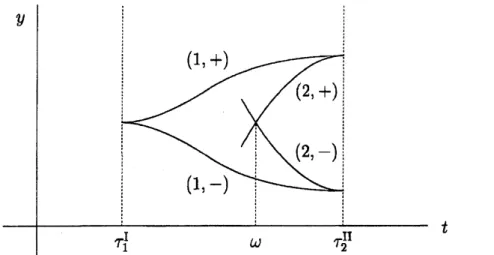
we
considera
crossing point ofthe two branches given by (39) (cf. Figure 5).Such
a
crossing point (i.e.,a
self-intersection point of the bicharacteristic curve) isdetermined by
(40) $\int_{\tau_{1}^{1}}^{\tau_{2}^{11}}\nu_{1,+}dt+\int_{\tau_{2}^{11}}^{t}\nu_{2,+}dt$ $= \int_{\tau_{1}^{1}}^{\tau_{2}^{\mathrm{I}\mathrm{I}}}\nu_{1,-}dt+\int_{\tau_{2}^{1\mathrm{I}}}^{t}\nu_{2,-}dt,$
which is equivalent to$I(t)=0.$ Hence the point$t=\omega$
can
be regardedas a
a
virtual$y$ $i$ “ $\mathrm{i}|$ : $(1, +)$ .$\cdot$ ‘ $|!||,\cdot$ $(2, +)$
.
$|||$ “ $||$ . $(2,$$-)$ $||$ . $(1,$ $-)$ $i||$.
$|$.
$\mathrm{t}$ . $|||||||$ $\tau_{1}^{\mathrm{I}}$ – $\tau_{2}^{\mathrm{I}\mathrm{I}}$ $-$Figure 5: Schematic illustration of the bicharacteristic
curve
of $(\Delta P_{\mathrm{I}})_{2}$.
(Thesymbol $(1, +)$ etc. designate the branch given by (36) with $(j, \mathrm{c})$ $=(1, +)$ etc.)
In view of Remark 2, it is appropriate to call the point $t=\omega$ to be
a
”virtualturning point” of $(P_{\mathrm{I}})_{2}$. One important point here is that $t=\omega$ is defined not only
by $I(\omega)=0$ but also by the equation 2$\int_{a(\omega)}^{b_{2}(\omega)}\sqrt{Q_{0}(x,\omega)}dx=0$ which is equivalent
to $I(\omega)=0,$ that is, $t=\omega$ is defined in terms ofthe integral associated with the
underlying Lax pair $(L_{\mathrm{I}})_{2}$. Having this fact in mind,
we
definea
virtual turningpoint of $(P_{\mathrm{I}})_{m}$ by using the underlying Lax pair $(L_{\mathrm{I}})_{m}$ in the following
manner:
Definition 3. Let $*_{k}(t))(k=1,2)$ be arbitrarily chosen two turningpoints of (the
first equation (6.a) of) the Lax pair $(L_{\mathrm{I}})_{m}$ (i.e., *7(t) $=a$(t)
or
$b_{j}(t)$), and let $C_{t}$ bean
arbitrarily chosen path (in the $x$-space) connecting $*$a(t) and $*_{2}(t)$.
Thena
point$t=\omega$ satisfying (41) $\int_{*_{2(\{v)}}^{*_{1}(\omega}$ , $)$ along $c_{\omega}\sqrt{Q_{0}(x,\omega)}dx=0$
is called
a
virtual turning point of $(P_{\mathrm{I}})_{m}$.
Remark 3. In the
case
of the Painlev6-I hierarchy,as
there exists onlyone
simpleturning point, the number of possible paths $C_{t}$ in (41) is finite. Furthermore, since
$\sqrt{Q_{0}(x,t)}$
can
be explicitly integrated (with respect to $x$) like(42) $\int^{x}\sqrt{Q_{0}}dx=$ (apolynomial in $x$) $\cross\sqrt{x-a(t)}$
in view of (20), for each choice of $C_{t}$ (the square of) (41) becomes of the form
(43) $F(b_{j}, \mathrm{i}_{1,0})$ $=0$
or
$G(b_{j}, b_{j’},\hat{u}_{1,0})$ $=0$according
as
$(*_{1}(t), *_{2}(t))=(b_{j}(\mathrm{t}), a(t))$or
$(b_{j}(t), b_{\mathrm{j}’}(t))$,where $F(X,u)$ and$G(X, \mathrm{Y}, u)$$U_{0}(x, t)=0$ (or,
more
precisely,a
root of $U_{0}(x,\hat{u}_{1,0})$ $=0$ since the $t$-dependence of $U_{0}$comes
only from its$\hat{u}_{j}$,0-dependence) , we thus find that, in order to seek fora
vir-tual turning point of $(P_{\mathrm{I}})_{m}$, it is sufficient to solve the following system ofalgebraic
equations
(44) $F(X, u)=U_{0}(X, u)=0$
or
$G(X, \mathrm{Y}, u)=U_{0}(X, u)=U_{0}(\mathrm{Y}, u)=0$(where
we
put $X=b_{j}$, $\mathrm{Y}=b_{j’}$ and $t$) $=\hat{u}_{1,0})$.
Sucha
systemcan
be algebraicallysolved by using the resultant. Hence
we
conclude that there exist finitely manyvirtual turning points in the
case
of $(P_{\mathrm{I}})_{m}$.
We also define
a
new Stokes curve emanating from a virtual turning pointas
follows:
Definition 4. Let $t=\omega$ be
a
virtual turning point of $(P_{\mathrm{I}})_{m}$.
(i) When $\omega$ is defined by (41) with $*_{1}$$(t)=b_{j}(t)$ and *2(t) $=a(\mathrm{t})$,
we
definea new
Stokes
curve
emanating from $\omega$ by(45) ${\rm Im} 7^{t}(\nu_{j,+}-\nu_{j,-})dt=0.$
(ii) When $\omega$ is defined by (41) with 11$(t)=b_{j}(t)$ and *2(t) $=b_{j’}(t)(j\neq j’)$,
we
define
a new
Stokescurve
emanating from$\omega$ by(46) ${\rm Im} \int_{\omega}^{t}(\nu_{j,+}-\nu_{j’,\pm})dt={\rm Im}\int_{\omega}$
’
$(\nu_{j’,\mp}-\nu_{j,-})dt=0,$
where we take $+$ sign in the first term and – sign in the second term (resp. – sign
in the first term and $+$ sign in the second term) if $C_{\omega}$ does not
cross
(resp. doescross)
a
cut to define $\sqrt{Q_{0}(x,\omega)}$.
A
new
Stokescurve
defined by (45) (resp. (46)) is calleda new
Stokescurve
oftype $(j, +;j, -)$ (resp. of type ($j,$ $+$;$j’,$ $\pm$) and $(j$, -;$j’,$ $\mp)$). (The type of
a
virtualturning point is defined in
a
similar manner.)In parallel with Proposition 2, we then obtain the following Proposition 4,
a
counterpart of the relations (22) and (23), for
a
virtual turning point and anew
Stokes
curve
emanating from it:Proposition 4. Let $t=\omega$ be
a
virtual turning pointof
$(P_{\mathrm{I}})_{m}$. Then we have thefollowing relations:
(i) When$\omega$ is
defined
by (41) $with*_{1}(t)=b_{j}(t)$ and*2(t) $=a(t)$,(47) $\frac{1}{2}\int_{\omega}^{\mathrm{t}}(l_{j,\mathit{4}}-\nu_{j,-})dt=2\int_{a(}^{b}$
3z
holds, where the integral
of
the right-hand sideof
(47) should be taken along the path$C_{t}$ that appears in the
definition of
$\omega$.(ii) When $\omega$ is
defined
by (41) $with*_{1}(t)$ $=b_{j}(t)$ and*2$(t)=b_{j’}(t)(j\neq j’)$,(48) $\int_{\omega}^{t}(\nu_{j,+}-\nu_{j’,\pm})dt=\int_{\omega}^{t}(\nu_{j’,\mp}-\nu_{j,-})dt=2\int_{b_{j},t)}^{b_{j}(t)}.\sqrt{Q_{0}(x,t)}$dx,
holds, where the integral
of
the right-handside should be taken along the path $C_{t}$as
in $(i)_{f}$ and the sign $\mathrm{f}$ and
$\mathrm{F}$
are
chosen in thesame
way as inDefinition
4, (ii).Proof
Theproofisessentiallythesame as
that ofProposition 2 (cf. [KKNT,PropO-sition 2.1.4]); to prove (i), let
us
consider the $t$-derivative of the right-hand side of(47). Since both endpoints $x=b_{j}(t)$ and $x=a(t)$ of the integral
are zeros
of $Q_{0}$,we
find(49) $\frac{\partial}{\partial \mathrm{t}}(2\int_{a(}^{b}$
j
$)$(’
$\sqrt{Q_{0}(x,t)}$dx
)
$=2 \int_{a(t)}^{b_{j}(t)}\frac{\partial}{\partial \mathrm{t}}ndx$.
Here,
as
is proved in [KKNT, Proposition 2.1.2],(50) $\frac{\partial}{\partial t}\sqrt{Q_{0}(x,t)}=\frac{\partial}{\partial x}\sqrt{x+2\hat{u}_{1,0}}$
holds. It then follows from (21) that
(51) $\frac{\partial}{\partial t}(2\int_{a(t)}^{b_{f}(t)}\sqrt{Q_{0}(x,t)}dx)=2\int_{a(t)}^{b_{j}(t)}\frac{\partial}{\partial x}\sqrt{x+2\hat{u}_{1,0}}dx$
$=2\sqrt{x+2\hat{u}_{1,0}}|_{x=b_{j}(t)}$
$= \nu_{j,+}=\frac{1}{2}(’ j,+-\nu_{j,-})$
.
As $\int_{a(\omega)}^{b_{f}(\{d)}\sqrt{Q_{0}}dx=0$holdsbythedefinition of$\omega$, integrating(51) from $\omega$to$\mathrm{t}$verifies
(47). In
a
similarmanner
we can
prove (ii) also. $\square$Remark 4. In labeling the characteristic roots $\nu_{j,\pm}$ of$C_{0}$,
we
implicitly used theRiemann surface of $\sqrt{Q_{0}}$,
or
cuts to define $\sqrt{Q_{0}}$. (See (21) and compare it with(20).) Intuitively speaking, each characteristic root $\nu_{j,\pm}$ is attached to
a
doubleturning point $r=b_{j}(t)$
on
the Riemann surface of $\sqrt{Q_{0}}$. (Thus it may be betterto
use
the notation $” x=b_{j,\pm}(t)$” from this viewpoint.) If in Definition 4 (ii)we
consider $C_{\omega}$ to be a path
on
the Riemann surface of $\sqrt{Q_{0}}$ connecting two suchdouble turning points $b_{j,\pm}$ and $b_{j’,\pm}$, the choice of thesign in (46) is consistent with
this identification between $\nu_{j,\pm}$ and $b_{j,\pm \mathrm{i}}$ for example, if$C_{\omega}$ does not
cross a
cut todefine $\sqrt{Q_{0}}$, it connects $b_{j,+}(t)$ and $b_{j’,+}(t)$ (and simultaneously $b_{j,-}$(t) and $b_{j’,-}(t)$).
Then thechoiceof the signin (46) immediatelyfollows ffomthe above identification.
Note that, from this point of view, the ‘true’ path in Definition 4 (i) is not $C_{\omega}$, but
rather its double
cover
$\tilde{C}_{\omega}$, i.e., doublecover
(on the Riemann surface of$\cap Q_{0}$ of
$C_{\omega}$ that connects $b_{j,+}(\omega)$ and
6
Complete description of the Stokes geometry
In the preceding section
we
gave the definition of virtual turning points andnew
Stokes
curves
emanating from them. As is exemplified by $(P_{\mathrm{I}})_{2}$,we
have to takesuch virtual turning points and new Stokes
curves
into account to obtain the correctglobal Stokes geometryfor $(P_{\mathrm{I}})_{m}$
.
On the otherhand, Definitions 3 and 4 have givenus
sufficiently many virtual turning points and new Stokescurves
in the followingsense:
Ifwe
add all the virtual turning points andnew
Stokescurves
given byDefinitions 3 and 4totheordinaryturningpointsand Stokes curves,
we
then obtaina
“saturated Stokes geometry”. Here
we
say thata
Stokesgeometry, i.e., thecollectionof (ordinary and virtual) turning points and (ordinary and new) Stokes curves, is
saturated (inthe
sense
that all thepossibilitiesare
exhausted) ifeverycrossing pointof (ordinary $\mathrm{a}\mathrm{n}\mathrm{d}/\mathrm{o}\mathrm{r}$ new) Stokes
curves
in the Stokes geometry in question belongsto
one
of the following three types: (In thedescription below the indices$j$, $k$, $l$ and$m$
are
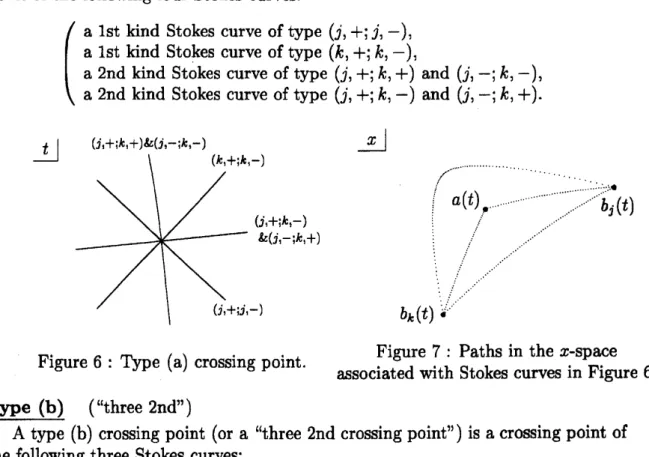
assumed to be mutually distinct.)yp$\mathrm{e}$ (a) (“two 1st
&
two 2nd”)A type (a) crossing point (or
a
“two 1st&
two 2nd crossing point”) isa
crossingpoint of the following four Stokes
curves:
$\{$
a 1st kind Stokes curve oftype $(j, +;j, -)$,
a
1st kind Stokescurve
oftype $(k, +;k,-)$,a 2nd kind Stokes curve of type $(j, +;k, +)$ and $(j, -;k,-)$ ,
a
2nd kind Stokescurve
oftype $(j, +\mathrm{i}k, -)$ and $(j, -;k, +)$.$\underline{t|}$ $(j,+j,+)\ (j,-jk,-)$ $\underline{x|}$ $(k,+j,-)$ $f^{\prime’}$ $a(t)$
.
$b_{j}(t)$ $(j,+j,-)\ (j,-jk,+)$ $(j,+;j,-)$ $b_{k}(t)$.
Figure 7: Paths in the rc-space
Figure 6: Type (a) crossing point.
associated with Stokes
curves
in Figure 6.Type (b) (“three 2nd”)
A type (b) crossing point (or
a
“three 2nd crossing point”)$)$ isa
crossing point ofthe following three Stokes
curves:
$\{$
a
2nd kind Stokescurve
of type $(j, +;k, +)$ and $(j, -;k,-)$,a
2nd kind Stokescurve
of type $(k, +;l, +)$ and $(k, -;l,-)$,(or the pattern where the sign $\pm$ associated with
an
index, say, I is interchangedlike “type $(j, +;k, +)$ and $(j, -;k, -)$, type $(k, +;l, -)$ and $(k, -;l, +)$, and type
$(j, +;l, -)$ and $(j, -;l, +)$”). $\underline{t}|$ $\underline{x|}$ $(k,+jl,+)\ (k,-l,-)$ $b_{k}(t)$
.
$.\dot{b}_{j}.(t)$ $(j,+jk_{1}+)\ (j,-k,-)$ $b_{l}(t)$.
Figure 9: Paths in the z-space
Figure 8:Type (b) crossing point. associated with Stokes
curves
i$\mathrm{n}$ Figure 8.
Type (c) $(” \mathrm{d}\mathrm{i}\mathrm{s}\mathrm{j}\mathrm{o}\mathrm{i}\mathrm{n}\mathrm{t}")$
A type (c) crossing point (or
a
“disjoint crossing point”) isa
crossing point ofthe following two Stokes
curves:
ype (c-1)
$\{$
a
1st kind Stokescurve
oftype$(j, +;j,-)$,
a
2nd kind Stokescurve
oftype $(k, +;l, +)$ and $(k, -;l_{3} -)$,’ $l$ $x$
.
$t$ $t$Figure 11 :Paths associated with Stokes
Figure 10 : Type (c-1) crossing point.
curves
in Figure 10.
yp$\mathrm{e}$ (c-2)
$\{$ a2nd kind Stokes
curve
oftype$(j, +;k, +)$ and $(j, -;k,-)$,
a2nd kind Stokes
curve
of type $(l, +;m, +)$ and $(m, -;l,-)$,$\underline{t|}$ $\underline{x|}$ -$\cdot$ $b_{j}$$(t)$ $k$ $b_{k}(t)$ $\prime\prime\prime\nu\wedge$ $b_{l}(t)$ $b_{m}(t)$
.
Figure 13:Paths associated with Stokes
Figure 12 : Type (c-2) crossing point.
curves
in Figure 12.Let
us
explain thereason
whywe
obtain a saturated Stokes geometry ifwe
consider all the virtual turning points and
new
Stokescurves
together with theordinaryturning points and Stokes
curves.
A key point is that the above local datanear
acrossing point of Stokescurves
in the$t$-spacecan
be translatedintothe globaldata in the $x$-space. In fact,
as
is claimed in Proposition 2or
4,a
path (in thex-space) connecting two turning points of theunderlying Lax pair $(L_{\mathrm{I}})_{m}$ is associated
with each (ordinary
or
new) Stokescurve
of$(P_{\mathrm{I}})_{m}$ via theintegralrelations like (22),(23)$)$ $(47)$
or
(48). Thus, ifwe
takea
crossing point of two (ordinary$\mathrm{a}\mathrm{n}\mathrm{d}/\mathrm{o}\mathrm{r}$ new)
Stokes curves,
we
are
given two such paths in the $x$-space associated with them andfour turning points of $(L_{\mathrm{I}})_{m}$ being endpoints of these two paths. Then, concerning
the combination of the four endpoints,
we
have the following threecases:
(1) The two paths share
one
endpoint and consequentlywe are
given threeend-points, amongwhich
a
simple turning point is included.(2) The two paths share
one
endpoint and consequentlywe are
given threeend-points, all ofwhich
are
double turning points.(3) The four endpoints (turning points) are mutually disjoint.
The
case
(1) corresponds toa
type (a) crossing point: At sucha
crossing point threeturningpoints $a(t)$, $b_{j}$(t) and $b_{k}(t)$
are
relevant in the $\mathrm{z}$-space. Then,as
a
path ofintegration for $\sqrt{Q_{0}}$ connecting two of them,
we
may consider four possible paths,as
is shown in Figure 7. (Notethat $\sqrt{Q_{0}}$ is holomorphic ata
double turning point,while
a
simple turningpoint isa
square-roottypesingular point of !.) Since theimaginarypart of the integral of$\sqrt{Q_{0}}$along two ofsuch fourpossible paths vanishes
by the assumption thatthepoint inquestion is
a
crossingpointoftwo Stokes curves,the imaginary part of the integral along all of these four paths should vanish. As
we
have exhaustively taken into account all the possible paths in defining virtualturningpoints and
new
Stokes curves, thismeans
that four Stokescurves
mustcross
at the point in question and hence
we
conclude that sucha
crossing point isa
type(a) crossing point. By
a
similar argumentwe can
also confirm that thecase
(2)all the (ordinary and virtual) turning points and (ordinary and new) Stokes curves,
only the three types ofcrossing points of Stokes
curves
may appear.Remark 5. For $(P_{\mathrm{I}})_{2}$ neithertype (b)
nor
type (c) crossing points appear, since theunderlying Lax pair $(L_{\mathrm{I}})_{2}$ has just two double turning points. Similarly type (c-2)
crossing points do not appear for $(P_{\mathrm{I}})_{3}$.
In this way, by adding virtual turning points and
new
Stokes curves,we
obtaina
saturated Stokes geometry of $(ffl)_{m}$.
However, to obtain a “complete Stokesge-ometry” of $(ffl)_{m}$, i.e., its correct global Stokes geometry,
we
still need to discussthe “effectiveness”
or
“activity” ofStokescurves.
That is,on
each portion ofStokescurves we
have to check whether the degeneracy of Stokes geometry of theunder-lying Lax pair $(L_{\mathrm{I}})_{m}$ does really
occur or
not. (On each Stokescurve
we
have therelation
(52) ${\rm Im} 7_{1}^{*}2_{t}\mathrm{j}$
’
$\sqrt{Q_{0}}dx=0$
with
some
turning points $*_{1}(t)$ and *2(l) of $(L_{\mathrm{I}})_{m}$, but (52) does not necessarilyimply the degeneracy of Stokes geometry of $(L_{\mathrm{I}})_{m}$. See [AKT, p.80] and [KKNT,
Remark 4.1].)
Concerning the problem of activity of Stokes curves,
we
first note the followingProposition 5. A
nern
Stokes curve is not activenear
a virtual turning $point_{f}$ thatis,
no
degeneracyof
the Stokes geometryof
$(L_{\mathrm{I}})_{m}$ occurs on anern
Stokescurve near
a
virrual turningpoint.Proof.
Assume thata
virtual turning point $t=\omega$ is notan
ordinary turning pointand that it is defined by
(53) $\int_{*}i$ ’
$\sqrt{Q_{0}}\mathrm{b}$ $=0$
with
some
turning points $*_{1}$ and $*_{2}$ of $(L_{\mathrm{I}})_{m}$.
Ifthe degeneracy of Stokes geometryof $(L_{\mathrm{I}})_{m}$
were
tooccur on a new
Stokescurve
emanating from $t=\omega$, the turningpoints $*_{1}$ and $*_{2}$ should be connected by
a
Stokescurve
7 of $(L_{\mathrm{I}})_{m}$ at $t=\omega$. Since(54) $\int_{*_{2}}^{x}\sqrt{Q_{0}}\mathrm{r}x$
is
a
real-valued monotone function (of $x$)on
$\gamma$, it then follows bom (53) that $*1$should coincide with $*_{2}$
.
Thismeans
that $t–$ \mbox{\boldmath$\omega$} should bean
ordinary turningpoint, contradicting the assumption. $\square$
Hence,
as
in thecase
of higher order linear equations, the portion ofa new
Stokes geometry (i.e., be drawn by
a
dotted line). On the other hand, in view ofProposition 2,
we
should keep solid the portion ofan
ordinary Stokescurve
near
anordinary turningpoint. Thus the activity ofStokes
curves
is completelydeterminednear
turning points.Note that the degeneracy of Stokes geometry of $(L_{\mathrm{I}})_{m}$, i.e., the existence of a
Stokes
curve
connecting two turning points, may be resolved only when anotherturning point of $(L_{\mathrm{I}})_{m}$
comes
across
the Stokescurve
in question. Since sucha
phenomenon
occurs
only at a crossing point of Stokescurves
of $(ffl)_{m}$,we
find thatthe activity of
a
Stokescurve
of $(P_{\mathrm{I}})_{m}$ changes only ata
crossing point of Stokescurves.
Thus, fromnow
on,we
consider classification ofall the ’admissible’ patternsforthe activityofStokes
curves
at each type ofcrossing points. Letus
first discussa
type (a) (i.e., two 1st
&
two 2nd) crossing point ofStokescurves.
At sucha
crossingpoint three turning points $a(t)$, $b_{j}(t)$ and $b_{k}(t)$ of $(L_{\mathrm{I}})_{m}$
are
relevant in the z-space(cf. Figure 7). Concerning the
occurrence
of degeneracy of the Stokes geometry of$(L_{\mathrm{I}})_{m}$,
we
have the following threecases:
(i) No pair of the three turning points is connected by
a
Stokescurve
of$(L_{\mathrm{I}})_{m}$.
(ii) Only two of them are connected by a Stokes
curve
of $(L_{\mathrm{I}})_{m}$.
(iii) All of them
are
connected by (two) Stokescurves
of $(L_{\mathrm{I}})_{m}$.In Case (i) all Stokes curves of $(ffl)_{m}$ passing through the crossingpoint in question
are
inactive (i.e., should be drawn bya
dotted line), while onlyone
Stokescurve
isactive and the others
are
inactive in Case (ii). Case (iii)can
be further classifiedinto the following three subcases:
Case (iii-l) Case (iii-2)
Case (iii-3) $\underline{x|}$
Figure
14
: Stokes geometry of $(L_{\mathrm{I}})_{m}$ in Case (iii).All of these three subcases have already been discussed in [KKNT, Section 4];
Cases (iii-l) and (iii-2)
are
Lax-adjacent crossing points and Case (iii-3) isnon-Lax-adjacent. The corresponding admissible patterns for the activity of Stokes
curves
of$(ffl)_{m}$ will be given in Figure 15 below. Thus the classification of all the admissible
patterns at
a
type (a) crossing point isnow
completed.In a similar
manner we can
classify all the admissible patterns also at type (b)and (c) crossing points. The followingis
a
list of all the admissible patterns for theactivity of Stokes
curves
at each type of crossing points:List of the admissible patterns for the activity of Stokes
curves
at eachtype of crossing points
Type (a) (“two 1st
&
two 2nd”)(i) All
curves are
dotted.(ii) Only
one curve
is solid, the othersare
dotted.(iii) (See below.)
Case (iii-l) Case $(\mathrm{i}\mathrm{i}\mathrm{i}- 1)’$
$\underline{t|}$
$\lambda_{1}^{k}k$
$\underline{t|}$
Case (iii-2) Case (iii-3) $\underline{t|}$
$*_{\iota}’/$
$*1//$ $k2$ $\underline{t|}$ $|$Figure 15 : Admissible patterns at
a
type (a) crossing point (in Case (iii)).$\mathrm{y}\mathrm{p}\mathrm{e}$ $(\mathrm{b})$ $($$(” \mathrm{t}\mathrm{h}\mathrm{r}\mathrm{e}\mathrm{e} 2\mathrm{n}\mathrm{d}")$
(i) All
curves are
dotted.(ii) Only
one curve
is solid, the othersare
dotted.(iii) (See below.)
Case (iii-l) Case (iii-2)
$\underline{t|}$ $\underline{t|}$ $(j_{1}+|.l,+)\ (j,-;l,-)|$
$k$
$k$
$|$ $|$
Figure 16 : Admissiblepatterns at
a
type (b) crossing point (in Case (iii)).Type (c) $(” \mathrm{d}\mathrm{i}\mathrm{s}\mathrm{j}\mathrm{o}\mathrm{i}\mathrm{n}\mathrm{t}")$
(i) All
curves are
dotted.(ii) Only
one
curve
is solid, the othersare
dotted.(iii) Both
curves are
solid.Remark 6. As in the description ofeach type ofcrossing points, i.e.,
as
in Figures6, 8, 10 and 12, the combination of the types of Stokes
curves
is not completelylisted and
some
interchange of the sign $\pm$ is allowed in Figures 15 and 16. In thesefigures the placement ofStokes
curves
is not specified, either.By the
same
reasoningas
in [KKNT, Remark 4.1]we
can
verify thata
pointan
ordinaryor
new Stokescurve
of $(P_{\mathrm{I}})_{m}$. Hence the “complete Stokes geometry”of $(P_{\mathrm{I}})_{m}$, i.e., the collection of points where the degeneracy of Stokes geometry
of the underlying Lax pair $(L_{\mathrm{I}})_{m}$ is observed, should consist of the (ordinary and
virtual) turning points and the (ordinary and new) Stokes
curves.
Furthermore, inthe complete Stokes geometry the pattern of the activity of Stokes
curves
at eachcrossing pointshouldnecessarily belong tothe above list. Thus,
as
theprocedurefordetermining the complete Stokes geometry of $(P_{\mathrm{I}})_{m}$,
we
can
propose the following:Procedure for determining the complete Stokes geometry
1’) Draw the Stokes
curves
emanating from ordinary turning points.2’) Locateall the virtualturningpointsanddrawthe
new
Stokescurves
emanatingfrom them.
3’) The portion of
a new
Stokescurve
containinga
virtual turning point shouldbe ignored in the Stokes geometry (i.e., be drawn by
a
dotted line).4’) The portion of
an
ordinary Stokescurve
adjacent toan
ordinaryturningpointshould be kept solid.
5’) We determine the activity ofeach portion ofStokes
curves so
that, in additionto $3^{\mathrm{o}}$) and 4’), the patternofthe activityat every (type (a), (b)
or
(c)) crossingpoint of Stokes
curves
may belong to the above list.$6^{\mathrm{o}})$ The complete Stokes geometry is then given by the collection of the turning
points and solid (active) portions of Stokes
curves
determinedby $5^{\mathrm{o}}$).If the activity ofeach portion of Stokes
curves
is uniquely determined ina
globallyconsistent manner by 5’), the Stokes geometry thus obtained is nothing but the
complete Stokes geometry. For example,
as we
shallsee
in what follows,we can
obtain the complete Stokes geometry of $(P_{\mathrm{I}})_{2}$ and that of $(P_{\mathrm{I}})_{3}$ by following the
above Procedure.
Example 1 (revisited). In the
case
ofthe 4th order Painlev\’e-I equation $(ffl)_{2}$,if
we
add virtual turning points andnew
Stokescurves
to ordinary turning pointsand ordinary Stokes curves,
we
obtain Figure 17. (In Figure 17 (and in Figures 18,20 and 21 below
as
well) virtual turning pointsare
denoted by small dots, whileordinary turning points
are
denoted by largedots.) Furthermore, using $3^{\mathrm{O}}$), $4^{\mathrm{o}}$) and$5^{\mathrm{o}})$ of the above Procedure,
we can
uniquelydetermine the activityof each portionofStokes curves,
as
is shown in Figure 18. Thus Figure 18 gives acompletedescriptionFigure 17 : Saturated Stokes geometry of $(P_{\mathrm{I}})_{2}$ in the w-plane. 1 $\prime\prime$
.
1 1 $\prime\prime\prime$ $\iota$ $\iota_{1\backslash }$ $\prime\prime\prime$ $\backslash \backslash$$\backslash \backslash \backslash$
$\backslash$ $\backslash$
$\backslash \backslash$
$.\backslash \backslash -\sim*$ $\backslash \backslash$ $\backslash \backslash$ $\backslash \backslash$ $\backslash \backslash$ – $\backslash$ $\prime\prime---rightarrow---\cdot$ $\vee\sim\backslash$ ’ $\backslash$ $\backslash$ $\prime\prime\prime\prime\prime\prime’\sim$ ’
$\backslash \sim\backslash \backslash \grave{\grave{\tau}}_{1}$
$\backslash$ $\backslash$ $\prime\prime\prime$ ’ $\backslash$ $\backslash$ $\backslash$ ’ $\backslash$ $\backslash$ $\backslash$
$\backslash \backslash \backslash$ $\iota$
Example 2. (6th order Painlev\’e-I equation)
$(P_{\mathrm{I}})_{3}$ $u^{(6)}=\eta^{2}(28uu^{(4)}+56u’u^{(3)}+42(u’’)^{2})-\eta^{4}(280u^{2}u’’+$ $280\mathrm{t}\mathrm{z}(u’)^{2}$
$+16c_{1}u’’)+\eta^{6}(280u^{4}+96c_{1}u^{2}-64c_{2}u-32c_{1}^{2}+64t)$
.
Similarlyto the
case
of$(P_{\mathrm{I}})_{2}$we
can
take$u=\hat{u}_{0}$as a
globally uniformizingparameterof its Riemann surface II (cf. [NT]). Figure19 describesthe configuration ofordinary
Stokes
curves
of $(ffl)_{3}$ in the u-plane.Just like $(ffl)_{2}$, adding virtual turningpoints and
new
Stokescurves
to Figure 19and using 3’), $4^{\mathrm{o}}$) and 5’) of the above Procedure to determine the activity of each
portion of Stokes curves,
we
obtain Figure 20 and Figure 21. Thus Figure 21 givesa complete description of the global Stokes geometry for $(P_{\mathrm{I}})_{3}$
.
Figure 19 : Stokes
curves
of $(ffl)_{3}$ (in the u-plane).Remark 7. The procedure for determining the complete Stokes geometry
can
beapplied in principle to other (hierarchies of) higher order Painlev! equations,
as
long
as
their underlying Lax pairsare
2 $\mathrm{x}2$ linear systems. There are, however,some
diiBculties to obtaina
complete description ofthe global Stokes geometry forFigure 20 : Saturated Stokes geometry of$(ffl)_{3}$
.
classification (of the types) of crossing points ofStokes
curves
in asaturated Stokesgeometry may not be complete in general, and another
one
is that infinitely manyvirtual turningpointsmay appearforhigher orderPainlev6 equations (except forthe
Painleve-I hierarchy). Both difficulties originate from the fact that the underlying
Lax pair has several simple turning points and consequently there exist nontrivial
period integrals $\oint\sqrt{Q_{0}}$ S. Among them the second difficulty is
more
serious;as
inthe
case
ofhigherorder linear equations, howto dealwithinfinitelymanyredundantvirtual turning points is
an
important open problem.Acknowledgement
This research issupportedinpart byJSPS Grant-in-AidNo. 14340042,No. 15740088
Figure 21 : Complete Stokes geometry of $(ffl)_{3}$.
References
[AKT] T. Aoki, T. Kawai and Y. Takei: New turning points in the exact WKB
analysisforhigherorderordinarydifferentialequations,Analyse alg\’ebrique
desperturbationssinguliferes, I; M\’ethodesr\’esurgentes, Hermann, 1994, pp.
69-84.
[BNR] H. L. Berk, W. M. Nevins and K. V. Roberts: New Stokes’ line in WKB
theory, J. Math. Phys., 23(1982), 988-1002.
[GP] P.R. Gordoa and A. Pickering: Nonisospectral scatteringproblems: A key
[KKNT] T. Kawai, T. Koike, Y. Nishikawa and Y. Takei: On the Stokes geometry
ofhigher order Painleve’ equations, RIMS Preprint No. 1443, 2004.
[KT1 T. Kawai and Y. Takei: WKB analysis of Painlev6 transcendents with a
large parameter. $\mathrm{I}$, Adv. Math., 118(1996), 1-33.
[KT2] –: Algebraic Analysis of Singular Perturbations, Iwanami, Tokyo,
1998. (In Japanese. An English translation is to be published by A.M.S.)
[K] N. A. Kudryashov: Thefirst and second Painlev? equations of higher order
and
some
relations between them, Phys. Lett. $\mathrm{A}$, 224(1997), 353-360.[KS] N. A. Kudryashov and M. B. Soukharev: Uniformization and
transcen-dence of solutions for the first and second Painlev6 hierarchies, Phys. Lett.
$\mathrm{A}$, 237(1998), 206-216.
[N1] Y. Nishikawa: WKB analysis of $ffl_{\mathrm{I}^{-}}P_{\mathrm{I}V}$ hierarchies, Master Thesis, Kyoto
Univ., 2003. (In Japanese.)
[N2] –: Towards theexact WKB analysis of$ffl_{\mathrm{I}^{-}}ffi$hierarchies. Preprint.
[NT] Y. Nishikawa and Y. Takei: On the structure of the Riemann surface in
the Painleve’ hierarchies. In Prep.
[S1] S. Shimomura: Painleve’propertyof
a
degenerate Gamier system of(9/2)-type and of
a
certain fourth order non-linearordinary differentialequation,Ann. Scuola Norm. Sup. Pisa, 29(2000), 1-17.
[S2] –: On the Painlev! I hierarchy, RIMS K\^oky\^uroku, No. 1203, 2001,
pp. 46-50.
[S3] A certain expression ofthe first Painleve’ hierarchy, preprint.
[T] Y. Takei: Exact WKB analysis, and exact steepest descent method. –
A sequel to “algebraic analysis of singular perturbations” -, Sugaku,
55(2003), 350-367. (In Japanese. Its English translation will appear in