MODEL COMPLETENESS OF THE THEORY OF HRUSHOVSKI‘S PSEUDOPLANE ASSOCIATED TO 5/8
神戸大学大学院システム情報学研究科 桔梗宏孝 (HIROTAKA KIKYO) GRADUATE SCHOOL OF SYSTEM INFORMATICS, KOBE UNIVERSITY
ABSTRACT. Hrushovski’s pseudoplane associated to rational number 5/8 has a model complete theory.
Hrushovski’s amalgamation construction, model completeness 03C10,03C13,03C25,03C30
1. INTRODUCTION
Generic structures constructed by the Hrushovski’s amalgamation construction are known to have theories which are nearly model complete. If an amalgamation class has the full amalgamation property then its generic structure has a theory which is not model com‐ plete [2]. On the other hand, Hrushovski’s strongly minimal structure constructed by the amalgamation construction, refuting a conjecture of Zilber has a model complete theory [5].
We have shown that the generic structure of K_{f}with a coefficient between 0and 1 for the predimension function has a model complete theory under some assumption on f[8].
Hrushovski’s original boundary function does not satisfy our assumption above. Never‐ theless, we show the model completeness of the theory of the generic graph associated to
5/8.
We essentially use notation and terminology from Baldwin‐Shi [3] and Wagner [12]. We aıso use some terminology from graph theory [4].
For a set X, [X]^{n} denotes the set of all subsets of Xof size n, and |X| the cardinality of
X.
We recall some of the basic notions in graph theory we use in this paper. These appear
in [4]. Let Gbe a graph. V(G) denotes the set of vertices of Gand E(G) the set of edges of
G.
E(G)is a subset of
[V(G)]^{2}.
|G|den^{\backslash }otes
|V(G)|. The degree of a vertex
vis the number
of edges at v. A vertex of degree 0is isolated. A vertex of degree 1 is a leaf. Gis a path
xx\ldots x_{k}if V(G)=\{x_{0},x_{1}, x_{k}\} and E(G)=\{xx,xx, x_{k-1}x_{k}\} where the x_{i}are
alı distinct. x_{0}and x_{k}are ends of G. The number of edges of a path is its length. A path of length 0is a single vertex. Gis a cycle x_{0}x_{1}\ldots x_{k-1^{X}0}if k\geq 3, V(G)=\{x_{0},x_{1}, x_{k-1}\}
and E(G)=\{x_{0}x_{1} ,x_{1}x_{2}, xxxx\} where the x_{i}are all distinct. The number of
edges of a cycle is its length. A girth of a graph Gis the length of the shortest cycle in G.
A non‐empty graph Gis connected if any two of its vertices are linked by a path in G. A connected component of a graph Gis a maximaı connected subgraph of G. A forest is a
graph not containing any cycles. A tree is a connected forest.
To see a graph Gas a structure in the model theoretic sense, it is a structure in language \{E\} where E is a binary relation symbol. V(G)will be the universe, and E(G) will be the interpretation of E. The language \{E\} will be called the graph language.
Suppose A is a graph. If X\subseteq V(A), A|X denotes the substructure B of A such that
V(B)=X. If there is no ambiguity, X denotes A|X. We usually follow this convention.
B\subseteq Ameans that Bis a substructure ofA. A substructure of a graph is an induced subgraph
in graph theory. A|X is the same as A[X]in Diestel’s book [4].
We say that Xis connected in A ifXis a connected graph in the graph theoretical sense
[4]. A maximal connected substructure ofAis a connected component ofA.
Let A, B, Cbe graphs such that A\subseteq Cand B\subseteq C. ABdenotes C|(V(A)\cup V(B)), A\cap B
denotes C|(V(A)\cap V(B)), and A-B denotes C|(V(A)-V(B)). If A\cap B=\emptyset, E(A,B)
denotes the set of edges xy such that x\in Aand y\in B. We put e(A,B)=|E(A,B)|. E(A,B)
and e(A,B) depend on the graph in which we are working. When we are working in a
graph G, we sometimes write E_{G}(A,B) and e_{G}(A,B)respectively.
Let Dbe a graph and A, B, and Csubstructures of D. We write D=B\otimes_{A}Cif D=BC, B\cap C=A, and E(D)=E(B)\cup E(C). E(D)=E(B)\cup E(C)means that there are no edges
between B-Aand C-A. Dis called afree amalgam of Band CoverA. IfAis empty, we
write D=B\otimes C, and Dis also called afree amalgam ofBand C. Definition 1.1. Let \alphabe a real number such that 0<\alpha<1.
(1) For a finite graph A, we define a predimension function \deltaby \delta(A)=|A|-\alpha|E(A)|.
(2) Let A and Bbe substructures of a common graph. Put \delta(A/B)=\delta(AB)-\delta(B). Definition 1.2. Let Aand Bbe graphs with A\subseteq B, and suppose Ais finite.
A\leq Bif whenever A\subseteq X\subseteq Bwith Xfinite then \delta(A)\leq\delta(X). A<B if whenever A\subsetneq X\subseteq Bwith Xfinite then \delta(A)<\delta(X).
We say that Ais closed in Bif A<B.
If \alphais irrationaı then \leq and < are the same relations, but they are different if \alpha is a
rational number. Our relation <is often denoted by \leq inthe literature and some people use \leq^{*} for our <. Since we want to use the relation \leq aswell, we use the symboı <for the closed substructure relation.
Let K_{\alpha}be the class of all finite graphs Asuch that \emptyset<A.
The following facts appear in [3, 12, 13]. Some proofs are given in [11]. Fact 1.3. LetA, B, Cbe finite substructures in a common graph.
(1) IfA\cap C is empty then \delta(A/C)=\delta(A)-\alpha e(A,C). (2) IfA\cap Cis empty and B\subseteq Cthen \delta(A/B)\geq\delta(A/C). (3) A\leq Bif and only if \delta(X/A)\geq 0for any X\subseteq B.
(4) A<Bif and only if \delta(X/A)>0for any X\subseteq Bwith X-Anon‐empty. (5) A\leq A.
(6) lfA\leq B then A\cap C\leq B\cap C.
(7) IfA\leq B and B\leq C then A\leq C.
(8) If A\leq Cand B\leq Cthen A\cap B\leq C.
(9) A<A.
(10) lf A<Bthen A\cap C<B\cap C.
(11) lf A<Band B<Cthen A<C.
(ı2) If A<Cand B<Cthen A\cap B<C. Fact 1.4. Let D=B\otimes_{A}C.
(2) IfA\leq C then B\leq D.
(3) lfA\leq B and A\leq Cthen A\leq D.
(4) lfA<C then B<D.
(5) If A<Band A<Cthen A<D.
Fact 1.5. (1) LetA, B, Cand Dbe graphs with D=B\otimes CandA\subseteq D. Then \delta(D/A)= \delta(B/A\cap B)+\delta(C/A\cap C).
(2) Let Dbe a graph andA a substructure ofD. Let \{D_{1},D_{2}, D_{k}\} be the set of all connected components of Dwhere the D_{i}are all distinct. Then
\delta(D/A)=\sum_{i=1}^{k}\delta(D_{i}/A\cap D_{i})
.Let B, Cbe graphs and g:Barrow Ca graph embedding. gis a closed embedding of Binto
Cif g(B)<C. Let Abe a graph with A\subseteq Band A\subseteq C. gis a closed embedding over Aif gis a closed embedding and g(x)=xfor any x\in A.
In the rest of the paper, Kdenotes a class of finite graphs closed under isomorphisms.
Definition 1.6. Let Kbe a subclass of K_{\alpha}. (K, <) has the amalgamation property if for
any finite graphs A,B,C\in K, whenever g_{1} : Aarrow Band g_{2}:Aarrow Care closed embeddings then there is a graph. D\in Kand closed embeddings h_{1} : Barrow Dand g_{2} : Carrow Dsuch that
h_{1}og_{1}=h_{2}og_{2}.
Khas the hereditary property if for any finite graphs A,B, whenever A\subseteq B\in Kthen A\in K.
Kis an amalgamation class if \emptyset\in Kand Khas the hereditary property and the amalga‐ mation property.
A countabıe graph M is a generic structure of (K, <) if the following conditions are
satisfied:
(ı) IfA\subseteq Mand Ais finite then there exists a finite graph B\subseteq Msuch that A\subseteq B<M.
(2) If A\subseteq Mthen A\in K.
(3) For any A, B\in K, if A<Mand A<Bthen there is a closed embedding of Binto Mover A.
Let A be a finite structure of M. By Fact 1.3 (12), there is a smallest B satisfying A\subseteq B<M, written c1(A). The set c1(A)is called a closure of Ain M.
Fact 1.7 ([3, 12, 13]). Let (K, <) be an amalgamation class. Then there is a generic structure of (K, <). LetMbe a generic structure of (K, <). Then any isomorphism between finite closed substructures of Mcan be extended to an automorphism of M.
Definition 1.8. Let Kbe a subclass of K_{\alpha}. A graph A\in Kis absolutely closed in Kif whenever A\subseteq B\in Kthen A<B.
Note that the notion of being absolutely closed in Kis invariant under isomorphisms.
Fact 1.9 ([11]). Let Kbe a subclass of K_{\alpha} and Ma generic structure of (K, <). Assume that Mis countably saturated. Suppose for any A\in Kthere is C\in Ksuch thatA <Cand Cis absolutely closed in K. Then the theory of Mis model complete.
Definition 1.10. Let Kbe a subclass of K_{\alpha}. (K, <)has the free amalgamation property if whenever D=B\otimes_{A}Cwith B,C\in K, A<B and A<C then D\in K.
By Fact 1.4 (4), we have the following.
Fact 1.11. Let Kbe a subclass of K_{\alpha}. If (K, <) has the free amalgamation property then it has the amalgamation property.
Definition 1.12. Let \mathbb{R}^{+} be the set of non‐negative reaı numbers. Suppose f: \mathbb{R}^{+}arrow \mathbb{R}^{+} is a strictly increasing concave (convex upward) unbounded function. Assume that f(0)= 0, and f(1)\leq 1. We assume that fis piecewise smooth.
f_{+}'(x)
denotes the right‐hand derivative at x. We havef(x+h)\leq f(x)+f_{+}^{t}(x)h
for h>0. Define K_{f}as follows:K_{f}=\{A\in K_{\alpha}|B\subseteq A\Rightarrow\delta(B)\geq f(|B|)\}.
Note that if K_{f}is an amalgamation class then the generic structure of
(K_{f}, <)
has a count‐ ably categorical theory [13].Definition 1.13. Let R, Sbe sets and \mu : Rarrow Sa map. For Z\subseteq[R]^{m}, put \mu(Z)=\{\{\mu(x_{1}), ...,\mu(x_{m})\}|\{x_{1}, ...,x_{m}\}\in Z\}.
Let B, C, and Dbe graphs and Xa set of vertices. We write D=B\rangle\triangleleft {}_{X}Cif C|Xhas no edges and the following hold:
(1) V (D)=V(B)\cup V(C).
(2) X=V(B)\cap V(C).
(3) E(D)=E(B)\cup E(C).
Since we are assuming that Chas no edges on X, Bis a usual substructure of Dbut Cmay not be a substructure of D in general. If Bhas no edges on X, then D is the free amalgam of Band Cover X.
Fact 1.14. Let Dbe a graph with D=Bx_{X}C. (1) \delta(D/B)=\delta(C/X).
(2) \delta(D)=\delta(B)+\delta(C/X).
Fact 1.15. Let Dbe a graph with D=Bx_{X}C. (1) If C|X<Cthen B<D.
(2) If C|X\leq Cthen B\leq D.
2. ZERO‐EXTENSIONS
Definition 2.1. Let Aand Bbe graphs. Bis a zero‐extension of A ifA\leq Band \delta(B/A)=0.
Bis a minimal zero‐extension of A if Bis a proper zero‐extension of Aand minimal with this property. In this case, A\subsetneq U\subseteq B implies A^{\cdot}<U.
Bis a biminimal zero‐extension of Aif Bis a minimal zero‐extension ofAand whenever
A'\subseteq Aand.
\delta(B-A/A')=0
then A'=A. We will use the following facts many times.Fact 2.2. LetAbe a substructure of a graph B. The following are equivalent: (1) Bis a biminimal zero‐extension ofA.
(2) \delta(B/A)=0and whenever D\subset\infty B then A\cap D<D.
Fact 2.3. Let D=B\otimes_{A}C where B and C are zero‐extensions of A. Then D is a zero‐ extension of A.
3. A HRUSHOVSKI’S BOUNDARY FUNCTION
Definition 3.1 ([6]). Let \alphabe a positive real number. We define x_{n}, e_{n}, k_{n}, d_{n}for integers
n\geq 1 by induction as follows: Put x_{1}=2 and e_{1}=1. Assume that x_{n} and e_{n} are defined.
Let r_{n}be a smallest rational number rsuch that r=k/d>\alphawith d\leq e_{n}where k and d
are positive integers. Let k_{n} and d_{n}be coprime positive integers with k_{n}/d_{n}=r_{n}. Finally, let x_{n+1}=x_{n}+k_{n}, and en+{\imath}=e_{n}+d_{n}.
Let a_{0}=(0,0), and a_{n}=(x_{n},x_{n}-e_{n}a) for n\geq 1. Let f be a function from \mathbb{R}^{+} to \mathbb{R}^{+} whose graph on interval [x_{n},x_{n+1}]with n) 0is a line segment connecting a_{n}and a_{n+1}. We call fa Hrushovski ’s boundary function associated to \alpha.
Example 3.2. Let \alpha=5/8. Then we have a following chart:
Fact 3.3 ([6]). Let f be a Hrushovski’s boundary function associated to \alpha. Then f is
strictly increasing and concave, and
(K_{f}, <)
has the free amalgamation property. There‐ fore, there is a generic structure of(K_{f}, <)
. Any one point structure is absolutely closedin K_{f}.
Proposition 3.4. Let fbe a Hrushovski’s boundary function associated to \alpha. lf \alpha is a
rational number then fis unbounded.
Proof. Let x_{n}, e_{n}, k_{n}, d_{n} and a_{n} be as in Definition 3.1. Let y_{n}be the y‐coordinate of a_{n}.
Then y_{n+1}-y_{n}=k_{n}-d_{n}\alpha>0since k_{n}/d_{n}>\alpha. Suppose \alpha=m/d. Then k_{n}-d_{n}\alpha\geq 1/d.
Therefore, f(x_{n})=y_{n}\geq n/d. Hence \lim_{narrow\infty}f(x_{n})=\infty. 口
4. MODEL COMPLETENESS
Let f be a Hrushovski’s boundary function associated to 5/8. Let M be a generic
structure of
(K_{f}, <)
. We show that the theory of Mis model complete. In the rest of the paper, we assume that \alpha=5/8.In order to discuss if a given graph is in K_{f} or not, the following definition will be
convenient.
Definition 4.1. Let Bbe a graph and c\geq 0 an integer. Bis normal to fif \delta(B)\geq f(|B|). Bis c‐normal to fif \delta(B)\geq f(|B|+c). Bis c‐critical to fif Bis c‐normal to fand cis
maximal with this property.
The following three lemmas are immediate from the definitions. Lemma 4.2 ([11]). LetAbe a finite graph.
(1) Suppose Ais normal to f and non‐empty. Then \delta(A)>0. (2) A\in K_{f}if and only if every substructure ofAis normal to f.
(3) Let c and c' be integers such that 0\leq c\leq c'. If A is c'‐normal to f then A is
c‐normal to f, and in particular, A is normal to f.
(4) Let A be normal to f. Let n be an integer such that \delta(A)\geq f(n) but \delta(A)< f(n+1). Such an nuniquely exists. Let c=n-|A|. Then Ais c‐critical to f. cis
a unique integer usuch thatA is u‐critical to f.
(5) Let Bbe another graph such that \delta(A)=\delta(B), |A|\leq|B| andA and Bare normal to f. Then Bis c‐critical to fif and only if Ais (|B|-|A|+c)‐critical to f.
Lemma 4.3. Assume \alpha=5/8. Let B\in K_{f}. Suppose |B|\geq 10and Bis c‐critical to fwith
0\leq c<5. Then Bis absolutely closed in K_{f}.
Proof. We have f(|B|+5)>\delta(B). Since \alpha=5/8, there are no positive integers x, ysuch that x- ya=0 with x<5. Hence, there are no extension Cof Bwith \delta(C/B)=0with
|C-B|<5.
Suppose there is an extension Cof Bwith \delta(C/B)<0, C\in K_{f}and |C-B|<5. Then we have \delta(C/B)\leq 1/8. Then f(|B|)<f(|C|)\leq\delta(B)-1/8. But since ı0 \leq|B |, we have
f_{+}'(|B|)\leq f_{+}'(10)=1/56
by Example 3.2. Therefore,f(|B|+5)\leq f(|B|)+5f_{+}'(|B|)<\delta(B)-1/8+5/56<\delta(B)
.Acontradiction. 口
Lemma 4.4. LetA, Ube graphs such thatA\subseteq U, \delta(A)\leq\delta(U), and A is |U-A|‐normal
to f. Then Uis normal to f.
Proof. \delta(U)\geq\delta(A)\geq f(|A|+|U-A|)=f(|U|). 口
Lemma 4.5. (1) Let C=A\otimes_{p}B where p is a single vertex and A,B\in K_{f}. Then
C\in K_{f}.
(2) Any finite forest belongs to K_{f}.
(3) Any cycle of length 6 or more belongs to K_{f}.
Proof. (1) Since one point structure is absolutely closed in K_{f}, we have p<Aand p<B. Therefore, C\in K_{f}by the free amalgamation property.
(2) follows by induction on the number of vertices using (1).
(3) Any paths belongs to K_{f} by (2). In a path of length 3 or more, the end vertices is closed in the path with \alpha=5/8. Amalgamating 2 paths of length 3 or more over its end vertices produces a cycle of length 6 or more. Hence, it belongs to K_{f} by the free amalgamation property. Any cycle of length 6 or more can be produced in this way. \square
Lemma 4.6. Let
B=A\rangle\triangleleft\{x,y\}P
where P=x\cdots y is a path. Suppose A\in K_{f}.(ı) lf the distance of xand yis 3 or more in Aand the length of Pis 3 then B\in K_{f}.
(2) If the distance of xand y is 3 or more in A and the length of Pis 3 or more then B\in K_{f}.
(3) Suppose the distance of xa\dot{n}dyis 2 or more in Aand the length of Pis 4 or more
then B\in K_{f}.
(4) Suppose the distance of xand yis 1 or more in Aand the length of Pis 5 or more then B\in K_{f}.
Proof. (1) Suppose Phas length 3. We can write P=xuvy. Let U be a substructure of B. U\cap Ais normaı to fbecause A\in K_{f}. If U=(U\cap A)\otimes_{x}xuor
U=(U\cap A)\otimes_{y}
vy then U\in K_{f}by Lemma 4.5.Suppose
U=(U\cap A)\otimes\{x,y\}
xuvy. We have\delta(U)=\delta(U\cap A)+2-3\alpha. Let t=|U\cap A|. If t\geq 4then
f_{+}'(t) \leq 1-\frac{3}{2}\alpha
andf(|U|)=f(t+2)\leq f(t)+2f_{+}'(t)\leq\delta(U\cap A)+2-3\alpha=\delta(U)
.Suppose t\leq 3. This means that U\cap A=xyor U\cap A=xywwith w\in A. Since xand yhas
distance 3 or more, wis not connected to xor y. Therefore, Uis a path or U=xuvy\otimes w.
FIGURE 1. A twig for 5/8
(2) -(4)We can write P=x\cdots x'uvy. Let A'=A\otimes_{x}x\cdots x'. Then
A'\in K_{f}
by Lemma4.5. Also,, the distance between / and
yis 3 or more by the assumption. Now,
B=\square
A'\otimes_{\{x_{i}'y\}}
x’uvy. Bbelongs to K_{f} by (1).Lemma 4.7. Let
B=A\rangle\triangleleft\{x_{\wedge}.y,z\}S
where S=xx'c\otimes_{c}yy'c\otimes zz'c^{-}Suppose A\in K_{f}and each pair of vertices in \{x,y,z\}has distance 2 or more. Then B\in K_{f}also.Proof. Let Ube a substructure of B. U\cap Ais normal to f because A\in K_{f}.
Suppose V(S)is not a subset of V(U). Then Ucan be obtained from U\cap Aby amalga‐
mations over 1 vertex, and connecting two points from x, y, zby a path of ıength 4. In this
case, Uis normal to K_{f}by Lemma 4.6.
Suppose V(S)is a subset of V(U). Then Uis an extension of U\cap Aby 4 vertices and 6
edges. We have |U|-|U\cap A|=4and \delta(U)-\delta(U\cap A)=4-6\alpha.
Case |U\cap A|=3. This means that V(U\cap A)=\{x,y,z\}. Since each pair from \{x,y,z\}
has distance 2 or more in A, there are no edges among them. So, U=Sis a tree and thus U\in K_{f}, and therefore Uis normal to f.
Case |U\cap A|\geq 4. Then
f_{+}'(|U \cap A|)\leq f_{+}'(4)=1-(3/2)\alpha=\frac{4-6\alpha}{4}=\frac{\delta(U)-\delta(U\cap A)}{|U|-|U\cap A|}.
Therefore, \delta(U)\geq f(|U|). This means that Uis normal to f.
Now, we see that B\in K_{f}. \square
Definition 4.8. (Twig and Wreath)
Let s=\{3/8, -2/8,3/8, -2/8, -2/8\rangle. Note that 1-\alpha=3/8and 1-2\alpha=-2/8 for \alpha=5/8 . We assume that s is indexed by 0,1, 2, 3, 4. s is a special sequence for 5/8
defined in [11]. For any l<4, we have
0< \sum_{i=0}^{l}s(i)<\alpha=5/8
and\sum_{i=0}^{4}s(i)=0
. Let s^{k}be a concatenation of ks' s. That is, s^{k} denotes a function gon \{i\in \mathbb{Z}|0\leq i<5k\} such that g(x)=s(xmod 5). For any i\leq j<5\cdot k, we have
| \sum_{\iota\iota=i}^{j}s(u)|<\alpha=5/8.
A graph W is caıled a twig associated to s if W can be written as W=BF with sub‐
structures Band Fhaving the following properties: (1) Bis a path b_{0}b_{1}b_{2}b_{3}b_{4}of length 5. (3) V(F)=\{f_{0}, fı , f_{3},f_{4}\}and Fhas no edges. (3) Each f_{i}\in Fis adjacent to b_{i}and a leaf of W. See Figure 1.
Let Dbe a substructure of W. F(D)denotes F\cap D.
Let k\geq 2. A graph Wis called a wreath associated to s^{k}if Wcan be written as W=BF
with the following properties:
(ı) Bis a cycle b_{0}b_{1}\cdots b_{5k-1}b_{0}oflength 5k.
(2)
V(F)= \bigcup_{i=0}^{k-1}\{f_{5i+1},f_{5i+3},f_{5i+4}\}
and Fhas no edges. (3) Each f_{l}\in Fis adjacent to b_{l}.FIGURE 2. A wreath for 5/8
See Figure 2.
We also say that Wis a wreath for 5/8 without referring to s^{k}.
H(W) denotes the set \{f_{5i+3}|0\leq i<k\}. Let Dbe a substructure of W. F(D)denotes F\cap D.
By Lemma 4.5, we have the following.
Lemma 4.9. Any twig for 5/8 belongs to K_{f}. Let Wbe a wreath for 5/8. lf the girth of W
is I0or more then Wbelongs to K_{f}.
Fact 4.10 ([11]). Let W be a twig or a wreath for 5/8. Then W is a biminimal zero‐
extension of F(W). In particular, if D is a proper substructure of W then F(D)<Dby Fact 2.2.
lf
B=A\rangle\triangleleft F(W)W
then Bis a minimal zero‐extension ofA. Moreover, if F(W)=V(A) then Bis a biminimal zero‐extension ofA.Definition 4.11. We call Ba special extension ofA over Pif
B=(AP)x_{F(W)}W
where W is a twig or a wreath for 5/8, Phas no edges, AP=A\otimes P, and V(A)\cap F(W) is a proper subset of F(W).We calı C a semi‐special extension of A over P if we can write C=B_{1}\otimes_{AP}B_{2}\otimes_{AP} \otimes_{AP}B_{n}where each B_{i}is a special extension of Aover P.
Lemma 4.12. Let Cbe a semi‐special extension ofA. Then A<C.
Proof. Let Cbe as in the definition of a semi‐special extension ofA. Suppose A\subsetneq U\subseteq C.
We can write
B_{i}=APx_{F(W_{i})}W_{i}
for some twig or wreath W_{i}. So, we can writeU=(U\cap B_{1})\otimes_{U\cap(AP)}\cdots\otimes_{U\cap(AP)}(U\cap B_{n})
.If U\cap(A\otimes P)is a proper extension of Athen \delta(A)<\delta(U\cap(AP)). Since AP\leq B_{i}for each i, we have U\cap(AP)\leq U\cap B_{i}. Therefore, U\cap(AP)\leq U. Hence, \delta(A)<\delta(U).
Suppose U\cap(AP)=A. Then V(U)\cap F(W_{i}) is a proper subset of F(W_{i}). Hence, U\cap
(AP)=U\cap A<U\cap B_{i}. Since Uis a proper extension ofA, there is jsuch that U\cap B_{j}is a
proper extension of U\cap A. Hence,
\delta(U/U\cap A)\geq\delta(U\cap B_{j}/U\cap A)>0.
We have shown that A<C. \square
Lemma 4.13. Let Abe a graph in K_{f}with |A|\geq 2. Suppose 0\leq k\leq|A|. Then there is a semi‐special extension D=C\otimes_{AP}Bof Aover Psuch that D\in K_{f}, |B-(AP)|=5|A| and
|C-(AP)|=5k.
Proof. We prove the lemma in the case that |A|=3and k=2. It will be easy to write down
a proof for generaı cases.
We show that a wreath W_{1} with girth 5|A|and a wreath W_{2}with girth 5kcan be properly
attached to Awill be a semi‐special extension of A over some P. Recall H(W) from the definition of a wreath. H(W_{1})will be V(A), and H(W_{2})will be a subset of V(A). V(P)will be F(W_{1})-H(W_{1}). Hence, |P| will be 2|A|. In case k=1, W_{2}will be a twig, and F(W_{2})
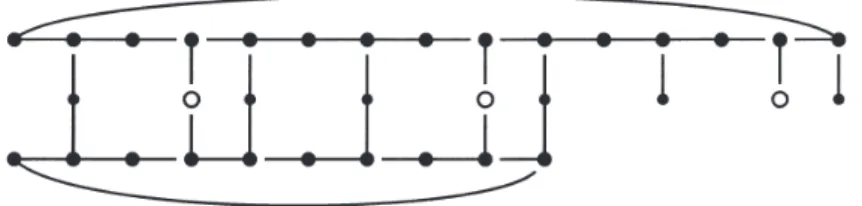
FIGURE 3. A semi‐special extension.
Let V(A)=\{a_{3},a_{8},a_{13}\}. Note that V(A)is indexed by \{5i+3|i=0,1,2\}. Attach new paths a_{3}b_{3}, a_{8}b_{8}, a_{13}b_{13} to A. Here, b_{3}, b_{8}, b_{13} are new vertices. Let A_{1} be the resulting graph. Then A_{1} belongs to K_{f}by Lemma 4.5.
Connect b_{3} and b_{8} by a new path b_{3}b_{4}b_{5}b_{6}b_{7}b_{8}, b_{8} and b_{13} by a new path b_{S}b_{9}b_{10}b_{1}b_{12}b_{13}, and b_{13} and b_{3} by a new path b_{13}b_{14}b_{0}b_{1}b_{2}b_{3} . Let D_{0} be the resulting graph. D_{0} belongs to Kfiby Lemma 4.6.
Now, attach new paths a_{3}c_{3}to D_{0}. The resulting graph belongs to K_{f}by Lemma 4.5.
Connect c_{3}and b_{4} by new path c_{3}c_{4}p_{4}b_{4}.
C^{\rceil}
onnect c_{4}and b_{6} by new path c_{4}c_{5}c_{6}p_{6}b_{6}.Connect c_{6}and a8by new path c_{6}c_{78}ca_{8}.
The resulting graph belongs to K_{f}by Lemma 4.6. We can repeat this part if kis ıarge.
Now, connect c_{8} and b_{9} by new path c_{8}c_{9}p_{9}b_{9}. The resulting graph belongs to K_{f} by
Lemma 4.6.
Connect 3 vertices c_{9}, b_{1} , c_{3} by structure c_{9}c_{0}c_{1}p_{1}b_{1}\otimes_{c_{1}}c_{1}c_{2}c_{3}. .The resulting graph belongs to K_{f}by Lemma 4.7.
Finally, attach new path b_{i}p_{i} at b_{i} for i=11, ı3, 14. The resulting graph Dbelongs to
K_{f}by Lemma 4.5, and it is a desired graph.
See Figure 3. White circıes are the vertices of A. The upper part is W_{1} and the lower
part is W_{2}. 口
Lemma 4.14. Let D=C\otimes_{AP}B be a semi‐special extension of A over P. Assume that D\in K_{p}and Bis aextension by a wreath Wwith F(W)=V(AP). Let
G=C\otimes_{AP}B_{1}\otimes_{AP}B_{2}\otimes_{AP}\cdots\otimes_{AP}B_{n} where B_{i^{-\cong}AP}Bfor each i=1, n. lf Gis normal to f then G\in K_{f}.
Proof. Note that C\otimes_{AP}Band C.\otimes_{AP}B_{j} for j\geq 1 are isomorphic over C. So, C\otimes_{AP}B_{j}
belongs to K_{f}for any j\geq 1.
We have
B=(AP)x_{F(W)}W
with F(W)=V(AP). Let W_{i}for i\geq 1be a wreath isomor‐phic to W such that B_{i}=(AP)\rangle\triangleleft W. Suppose U\subseteq G.
Case AP\subseteq U. Since Gis normaı to f, Uis normaı to fby Lemma4.4.
Case A\not\in U . Then U\cap A is a proper subset of A. For each i with 0\leq i\leq n, put U_{i}=U\cap B_{i}. Then for i\geq 1, we have
U_{i}=(U\cap AP)x_{F(D_{l})}D_{i}
where F(D_{i}) is a proper subset of F(W_{i})=V(AP). Hence, F(D_{i})<D_{i} by Lemma 4.10 for each i\geq 1. We haveU\cap C<(U\cap C)\lambda_{F(D_{\dot{I}})}D_{j}
by Lemma 1.15. PutU_{i}'=(U\cap C)x_{F(D_{l})}D_{i}
. ThenU\cap C<U_{i}'.
Note that it is possible thatU\cap C=U_{i}'
. Since(U\cap C)\lambda_{F(D_{i})}D_{i}=(U\cap C)g_{U\cap(AP)}U_{i}
, wehave
U=
Uí
\otimesU
\capC
\otimes_{U\cap C}U_{n}'.
Since
U_{i}'=(U\cap C)\otimes_{U\ulcorner M}U_{i}
is a substructure of C\otimes_{A}B_{i}\in K_{f},U_{i}'
belongs to K_{f}for i=1,n. Therefore, Ubelongs to K_{f}by the free amalgamation property. \square
Theorem 4.15. Let fbe a Hrushovski sboundary function associated to 5/8. Let Mbe
the generic structure of
(K_{f}, <)
. Then the theory of Mis model complete.Proof. Suppose A\in K_{f}. We show that there is a graph Gin K_{f} such that A<Gand Gis
absoıutely closed in K_{f}. Then we get the theorem by Fact 1.9.
Since a one point structure is absolutely closed, we can assume that |A|\geq 2.
Let Bbe a special extension of Aby a wreath W for 5/8 with H(W)=A . Let Pbe
a substructure of Bwith V(P)=F(W)-V(A). We have
B=APx_{V(AP)}W
. We have \delta(B)=\delta(AP)and |B-AP|=5|A|.By Lemma 4.13, Bbelongs to K_{f}. Hence, Bis normal to f.
Let nbe such that \delta(B)\geq f(n) but \delta(B)<f(n).
Let n-|AP|=5|A|l+mwith 0\leq m<5|A|, and m=5k+rwith 0\leq r<5.
By Lemma 4.13, there is D\in K_{f} such that D=C\otimes_{AP}B where C is also a special extension of Awith |C-(AP)|=5k.
Let
G=CB_{1}BB
where B_{iAP}\cong B for each i=1, l. Then |G|=|AP|+5k+5|A|l=n-r. Hence, Gis normal to f. By Lemma 4.14, Gbelongs to K_{f}. Gis r‐criticaı and 0\leq r<5. Also, we
have |G|\geq|B|>5|A|\geq 10. Hence, Gis absolutely closed in K_{f}by Lemma 4.3.
Gis a semi‐special extension of Aover P. Therefore, A<Cby Proposition 4.ı2. \square REFERENCES
[1] J.T. Baldwin and K. Holland, Constructing \omega‐stable structures: model completeness, Ann. Pure Appı. Log. 125,159-172(2004).
[2] J.T. Baldwin and S. Shelah, Randomness and semigenericity, Trans. Am. Math. Soc. 349, 1359−1376 (1997).
[3] J.T. Baldwin and N. Shi, Stable generic structures, Ann. Pure Appl. Log. 79,1-35(1996). [4] R. Diestel, Graph Theory, Fourth Edition, Springer, New York (2010).
[5] K. Holland, Model completeness of the new strongly minimal sets, J. Symb. Log. 64,946-962(1999). [6] E. Hrushovski, A stable \aleph_{0}‐categorical pseudoplane, preprint (1988).
[7] E. Hrushovski, A new strongly minimal set, Ann. Pure Appl. Log. 62,147-166(1993).
[8] K. Ikeda, H. Kikyo, Model complete generic structures, in the Proceedings ofthe 13th Asian Logic Confer‐ ence, World Scientific, 114‐123 (2015).
[9] H. Kikyo, Model complete generic graphs I, RIMS Kokyuroku 1938, 15‐25 (2015).
[10] H. Kikyo, Balanced Zero‐Sum Sequences and Minimal Intnnsic Extensions, to appear in RIMS Kokyuroku. [11] H. Kikyo, Model Completeness of Generic Graphs in Rational Cases, Archive for Mathematical Logic,
published on line (2017).
[12] \Gamma.O. Wagner, Relational structures and dimensions, in Automorphisms of first‐order structures, Clarendon
Press, Oxford, 153‐ı 81 (1994).