THE
MAGNUS
REPRESENTATION
AND ABELIAN QUOTIENTS OFGROUPS OF HOMOLOGY CYLINDERS
TAKUYA SAKASAI
1. INTRODUCTION
The study of
groups
of homology cylindersover
a surface
was
initiated
byGoussarov
[4] and Habiro [5] in their surgery theory and then deep relationships to mapping
class
groups
andJohnson
homomorphismswere
given inGaroufalidis-Levine
[2] and Levine [9].Recently their structures
are
intensivelystudied
by many people from various contexts.Here
we
focuson
abelian quotients of the homology cobordism group of homologycylinders. This
group
was
shown to be infinitely generated by $Cha-\mathbb{R}iedl$-Kim [1] byusing the invariant
which we call
the H-torsion here. Thepurpose of
thispaper
is touse
anotherinvariant called the Magnus representation to obtain abelian quotients of thesame
group and generalize it to higherdimensional
cases.
Allmanifolds
are assumed
tobe smooththroughoutthis paper, while similar statementshold for other categories.
This research
was
partially supported byKAKENHI
(No. 21740044), Ministry ofEdu-cation, Science, Sports and Technology, Japan.
2. HOMOLOGY CYLINDERS
Let $\Sigma_{g,1}$ be
a
compact oriented surface of genus $g\geq 1$ withone
boundary component.We
takea
base
point$p$of
$\Sigma_{g,1}$on
the boundary $\partial\Sigma_{g,1}$ and $2g$oriented
loops $\gamma_{1},\gamma_{2},$$\ldots,\gamma_{2g}$as
in Figure 1. Theseloops forma
spine$R_{2g}$of$\Sigma_{g,1}$and therefore
givea
basis of
$\pi_{1}\Sigma_{g,1}$as a
free
group
of rank $2g$. The boundary loop $\zeta$ is given by $\zeta=[\gamma_{1}, \gamma_{g+1}][\gamma_{2}, \gamma_{g+2}]\cdots[\gamma_{g},\gamma_{2g}]$.
$p$
FIGURE 1.
Our
basis of $\pi_{1}\Sigma_{g,1}$Put $H:=H_{1}(\Sigma_{g,1})$
.
Thegroup
$H$can
be identified with $\mathbb{Z}^{2g}$by
choosing $\{\gamma_{1}, \gamma_{2}, \ldots, \gamma_{2g}\}$as
a
basis of $H$, wherewe
write $\gamma_{j}$ again for $\gamma_{j}$as
an
element of $H$.
This basis isa
symplectic basis with respect to the intersection pairing
on
$H$.Definition
2.1.A
homology cylinderover
$\Sigma_{g,1}$ consists ofa
compact oriented3-manifold
$M$ with two embeddings $i_{+},$$i_{-}$ :
$\Sigma_{g,1}\mapsto\partial M$, called the markings, such that:
(i) $i+$ is
orientation-preserving
and $i_{-}$ is orientation-reversing;(ii) $\partial M=i_{+}(\Sigma_{g,1})\cup i_{-}(\Sigma_{g,1})$ and $i_{+}(\Sigma_{g,1})\cap i_{-}(\Sigma_{g,1})=i_{+}(\partial\Sigma_{g,1})=i_{-}(\partial\Sigma_{g,1})$;
(iii) $i_{+}|_{\partial\Sigma_{g,1}}=i_{-}|_{\partial\Sigma_{g1};}$
(iv) $i_{+},$$i_{-}:H_{*}(\Sigma_{g,1})arrow H_{*}(M)$ are isomorphisms, namely $M$ is
a
homology productover
$\Sigma_{g,1}$.We denote
a
homology cylinder by $(M, i_{+}, i_{-})$or
simply $M$.
Two homology cylinders $(M, i_{+}, i_{-})$ and $(N,j_{+},j_{-})$ over $\Sigma_{g,1}$
are
said to be isomorphicifthereexists an orientation-preserving diffeomorphism $f$ : $Marrow N\underline{\simeq}$
satisfying$j+=foi+$
and$j_{-}=foi_{-}$
.
We denote by$C_{g,1}$ the set ofall isomorphism classes of homologycylindersover
$\Sigma_{g,1}$.We
definea
product operationon
$C_{g,1}$ by$(M, i_{+}, i_{-}) \cdot(N,j_{+},j_{-}):=(M\bigcup_{i_{-}\circ(j_{+})^{-1}}N, i_{+},j_{-})$
for $(M, i_{+}, i_{-}),$ $(N,j_{+},j_{-})\in C_{g,1}$, which endows $C_{g,1}$ with a monoid structure. The unit
is $(\Sigma_{g,1}\cross[0,1], id\cross 1, id\cross O)$, where collars of $i_{+}(\Sigma_{g,1})=($id $\cross 1)(\Sigma_{g,1})$ and $i_{-}(\Sigma_{g,1})=$ $(id\cross 0)(\Sigma_{g,1})$
are
stretched half-way along $(\partial\Sigma_{g,1})\cross[0,1]$so
that $i_{+}(\partial\Sigma_{g,1})=i_{-}(\partial\Sigma_{g,1})$.
Example 2.2. For each diffeomorphism $\varphi$ of $\Sigma_{g,1}$ which fixes $\partial\Sigma_{g,1}$ pointwise,
we can
construct
a
homology cylinder by setting$(\Sigma_{g,1}\cross[0,1], id\cross 1, \varphi\cross 0)$
with the same treatment of the boundary
as
above. It is easily checked that theisomor-phism class of $(\Sigma_{g,1}\cross[0,1], id\cross 1, \varphi\cross 0)$ depends only on the (boundary fixing) isotopy
class
of $\varphi$ and that this construction givesa
monoid homomorphism from the mapping class group$\sqrt{}(4_{g,1}$ to$C_{g,1}$. In fact, it isan
injective homomorphism (seeGaroufalidis-Levine$\Lambda t_{g,1}[2,Section2.4]$ and Levine [9, Section 2.1]
$)$
.
We may regard $C_{g,1}$as an
enlargement ofExample 2.3 (Levine [9]). Let $L$ be
a
pure string link of $g$ strings. Wecan
embeda
g-holed disk $D_{g}^{2}$ into $\Sigma_{g,1}$as
a
closed regular neighborhood of the union of the loops$\gamma_{g+1},$ $\gamma_{g+2},$
$\ldots,$$\gamma_{2g}$ in Figure 1. Let $C$be the complement of
an
opentubular neighborhoodof $L$ in $D^{2}\cross[0,1]$. By choosing
a
framing of $L$, we can fixa
diffeomorphism $h$ : $\partial Carrow\underline{\simeq}$$\partial(D_{g}^{2}\cross[0,1])$. Then the manifold $M_{L}$ obtained from $\Sigma_{g,1}\cross[0,1]$ by removing $D_{g}^{2}\cross[0,1]$
and regluing $C$ by $h$ becomes
a
homology cylinder with thesame
markingas
the trivialhomology cylinder.
In [2],
Garoufalidis-Levine
further introduced the following equivalence relation amonghomology cylinders.
Definition 2.4. Two homology cylinders $(M, i_{+}, i_{-})$ and $(N, i_{+}, i_{-})$
over
$\Sigma_{g,1}$are
said tobe homology cobordantifthereexists
a
compact oriented smooth4-manifold $W$ such that: (1) $\partial W=MU(-N)/(i_{+}(x)=j_{+}(x), i_{-}(x)=j_{-}(x))$ $x\in\Sigma_{g,1}$;(2) The
inclusions
$M\mapsto W,$ $N\mapsto W$ induce isomorphismson
the integral homology.We denote by $\mathcal{H}_{g,1}$ the quotient set of $C_{g,1}$ with respect to the equivalence relation of
We call $\mathcal{H}_{g,1}$ the homology cobordism
group
of homology cylinders. It is known that thecomposition $\mathcal{M}_{g,1}\mapsto C_{g,1}arrow \mathcal{H}_{g,1}$ is
an
injectivegroup
homomorphism.The
group
$\mathcal{M}_{g,1}$ and themonoid
$C_{g,1}$ sharemany
properties.The
most fundamental
one
is given by the actionon
$H$.We can
definea
map$\sigma$ : $C_{g,1}arrow$
Aut
$H$by assigning to $(M, i_{+}, i_{-})$ $\in C_{g,1}$
an
automorphism $i_{+}^{-1}oi_{-}$ of $H$. This map extends thenatural action of $\mathcal{M}_{g,1}$
on
$H$ and it isa
monoid homomorphism. Wecan check
that theimageconsists ofthe automorphisms of$H$ preserving the intersection pairing. Therefore,
under the identification $H\cong \mathbb{Z}^{2g}$ mentioned above,
we
havean
epimorphism $\sigma:C_{g,1}arrow Sp(2g, \mathbb{Z})$.
We put $\mathcal{I}C_{g,1}$ $:=Ker\sigma$, which is
an
analogue ofthe Torelli group $\mathcal{I}_{g,1}=Ker(\sigma$ : $\mathcal{M}_{g,1}arrow$Sp$(2g, \mathbb{Z}))$.
We
can
see
that
$\sigma$ inducesa group
homomorphism $\sigma$ : $\mathcal{H}_{g,1}arrow$ Sp$(2g, \mathbb{Z})$and
we
denote itskernel
by$\mathcal{I}\mathcal{H}_{g,1}$.
3. MAGNUS REPRESENTATION AND $H$-TORSION FOR HOMOLOGY CYLINDERS
Here,
we
recall two invariants for homology cylinders from [15]. Forour
purpose, itsuffices to consider a simplified version corresponding to commutative rings.
Since
$H=H_{1}(\Sigma_{g,1})$ isa
free abeliangroup,
itsgroup
ring $\mathbb{Z}[H]$can
beembedded
in thefractional field $\mathcal{K}_{H}$ $:=\mathbb{Z}[H](\mathbb{Z}[H]-\{0\})^{-1}$. Let $(M,i_{+},i_{-})\in C_{g,1}$ be
a
homology cylinder.Since
$H_{1}(M)\cong H_{1}(\Sigma_{g,1})$, the field $\mathcal{K}_{H_{1}(M)}$ $:=\mathbb{Z}[H_{1}(M)](\mathbb{Z}[H_{1}(M)]-\{0\})^{-1}$ isdefined.
We regard $\mathcal{K}_{H}$ and $\mathcal{K}_{H_{1}(M)}$
as
localcoefficient
systemson
$\Sigma_{g,1}$ and $M$ respectively. Byan
argument using covering spaces,
we
have the following.Lemma
3.1.
$i\pm:H_{*}(\Sigma_{g,1},p;i_{\pm}^{*}\mathcal{K}_{H_{1}(M)})arrow H_{*}(M,p;\mathcal{K}_{H_{1}(M)})$are
isomorphismsas
right $\mathcal{K}_{H_{1}(M)}$-vector spaces.
This lemma plays
an
important role in definingour
invariants below.(I) Magnus representation
By using the spine $R_{2g}$ taken in the previous section,
we
identify $\pi_{1}\Sigma_{g,1}=\langle\gamma_{1},$$\ldots,$ $\gamma_{2g}\rangle$ with
a
freegroup
$F_{2g}$ of rank $2g$.
Since
$R_{2g}\subset\Sigma_{g,1}$ isa deformation
retract,we
have$H_{1}(\Sigma_{g,1},p;i_{\pm}^{*}\mathcal{K}_{H_{1}(M)})\cong H_{1}(R_{2g},p;i_{\pm}^{*}\mathcal{K}_{H_{1}(M)})$
$=C_{1}(\overline{R_{2g}})\otimes_{F_{2g}}i_{\pm}^{*}\mathcal{K}_{H_{1}(M)}\cong \mathcal{K}_{H_{1}(M)}^{2g}$
with a basis $\{\tilde{\gamma_{1}}\otimes 1, \ldots,\overline{\gamma_{2g}}\otimes 1\}\subset C_{1}(\overline{R_{2g}})\otimes_{F_{2g}}i_{\underline{\pm}}^{*}\mathcal{K}_{H_{1}(M)}$as aright free $\mathcal{K}_{H_{1}(M)}$-module,
where
$\tilde{\gamma_{i}}$ isa
lift of$\gamma_{i}$
on
theuniversal
covering $R_{2g}$of
$R_{2g}$.
We denote by$\mathcal{K}_{H_{1}(M)}^{2g}$ the
space
of
column vectors with $n$ entries in $\mathcal{K}_{H_{1}(M)}$.Definition 3.2. (1) For $M=(M, i_{+}, i_{-})\in C_{g,1}$,
we
denote by $r’(M)\in$GL
$(2g, \mathcal{K}_{H_{1}(M)})$the representation matrix of the right $\mathcal{K}_{H_{1}(M)}$-isomorphism
$\mathcal{K}_{H_{1}(M)}^{2g}\cong H_{1}(\Sigma_{g,1},p;i_{-}^{*}\mathcal{K}_{H_{1}(M)})arrow H_{1}(\Sigma_{g,1},p;i_{+}^{*}\mathcal{K}_{H_{1}(M)})\cong \mathcal{K}_{H_{1}(M)}^{2g}i_{+}^{-1}\circ i-\underline{\simeq}$
(2) The Magnus representation for $C_{g,1}$ is the map $r$ : $C_{g,1}arrow$
GL
$(2g, \mathcal{K}_{H})$ which assignsto $M=(M, i_{+}, i_{-})\in C_{g,1}$ the matrix $r(M)$ $:=i_{+r’(M)}^{-1}$ obtained from $r’(M)$ by applying
We call $r(M)$ the Magnus matrixfor $M$. The map $r$ has the following properties: Theorem 3.3 ([15, 14]). (1) (Crossed homomorphism) For$M_{1},$ $M_{2}\in C_{g,1_{f}}$ we have
$r(M_{1}\cdot M_{2})=r(M_{1})\cdot\sigma(M_{1})r(M_{2})$.
Inparticular, the restwiction
of
$r$ to $\mathcal{I}C_{g,1}$ isa
homomorphism.(2) (Symplecticity) For any $M\in C_{g,1}$, we have the equality
$\overline{r(M)^{T}}\tilde{J}r(M)=^{\sigma(M)}\tilde{J}$,
where
$\overline{r(M)^{T}}$ isobtained
from
$r(M)$ by taking the tmnsposeand
applyingthe involution
induced
from
the map $(H\ni x\mapsto x^{-1}\in H)$ to each entry, and $\tilde{J}\in$ GL$(2g, \mathbb{Z}[H])$ is
the matrix which appeared in Papakyriakopoulos’ paper [12] and it is mapped to the usual
symplectic matrix by applying the trivializer$\mathbb{Z}[H]arrow \mathbb{Z}$ to each entry.
(3) (Homology cobordism invariance) The map $r:C_{g,1}arrow$ GL$(2g, \mathcal{K}_{H})$ induces
a
crossedhomomorphism$r:\mathcal{H}_{g,1}arrow$ GL$(2g, \mathcal{K}_{H})$ and its restriction to $\mathcal{I}\mathcal{H}_{g,1}$ is a homomorphism.
Remark 3.4. Definition 3.2 and Theorem 3.3 (1), (2)
are
extensions of those for themapping class group $\mathcal{M}_{g,1}$ (see Morita [10] and Suzuki [16]). By a theorem of
Dehn-Nielsen, the group $\mathcal{M}_{g,1}$ is naturally embedded in the automorphism group Aut$F_{2g}$ of
$F_{2g}\cong\pi_{1}\Sigma_{g,1}$
as
the subgroup consisting of automorphisms which fix $\zeta$. The Magnusrepresentation for $\mathcal{M}_{g,1}$ is
a
restriction of that forAut
$F_{2g}$ using Fox derivations. Inparticular,
we
see
that
$r(\mathcal{M}_{g,1})\subset$GL
$(2g, \mathbb{Z}[H])$.
Note that there
existsa
homologycylinder $M\in C_{g,1}$ satisfying $r(M)\not\in$ GL$(2g, \mathbb{Z}[H])$ (see Example 3.7).
At
present,no
embedding of $C_{g,1}$or
$\mathcal{H}_{g,1}$ to the automorphism group ofsome
groupis known. However, by using
a
completion $F_{2g}^{acy}$ of $F_{2g}$ called the acyclic closure (orHE-closure), which
was
defined by Levine [7, 8], wecan
define a homomorphismAcy : $C_{g,1}arrow$ Aut$F_{2g}^{acy}$
and it factors through $\mathcal{H}_{g,1}$. This extends the embedding $\mathcal{M}_{g,1}\mapsto$ Aut$F_{2g}$ and the
Magnus representation for homology cylinders is derived from that for Aut$F_{2g}^{acy}$ (see [13]
for details). In this paper, we only
use
the following properties of$F_{n}^{acy}(n\geq 2)$:(i) $F_{n}^{acy}$ includes $F_{n}$ and it is strictly bigger than $F_{n}$
.
(ii) The embedding $F_{n}\mapsto F_{n}^{acy}$ induces
an
isomorphism $H_{1}(F_{n})arrow H_{1}(F_{n}^{acy})\underline{\approx}$.(iii) Any endomorphism of $F_{n}$ which induces
an
isomorphismon
$H_{1}(F_{n})$ is extendedto
an
isomorphism of$F_{n}^{acy}$.
(iv)
Aut
$F_{n}^{acy}$ includesAut
$F_{n}$ and the action ofAut
$F_{n}$on
$H_{1}(F_{n})\cong \mathbb{Z}^{n}$ isextended
to that ofAut$F_{n}^{acy}$
on
$H_{1}(F_{n}^{acy})\cong H_{1}(F_{n})$, which is expressed byan
epimorphism$\sigma$ : Aut$F_{n}^{acy}arrow$ GL$(n, \mathbb{Z})$.
(II) H-torsion
Since
the relative complex $C_{*}(M, i_{+}(\Sigma_{g,1});\mathcal{K}_{H_{1}(M)})$ obtained from any smoothtriangu-lation of $(M, i_{+}(\Sigma_{g,1}))$ is acyclic by Lemma 3.1,
we can
consider its Reidemeister torsion $\tau(C_{*}(M, i_{+}(\Sigma_{g,1});\mathcal{K}_{H_{1}(M)}))\in \mathcal{K}_{H_{1}(M)}^{\cross}/(\pm H_{1}(M))$, where $\mathcal{K}_{H_{1}(M)}^{\cross}$ $:=\mathcal{K}_{H_{1}(M)}-\{0\}$ is theDefinition 3.5. The H-torsion $\tau(H)$ of
a
homology cylinder $M=(M, i_{+}, i_{-})\in C_{g,1}$ isdefined by
$\tau(M):=^{i_{+}^{-1}}\tau(C_{*}(M, i_{+}(\Sigma_{g,1});\mathcal{K}_{H_{1}(M)}))\in \mathcal{K}_{H}^{\cross}/(\pm H)$,
where $\mathcal{K}_{H}^{\cross}=\mathcal{K}_{H}-\{0\}$ is the unit group of$\mathcal{K}_{H}$
.
The map $\tau$ : $C_{g,1}arrow \mathcal{K}_{H}^{\cross}/(\pm H)$ has the following properties:
Theorem 3.6. (1) (Crossed homomorphism [15]) For$M_{1},$ $M_{2}\in C_{g,1}$,
we
have $\tau(M_{1}\cdot M_{2})=\tau(M_{1})\cdot\sigma(M_{1})\tau(M_{2})$.In particular, the restriction
of
$\tau$ to $\mathcal{I}C_{g,1}$ isa
homomorphism.(2) (Cha-Friedl-Kim [1, Theorem 3.10])
If
$(M,i_{+}, i_{-}),$ $(N,j_{+},j_{-})\in C_{g,1}$are
homologycobordant, then
there
exists $q\in \mathcal{K}_{H}^{\cross}$ suchthat
$\tau(M)=\tau(N)\cdot q\cdot\overline{q}\in \mathcal{K}_{H}^{\cross}/(\pm H)$.
Note
that the restriction of $\tau$ to $\mathcal{M}_{g,1}$ is trivial since $\Sigma_{g,1}\cross[0,1]$ is simple homotopyequivalent to $\Sigma_{g,1}\cross\{1\}$
.
Example
3.7.
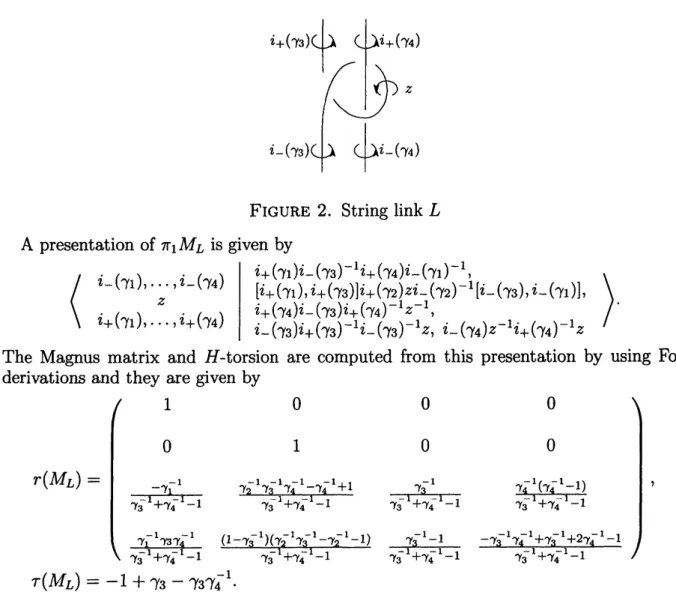
Let $L$ be thestring linkof 2 strings depictedin Figure 2. Wecan
constructa
homology cylinder $(M_{L}, i_{+}, i_{-})\in C_{2,1}$as
mentioned in Example2.3.
FIGURE 2. String link $L$
A
presentation of$\pi_{1}M_{L}$ is given by$i_{+}(\gamma_{1})i_{-}(\gamma_{3})^{-1}i_{+}(\gamma_{4})i_{-}(\gamma_{1})^{-1}$ $i_{+}(\gamma_{4})i_{-}(\gamma_{3})i_{+}(\gamma_{4})^{-1}z^{-1}$, $\langle$ $i_{+}(\gamma_{1}),..,i_{+}(\gamma_{4})i_{-}(\gamma_{1}),\ldots,i_{-}(\gamma_{4})z$
.
$i_{-}(\gamma_{3})i_{+}(\gamma_{3})^{-1}i_{-}(\gamma_{3})^{-1}z,i_{-}(\gamma_{4})z^{-1}i_{+}(\gamma_{4})^{-1}z[i_{+}(\gamma_{1}),i_{+}(\gamma_{3})]i_{+}(\gamma_{2})zi_{-}(\gamma_{2})^{-1}[i_{-}(\gamma_{3}),i_{-}(\gamma_{1})]$ , $\rangle$.
The Magnus matrix and H-torsion
are
computed fromthis
presentation by usingFox
derivations
and theyare
given by$r(M_{L})=(\begin{array}{llll}1 0 0 00 1 0 0\frac{-\gamma_{1}^{-1}}{\gamma_{3}^{-1}+\gamma_{4}^{-1}-1} \frac{\gamma_{3}^{-1}}{\gamma_{3}^{-1}+\gamma_{4}^{-1}-1} \frac{\gamma_{4}^{-1}(\gamma_{4}^{-1}-1)}{\gamma_{3}^{-1}+\gamma_{4}^{-1}-1}\frac{\gamma_{1}^{-1}\gamma s\gamma_{4}^{-1}}{\gamma_{3}^{-1}+\gamma_{4}^{-1}-1} \frac{\gamma_{3}^{-1}-1}{\gamma_{3}^{-1}+\gamma_{4}^{-1}-1} \frac{-\gamma_{3}^{-1}\gamma_{4}^{-1}+\gamma_{3}^{-1}+2\gamma_{4}^{-1}-1}{\gamma_{3}^{-1}+\gamma_{4}^{-1}-1}\end{array})-1$’
Note that
$-1-1\gamma_{3}+\gamma_{4}-1$ $\det(r(M_{L}))=\gamma_{3}\gamma_{4}\overline{\gamma_{3}^{-1}+\gamma_{4}^{-1}-1}$.
4. ABELIAN QUOTIENTS
Abelian quotients of a monoid or group are helpful in extracting information on the
structure of the monoid
or
group. Here,we
focuson
abelian quotients of$C_{g,1}$ and $\mathcal{H}_{g,1}$and compare them to the corresponding result for $\mathcal{M}_{g,1}$
.
Before
discussing,as
commented in [3],we
point out that $C_{g,1}$has
themonoid
$\theta_{\mathbb{Z}}^{3}$ ofhomology 3-spheres
as a
big abelian quotient. In fact, we have aforgetful homomorphism$F:C_{g,1}arrow\theta_{\mathbb{Z}}^{3}$ defined by $F(M, i_{+}, i_{-})=S^{3}\# X_{1}\# X_{2}\#\cdots\# X_{n}$ for the prime decomposition
$M=M_{0}\# X_{1}\# X_{2}\#\cdots\# X_{n}$ of$M$ where $M_{0}$ is the unique factor having non-empty boundary
and $X_{i}\in\theta_{\mathbb{Z}}^{3}(1\leq i\leq n)$. The map $F$ owes its well-definedness to the uniqueness of the
prime decomposition of 3-manifolds and it is
a
monoid epimorphism.Theunderlying3-manifolds ofhomology cylindersobtained from$\mathcal{M}_{g,1}$ areall $\Sigma_{g,1}\cross[0,1]$
and, in particular, irreducible. Therefore it
seems more
reasonable to compare $\mathcal{M}_{g,1}$ withthe submodule $C_{g,1}^{irr}$ of$C_{g,1}$ consisting of all $(M, i_{+}, i_{-})$ with $M$ irreducible.
In contrast with the fact that $\mathcal{M}_{g,1}$ is a perfect group for $g\geq 3$ (see Harer [6]), many
infinitely generated abelian quotients for monoids and homology cobordism groups of
irreducible homology cylinders have been found until
now.
For example,we
have the following results:$\bullet$ In [15, Corollary 6.16],
we
showed the submonoids $C_{g,1}^{irr}\cap \mathcal{I}C_{g,1}$ and $Ker(C_{g,1}^{irr}arrow$$\mathcal{H}_{g,1})$ have abelian quotients isomorphic to $(\mathbb{Z}\geq 0)^{\infty}$. The proof uses the H-torsion $\tau$ and its non-commutative generalization.
$\bullet$ Morita [11, Corollary 5.2] used what is called the trace maps to show that $\mathcal{I}\mathcal{H}_{g,1}$ has
an
abelian quotient isomorphic to $\mathbb{Z}^{\infty}$.$\bullet$ In [3, Theorem 2.6],
we
showed that $C_{g,1}^{irr}$ has an abelian quotient isomorphic to $(\mathbb{Z}_{\geq 0})^{\infty}$ by using sutured Floer homology (a variant of Heegaard Floer homology).However, this abelian quotient does not induces that of$\mathcal{H}_{g,1}$.
Let
us
focuson
abelian quotients of $\mathcal{H}_{g,1}$. By taking into account the similarity be-tween the two groups $\lambda 4_{g,1}$ and $\mathcal{H}_{g,1}$, it had been conjectured that $\mathcal{H}_{g,1}$was
perfect.However,
Cha-Friedl-Kim
[1]found
a
method for extracting homology cobordantinvari-ants of homology cylinders from the H-torsion $\tau$ : $C_{g,1}arrow \mathcal{K}_{H}^{\cross}/(\pm H)$, which is a crossed
homomorphism,
as
follows.First they consider the subgroup $A\subset \mathcal{K}_{H}^{\cross}$ defined by
$A:=\{f^{-1}\cdot\varphi(f)|f\in \mathcal{K}_{H}^{\cross}, \varphi\in Sp(2g, \mathbb{Z})\}$,
by which
we can
obtaina
homomorphism$\tau:C_{g,1}arrow \mathcal{K}_{H}^{\cross}/(\pm H\cdot A)$.
Note that $f=\overline{f}$ holds in $\mathcal{K}_{H}^{\cross}/(\pm H\cdot A)$ since $-I_{2g}\in$ Sp$(2g, \mathbb{Z})$
.
Second, they used theequality mentioned in Theorem
3.6
(2). Namely, ifwe
put$N:=\{f\cdot\overline{f}|f\in \mathcal{K}_{H}^{\cross}\}$,
then
we
obtaina
homomorphismNote
that $f^{2}=1$holds
forany
$f\in \mathcal{K}_{H}^{\cross}/(\pm H\cdot A\cdot N)$.The structure of $\mathcal{K}_{H}^{\cross}/(\pm H\cdot A\cdot N)$ is given
as
follows. Recall that $\mathcal{K}_{H}=\mathbb{Z}[H](\mathbb{Z}[H]-$$\{0\})^{-1}$
.
The ring $\mathbb{Z}[H]$ isa
Laurent polynomial ring of $2g$ variables and it isa
uniquefactorization
domain. Thus every Laurentpolynomial $f$ isfactorized into irreduciblepoly-nomials uniquely up to multiplication by
a
unit in $\mathbb{Z}[H]$.
Therefore, for everyirreducible
polynomial $\lambda$,
we can
count the exponent of $\lambda$ in the factorization of$f$
.
This countingnaturally extends to that for elements in $\mathcal{K}_{H}^{\cross}$. Under the identification by $\pm H\cdot A\cdot N$,
an
element in $\mathcal{K}_{H}^{\cross}/(\pm H\cdot A\cdot N)$ is determined by the exponents of all Sp$(2g, \mathbb{Z})$-orbits ofirreducible
polynomials (up to multiplication bya
unit in $\mathbb{Z}[H]$) modulo 2.Hence
$\mathcal{K}_{H}^{x}/(\pm H\cdot A\cdot N)$ is isomorphic to $(\mathbb{Z}/2\mathbb{Z})^{\infty}$
.
Finally by using $(\mathbb{Z}/2\mathbb{Z})$-torsion of the knot
concordanoe
group,
they show the following:Theorem 4.1 (Cha-Friedl-Kim [1]). The homomorphism
$\tilde{\tau}:\mathcal{H}_{g,1}arrow \mathcal{K}_{H}^{\cross}/(\pm H\cdot A\cdot N)$
is not surjective but its image is isomorphic to $(\mathbb{Z}/2\mathbb{Z})^{\infty}$.
Now
we
try to investigateabelianquotients of$\mathcal{H}_{g,1}$ by usingthe Magnus representation $r$.
It looks easier to extract information of $\mathcal{H}_{g,1}$ from the representation $r$ together withCha-Fkiedl-Kim’s
idea, since $r$ itselfisan
homology cobordism invariantas
mentioned in Theorem3.3
(3). Consider two maps$\hat{r}:\mathcal{H}_{g,1}arrow^{r}GL(2g, \mathcal{K}_{H})arrow \mathcal{K}_{H}^{\cross}\detarrow \mathcal{K}_{H}^{\cross}/(\pm H)$ ,
$\tilde{r}:\mathcal{H}_{g,1}arrow^{\hat r}\mathcal{K}_{H}^{\cross}/(\pm H)arrow \mathcal{K}_{H}^{\cross}/(\pm H\cdot A)$ .
While $\hat{r}$is
a
crossed homomorphism, its restriction to$\mathcal{I}\mathcal{H}_{g,1}$ and
$\tilde{r}$
are
homomorphisms.Note that both $\mathcal{K}_{H}^{\cross}/(\pm H)$ and $\mathcal{K}_{H}^{\cross}/(\pm H\cdot A)$
are
isomorphic to $\mathbb{Z}^{\infty}$. Theorem 4.2. (1) For $(M, i_{+}, i_{-})\in C_{g,1}$, the equality$\hat{r}(M)=\overline{\tau(M)}\cdot(\tau(M))^{-1}$ $\in \mathcal{K}_{H}^{\cross}/(\pm H)$
holds.
(2) For$g\geq 1$, the homomorphism$\tilde{r}:\mathcal{H}_{g,1}arrow \mathcal{K}_{H}^{\cross}/(\pm H\cdot A)$ is trivial.
(3)
For
$g\geq 2_{f}$ the homomorphism $\hat{r}:\mathcal{I}\mathcal{H}_{g,1}arrow \mathcal{K}_{H}^{\cross}/(\pm H)$ is not surjective but its imageis
isomorphicto
$\mathbb{Z}^{\infty}$.
Sketch
of Proof.
(1) follows $hom$ the definitions of the invariants and and torsion duality.We omit the details.
As mentioned above, the actionofSp$(2g, \mathbb{Z})$ implies that $f=\overline{f}$ for any $f\in \mathcal{K}_{H}^{\cross}/(\pm H\cdot$
$A)$. Then
our
claim (2) immediately follows from (1). (Wecan
alsouse
the symplecticity(Theorem
3.3
(2)) of$r$ to show (2).$)$To show (3),
we
use
the homology cylinder $M_{L}\in C_{2,1}$ in Example 3.7. While $M_{L}\not\in$$\mathcal{I}C_{2,1}$,
we
can
adjust it bysome
$g_{1}\in \mathcal{M}_{2,1}$so
that $M_{L}\cdot g_{1}\in \mathcal{I}C_{2,1}$.
Since $\hat{r}$is trivial
on
$\mathcal{M}_{2,1}$,
we
have$\hat{r}(M_{L}\cdot g_{1})=\hat{r}(M_{L})=\frac{\gamma_{3}+\gamma_{4}-1}{\gamma_{3}^{-1}+\gamma_{4}^{-1}-1}\in \mathcal{K}_{H}^{\cross}/(\pm H)$
.
Take $f\in \mathcal{M}_{2,1}$ such that $\sigma(f)\in$ Sp$($4,$\mathbb{Z})$ mapsConsider $f^{m}\cdot M_{L}\in C_{2,1}$ and adjust it by
some
$g_{m}\in \mathcal{M}_{2,1}$ so that $f^{m}\cdot M_{L}\cdot g_{m}\in \mathcal{I}C_{2,1}$.
Thenwe
have$\hat{r}(f^{m}\cdot M_{L}\cdot g_{m})=\sigma(f^{m})_{\hat{r}(M_{L})}=\frac{\gamma_{2}^{m}\gamma_{3}+\gamma_{4}-1}{\gamma_{2}^{-m}\gamma_{3}^{-1}+\gamma_{4}^{-1}-1}\in \mathcal{K}_{H}^{\cross}/(\pm H)$ .
We
can
check that the values $\{\frac{\gamma_{2}^{m}\gamma_{3}+\gamma_{4}-1}{\gamma_{2}^{-m}\gamma_{3}^{-1}+\gamma_{4}^{-1}-1}\}_{m=0}^{\infty}$ generate an infinitely generatedsubgroup of $\mathcal{K}_{H}^{\cross}/(\pm H)$
.
This completes the proof when $g=2$. Wecan use
the abovecomputation for $g\geq 3$ by
a
stabilization. $\square$Consequently,
we
have obtained a result similar to Morita [11, Corollary 5.2] andCha-Friedl-Kim
[1,Theorem
7.2
(2)].5.
GENERALIZATION
TO HIGHER-DIMENSIONAL CASESWe
can
consider homology cylindersover
$X$ for any compact oriented connectedk-dimensional manifold
$X$with $k\geq 3$ by rewritingDefinition
2.1 word-by-word.Let
$\mathcal{M}(X)$,$C(X)$ and $\mathcal{H}(X)$denotethe corresponding diffeotopygroup, monoid of homologycylinders and homology cobordism group of homology cylinders. We have natural homomorphisms
$\mathcal{M}(X)arrow C(X)arrow \mathcal{H}(X)$.
Remark 5.1. In contrastwith the
case
ofsurfaces, the homomorphism$\mathcal{M}(X)arrow C(X)$ isnot necessarily injective for
a
generalmanifold
$X$. In fact, if $[\varphi]\in Ker(\mathcal{M}(X)arrow C(X))$, the definition of the homomorphism only says that $\varphi$ is a pseudo isotopyover $X$.For $k\geq 2$ and $n\geq 1$,
we
put$X_{n}^{k}:=\#(S^{1}n\cross S^{k-1})$.
The
manifold
$X_{n}^{k}$ may be regardedas a
generalizationofa
closedsurface
since$X_{n}^{2}=\Sigma_{n,0}$.
Suppose $k\geq 3$
.
Then $\pi_{1}X_{n}^{k}\cong\pi_{1}$($X_{n}^{k}$ –Int$D^{k}$) $\cong F_{n}$, where Int$D^{k}$ isan
open k-ball,and $H_{1}$ $:=H_{1}(F_{n})\cong \mathbb{Z}^{n}$
.
Let $\langle x_{1},$$x_{2},$
$\ldots,$
$x_{n}\rangle$ be a basis of $F_{n}$ (and $H_{1}$). We have
a
monoid homomorphism
Acy : $C$($X_{n}^{k}$ –Int$D^{k}$) $arrow$ Aut$(F_{n}^{acy})$ and it induces
a
group homomorphismAcy : $\mathcal{H}$($X_{n}^{k}$ –Int$D^{k}$) $arrow$ Aut$(F_{n}^{acy})$ Consider the composition
$\tilde{r}$:
Aut
$(F_{n}^{acy})arrow^{r}$ GL$(n, \mathcal{K}_{H_{1}})arrow \mathcal{K}_{H_{1}}^{\cross}\detarrow \mathcal{K}_{H_{1}}^{\cross}/(\pm H_{1}\cdot A’)\cong \mathbb{Z}^{\infty}$ ,where $\mathcal{K}_{H_{1}};=\mathbb{Z}[H_{1}](\mathbb{Z}[H_{1}]-\{0\})^{-1}$ and $A’;=\{f^{-1}\cdot\varphi(f)|f\in \mathcal{K}_{H_{1}}^{\cross}, \varphi\in GL(n, \mathbb{Z})\}$
.
The map $\tilde{r}$is
a
homomorphism for thesame reason
mentioned in the previous section. Theorem 5.2. For
any
$k\geq 3$ and $n\geq 2$,we
have:(1) The homomorphism Acy: $\mathcal{H}$($X_{n}^{k}$ –Int$D^{k}$) $arrow$ Aut$(F_{n}^{acy})$ is surjective.
(2) The image
of
$\tilde{r}$is aninfinitely genemted subgroupof
$\mathbb{Z}^{\infty}$. Inparticular, the abelian gmups $H_{1}$(Aut$(F_{n}^{acy})$) and $H_{1}(\mathcal{H}(X_{n}^{k}$ –Int$D^{k}))$ haveinfinite
$mnk$.Sketch
of Proof.
(1) followsfrom
a
construction similar
to theone
used
in the proofof
[13, Theorem 6.1]. To show (2), consider
a
homomorphism $f_{m}:F_{n}arrow F_{n}$ defined by$f_{m}(\gamma_{1})=(\gamma_{1}\gamma_{2}^{-1}\gamma_{1}^{-1}\gamma_{2}^{-1})^{m}\gamma_{1}\gamma_{2}^{2m}$, $f_{m}(\gamma_{i})=\gamma_{i}(2\leq i\leq n)$
for
each$m\geq 1$.
The homomorphism $f_{m}$ inducesan
isomorphismon
$H_{1}(F_{n})$ andtherefore
it
extends
toan
automorphism (denoted also by $f_{m}$)of
$F_{n}^{\kappa y}$.
Bythe Fox
calculus,we can
easily check that
$\tilde{r}(f_{m})=1-\gamma_{2}+\gamma_{2}^{2}-\gamma_{2}^{3}+\cdots+\gamma_{2}^{2m}$
.
Then (2) follows from the irreducibility ofthese polynomials when $2m+1$ is prime by
a
well known fact
on
the cyclotomic polynomials. $\square$REFERENCES
[1] J. C. Cha, S. Fried], T. Kim, The cobordism group
of
homology cylinders, preprint (2009), arXiv:0909.5580.[2] S. Garoufalidis, J. Levine, $\mathcal{I}\}_{t}e$-levd invariants
of
three-manifolds, Massey products and theJohnsonhomomorphism, Graphs and patterns in mathematics and theorical physics, Proc. Sympos. Pure Math. 73 (2005), 173-205.
[3] H. Goda, T. Sakasai, Abelian quotients
of
monoidsof
homology cylinders, preprint (2009), arXiv:0905.4775, to appearinGeom. Dedicata.[4] M. Goussarov, Finitetype invariants andn-equivalence
of
3-manifolds, C. R. Math. Acad. Sci. Paris 329 (1999), 517-522.[5] K. Habiro, Claspers and
finite
type invanants oflinks, Geom. Topol. 4 (2000), 1-83.[6] J. Harer, The second homology group
of
the mapping class groupof
an orientable surface, Invent. Math. 72 (1983), 221-239.[7] J. Levine, Link concordance and algebraic closure, $\Pi$, Invent. Math. 96 (1989), 571-592.
[8] J. Levine, Algebraic closure
of
groups, Contemp. Math. 109 (1990), 99-105.[9] J. Levine, Homology cylinders: an enlargement
of
the mapping class group, Algebr. Geom. Topol. 1 (2001), 243-270.[10] S. Morita, Abelian quotients ofsubgroups
of
the mapping class group ofsurfaces, Duke Math. J. 70 (1993), 699-726.[11] S. Morita, Symplectic automorphismgroups
of
nilpotent quotientsof
fundamental
groupsof
surfaces, Adv. Stud. Pure Math. 52 (2008), 443-468.[12] C. D. Papakyriakopoulos, Planar regular coverings
of
orientable closedsurfaces,Ann. ofMath.Stud. 84, Princeton Univ. Press (1975), 261-292.[13] T. Sakasai, Homology cylinders and the acyclic closure
of
afree
group, Algebr. Geom. Topol. 6(2006), 603-631.
[14] T. Sakasai, The symplecticity
of
the Magnus representationfor
homology cobordismsof
surfaces, Bull. Austral. Math. Soc. 76 (2007), 421-431.[15] T. Sakasai, The Magnus representation and higher-order Alexander invariants
for
homology cobor-disms ofsurfaces, Algebr. Geom. Topol. 8 (2008), 803-848.[16] M. Suzuki, Geometric interpretation
of
the Magnus representationof
the mapping class group,Kobe J. Math. 22 (2005), 39-47.[17] V. Turaev, Introduction to combinatorialtorsions, Lectures Math. ETH Z\"urich, Birkh\"auser(2001). DEPARTMENT OF MATHEMATICS, TOKYO INSTITUTE OF TECHNOLOGY, 2-12-1 OH-OKAYAMA, MEGURO-KU, TOKYO 152-8552, JAPAN