Empirical Examination of the Schwartz Value
Theory from a Cross-National Comparative
Perspective:Data Analysis of the World Values
Survey
journal or
publication title
関西学院大学社会学部紀要
number
127
page range
1-11
year
2017-10-31
URL
http://hdl.handle.net/10236/00026363
Ⅰ.Introduction
The purpose of this paper is to conduct an empirical examination of the value theory of Shalom Schwartz from a crossnational comparative perspective through a data analysis of the World Values Survey (WVS).
A great deal of research has already been conducted on the topic of values, and a vast amount of literature addressing this issue already exists (cf. Manabe, 2016). In this field, Schwartz’s value re search is among those receiving the most attention within the global academic community. This is re flected in the high frequency with which his works are cited in the academic literature in this field. In Japan, his theory, model, and method are introduced in various forms, including citations in individual research papers, research examples in review papers, and explanations in dictionaries and encyclope dias.
The content is primarily focused on Schwartz’s depiction of human values in a configuration
Empirical Examination of the Schwartz Value Theory
from a CrossNational Comparative Perspective:
Data Analysis of the World Values Survey*Kazufumi MANABE
**─────────────────────────────────────────────────────
*
Key words: Schwartz value theory, circular continuum, World Values Survey, Smallest Space Analysis
**Professor Emeritus, Kwansei Gakuin University, Japan
Professor, School of Global Studies and Collaboration, Aoyama Gakuin University, Japan
Figure 1 Schwartz (1992) Value Model
(Adapted from Davidov et al. eds., 2011)
model referred to as a “circular continuum.” Schwartz’s “circular continuum of values” model is a structural model that shows the mutual relationships between the ten motivationally distinct types of basic human values: power, achievement, hedonism, stimulation, selfdirection, universalism, benevo lence, tradition, conformity, and security. In this circular continuum, the values that are positioned in adjacent regions (the fanshaped or wedgeshaped regions) hold similar meaning. The values posi tioned in the region on the opposite side of the circular continuum have the opposite meaning. This is Schwartz’s basic structural model (Fig. 1) of human values (Schwartz, 1992). Using the terms of Louis Guttman, a pioneer in the field of social measurement, this would be referred to as a “circum plex” (Levy, ed., 1994; Manabe, 2016).
In this paper, I specifically examine the shape (configuration) of the Schwartz Value Model. Ⅱ.Method of Examining the Schwartz Value Model
This paper presents an empirical examination of the Schwartz Value Model through a data analy sis of the 6th World Values Survey (WVS; 20102014). The empirical nature of this examination is its first distinctive feature.
Next, the purpose of conducting the data analysis is to examine the crossnational comparability of the structural model of values as shown in the geometric shape known as the “circular continuum.”
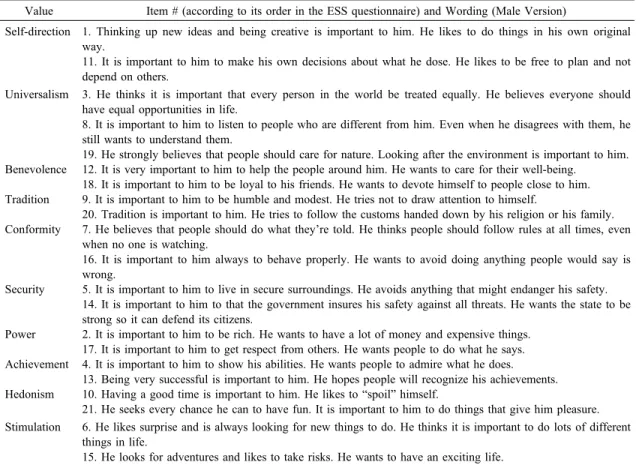
Table 1 Schwartz (1992) Value Types and ESS Question Items
(Adapted from Datler, Jagodzinski and Schmidt, 2013)
Value Item # (according to its order in the ESS questionnaire) and Wording (Male Version)
Selfdirection 1. Thinking up new ideas and being creative is important to him. He likes to do things in his own original way.
11. It is important to him to make his own decisions about what he dose. He likes to be free to plan and not depend on others.
Universalism 3. He thinks it is important that every person in the world be treated equally. He believes everyone should have equal opportunities in life.
8. It is important to him to listen to people who are different from him. Even when he disagrees with them, he still wants to understand them.
19. He strongly believes that people should care for nature. Looking after the environment is important to him. Benevolence 12. It is very important to him to help the people around him. He wants to care for their wellbeing.
18. It is important to him to be loyal to his friends. He wants to devote himself to people close to him. Tradition 9. It is important to him to be humble and modest. He tries not to draw attention to himself.
20. Tradition is important to him. He tries to follow the customs handed down by his religion or his family. Conformity 7. He believes that people should do what they’re told. He thinks people should follow rules at all times, even
when no one is watching.
16. It is important to him always to behave properly. He wants to avoid doing anything people would say is wrong.
Security 5. It is important to him to live in secure surroundings. He avoids anything that might endanger his safety. 14. It is important to him to that the government insures his safety against all threats. He wants the state to be strong so it can defend its citizens.
Power 2. It is important to him to be rich. He wants to have a lot of money and expensive things. 17. It is important to him to get respect from others. He wants people to do what he says. Achievement 4. It is important to him to show his abilities. He wants people to admire what he does.
13. Being very successful is important to him. He hopes people will recognize his achievements. Hedonism 10. Having a good time is important to him. He likes to “spoil” himself.
21. He seeks every chance he can to have fun. It is important to him to do things that give him pleasure. Stimulation 6. He likes surprise and is always looking for new things to do. He thinks it is important to do lots of different
things in life.
15. He looks for adventures and likes to take risks. He wants to have an exciting life.
The World Values Survey (WVS) is a particularly suitable data set for this specific objective.
1. Question Items Used in the Data Analysis
As already mentioned, the responses to the 6th WVS are used as the survey data for conducting the empirical examination presented in this paper. For more information on the wording of the ques tion items used in this data analysis, please see the appended materials.
Schwartz’s values items were incorporated into the 5th WVS (20052009) and these were based on the question items used in the 2nd European Social Survey (ESS).
As shown here, two or three questions are used on the ESS for each type of the Schwartz values. In fact, it isn’t until the 5th WVS that the value questions are organized into 10 questions using only one question per value type instead of two or three (Table 2). The relationships between the questions on the WVS and the Schwartz Value Model are shown in Fig. 2.
The question item corresponding to “Benevolence,” which is one of the value types, was worded as “(E) It is important to this person to help the people around this person” on the 5th WVS, but was
Table 2 Schwartz (1992) Value Types and WVS Question Items
Value Types WVS Question Items
(A) Selfdirection V 70. It is important to this person to think up new ideas and be creative; to do things one’s own way. (B) Power V 71. It is important to this person to be rich; to have a lot of money and expensive things.
(C) Security V 72. Living in secure surroundings is important to this person; to avoid anything that might be dangerous. (D) Hedonism V 73. It is important to this person to have a good time; to “spoil” oneself.
(F) Benevolence V 74. It is important to this person to do something for the good of society.
(G) Achievement V 75. Being very successful is important to this person; to have people recognize one’s achievements. (H) Stimulation V 76. Adventure and taking risks are important to this person; to have an exciting life.
(I) Conformity V 77. It is important to this person to always behave properly; to avoid doing anything people would say is wrong. (J) Universalism V 78. Looking after the environment is important to this person; to care for nature and save life resources. (K) Tradition V 79. Tradition is important to this person; to follow the customs handed down by one’s religion or family.
Figure 2 Schwartz (1992) Value Model and Alphabetical Symbols of WVS Question Items
replaced by or added as “(F) It is important to this person to do something for the good of society” on the 6th WVS. For this reason, item (E) is not included on the 6th WVS in some countries. Data from item (E) is therefore excluded from the data analysis in this empirical examination of the Schwartz model from the perspective of crossnational comparison.
2. Countries Included in the Data Analysis
Next, countries were selected based on previous research as follows. For the 6th WVS, the WVS Executive Committee reported that the Schwartz values question items were not structured in a way that confirmed the theory in all countries. In some advanced countries and Latin American countries, a structure could be seen that confirmed the theory, but in former Communist bloc countries, Islamic countries, African countries, and the countries of South Asia, the structure was far from the theory (Yamazaki, 2016). Based on this report, the following 10 countries were selected for conducting the data analysis in this paper. Analyzing the data from these 10 countries enables the empirical confirma tion and modification of the findings of previous studies.
Western countries: Germany, US
Former Communist bloc countries: Russia Islamic countries: Turkey
African countries: South Africa
Asian countries: Japan, South Korea, China, Thailand, Malaysia
3. Method of Data Analysis
Based on the abovementioned preparatory work, I conducted the following three types of data driven analyses.
(1) Examination of the frequency distribution of the responses to the 10 Schwartz question items. (2) Examination of the correlation matrix showing the interrelationships between the responses to the abovementioned 10 question items (examination of the sign and size of the correlation coeffi cient).
(3) Examination of the result of Smallest Space Analysis (SSA) based on a correlation matrix, also known as an SSA map.
This paper focuses on (3).
Ⅲ.Cross-national Comparison of SSA Maps for the Schwartz Value Question Items Smallest Space Analysis (SSA), a type of multidimensional scaling, is a method of expressing the relationships between n number of question items shown in a correlation matrix by the size of the dis tance between n points in an mdimensional (m<n) space plot. The higher the correlation, the smaller the distance, and the lower the correlation the greater the distance. Usually a 2dimensional (plane) or 3dimensional (cube) space plot is used to visually depict the relationships between question items (Manabe, 2001).
SSA is the most appropriate technique of visually depicting the overall structure of and relations
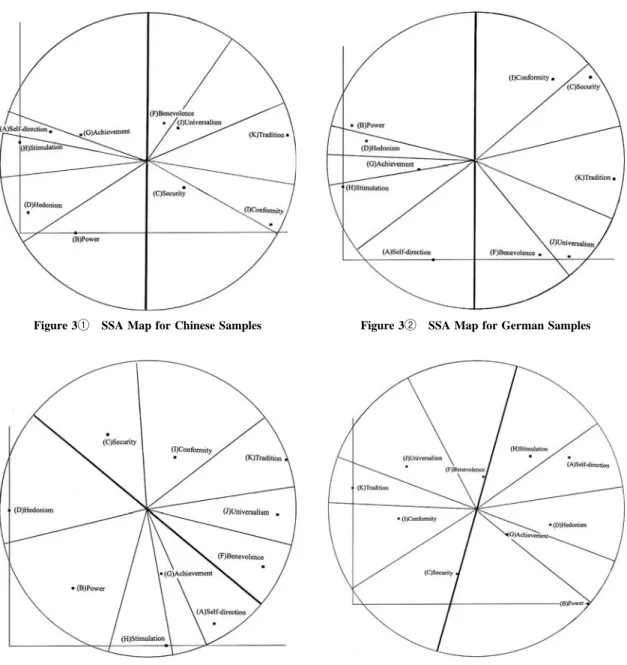
between the question items. Executing the HUDAP SSA program based on Guttman’s weak monoton icity coefficient (instead of Pearson’s product moment correlation coefficient) made it possible to cre ate 2dimensional SSA maps (Figs. 3①3⑩) for the 10 countries included in this analysis.
The computercalculated results output was a printout of ten symbols of A K expressing the lo cation of each question item in the 2dimensional Euclidean space. The 10 fanshaped or wedge shaped segments (spatial regions) depicted on the SSA map are the results of my effort to assign meaning to the space plot of these 10 items based on the empirical laws of Guttman’s Facet Theory. Essentially this interpretation of each of these 10 question items is positioned in one of 10 fanshaped or wedgeshaped spatial regions partitioned by 10 radial lines expanding out from the center of a cir cle.
Figure 3① SSA Map for Chinese Samples Figure 3② SSA Map for German Samples
Figure 3③ SSA Map for Korean Samples Figure 3④ SSA Map for Japanese Samples
Of course, it was Schwartz who first had the idea of applying the statistical technique of Guttman’s Smallest Space Analysis to the structural analysis of the 10 question items on values. The goal of this data analysis is to empirically confirm Schwartz’s idea from a crossnational comparative perspective. Smallest Space Analysis, by expressing the world of meaning constructed by human be ings in the visual form of a geometric figure, is a technique that makes it possible to develop objective and visual representations of theoretical ideas based on the insights and imagination of the researcher. Originally, the socalled contiguity hypothesis played a central role in Guttman’s Facet Theory. Spe cifically, this can be understood as follows. A questionnaire survey is a technique for exploring the
Figure 3⑤ SSA Map for Malaysia Samples Figure 3⑥ SSA Map for Russian Samples
Figure 3⑦ SSA Map for South African Samples Figure 3⑧ SSA Map for Thai Samples
world of meaning constructed by human beings. As the meanings of the words used in the question items become more similar, statistically closer relationships between the question items can be ob served in the survey results. The statistical technique that can empirically confirm this contiguity hy pothesis is none other than Smallest Space Analysis.
Next, we must ask how we can confirm, from a crossnational comparative perspective, the Schwartz’s Value Model, which visually depicts data using Smallest Space Analysis. I proceeded in the following five steps.
First, Schwartz Value Model is, in Schwartz’ own words, a “circular continuum model.” To con firm the Schwartz Model is to confirm whether the structure of the interrelationships between the val ues question items is expressed in the geometrical configuration of a circular continuum in the same way in all of the 10 countries examined in this analysis. I used two check points for confirming this configuration.
(1) Is the boundary of the space in which the values question items are plotted expressed in a circu lar shape?
(2) Are each of the values question items exclusively plotted in one of the 10 distinct fanshaped or wedgeshaped segments (spatial regions) of the circle?
Second, I confirmed whether the values question items in adjacent fanshaped or wedgeshaped spatial regions of the SSA maps of each country were the same as in the Schwartz Model.
Third, I confirmed whether the values question items that are plotted in the opposite fanshaped or wedgeshaped spatial regions extending beyond the center of the circle are the same as in the Schwartz Model.
Figure 3⑨ SSA Map for Turkish Samples Figure 3⑩ SSA Map for American Samples
Fourth, in the Schwartz model, the 10 values items start from Universalism, and move clockwise in circular order through Security and Power to arrive at SelfDirection. From steps 2 and 3 above, I confirmed whether this circular order can be confirmed on each country’s SSA map.
Finally, Schwartz grouped the 10 values items further into four higher order value types: “Self Transcendence,” “Conservation,” “SelfEnhancement,” and “Openness to Change.” Here, too, as in the case above, the correlations with the value groups in adjacent regions are high, while the correlations with the value groups on the opposite side are low. I confirmed whether this trend can likewise be seen on each country’s SSA map.
In this paper, I focus on the outcomes of step 1 with three main findings.
(1) In the SSA maps of all 10 countries, the 10 values items are plotted within a single circle, and each is exclusively positioned into one of the 10 distinct fanshaped or wedgeshaped segments of the circle partitioned by 10 radial lines extending out from the center. These results indicate that the space plot of the values items on the SSA map do in fact reflect the space partition shape that Schwartz re fers to as a “circular continuum”.
(2) The SSA maps of the 10 countries have similarities in terms of their geometric shape, but differ ences were evident in the circular order of the space plot of the values items, that is, in the content of the items plotted in adjacent fanshaped or wedgeshaped regions and the content of the items plotted in the fanshaped or wedgeshaped regions on the opposite side of the circle across the center point. A more detailed description of this difference would require an overall descriptive design (for example, a Facet Design).
(3) However, there were similarities across the 10 countries beyond the overall shape of the SSA map. One was in the content of the values items positioned in the right half and left half of the Schwartz model. Differences between countries could be seen in the circular order of the space plot of the question items on the SSA map, but if the values items are partitioned by a vertical line or a di agonal line, they separate out into a J, F, K, I, C group (SelfTranscendence and Conservation) and an A, H, D, G, B group (Openness to Change and SelfEnhancement) in all 10 countries.
These findings suggest that the “circular continuum of values” model guarantees crossnational comparability, and provides a useful basic framework for conducting a comparative analysis of the structure of mutual correlations between the values items in the 10 countries.
Ⅳ.Conclusion
In this paper, I conducted a data analysis to confirm whether the Schwartz value model is a use ful model in the context of crossnational comparison. Future research should refine this approach by examining the value model from perspectives of reliability and validity. The direction of such research would be the construction and refinement of the value model as a measurement model.
However, there are other paths for conducting values research. Even as I inquire the former path
forward for exploring the remaining issues identified in this paper, I have already begun preparing to conduct research that goes beyond the theme of refining the measurement model. On the one hand, my interest lies in using this measurement model as a tool or method to highlight the various aspects of values and their structure in a given country or society. On the other, I am interested in using the measurement model as a key variable in constructing a causal model positioned within the correlation between cause variables (e.g., gender, age, level of education) and consequence variables (e.g., life sat isfaction, gender/family values, religiosity, political consciousness). I also propose conducting research to confirm the causal model from a crossnational comparative perspective.
References
Datler, Georg, Jagodzinski, Wolfgang and Schmidt, Peter (2013). Two Theories on the Test Bench: Internal and External Valid ity of the Theories of Ronald Inglehart and Schalom Schwartz, Social Science Research, 42.
Davidov, Eldad, Schmidt, Peter and Billiet, Jaak eds. (2011). CrossCultural Analysis: Methods and Applications, Routledge. Levy, Shlomit ed. (1994). Louis Guttman on Theory and Methodology: Selected Writings, Dartmouth.
Manabe, Kazufumi (2001). Facet Theory and Studies of Japanese Society: From a Comparative Perspective, Bier’sche Verlang sanstalt, Bonn, Germany.
Manabe, Kazufumi (2016). Values, in G. Mazzoleni et al. eds., The International Encyclopedia of Political Communication, Vol.3, Wiley Blackwell.
Manabe, Kazufumi (2016). Use of Facet Theory in Developing Values Theory of Shalom H. Schwartz, Journal of Aoyama
Standard (Aoyama Gakuin University) No.11.
Schwartz, Shalom H. (1992). Universal in the Content and Structure of Values: Theory and Empirical Tests in 20 Countries, in M. Zanna ed., Advance in Experimental Social Psychology, 25, Academic Press.
Yamazaki, Seiko (2016). Happiness, Life Satisfaction and Values, in K. Ikeda ed., The People’s Way of Thinking in Japan and
in the World (in Japanese), KeisoShobo, Japan.
Special Remark
This paper is based on the presentation at 7thConference of the European Survey Research Association, University of Lisbon,
Portugal, July 1721, 2017, and is financially supported by the Center for Global Studies and Collaboration, Aoyama Gakuin University.
Appendix: WVS Question Wordings
Now I will describe some people. Using this card, would you please indicate for each description whether that person is very much like you, like you, somewhat like you, no like you, or not at all like you?
(Code one answer for each description):
Very much like me Like me Some what like me A little like me Not like me Not at all like me V 70. It is important to this person to think up new ideas and be creative;
to do things one’s own way. 1 2 3 4 5 6 V 71. It is important to this person to be rich; to have a lot of money and
expensive things. 1 2 3 4 5 6 V 72. Living in secure surroundings is important to this person; to avoid
anything that might be dangerous. 1 2 3 4 5 6 V 73. It is important to this person to have a good time; to “spoil” oneself. 1 2 3 4 5 6 V 74. It is important to this person to do something for the good of soci
ety. 1 2 3 4 5 6
V 75. Being very successful is important to this person; to have people
recognize one’s achievements. 1 2 3 4 5 6 V 76. Adventure and taking risks are important to this person; to have an
exciting life. 1 2 3 4 5 6 V 77. It is important to this person to always behave properly; to avoid
doing anything people would say is wrong. 1 2 3 4 5 6 V 78. Looking after the environment is important to this person; to care
for nature and save life resources. 1 2 3 4 5 6 V 79. Tradition is important to this person; to follow the customs handed
down by one’s religion or family. 1 2 3 4 5 6
Empirical Examination of the Schwartz Value Theory
from a CrossNational Comparative Perspective:
Data Analysis of the World Values Survey
ABSTRACT
The purpose of this paper is to conduct an empirical examination of the value the ory of Shalom Schwartz from a crossnational comparative perspective through a data analysis of the World Values Survey (WVS). Schwartz’s “circular continuum of val ues” model is a structural model that shows the mutual relationships between the ten motivationally distinct types of basic human values: power, achievement, hedonism, stimulation, selfdirection, universalism, benevolence, tradition, conformity, and secu rity. The 10 countries were selected for conducting the data analysis, namely Germany, the United States, Russia, Turkey, South Africa, Japan, South Korea, China, Thailand, and Malaysia. As a method of data analysis, Smallest Space Analysis (SSA) developed by Louis Guttman was used. SSA maps of the 10 countries have similarities in terms of their geometric shape (a space partition shape that Schwartz refers to as a “circular continuum”), but differences were evident in the circular order of the space plot of the values items. These findings suggest that the circular continuum model provides a use ful basic framework for conducting a comparative analysis of basic human values.
Key Words: Schwartz value theory, circular continuum, World Values Survey, Small
est Space Analysis