Optimization
Games on
Graphs
*Xiaotie
Deng
(
都
小鉄)\dagger
Toshihide Ibaraki(
茨木 俊秀)\ddagger
HiroshiNagamochi (
男持 仁Abstract
Weintroducea general integer programmingformulation for a class of combinatorial
op-timization games, which include manyinteresting problems on graphs. The formulation
im-mediately allows us to improve thealgorithmicresult forfinding imputations in thecore (an
important solution concept in cooperative game theory) of the network flow game on unit
networks. An important result is a general theorem that the core for this class of games is
nonempty if and only if a related linearprogramhas an integeroptimal solution. We study
the properties for this mathematical condition to hold for several problems on graphs, and
apply them to resolve algorithmic and complexity issues fortheir cores: decide whether the coreis empty; if thecore is empty, find an imputation in thecore;given an imputation$x$, test
whether $x$ is in thecore.
1
Introduction
Game theory has a profound influence on methodologies of many different branches of
sci-ences, especially those of economics, operations research and management sciences. The thesis
ofbounded rationality is introduced as a crucial concept forgame theoretical strategies to have
practically meanful implementations in real life situations $[15, 17]$
.
In particular, computationalcomplexity (existence ofpolynomialtime algorithms) has been singled out as one important
fac-tor for the bounded rationality of the participating agents in a game, and several authors have
taken algorithmic and complexityissues as themain focus in solutions for gametheory problems
[1, 4, 8, 9, 12, 13, 15].
Recently, Kalai has extensively discussed the interplays of operations research, game theories,
and theoretical computer science [8]. An interesting problem discussed by Kalai is a network
flow game. Consider a digraph $D=(V, E)$ with a source vertex $s$ and a sink vertex $t$
.
Kalaiand Zemel [8, 10, 11] consider a cooperative game associated with the maximum flow from $s$ to
$t$ by identifying each arc as a player, and defining the value $v(S)$ of a subset (i.e., a coalition)
$S\subseteq E$ to be the value of a maximum flow in the subgraph $D[S]=(V, S)$
.
Call a mapping$z:Earrow R_{+}$ ($R_{+}$ is the set ofnonnegative reals) as an imputation if$z(V)=v(V)$ holds, where
$z(S)$ for $S\subseteq V$ represents $\sum_{u\in S}z(u)$
.
The core is defined to be the set ofimputations $z$ suchthat $z(S)\geq v(S)$ holds for all $S\subseteq E[16,18]$
.
The maximum flow game distributes the profit *The authors gratefully acknowledge the partial support of the Scientific Grant in Aid by the Ministry ofEducation, Science and Culture of Japan. The major part of this research was conducted while the first author visitedKyoto Universityin 1996, bythe suport of the Japan Society ofthe Promotion of Science(JS95061).
\dagger Dept. of Computer Science,York University, North York, Ontario, Canada$\mathrm{M}3\mathrm{J}$1P3. Email: [email protected]
\ddagger DepartmentofApplied Mathematics and Physics, Faculty of Engineering, Kyoto University, Kyoto606,Japan.
from the maximum flow to players who control the arcs in the network. In practice, this can
be regarded, for example, as a measure of reliability for maintaining a communication network
between $s$ and $t$
.
An imputation is a way to distribute the credit for asubset of arcs toward
the level of connectivity maintained by them. The concept of core provides us a fundamental
principlefor such imputation to be rational, as it says that any subgroup of players would acquire
at least as much payment as they can collectively obtainas a subgroup.
For a special case of the maximum flowgame on unit networks, i.e., those with capacity ones,
Kalai and Zemel [11] showed a convex characterization theorem of the core: An imputation is
in the core if and only if it is a convex combination of the characteristic vectors ofminimum
cuts. This immediately implies that the core is always nonempty and leads to polynomial time
algorithms for those problems related to the core; that is, one can find an imputation in thecore
in polynomial time, as well as one can test in polynomial time whether a given imputationis in
thecore or not. The
maximum
flow gameenjoys a further nicepropertythat it is totally balanced, i.e., the cores of all the subgames are nonempty.It is not accidental that the above special case of the maximum flow game always has a
nonempty core and allows polynomial time solution algorithms. In Section 2, we introduce a
general (and different from that of Kalai and Zemel for the network game on unit networks)
integer programming formulationofcombinatorialoptimization games, andshow that the game
hasa nonempty core if and only if the correspondinglinear programming relaxationhasaninteger
optimalsolution. In the network flowgame on unit networks, it turnsoutthat the linearprogram
relaxation always has an integer solution, as guaranteed by Menger’s Theorem [6].
In Section 3, we introduce several interesting examples. For the single source single sink net-work game, the algorithm of Kalai and Zemel only works for edge players in a directed unit
network. As an advantage of our integer programming formulation, this can be immediately
extended to an undirectedgraph, to vertex players and s-t vertex-connectivity as the gamevalue,
as well as the matching game for bipartite graphs. This approach can also be applied to solve
several othergames. Ofcourse, the integrality condition does not always hold. A specially
inter-esting case is the $\mathrm{m}\mathrm{a}\mathrm{t}\mathrm{c}\mathrm{h}\mathrm{i}\mathrm{n}\mathrm{g}/\mathrm{v}\mathrm{e}\mathrm{r}\mathrm{t}\mathrm{e}\mathrm{x}$-cover
game
for general graphs. Though one integer programis polynomially solvable and the other is $\mathrm{N}\mathrm{P}$-hard for this pair of graph optimization problem,
thelinear programmingrelaxations of the pair are dual to each other. However, we will see that
the conditionfor the nonemptiness of the core is polynomially checkable for both games in each
pair. This is not necessarilytrue ofall the $\mathrm{N}\mathrm{P}$-hard combinatorial optimization
problems. There
are cases in which none of the integrality and polynomial time solvability holds. For the graph coloring game, it is an $\mathrm{N}\mathrm{P}$-hard problem to
decide whetherthe core is empty or decide whether
an imputation is in the core. Exactly in such situations, the complexity concept grown out of
theoreticalcomputerscienceprovides abetter understandingonwhy a goodmathematical
char-acterization is not obtainable [5]. For the graph coloring game, we could reveal the equivalence
2
Maximization
and
Minimization Games
2.1
Definitions
Let $A$ be an $m\cross n\{0,1\}$-matrix. Let $1_{k}$ and $0_{k}$ denote the column vectors with all ones and
all zeros, respectively, of dimension $k$
.
We may denote these vectors by 1 and $0$ for simplicity.Let $M=\{1,2, \cdots, m\}$ and $N=\{1,2, \cdots, n\}$ be the corresponding index sets, and let $t$ denote
the transposition. Consider the following linear program,
$LP(c, A,\mathrm{n}\mathrm{a}\mathrm{x})$
:
$\max y^{t}c$$s.t$
.
$y^{t}A\leq 1_{n}^{t}$, $y\geq 0_{m}$,and itsdual,
$DLP(c,A, \max)$ : $\min 1_{n}^{t}x$
$s.t$
.
$Ax\geq c$, $x\geq 0_{n}$,where $c$ is an $m$-dimensional column vector $\in R^{m},$ $y$ is an
m-dimensiOna.1
columnvect.o.r
ofvariables and $x$ is an $n$-dimensional column vector of variables.
Wedenote the corresponding integerprogrammingversion of$LP(c, A, \max)$by$ILP(C, A, \max)$
.
Since $A$ is a $\{0,1\}$-matrix, the integrality constraints are equivalent to require $y$ to have $\{0,1\}$
values. We define the packing gameGame$(c, A, \max)$ as follows, where$\overline{S}=N-S$:
1. The player set is $N$
.
2. For each subset $S\subseteq N,$ $v(S)$ is defined as the value of the following integer program:
$ILP(c, A_{M},s, \max)$ : $\max y^{t}c$
$s.t$
.
$y^{tt}A_{M,S}\leq 1_{|s|}$, $yA_{M,\overline{S}}t\leq \mathrm{o}tn-|s_{1}$ ,$y\in\{0,1\}^{m}$,
where$A_{T,S}$ is thesubmatrix of$A$ with row set $T$ and column set $S$, and $v(\emptyset)$ is defined to be $0$
.
Sincethis is a maximizationproblem, we may as well assume that $c_{j}>0$ for$j$ with$A_{j}$. $\neq 0$
.
Otherwise,we can always choose $y_{j}=0$
.
For a vector $z:Narrow R_{+}$ and a subset $S\subseteq N$, let $z(S)$denote $\sum_{j\in s^{Z}}(j)$
.
Let us recall that a vector $z$:
$Narrow R_{+}$ is an imputation if$z(N)=v(N)$, andan imputation is in the core if$z(S)\geq v(S)$ holds for all $S\subseteq N$
.
Wethen introducea covering game$c_{ame}(c, A, \min)$for theminimizationprobleminthe similar
manner:
1. The player set is $M$
.
2. For each subset $T\subseteq M,$ $v(T)$ is defined as the value of the following integer program:
$ILP(d,A \tau,N,\min)$ : $\min d^{t}x$
$s.t$
.
$A_{T,N^{X}}\geq 1_{|T|}$, $x\in\{0,1\}^{n}$,Again we can assume $d_{j}>0$ for all $j$
.
Otherwise we may always choose $x_{j}=1$ to simplifythe problem. Since the value of the game is defined by a solution to the minimizationproblem,
thisis in fact a problem of sharing the cost of the game. Thus, we would revise the definitions
of imputation and core. A vector $w$ : $Marrow R_{+}$ is an imputation if $w(M)=v(M)$, and an
imputationis in the core if$w(T)\leq v(T)$ holds for all $T\subseteq M$
.
From definition, we easily see that both packing game and covering game are monotone (i.e.,
$v(S’)\leq v(S),$ $S’\subseteq S\subseteq N$ holds for Game$(c, A, \max)$, and $v(T’)\leq v(T),$ $T’\subseteq T\subseteq M$ holds for
Game$(d, A, \min))$
.
As a justification of introducing these general formulations, note that the maximum flow
game on a digraph $D=$ (V,$E$) with source $s$ and sink $t$, studied in [11], can be formulated
as Game$(1_{m}, A, \max)$ ifwe interpret that $A$ is the path-arc incidence matrix: $A_{ij}=1$ if arc$j$ is
inthe i-th directed s-t path, and $0$ otherwise. Constraint $y^{t}A\leq 1_{n}^{t}$ requires that, for each arc$j$,
there is at most one path chosen by $y$, which goes throughthe arc (i.e., arc capacity is 1).
In this paper, we shall introduce a number of optimizationgames on graphs, which are
formu-latedas the abovemaximization $\mathrm{a}\mathrm{n}\mathrm{d}/\mathrm{o}\mathrm{r}$ minimization games, and study the following properties
and questions concerning their cores.
1. Nonemptyness: Is the core of the game always nonempty?
2. Convex characterization: Can any imputation in the core be represented as a convex
com-bination ofsome well-defined dual objects (such as minimum s-t cuts)?
3. Testing nonemptiness: Can it be tested in polynomial time whether a given instance of the
game has nonempty core?
4. Checking membership: Can it be checked in polynomial time whether a given imputation
belongs to the core?
5. Finding a core member: Is it possible to find animputationinthecore inpolynomial time?
As our discussion will focus on games on graphs, the polynomiality is determined in terms
of the input size ofthe graph (i.e., the number of vertices $|V|$ and the number ofarcs or edges
$|E|)$
.
Even though thesizes of the constraintmatrices$A$ intheabove formulations are sometimesexponentialin $|V|$ and $|E|$ (e.g.,the$A$ for the maximum flowgamehas exponentially manyrows),
we would like to obtain algorithms of polynomial time in the input size of the graphs.
We note at this point that two games Game$(c, A, \max)$ and Game$(c, A, \min)$ are not dual in
the sense of the underlying linear programs since the roles of objective function and the right
hand side oftheconstraint arenot interchanged. Inthecase of$c=1$, however, the corresponding
linear relaxations become dual to each other.
2.2
Main
theorems
We give important lemmas and theorems that characterize the cores of the maximizationand
minimization games defined in the previoussebsection.
1. $z(N)=v(N)$ ($i.e.,$ $z$ is an imputation),
2. $z(s_{i})\geq c_{i}$
for
all$i\in M$, where $S_{i}=\{j\in N|A_{ij}=1\}(i.e.,$$z$ isfeasible
to $DLP(C, A, \max)$of
$LP(c, A, \max)$.
$\square$Theorem 1 The core
for
Game$(c, A, \max)i_{\mathit{8}}$ nonemptyif
and onlyif
$LP(C, A, \max)$ has aninteger optimal $\mathit{8}oluti_{\mathit{0}}n$
.
In $\mathit{8}uch$ case, a vector$z$ : $Narrow R_{+}$ is in the coreif
and onlyif
it is anoptimalsolution to $DLP(C, A, \max)$
.
$\square$Lemma 2 A vector$w$ :$Marrow R_{+}$ is in the core
of
Game$(d,A, \min)$if
and onlyif
1. $w(M)=v(M)$ ($i.e.,$ $w$ is an imputation),
2. $w(T_{j})\leq d_{j}$
for
all$j\in N$, where $T_{j}=\{i\in M|A_{ij}=1\}(i.e.,$ $z$ isfeasible
to the dual$DLP(d,A, \min)$
of
$LP(d, A, \min))$.
$\square$Theorem 2 The core
for
Game$(d,A, \min)$ is nonemptyif
and onlyif
$LP(d,A, \min)$ has aninteger optimal solution. In such case, a vector$w:Marrow R_{+}$ is in the core
if
and onlyif
it is anoptimal solution to $DLP(d, A, \min)$. $\square$
3
A
Selection
of Examples
There are many interesting optimization games on graphs, which can be formulated as in
Section 2. We will focus on the following games.
1. Maximumflowgame in unit networks, s-t edge connectivitygame in undirectedgraphs, s-t
vertex connectivity game in undirected graphs, and maximum matching game in bipartite
graphs.
2. Maximum$r$-arborescence game.
3. Maximummatching game and minimum vertexcover game.
4. Maximumindependent set game and minimum edge cover game.
5. Minimum coloring game.
3.1
Network Flow Game and Its Variants
Let us consider the maximum flow game in a unit directed network $D=(V, E)$ with source
$s\in V$ and sink $t\in V$, which is also denoted simply by $D=(V, E, s, t)$
.
We call a unit network(i.e., with arc capacity one) also as a digraph. The value of a maximum flow in the case of a
digraph $D$ is the number of arc disjoint s-t paths in $D$
.
For this reason, it is also called the s-tarc-connectivity of$D$
.
A partition of $V,$ $C=(U, V-U)$, is called a cut in $G$,
and represents thesetofarcs $\{(i,j)\in E|i\in U,j\in V-U\}$
.
Acut is an s-t cut if$s\in U$ and$t\in V-U$.
Aminimums-t cut is an s-t cut with the minimum cardinality as an arc set. The following property is well
known as Menger’s theorem (which is a special case of a more general result called the max-flow
Lemma 3 Given a digraph $D=(V, E, s, t)$, the s-t arc-connectivity
of
$D(i.e.$, the valueof
amaximumflow) is equal to the size
of
a minimums-t cut in D. $\square$Basedon this lemma, we seethatthere isa polynomial time algorithm to generate a imputation
in the core. Take a minimum 8-t cut $C$in $D$, and let $I_{C}$ be its characteristic vector; $I_{C}(j):=1$ if
$j\in C$and$0$otherwise. Let $z:=I_{C}$
.
Then$z$ is an imputation since $z(E)=|C|=v(E)$ by Lemma3. Furthermore, for any $S\subseteq E$, we have $z(S)=|C\cap S|\leq v(S)$ by Lemma 3 and the fact that
$C\cap S$ is an 8-t cut in $D[S]$
.
Therefore, this $I_{C}$ is indeed in the core, and the core is nonempty.Now a vector $z\in R^{|E|}$ is a convex combination of a family of$C$ if $z= \sum_{C}\lambda_{C}IC$ holds for some
$\lambda_{C}$ such that $\sum_{c^{\lambda_{C}=}}1$ and $\lambda_{C}\geq 0$for all $C$
.
If the family of$C$is finite, the set of such $z$ formsa convex polyhedron whose extremal points are precisely those characteristic vectors $I_{C}$
.
Kalaiand Zemel [10] went one step further to show that an imputation$z$ is in the core if and only if it
is a convex$\mathrm{c}\mathrm{o}\mathrm{m}\dot{\mathrm{b}}$
ination of$I_{C}$ ofminimum s-t cuts C. $\cdot$.
Insomecases, theremay be dummy players in thegame in thesense that those players$j$ always
get $z(j)=0$in an imputation$z$ : $Narrow R_{+}$
.
We say that an imputation$z$ is in the core of agamewith a set $\dot{N}\subseteq N$
\’Of
dummy players ifit is in the core of thegain
$\mathrm{e}$ and $z(j)=0,$ $j\in\dot{N}$ holds.
Ofcourse, a game may not have a corefor some set $\hat{N}$
ofplayers, even if$\mathrm{i}.\mathrm{t}$ has a nonempty core
(ifthere is no dummy player).
To make Game$(1|M|’ A, \max)$ more general for the purpose of utilizing it in discussing the
s-t vertex-connectivity game and some other games later, we introduce a set $\hat{E}\subseteq E$ of dummy
players. A set $\hat{E}$
ofarcs (for dummy players) is called valid if $F=E-\hat{E}$ contains at least one
minimums-t cut $C\subseteq E$of$D$
.
A game is trivial if$v(N)=0$ for the set of entire players.Theorem 3 For a
digraph..D
$=(V, E, s,t)$ and a set $\hat{E}$of
dummy players, the nontrivial s-t arcconnectivity game has nonempty core
if
and onlyif
$\hat{E}$is valid. $\square$
Theorem 4 Let $z$
:
$Earrow R_{+}$ be an imputationof
the nontrivial s-t arc-connectivity game on adigraph$D=(V, E, s,t)$ with a valid set$\tilde{E}$
of
dummy players. Then$z$ is in the core with respect to$\dot{E}(i.e., z(e)=0,$ $e\in\hat{E})$
if
and onlyif
it $i_{\mathit{8}}$ a convex combinationof
the setof
the characteristicvectors
for
minimum s-t cuts$C$ contained in $F=E-\hat{E}$.
$\square$Corollary 1 For a valid set $\hat{E}$
of
dummy players, testing nonemptiness, checking membershipand finding a core member
of
the 8-t arc-connectivity game, can all be answered in polynomialtime. $\square$
We emphasize at this point that the results in Theorems 3 and 4 can be extended to other
optimization games on graphs, whichcan be reducibleto the maximum flow game in a directed
network. Those problems include:
Pl: s-t edge-connectivity $\dot{\mathrm{g}}$ame in an undirected graph $G=(V, E, s,t)$, where players are on
edges and $v(S),$ $S\subseteq E$ is defined to be the size ofmaximumflowfrom $s$ to$t$ intheinduced
network $G[S]$,
P2: s-t vertex-connectivity game in a digraph $D=(V, E, s,t)$ (resp. undirected graph $G=$
(V,$E,$$s,t$)$)$,where playersare on verticesexcept $s$ and$t$, and$v(S),$ $S\subseteq V-\{s,t\}$ is defined to be the maximum number of arc (resp., edge) disjoint paths from $s$ to $t$ in the induced
P3: maximum matching game with edge players on a bipartite graph $G=(V_{1}, V_{1}, E)$, where
$v(S),$ $S\subseteq E$ is defined to be the size of maximum matching in the induced graph $G[S]$
.
For a digraph $D=(V, E, s, t)$ (or undirectedgraph $G=(V,$$E,$$s,t)$), a subset $W\subseteq V-\{s,t\}$
is called an s-t vertex-cutifthegraph induced by $V-W$ hasno path from $s$ to $t$
.
Corollary 2 For a game in the above $Pl$ (resp., $P\mathit{2}$ and $P\mathit{3}$), the core is always nonempty, and
if
thegame.
is not trivial, the core is a convex combinationof
a setof
characteristic vectorsof
minimum s-t cuts (resp., minimum s-t vertex-cuts
for
$P\mathit{2}$ and minimum $vert\dot{e}x$-coversfor
$P\mathit{3}$).Furthermore, testing $nonemptineS\mathit{8}$, checking membership and finding a core member
of
all thesegames, can be answered in polynomial time. $\square$
One may define a minimum cut game in a digraph $G=(V, E, s, t)$ as the covering game
Game$(1_{1}E|’ A, \min)$, whichis the dualgameofthe s-t arc connectivity game Game$(1_{||}p, A, \max)$,
where $A=A_{P,E}$ is the incidence matrix between the arc set $E$ and the s-t path set $\prime P$
.
Thisgame has players on 8-t paths in $’\rho$, which may be exponentially many in the size of $|V|$ and
$|E|$
.
Recall that, for any subset $S\subseteq E,$ $LP(1_{|\mathcal{P}|}, Ap,s, \min)$ naturallyrepresents the maximumflow problem in the induced digraph $G[S]=(V, S, s,t)$, and hence it has an integer optimal
solution due to Lemma 3, which is now applied to $G[S]$
.
However, this is not the case in theminimum cutgame. Although $LP(1_{|E}|’ A, \min)$has an integer optimal solution due to Lemma 3,
the corresponding linear programs $LP(1_{|E|},A \tau,E,\min)$ for subsets $T\subset \mathcal{P}$ may not enjoy such
an itegral property. For example, $G$ possibly contains three s-t paths $P_{i},$ $i=1,2,3$ such that
$P_{i}\cap P_{j}=\{e_{ij}\},$ $1\leq i<j\leq 3$ hold for some arcs $\{e_{12}, e_{23}, e_{13}\}\subseteq E$
.
For $T=\{P_{1}, P_{2}, P\mathrm{s}\}\subseteq \mathcal{P}$,$LP(1_{|E|}, A \tau,E,\min)$ hasanoptimalsolution$x$ : $Earrow R_{+}$ such that$x(e_{12})=x(e23)=x(e_{1}3)=0.5$
and $x(e)=0$ for other arcs, implying that it is has no integer optimal soltion (with the optimal
value 1.5).
3.2
Arborescence Game
The maximum $r$-arborescence game and minimum $r$-cut game is played on a digraph $D=$
(V,$E$) with a root $r\in V$
.
Recall that an $r$-arborescence in $D$ is a spanning directed tree suchthat everyvertex in $D$is reachablefrom$r$
.
Foreachsubset $S\subseteq E$ofarcs (i.e., players),thegamevalue$v(S)$ is definedto be the size of themaximum number of$r$-arborescences on the subgraph
$G[S]–(V, S)$
.
This game can be formulated as a packing game Game$(1_{|M}A, \max|’)$ by matrix$A$ such that the rows correspond to all $r$-arborescences and the columns correspond to all arcs;
$A_{ij}=1$ if and only if arc$j$ is in the i-th r-arborescence.
The model of the $r$-arborescence game can arise when we want to maintain paths from a
distinguished source $r$ to all the vertices in the network. For each arc in $D$, there is one player
in control of this arc. Note that such $k$ is equal to the maximum number of pairwise disjoint
$r$-arborescences. For this reason, we call the maximum $r$-arborescence game also as the single
source connectivity game(on digraphs). By Lemma 1, an imputation is in the core of this game if
and only if there is no $r$-arborescence such that the sum of the imputation on the r-arborescence
is less than one.
The questions about of the core of this game can be answered in polynomial time, similar to
the $r$-arborescences and the $r$-cuts follows from the next well known result of Edmonds [2]. A
cut $C=(U, V-U)$ ina digraph represents the set ofarcs from $U$ to $V-U$
.
It is called an r-cutif$r\in U$ holds.
Lemma 4 [2] In a digraph$D=(V, E)$ with root$r\in V$, the maximum number
of
pairwise disjoint$r$-arborescences is equal to the minimum cardinality
of
an $r$-cut. $\square$Let the maximum number of disjoint $r$-arborescences be $k$
.
Since these $k$ pairwise disjoint$r$-arborescencesform a solution to the primal linear program$LP(1_{|M|}, A, \max)$ of this game, and
the minimum cardinality $r$-cut ofsize $k$ is a solution to its dual linear program, it follows that
theyare optimalsolutions tothe primal and the dual, respectively, by the duality theory of linear
programming. Therefore the primal linear program has aninteger solution.
A set $\hat{E}$ ofarcs (fordummyplayers)
is called valid if$F=E-\hat{E}$ contains at least one minimum
$r$-cut $C\subseteq E$ of$D$
.
Analogouslywith Theorems 3 and 4, wehave the followingresults.Theorem 5 For a digraph $D=(V, E)$ with root $r\in V$ and a set $\hat{E}$
of
dummy players, themaximum$r$-arborescence game with$v(E)>0$ has nonempty core
if
and onlyif
$\hat{E}$is valid. $\square$
Theorem 6 Let$z$ : $Earrow R_{+}$ be an imputation
of
the maximum$r$-arborescence game on a digraph$D=(V, E)$ with root$r\in V$ and a valid set$\hat{E}$
of
dummy players and let$v(E)>0$.
Then$z$ is inthe core with respect to $\hat{E}(i.e., z(e)=0,$ $e\in\hat{E})$
if
and onlyif
it $i_{\mathit{8}}$ a convex combinationof
theset
of
the characteristic vectorsfor
minimum$r$-cuts$C$ contained in $F=E-\hat{E}$.
$\square$Corollary 3 For a set $\hat{E}$
of
dummy players, testing nonemptiness, checking membership andfinding a core member
of
the maximum $r$-arborescence game, can all be answered in polynomialtime. $\square$
3.3
Matching
andVertex Cover
Given a graph $G=(V, E)$, we define the maximum matching game by a game such that the
players
are
on vertices and thegame
value $v(S)$ for a subset $S\subseteq V$ is the maximum matchingsize in the subgraph$G[S]$ induced by $S$
.
Similarly, the minimum vertex cover game is defined bya game such that playersare onedges and $v(S)$for $S\subseteq E$istheminimumvertexcover size inthe
subgraph $G[S]=(V, S)$
.
These games are formulated by packing game Game$(1|E|’ A, \max)$ andcovering game Game$(1|V|’ A, \min)$, respectively, where the constraint matrix $A$ is the incidence
matrixof$G$in which the rows correspondto edges $E$ and the columns correspond to vertices $V$;
$A_{ij}=1$ ifand only if edge $i$ and vertex$j$ are incident.
For bipartitegraphs as discussedatthe end ofSection 3.1, the maximum matching game can be
formulatedas a special case of the s-t arc-connectivity problem with a subset of edges as players.
Thus, we have the convex characterization of the core, and all problems about the core can be
answered in polynomial time. Similarresults also hold for the minimum vertex cover game (as
will be discussed in Section 3.3.2). However, these nice properties break downfor general graphs,
and the core is nonempty only for some special classes of graphs.
By Lemma 1, an imputation$z$is in thecoreof the matchinggameif and only if$z(u)+z(u^{/})\geq 1$
for which the cores are always nonempty. The class of graphs for which the size of a minimum
vertex cover is the sameas the size of a maximum matching, and the class of graphs with perfect
matching. For a graph $G=(V, E)$ in the first class, we assign $z(v)=1$ if $v$ is in the minimum
vertex cover and $z(v)=0$ otherwise. It is easy to see that this $z$ is indeed in the core. For
a graph $G=(V, E)$ in the second class, we assign every vertex $v\in V$ with $z(v)=0.5$
.
Then$z(V)=|V|/2=v(E)$,since $G$has a perfect matching. Furthermore, since the size of a maximum
matching in any subgraph $G[S]$ inducedby $S\subseteq V$ is no more than $|S|/2$, this $z$ is indeed in the
core.
On the other hand, one can easily construct graphs with non-empty cores which are not in
the above two classes. For example, take two graphs one from each of the above classes, and
connect them with edges between the vertices in the minimum cover and the vertices in the
perfect matching. However, the next theorem says that these are essentially all graphs which
have nonempty coresfor the maximum matching game.
Theorem 7 An undirected graph $G=(V, E)$ has a nonempty core
for
the maximum matchinggame
if
and onlyif
there exists a $\mathit{8}ubsetV_{1}\subseteq V$ such that1. the subgraph$G_{1}=G[V_{1}]$ induced by $V_{1}$ has a minimum vertexcover $W$ with the same size
$a\mathit{8}$ its maximum matching,
2.
the subgraph $G_{2}=c[V-V_{1}]$ induced by $V-V_{1}$ has a perfect matching,3. all the remaining edges $(u, u^{/})\in E$ between $G_{1}$ and $G_{2}$ satisfy$u\in W$
for
the vertex cover$W$ in 1. $\square$
Corollary 4 For the core
of
the maximum matching game, testing nonemptiness, checkingmem-bership andfinding a core member, can be done in polynomial time. $\square$
Recallthat an integer solution of its dual $LP$ problem $DLP(1_{|E|}, A, \max)=LP(1|V|’ A, \min)$
of themaximum matching game implies a minimum vertex cover. In some class of graphs which
have a nonempty core, the size of a maximum matching is not equal to the size of a minimum
vertex cover (e.g., $K_{4}$ has a perfect matching, but its minimum size of a vertex cover is 3).
In such a case, the core of the matching game cannot be represented by a convex combination
ofinteger solutions of its dual problem $LP(1_{|V}|’ A, \min)$, i.e., minimum vertex covers (because
their optimal values are different), implying that the convex characterization ofthe core of the
maximum matching game is not possible.
Theorem 8 The core
for
the minimum vertex cover game on graph $G=(V, E)$ is nonemptyif
and only
if
the sizeof
a maximum matching is equal to the sizeof
a minimum vertex cover. $\square$Theorem 9 For the core
of
the minimum vertex cover game, testing nonemptiness, checkingmembership andfinding a core member, can be done in polynomial time. $\square$
3.4
Edge Cover and Independent Set
For an undirected graph $G=(V, E)$, we can define a mutually dual pair of the minimum
respectively, where the constraint matrix $A^{/}$ is the incidence matrix of $G$ in which the rows
correspond to vertices and the columns correspond to edges (i.e., the transposition of the matrix
$A$usedforthe pairof themaximum matchinggame and theminimum vertexcovergame). Thus,
for the minimum edge covergame,the players are on vertices, and the game value$v(S)$ for$S\subseteq V$
is theminimum number ofedgesthat cover all vertices in $S$, i.e.,
$\min\{|F||F\cap E(u)\neq\emptyset, \forall u\in S\}$,
where$E(u)$ denotesthe set of edges in $E$whichare incidentto$u$
.
Note that$v(S)$is not necessarilythesizeofa minimum edge cover inthe subgraph$G[S]$ induced by vertex set $S$
.
Fortheminimumedge covergame, we assume that $G$ has no isolated vertex to prevent it from becoming infeasible.
Similarly, the players for the maximum$\mathrm{i}\mathrm{n}\mathrm{d}\mathrm{e}\mathrm{p}\mathrm{e}\mathrm{n}\dot{\mathrm{d}}$
ent set game are on edges and thegame value
$v’(T)$ for $T\subseteq E$ is the size of a maximum independent set in the subgraph $G[V\langle T\rangle]$ induced by
$V\langle T\rangle$, where $V\langle T\rangle$ is defined by
$V\langle T\rangle=$
{
$i\in V|i$ is adjacent only to edges in $T$}.
(Notethat $v’(\tau)$ is not the size of a maximum independent set in the subgraph $G[T].$)
Theorem 10 Let$G=(V, E)$ an undirected graph with no isolated vertex. Then $w$ : $Varrow R_{+}$ is
in the core
of
the minimum edge cover game on $G$if
and only $if\overline{w}=1_{|V|}-W$ is in the coreof
the maximum matching game on G. $\square$
Corollary 5 An undirected graph $G=(V, E)$ has a nonempty core
for
the minimum edge covergame
if
and onlyif
there exists a subset $V_{1}\subseteq V$ such that$1^{/}$. the subgraph
$G_{1}=G[V_{1}]$ induced by $V_{1}$ has a maximum independent set $W’$ with the same
size as its minimum edge cover,
$2^{/}$
.
the subgraph$G_{2}=G[V-V_{1}]$ induced by $V-V_{1}$ has a perfect matching ($i.e.$, an edge cover
with $|V|/2$ edges),
$3’$
.
all the remaining $edge\mathit{8}(u, u’)\in E$ between$G_{1}$ and$G_{2}$ satisfy$u\in V-W’$for
the maximumindependent set$W’$ in $1^{/}$
.
$\square$Theorem 11 Let$G=(V, E)$ be an undirected graph with no isolated vertex. Then the core
for
the maximum independent set game on graph$G$ is nonempty
if
and onlyif
the sizeof
a maximumindependent set is equal to the size
of
a minimum edge cover in G. $\square$Theorem 12 For the core
of
the maximum independentsetgame, testing nonemptiness, checkingmembership and finding a core member, can be done in polynomial time. $\square$
Theorem 13 Given an undirected graph $G=(V, E)$ with $V\neq\emptyset$ but no isolated vertex, $an$
imputation is in the core
of
the maximum independent set gameif
and onlyif
it is a convexcombination
of
the characteristic $vector\mathit{8}$of
minimum edge covers. $\square$One may define the maximum clique problem in an undirected graph $G=(V, E)$ as the maximumindependent set problemon its complement $\mathrm{g}\mathrm{r}\mathrm{a}_{\mathrm{P}^{\mathrm{h}\overline{c}}}=(V,\overline{E})$
.
Obviously, such cliquegame is given by a packing game Game$(1A//, \max|\overline{E}|’)$ which has playerson the edges in$\overline{G}$, where
$A^{\prime/}$ is the vertex-edgeincidence matrix$A^{\prime/}$ of the complement $\mathrm{g}\mathrm{r}\mathrm{a}_{\mathrm{P}^{\mathrm{h}\overline{c}}}$
.
Therefore, all the results3.5
Chromatic Number
Let $\chi(G’)$ denote the chromatic number of an undirected graph$G’$ (i.e., the minimum number
ofmaximal independent set which together covers all vertices of $G’$). For the minimum coloring
game on a graph $G=(V, E)$, we define the game value $v(S),$ $S\subseteq V$ as $\chi(G[S])$, i.e., the size of
a minimum coloring of the subgraph $G[S]$ induced from $G$ by $S$
.
This game can be representedby a covering game Game$(1| \mathcal{I}|’ A, \min)$, the rows of the matrix $A$ correspond to the vertices in
a graph $G$, and the columns correspond to maximal independent sets, where $\mathcal{I}$ denotes the set
of all maximal independent sets in $G$
.
The coloring game arises frequently in applications if thesmallest number of conflict-free groups are sought in a system where vertices represent members
and edges represent conflicts between members. This type of conflict graphs, for example, can be
foundin manyresource sharing problems.
By Lemma 2, a vector$w$ : $Varrow R_{+}$ is in the core of the minimum coloringgame if and only if
1. $w(V)=\chi(G)$
,
2. $w(S)\leq 1$ for any independent set $S\subseteq V$
.
Let $\omega(G)$ denote the size of a maximum clique in $G$, which satisfies $\omega(G)\leq\chi(G)$, as widely
known in the coloring problem. We can easily observe that the characteristic vector $I_{C}$ of a
maximum clique $C\subseteq V$ is a core of the coloring game if $\omega(G)=\chi(G)$ holds. Therefore the
minimum coloring game on such a graph has nonempty core. However, the converseis not true.
That is, there is a graph $G=(V, E)$ such that $\omega(G)<\chi(G)$ but the core of the coloring game
is nonempty. For example, for a graph $G$ with $\omega(G)<\chi(G)$ and $\alpha(G)\chi(G)=|V|$, the $z$ defined
by $z(u):=\chi(G)/|V|$ for all $u\in V$ is in the core, where $\alpha(G)$ is the stable number of $G,\mathrm{i}.\mathrm{e}.$,
the size of a maximum independent set. Therefore, in general, the coloring game has no convex
characterization by a set of maximum cliques. Also, from such a graph $G$, construct the graph
$G’=G+K_{\chi(}c)$ by adding complete graph $K_{\chi(}c$) via a single common vertex. Then $G’$ satisfies
$\omega(G’)=\chi(G’)$, but has nonempty core because its core is the same as that of$G$, which is not
a convex combination of cliques. That is, in general, the coincidence of the optimum values of
$ILP(1_{m}, A, \max)$ and $IPL(1_{n}, A, \min)$ doesnot imply the convex characterization of the core of
a covering game Game$(1n’ A, \min)$
.
Theorem 14
If
a graph$G=(V, E)$ is bipartite and$E\neq\emptyset$, an imputation$w$ : $Varrow R_{+}$ is in thecore
of
the minimum coloring gameif
and onlyif
it$i_{\mathit{8}}$ a convex combinationof
the $Characteri_{\mathit{8}}ti_{C}$vectors
of
$edge\mathit{8}$ in$E;i.e.,$ $w= \sum_{e\in E}\lambda_{e}I_{e}$, with $\sum_{e\in E}\lambda_{e}=1$ and$\lambda_{e}\geq 0$for
all$e\in E.$ This canbe tested in polynomial time. $\square$
Theorem 15 For the minimum coloring game, it is $NP$-complete to decide whether the core is
empty or not. It is $al_{\mathit{8}}oNP$-complete to decide whether a given imputation is in the core or not.
$\square$
Theorem 16 Let $G=(V, E)$ be a perfect graph. Then the core
of
the minimum coloring gameis $alway\mathit{8}$ nonempty. Furthermore it can be tested in polynomial time whether an imputation$w$ is
in the core ornot. $\square$
Theorem
17
A graph $G=(V,E)$ is perfectif
and onlyif
the minimum coloring game on $G$ is4
Conclusion
The computational issues in game theory have received much attention recently, and have been
a motivation ofour investigation into the classes ofoptimization games on graphs. We conclude
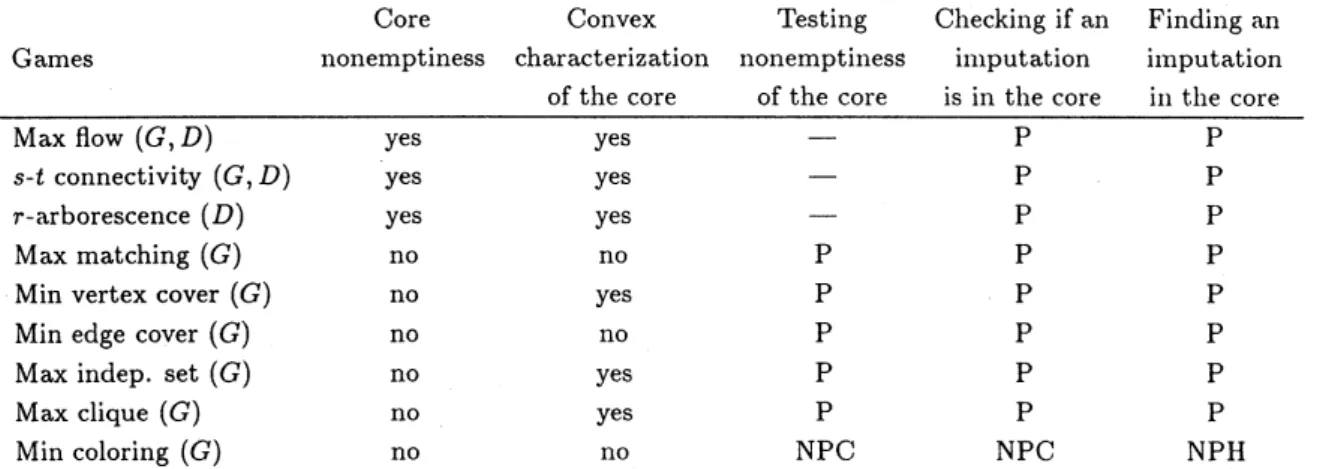
the paper by giving a table of the results considered for the five $\mathrm{p}\mathrm{r}\mathrm{o}\mathrm{p}\mathrm{e}\mathrm{r}\mathrm{t}\mathrm{i}\mathrm{e}\mathrm{s}/\mathrm{q}\mathrm{u}\mathrm{e}\mathrm{s}\mathrm{t}\mathrm{i}\mathrm{o}\mathrm{n}\mathrm{S}$ raised in Section 2.
Table 1. Summary of the results for optimizationgames on graphs.
Core Convex Testing Checking if an Finding an
Games nonemptiness characterization nonemptiness imputation $\mathrm{i}_{1}\mathrm{n}\mathrm{p}_{\mathrm{U}}\mathrm{t}\mathrm{a}\mathrm{t}\mathrm{i}_{0}\mathrm{n}$
$\frac{\mathrm{o}\mathrm{f}\mathrm{t}\mathrm{h}\mathrm{e}\mathrm{C}\circ \mathrm{r}\mathrm{e}\mathrm{i}_{\mathrm{S}\mathrm{i}\mathrm{n}\mathrm{t}\mathrm{h}\mathrm{i}1\mathrm{t}\mathrm{h}\mathrm{o}}\mathrm{e}\mathrm{c}\mathrm{o}\Gamma \mathrm{e}1\mathrm{e}\mathrm{C}\mathrm{r}\mathrm{e}}{{\rm Max} \mathrm{f}\mathrm{l}\mathrm{o}\mathrm{w}(G,D)-\mathrm{p}\mathrm{p}}$
of thecore
yes yes
s-t connectivity $(G, D)$ yes yes $\mathrm{P}$ $\mathrm{P}$
$r$-arborescence $(D)$ yes yes $\mathrm{P}$ $\mathrm{P}$
${\rm Max}$matching $(G)$ no no $\mathrm{P}$ $\mathrm{P}$ $\mathrm{P}$
${\rm Min}$vertex cover $(G)$ no yes $\mathrm{P}$ $\mathrm{P}$ $\mathrm{P}$
${\rm Min}$edge cover $(G)$ no no $\mathrm{P}$ $\mathrm{P}$ $\mathrm{P}$
${\rm Max}$indep. set $(G)$ no yes $\mathrm{P}$ $\mathrm{P}$ $\mathrm{P}$
${\rm Max}$clique $(G)$ no yes $\mathrm{P}$ $\mathrm{P}$ $\mathrm{P}$
${\rm Min}$ coloring $(G)$ no no NPC NPC NPH
$D:\mathrm{d}\mathrm{i}\mathrm{g}\mathrm{r}\mathrm{a}_{\mathrm{P}}\mathrm{h}\mathrm{S}_{)}G$: undirected graphs, $\mathrm{P}$: polynomial time,NPC: $\mathrm{N}\mathrm{P}$-complete, NPH: $\mathrm{N}\mathrm{P}$-hard, –: trivial
References
[1] X.DengandC.Papadimitriou,“OntheComplexityofCooperative Game SolutionConcepts,”
Mathematics ofOperations ${\rm Res}$earch, 19, 2, pp. 257-266, 1994.
[2] J. Edmonds, “Edge Disjoint Branching,” Combinatorial Algorithms, edited by R. Rustin,
Academic Press, New York, 1973.
[3] L. R. Ford, andD. R. Fulkerson, “Flows in Networks,” Princeton University Press, Princeton,
1962.
[4] C. Futia, “The Complexity of Economic Decision Rules,” J. of Mathematical Economics, 4,
pp. 289-299,
1977.
[5] M. R. Garey and D. S. Johnson, “Computers and Intractability: A Guide to the Theory of
$\mathrm{N}\mathrm{P}$-completeness”, SanFrancisco, W.H. Freeman&Company, Publishers, 1979.
[6] M. $\mathrm{G}\mathrm{r}\ddot{\mathrm{o}}\mathrm{t}_{\mathrm{S}}\mathrm{C}\mathrm{h}\mathrm{e}1$, L.
Lov\’asz,
andA. Schrijver, “Geometric Algorithms and Combinatorial
Opti-mization,” Springer-Verlag, Tokyo, 1988.
[8] E. Kalai, “Games, Computers, and O.R.,” $ACM/SIAM$Symposium on Discrete Algorithms,
pp. 468-473, 1995.
[9] E. Kalai and W. Stanford, “Finite Rationality and Interpersonal Complexity in Repeated
games,” Econometrica, 56, 2, pp. 397-410, 1988.
[10] E. Kalai, and E. Zemel, “Totally Balanced Games and Games of Flow,” Mathematics of
Operations Research, 7, pp. 476-478, 1982.
[11] E. Kalai, and E. Zemel, “GeneralizedNetwork Problems Yielding Totally Balanced Games,”
Operations Research, 30, pp. 998-1008, 1982.
[12] N. Megiddo, “OnComputable Beliefs ofRationalMachines,” Gamesand Economic Behavior,
1, pp. 144-169, 1989.
[13] H. Nagamochi, D. Zeng, N. Kabutoya, and T. Ibaraki, “Complexity of the Minimum Base
Games on Matroids,” to appear in Mathematics of Operations Research.
[14] M. Padberg, “Linear Optimization and Extensions,” Springer, Berlin, 1995.
[15] C. H. Papadimitriou, “Game Against Nature,” J. of Computing Systems Science, 31, pp.
288-301, 1985.
[16] L. @. Shapley, “On Balanced Sets and Cores” Naval ${\rm Res}$earch Logistics Quarterly, 14, pp.
453-460,
1967.
[17] H. Simon, “Theories of Bounded Rationality,” in Decision and Organization, R. Radner
(ed.), North Holland,
1972.
[18] J. Szep and F. Forgo, “IntroductiontotheTheory of Games,” D.Reidel Publishing Company,