Title The Knowledge-Bridging Process in Software Offshoring from Japan to Vietnam
Author(s) Nguyen, Thu Huong; Umemoto, Katsuhiro; Dam, Hieu Chi
Citation The Electric Journal of Information Systems in Developing Countries, 64(9): 1-29
Issue Date 2014
Type Journal Article
Text version publisher
URL http://hdl.handle.net/10119/12354
Rights
Copyright (C) 2014 The Electronic Journal of Information Systems in Developing Countries. Thu Huong Nguyen, Katsuhiro Umemoto, Hieu Chi Dam, The Electric Journal of Information Systems in Developing Countries, 64(9), 2014, 1-29. Description
T
HEK
NOWLEDGE-B
RIDGINGP
ROCESS INS
OFTWAREO
FFSHORING FROMJ
APAN TOV
IETNAMNguyen Thu Huong
Japan Advanced Institute of Science and Technology, Japan
Umemoto Katsuhiro
Japan Advanced Institute of Science and Technology, Japan
[email protected] Dam Hieu Chi
Japan Advanced Institute of Science and Technology, Japan
[email protected] ABSTRACT
The role of coordinators in highly knowledge-intensive international business has been increasingly portrayed as filling the communication, cross-cultural, social gaps; or facilitators of knowledge sharing and knowledge transfer. However, they do not mention the process coordinators cooperate with partners to create new knowledge; whereas a critical issue is to facilitate the collaboration among partners in international and cross-cultural context. Our study bridges this gap by studying the knowledge-bridging process of bridge System Engineers (bridge SEs) in the software offshore development context. Our analysis pointed out that beside required knowledge, bridge SEs utilized background of long term residence or study abroad; and “bridging-knowledge” to adjust communication contents before information is sent from one side to another. Based on the theoretical work of Nonaka and Takeuchi (1995) and empirical evidence of bridge SEs in Software Offshoring from Japan to Vietnam; we further develop the model of Knowledge-bridging process to show how the bridge SEs, the vendor and the client interact to create technological, business, bridging knowledge and decrease the cultural gaps.
KEYWORDS: Bridge SEs, know-how, tacit knowledge, explicit knowledge, knowledge-bridging, knowledge creating.
1. INTRODUCTION
Software offshoring, a fairly recent high tech international business trend, makes a significant contribution to the global economy through job creation, innovation and stimulation of the internalization process1. According to a report on ICT research2, the total revenue of offshoring during 2010 was US$124.41 billion, equivalent to 29.3% of the total output of the outsourcing industry worldwide.
In offshoring, each contract is signed with a different client and with different requirements, which results in a “custom-manufactured” product. Offshoring a “custom- manufactured” product such as software requires significant interaction between partners and each partner in turn needs to have knowledge of the software, technology, culture, language and business domain of the other. To fill the gaps between two partners, bridge SEs - a type of coordinator who mediates and enhances the relationship between clients and vendors - may be utilized (Nguyen et al., 2011).
The prior studies on coordinating process refer boundary spanning (Malinowski, 1922; Allen and Cohen, 1969; Adam, 1976), cultural margining (Stonequist, 1935; Bochner,
1 Among Fortune 1000 firms, 95% use an Offshore Strategy (Hatch, 2005). 2
http://computerworld.com.ph/xmg-global-releases-2010-outsourcing-year-end-revenue-forecast/ (accessed on 2011/02/14).
1982) and information gatekeeping (Metoyer-Duran, 1993; Von Hippel, 1976), cross-cultural collaborating process (Smith, 1999; Motoo, 2004). However, the coordinating roles in technological and business related issues are not explained in detail. Furthermore, the coordinators in those studies have roles of boundary, marginal, gatekeeping; worked isolated with low performance and do not directly join in the production process.
Recent studies on coordinators in the context of highly knowledge-intensive industries emphasized their role to fill social, technological gaps; their role as facilitators of knowledge sharing; and their roles in knowledge transfer process (Barner-Ramussen et al., 2008; Milewski et al., 2008; Boden and Avram, 2009; Nguyen et al., 2011). Kotlarsky et al. (2008) emphasized that managers of software global software projects should consider their organization in terms of knowledge processes, rather than information flow. However, no empirical study analyzed the specified roles of coordinators in knowledge creation process between the clients and vendors
The purpose of this paper is to explore the knowledge creating process of bridge System Engineers, embodied in the roles and the working process of bridge SEs. From which, we develop a theoretical model of knowledge-bridging process, with the collaboration of the vendor - bridge SEs - the client. Some major research questions guiding the research are: (1) How have bridge SEs created new knowledge in the software offshoring process; (2) What kinds of new knowledge have bridge SEs created in the process?
We adopt a case study approach to explain the social behaviors of individuals, how individuals interact and the way mutual understanding is negotiated. The case is the software offshoring process between the biggest software offshore company in Vietnam - FPT Software - and two of their main Japanese clients. Through findings on bridge SEs, the research provides suggestions and recommendations for practitioners in international business cooperation in global knowledge economy.
To date, coordinators have usually been considered to play a mediating role, filling linguistic and cross-cultural gaps, information processing and acting as cultural adaptation facilitators, not directly joining in the production process. Through the case of bridge SEs, we found that bridge SEs joined directly in the software production process, by going back and forth between Vietnam and Japan. Beside communication, technological skill, knowledge of multi-business domain; they utilized experience of studying or long term residence in Japan and “bridging knowledge” to adjust communication content before it is sent to other side. The knowledge was created through collaboration with the Vietnamese vendor, bridge SEs and the Japanese clients in four phases of knowledge-bridging process model: sharing, aligning, calibrating and storing. We suggest that the knowledge-creating process among partners in international and cross-cultural context should be studied more closely by both academics and practitioners.
2 RELATED WORK
2.1 Knowledge Management in Cross-cultural context
The concept of “knowledge” can be discussed from many different perspectives such as the nature of knowledge and knowledge relationships within a specified context (e.g., Hedlund, 1986; Nonaka and Takeuchi, 1995; Polanyi, 1958). Knowledge embedded in formal rules, tools and processes that can be easily passed on using systematic language is named “explicit knowledge”. Knowledge which we know but find to be difficult to put into words, difficult to articulate and transfer, is named “tacit knowledge” or “implicit knowledge” (Nonaka and Takeuchi, 1995; Polanyi, 1958). While many knowledge-based models have mentioned the nature of knowledge, some have focused on knowledge relationships with specified business
contexts. Because this study discusses how actors in the Knowledge Management process deal with knowledge, the concept of knowledge relationships, rather than the nature of knowledge, is the main focus.
Knowledge in customer relationships can be categorized as customer knowledge and technical knowledge. Gebert et al. (2003) proposed three aspects of customer knowledge: knowledge for customers, about customers and from customers. Knowledge in business relationships has been categorized into technical knowledge and client knowledge (Empson, 2001; Orshi et al., 2007; Wieandt, 2008). According to Nonaka and Takeuchi, knowledge has been created through two dimensions, epistemological and ontological dimensions. There are four levels of knowledge creation: individual, group, organization and inter-organizational level. A spiral emerges when the interaction between tacit and explicit knowledge is elevated dynamically from a lower ontological level to higher levels. In this research, we focus to analyze the inter-organizational level of the knowledge creation process that takes place through the interaction with members outside of the organization such as clients, suppliers and so on.
According to Nonaka (2004), all the works on the creation, dissemination and leveraging of knowledge to make group or organization successful can be classified as Knowledge Management. The key idea of Nonaka and Takeuchi (1995)’s work is the process of knowledge creation process which is described by SECI model (socialization, externalization, combination and internalization) (see Figure below). In the first stage, the socialization of tacit transforms to knowledge that can be codified and transferred from tacit to explicit in the second stage call “externalization”. The third stage is to combine different externalized knowledge in the previous stage. This combination increases the amount of tacit knowledge which will be internalized in organization. The socialization of this new tacit knowledge is a virtuous circle which is considered as a process of knowledge creation.
With increasing globalization and the emergence of a knowledge society, knowledge and its international management have become crucial factors for gaining and sustaining competitive advantage (Blecker and Neumann, 2000). Unfortunately, knowledge management is not an easy task because of the multi-faceted nature of the boundaries, cultures, processes and organizational structures involved (e.g., Bressman et al., 1999; Lee, 2001; Nonaka and Takeuchi, 1995; Smith et al., 2008). Among these issues, cultural differences and the cross-cultural context play an important role for and influence global knowledge creation and management (Desouza and Awazu, 2005; Holden, 2001; Kohlbacher and Krahe, 2007; Weir and Hutchings, 2005). Holden (2001), in particular, argued that knowledge management in the global economy is a form of cross-cultural management while also admitting that culture should be considered as a form of knowledge, be treated as an organizational resource and as an object of knowledge management.
Most scholars mentioned knowledge management in cross-cultural context in the form of knowledge transferring, knowledge sharing, knowledge creating through the practical contexts of international joint ventures, multi-national cooperation, alliances and acquisition. Through a longitudinal study of North American-based joint ventures between North American and Japanese firms, Inkpen and Dinur (1998) presented the knowledge management processes and the primary types of knowledge associated with each process. The knowledge associated with technology sharing was classified as explicit, objectified knowledge because it was explained to relate to product designs or specific manufacturing processes. The knowledge sharing is conducted through Joint Venture-parent interactions, although there was a high potential for sharing tacit, collective knowledge such as associated with a commitment to product quality. Personal transfers had the potential to transfer tacit, difficult to articulate knowledge, such as beliefs and norms of behaviors. Finally, through strategic integration, JV partners can gain access to objectified, explicit knowledge as well as cultural related, communal knowledge about organizational behaviors and norms.
Nguyen (2009) was the first to define the term “Cross-cultural knowledge management”. She also developed clockwise and counter-clockwise spiral models of CCKM through empirical work with two cases of French-Vietnamese joint venture and Japanese-Vietnamese joint venture. The clockwise spiral model visualizes cross-cultural knowledge creation in usual direction, described the embeddedness of culture. There are three phases: fragmentation, integration and differentiation which overlapped with each other. The counter-clockwise described the opposite direction that may occur in the cross-cultural knowledge creation process.
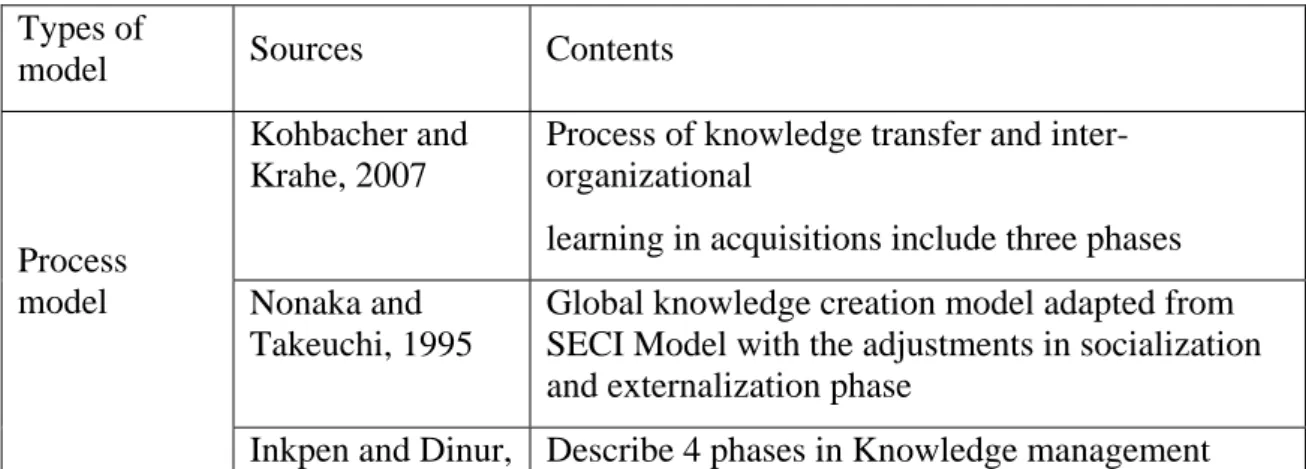
We synthesize the models of cross-cultural knowledge management that have been mentioned by scholars and their main contents in the table below.
Table 1: Models of Knowledge Management in Cross-cultural Context Types of
model Sources Contents
Process model
Kohbacher and Krahe, 2007
Process of knowledge transfer and inter-organizational
learning in acquisitions include three phases Nonaka and
Takeuchi, 1995
Global knowledge creation model adapted from SECI Model with the adjustments in socialization and externalization phase
1998 process and types of knowledge in each phase Nguyen, 2009 Clockwise and counter-clockwise spiral models of
CCKM includes three phases
Factor model
Bhagat et al., 2002
Describe the relationship between effectiveness of Cross-cultural knowledge transfer with the type of knowledge, the nature of transacting cultural patterns and the cognitive styles of the individuals involved in such transactions.
Bresman et al., 1999
Discussed five factors influencing to cross-cultural knowledge transfer
Smith et al., 2008 Discussed the factors influencing
inter-organizational knowledge transfer occurring from donor firm, recipient firm, nature of knowledge and inter-organizational dynamics.
Actor model
Yashiro, 2008 Present cross-cultural knowledge creation model in technology transfer with the involvement of dual core personnel
Among these models, some include strategies to cope with barriers in cross-cultural knowledge management such as utilizing leadership (Nguyen, 2009), on the job cross-cultural training (Black and Mendenhall, 1990; Forster, 2000; Krishna, 2004), utilizing “third culture” (Hui and Graen, 1997, Pauleen, 2007); “cultural match” (Krishna et al., 2004) or “coordinator” (Honda et al., 2004; Braun, 2007; Mahnke et al., 2008). The coordinators in highly knowledge-intensive cooperation (such as high-tech industries) involve with technological, multi-business domains of business and not only transfer but also collaborate with partners to create new value, knowledge. This finding raises the need to study about knowledge coordinating process in highly knowledge intensive and cross-cultural collaboration.
2.2 Coordinators in Cross-cultural Collaboration 2.2.1 Cultural Marginality
The cultural marginality refers to people who have internalized two or more cultural frames of reference or arise in a bi-cultural or multi-cultural situation. These people are supposed to play important role in intercultural communication (Taylor and Osland, 2003). Stonequist (1935) mentioned that the marginal individual passes through a life-cycle: introduction to the two cultures, crisis and adjustment. The first stage is the stage of preparation when the individual is being introduced into the two cultures. Without at least partial assimilation the individual would not later experience the conflict of loyalties. He further explained that the assimilation is often an unwitting process in which the individual does not realize he is taking over two cultures and not conscious of any personality problem; usually this stage is confined to childhood. The second stage has the character of a “crisis”: the individual, through one or more defining experiences, becomes aware of the cultural conflict which involves his own career.
Regarding the role of culturally marginal people, Bochner (1982) concluded that marginal people are often ideally suited to boundary spanning or mediating roles between
cultures, since they understand both cultures objectively and subjectively. Beside many positive points of utilizing cultural marginal people such as adjusting and harmonize the differences between cultures, there are some negative aspects to marginality. Marginal people such as expatriates feel that they live on the periphery rather than at the centre of a group of community (Osland, 1995). This can translate in to less opportunity to speak or be heard because they are not members of the dominant coalition. This may also consciously or unconsciously monitor their communication to reflect their marginal role.
2.2.2 Expatriate Managers or International Managers
Expatriate or international manager is defined as an executive who is able to assume a leadership position fulfilling international assignments across countries and cultures (Pucik and Saba, 1998). Expatriates can be used for a number of different reasons: for specific staffing needs (a vacancy exists in a foreign unit), for management development purposes (development of an internationally experienced management team) and for organization development purposes (control and coordination, knowledge transfer and instilling corporate culture) (Riusala and Suutari, 2004). Thomas (1994) found that expatriates are important for developing Multinational Corporations because they are able to act as the links through which subsidiaries can connect to the host countries to obtain useful resources. The working efficiency of expatriates can also be evaluated by the completion of assignments, cross-cultural adjustment and performance.
Au and Fukuda (2002) based on a survey on 232 expatriates working in Hong Kong concluded that expatriates provide benefits to multinational corporations when they enact boundary spanning roles. Their findings also indicated that local experience and the diversity of social networks were conductive to the boundary spanning activities of expatriates, whereas environmental uncertainty and overseas experience has little effect. By engaging in boundary spanning activities, expatriates felt less role ambiguity and gained role benefits and were more eager to use the resources that were found within different communities of the host country.
2.2.3 Information Gatekeeper
“Gatekeeper” has been used broadly to describe those people who act as agents of acculturation when they disseminate information within their ethnic communities. Gatekeepers are an important group of people who link people with alternatives or solutions by serving as information providers who move between cultures. They can be considered as receivers and disseminators of information, influencers of public opinion, or facilitators of cultural adaptation (Metoyer-Duran, 1993). Also, as von Hippel (1976) found, boundary spanners who serve representational roles are often not an effective or highly utilized source of information for other relevant organizational members.
Utilizing gatekeepers has been discussed in many studies as one way to deal with the difficulties of communicating across differentiated boundaries (e.g. Liu, 1995; Katz and Tushman, 1981) because they are capable of understanding and translating contrasting coding schemes. With the help of gatekeepers, external information can flow into the systems by means of a two-step process. Gatekeepers are able to gather and understand external information and new technological developments and subsequently, are able to translate this information into terms that are more meaningful and useful to their more locally oriented colleagues (Katz and Tushman, 1979).
2.2.4 Boundary Spanners
Malinowski (1922) first introduced the idea of a person who communicates across different groups and establishes links among them. After 40 years, some research explored the nature of boundary spanning and boundary spanning roles (such as Adams, 1976; Starbuck, 1976). The organizational literature has used the concept of “boundary spanners” to refer to specific agents who appear key to the relationships between distinct groups, at the intra- and inter-organizational levels (Allen and Cohen, 1969; Tushman, 1977). There is a series of research on the roles of boundary spanning. Aldrich and Herker (1977) identified two distinct functions of boundary spanning roles: information processing and external representation of the organization to outsiders. Using longitudinal network data collected during labor negotiation, Friedman and Podolny (1992) found that boundary spanning is a differentiated function that is not necessarily loaded onto one person: some individuals among the group of people on the bargaining team broker ties toward their opponents (known as representatives). Meanwhile, others broker ties from their opponents (known as gatekeepers) and some broker social emotional ties (known as trust brokers) and others broker task-oriented ties (known as advice brokers).
While many scholars discussed the role of boundary spanners in organizational contexts, some mentioned boundary spanners in the context of MNC. Kostova and Roth (2003) suggested that boundary spanners within MNCs create personal contact networks with people in other units through which colleagues from their own units can then benefit and that this micro-macro process facilitates access to information across-units and the building of organizational trust. In the same MNC context as Kostova and Rosh (2003), Barner-Ramussen et al. (2008) pointed out three important skills of boundary spanners including cultural skills, social capital and language skills. They also recommended that instead of treating boundary spanners as a homogenous group, one should perhaps approach the issue in terms of “degree” or “level” of boundary spanning, or as a Russian-doll structure where there are inner and outer circles of boundary spanning activities. Kotlarski et al. (2009) in a study of the role of a transactive memory system in bridging knowledge boundary, concluded that organizational, functional, hierarchical, cultural and other differences between individuals in group can be translated into knowledge gaps which create difficulties for collaborative work.
Recently, some studies mentioned the role of bridge engineers in global distributed work as boundary spanning roles. Johri (2008) emphasized that with the emergence of globalization, an increasing number of engineers are now playing the new role of boundary spanners and are brokering knowledge across geographic boundaries. He pointed out that beside skills such as working across time zones, using technology effectively and developing interpersonal networks, there are additional tacit aspects of this role that can be learned only through participation. In line with Barner-Ramussen et al. (2008), Milewski et al. (2008) and Du and Pan (2013) presented the concept of bridges from a social network perspective. They concluded that human actors play key roles in social networks, influencing the fate of software development projects. Bridges are facilitated by people who are acting naturally for managing and mediating communication and filling the structure holes in social networks. Usually they work with both sides, visit remote sites and spend time working there and are often expatriates who have lived in different countries and experienced different cultures. Reviewing existing studies on boundary spanners, Du and Pan (2013) synthesized that the person filling this bridge role must be both an internal and external communication star. To become an internal star, the individual needs to obtain strong technical skills, so that he will be frequently consulted by internal members on work related matters. To become an external star, the individual needs to possess communication skills, so that he can acquire external requests and respond to them skillfully.
We share the same views with above studies and adopt their term in our study in terms of cultural skill, social capital and communication skills. However, we also found that Barner-Ramussen et al. (2008), Milewski et al. (2008), Johri (2008) and Du and Pan (2013) have not mentioned the working process of this bridge role, especially how have they collaborated with both sides to co-create new knowledge, value while this is critical by the increasing trends in international business cooperation in highly knowledge-intensive industries.
3. RESEARCH METHOD
We chose the case study as our research method for three reasons. First, the main research question is based on “how” and is thus better answered through inductive method (Walsham, 1995). A case study is the preferred research method when “how” and “why” questions are being asked because they deal with operational links needing to be traced over time, rather than mere frequencies or incidence (Yin, 2009). Therefore, a case study is an appropriate approach for this study, especially when it focuses on explaining the social behaviors of individuals, how individuals interact and the way mutual understanding is negotiated. Second, since our study present a phenomenon within a real-world context - the case of the software offshoring process between the biggest software offshore company in Vietnam and two main Japanese clients – the case study method favors the collection of data in natural settings, compared with relying on “derived” data (Bromley, 1986, p.23), such as, responses to a researcher’s instruments in an experiment or responses to questionnaires in a survey. Third, choosing to conduct interpretive case study in Information System field adheres to the trend since the early 1990s, by the increasing importance of interpretive research in Information System field (Walsham, 2006).
We chose the offshore outsourcing between FPT Software and their two main Japanese clients as our case study. FPT Software has been the fastest-growing and biggest company in Vietnam’s software offshore development industry. Also, FPT Software has been the company which utilized Bridge SEs effectively due to the 58% software production revenue from Japanese market. Bridge SE is a new role in this offshore company, which has been supposed to facilitate the relationship between vendors (China, Vietnam, etc.) with Japan clients. However, no study has explored their working process, especially the process how they involved the offshore work to facilitate the relationship and co-create with both sides to create new value, knowledge for the collaboration. From studying the work of bridge SEs, it could provide practical implications for other software offshore companies in Vietnam that have plans to exploit bridge SEs.
Another reason to choose FPT Software as the case is that they are one or three cases following on from our last study in terms of software entrepreneurship in Vietnam. We could utilize the data base and relationship of previous study in the current data collecting process.
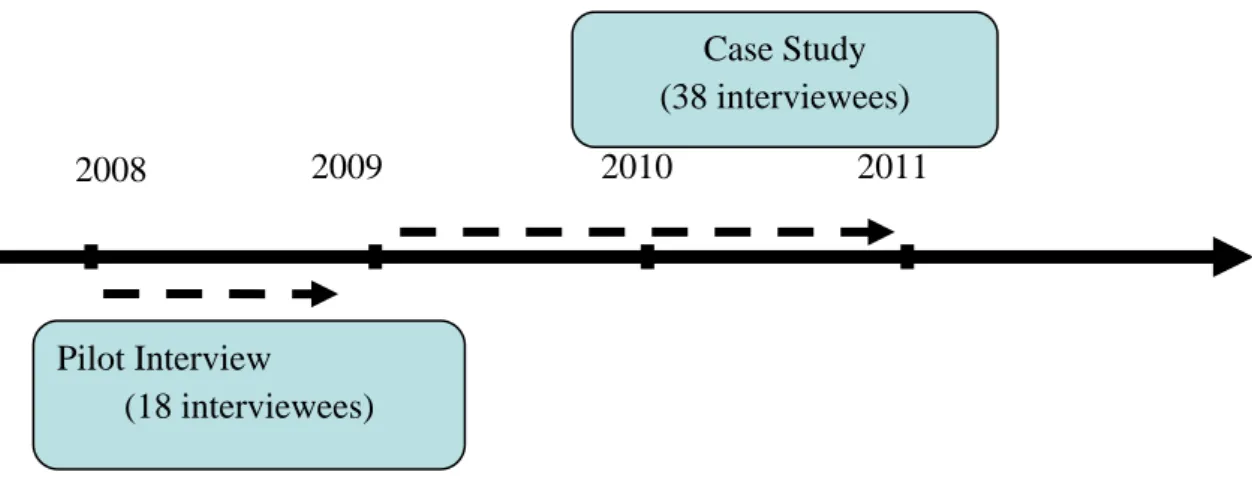
Data collection: The data was collected into two phases: the first was in 2008 and 2009; and the second was in 2010 and 2011.
Figure 2: Data Collection Schedule
In the first phase, our objective is to explore factors that affect the offshore relationship between FPT Software and their main clients and to expose the emerging role of the Bridge SEs to deal with above factors. Findings of the pilot interview are helpful to modify the research questions and to identify the main focus of the study (to assure that the study goes in the right direction). In 2008, FPT Software divided into 21 operation groups which are located in the 3 main cities of Vietnam: Hanoi, Da Nang and Ho Chi Minh City. We collected data with 3 operation groups in Ha Noi and onsite managers, Bridge SEs who are working in FPT Japan.
The data collection was composed of both primary and secondary sources. The primary data analysis is based on semi-structured interviews with group leaders, project managers and team leaders. The first step of interviews took place at the headquarters of FPT Software in Hanoi with group leaders and project managers of offshore projects that relate to Japanese clients (total of 12 interviews). The main content of the questionnaire examines the relationship between offshore software development projects and Japanese clients including advantages, disadvantages of communication process, solution for difficulties and other issues. Each of the interviews lasted for between 1 and 2 hours. The researcher visited 3 Operation Groups and joined in 2 distance meetings of offshore projects regarding offshore work for Japanese clients. The second step of semi-structured interviews was conducted in October 2009, via email and telephone. 12 interviews were carried out with the same interviewees, 6 other onsite managers and Bridge SEs who work in Tokyo. The contents of the questionnaire are on the role of Bridge SE in the offshore relationship between Japanese clients and the groups that we conducted interviews with in the first phase. The interviewees reported on the type of coordinators they used when communicating with clients, role of each type of coordinators, working processes and requirements for each type of coordinators.
In the second phase in 2010, interviews were taken with 13 interviewees in Ha Noi, including the CEO of FPT, CEO of FPT Software (a subsidiary of FPT Corporation), directing managers, project managers and team leaders who manage or have working relationship with Bridge SEs. The researcher spent one week observing in the FPT Software office and recorded working behaviors of the project team and participated in conference meetings between project members with Bridge SEs who are onsite in Japan. Follow up questions were also conducted by email with some keys interviewees. During Dec. and Jan. 2011, interviews with 20 interviewees in FPT Japan including CEO, Vice president, Human Resource manager were conducted. The data collection in Tokyo focused on Bridge SEs and key members in the offshoring relationship. Five interviewees from two main Japanese
2008 Pilot Interview (18 interviewees) Case Study (38 interviewees) 2009 2010 2011
clients including project managers and project engineers; were contacted by email for follow up.
Data analysis: The case analysis includes three parts. In the first part, we present the working process of bridge SEs, which is written in narrative, as Eisenhardt and Graebner (2007) highlighted that “rich qualitative data is readily addressed by simply presenting a relatively complete rendering of the story within the text. The story typically consists of narrative that is interspersed with quotations from key informants and other supporting evidence. The story is then intertwined with the theory to demonstrate the close connection empirical evidence and emergent theory (p.29).
In the second part, we adopted the theoretical works of Barner-Ramussen et al. (2008) and Milewski et al. (2008) in terms of cultural, social and communication skills to analyze the gaps and the skills of bridge SEs. We then expand the discussion to the context of offshoring outsourcing by analyzing the business domain, technical and other issues. In the third part, we adopted four mode of knowledge conversion in SECI model of knowledge creating process (Nonaka and Takeuchi, 1995) to indicate the knowledge bridging process model of bridge SEs.
After completing the data analysis, the reports were sent to the respondents to verify whether our presentation matches the intention of their original comments. Secondary sources were also used, including document reviews on organizational structure, IT businesses and their business strategy, as well as corporate websites, annual reports and the company brochure. To minimize the risks of misinterpretation or data inaccuracy when using secondary data, we sent the report to the interviewees as well as some of their Japanese customers. Furthermore, we compared our secondary data with data of the Vietnam Software Association (VINASA, a software business association headquartered in Hanoi Software Centre) regarding profiles and other information of FPT Software.
4. CASE ANALYSIS 4.1 Case Background
FPT Software Joint Stock Company (homepage: www.fpt-soft.com) is a subsidiary of FPT Corporation. During the past 20 years, FPT Software has been the fastest-growing and biggest company in Vietnam's software offshore development industry. FPT Software has businesses in the domains of Banking and Financial Services, Utilities, Telecom, Manufacturing, Insurance, Government and Public Services, IT Services, Retail and Infrastructure. They provide software services such as: Software Development, Maintenance, ERP Implementation, Quality Assurance Testing, Migration Services, Business Process Outsourcing and Embedded Systems Development. Their business segmentation focuses on the overseas market. Their biggest sales market is Japan, with 19 clients, which accounts for 58% of software production by revenue. Other areas are Asia Pacific (14%), USA (13%), EU (10%) and the domestic market with only 5% of production.
Company A and Company B were recommended as elements of the case study by the general manager of FPT Software because of the significant business they had engaged in over the previous year. Client Company A is one of the leading companies in Japan in the IT services consulting field. They focus on three core businesses, information processing services, software development and system sales. Their main aspects of work include Finance Services (Security/Banking), Governments, Schools, Construction and General Companies with nearly 1200 employees. Company A has two main product packages: Security product and System Integration. Client Company B is a technology company and one of the world’s largest manufacturers of computer printers and of information and imaging related equipment.
The main aspects of their work include development, manufacture, sales, marketing and servicing of imaging products, electronic devices and precision products with nearly 80,000 employees in consolidation and 13,000 employees in the parent company. Company B’s main sales revenue comes from imaging products with 68.6% of total sales.
4.2 The Working Process of Bridge SEs
Based on the data collected by observation and interview, we presented the work of bridge SEs into four main phases.
The first phase is “Planning with client and offshore project”. Bridge SEs synergistically interact with members in both Vietnam and Japan to complete their bridging work. In the beginning of the offshoring process, bridge SEs receive information from team leaders of the client teams in terms of overview requests, for example, a request for offshoring a software development full cycle such as enterprise resource planning, or an operation, integration system, or application level – to revise or input functions in the electronic banking system. After that, the designers and programmers explain detailed requests, including their requirements about quality, progress, delivery time, testing and risk management. With some offshore contracts related to Japanese finance and banking, health care, stock market, sales bridge SEs receive training about basic and specified business domain knowledge of the offshore contract from the person in charge of business. During this phase members in client companies often shared their mindsets, anxiety about the capacity of FPT Software’s offshore teams and their viewpoints about the offshore contracts with bridge SEs. The second group that bridge SEs interact with is offshore teams in FPT Software. First, Project Managers explain the draft response to develop the offshore software product based on the overview requests that offshore teams receive from the client. Second, project managers and project technical leaders explain the process to develop each module of the offshore contract. Based on this information and on the observations in the discussion with offshore team members, bridge SEs estimate the mindsets and attitudes of offshore teams.
The second phase is “Breaking down requirements; design plan and transfer”. Through the whole process, bridge SEs need to use their knowledge, soft skills and the networks they have created to assess and address the differences between the two teams with different national backgrounds. Basing on their technical, business, cultural related differences, bridge SEs align information and knowledge before it is transferred from client to offshore team and conversely, from offshore team to client. The main purpose is to minimize the gaps of the two partners by empathizing, attitude reading and problem solving. Some techniques to adjust the information before it is transferred from one side to another, such as:
• Arranged, modeled the requirements, product development plan into charts, graphics, tables, systemized, filtered information (9/16 bridge SEs)
• Created mind mapping, video and images simulation and excel memo functions3 to support explanations (6/16 bridge SEs)
• With some business system in offshore contracts (Japanese stock market rules and regulations, personal income calculation system, a customer management system in a Japanese clinic) (5/16 bridge SEs)
Self-learnt through books, internet and created notes about business domain
3
Discussed with members in client company, Japanese staff in FPT Software, Bridge SEs’ seniors and refined notes
Used familiar examples with Vietnamese people to explain new business knowledge
• Created supplementary documents to explain for offshore teams in case where client’s requirements are short and simple (3/16 bridge SEs)
The third phase is “Problems solving, review, fix, final quality assurance and deliver the product”. Bridge SEs are often seen as coordinators who stand outside of the relationship. However, their roles are alternative and flexible depending on the nature of the project and the requirements from the offshore team and the client team. In some projects, Bridge SE calibrate and are involved in almost all steps in the offshoring process. In such cases, bridge SEs merge with the client’s team to design the requirements, to review the product and evaluate the project quality. In other cases, bridge SEs merge with the offshore team to design the plan together with project manager. Bridge SEs are often involved in the review, bug fixing and quality assurance phase. Bridge SE also work as project system engineers. This takes significant effort and requires a high level of technical skill. Not all Bridge SEs have enough capacity and knowledge to deal with calibrating step; it is especially difficult for some Bridge SEs without university education background in IT4. In some cases, the offshore project manager does not have enough skill to manage the project. In these situations, bridge SEs manage the offshore project together with the offshore project manager. In a few cases, bridge SEs returned to Vietnam to break down the client requirements or join the offshore team during the coding stage to assure the product was delivered on time.
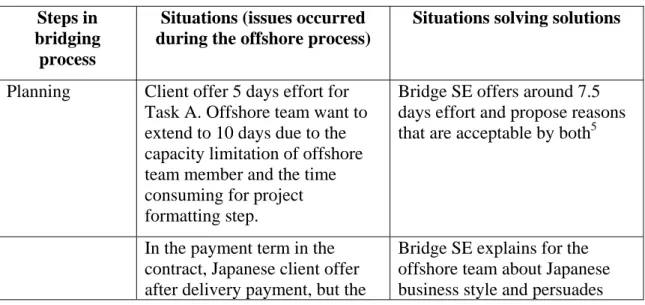
When resolving problems such as misunderstanding or conflict, bridge SEs harmonize the relationship between the two partners by proposing the solutions that he supposed would be acceptable by both sides. Sometimes, they need to motivate the offshore team by encouraging them when the work load is high, or when the team is under pressure, often during times when the have received complaints from the client. We explain more about our arguments by listing and analyzing the bridge SEs’ social behaviors in the Table below
Table 2: Problem Solving Situations of Bridge SEs Steps in
bridging process
Situations (issues occurred during the offshore process)
Situations solving solutions
Planning Client offer 5 days effort for Task A. Offshore team want to extend to 10 days due to the capacity limitation of offshore team member and the time consuming for project formatting step.
Bridge SE offers around 7.5 days effort and propose reasons that are acceptable by both5
In the payment term in the contract, Japanese client offer after delivery payment, but the
Bridge SE explains for the offshore team about Japanese business style and persuades
4
Interview with Mr. Le Tec Nen - Former Bridge SE on 2010/12/15 in Ha Noi, Viet Nam.
5
offshore team offer before delivery payment or step by step delivery payment due to
perceived risk.
them to accept after delivery payment.6
Requirement transfer and design plan confirmation
Client design the requirement by Japanese engineer language. Offshore team does not understand the requirement contents.
Bridge SEs7:
organization meetings share with offshore team the skill to read the document by
creating memo (excel memo function) and guide them which part should read first send the simulation videos or
images to illustrate for explanation.
modeling the document into mind mapping format Offshore project manager and
project technical leader design plan but client’s designer could not understand (due to the cross-cultural difference, immature in report writing)
Bridge SE creates additional documents for the design plan before transferring to client. Besides, he creates Guidelines (Format) for offshore team for the next project.
In the Q and A (Questions and Answers regarding requirements and design plans), offshore team members do not ask the right question (Yes/No)…
Bridge SE8 creates Q and A Guide line for offshore team: minimize the Yes/No
questions
ask questions and propose some solutions
synthesize and filter the questions before asking… Review, Fix,
Quality Assurance
Offshore team member and client team member have different mindset about quality assurance. Offshore ignore some stages in review process.
Bridge SE9 has meeting with offshore team to explain the mindset of client about quality assurance and create Review process manual for offshore team (self-review, peer-review, technical leader review, quality
6
Interview with Mr. Vu Tien Thinh - Bridge SE on 2010/11/12 in Tokyo, Japan.
7
Interview with Mr. Nguyen Duc Kinh and Nguyen Hoang Duong - Bridge SEs on 2011/01/22 in Tokyo, Japan.
8
Interview with Mr. Nguyen Hoang Cong - Bridge SE in 2011/1/22 on Tokyo, Japan.
9
assurance engineer review…) Bridge SE10 reviews the product
before it is being delivered to the client and found some mistakes. Bridge SE asks offshore team fix the bugs (mistakes) but they do not accept.
Bridge SE raises the problems to the client’s team leader and ask them send request directly to offshore team.
Delivery In some final days before the deliver time, Bridge SEs feel the offshore team effort and
progress is not enough to deliver timely.
Bridge SE11
Encourages the offshore team to keep the deadline
Asks the client letting offshore teams have some break days before continuing the next step.
After proposing solutions for both sides, bridge SEs refined the ideas by discussing them with Japanese native staff and senior bridge SEs in FPT Japan.
Ogawa san is the person who told me that “ho-ren-so” manner or quality related issues should be strictly obeyed. From that I know that I should not compromise with the above issues and should encourage offshore teams to obey these Japanese rules12.
When the client asked me to transfer some directives to the offshore team, I did so and offshore members said that they understood and would follow. However, they understood wrongly and repeated the same mistakes in the next step. I discussed the problems with some senior bridge SEs. They suggested me to ask offshore team members to send confirmation emails about what they understood about problems13.
In parallel, bridge SEs communicate with members in the client company to create a close relationship. The social networks with member in client’s groups are supposed to be critical for their bridging work, rather than other required skills for a bridge SEs.
I have a close friendship with a designer in NTT Soft, who helped me understand clearly about business domain knowledge, the real thinking, views, attitudes of the client team and sometimes information about future business plans of the client which could bring potential offshore contracts for FPT Software. Especially, this designer helped me a lot in cost negotiation. At the beginning of the project, I keep discussing with him about the status and difficulties of offshore team. He then helped me to explain for his PM why I proposed X-Y-Z cost14.
In order to build up business knowledge guidelines for the offshore team, I’m always proactive to study and receive explanations from a team leader in MHTS. Sometimes, the client team members did not satisfy with my work or offshore team, but they keep quiet, say
10
Interview with Mr. Ho Viet Hong - Bridge SE in 2011/1/22 on Tokyo, Japan. 11
Video conference interview with Mr. Vu Tien Thinh - Bridge SE on 2011/1/17.
12
Interview with CongNH – a bridge SE on 2011/01/22
13
In interview with KinhND - a bridge SE on 2011/01/22
14
nothing. The team leader helped me to understand what his team was thinking and suggested me some solutions to deal with problems15.
The last phase is “After delivery: Externalizing and Sharing Experience”. Bridge SEs accumulate their experience by collecting, gathering and externalizing their tacit knowledge, experience and know-how into explicit knowledge. They make Japanese tacit knowledge (knowledge about process, clients and occurring situations) embedded in the requirements which are then understood by offshore teams. They then make the offshore teams’ Vietnamese tacit knowledge (knowledge about offshore team capacity, limitations, occurring situations) understood by Japanese team members. Externalizing this type of tacit knowledge occurs through creating reports, such as the postmortem report for an evaluation meeting16.
I often take not all situations and issues that I think that it will be useful for me and for my juniors in future in all working phases, from planning phase to after delivery phase. For example, in planning phase I summarize some patterns that often occurs issue and how I solved problems. Or in review phase, after giving a lot of effort to help offshore team to review and fix code, I found that I need change the way to review: give review rule for offshore team and only review sampling. Finally, after writing postmortem analysis and evaluation meeting with offshore team and client, I synthesize all experience I got in the phases into a handover documents folder17.
I have learnt a lot from Japanese client. Because of the requirements from clients, Bridge SE needs to sit beside client team member. We work together, eat together and even live together in an apartment which help me have chance to understand about Japanese thinking ways, sense, manner and so on. Also, I have learnt from their behaviors, their manners when they answer the telephone of their clients18.
At a higher level, after externalizing knowledge in each offshore project, some bridge SEs have combined and synthesized experience from different projects and different clients into the forms of manuals, handbooks, guidelines that are easier to share with others.
4.3 The Roles and Skills of Bridge SEs
In this part, we adopted three concepts in the studies of Barner-Ramussen et al. (2008) and Milewski et al. (2008) in terms of cultural, social and communication skills to analyze the gaps and the skills of bridge SEs and expand the discussion to the context of offshoring outsourcing by analyzing the business domain and technical issues.
Communication gaps occur when two partners come from different countries without a common language. In this case, Japanese clients do not like to speak English, while few Vietnamese software engineers can speak Japanese. The case analysis revealed that the communication gap is the biggest challenge in offshoring from Japan to Vietnam. Two solutions include utilizing coordinators (communicators, or Bridge SEs) and employing a project manager who can directly communicate with the partners in Japanese. Utilizing bridge SEs is a high cost, but effective solution. Bridge SEs often speak Japanese at level 2 in the Japanese Language Proficiency Test, which means bridge SEs have taken at least 600 hours of Japanese courses, can make advanced business conversation and have a vocabulary of 1000 Kanji words and 6000 Japanese words. Bridge SEs fill the language gaps between Japanese clients and FPT Software when they translate clients’ requirements, offshore team’s software development plans, offshore contracts and all the communication contents from the
15
Interview with NgaNM – a bridge SE on 2011/01/23 16
In Japanese they are called kaizen teian and hanseikai (改善提案と反省会) 17
Video conference interview with Mr. Nguyen Hai Duong - Bridge SE on 2011/01/19 18
beginning to the end of the project. Bridge SEs create supplemental documents to explain some concepts that exist in the Japanese IT sector, Japanese business manners and other cultural traditions that do not exist in Viet Nam, such as “ho-ren-so” manner and “reichyo” manner.
The cultural gaps occur in this case mainly in the form of business manners and the difference of viewpoints about the connection between work and private matters and the customs when mistakes occur during the production process. Bridge SEs use their language, cultural understanding to analyze the strengths and weaknesses of each partner and differences between the two partners, estimate their mindsets and thinking and use this understanding to propose solutions and reconcile differences. For example, clients expect that Vietnamese engineers obey the “ho-ren-so” manner (to report, contact and discuss whenever a problem occurs) while Vietnamese engineers tend to solve problems, continue to work and report the mistakes when delivering the product. Bridge SEs evaluated this weakness of the offshore teams and persuaded them to change, adjust and adapt themselves to this custom of the client. In another situation, the Vietnamese engineers often commented that they do not understand the requirements and the responses of the clients clearly because they are so ambiguous and abstract. Bridge SEs persuaded the client to remedy this weakness by clarifying their requests or writing supplementary documents. In parallel, they motivate offshore team members to confirm the discussions’ contents with client via emails. By these actions, bridge SEs help the Vietnamese and Japanese engineers to overcome cultural gaps.
Our findings in terms of social capital and networks of bridge SEs support Milewski et al. (2008) and Du and Pan (2012)’s discussions. Bridge SEs play critical roles in social networks of vendor team and client team and therefore facilitate the software development projects. They could be called “internal communication stars” in the group when have stronger power than project managers (PM). They can command the work of the PM. In some cases, if they found that the capacity of PM is not enough to manage the offshore project effectively, they could ask the leaders of FPT Software to find another PM for the project. Bridge SEs have the power to ask offshore project member to conduct the detailed requests of the contracts, or requests from the Japanese client. As a representative of FPT Software’s offshore team or could be called an “external communication star”, bridge SEs express and analyze the difficulties of the offshore team. Based on this, bridge SEs can convince Japanese client companies to adjust and match the ability and the context of the service provider. During the time working in the client teams, bridge SEs give comments and judgments about the client team’s staff to the leader of the client.
Bridge SEs work in both a position as a bridge (a coordinator) and a position of an insider who is a member of a team, group or project. Bridge SEs join the Japanese client company as a member of that company and understand most about FPT Software, allowing them to draft contract requirements and outline how requirements match with the capacity and the context of FPT Software. To achieve this they are often sent to Japan well before a project starts.
In parallel, bridge SEs join in offshore teams of FPT Software as members who understand the Japanese clients. They both analyze the requirements of the client and support offshore teams in designing the product development plan to match the requirements of the client. They conduct discussions online or sometimes return to Vietnam to do these tasks. Bridge SEs working places are flexible; they go to overseas partner’s offices and return to their home country many times during each project. In the following stages, bridge SEs works as members of the client teams, as they understand most about Vietnamese engineers and offshore teams, which helps them evaluate the product development plan and to consult
for the client to adjust their requirements to match with the capacity, context of Vietnam, of FPT Software in general and Vietnamese engineers in particular. By this characteristic, bridge SEs are deeply involved in designing requirements, preparing development plans and revising the products as insiders in the offshoring process.
Each software offshore contract has different contents. Some contracts involve developing application software in business domain such as finance, banking or health care. In general, the Japanese clients understand both business domain knowledge and common rules and laws of Japan. Meanwhile, Vietnamese engineers lack both business domain knowledge and common understanding of personal income tax law, insurance law, securities law, the medical and hospital system and so on in Japan. It is very difficult for Vietnamese offshore teams to develop offshore even if they receive detailed requirements from the Japanese clients. In order to fill this gap, bridge SEs study through books and internet and create notes about the Japanese business domain. They then work with members of the client company, native staff in FPT Japan and bridge SEs’ seniors, to refined the notes which created by bridge SEs. Finally, bridge SEs use examples familiar with Vietnamese people to explain new business knowledge and arrange training classes for Vietnamese engineers.
Beside communication, cultural and business gaps, there are some technical related issues. The gaps in IT skills result in increased time needed to complete work. In another situation related to software product quality checks, the rules to check and test software products of Japanese clients are loose, not indicated in a specified review process. Meanwhile, FPT Software engineers have no experience about the priority order in the review process and omitted a number of critical stages. Bridge SEs join in the process of checking and fixing mistakes and learn and develop review process guidelines, confirm changes with clients; and provide training for offshore team about the review process. In cases of multiple mistakes, bridge SEs return to Vietnam to solve problems directly with the offshore team.
One important finding from the case is that bridge SEs can fill the above gaps because they join directly in the offshore software production contract. Not only transferring the communication contents between two partners, bridge SEs take part in drafting the requirements as a member of the client company. They also take part in drafting the software development plan in Vietnam. We also found that among skills for a bridge SE, communication skill is more important than other skills.
4.4 The Knowledge Bridging Process of Bridge SEs
From the working process of bridge SEs in practice, we developed the “knowledge- bridging process” model, based on the four modes of knowledge conversion in the knowledge creating process model of Nonaka and Takeuchi (1995). The knowledge conversion takes place in four phases: knowledge sharing, knowledge aligning, knowledge calibrating and knowledge storing
4.4.1 The First Mode: From Tacit Knowledge to Tacit Knowledge (Sharing Phase)
First, the client shares with Bridge SEs about their requirements, desire, mindsets, attitudes, viewpoints regarding the work they want to send offshore. The vendor shares with Bridge SEs about their capability to satisfy the terms in the client’s requirements, their desire, mindsets, attitudes, viewpoints. In parallel, Bridge SEs share with two partners the potential gaps, problems that might me occur during the cooperation process.
The first phase in the process (Sharing) is developed basing on the first concrete bridging step (Planning with client and offshore project). In detail, when a project starts, the Japanese client discuss the draft of the requirements with bridge SEs. After understanding the
overview of the drafts, bridge SEs have responses, consult with the client teams regarding what should be revised, adjust to match the capacity, backgrounds and context of the offshore team in Vietnam. After that, bridge SEs have meetings with offshore team members to design technical plans, team organization, cost…in which bridge SEs share information about clients including client’s mindset, attitude, budget, characteristics of the client team leaders and so on. The “Sharing” phase take place first because the client themselves do not understand clearly and detailed about their requirements, sometimes just beginning from the draft ideas. And the interacting and sharing with Bridge SEs is helpful for them to clarify their ideas. The vendor produce tools, the human resource but they don’t have the work and don’t knowledge the detail contents of the work. Besides, there are gaps between the vendor and the client company which are located in different countries in term of culture (viewpoints, mindsets), business knowledge, technological knowledge and language which need ‘sharing’ to break down the gaps. In the end of this phase, bridge SEs after receiving sharing information from the client and the vendor, acquire initial impression about requirements of the clients, capacity of the vendor, mindsets, attitudes, viewpoint of each partners and the gaps between two partners and some potential risks. Most of this knowledge is tacit, embedded in bridge SEs’ thinking which basing on their experiences and observations during interaction to estimate about the vendor, the client.
4.4.2 The Second Mode: From Tacit Knowledge to Explicit Knowledge (Aligning Phase) In the aligning phase, Bridge SEs use their comprehensive knowledge and understanding about two partners, combining with acquired tacit knowledge in the “Sharing” phase to analyze and clarify the requirements and the product development plan, using some typical techniques, such as mind mapping, video or images simulation, memo addition. Or, when explaining some difficult or high level specialized contents, bridge SEs use examples, metaphors that make the partner understandable. More importantly, in this phase, bridge SEs analyze the differences between two partners, the strengths, the weaknesses, causing problems. In parallel, bridge SEs find solutions to solve problems, reconcile the differences and then exchange their ideas with some special members such as foreign staff in the vendor company, their key partnership in the client company, or some senior bridge SEs to refine, narrow down ideas and solutions.
The second phase is developed basing on the second bridging step (Breaking down requirements; design plan and transfer). When the client and offshore team have agreements on cost and other terms, bridge SEs break down the requirements, create supplemental documents for unclear points and ask client teams to adjust unreasonable terms. Bridge SEs use these documents to explain to the offshore team about technical requirements and conduct training about business related contents such as Japanese finance and banking, health care, stock market, sales. On the other hand, bridge SEs confirm, adjust the design plan of offshore team, create supplemental documents to harmonize with the requirements of the client; and then transfer to the clients. Sometimes, bridge SEs arrange meetings for two partners to discuss the problems occurring.
“Aligning” phase is critical because the existence of many differences between two partners from language, business, technological knowledge to the strengths, weaknesses. Without the aligning from bridge SEs, the client and the vendor find it difficult to overcome obstacles blocking the smooth cooperation. In the end of this phase, bridge SEs have clearer image about how to transfer the requirement contents understandable by the vendor and how the client could understand the product development plan of the vendor. Bridge SEs codify their thinking, tacit knowledge that they acquired into documents.
4.4.3 The Third Mode: From Explicit Knowledge to Explicit Knowledge (Calibrating Phase)
In the calibrating phase, Bridge SEs use the modified and supplemental documents that they created in the aligning phase to discuss with the client and the vendor together to adjust the contract contents to match with each other; to solve the problems occurring and to check the quality, find the mistakes and revise them. If in the sharing and aligning phase, Bridge SEs stand outside to transfer the communication contents, then they stand inside to develop the product from this ‘calibrating’ phase.
As insiders of service provider, Bridge SEs determine the mistakes; check mistakes and rectify them. By being involved in the real work of product development process, they understand and could find critical reasons to negotiate when the deadline need to extend. As insiders of clients, Bridge SEs push service provider team to assure the quality, the progress and sometimes check, test all products again.
The third phase in the model (Calibrating) is developed basing on the third bridging step (Problems solving, review, fix, final quality assurance and deliver the product). Bridge SEs help the offshore teams and client teams analyze the occurring problems regarding change requirements, bugs, misunderstandings or business customs differences. Besides, they help client team check product quality, determine bugs and ask the Vietnamese engineers to fix the bugs.
This phase is very important for bridge SEs to confirm their ideas, their proposed solutions for problems are reasonable or not. In the end of this phase, the client with the coordination of Bridge SEs has a better understanding about their detailed requirements, about the capacity of the vendor, the differences between them and the vendor and the strengths, the weaknesses of the vendor. Conversely, the vendor also has a better understanding about the client.
4.4.4 The Fourth Mode: From Explicit Knowledge to Tacit Knowledge (Storing Phase) In the storing phase, Bridge SEs first externalize and accumulate in a postmortem report the problems that they met in project; the ways they align, calibrate the work; the attributes of people they contacted. They then join in the project evaluation meeting with the participation of the vendor team, the client team and Bridge SEs; to evaluate the completion of the project (require - response), working efficiency of team members, KB manager. KB helps the vendor evaluate the client, the client evaluate the vendor more accurately. By this accumulating phase, Bridge SEs share knowledge with both partners and acquire synthesized comprehensive knowledge, soft skills. If the project succeeds and Bridge SEs could deal with the work well, they receive trust, relief from client and relief from the service provider.
The fourth phase in the model (Storing) is developed basing on the fourth bridging step (After delivery). When the offshore products have been delivered, the tasks of bridge SEs are summarizing the mistakes, problems in all offshore bridging phases, preparing and organizing the postmortem meetings. More importantly, the documents then accumulate and save into common assets to share with other members in two companies in future projects.
From the contents of the postmortem meetings, the client capture some new tacit knowledge about the vendor, the vendor company’s members gain some new tacit knowledge about the clients. And bridge SEs also have a new understanding about the gaps between the client and the vendors and the bridging knowledge.
4.4.5 The SACS Model of Knowledge Bridging Process
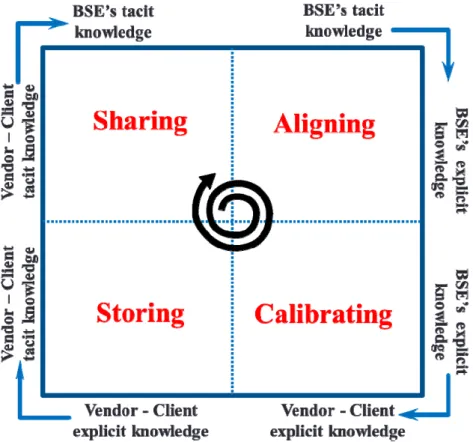
Figure 2 - the knowledge-bridging process model - illustrates the process when the clients, the vendors and Bridge SEs collaborate to create new value, new knowledge, in which bridge SEs have central role in the process with four phases: (1) Knowledge Sharing, (2) Knowledge Aligning, (3) Knowledge Calibrating and (4) Knowledge Storing (see Figure 3).
In each phase, especially in the final phase, Bridge SEs create “bridging knowledge” including (1) know-how to interpret one’s ideas understandable to the others; (2) know-how to bridge the business manners, mindset, capacities gaps; (3) know-how to check software product quality; (4) know-how to manage the relationship with the client (5) and know-how to manage the relationship with vendor teams.
Know-how to interpret one’s ideas understandable to the others by clarifying the requests and the responses and transferring such as systemizing, modeling, using mind mapping, video and images simulation, create supplement documents to explain ambiguous communication contents.
Know-how to bridge the business manners, mindsets, capacities gaps between two partners by problems solving such as reconcile the different viewpoints of FPT Software and Japanese clients about deadline to deliver offshore products; persuade the FPT Software team members to change, adjust and adapt to the “ho-ren-so” manner of Japanese clients; negotiate with Japanese clients to accept the manner of having tight connection between work and private things.
Know-how to check software product quality by joining the project to check, fix the bugs and from that creating quality check guideline, hand over documents including bridge SEs experiences regarding the attributes of Japanese clients (the loose rules to check, test products, often not indicated review process); the attributes of FPT Software engineers (no experience about the priority order in review process, omitted a number of critical stages in product review process).
Know-how to manage the relationship with clients through interaction, practice works with members in client teams such as establishing close relationship with some staff members in Japanese client companies; helping the client understand the positive and negative points of Vietnamese engineers; estimating the risks from FPT Software teams and inform the client; informing the occurring problems accompanying with solutions.
Know-how to manage the relationship with the vendor teams through interaction, practice works with members in FPT Software’s offshore teams such as coming back to Vietnam to solve problems or to join in the offshore product development process as an official member in some urgent cases; tell offshore teams the mindsets, attitudes, expectations of the client; or to explain the difficulties, asking for sympathy of the Japanese client for the situation and context of FPT Software teams.
Figure 3: SACS Model of Knowledge-Bridging Process
The SACS knowledge-bridging process model starts with the “Sharing” phase in which bridge SEs use their existing comprehensive knowledge (language skills, technical, business, cross-cultural, social skills) to acquire tacit knowledge in the form of mindsets, attitudes, policies of two partners. In the second phase, Bridge SEs use their comprehensive knowledge, combining with understandings about mindsets, attitudes, policies of two partners to align, harmonize and reconcile the differences between two partners. This phase helps them attain experiential knowledge such as persuasion and negotiation skills. In the third phase of the bridging process, Bridge SEs merge in client and service provider teams, to calibrate the work as a member of this partner to interact with another partner. This phase gives them chance to polish their communication skill, upgrade their business knowledge, technical knowledge and understandings about the vendor and the client’s process model and business manner. The last phase happens when Bridge SEs have meetings with members in client and members in service provider through online conferences to accumulate, synthesize and evaluate the project and store knowledge. These four bridging phases repeat in other projects, other clients and the knowledge has been enriched through the spiral. The cross-cultural synergistic interaction takes place in all phases, in which Bridge SEs could interact with individuals in group, group, intra-organization and inter-organization. For example, in the case of software offshoring, bridge SEs contact with project manager to design the product development plan; with quality assurance group when checking product quality, with offshore vendor leaders or client leaders. Another important attribute of four phases is Bridge SEs work as a bridge in two upper phases; and as insiders in two lower phases.
5. SUMMARY
This paper discusses the roles of bridge SEs in the software offshoring and explores their knowledge-bridging process to co-create new knowledge for the vendor and the client. Our analytical framework is based mainly on theoretical work of Barner-Ramussen et al. (2008)
and Milewski et al. (2008) on important skills of boundary spanners; and Nonaka and Takeuchi (1995) on four modes of knowledge conversion in knowledge creating process model. Our study expands the discussion to the context of inter-organizational and cross-cultural knowledge management and provides empirical evidence on the involvement of bridge SEs on the knowledge creating process.
The case of software offshoring from Japan to Vietnam shows that bridge SEs have the key role to promote the knowledge co-creating process among the vendor, the client and bridge SEs by:
(1) joining directly in the software production process,
(2) using their communication, cross-cultural, social, technological skills, multi-domain of business knowledge and experience of studying abroad or long term residence in Japan and “bridging knowledge” to adjust communication content before information is sent from one side to other side
(3) having strong power, work as both insiders and outsiders at the same time.
Differing with the knowledge creating process model of Nonaka and Takeuchi which described in organizational context, our study expands the discussion to inter-organizational and cross-cultural context. The knowledge-bridging process model has four phases: (1) Knowledge Sharing which the vendor – client’s tacit knowledge is converted to bridge SEs’ tacit knowledge; (2) Knowledge Aligning which the bridge SEs’ tacit knowledge is converted to explicit knowledge; (3) Knowledge Calibrating which the bridge SEs’ explicit knowledge is converted to vendor-client’s explicit knowledge and (4) Knowledge Storing which the vendor-client’s explicit knowledge is converted to tacit knowledge. There are 3 partners join the knowledge-bridging process to co-create new value (new technological, business knowledge, bridging knowledge and decrease in cultural gaps). Understanding the skills and roles of bridge SEs and their knowledge-bridging process help practitioners to utilize bridge SEs more effective as a key member to promote the knowledge co-creation process. We suggest that the concept of bridge SEs could be employed in inter-organizational and cross-cultural knowledge creating process of Multinational Cooperation or International Joint Ventures of offshoring in other nations.
Although there have efforts to point out a new research direction about the role and the work of coordinators in the highly knowledge intensive collaboration, there still are some limitations. First, we proposed four phases of knowledge-bridging process but have not mentioned the quantitative analysis about the importance of each phase in the bridging process and the contribution of bridge SEs in each phase. Second, the findings are based mainly on the case which utilized bridge SEs effectively (Japanese clients and FPT Software). The other cases that does not utilize bridge SEs or utilized ineffectively (Japanese clients and other Vietnamese IT vendors) have not been explored. Besides, the study focuses only on the knowledge-bridging process between Japan and Vietnam, but the other cases (Japan-India, Japan-China) have not been explored. Therefore, we suggest that more case studies on knowledge-bridging process from Japan to India and from Japan to China, to test the SACS model should be conducted. And comparative case studies of the knowledge-bridging processes between developed–developing countries and between developed–developed countries may receive concern by both academic and practitioners. The work of Bridge SEs is a part of extra value that service providers give to service users. Bridge SEs not only coordinate and bridge but also consult to both parties. From this view, studying the role and the working process of Bridge SEs from service science perspective; the triad collaboration