
Regional Differences in the Perception of
Study Abroad in Japan:A Case Study of
International Exchange Students at Kwansei
Gakuin University
journal or
publication title
Kwansei Gakuin University Humanities Review
volume
22
page range
145-159
year
2018-02-18
Regional Differences in the Perception of Study Abroad in Japan:
A Case Study of International Exchange
Students at Kwansei Gakuin University
Shin TANABE*, Matthias HENNINGS*Abstract
This paper aims to reveal the perceptual differences among interna-tional exchange students who study in Japan. The study analyzes the ques-tionnaire responses of 176 international exchange students at Kwansei Gakuin University (KGU). It elucidates the differences among students in how they became interested in studying in Japan (and at KGU), what they see as their objective for studying in Japan, and how they perceive their study-abroad experience. The authors argue that exchange students from Europe and North America envisage cultural differences between their home countries and Japan, in contrast to students from Asia. While in Ja-pan, students from North America have an inclination to understand the cultural differences through nonacademic programs, whereas students from Europe have a predilection to understand the cultural differences through different academic courses (especially Japan Studies courses). Students from Asia, seem to gain a better understanding of Japanese culture through both academic and nonacademic programs at KGU.
I. Introduction
Since 2007, when it launched the “Asian Gateway Initiative,” the Japanese government announced that it would accept 300,000 international students per year so as to attract and cultivate more talented pro-Japanese foreigners and increase the
────────────────────────────────────────── * Associate Professor, Center for International Education and Cooperation, Kwansei Gakuin
Univer-sity
Kwansei Gakuin University Humanities Review
Vol. 22, 2017 Nishinomiya, Japan
cultural diversity of Japanese society (Breaden, 2013; Lassegard, 2016). Toward this end, the government implemented different international educational projects in suc-cession, such as the Global 30 project, Re-Inventing Japan project, Go Global
Ja-pan project, and the Top Global University Project. As a result of different
govern-ment funding opportunities and relevant scholarship paygovern-ments that promoted these international exchange programs, an increasing number of international students came to Japanese universities from different parts of the world (Sugimura, 2016). According to the Japan Student Services Organization (JASSO), the number of in-ternational students enrolled in Japanese higher education institutions increased from 121,812 in 2005 to 171,122 in 2016. The majority of these international students were Chinese students, who made up 43.9% of the international students in Japanese higher education institutions, followed by Vietnamese students (16.7%), South Ko-rean students (7.9%) and Nepalese students (7.9%) (Japan Student Services Organi-zation (JASSO), 2017). During this period, the number of international students who participated in short-term programs, or nondegree programs that last less than a year, increased from 6,727 in 2005 to 16,788 in 2016. The breakdown of these stu-dents in 2016 was 5,570 Chinese stustu-dents (33.2%), followed by 1,641 American students (9.8%), 1,572 South Korean students (9.4%), 1,312 Taiwanese students (7.8%), and 754 French students (4.5%). In short, while Asian students accounted for the majority of international students studying at Japanese higher educational in-stitutions in general, a significant number of non-Asian international students ac-counted for short-term programs at Japanese higher education institutions. This means that faculty members and administrative officers in Japanese universities should pay attention to the needs of both Asian and non-Asian students when devel-oping programs for short-term exchange students.
While some Japanese universities try their best to welcome short-term exchange students from different social and cultural backgrounds1), the majority of Japanese universities still struggle to accommodate these different students and promote inter-nationalization of their campus. They often face difficulties grasping the objectives and situations of these students who spend a semester or two on their campuses, let alone the perceptional differences among these exchange students.
To stimulate the discussion on internationalization and diversification of Japa-nese universities, this paper reveals the perceptual differences among international students who study in Japan based on the survey results of exchange students at
────────────────────────────────────────── 1 ) Rikkyo University, for example, opened a prayer room in 2016 to better serve the needs of international students, while a cafeteria at Sophia University started to offer a range of halal meals for Muslim students. International Christian University, Waseda University and To-kyo Metropolitan University offer academic writing support to international students so that they are comfortable in writing papers either in Japanese or English.
Shin TANABE, Matthias HENNINGS
Kwansei Gakuin University (KGU). The analysis reveals that while students from Europe and North America became interested in Japan for its exotic and unique cul-ture that is very different from their homes, students from Asia are apt to understand Japanese culture on the basis of the cultural and geological proximity between their home country and Japan. Students from North America have an inclination to savor their cultural differences through their extra-curricular activities in Japan, whereas students from Europe have a predilection to appreciate this cultural difference through classroom activities (especially English-medium courses on Japan). Students from Asia, meanwhile, appreciate the nuance of Japanese culture through both class-room activities and extra-curricular activities.
By considering these differences among international students when developing academic courses and student services for exchange students, Japanese universities may be able to offer more inclusive programs and accommodate international stu-dents as well as promote campus diversity on a deeper level. In what follows, the paper first reviews previous studies that documented the different viewpoints among short-term international students on a study-abroad experience in Japan and intro-duces the questionnaire results of 176 international exchange students who studied at KGU between September 2016 and July 2017. It is hoped that faculty and staff will find this paper useful for restructuring their curricula for the purpose of sup-porting exchange students effectively.
II. The Significance of Study Abroad in Japan
While the number of short-term international students has been increasing in Japanese universities, surprisingly few studies have documented the significance of study abroad in Japan for international exchange students, let alone the different per-ceptions among these students.
One study on the different objectives and results of study abroad in Japan among international students was documented by Ninomiya and Huang, who con-ducted questionnaire surveys with 417 students studying at national, public, and pri-vate universities in Japan. They pointed out that while students from Asia come to Japan for the purpose of deepening their understanding of their academic discipline in addition to their understanding of Japanese language and culture, students from western countries came to Japan to learn the Japanese language, learn about Japa-nese lifestyle and culture, and learn about Japan and Asia. With respect to the re-sults of study abroad in Japan, the two authors indicated that 89.8% of respondents felt their study-abroad program was either “very successful” or “somewhat success-ful”. More American and Europeans marked “very successful” (49.1% and 37.2% respectively) compared to Chinese, Koreans, and other Asians, who marked “very Regional Differences in the Perception of Study Abroad in Japan 147
successful” (24.5%, 11.5%, and 10.9% respectively). They also revealed that inter-actions with the Japanese contributed most to the satisfaction of western students, whereas the kindness of people at Japanese universities (including academics, staffs and students) and the computer environment contributed most to the satisfaction of Asian students (Ninomiya & Huang, 1997).
More recently, Sato analyzed online survey results of more than 300 interna-tional students who studied in Japan for less than a year. She found that while Asian students pursued the acquisition of knowledge and skills relevant to their majors, North American and Australian students were more interested in improving their Japanese language skills, and Europeans were keen on understanding Japanese cul-ture. Analyzing explanatory factors of positive program evaluation among interna-tional exchange students studying in Japan, she found that the quality of Japanese language classes was crucial for European and Australian students, while activities such as field trips mattered most to students from North America. Additionally, in-teractions with Japanese students were positively evaluated by Asian students, while interactions with other international students was considered an important factor for European students (Sato, 2011).
As for qualitative analysis, Hashimoto conducted semi-structural interviews with 24 Australian exchange students who participated in a short-term study-abroad program in seven national universities in Japan. She stated that many of these stu-dents, while motivated to learn about Japanese society in the beginning, soon be-came dissatisfied with the academic courses offered at their respective Japanese uni-versities mainly because of the low quality of teaching (including one-way lectures and opaque assessments) and course contents. As a result, these students diverted their attention from academic activities to nonacademic activities, such as sports and interaction with other international students, for fear of wasting their precious time in Japan (Hashimoto, 2004).
Although each of these previous studies partially documented the different pur-poses and results of their study-abroad experiences in Japan among exchange dents, more research is necessary to reveal the differences among international stu-dents coming from different regions and to elucidate the reasons behind these differ-ences.
III. Study-Abroad Experience at KGU
In what follows, the authors reveals the perceptional differences among ex-change students concerning their study-abroad experience in Japan and at KGU based on an analysis of questionnaire results. The primary objective of this research is to understand the factors that motivated these students to study in Japan, their
Shin TANABE, Matthias HENNINGS
achievements through the exchange program in Japan (at KGU), and their satisfac-tion with the overall study-abroad experience in Japan (at KGU).
Survey Design
Participants
In this study, the authors collected data from 176 international exchange stu-dents who enrolled in KGU’s Contemporary Japan Program (CJP) for a semester or two between September 2016 and July 2017. The CJP is a specially designed pro-gram for incoming exchange students from a network of over 140 partner universi-ties in 36 countries. These students can choose either a Japanese Language Track (JLT; a program that focuses on Japanese language studies) or Modern Japan Track (MJT; a program that focuses on Japan studies through English-medium courses) before they start their program at KGU. Although JLT students can take some English-medium courses and MJT students can take some Japanese language courses as electives, the former students mainly focus on language acquisition while the latter students focus on the understanding of Japanese society and culture in English.
Of all 176 exchange students, 113 students enrolled in JLT and 63 students en-rolled in MJT. 78 students were male and 98 students were female. 55 students (31.3%) came from universities in Asia, 53 students (30.1%) came from universities in North America (Canada and the United States), 16 students (9.1%) from universi-ties in other Anglophone countries (United Kingdom, Australia, and New Zealand), and 58 students (33.0%) came from universities in Europe2). Roughly one third of the students in the survey came from North America and Europe, and slightly fewer respondents came from Asia.
Procedure and Research Instruments
The students in the CJP program were asked to fill out the Questionnaire on
Student’s Study Abroad Experience in Japan in December 2016 and July 2017. This
questionnaire consisted of both multiple-choice questions and open-ended questions and asked for basic personal and program information, students’ objective for study-ing abroad in Japan/at KGU, achievements through the study-abroad experience in Japan/at KGU, the usefulness of academic and nonacademic programs at KGU, and satisfaction with their study-abroad experience. Students could answer the question-naire in either Japanese or English. Some items, such as the quality of KGU classes, usefulness of KGU classes, and study hours per day outside classes both at their
────────────────────────────────────────── 2 ) A student from Mexico and three other students who failed to reveal the location of their
home institution were removed from the analysis.
home institution and at KGU were added to the questionnaire distributed in July 2017. While most students provided their answers using printed questionnaire forms, 20 JLT students used an online questionnaire form in the July 2017 survey.
The questionnaire results were classified and analyzed according to the location of each student’s home institution using both IBM SPSS Statistics and QSR’s NVivo 11 Pro3).
Survey Results
Interest in Japan
To find out the objectives for studying abroad in Japan, we first asked ex-change students why they were interested in Japan. More than half of the exex-change students, regardless of the location of their home institution, indicated that they be-came interested in Japan for its cultural attractiveness. However, there was a clear difference among students with regard to how they perceived Japanese culture: whereas exchange students from the Asian region often described what they consid-ered as Japanese culture using expressions such as “(Japanese) anime,” “Japanese movies and drama,” “Nintendo games,” “Shinto shrine” and “Japanese food,” change students from non-Asian regions often depicted it more broadly, using ex-pressions such as “Japanese culture,” and “Japanese lifestyles.”
Furthermore, as shown in Table 1, while exchange students from Asia per-ceived some cultural differences on the basis of cultural and geological proximity between their home country and Japan, exchange students from non-Asian regions tended to emphasize the uniqueness of Japanese culture and differences with their home cultures by using adjectives such as “different,” “exotic,” and “unique.” Many of these students also used adverbs such as “very,” “so,” and “really” before those adjectives, emphasizing the high level of the foreignness of Japanese culture.
On the whole, while students from the Asian region have a more concrete im-age of Japanese culture, students coming from non-Asian regions have a relatively vague image of Japanese culture and are attracted to its exotic nature. Through an exchange program in Japan (at KGU), the latter students hoped to experience the cultural differences from their home culture and expand their worldview.
Objectives of Studying in Japan
After describing their reasons for being interested in Japan, the students were asked to evaluate the importance of 11 items as their objectives for studying in
Ja-────────────────────────────────────────── 3 ) In this study, the authors paid attention to the location of one’s home institution, not one’s nationality, under the assumption that one evaluates one’s study-abroad experience by com-paring it with one’s undergraduate experience at one’s home institution, not with the culture of one’s birthplace.
Shin TANABE, Matthias HENNINGS
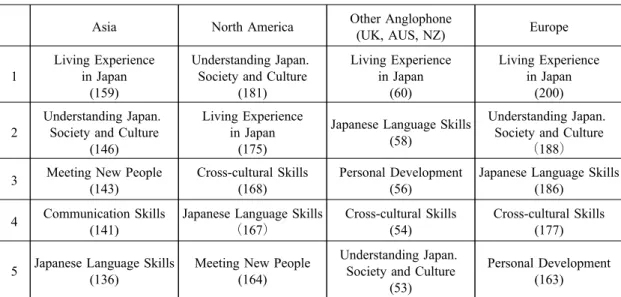
pan. These items included “Japanese language skills,” “understanding Japanese soci-ety and culture,” “experience of living in Japan,” “career development and future employability,” and “meeting new people and making friends.” They were asked to evaluate the items’ importance by circling either “not at all important (1),” “some-what important (2),” “moderately important (3),” or “very important (4).” The authors summed all the scores of “moderately important” and “very important” per item and created rakings classified by the location of students’ host universities (Ta-ble 2).
As is clear from the table, the majority of international students chose to study in Japan to have a “living experience in Japan” and to understand Japanese society and culture. Different from the arguments made by Ninomiya and Huang, and Sato, who found that Asian students tend to pursue the acquisition of knowledge and skills relevant to their majors, the majority of students (regardless of the location of their home institutions) in the survey seem to have decided to study in Japan (at KGU) to learn and experience Japanese culture. Interestingly, however, many stu-dents from non-Asian regions ranked “cross-cultural skills” as third and fourth in their important objectives for studying in Japan. This contrasts sharply with students from Asia who ranked “cross-cultural skills” seventh in their list. It seems that stu-dents from non-Asian regions expected to encounter cross-cultural differences when they studied in Japan more than students from Asian regions.
Table 1 Reasons for being interested in Japan
Students from Asia It’s a neighbor of the Great Han (China). It has a unique aesthetic in life. It bears the ashes of the Han’s culture.
Everything is very similar to my country, Taiwan. So I wonder about those differ-ent things and cultures in Japan.
Close country and has a different culture. It is one of the developed countries in the world.
Students from North America
I was interested in the culture because it was so different from my native culture. I want to become a more open-minded person. As Japan is very different from Can-ada and the West, I thought it would expand my worldview the most. Also, I love kanji and the Japanese language in general.
Students from other Anglophone countries (UK, AUS, NZ)
I study Japanese at university and find Japan very interesting as it is so different from Australia. Japan has a rich culture and long history unlike Australia.
I am interested in Japan because the culture is different from my own, and it has a rich history.
Students from Europe I was very interested in Japan’s unique culture, which really differentiates it from any other (Asian) country.
The country is very different from western countries. I wanted to learn and under-stand it more. Even among Asian cultures, the country is a unique and interesting combination of old and new.
0% 20% 40% 60% 80% 100% Japan KGU Japan KGU Japan KGU Japan KGU
Very Much Mostly Students from North America
Students from UK/AUS/NZ Students from Europe Students from Asia
Perceptions of Study-Abroad Experience in Japan and at KGU
If exchange students have different objectives and perceptions about studying in Japan, how did these students perceive their study-abroad experience in Japan and at KGU? Chart 1 shows exchange students’ overall satisfaction with the study-abroad experience in Japan and at KGU.
As the chart shows, more than 80% of exchange students felt satisfied with their study-abroad experience in Japan, regardless of the location of their home in-stitutions. Looking at the percentage of students who chose “very much” (satisfied), it is clear that these students valued their experience in Japan over their experience at KGU. This was especially pronounced in students from North America: more than 60% of them said that they were “very much” satisfied with their study-abroad experiences in Japan, while less than 40% of them said that they were “very much”
Table 2 Study objectives of Exchange Students Classified by the Location of Home Institutions
Asia North America Other Anglophone(UK, AUS, NZ) Europe
1
Living Experience in Japan
(159)
Understanding Japan. Society and Culture
(181) Living Experience in Japan (60) Living Experience in Japan (200) 2 Understanding Japan. Society and Culture
(146)
Living Experience in Japan
(175)
Japanese Language Skills (58)
Understanding Japan. Society and Culture
(188) 3 Meeting New People(143) Cross-cultural Skills(168) Personal Development(56) Japanese Language Skills(186) 4 Communication Skills(141) Japanese Language Skills
(167)
Cross-cultural Skills (54)
Cross-cultural Skills (177) 5 Japanese Language Skills
(136)
Meeting New People (164)
Understanding Japan. Society and Culture
(53)
Personal Development (163)
Numbers in parenthesis describe the sum score of “ moderately important” (3 points) and “very important” (4 points).
Chart 1 Satisfaction with Study Abroad in Japan
Shin TANABE, Matthias HENNINGS
satisfied with their study-abroad experience at KGU. It seems that the experience outside the campus contributed to the satisfaction of these students. While the ma-jority of students valued their experience in Japan over their experience at KGU, if we combine the numbers of “very much” and “mostly,” we get a slightly different picture: while students from non-Asian regions still prioritized the study-abroad ex-perience in Japan over the study-abroad exex-perience at KGU, students from Asia per-ceived their abroad experience at KGU more positively than their study-abroad experience in Japan.
One may be able to understand the reason for this difference by looking at the correlation between “satisfaction of study abroad in Japan” and usefulness of aca-demic factors (Japanese language courses, Japan studies courses, etc.) and nonaca-demic factors (residential life, club and circles, Global Student (GS) network etc.). Table 3 shows the correlation using Spearman’s correlation. While academic factors (especially Japanese language courses) and nonacademic factors (especially residen-tial life and Nihongo partner [Japanese language partner] program) seem to have contributed to the satisfaction of students from Asia, nonacademic factors (residen-tial life, GS network, and Nihongo partner programs) seem to have contributed to the satisfaction of students from North America, and academic factors (especially Ja-pan studies courses) seem to have contributed to the satisfaction of students from Europe.
Table 3 Correlations between “satisfaction with study abroad in Japan” and usefulness of program factors classified by the location of respondents’ home institutions
Japanese Language Courses
Japan Studies Courses
Other Courses
at KGU Residential Life
Asia 0.398** 0.289 0.140 0.383**
North America 0.179 0.047 0.123 0.446**
UK, AUS, NZ 0.325 0.194 −0.029 −0.262
Europe 0.218 0.307* −0.082 −0.046
Club and Circles GS Network
Volunteering/ Internship Opportunities International Events (Coffee Hours) Nihongo Partner Program Asia 0.006 −0.022 0.143 0.226 0.312* North America 0.147 0.449** 0.242 0.185 0.475** UK, AUS, NZ −0.070 −0.028 −0.143 0.043 0.338 Europe −0.163 0.255 −0.095 0.222 −0.148 **p<.01, *p<.05
This trend can be also identified in the written comments by students who de-scribed why they were satisfied or not satisfied with their study-abroad experience in Japan/at KGU, as shown in Table 4.
As these comments indicate, while students from North America valued their overall study-abroad experience (especially extra-curricular activities) in Japan, stu-dents from Europe valued their study-abroad experience centered on courses (espe-cially English medium courses on Japan) at KGU. Students from Asia, meanwhile, appreciated both academic and nonacademic programs and offered high praise for KGU’s facilities, such as its dorms and classroom buildings that allowed them to engage in activities with others and to utilize their leisure time effectively in Japan.
* * *
Although students from North America tend to value their study-abroad experi-ence in Japan, they tend to question the quality of the academic programs at KGU. In fact, the additional survey conducted in July 2017 indicated that 18 out of 24 (75%) students from North America felt that the workload for classes at KGU was either “much lighter” or “lighter” than their home institutions, and 11 out of 24 (45.8%) of these students thought that the quality of classes at KGU was either
Table 4 Reasons for satisfaction with the study-abroad experience in Japan/at KGU
Students from Asia I’m totally satisfied. This program helps me brush up my Japanese, make friends with Japanese students, and much more.
KGU has a good exchange student program and network. Also, the campus is beau-tiful and quite easy to use.
The activities are filled with our leisure time and the facilities of the campus are fantastic. We can do whatever we like.
Students from North America
It gave me the opportunity to see what living in Japan is like. It also showed me how to be more independent. I learned a lot about the Japanese lifestyle.
The classes are the only thing I am dissatisfied about. Besides that, I have loved be-ing in Japan.
Japan was a good experience, but Kangaku was not because I don’t like the school system―lots of pointless work.
Students from other Anglophone countries (UK, AUS, NZ)
CIEC has gone above and beyond to ensure that exchange students have a produc-tive and enjoyable life at KGU.
KGU provided excellent language courses and always demonstrated their devotion to the students. It was a wonderful experience, and I only wish I had had the cour-age to take the advantcour-age of more opportunities.
Students from Europe I have amazing memories from my time spent in Japan, and I have learned so much interesting things about the Japanese culture in classes.
Generally, the teachers were good and I am satisfied. However, it’s been very busy and it’s been hard to keep my motivation up the entire semester.
It was a great experience! I learned a lot and got to use more Japanese, which was really great. The classes were interesting, and everyone was really kind and helpful.
Shin TANABE, Matthias HENNINGS
“much worse” (1 students) or “worse” (10 students) than their home institutions. Fewer than 40% of students from North America stated that they studied more than 2 hours per day outside their classes at KGU, even though approximately 75% of them had said that they studied more than 2 hours per day outside their classes at their home institutions.
Some of the following comments illustrate these students’ frustration with the academic courses (especially English-medium courses on Japan) at KGU.
Japanese studies and other courses taught in English seemed to have interest-ing topics, but the actual material was either too basic or uninterestinterest-ing enough to seem useless.
Some international study courses boast great syllabi, but the class content was very shallow or focused on rather irrelevant material…some professors are knowledgeable and have merits, but as a teacher there is definitely a lack of teacher professionalism.
In short, students from North America perceived classes at KGU as lax and poor quality compared to ones at their home institutions. They felt that instructors at KGU did not engage with students and failed to offer structured course contents like the ones they had experienced in their home universities.
Nonetheless, eight out of ten students from North America indicated that they still achieved their personal development through the study-abroad program. As the following comments show, these students felt that they became more malleable and independent as they stayed away from their home country and explored a different culture through the study-abroad program in Japan.
I have greatly enjoyed my time here. I previously felt restricted both person-ally and academicperson-ally to western culture. I am very happy that I now have a broader understanding of the world and have made friends whose lives are very different from my own.
I have grown significantly, in my ability to understand, work, and bond with others of different backgrounds than my own.
Thus, although these students from North America seemed to be dissatisfied with the classes at KGU, they were satisfied with their overall study-abroad experi-ence in Japan. In particular, they felt satisfied with extra-curricular activities, such as residential life, GS network, and Nihongo partner programs (see Table 3). Overall, they seemed to experience personal development through their stay in Japan.
* * *
Different from students from North America, students from Europe seemed to be relatively satisfied with the courses at KGU. According to the additional survey conducted in July 2017, 9 out of 15 students (60%) agreed that KGU’s courses were either “lighter” or “much lighter,” and only 5 out of 16 students (31.3%) said that KGU was “worse” than their home institution (no student from Europe chose “much worse”). In terms of usefulness, 10 out of 16 (62.5%) of students from Europe agreed that KGU’s courses were either “useful” or “very useful,” whereas only 54.1% of students from North America chose these two options.
Although there were a few students who complained about the course contents, a considerable number of students from Europe indicated their satisfaction with the English-medium courses on Japan. As shown below, several students commented that they gained knowledge and insights on Japanese language and Japanese society through their courses at KGU:
The Japanese language courses allowed me to communicate better with nese people. Japan studies courses gave me a better understanding of Japa-nese society, customs, and culture…
My goal was to improve my Japanese and my understanding of Japanese culture. So, the language courses and Japan study courses helped a lot with that.
Concurring with the last comment, several students from Europe appreciated the variety of courses offered at KGU. It seems that the availability of different op-tions mean a lot to these students, as they had more freedom to direct their study-abroad experience in Japan. Conversely, these students expressed some frustration when they were forced to engage in academic or nonacademic processes at KGU. In fact, some students complained about the workload of Japanese language classes and
Nihongo partner programs:
It feels like I am forced to study [Japanese] and work as hard as I can. And there is so much work to do, although I am here on a voluntary basis.
Even though my Nihongo partners are very nice, it felt so forced to meet up with them, and there was a lot of pressure, especially when my own Japa-nese skills were nonexistent or at a very basic level.
In a similar fashion, students from Europe often expressed frustration with the “paternalism” of the administration officers at KGU. Some of the following com-ments illustrate their points:
Shin TANABE, Matthias HENNINGS
I love my stay a lot even though the rules made us sometimes feel like little kids who needs constant supervision.
KGU is such a beautiful campus. Global Lounge, gym, and Big Mama are my favorite places. I dislike the rules, including KGU’s dorm/homestay rules. Way too strict. I mean we are students and not kids anymore.
While these students from Europe appreciated their study-abroad experience in Japan and showed a relatively more positive view about the courses at KGU, they felt frustrated because of the imposition of their course work and administrative regulations. They seemed to find it more fulfilling if they had options and the sup-port to pursue their studies, as well as the autonomy to direct their student life in Ja-pan by themselves.
* * *
As indicated in Table 3, Asian students tended to be content with both the aca-demic and nonacaaca-demic programs at KGU. According to the additional survey con-ducted in July 2017, 6 out of 10 students (60%) agreed that KGU’s courses were either “lighter” or “much lighter,” and only 1 out of 10 students (10%) said that KGU was “worse” than their home institution (no student from Asia chose “much worse”). In terms of usefulness, 8 out of 10 students (80%) from Asia agreed that KGU’s courses were either “useful” or “very useful.” Although the sample size may be too small to draw a conclusion, students from Asia seem to be content with the academic programs at KGU.
Interestingly, quite a few students from Asia mentioned the environment of KGU that contributed to their satisfaction with studying abroad in Japan. In particu-lar, they perceived the dorms and other facilities at KGU in a positive light.
I am quite satisfied with the campus, dormitory (residence 4), and most of the facilities. They are in good condition.
The dorms are of good quality, and my friends there are nice and helpful. I think Kwansei Gakuin has nice facilities and a beautiful campus. Teachers are nice as well.
Ninomiya and Huang pointed out that the computer environment mattered to the Asian students they surveyed, but the Asian exchange students at KGU seemed to value the facilities of the university. It seems that these facilities set up an envi-ronment for students from Asia to engage in different activities and collaborate with other students.
While there were few negative comments on the program at KGU, several stu-dents expressed their concern about living costs and unavailability of a scholarship. Regional Differences in the Perception of Study Abroad in Japan 157
It seems that these students felt financial pressure from time to time since their cost of living in Japan exceeded their initial estimation. By and large, however, students from Asia seemed to find satisfaction in both the academic and nonacademic aspects of their study-abroad experience in Japan.
IV. Conclusion
This paper has revealed the perceptional difference among international ex-change students studying in Japan/at KGU. As the authors have argued, while stu-dents from Asia perceived some cultural differences on the basis of cultural and geological proximity, students from non-Asian regions had a vague exotic image of Japanese culture and perceived huge differences between Japan and their home country. As a result, students from non-Asian regions expected to encounter cross-cultural differences when they studied in Japan. When reflecting upon their experi-ence in Japan, students from Asia praised both the academic and nonacademic pro-grams as well as the facilities at KGU that allowed them to engage in activities with others, while the students from North America tended to value nonacademic pro-grams (residential life, GS network, and Nihongo partner program) over the aca-demic programs at KGU. Students from Europe, meanwhile, valued acaaca-demic pro-grams (particularly Japan Studies program) over nonacademic propro-grams at KGU and were sensitive to assignments and regulations that restricted their freedom to direct their study-abroad experience in Japan.
Considering these diverse preferences and needs, it is surely difficult to concur-rently fulfill the expectations and needs of all international students coming from different parts of the world. Nonetheless, it is still important for KGU and other Japanese universities to understand these different perceptions (both academic and nonacademic perceptions) among international students and to make efforts to incor-porate different approaches, such as collaborative project-based learning programs, field work, and writing support to maximize their study-abroad experience. Through such efforts, KGU and other Japanese universities, can truly embrace diversity on a deeper level and promote internationalization of their undergraduate program.
Acknowledgements
The authors would like to thank Center for Research into and Promotion of Higher Educa-tion at Kwansei Gakuin University for funding this project.
Shin TANABE, Matthias HENNINGS
References
Breaden, J. (2013). The Organizational Dynamics of University Reform in Japan: International
Inside Out. New York: Routledge.
Hashimoto, H. (2004). Osutoraria no Daigaku kara no Tanki Ryugaku Puroguramu Sankasha no Bengakumen deno Manzokudo [Academic Satisfaction of Exchange Students from Austra-lian Universities]. Ryugakusei Kyoiku [Journal of International Students Education], 181-191.
Japan Student Services Organization (JASSO). International Students in Japan. Retrieved in Aug.3, 2017 from http://www.jasso.go.jp/en/about/statistics/intl_student/__icsFiles/afieldfile/ 2017/03/29/data 16_brief_e.pdf
Lassegard, J. P. (2016). Educational Diversification Strategies: Japanese Universities’ Effort to Attract International Students. In C.-h. C. Ng, R. Fox, & M. Nakano, Reforming Learning
and Teaching in Asia-Pacific Universities: Influences of Globalised Processes in Japan, Hong Kong and Australia (pp.47-76). Singapore: Springer.
Ninomiya, A., & Huang, F. (1997). Tanki Ryugakusei no Seiko Manzoku Kitei Yoin ni Kansuru Kisoteki Kenkyu [A Basic Study on Factors of Feelings of Success and Satisfaction of For-eign Students with the Study Abroad Program in Japan]. Ryugakusei Kyoiku [Journal of In-ternational Students Education], 1-10.
Sato, Y. (2011). The Needs and Problems of Short-Term Exchange in Japan: A Questionnaire Analysis of Short-Term Exchange Students According to Their Regions, Study Period and Courses. Ryugakusei Kyoiku [Journal of International Students Education], 13-24.
Sugimura, M. (2016). Transformation of Higher Education Systems in the Dynamics of Contem-porary Globalization: The Case of Japan. In C. S. Collins, M. N. Lee, J. N. Hawkins, & D. E. Neubauer, The Palgrave Handbook of Asia Pacific Higher Education (pp.183-194). New York: Palgrave Macmillan.

![Table 3 shows the correlation using Spearman’s correlation. While academic factors (especially Japanese language courses) and nonacademic factors (especially residen-tial life and Nihongo partner [Japanese language partner] program) seem to have contribut](https://thumb-ap.123doks.com/thumbv2/123deta/8325994.1293100/10.774.80.696.643.983/correlation-spearman-correlation-especially-japanese-nonacademic-especially-japanese.webp)
