Molecular Characterization
of Banana bunchy top virus
and Cucumber mosaic virus
from Abaca (Musa textilis Nee)
By
Noriko F
URUYA*, Teodora O. D
IZON** and Keiko T. N
ATSUAKI***
(Received February ,2, ,**0/Accepted April ,+, ,**0)Summary : Abaca (Musa textilis Nee), a fiber crop, is considered one of principal industrial-crops in the Philippines. This study was conducted to clarify the occurrence and the molecular characterization of Banana bunchy top virus (BBTV), Cucumber mosaic virus (CMV), and Banana bract mosaic virus (BBrMV) in abaca and banana plants collected in Luzon and Negros islands, the Philippines. In abaca, we detected BBrMV from -., BBTV from +,, and CMV from 0 out of -1 samples. In banana, we confirmed BBTV from +3, BBrMV from +., and CMV from - out of ,/ samples. These results revealed that BBrMV for abaca, BBTV and BBrMV for banana were major viruses in the studied area, although abaca bunchy top was recognized as the most serious disease economically. Several abaca varieties were evaluated for their resistance against bunchy top disease and found some hybrids to show resistant reaction. The putative causal virus of abaca bunchy top disease was partially sequenced, and the -genes of the replication initiation protein, the coat protein, and the movement protein were compared with those of related viruses previously reported. As the virus isolated from abaca plants showed more than 33ῌ of homologies with BBTVs isolated from banana plants by comparison of the putative amino acid sequences of the each genes, both isolates were shown as identical in molecular character-ization. Moreover, this study showed the first detection of CMV from abaca by ELISA and RT-PCR. Based on the sequence analysis of the coat protein gene, one abaca isolate of CMV was classified as subgroup IB.
Key words : abaca, banana, bunchy top disease, Banana bunchy top virus, Philippines ῍῍῍῍῍῍῍῍῍῍῍῍῍῍῍῍῍῍῍῍῍῍῍
Introduction
Abaca (Musa textilis Nee), often known as Manila hemp, is endemic to the Philippines and cultivated in some parts of the country. It has been the source of high quality fibers for cordage products such as ropes and binders, pulp and paper manufactures, and others. In Japan, the fiber of abaca is used as a material of a ten thousand yen bill and ropes for tug-of-war. According to the Fiber Industry Development Agency (FIDA) in the Philippines (FIDA,,**/ : http : //fida.da.gov.ph),since
+33/through ,**., abaca production averaged 02,++, Mt, which is equivalent to an increase of +./ῌ annually. In ,**., the total production of abaca fiber reached 1,,23+ Mt, an increase of ...ῌ over the ,**- level. In the same year, a total of 11,/,0 abaca farmers have been cultivating a total of +,1,,/2 ha. By the end of ,**., a total of 2,,/, ha of new abaca farms were established in abaca producing areas of the Philippines and each farmer has about , ha on average. There has been no steady increase in production of abaca through the years due to several factors, e.g. dampening foreign
* ** ***
Department of International Agricultural Development, Graduate School of Agriculture, Tokyo University of Agriculture Present address : National Institute for Agro-Environmental Sciences
Institute of Plant Breeding, University of the Philippines at Los Ban›os
Department of International Agricultural Development, Faculty of International Agriculture and Food Studies, Tokyo University of Agriculture
demand due to global recession, lack of healthy plant-ing materials, and infestation of pests and diseases more specifically abaca bunchy top and mosaic. Al-though the world production of abaca has declined to more than half of that in the first half of the ,*th
century when the cultivation was very active, approx-imately 03ῌ of the abaca world production is still from the Philippines in the year of ,**/ (FAOSTAT, ,**0 : http : //faostat.fao.org/).
As abaca belongs to the same genus Musa with banana and plantain (Musa spp.), it will be significant to study viruses occurring on abaca and banana for the protection of their virus diseases. Bunchy top disease in abaca was first observed in Silang, Cavite, the Philip-pines, as early as +3+/ but became serious from +3,- up to this date. Due to this disease, many plantations in Cavite and Laguna, the Philippines were abandoned by farmers because abaca became unproductive. The dis-ease spread to other parts of the country specifically Luzon and Bicol regions where many farmers plant abaca as a source of cash and for fiber craft industry.
The symptoms of abaca bunchy top disease (ABTD) and banana bunchy top disease (BBTD) in banana are very similar in terms of stunting and narrowing of the leaves. Most of the commercial banana cultivars in the Philippines like Lakatan, Latundan, and Saba are sus-ceptible to bunchy top disease. However, the first o$cial report of ABTD,-ῌ
was -/ years earlier than that of BBTD0ῌ
in the Philippines.
In “Banana Diseases” by WARDLAW-.ῌ, the description
by OCFEMIA(+3,1) was cited that some banana cultivars,
growing in the neighboring area of abaca seriously a#ected with ABTD, were apparently not susceptible, and MONSALAD(+3--) reported that the ABTD was
for-merly thought to be quite distinct from BBTD and caused by a di#erent virus. Whereas, Magee,*ῌ
suc-ceeded in aphid transmission of the disease from abaca to banana and from banana to abaca by banana aphid, Pentalonia nigronervosa Coq., and concluded that there may be at least three active strains or types of the causal virus in di#erent Philippine islands. In “Disease of Banana, Abaca and Enset”+0ῌ
, the description by THOMAS and BAJET (+33-, unpublished) was cited that
Banana bunchy top virus (BBTV) was detected in a sample a#ected by ABTD by ELISA in the Philippines. Based on aphid transmission and serological pro-perties of the causal virus, the pathogen of ABTD which is referred to as Abaca bunchy top virus (ABTV) is considered to be the synonym of BBTV, the patho-gen of banana bunchy top disease. However, direct comparison of these two viruses from abaca and banana plants by molecular method has not been
stud-ied yet.
The objectives of this study are to detect the viruses from abaca and banana plants in the Philippines to learn their major viruses, evaluate the resistance of abaca varieties against ABTD, detect the putative causal virus of ABTD and characterize it to study identity with BBTV. A part of characteristics of Cu-cumber mosaic virus (CMV) from abaca was also studied because the detection of CMV from abaca has not been carried out on serological and molecular basis.
Materials and Methods
Plant materials
From +333 to ,**-, -1 samples of abaca and ,/ samples of banana showing symptoms of viral disease such as bunchy top, mosaic, and distortion were col-lected in Luzon and Negros islands, the Philippines. These materials were imported to Japan with the per-mission of the Ministry of Agriculture, Forestry and Fisheries, Japan (+/-Yokohama PQ -0+, ,**-).
Virus detection by ELISA
To detect - major Musa viruses, BBTV, CMV, and Banana bract mosaic virus (BBrMV), ELISA kits (Agdia, USA) were used according to the manufacturer’s instructions. We evaluated the sample which showed -times higher absorbance value at A.*/nmthan that of the
healthy sample as positive reaction to the virus. Evaluation of resistance of local abaca varieties to abaca bunchy top disease
Local abaca varieties and hybrids in the Abaca Germplasm Collection of the Institute of Plant Breed-ing, the Philippines were evaluated for resistance to bunchy top disease. For field evaluation, about +-varieties/hybrids were evaluated in Albay, a part of the Bicol region where almost all abaca varieties are popularly grown. ABTD is the most serious disease of abaca in the Bicol region. Hence, there is enough di-sease pressure that warrants field evaluation. Percent incidence, number of plants showing ABTD symptoms over the total number of plants, was taken at flowering and harvesting stages. For screen house evaluation, abaca was grown from corms or seeds in plastic pots. After two months, each plant was inoculated with viruliferous aphids, Pentalonia nigronervosa. Evalua-tion of the reacEvalua-tion of the inoculated plants was deter-mined after one month using the rating scale/disease index. Five grades of Reaction Class (RC) from + (none to slight bunchy top symptoms) to / (very severe sym-ptoms-leaves badly deformed and almost bladeless) with responded class value (CV) of +*, -*, /*, 1* and +**,
respectively. Then Disease Index (῎number of seed-lings in RC῍CV/number of inoculated seedlings) was calculated. Resistance was judged by Disease Index of * as highly resistant, + as resistant, , as moderately resistant, - as moderately susceptible, . as susceptible and / as highly susceptible.
Polymerase chain reaction (PCR)
To amplify the genome of BBTV by PCR, total DNA was extracted from plant midribs (*.+ g) using a PhytoPure DNA extraction kit (Nucleon, UK). Ampli-fication of full length of each of three BBTV compo-nents, DNA-R, DNA-S, and DNA-M, were carried out using TaKaRa Ex TaqTM (TaKaRa, Japan) and the
primers shown in Table +. The reaction steps were as follows : 3.῏ . min, -* cycles of 3.῏ + min, ./ to 0+῏ + min, 1,῏ , min, and 1,῏ +* min.
Reverse transcriptase-PCR (RT-PCR)
To amplify the genome of CMV by RT-PCR, total RNA was extracted from plant leaves (*.+ g) using +ῌ SDS following phenol/chloroform extraction,1ῌ
. The cDNA synthesis was carried out using a reverse primer, +*R (/’ CGC CCT GCA GTG GTC TCC TTT TGG A -’, KAWAGUCHI and NATSUAKI, personal communication),
and the First-Strand cDNA Synthesis Kit (Amersham Biosciences, UK) at -1῏ for + hour. Then, the coat protein gene of CMV was amplified by PCR using TaKaRa Ex TaqTM(TaKaRa, Japan) and Cucumovirus
universal primers1ῌ
(Table +). Cloning and sequencing analysis
The amplified products were fractionated on ,ῌ agarose gel in Tris-Acetate-EDTA (TAE) bu#er and stained with ethidium bromide. Then each target band, approximately + kbp, was recovered using a QIAquickTM Gel Extraction kit (QIAGEN, Germany).
After the bands were ligated into the pGEM-T Vector (Promega, USA) and transformed into E. coli DH/a (Life Technologies Inc., USA), appropriate clones were
selected following mini-preparation using LaboPassTM
Mini Plasmid DNA Purification Kit (Hokkaido System Science, Japan). We sequenced at least - clones using the ABI PRISM -11 DNA Sequencer with an ABI Prism BigDyeῌ Terminator Cycle Sequencing Kit (Applied Biosystems, USA).
Nucleotide and amino acid sequence alignments, and homology analysis were performed using Assembly LIGN +.*.3c (Accelrys, USA), CLUSTAL W package-+ῌ
with Mac Vector 0./.- (Accelrys, USA). Phylogenetic analysis was carried out by using PAUP* ..* beta version-*ῌ
. Comparative sequences of BBTV DNA-R, BBTV DNA-S, BBTV DNA-M, and the coat protein gene of CMV were obtained from DDBJ/EMBL/GenBank (Table , and -).
The nucleotide sequence data reported in this paper appeared in the DDBJ/EMBL/GenBank databases under accession numbers AB,/*3/--AB,/*30,.
Results and Discussion
Serological detection of BBTV, CMV, and BBrMV We detected the major - Musa viruses, BBTV, CMV, and BBrMV, from -1 abaca and ,/ banana samples collected in the Philippines by ELISA (Table .). In abaca, BBrMV was detected from -. samples, and +, samples showed positive reaction to anti-BBTV. More-over, 0 abaca samples reacted to anti-CMV antibody. In banana, BBTV, BBrMV, and CMV were detected from +3, +., and - samples, respectively. These results revealed that BBrMV for abaca, BBTV and BBrMV for banana were their major viruses in the studied area. Judging by symptoms, however, bunchy top disease on abaca seemed the most serious and devastative in fiber production due to its severe bunchy top symptom, while the symptom caused by BBrMV was not often conspicuous.
Evaluation of resistance of local abaca varieties to abaca bunchy top disease
Percent incidence of ABTD on local cultivars and
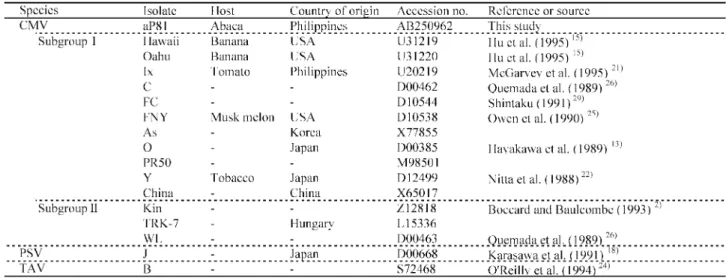
Table - CMVs used in the coat protein gene analyses Table , BBTVs and the ralated species used in DNA analyses
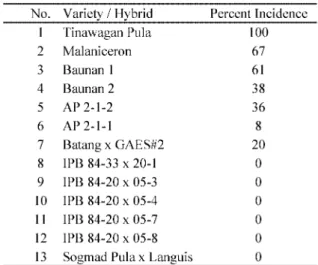
hybrids in the field evaluation ranging from * to +**ῌ was shown in Table /. The local cultivars had higher percent incidence as compared to the hybrids. As for seven hybrids, they were developed at the Institute of Plant Breeding, UP Los Ban›os, and IPB 2.ῌ,*ῌ*/ series were crossed between Itolaus -3, a known resistant variety, and Magsarapong, a known susceptible but high yielding variety. Of the seven hybrids, only one (BatangῌGAES #,) showed bunchy top while the rest showed no symptom.
Of the /2 collections evaluated in screen house exper-iment, ,. varieties/hybrids (PacolῌCES +++ῌ,, Pacol 0,ῌ+, Tetraploid ,, Musa agutay, Sogmad Pula, IPB 2.ῌ--ῌ,*ῌ+, IPB 2.ῌ,*ῌ*/ῌ-, IPB 2.ῌ,*ῌ*/ῌ., IPB 2.ῌ,*ῌ*/ῌ1, Inosa +,, Cantong, Soglin, Soglaguis Sogmin, Amokid, Daganon, Libuntanay, Lagwis, Bisaya *+, Kadaohan, Libutanay, Kalinawan Linlay, Sogmad PulaῌLanguis) were resistant, 0 (Sogmad, Baunan, Layahon, Lunhan, IPB 2.ῌ,*ῌ*/ῌ2, BatangῌGAES #,) moderately
resist-ant, 3 (Igit, Agatayon, Sogmad Pula, Agutay, Wild ., Itolaus -3ῌMagsarapong, Tetraploid #+ῌItolaus -3, PacolῌCES ,, MaguindanaoῌPacol) moderately sus-ceptible and +3 (Lunjan, Damulon, Maguindanao Black, Maguindanao White, Tinawagan Puti, Tangongon, Tinawagan Pula, San Bagui, Bongotsanon, Dehayop, Bongal-D, Danganon, Linminlay, Languis, Sa-ahon *+, Bontang, Banguisan, Luminlay, Hinagikhik) suscepti-ble to abaca bunchy top disease. Although there are many varieties found resistant under screen house con-dition, they are not popularly grown in abaca growing parts of the country due to low yield and undesirable fiber characteristics. However, the most popular ones like Tinawagan Puti, Tinawagan Pula and Tangongon were revealed to be susceptible to the disease. After the field evaluation, the resistant varieties shown in this study could be used in the improvement of popular and high yielding varieties.
Molecular detection and characterization of BBTV isolated from abaca
Two abaca samples, aP-, and aP-., showing bunchy top symptoms and reacted to anti-BBTV antibody, were applied to molecular detection of BBTV by PCR. Three sets of BBTV specific primers (Table +) for -major components, DNA-R, DNA-S, and DNA-M, could amplify the each target DNAs from the abaca samples (data not shown).
PCR-amplified DNA fragments from these , abaca samples, aP-, and aP-., were sequenced after cloning, and compared with BBTV isolates from banana plants (hereafter BBTV banana isolates) previously reported in various parts of the world and the related species in the family, Nanoviridae. Each - major components of PCR-amplified DNA fragments from the abaca plants had the same genome structures with BBTV banana isolates. In the comparison of the putative amino acid
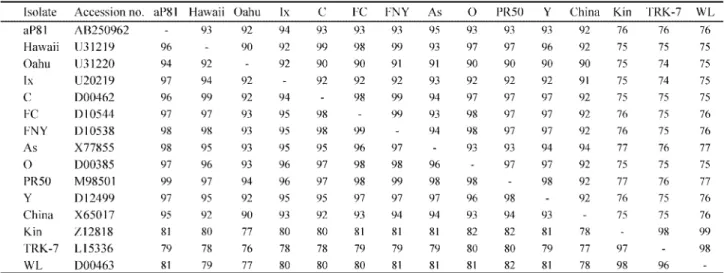
Table 0 Sequence homologies (ῌ) of DNA-R, and - ORFs (DNA-R : master-rep protein, DNA-S : coat protein, DNA-M : movement protein) between abaca isolates and among abaca and banana isolates Table / Incidence of abaca bunchy top disease
sequences of the coat protein gene among BBTV iso-lates from the Philippines, , abaca isoiso-lates (hereafter BBTV abaca isolates, BBTV-aP-, and BBTV-aP-.) com-pletely corresponded with , BBTV banana isolates, BBTV-bP,0 and BBTV-bP/, while + banana isolate, BBTV-Ph, had one substitution of alanine from glycine at position ,* (Fig. +).
The homology analysis of - major ORFs (Table /), the replication initiation protein gene coded in DNA-R, the coat protein gene coded in DNA-S, and the movement protein gene coded in DNA-M, showed that BBTV-aP-, and BBTV-aP-. had very high homologies (33ῌ+**ῌ) with those of all - BBTV banana isolates collected in the Philippines.
BBTVs isolated from bananas in the Philippines are grouped in the Asian group along with BBTVs from Indonesia and Japan+*, +1ῌ
. In the major common region (CR-M) of DNA-R, the nucleotide sequences of , BBTV abaca isolates indicated apparently higher homologies with the Asian group (23ῌ+**ῌ) than with the South Pacific group (0,ῌ01ῌ).
In the Philippines, abaca bunchy top disease (ABTD) was first reported in +3,0 followed by the first report of banana bunchy top disease (BBTD) -/ years later. Since then identity of the pathogens of ABTD and BBTD has been a long-time controversial issue. The pathogen of ABTD, often described as Abaca bunchy top virus (ABTV), and the pathogen of BBTD, Banana bunchy top virus (BBTV) are known to share similar
characters such as bunchy top symptom, host range which is mainly limited to Musa spp., banana aphid transmission and reaction to anti-BBTV antibody. At present BBTV is o$cially recognized as one virus spe-cies in the genus Babuvirus by the International Com-mittee on Taxonomy of Viruses2ῌ
.
In this study, we confirmed the positive reaction of abaca samples of ABTD with anti-BBTV antibody as demonstrated by THOMASand BAJET(+33-, unpublished). Then, we showed that the putative causal viruses of the abaca samples a#ected by ABTD could be detected by PCR using BBTV specific primers. Finally, we concluded that BBTV could be detected from ABTD a#ected abaca. Additionally, the nucleotide sequences of DNA-R, DNA-S, and DNA-M of BBTV amplified from abaca (BBTV abaca isolates) by PCR were determined for the first time. It was also indicated that the replica-tion initiareplica-tion protein genes, the coat protein genes, and the movement protein genes of BBTV abaca iso-lates had very high homologies with those of BBTV banana isolates, and the BBTV abaca isolates belonged to the Asian group, but not the South Pacific group. These results revealed that BBTV, in the Philippines, occurs not only in banana but also in abaca, and BBTV could come and go between banana and abaca. Molecular detection and characterization of CMV isolated from abaca
One abaca sample, aP2+ from which CMV and Fig. + The putative amino acid sequence comparison of the coat protein gene of BBTVs isolated from
BBrMV were detected by ELISA, was used for RT-PCR detection of CMV. Under the annealing condition of /*῍, the target DNA fragment of approximately 2** bp was amplified from aP2+ with universal primers that amplify entire viral coat protein gene of the members of the genus Cucumovirus1ῌ
(Table +) (data not shown). The nucleotide sequence amplified from aP2+ was determined following cloning and compared with pre-viously reported +/ isolates of CMV. The putative amino acid sequences of the coat protein gene had higher homologies with CMV subgroup I (3.ῌ33ῌ) than with CMV subgroup II (13ῌ2+ῌ) (Table 1). In phylo-genetic analysis based on the putative amino acid se-quences of the coat protein gene, CMV-aP2+ belonged to CMV subgroup IB, but not CMV subgroup IA (Fig. ,). Occurrence of CMV on abaca was experientially known in the Philippines/ῌ
, however, there was no study based on detection and characterization of CMV. In this study, we detected CMV from an abaca plant by ELISA and RT-PCR, and showed the CMV isolate was classified into CMV subgroup IB according to the mo-lecular characterization for the first time. This study showed that abaca was included as one of the host plants of CMV as well as banana.
Acknowledgement
Financial support from the Yuasa International Foundation, Japan, is gratefully acknowledged. We also thank Dr. Dionisio G. ALVINDIA (Bureau of
Postharvest Research and Extension, Central Luzon State University Compound, Science City of Mun›oz, Nueva Ecija, the Philippines) for sample collection in the Philippines, and Ms. Maiko HIROSEfor CMV
experi-ments.
Table 1 Sequence homologies (ῌ) of the coat protein gene among CMV abaca and other isolates*
Fig. , Additive tree depicting the relationships of Cucumber mosaic virus (CMV)-aP2+ to other CMVs, Tomato aspermy virus (TAV), and Peanut stunt virus (PSV) based on the putative amino acid sequences of the coat protein genes.
References
+ῌ BELL, K.E., DALE, J.L., HA, C.V., VU, M.T. and REVILL, P.A., (,**,) Characterization of Rep-encoding components associated with banana bunchy top nanovirus in Viet-nam. Arch. Virol., +.1, 03/ῌ1*1.
,ῌ BOCCARD, F. and BAULCOMBE, D., (+33-) Mutational analy-sis of cis-acting sequences and gene function in RNA- of cucumber mosaic virus. Virology, +3-, /0-ῌ/12.
-ῌ BOEVINK, P., CHU, P.W. and KEESE, P., (+33/) Sequence of subterranean clover stunt virus DNA : a$nities with the geminiviruses. Virology, ,*1, -/.ῌ-0+.
.ῌ BURNS, T.M., HARDING, R.M. and DALE, J.L., (+33/) The genome organization of banana bunchy top virus : anal-ysis of six ssDNA components. J Gen. Virol., 10, +.1+ῌ +.2,.
/ῌ CALINISAN, M.R., (+3-.) Notes on a suspected mosaic of abaca in the Philippines. Philipp. J. Agric., /, ,//ῌ,/1. 0ῌ CASTILLO, B.S. and MARTINEZ, A.L., (+30+) Occurrence of
bunchy top disease of banana in the Philippines. FAO Plant Protection Bulletin, 3, 1.ῌ1/.
1ῌ CHOI, S.K., CHOI, J.K., PARK, W.M. and RYU, K.H., (+333) RT-PCR detection and identification of three species of cucumoviruses with a genus-specific single pair of primers. J. of Virological Methods, 2-, 01ῌ1-.
2ῌ FAUQUET, C.M., MAYO, M.A., MANILOFF, J., DESSELBERGER, U. and BALL, L.A. ed., (,**/) Virus Taxonomy : Eighth Report of the International Committee on Taxonomy of Viruses. Academic press, London, UK.
3ῌ FRANZ, A.W., VAND. WILK, F., VERBEEK, M., DULLEMANS, A.M. and VAND. HEUVEL, J.F., (+333) Faba bean necrotic yellows virus (genus Nanovirus) requires a helper factor for its aphid transmission. Virology, ,0,, ,+*ῌ,+3. +*ῌ FURUYA, N., KAWANO, S. and NATSUAKI, K.T., (,**/)
Char-acterization and genetic status of Banana bunchy top virus isolated from Okinawa, Japan. J. of Gen. Plant Pathol., 1+, 02ῌ1-.
++ῌ FURUYA, N., SOMOWIYARJO, S. and NATSUAKI, K.T., (,**.) Virus detection from local banana cultivars and the first molecular characterization of Banana bunchy top virus in Indonesia. Jour. Agri. Sci., Tokyo Univ. of Agric., .3, 1/ῌ 2+.
+,ῌ HARDING, R.M., BURNS, T.M. and DALE, J.L., (+33+) Virus-like particles associated with banana bunchy top dis-ease contain small single-stranded DNA. J Gen. Virol., 12, +13/ῌ+2*,.
+-ῌ HAYAKAWA, T., MIZUKAMI, M., NAKAJIMA, M. and SUZUKI, M., (+323) Complete nucleotide sequence of RNA - from cucumber mosaic virus (CMV) strain O : comparative study of nucleotide sequences and amino acid se-quences among CMV strains O, Q, D and Y. J. Gen. Virol., 1*, .33ῌ/*..
+.ῌ HE, Z.F., LI, H.P., XIAO, H.G. and FAN, H.Z., (,***) Cloning and sequencing of DNA component + of two BBTV strains. Acta Phytopathological Sinica, -*, -0.ῌ-03. +/ῌ HU, J.S., LI, H.P., BARRY, K. WANG, M., and JORDAN, R.
(+33/) Comparison of dot-blot, ELISA, and RT-PCR assays for detection of two cucumber mosaic virus iso-lates infecting banana in Hawaii. Plant Dis., 13, 3*,ῌ3*0. +0ῌ JONES, D.R., (,***) Diseases Caused by Viruses. In : JONES, D.R. (ed) Diseases of Banana, Abaca and Enset, CABI, UK, pp ,.+ῌ,3-.
+1ῌ KARAN, M., HARDING, R.M. and DALE, J.L., (+33.) Evidence for two groups of banana bunchy top virus isolates. J. Gen. Virol., 1/, -/.+ῌ-/.0.
+2ῌ KARASAWA, A., NAKAHO, K., KAKUTANI, T., MINOBE, Y. and EHARA, Y., (+33+) Nucleotide sequence of RNA - of
peanut stunt cucumovirus. Virology, +2/, .0.ῌ.01. +3ῌ KATUL, L., MAISS, E., MOROZOV, S.Y. and VETTEN, H. J.,
(+331) Analysis of six DNA components of the faba bean necrotic yellows virus genome and their structural a$nity to related plant virus genomes. Virology, ,--, ,.1 ῌ,/3.
,*ῌ MAGEE, C. J.P., (+3/-) Some aspects of the Bunchy Top
disease of banana and other Musa spp. J. and Proceed-ings of the Royal Society of New South Wales, 21, +ῌ+2. ,+ῌ MCGARVEY, P., TOUSIGNANT, M., GELETKA, L., CELLINI, F.
and KAPER, J.M., (+33/) The complete sequence of a
cucumber mosaic virus from Ixora that is deficient in the replication of satellite RNAs. J. Gen. Virol., 10, ,,/1ῌ ,,1*.
,,ῌ NITTA, N., MASUTA, C., KUWATA, S. and TAKANAMI, Y.,
(+322) Comparative studies on the nucleotide sequence of cucumber mosaic virus RNA - between Y strain and Q strain. Ann. Phytopathol. Soc. Jpn., /., /+0ῌ/,,. ,-ῌ OCFEMIA, G.O., (+3,0) Progress report on bunchy-top of
abaca or Manila hemp. Phytopathology, +0, 23..
,.ῌ O’REILLY, D., THOMAS, C. J. and COUTTS, R.H., (+33.)
Nucle-otide sequence of RNA - of the British type isolate (Blencowe strain) of tomato aspermy virus. Virus Genes, 2, 13ῌ2+.
,/ῌ OWEN, J., SHINTAKU, M., AESCHLEMAN, P., TAHAR, B.S. and
PALUKAITIS, P., (+33*) Nucleotide sequence and evolutionary relationships of cucumber mosaic virus (CMV) strains : CMV RNA -. J. Gen. Virol., 1+, ,,.-ῌ,,.3. ,0ῌ QUEMADA, H., KEARNEY, C., GONSALVES, D. and SLIGHTOM,
J.L., (+323) Nucleotide sequences of the coat protein genes and flanking regions of cucumber mosaic virus strains C and WL RNA -. J. Gen. Virol., 1*, +*0/ῌ+*1-. ,1ῌ ROSNER, A., BAR-JOSEPH, M., MOSKOVITZ, M. and
MEVARECH, M., (+32-) Diagnosis of specific viral RNA sequences in plant extracts by hybridization with a polynucleotide kinase-mediated, -,
P-labeled, double-stranded RNA probe. Phytopathology, +01, 0/-ῌ0/0. ,2ῌ SANO, Y., WADA, M., HASHIMOTO, Y., MATSUMOTO, T. and
KOJIMA, M., (+332) Sequences of ten circular ssDNA
com-ponents associated with the milk vetch dwarf virus genome. J. Gen. Virol., 13, -+++ῌ-++2.
,3ῌ SHINTAKU, M., (+33+) Coat protein gene sequences of two cucumber mosaic virus strains reveal a single amino acid change correlating with chlorosis induction. J. Gen. Virol., 1,, ,/21ῌ,/23.
-*ῌ SWOFFORD, D.L., (+332) PAUP* : Phylogenetic analysis using parsimony, Version .. Sinauer Associates, Sunder-land, MA, USA.
-+ῌ THOMPSON, J.D., HIGGINS, D.G. and GIBSON, T. J., (+33.)
CLUSTAL W : improving the sensitivity of progressive multiple sequence alignment through sequences weighting, position-specific gap penalties and weight matrix choice. Nucleic Acids Res., ,,, .012ῌ.02*. -,ῌ TIMCHENKO, T., KATUL, L., SANO, Y., de KOUCHKOVSKY, F.,
VETTEN, H. J. and GRONENBORN, B., (,***) The master rep
concept in nanovirus replication : identification of miss-ing genome components and potential for natural ge-netic reassortment. Virology, ,1., +23ῌ+3/.
--ῌ WANITCHAKORN, R., HARDING, R.M. and DALE, J.L., (,***)
Sequence variability in the coat protein gene of two groups of banana bunchy top isolates. Arch. Virol., +./, /3-ῌ0*,.
-.ῌ WARDLAW, C.W., (+31,) The virus diseases : bunchy top. Banana Diseases, Inculuding Plantains and Abaca. Long-man, Green, London, UK, pp 02ῌ++/.
-/ῌ XIE, W.S. and HU, J.S., (+33/) Molecular cloning, sequence analysis and detection of banana bunchy top virus in Hawaii. Phytopathology, 2/, --3ῌ-.1.
アバカ
῏Musa textilis Neeῐに発生するバナナバンチ῎
トップウイルスとキュウリモザイクウイルスの
分子生物学的性状の解明
古屋典子*
ῌTeodora O. D
IZON**
ῌ夏秋啓子***
῏平成 +2 年 , 月 ,2 日受付ῌ平成 +2 年 . 月 ,+ 日受理ῐ要約 : 繊維用作物であるアバカ῏Musa textilis Neeῐ は῍ フィリピンの主要工芸作物の + つであるῌ フィリピ
ンのルソン島とネグロス島のアバカとバナナについて῍ バナナバンチ῎トップウイルス ῏Banana bunchy
top virus ; BBTVῐ῍ キュウリモザイクウイルス ῏Cucumber mosaic virus ; CMVῐ῍ および Banana bract mosaic virus῏BBrMVῐ の発生状況を調査したῌ 収集したアバカ -1 株中 -. 株からは BBrMV が῍ +, 株から は BBTV が῍ 0 株からは CMV が検出されたῌ また῍ 収集したバナナ ,/ 株中 +3 株からは BBTV が῍ +. 株か らは BBrMV が῍ - 株からは CMV が検出されたῌ このことから῍ 本研究で調査した地域のアバカでは BBrMVが῍ バナナでは BBTV と BBrMV が主要なウイルスであることが明らかになったῌ また῍ バンチ῎ トップ病のアブラムシ伝搬試験を行い῍ 本病に対して抵抗性を有するアバカの品種を示したῌ アバカバン チ῎トップ病の病原と推定されるウイルスについて῍ 塩基配列を一部決定し῍ 複製開始タンパク質遺伝子῍ 外被タンパク質遺伝子῍ 移行タンパク質遺伝子を既報のウイルスと比較したῌ アバカから分離されたウイル スは῍ バナナから分離された BBTV と各遺伝子のアミノ酸配列で 33῍ 以上の高い相同性を示したことか ら῍ アバカでもバナナと同様に BBTV が発生していることが῍ 分子生物学的に初めて証明されたῌ また῍ ア バカにおける CMV の発生を ELISA 法と RT-PCR 法によって初めて確認し῍ 外被タンパク質遺伝子の解析 から῍ CMV サブグル῎プ IB に分類されることを示したῌ
キῌワῌド : アバカ῍ バナナ῍ バンチ῎トップ病῍ Banana bunchy top virus, フィリピン
* ** *** 東京農業大学大学院農学研究科国際農業開発学専攻 ῏現 独立行政法人農業環境技術研究所ῐ フィリピン大学ロスバニオス校植物育種研究所 東京農業大学国際食料情報学部国際農業開発学科