Consideration of a prosodic transfer account
with reference to Japanese-speaking learners’ production of functional morphemes in L2 English
山崎 妙
Abstract
The present paper investigates L2 learners’ suppliance of functional morphology. It aims to examine the plausibility of Prosodic Transfer Hypothesis, which proposes that L2 learners’ production of inflectional morphology is constrained by their L1 prosodic structures (Goad, White and Steele 2003; Goad and White 2004, 2006). Assuming that the prosodic structures of inflectional morphology in English and Japanese are different from each other, whether Japanese learners show similar degree of difficulties in producing the English 3sg –s, the plural –s and the genitive –s, which are identical in terms of prosodic properties, was examined. Results indicated that the suppliance rate of these three morphemes were significantly different, suggesting that the Prosodic Transfer Hypothesisdoes not solely explain the L2 learners’ variable use of the inflections.
1 Introduction
It is well known that adult second language learners frequently omit inflectional morphology such as tense and agreement makers in their speech (Hawkins and Liszka 2003; Ionin and Wexler 2002; Lardiere 1998a, b;
Prévost and White 2000; White 2003; among others). The source of inconsistent suppliance of such inflections, or ‘variability’, has been an object of study for a long time. Within the framework of the generative grammar, two contrasting views exist to explain this variability: the Impaired Functional Representation and the Full Functional Representation views. In what follows, these views will be briefly introduced.
In the Impaired Functional Representation view, it is claimed that L2 learners are unable to fully acquire functional categories and formal features which are unavailable in their L1. For instance, Hawkins and Liszka (2003) account for Chinese speakers’ low suppliance of the English past tense inflection –ed (63%) by arguing that they cannot acquire the formal feature [+/- past] because it is not present in their L1. By contrast, it is shown that Japanese speakers and German speakers, who have the [+/- past] feature in their L1, supply the regular past tense inflection more successfully (92% and 96%, respectively) than Chinese speakers.
The Full Functional Representation view claims that L2 functional categories and their associated features are fully acquirable even though they are absent from the L1 grammar. Prévost and White (2000) argue that
Tae YAMAZAKI
variability in suppliance of L2 functional morphology is attributed to the difficulty in mapping syntactic features to the surface morphology, rather than to impaired functional representation. For example, it is assumed that L2 learners’ omission of tense and agreement inflections is not a reflection of the fact that they have not acquired functional categories and formal features associated with tense and agreement; instead, the learners just use an underspecified default form when they omit these inflections. This assumption is labeled
‘Missing Surface Inflection Hypothesis’.
In favour of the Full Functional Representation view, the Prosodic Transfer Hypothesis has been proposed (Goad, White and Steele 2003; Goad and White 2004, 2006), which claims that L1 prosodic structure constrains production of L2 grammatical morphology. For example, Goad, White and Steele (2003) argue that Mandarin Chinese speakers have difficulty in supplying the English regular past tense and agreement inflections due to the difference between English and Chinese in terms of their prosodic structures of the construction of verbs stems and verbal inflections. Specifically, the English tense and agreement inflections adjoin to the Prosodic Word while the Chinese lacks such structures. The aspect marker, which is the only inflection in Chinese, incorporates into the Prosodic Word, instead. In their study, results of a grammaticality judgment task and analyses of the learners’ production with regard to nominal case assignment, accuracy of agreement and incidence of copula, auxiliaries and modals revealed that the learners seemed to have fully represented the functional category Infl and its associated features. It was thus concluded that L2 learners failed to consistently supply certain grammatical morphemes, not because they were unable to construct functional representation relevant to the morphemes, but because they were unable to construct L2 prosodic structures which are absent from their L1. Later I will discuss the Prosodic Transfer Hypothesis and related studies more in detail.
In this paper, I will investigate Japanese speakers’ production of three English functional morphemes, the third person present singular –s (hereafter, the 3sg –s), the plural marker –s and the genitive marker –s, in order to examine the plausibility of the Prosodic Transfer Hypothesis. The organization of the present paper is as follows. Section 2 gives a brief introduction of Prosodic Phonology, and describes the prosodic structures of functional morphology in English and Japanese. Next, a previous study on the Prosodic Transfer Hypothesis is reviewed in Section 3. Section 4 presents the study and its findings. In Section 5, I conclude that constraints of L1 prosodic structure cannot be an only source of difficulty in production of L2 functional morphology.
2 Theoretical background
2.1 The interaction of morphology, syntax and phonology
Within the framework of Lexical Phonology, it is supposed that there are three levels of phonological
representation: underlying, lexical and surface representations. The lexical representation was proposed in order to mediate between the underlying representation, which is too abstract, and the surface representation, which is too detailed (Gussenhoven and Jacobs 1998: 116). Additionally, two phonological rules are introduced: lexical and postlexical rules. The underlying representation undergoes the application of the lexical rules, and then the lexical representation is produced. Furthermore, the lexical representation undergoes the application of the postlexical rules, and then the surface representation is produced. Figure 1 illustrates this process:
(Gussehoven and Jacobs 1998: 128) Figure 1 Phonological representations and phonological rules
Gussenhoven and Jacobs (1998) assume that the lexical rules are applied inside the lexicon whereas the postlexical ones are applied outside the lexicon. It follows that after all the lexical rules are applied to words and then the words have constructed a sentence, the postlexical rules are applied. Let us take a look at an example of a lexical rule in Dutch:
(1) Underlying representation Surface representation
a. [te:kən]N te:kə 'sign'
b. [te:kən]V+ə n]Inf te:kə nə 'to draw'
c. [te:kən]V te:kə n 'draw'
Dutch has n-deletion rule, which requires word-final [n] after [ə] to be deleted. Whether this rule is applied or not depends on the word’s category label; namely, it is not applied to verb stems (i.e., 1c) but applied to nouns and infinitives (i.e., 1a and 1b). By contrast, postlexical rules apply across word boundaries since they manipulate the lexical representation, in which words have undergone application of all necessary lexical rules and have been inserted into a syntactic structure. The application of these rules is addressed in relation to each
UNDERLYING REPRESENTATION Lexical rules
↓
LEXICAL REPRESENTATION Postlexical rules
↓
SURFACE REPRESENTATION
utterance’s prosodic structure. In the following subsection, the prosodic structure and its constituents will be accounted for.
2.2 Functional morphology and its prosodic structure Prosodic structure
In the theory of Prosodic Phonology, a sentence is assumed to be equipped with a hierarchically organised prosodic structure, which does not necessarily correspond to morphosyntactic structure of the sentence (Selkirk 1997: 186). The constituents of the structure include Utterance (Utt), Intonational Phrase (IP), Phonological Phrase (PPh), Prosodic Word (PWd), Foot (Ft) and Syllable (σ), which were hierarchically ranked (Selkirk 1997: 190).
Firstly, the (Phonological) Utterance does not always correspond to a single syntactic sentence; that is, a string of two sentences without a pause directed to the same listener is regarded as a single Utterance, whereas adjacent two sentences directed to different listeners constitute two Utterances (Gussenhoven and Jacobs 1998:
243). Consider occurrences of r-linking in Received Pronunciation described in (2):
(2) a. Utt(...sti[r]ing...)Utt "stirring"
b. Utt(A fai[r]idea)Utt "A fair idea"
c. Utt(Hi Sheila! [r]Everything all right?)U tt
d. Utt(Hi Peter!)Utt *[r] Utt(Open the window, Sheila)Utt
The fact that [r] is inserted in (2a-c) suggests that the r-linking rule is applied across syntactic sentences as well as within and across syntactic words. However, it does not apply across Utterances, as shown in (2d), consisting of two Phonological Utterances.
Secondly, the Intonational Phrase basically corresponds to the root sentence, but its boundaries are not necessarily syntactically driven (Gussenhavoen and Jacobs 1998: 243). Consider (3):
(3) a. IP(Why don't you sell Janet, your Honor?)IP b. IP(Why don't you sell Janet your honor?)IP
(3a) and (3b) are syntactically different because the last phrase ‘your Honor’ is a vocative in (3a). Nevertheless, they are identical in terms of their prosodic structure at the intonational phrase level since they have the intonational contour in common.
Thirdly, the Phonological Phrase is likely to correspond to the syntactic phrase, but again, it is not always the case as indicated in (4):
(4) a. On Tuesdays, he gives PPh(the Chinese dishes)PPh
b. On Tuesdays, he gives PPh(the Chinese)PPh PPh(dishes)PPh
c. Rabbits PPh(reproduce)PPh PPh(quickly and diligently)PPh
d. Rabbits PPh(reproduce quickly)PPh
Hayes (1989) proposes that Phonological Phrases involve rhythm rules. For example, Chinese is an adjective in (4a) while the Chinese is a noun phrase in (4b). The main stress on Chinese is place on the first syllable in (4a) but on the last syllable in (4b). This indicates that the stress on Chinese in (4a) is affected by that on dishes because they are in the same Phonological Phrase, unlike (4b). Similarly, the main stress of reproduce is on its last syllable in (4c) but its first syllable in (4d). This is because in (4d) the stress on reproduce is affected by that on quickly, suggesting that they constitute a single Phonological Phrase. These examples serve as the evidence for the claim that syntactic information is not the only factor dealing with Phonological Phrase (Gussenhoven and Jacobs 1998: 246-7).
Lastly, the Prosodic Word does not correspond to the morphological word (Gussenhoven and Jacobs 1998:
247). For instance, a compound, which is a single morphological word, can be regarded as a complex of phonological words in various languages. Consider the syllabificaiton of a German compound Mundart:
(5) a. mʊnt.a:rt
b. *mʊn.ta:rt
Mundart literally means mouth type, meaning ‘dialect’ in English. It is syllabified as (5a) instead of (5b). It is assumed that syllabification should take place following Maximum Onset Principle (Gussenhoven and Jacobs 1998: 151):
(6) Maximum Onset Principle (MOP)
First make the onset as long as it legitimately can be; then form a legitimate coda.
To fulfill the MOP, Mundart should be syllabified as (5b); otherwise, [art] has no onset. However, it is actually syllabified as (5a), suggesting that the Morphological Word comprises two Phonological Words: PWd(Mund)PWd
PWd(art)Pwd.
As mentioned above, these constituents are hierarchically structured to compose a prosodic structure. A
well-formed prosodic structure has to satisfy Strict Layer Hypothesis (Selkirk 1997: 189):
(7) Strict Layer Hypothesis
A prosodic constituent of level Ci immediately dominates only constituents of next level down in the prosodic hierarchy, Ci-1.
Representation which conforms to the Strict Layer Hypothesis is shown in (8):
(8) ( ) Utt
( )( ) IP
( )( )( )( ) PPh
( )( )( )( )( )( )( )( ) PWd
(Based on Gussenhoven and Jacobs 1998: 242)
Selkirk (1997) further proposes four constraints on prosodic hierarchical structures as follows:
(9) a. Layeredness: No Ci must dominate a Cj, j>i e.g. "No σ dominates a Ft."
b. Headedness: Any Ci must dominate a Ci-1 (except if Ci=σ), e.g. "A PWd must dominate a Ft."
c. Exhaustivity: No Ci immediately dominates a constituent Cj, j<i-1, e.g. "No PWd immediately dominates a σ."
d. Nonrecursivity: No Ci dominates Cj, j=i, e.g. "No Ft dominates a Ft."
Layeredness and Headedness must hold universally, while Exhausitivity and Nonresursivity might be violated in some cases (Selkirk 1997: 190).
English functional morphemes
Selkirk (1997) proposes that ‘a functional word (Fnc) may be prosodised either as a PWd, or as one of three different types of prosodic clitics’ (p.188). A lexical word (Lex) and a functional word (Fnc) are orgnised in either way of the following:
(10) a. Prosodic Word ((fnc)PWd (lex)PWd )PPh Prosodic Clitics:
b. free clitic (fnc ( lex )PWd )PPh
c. internal clitic ((fnc lex)PWd )PPh
d affixal clitic ((fnc (lex)PWd )PWd )PPh
Following Selkirk’s proposal, Goad and White (2004) suppose that English inflectional morphemes, such as the 3sg –s, the plural –s and the genitive–s, are structured as an affixal clitic (i.e., 10d) as illustrated in (11):
(11) PWd
PWd
base fnc
Goad and White provide evidence of the analysis that those inflections adjoin to the stem PWd, instead of being incorporated into the PWd. Unlike inflectional morphemes, English derivational morphemes are considered to be incorporated into the stem PWd because such a suffix induces rhyme shortening in the stem under some conditions. Consider (12):
(12) a. five [faɪv] + ‘-th’ Æ[fɪfѲ] cf. *[faɪvѲ] Derivational morphology b. arrive [ərajv] + ‘-ed Æ [ərajvd] cf. *[ərɪvd] Inflectional morphology
When a consonant-initial affix attaches to a stem ‘which has a final rhyme of the three segments (the maximum possible in monomorphemic words (p. 129),’ such as five [faɪv], the rhyme must shorten; for example, as in (12a), when [Ѳ] is attached to five, the diphthong in the rhyme [aɪ] shortens to [ɪ], yielding [fɪfѲ], instead of [faɪvѲ]. By contrast, as (12b) represents, an inflectional suffix does not cause the rhyme shortening; the addition of [d] does not require [ərajv] to change into [ərɪv]. This indicates that the addition of inflectional morphemes does not violate the rule that the final rhyme has three segments at the maximum in English, suggesting that English inflections are attached outside the stem PWd.
In addition, English nominal suffixes such as the plural –s and the genitive -s have the same prosodic properties as the verbal ones. Considering that the nominal ones are a functional word attaching to a lexical word stem, they may be prosodised as a prosodic clitic, shown in (10). Judging from the fact that an attachment
of them does not induce phonological changes within the stem, it would be reasonable to assume that the nominal inflections are stem-external, like the verbal inflections.
Japanese functional morphemes
Japanese has functional morphemes: verbal and adjective conjugation endings and Case particles (Tsujimura 1996: 141).
(i) Verbal and adjectival conjugations
Functional morphemes, such as the non-past tense marker –(r)u and the past tense marker –ta/ da for verbs and the non-past tense marker –i and the past tense marker (-kat)-ta for adjectives, attach to a verbal or a adjective root (Tsujimura 1996: 142). Examples of verbal and adjectival conjugations are given in (13):
(13) a. non-past tense (verb): -(r)u
tabe "eat" Æ tabe-ru "eat, will eat"
nom "drink" Æ nom-u "drink, will drink"
b. past-tense (verb): -ta/ da
tabe "eat" Æ tabe-ta "ate"
nom "drink" Æ non-da "drank"
c. non-past tense (adjective): -i
ooki "big" Æ ook-i "is big"
aka "red" Æ aka-i "is red"
d. past-tense (adjective): -kat-ta
ooki "big" Æ ooki-kat-ta "was big"
aka "red" Æ aka-kat-ta "was read"
(Tsujimura 1996: 142-143)
In what follows, phonological properties of the conjugated forms will be considered. First, an appropriate paradigm of verb endings is chosen according to a phonological form of root verbs. The paradigm is described in (14), including the non-past tense, the negative, the past tense, the conditional and the provisional forms:
(14) tabe "eat" tat "stand"
non-past tabe-ru tat-u
negative tabe-nai tat-anai
past tabe-ta tat-ta
conditional tabe-tara tat-tara
provisional tabe-reba tat-eba
(Tsujimura 1996: 41)
The paradigm of verb ending for tabe is applied to verbs in (15a), and that for tat is applied to verbs in (15b):
(15) a. same "cool", kare "wither", kari "borrow", koware "break", kotae "answer", todoke "deliver", tasuke "help"
b. kak "write", kat "win", sir "know", nom "drink", sas "stick", tomar "stop", tikazuk "approach"
Considering that verb roots in (15a) end in a vowel and those in (15b) end in a consonant, we can say that the phonological form of the individual root determines which paradigm should be taken to construct the conjugated forms.
Next, it is assumed that verbal forms undergo phonological changes after a conjugation paradigm is determined. Let us take the past tense form for example. Consider the phonemic and phonetic representations illustrated in (16)-(19):
(16) a. /kat + ta/ Æ [kat:a] "won"
b. /mat + ta/ Æ [mat:a] "waited"
(17) a. /kaer +ta/ Æ [kaet:a] "returned"
b. /hair + ta/ Æ [hait:a] "entered"
(18) a. /yob + ta/ Æ [yonda] "called"
b. /tob + ta/ Æ [tonda] "flew"
(19) a. /nom + ta/ Æ [nonda] "drank"
b. /yom + ta/ Æ [yonda] "read (past)" (Tsujimura 1996: 43)
In (16-19), ‘+’ represents a boundary between a verb stem and the past tense ending, and ‘:’ indicates that a consonant is long or geminate. The verb forms in (16) do not undergo phonological changes but those in (17-19) do. These changes are schematised in (20), (21) and (22), respectively.
(20) r Æ t / __ + ta
(21) b Æ n / __ +ta t Æ d / n + __
(22) m Æ n / __ + ta t Æ d / n + __
In sum, Japanese verb forms are constructed in the following procedures: First, a verb conjugation paradigm is determined according to the phonological properties of a verb root to which a verb ending attaches. Then, the verbal ending attaches to the verbal root at the phonemic level. Finally, phonological changes take place on the phonemic representation, constructing the surface phonological representation. Recall that English derivational suffixes are assumed to incorporate into PWd, according to Goad and White’s (2004) analysis, on the grounds that the suffixation triggers the phonological change, which is the rhyme shortening within a root under a certain condition; on the other hand, the English inflections adjoin to PWd. For the same reason, we can assume that Japanese verb endings, which are subject to the phonological changes, incorporate into PWd.
Therefore, the English and the Japanese inflectional morphemes have the different prosodic properties.
(ii) Case particles
Japanese has Case particles: Nominative (Nom) –ga, Accusative (Acc) –o, Dative (Dat) –ni, Genitive (Gen) –no and Topic marker (Top) –wa. Examples of these particles are given in (23):
(23) a. Taroo-ga hasit-ta.
Taro-Nom run-past
"Taro ran."
b.Kodomo-ga hon-o yon-da.
Child-Nom book-Acc read-past
"The child read the book."
c. Ziroo-ga Yosio-ni ringo-wo age-ta.
Ziro-Nom Yosio-Dat apple-Acc give-past
"Ziro gave an apple to Yoshio."
d. Hanako-no musuko-ga warat-ta.
Hanoko-Gen son-Nom laugh-past "Hanako's son laughed."
e. Ano uti-wa ooki-i.
that house-Top big-non-past
"As for that house, it is big." (Tsujimura 1996: 134)
According to Pierrehumbert and Beckman (1988), the Japanese Case makers incorporate into the stem PWd.
Take a look at their analysis of the prosodic structures of a Japanese sentence in (24):
(24)
(Pierrehumbert and Beckman 1988: 118)
The prosodic tree in (24) shows that the Genitive Case particle –no and the Topic Case marker –wa are attached inside the Phonological Word. Following this analysis, I will assume that the Japanese Case markers are stem-internal throughout this paper.
3 An earlier study: Goad, White and Steele (2003)
This section addresses a previous study in favour of the Prosodic Transfer Hypothesis, which proposes that L1 prosodic structure constrains suppliance of L2 functional morphology in speech production. In order to provide evidence for this hypothesis, Goad, White and Steele (2003) inquired into production of L2 Mandarin-speaking leaners of English with regard to the 3sg agreement and the past tense morphology.
ʋ utterance
ɩ ɩ intermediate phrase
α α α accentual phrase
ω ω ω ω ω word
σ σ σ σ σ σ σ σ σ σ σ σ σ syllable
μ μ μ μ μ μ μμ μ μ μ μ μ μ μ μ mora
a ne –no a ka i se' e ta a -wa do 'ko de su ka? phoneme tier big sister-Gen red sweater -Top where is-non-past-Q
"Where is big sister's red sweater?"
Goad, White and Steele (2003) argue that ‘while tense and agreement features are underlyingly present in the IL [i.e., interlanguage] grammar, learners are unable to produce the corresponding forms because they cannot represent them prosodically in outputs’ (p. 265). They assume that prosodic structures of inflectional morphology in English and Chinese are different. In English, inflectional morphemes such as the regular past –ed, the 3sg –s, and the plural –s adjoin to the PWd as represented in (25a). By contrast, in Chinese, the aspect marker, which is the only inflectional morpheme, incorporates into the PWd as shown in (25b):
(25) a. English – PWd external b. Chinese – PWd internal
(Goad, White and Steele 2003: 266)
Based on the analysis that Chinese language does not permit the adjunction to the PWd, which is required for the English inflections, Goad, White and Steele made a prediction that Chinese speakers would have difficulty in producing the tense and agreement morphemes in a consistent manner since the learners would fail to represent the English inflections prosodically. Specifically, two patterns of omission were predicted. First, the learners can realise that English does not permit the incorporation of the inflections into PWd, but cannot represent them in their outputs. Thus, they would omit the inflections across-the-board. Second, the learners will try to produce English inflected words where the inflections can incorporate into PWd, like the Chinese aspect. Accordingly, they would inflect words with a certain type of stem, and would fail to inflect words otherwise. In other words, their suppliance of the inflections will be affected by the prosodic structure of a stem.
Twelve Mandarin Chinese speakers, with high intermediate to low advanced proficiency of English, participated in the study. Production data were elicited by picture description tasks.
Table 1 describes overall results of suppliance of the tense and the agreement morphemes. These
PWd PWd
PWd Ft
Ft σ σ
σ σ m a i3 l ə5
Buy ASP
grab d/z 'bought already'
morphemes were omitted in some degree. Suppliance was the highest for the irregular past probably because it does not involve adjunction to PWd; namely, the Chinese speakers had no problem producing the irregular past forms since they did not have to deal with the stem-external structure. By contrast, they were likely to omit the 3sg –s and the regular past –ed, which involve the incorporation into PWd, as predicted.
Table 1 Suppliance of tense and agreement morphology for lexical verbs
(Based on Goad, White and Steele 2003: 271)
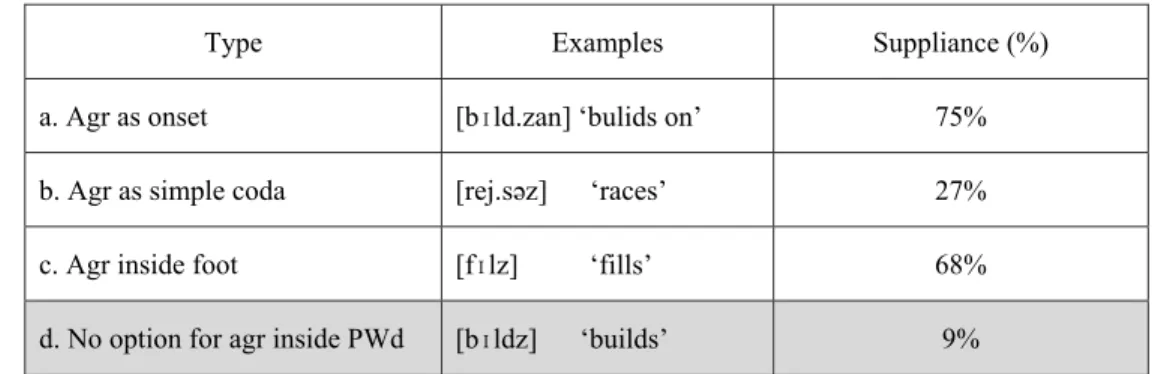
Next, let us focus on suppliance of the 3sg –s. Recall the second prediction: stem shapes are responsible for variable suppliance rate of the inflections. Specifically, it was predicted that the suppliance is higher in the cases where the 3sg –s can incorporate into the stem PWd theoretically. As shown in Table 2, the 3sg –s can incorporate into PWd in Types (a-c) while it cannot in Type (d). Table 2 also indicates suppliance of the 3sg –s for each stem type by six subjects who had provided it in more than 50% of obligatory contexts. The suppliance was lower for (d) than for the others, which conforms to the second prediction.
Table 2 Agreement (3sg –s) in production by stem shape
(Based on Goad, White and Steele 2003: 273)
The Prosodic Transfer Hypothesis seems to be able to explain the variable suppliance of the L2 functional morphology at first glance; nevertheless, some findings in Goad, White and Steele (2003) cannot be accounted for solely by the prosodic transfer. Firstly, what puzzles me is the difference in suppliance of the regular past tense and the 3sg agreement morphemes in Table 1 (57% and 28%, respectively). As (25a) indicates, both of these morphemes are stem-external. Given the hypothesis, thus, the L1 prosodic constraint should have affected
3rd singular Reg past Irreg past
57/201 (28%) 16/28 (57%) 55/71 (78%)
Type Examples Suppliance (%)
a. Agr as onset [bɪld.zan] ‘bulids on’ 75%
b. Agr as simple coda [rej.səz] ‘races’ 27%
c. Agr inside foot [fɪlz] ‘fills’ 68%
d. No option for agr inside PWd [bɪldz] ‘builds’ 9%
the suppliance of both morphemes in the same degree. Similarly, in Table 2, the suppliance rates for Types a, b and c should be the same because their prosodic properties are identical in the sense that the inflection –s can be theoretically stem-internal; however, the suppliance for Type b is much lower than that for Types a and c.
Therefore, these results may imply that the difference in suppliance can be explained by a factor other than the prosodic transfer.
4 The study
4.1 Predictions
The analyses of the prosodic structures of the English and Japanese functional morphemes I have done so far enable us to summarise the morphological and phonological properties of the functional morphemes at issue as follows. First, the English 3sg –s, the plural –s and the genitive –s have the same prosodic structure in common.
Second, Japanese does not have systems of the 3sg agreement and the plural marking but has the genitive Case marker –no, which morphologically corresponds to the English genitive -s. Third, the Japanese genitive maker constitutes the different prosodic structure from the three English inflections: the former is stem-internal and the latter three are stem-external.
The purpose of this study is to test the Prosodic Transfer Hypothesis. Based on the descriptions just above, the following two predictions were made:
A) If the L1 prosodic constraint affects L2 learners’ suppliance of functional morphology, Japanese-speaking learners would have similar degree of difficulty in producing the three types of –s in the L2 English.
B) If the Prosodic Transfer Hypothesis is correct, the suppliance will be influenced by stem shape. As we saw in Table 2, suppliance will be higher for the stem where the inflection can incorporate into PWd (i.e., Type a-c) than for the stem which is impossible to do it (i.e., Type d).
4.2 Method Subjects
Ten Japanese learners of English participated in the study. They were all college students in Japan, and had studied English in classroom settings for at least six years at the moment of the study. Six of them had taken the TOEIC test, and their scores varied from around 540 to 895. Prior to the data collection, I administered a grammar test which comprised 15 multiple choice items, by referring to test items in Philips (2001).(1) The average number of correct answers was 13.0 out of 14. χ2 test showed that there was not significant difference of the number of correct answers among subjects (χ2= 2.67, df = 8); thus, we can assume that they have the similar level of grammatical knowledge.
――――――――――――――
(1)Due to a typological error, I excluded one item from being marked. Thus, the analysis of the subjects’ grammatical
Procedures
Production data were elicited through an oral translation task. The subjects were asked to translate each Japanese sentence into English one. Their translations were audiotape recorded and transcribed by the author of this paper. The task was divided into two parts in the middle. Just before the first part began, I gave them a vocabulary list including some of the words which were expected to be used in the first part of the task. After the first part finished, another vocabulary list for the second part was given. The subjects had 1 minute for reading each vocabulary list. The lists were utilized so as to elicit target words.
The task consisted of 48 target and 12 filler sentences. The target sentences were designed to elicit 30 tokens of the 3sg –s, 30 tokes of the plural –s and 15 tokens of the genitive –s. Two sets of the task, in which the test sentences were ordered reversely, were used. A full set of the task is given in Appendix.
The transcribed sentences were coded by the author. If a non-target lexical word was used, the inflection which attached to the word was not analysed. For instance, the word ‘see’ was used instead of the target word
‘watch’, this verb was excluded from the analyses. Moreover, when subjects repeated a word, and then they changed its inflection, the first answer was analysed. For example, in the sentence such as ‘David sleep sleeps only four hours a day’, the first form ‘sleep’ was adopted and coded as no inflection. In total 680 tokens were analysed.
In addition to the translation task, the subjects were asked to answer a questionnaire which aimed at finding out the amount of their previous and current exposure to English.
4.3 Results
Suppliance of the 3sg –s, the plural –s and the genitive –s is given in Figure 2.
The result was inconsistent to Prediction A: If the L1 prosodic constraint affects L2 learners’ suppliance of Figure 2 Suppliance of the 3sg –s, the plural –s and the genitive –s (%)
41.3
73.6
98.6
0 20 40 60 80 100
3sg plural genitive
functional morphology, Japanese-speaking learners would have similar degree of difficulty in producing the three –s. Take a look at Figure 2. Suppliance was higher for the plural –s (73.6%) than for the 3sg –s (41.3%), and the genitive makers were supplied in almost all the cases (98.6%). A one-way ANOVA revealed that there was a main effect of the morpheme type (F(2,72)=55.63, p<.000; η2=.61). Multiple comparisons indicated that there was a significant difference among these three types of morphemes. This suggests that the Japanese learners showed different levels of difficulty across the morphemes even though they are the same in terms of the prosodic structure.
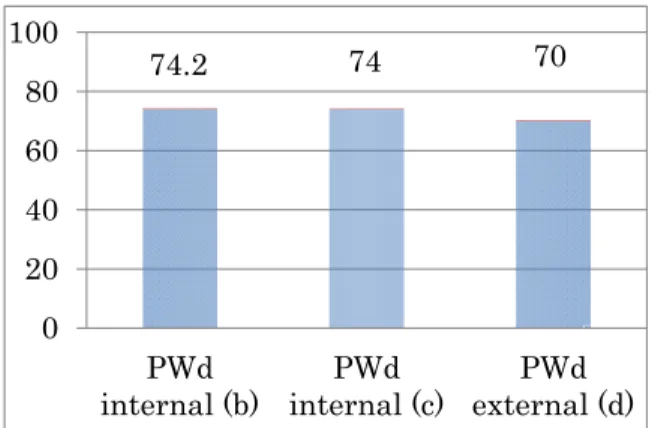
Next, Prediction B (i.e., If the Prosodic Transfer Hypothesis is correct, the suppliance will be influenced by stem shape.) was not proved to be right, either. Figure 3 shows suppliance of the plural –s by stem shape.
Test sentences which targeted to elicit the 3sg –s and the genitive –s did not include a variety of stem shape, so I focused on the plural marking.
It was predicted that suppliance of Type (d) would be the most difficult because it never allows the stem- internal structure. However, suppliance was not different among these three types of stem shape. A one-way ANOVA was administered, and it indicated that there was not a main effect of stem shape (F(2,29)=0.06, ns;
η2=.004). This suggests that the Japanese learners were not affected by whether an inflection is theoretically allowed to incorporate into PWd or not.
4.4 Discussions
The results revealed that the constraints of L1 prosodic structure cannot be an only source of difficulty in producing L2 functional morphology. Now it is necessary to find an alternative way of identifying the source of the variable use of these morphemes. Why was the suppliance the highest for the genitive –s and the lowest for the 3sg –s?
Figure 3 Suppliance of the plural –s by stem type (%)
74.2 74 70
0 20 40 60 80 100
PWd
internal (b) PWd
internal (c) PWd external (d)
A possible reason is that the genitive –s is the easiest because the Japanese genitive maker –no is similar to the English –s. This suggests that production of a functional morpheme in L2 can be facilitated when L1 has an overt morpheme which corresponds to the L2 functional morpheme. Apparently, this phenomenon conforms to White’s (2003: 139) claim, in which it is proposed that ‘Presence of overt inflectional morphology in the L1 appears to sensitize the L2 speaker to overt morphology in the L2, and to facilitate its use ….’
Another possible reason is that the 3sg –s is the most difficult because it has no ‘meaning’ itself, whereas the other two have meanings. However, this cannot account for why the plural –s is more problematic than the genitive –s.
Alternatively, the number of formal feature which should be taken into account may determine difficulty of producing a particular morpheme because of difference in processing cost (Slabakova and Montrul 2008).
That is, for the 3sg –s to be marked, the [number] and [person] features should be considered, while only [number] for the plural and only [+/-genitive] for the genitive marker should be considered. However, again, this cannot explain why the plural is more difficult than the genitive.
Now let us think about another possible reason, given the Impaired Functional Representation view. The Interpretability Hypothesis, which argues that uninterpretable features which are unavailable in the L1 cannot be acquired (Tsimpli 2003, Hawkins and Hattori 2006, Tsimpli and Dimitrakopoulou 2007, Tsimpli and Papadopoulou 2009), correctly predicts the lowest suppliance of the 3sg –s. In Japanese, an uninterpretable feature involving the English agreement is unavailable while that involving the plural and the genitive marking is available. Therefore, we may suppose that the former is problematic and the latter two are not. Moreover, whether a particular formal feature or feature specification exists in the L1 may influence suppliance of a relevant surface form. According to Watanabe (2006), the plural marking is problematic for Japanese speakers because the [+/-number] and [+/-singular] features are involved in the plural marking in English whereas in Japanese the [singular] feature is underspecified like [Øsingular]. In the case of the genitive marking, by contrast, since the [genitive] feature is specified either [+] or [-] in Japanese, the English genitive marking may not be that difficult. What should be noted here is that the cross-linguistic difference in terms of formal features should not be ignored to explain the Japanese learners’ variable use of –s.
5 Conclusion
This paper has examined if the Prosodic Transfer Hypothesis is plausible. The investigation of the Japanese speaker’s production revealed that the hypothesis does not fully explain L2 learners’ inconsistent use of functional morphology. Assuming that the English 3sg –s, the plural –s and the genitive –s adjoin to PWd while the Japanese inflections and case particles incorporate into PWd, it is predicted that the Japanese learners should have the similar degree of difficulty across these three morphemes. However, it was not the case.
Furthermore, the Japanese learners’ suppliance of the plural -s were not influenced by stem type, which is also inconsistent to the hypothesis. Instead, I suppose that it is worthwhile to take into account learnability of formal features in order to explore sources of L2 learners’ variable uses of functional morphology.
References
Goad, H. & White, L. (2004). Ultimate attainment of L2 inflection: Effects of L1 prosodic structure. EUROSLA Yearbook, 4, 119-45.
Goad, H. &White, L. (2006). Prosodic transfer: L1 effects on the production of L2 determiners. BUCLD 30 Proceedings. 213-24.
Goad, H., White, L. & Steele, J. (2003). Missing Surface Inflection in L2 Acquisition: A Prosodic Account.
BUCLD 27 Proceedings. 264-75.
Gussehoven, C. & Jacobs, H. (1998). Understanding Phonology. London: Arnold.
Hawkins, R. & Hattori, H. (2006). Interpretation of English multiple wh-questions by Japanese speakers: A missing uninterpretable feature account. Second Language Research, 22, 269-301.
Hawkins, R. & Liszka, S. (2003). Locating the source of defective past tense marking in advanced L2 English speakers. In: R. Hout, A. Hulk, F. Kuiken & R. Towell. (eds). The Lexicon-Syntax Interface in Second Language Acquisition. Amsterdam: John Benjamins. 21-44.
Hayes, B. (1989). The prosodic hierarchy in meter. In: P. Kiparsky & G. Youmans (eds). Phonetics and Phonology: Rhythm and Meter. Orlando, FL: Academic Press, 201-60.
Ionin, T. & Wexler, K. (2002) Why is 'is' easier than '-s'?: Acquisition of tense/ agreement morphology by child second language learners of English. Second Language Research, 18, 2, 95-136.
Lardiere, D. (1998a). Case and tense in the ‘fossilized’ steady states. Second Language Research, 14, 1-26.
Lardiere, D. (1998b). Dissociating syntax from morphology in a divergent L2 end-state grammar. Second Language Research, 14, 359-75.
Phillips, D. (2001). Longman Introductory Course for the TOEFL Test. New York: Longman.
Pierrehumbert, J. & Beckman, M. (1988). Japanese Tone Structure. Cambridge, Mass: MIT Press.
Prévost, P. & White, L. (2000). Missing Surface Inflection or Impairment in second language acquisition?
Evidence from tense and agreement. Second Language Research, 16, 103-33.
Selkirk, E. (1997). The prosodic structure of function words. In: J. L. Morgan & K. Demuth (eds). Signal to Syntax. Hilldale, NJ: Lawrence Erlbaum. 187-213.
Slabakova, R. & Montrul, S. (2008). Aspectual shifts: Grammatical and pragmatic knowledge in L2 acquisition.
In: J. M. Liceras, H. Zobl & H. Goodluck (eds). The Role of Formal Features in Second Language Acquisition. New York: Lawrence Erlbaum Associates. 455-83.
Tsimpli, I.-M. (2003). Clitics and determiners in L2 Greek. Proceedings of the 6th Generative Approaches to Second Language Acquisition Conference (GASLA 2002), 331-39.
Tsimpli, I.-M. & Dimitrakopoulou, M. (2007). The Interpretability Hypothesis: Evidence from wh-interrogatives in second language acquisition. Second Language Research, 23, 215-42.
Tsimpli, I.-M & Papadopoulou, D. (2009). Aspect and the interpretation of motion verbs in L2 Greek. In: N.
Snape, Y.-K. I. Leung and M. Sharwood Smith (eds), Representational Deficits in SLA: Studies in Honor of Roger Hawkins. Amsterdam: John Benjamins. 187-227. Retrieved 11 Novermber, 2011 from http://www.enl.auth.gr/staff/tsimpli.htm.
Tsujimura, N. (1996). An Introduction to Japanese Linguistics. Alden, MA: Blackwell.
Watanabe, A. (2006). Functional Projections of Nominals in Japanese: Syntax of Classifiers. Natural Language
& Linguistic Theory, 24, 241-306.
White, L. (2003) Fossilization in steady state L2 grammars: Persistent problems with inflectional morphology.
Bilingualism: Language and Cognition, 6, 2, 129-41.
Appendix The experimental task
Sue books a train ticket on the internet to see her daughter every week.
Alice's mother cooks for her family every day.
Bill always parks his car in front of the post office.
Liz visits her grandmother every Sunday.
Vivian usually eats a lot.
The man's wife plays tennis every Sunday.
My boyfriend calls me “honey”.
Anne lives in Kyoto.
Richard always goes to school by bus.
Bob cleans the house twice a week.
Jill's mother teaches English at the university.
The old man watches a football game on TV every night.
Nick's daughter usually practices the piano after dinner.
The sun rises in the east.
Ted always brushes his teeth before breakfast.
Five cooks are working at the restaurant.
Dick's mother broke two cups last night.
My town has several parks.
There are several ships in the harbor.
Elephants live for more than fifty years.
I will read three Shakespeare plays during the winter holiday.
My sister's boss got a lot of phone calls yesterday.
There are a lot of files on the shelf.
We cannot see stars in Tokyo.
I need ten glasses for my daughter's birthday party.
I have seven classes a week.
A lot of watches were sold in my mother's shop.
Two buses are coming.
Horses eat grass.
My sister works for two companies.
David sleeps for only four hours a day.
Max skates on the lake every winter with several friends.
Jane sometimes writes to her parents.
My son's girlfriend likes playing with cats.
Alice swims two miles every day.
He reads five newspapers every day.
The lady files a lot of documents every morning.
My brother learns a lot of songs at school.
He sometimes sells his books at auction.
Hilary watches TV for five hours a day.
He watches a couple of films a week.
Jack's brother uses several maps in the geography class.
George's father washes three cars every Saturday.
My husband always washes the dishes after dinner.
My grandfather's house was built in 1920.
Patrick's father bought a bicycle last week.
My teacher's wife can speak Spanish very well.
The nurse's son is the tallest in the class.