system: an alternative‑technology approach towards sustainable smart‑green vertical greening in smart cities
著者 Paiyao Hung, Kuanghui Peng
journal or
publication title
International Review for Spatial Planning and Sustainable Development
volume 5
number 1
page range 55‑70
year 2017‑01‑15
URL http://hdl.handle.net/2297/46731
doi: 10.14246/irspsd.5.1_55
55
DOI: http://dx.doi.org/10.14246/irspsd.5.1_55
Copyright@SPSD Press from 2010, SPSD Press, Kanazawa
Green-energy, water-autonomous greenhouse system:
an alternative-technology approach towards
sustainable smart-green vertical greening in smart cities
Paiyao Hung
1and Kuanghui Peng
1*1 College of Design, National Taipei University of Technology
* Corresponding Author, Email: [email protected] Received: Feb 03, 2016; Accepted: Oct 15, 2016
Key words: Green-energy, Water-autonomous Greenhouse System, Sustainable, Smart- green, Vertical Greening, Smart City
Abstract: By means of “going greener”, “getting smarter” and “converging smart-green”, an innovation-driven smart city could address the steps toward more sustainability and aim toward improved human well-being. A vertical greening means a vertical triumph of greenery in a high density urban area, in some ways it displays the level of smartness and greenness in a city. Researchers have suggested the use of vertical greening in urban areas to improve sustainability of the environment. However, conventional vertical greening is in open fields, unprotected, threatened by climate disasters, lacking in better controlled climate conditions and plant response-based circumstances. In addition are always the challenges of energy saving, reduction of CO2 emissions, reduction in water use and in pesticide use. A greenhouse system could instead solve different facets of these problems in conventional vertical greening to achieve an optimal balance between an efficient environmental control and efficient plant use of available resources. The greenhouse solution appears to be intellectually justifiable, adaptable and innovative, and appears beneficial to a smart-green and sustainable smart city. Through the literature review and foresighted design point of view, the paper first summarizes the major concepts and trends of smart cities, vertical greening usage and new greenhouse technologies, and approaches an introduction to the relationship and development between vertical greening and greenhouse systems, and is followed by a presentation of a proposed novel prototype of a green-energy, water-autonomous greenhouse system. The sophisticated and multi- disciplinary greenhouse system reveals its innovations and advantages by using water resources and solar energy in a rational way, fit for an alternative- technology approach towards sustainable smart-green vertical greening in smart cities. Aimed at improving responsiveness, efficiency and performance for environmental and resource sustainability, and also aimed at improving well-being, the system is expected to be a foresight with simplicity in evolutionary vertical greening. By means of Industry Foundation Classes file format, with a true BIM model consisting of a digital prototype of the physical elements, further design of the system will allow us to simulate an ideal greenhouse type of vertical greening and understand its behavior in both the computer environment and actual on-site construction, as well as allow the building of a smart-green point cloud with BIM workflow on any network in a smart city.
1. INTRODUCTION 1.1 Background
The 21st century has been described as the “Urban Century”. Cities around the world are faced with complex social and ecological challenges caused by population growth, urbanization and climate change. In envisaging these challenges, cities are increasingly concerned with providing innovation-driven, more environmentally-responsive, resource- efficient materials and technologies, and with providing performative answers to strengthen future viability of cities and to improve the quality of life for citizens in future urban communities. Accordingly, the use of the term “green city” and “smart city” has sharply increased in recent years.
Both ‘green’ and ’smart’ are umbrella terms. According to Attmann (2009), ‘green’ involves a combination of values—environmental, social, political and technological—and thus seeks to reduce the negative environmental impact by increasing efficiency and moderation in the utilization of materials, energy and development space, so green is an abstract concept which requires the inclusion of the following terms:
sustainability, ecology and performance. According to Hatzelhoffer et al.
(2012), considering the term from an Anglo-American perspective, ‘smart’
can have a whole array of meanings. It can be used in the sense of something being brisk, elegant, competent or fashionable, as well as meaning clever or intelligent. An international scientific team led by Caracliu in 2009 drew up six criteria and formulated the definition of a smart city, “We believe a city to be smart when investments in human and social capital and traditional (transport) and modern communication infrastructure (ICT) fuel sustainable economic growth and a high quality of life, with a wise management of natural resources through participatory governance” (Hatzelhoffer et al., 2012). According to Posada, the term ‘sustainability’ is broader in its reach than ‘green’, addressing the long-term impacts of the built environment on future generations and demanding an examination of the relationship between ecology, economics and social well-being (Kwok & Grondzik, 2011).
To sum up the above, considering the overall umbrella concepts, both
‘green’ and ‘smart’ could be combined into ‘smart-green’ on the basis of sustainable materials and technologies, resources and environment. By means of ‘going greener’, ‘getting smarter’ and ‘converging smart-green’, an innovation-driven smart city could address the steps toward more sustainability and aim at improved human well-being.
Vertical greening, according to Peng, Kuo, and Lin (2015), can increase
the amount of urban greening, reduce urban heat island effects, improve the
quality of outdoor and indoor air, beautify urban landscape, lower indoor
temperatures, increase energy efficiency, protect building structures and
reduce noise. Expanding the use of vertical greening is a good way to
rehabilitate high-rise, congregated house, building façades and sustain a
green wall system for improving the sustainability of the environment (Peng,
2013). Moreover, beyond the environmental function of providing
horticultural cultivars to the urban landscape, vertical greening can also be a
type of agricultural cropping for food production in a city. A vertical
greening means a vertical triumph of greenery in a high density urban area
and its surface environment, it suitably displays the level of smartness and
greenness of a city.
However, conventional vertical greening used to be in open fields, unprotected, threatened by climate disasters, such as high wind speed and heavy rainfall, lacking in better controlled climate conditions and plant- response-based circumstances, and are now used to face the challenges of energy saving, reduced CO
2emissions, reduction in water use and in pesticide use. However, water scarcity and the large demand for primary energy are still serious handicaps for the sustainability of the actual production system.
On the one hand, progressive technological solutions, developed from traditional to modern and from conventional to unconventional solutions, will help vertical greening itself to be more smart-green and sustainable. But on the other hand, a greenhouse system could additionally solve different facets of the problems in conventional vertical greening because a greenhouse system which minimizes the use of water and energy could be developed by an increasingly sophisticated and multi-disciplinary approach to achieve an optimal balance between an efficient environmental control and efficient plant use of available resources. This appears to be much more intellectually justifiable, adaptable and innovative, and appears much more beneficial to a smart-green and sustainable smart city.
1.2 Motivation and Objectives
The purposes of this paper are as follows:
1. To summarize the major concepts and trends of smart city, vertical greening and new greenhouse technologies and approaches by reviewing relevant subjects of research that focus on those factors of water saving, green energy management, natural ventilation and system integration, which make progressive greenhouses the possibility of becoming more sustainable and smart-green.
2. To present a novel prototype of a green-energy, water-autonomous greenhouse system that is mainly dependent only on solar energy, having a considerable reduction in water use due to closed-cycle water recycling inside the greenhouse and with the recovery of evapotranspiration- condensation, and by integrating networking solutions converging smart- green technologies.
3. By discussing the innovations and advantages, to reveal that the proposed GEWA system (green-energy water-autonomous greenhouse system), which was developed by an increasingly sophisticated and multi- disciplinary approach, has become a more responsive, efficient, and performative fit for an alternative-technology approach towards sustainable, smart-green vertical greening in smart cities.
4. To suggest the usage of a true Building Information Modeling (BIM) model for further design of the proposed greenhouse system to allow us to build a smart-green point cloud with a BIM workflow on any network in a smart city.
2. LITERATURE REVIEW 2.1 New generation greenhouses
For overcoming drought, the Cycler Support Guide (Buchholz, 2008)
aimed to investigate the potential of growing food using a base of
unconventional water sources so as to describe a long term scenario including a new generation of water efficient greenhouses. A group of new greenhouse technologies allows collecting condensed water from air water vapor within greenhouses. By using this kind of much less conventional water, together with harvested rainwater, it is possible to reach a water autonomous irrigation situation in many regions of the world. A major point is that the natural water cycle can be circumvented and water efficiency can be drastically improved through the use of new greenhouse technologies.
They outline that a greenhouse could “provide condensed water regained after being evaporated by plants with recycling rates of up to 80% and reduced water consumption compared to open field intensive production of 95%”. In the Cycler Support Guide, five new generation greenhouse model research areas are proposed, including: (1) closed greenhouse for food, (2) closed greenhouse for non-food crops including greenhouse integrated solid state fermentation, (3) open greenhouse with natural convection, built on mountain slopes, using saline water from the sea for evaporative cooling, integrated aqua farming for fish and algae production using waste water and solid waste from fish procession, (4) model urban area for wastewater pre- selection in urban areas with use of greywater in greenhouse projects, and (5) concentrated solar power projects with cooling water recycling in closed greenhouses (Buchholz, 2008).
The Naples event of the Greensys 2007 symposium (Giacomelli, 2007) demonstrated that room for improvement in greenhouse cropping is evident.
In Naples, the main focus was on a famous closed greenhouse prototype named Watergy Regarding innovation in greenhouse engineering, Giacomelli (2007) points out in his address that: (1) greenhouse components and designs directly impact on crop growth; (2) correctly assessing the importance of crop-greenhouse interactions is needed; (3) real-time measuring of a maximum number of parameters is necessary; and (4) other than the Watergy project, engineers have to find the ways and means to substantially reduce energy and water use and to ensure that an acceptable return on investment can be achieved when high enough yields are produced. In the opinion of Prof. Stefania De Pascale, convener of Greensys 2007, a greenhouse system is in some respect already an energy-saving system compared to open field agriculture and is an excellent environment to achieve an optimal balance between an efficient environmental control and an efficient plant use of the available resources (Giacomelli, 2007).
2.2 Watergy project
Research for the Watergy project was funded by the European Union’s 5th Framework Program promoting Energy, Environment and Sustainable Development (Zaragoza, Guillermo et al., 2007).
The Watergy project proposes two prototypes utilizing the application of
a novel humid-air solar collector. The first is constructed in Almeria
(Spain), and it is a closed greenhouse for solar thermal energy capture, water
recycling, water desalination and advanced horticulture use. The second is
constructed in Berlin (Germany), and it is a greenhouse with an autonomous
supply of heat and also of clear water, and is connected to the building and
purifies its residual grey water. In the context of sustainable architecture, the
Watergy system means that this concept of zero energy is complemented
with that of water autarchy. This autonomous and local way of treating
urban residual water means that, on one hand, the decentralization of an
urban water supply can be processed with self-sufficient systems able to
close the water cycle locally, and on the other hand, intensive agriculture can be freed from its enormous consumption of water. The concept of solar collectors is that humid air allows the storing of more thermal energy at a given temperature and the same amount of energy can be transported by a much lower air volume flow, sustained by natural buoyancy, while the evaporation and condensation processes increase the efficiency of the heat transfer (Zaragoza, Guillermo et al., 2007).
The Watergy project was widely discussed in the context of many subjects of research, including: (1) thermal control for optimized food production and greywater recycling by a new solar, humid-air collector system; (2) the functioning of such a system for solar thermal energy collection, water treatment and advanced horticulture (Zaragoza, Guillermo et al., 2005); (3) using the simulation environment ‘Smile’ to simulate thermal and fluid dynamical processes including water interactions between plants and air (Jochum & Buchholz, 2005); (4) describing passive cooling and dehumidification strategies (Buchholz et al., 2006); (5) critical discussion following the results of EI Ejido in Almeria, Spain (Zaragoza, G
& Buchholz, 2008); (6) exploring a suitable method to provide required automatic adaptation to an adaptive model for greenhouse control (Speetjens, Stigter, & Van Straten, 2009); and (7) developing a physics- based model, based on enthalpy and mass balances, to predict the new solar, humid-air collector system’s behavior (Speetjens, Stigter, & van Straten, 2010).
2.3 Water saving
Water saving concepts have been discussed in many subjects of research, including: (1) that novel high technological solutions in greenhouse production can lead the way to highly efficient water use production techniques, which can alleviate the water shortage problem (van Kooten, Heuvelink, & Stanghellini, 2008); (2) the technical aspects and results of a trial using a fully closed greenhouse showing advantages in reduction in energy, water and chemical crop protection (Opdam et al., 2005); and (3) compared to irrigated crops outdoors, the seasonal evapotranspiration of greenhouse horticultural crops is relatively low due to the lower evaporative demand inside the greenhouse (Orgaz et al., 2005).
2.4 Energy management
Energy management concepts have been discussed in many subjects of
research, including: (1) that final energy efficiency is determined by
improvements in energy conversion, reductions in energy use for
environmental control and the efficiency of crop production, and the
development range from new modified covering materials, innovative and
energy conservative climate control equipment and plant response based
control systems to integrated energy efficient greenhouse designs (Bakker et
al., 2008); (2) where the greenhouse system was treated as a solar collector
having an absorber plate (the greenhouse soil) and a cover system consisting
of three semi-transparent parallel layers (the greenhouse cover, the humid
air and the plants), and that there are some general methods for estimating
the amounts of solar energy absorbed by the greenhouse components and
lost to outside the greenhouse (Abdel-Ghany & Al-Helal, 2011); (3) an
energy management concept to maximize the utilization of solar energy
through seasonal storage by removing excess sensible and latent heat
because of no ventilation in a fully closed greenhouse, and although higher amount of solar energy can be harvested in a fully closed greenhouse, in reality, a semi-closed greenhouse concept may be more applicable (Vadiee
& Martin, 2012); (4) many thermal energy storage systems, like TES, UTES, SCW, PCM and BETS, could be considered as seasonal storage or short term storage, and a theoretical model could be developed to carry out energy analyses (Vadiee & Martin, 2013); and (5) fluorescent solar concentrators, photoselective and other materials could be considered to be solar radiation manipulations in greenhouse claddings to provide advantages for plants (Lamnatou & Chemisana, 2013).
2.5 Natural ventilation
Natural ventilation concepts have been discussed in many subjects of research, including: (1) relative to a naturally ventilated greenhouse, wind direction significantly affects the flow patterns both inside the greenhouse and at the roof openings, also affecting the ventilation rate and the air and crop temperature distributions (Teitel et al., 2008); (2) excessively high internal temperatures have negative effects on the yield and quality of almost all greenhouse crops because that ventilation is generally insufficient, and the reduced CO
2levels and the creation of high humidity adversely affects inside air composition, and condensation on the cover also reduces the transmission of solar radiation (Parra et al., 2004); (3) to maximise ventilation when wind speeds are low, buoyancy-driven ventilation and combined roof and sidewall ventilation should be used (Baeza et al., 2009); and (4) there is a unique relationship between water use efficiency and the coupling of the greenhouse environment to the outside air, increasing the capacity of the cooling system could reduce ventilation needs of semi-closed greenhouses and so increase water use efficiency (Katsoulas et al., 2015).
2.6 New approaches of technology
New approaches of greenhouse technology have also been discussed in
many subjects of research, including: (1) all three geographic areas of
Northern Asia share the need of having optimized climate control based on
crop response to the greenhouse environment. For more efficient
greenhouses, the progress in Northern Asia is toward greenhouses being
solar collectors and to develop new heating strategies. Important subjects
addressed in the Netherlands are energy conservation and increasing
mechanisation, and in the Mediterranean there is growing interest in semi-
closed greenhouses with CO
2enrichment and control of excessive humidity
(Montero et al., 2011); (2) to achieve a sustainable greenhouse that is energy
neutral, consumes only the essential amount of water, and has minimal
negative environmental impact, recent years have witnessed the
development of photovoltaic cells for power generation, insect-proof
screens, and the use of tools of computational fluid dynamic (CFD)
simulations to investigate the effects of structure shape, ventilator size and
arrangement of microclimates (Teitel, Montero, & Baeza, 2012); (3) the
contribution of a low energy concept by combining energy saving methods
with an improved control of greenhouse microclimate, and also by
improving the cropping system and using new cultivars, so that the closed
greenhouse can be developed and propagated as an energy producing
greenhouse, and that the greenhouse should be operated semi-closed to
improve the use of solar energy for heating (Tantau et al., 2011); and (4) passive greenhouses using only renewable energy sources, such as geothermal, wind and solar, by means of cool water heat pumps, wind turbines and photovoltaic panels, are thereby fully free of any energetic infrastructure and can be installed in remote areas, so offer a fundamentally sustainable agricultural resource and a global ecological reconstruction opportunity (Balas, 2014).
2.7 Vertical greening technology
Finally, the following research reveal the contributions and constraints of vertical greening in the urban environment.
Misni, Baird, and Allan (2013) studied the potential impact of shade trees and different types of foliage on the thermal performance of houses and found that well-designed landscaping around houses could potentially reduce heat build-up, by shading, evapotranspiration, and wind channelling, by as much as 3°
C.
Lin and Huang (2013) reviewed potential environmental benefits and an applied experience in Taipei city and found that vertical greening has made a significant contribution to landscape beautification in Taipei.
Peng (2013) studied the relationship and development between vertical greening and greening buildings and focused on vertical greening technology and innovations for increasing green space, creating urban green networks and applying vertical greening to urban rehabilitation and maintenance.
Peng, Kuo, and Lin (2015) proposed a fiber reinforced plastic vertical greening system and a way of arranging plants in groups, natural irrigation, and a rainwater recycling system to encourage the use of vertical greening in urban rehabilitation and to improve sustainability of the environment in Taiwan.
According to Hemming et al. (2014), in Taiwan, open field vegetable production is threatened by subtropical climatic disasters, such as high wind speeds and heavy rainfall, which can cause the destruction of whole crops.
Also, the vegetable production is threatened by pests and diseases resulting in a high need for pesticides, and the greenhouse production systems are able to provide protection for the crops.
3. GREEN-ENERGY, WATER-AUTONOMOUS GREENHOUSE SYSTEM
3.1 A novel prototype of a green-energy, water- autonomous greenhouse system
The presented novel prototype of a green-energy, water-autonomous greenhouse system has been patented as an invention in Taiwan for a period from 2015-03-21 to 2031-08-24. The patent number is I-477230.
3.1.1 Summary of the prototype
The objective of the present prototype is to provide a green-energy,
water-autonomous greenhouse system, wherein the system can be installed
in suspension outside a window in order to automatically supply electric
power for its internal operations by means of the solar power generation device configured therein, such that a plant ecological environment system, similar to a greenhouse, can be maintained within the window box.
The solar power generation device converts absorbed light energy into electric energy to drive the thermoelectric cooling chip board’s operation, and the operations of the thermoelectric cooling chip board can reduce the surrounding temperature, thereby generating condensed water to drop irrigate the plants cultivated in the plantation trough. In addition, the sunlight illumination further causes the temperature in the system to rise up such that the water molecules within the system may evaporate, and wet, warm air is continuously heated and humidified, ascending by way of its natural buoyancy and with the assistance from the air circulation enhanced by a built-in ventilation device; as such, a plant ecological environment system can be achieved by way of this continuous circulation process.
3.1.2 Detailed descriptions of the preferred embodiments
The aforementioned and other technical contents, aspects and effects, in relation to the present prototype, can be clearly appreciated through the detailed descriptions concerning the preferred embodiments of the present prototype in conjunction with the appended drawings, shown in Section 3.1.3.
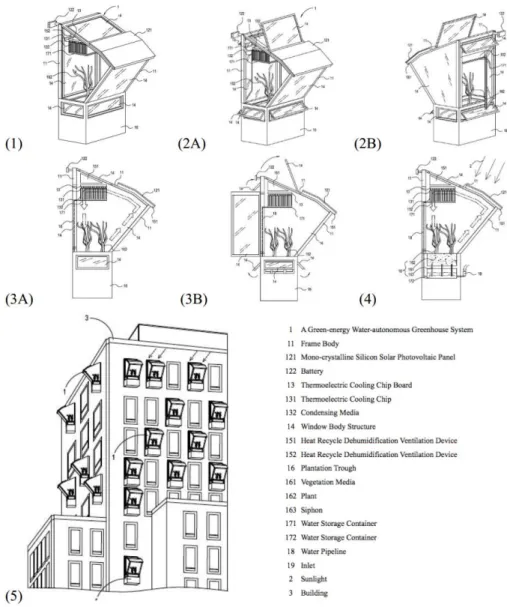
Refer initially to Figure 1, objects 1, 2A, 2B, 3A and 3B, wherein a stereo combinatorial structure view, a front stereo view, a rear stereo view and a lateral view for a green-energy, water-autonomous greenhouse system, according to the present invention, are respectively shown. From the figures, it can be seen that the system (1) comprises a frame body (11), having a plantation trough (16) installed at the bottom; a solar power generation device, installed at the top of the frame body (11) (and including a mono- crystalline silicon solar photovoltaic panel (121) and a battery (122)); a thermoelectric cooling chip board (13) (which includes a plurality of thermoelectric cooling chips (131) and a condensing media (132)); and at last a window body structure (14) installed on the frame body, wherein the front, rear, left, right and upper frames of the frame body (11) all allow the installation of at least a window body structure (14). In addition, the thermoelectric cooling chip board (13) is installed on the upper side within the frame body (11), the solar power generation device is installed on the top of the frame body (11), and the solar power generation device is connected to the thermoelectric cooling chip board (13) by way of the battery (122), so as to provide electric power for the operations of the thermoelectric cooling chip board (13).
In addition, it can be seen from Figure 1, Objects 1, 2A and 2B, that the
frame body (11) includes a front frame, a rear frame, a left frame, a right
frame and an upper frame, and the window body structure (14) is installed
on the front frame, the rear frame, the left frame, the right frame or the
upper frame of the frame body (11). Herein, the window body structure (11)
may be a manual pushed-out window, an electric projected-out window or a
fixed window, so that in case the window body structure (11) is a manual
pushed-out window or an electric projected-out window, as shown in Figure
1, Objects 1 2A, 2B and 3B, it can be pushed outward to open in order to
perform air circulation for the interior of the system (1). Furthermore, a
solar photovoltaic chip can be additionally installed within the window body
structure (14) thereby acting as a splitter or dimmer glass to regulate and
control the power supply, and the solar photovoltaic chip may be Copper- Indium-Gallium-Selenide (CIGS) solar cells.
Also, the window body structure (14) in the front frame, left frame or right frame of the frame body (11) may include a prism sheet splitter glass or a dimmer glass.
Moreover, a condensing media (132) may be placed under the thermoelectric cooling chip board (13) such that the cooling terminal of the thermoelectric cooling chip board (13) can reduce the temperature and generate condensed water on the condensing media (132).
Additionally, the solar power generation device may include a mono- crystalline silicon solar photovoltaic panel (121) and a battery (122), and the battery (122) is connected to the mono-crystalline silicon solar photovoltaic panel (121) and the thermoelectric cooling chip board (13), wherein the interior of the mono-crystalline silicon solar photovoltaic panel (121) includes a solar photovoltaic chip which can be mono-crystalline silicon solar cells.
Yet also, at a minimum, a heat recycle dehumidification ventilation device (151 and 152) can be additionally installed in the system (1) so that these heat recycling dehumidification ventilation devices (151 and 152) are capable of providing the features of inward air dehumidification, heat exchange and ventilation, wherein the heat recycle dehumidification ventilation device (151) may be set up between the mono-crystalline silicon solar photovoltaic panel (121) of the solar power generation device and the frame body (11), and the other heat recycle dehumidification ventilation device (152) installed between the frame body (11) and the thermoelectric cooling chip board (13).
Furthermore, as shown in Figure 1, Object 4, the plantation trough (16) can include the vegetation media (161) and at least a plant (162), wherein the plant (162) may be an ornamental plant or an edible plant, the plantation trough (16) may be a light porous moisture-retentive vegetation media trough and the vegetation media (161) may be a soil or porous moisture- retentive media. Also, a siphon (163) can be connected between the vegetation media (161) in the plantation trough (16) and the water storage container (172).
In addition, it can be observed from Figure 1, Object 4, that at least two water storage containers (171 and 172) can be added to the inside of the frame body (11), wherein a water storage container (171) can be placed under the thermoelectric cooling chip board (13) and the other one placed beneath the vegetation media (161) of the plantation trough (16), in which these two water storage containers (171 and 172) are connected by way of a water pipeline (18) so as to transfer water held in the water storage container (171) into the water storage container (172).
Next, it can be seen from Figure 1, Object 4, that a recycle pipeline (not shown) as well as an inlet (19) can be additionally installed in the system (1), wherein the recycle pipeline facilitates the recycle usage of condensed water or rainfall, and an end of the inlet (19) is connected to the water storage container (172) under the vegetation media (161) in the plantation trough (16), such that the user can also manually irrigate via the inlet (19).
In addition to the above-said implementations, other devices can also be
configured to the system (1) according to the present prototype. For
example, an electronic supervisory system (not shown) may be alternatively
connected into the system (1) such that the electronic supervisory system
can have control over the window body structure (14) and the thermoelectric
cooling chip board (13). Furthermore, a ventilation device capable of
ventilation amount adjustments (not shown), a thermo-hygrometer capable of detecting the temperature and humidity in the system (1) (not shown) or a barometer capable of detecting air pressure values in the system 1 (not shown) can be additionally installed.
The electronic supervisory system can further control the ventilation device, the thermo-hygrometer or the barometer such that the user can remotely monitor the environmental variations within the system (1) and control the ventilation device so that the ventilation device can automatically adjust the states of air speed, air withdrawal and air exhaustion in order to adjust the temperature in the system (1). What is more, the electronic supervisory system also allows the user to remotely monitor the environmental variations in the system, and the electronic supervisory system can control the window body structure to open or close automatically and manipulate the thermoelectric cooling chip board (13) to adjust the internal temperature.
Consequently, as shown in Figure 1, Object 4, when the sunlight (2) illuminates the mono-crystalline silicon solar photovoltaic panel (121), the solar power generation device converts absorbed light energy into electric energy and transfers electric power to the thermoelectric cooling chip board (13) as well as to the ventilation device (not shown); therefore, when the thermoelectric cooling chip board (13) operates, the cooling end of the thermoelectric cooling chip (131) in the thermoelectric cooling chip board (13) can reduce the temperature and condensed water created by means of the condensing media (132), which can drop down due to gravity and irrigate the plant (162) in the plantation trough (16). Meanwhile, because the sunlight (2) illuminates the system (1), the internal temperature may increase and the potential energy difference between the plant (162) and the vegetation media (161) (e.g., soil) in the plantation trough (16) causes water molecules to evaporate and rise up to the top, and the air circulation can be enhanced with the ventilation device, such that the wet, warm air can be continuously heated and humidified in order to ascend, thereby achieving a plant ecological environment system capable of autonomous circulations by means of this continuous circulation process.
3.1.3 Brief description of the drawings
Figure 1 shows the drawings and major component symbol descriptions
include a stereo combinatorial structure view, a front stereo view, a rear
stereo view, two lateral views, an operation diagram, and an embodiment
diagram for a green-energy, water-autonomous greenhouse system according
to the present invention.
Figure 1. Drawings and major component symbol description
4. DISCUSSION 4.1 Innovations
Figure 2. Innovations in system
Figure 2 shows the diagram of system function and a symbol picture according to the present invention.
Innovations in the presented prototype of the green-energy, water- autonomous greenhouse system are pointed out as follows:
1. “A system is a set of things… interconnected in such a way that they produce their own pattern of behavior over time. The system may be buffeted, constricted, triggered, or driven by outside forces. But the system’s response to these forces is characteristic of itself, and that response is seldom simple in the real world. A system is more than the sum of its parts;
it may exhibit adaptive, dynamic, goal-seeking, self-preserving, and sometimes evolutionary behavior” (Meadows, 2008). Just like the system defined above, the green-energy, water-autonomous greenhouse system (simply named GEWA), interconnected by a set of elements showed in Figure 1 and Figure 2, is indeed a coherently organized system that achieves an adaptive eco-environment.
2. The system’s characteristic key functioning is started with the using of a thermoelectric cooling chip board on the basis of the Peltire effect, which makes it possible for the evaporation and condensation processes for a small water cycle to be completed inside the greenhouse, and an autonomous water supply to be accomplished.
3. GEWA is an enhancement on the sophisticated and multidisciplinary approaches and technologies mentioned in most of the reviewed research subjects and tries to achieve an adaptive, semi-closed climate-responsive, passive greenhouse system with the following points of invention:
(1). There is an automatic supply of electric power for the internal operations by means of a solar power generation device installed at the top of the frame body. The solar power generation device is connected to a thermoelectric cooling chip board by way of a battery to provide electric power to drive it to reduce the surrounding temperature, thereby generating condensed water.
(2). The condensed water was phase-changed by evapotranspirated water vapors, which ascend with sunlight-illuminated wet warm air by natural buoyancy.
(3). An electronic supervisory system can be connected, thereby allowing control over the operation of a window’s open-closure and illumination adjustments, the thermoelectric cooling chip board, the ventilation device, the heat recycle dehumidificator, the hygrometer, the thermometer, the barometer and other measuring.
4. The special integrated mechanism applied in the system includes:
(1) the photovoltaic effect of the solar power system; (2) purification of water; (3) photocatalysis on the surface of structure and materials, equipment and devices; (4) a fuzzy control strategy for the climatic sensor system; (5) the photoelectrochromic effect of window glass; (6) prism sheet splitter glass; and other intelligent automations.
5. The GEWA will be developed as a cyber physical system.
4.2 Advantages: in the general system
Compared with other conventional application technologies, GEWA
further offers the following advantages:
1. A plant ecological environment system that can be maintained autonomously by the system.
2. The window of the present prototype facing indoors can be opened to supply the generated oxygen into the room, thereby attaining the purposes of green environment and beautification effects, and the people within the room can also enjoy the delightful view.
3. The present prototype can be installed extending outwards from a window, does not occupy indoor space and is very convenient to arrange.
Meanwhile, such an outside-window installation can be helpful for adding suitable ornamental plants or alternatively practicing edible plant vegetation to act as a small-sized vegetation farm.
4. Environmental variations within the system can be monitored remotely by an externally connected electronic supervisory system and the changing environmental factors can be controlled and suitably regulated to maintain an optimal growth environment for plants.
4.3 Advantages: Interaction across a building system
A GEWA, as an eco-environment, could have many interactions across a building system. It could be an experimental platform, a climate station, a cloud point, and indeed be a third environment in between the outside and interior building environment. Being a third environment, GEWA could be more adaptive than conventional vertical greening by its additional function of mitigating environmental impact to a building. It could become a cyber physical system.
Figure 3. CFD environmental simulations of wind flow through greenhouse (simulated by WindperfectDX., Total number of grid points is 2,753,520 )
An example is described by a CFD simulation investigating the influence of GEWA on the wind flow from the outside to the inside of the building.
As shown in Figure 3, a wind flow with an average wind speed of 2.43m/s
with a SW wind direction was simulated, Figure 3, Objects a to c, show a
CFD model and a grid pattern with 2,753,520 computating grids. Figure 3,
Object d shows the windflow section at Range: 0~3m/s, Object e shows
windspeed distribution at 1.5m high at Range: 0~3m/s, Object f shows the windspeed equalizer surface at windspeed 1m/s. From the results of the analysis, the windflow pattern could be realized and the effects on the environment could be evaluated.
Other environmental factors and parameters like temperature and humidity could also be simulated.
4.4 Advantages: Incorporating greenery into a building
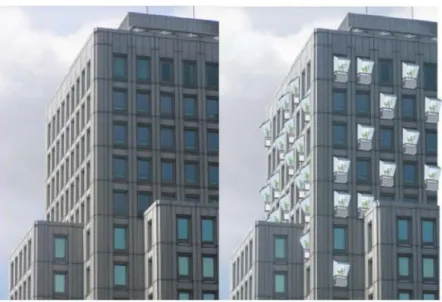
Figure 4. Incorporating greenery into a building, before and after.
Figure 4 shows an example of incorporating GEWA into the Mega Holdings Building, Taipei using a real ‘before’ photograph and an ‘after’
simulation photograph.
A GEWA could incorporate a variety of greenery into buildings on the walls and openings; it could be a window garden, a sky garden or a vertical farm. It could develop a vertical greenery networking system in a smart city.
It is expected that GEWA will be used to incorporate greenery into a building as an alternative of vertical greening, in order to open a very interesting possibility for increasing attractiveness of cityscapes and to enhance progressive urban revitalization in smart cities.
5. CONCLUSION AND RECOMMENDATION 5.1 Conclusion
A sophisticated and multi-disciplinary green-energy, water-autonomous greenhouse system, by using the water resource and solar energy in a rational way to aim at more well-being based on more products, more information, more services, and more experience, could be an alternative- technology approach towards a sustainable smart-green vertical greening in smart cities.
Aimed at improving responsiveness, conservation, efficiency and performance for environmental sustainability, resource sustainability, and material and technological sustainability, and also aimed at achieving better
N
well-being, GEWA is expected to be a foresight with simplicity in evolution.
5.2 Recommendation
The following studies are suggested for future research:
1. A real model of the prototype should be established to conduct a relevant experimental study and to contribute big data for research.
2. A foresight design based on Building Information Modeling (BIM) is necessary to provide advanced understanding of the proposed greenhouse system and to allow the building of a smart-green point cloud with BIM workflow on any network in a smart city.
REFERENCES
Abdel-Ghany, A., & Al-Helal, I. (2011). "Solar Energy Utilization by a Greenhouse: General Relations". Renewable Energy, 36(1), 189-196.
Attmann, O. (2009). Green Architecture (Greensource Books): Advanced Technolgies and Materials. New York: McGraw-Hill Education.
Baeza, E. J., Pérez-Parra, J. J., Montero, J. I., Bailey, B. J., López, J. C., & Gázquez, J. C.
(2009). "Analysis of the Role of Sidewall Vents on Buoyancy-Driven Natural Ventilation in Parral-Type Greenhouses with and without Insect Screens Using Computational Fluid Dynamics". Biosystems Engineering, 104(1), 86-96.
Bakker, J. C., Adams, S. R., Boulard, T., & Montero, J. I. (2008). "Innovative Technologies for an Efficient Use of Energy". Acta Hort, 801, 49-62.
Balas, M. M. (2014). "Seven Passive Greenhouse Synergies". Acta Polytechnica Hungarica, 11(4), 199-210.
Buchholz, M. (2008). "Overcoming Drought: A Scenario for the Future Development of the Agricultural and Water Sector in Arid and Hyper Arid Areas, Based on Recent Technologies and Scientific Results". Implementation Guide of the "Cycler Support"
project (RTD FP 6 -INCO, Ref. Nr. 031697) Retrieved from http://www.user.tu- berlin.de/marbh/ImplementationGuide.pdf
Buchholz, M., Buchholz, R., Jochum, P., Zaragoza, G., & Pérez-Parra, J. (2006).
"Temperature and Humidity Control in the Watergy Greenhouse". Acta Hortic, 719, 401- 408.
Giacomelli, G. (2007). "Innovation in Greenhouse Engineering for Greensys2007".
Retrieved from www.newaginternational.com
Hatzelhoffer, L., Humboldt, K., Lobeck, M., & Wiegandt, C. (2012). Smart City in Practice:
Innovation Lab between Vision and Reality. Berlin: Jovis.
Hemming, S., Speetjens, S. L., Wang, D., & Tsay, J. R. (2014). "Greenhouse Design for Vegetable Production in Subtropical Climate in Taiwan". Acta Hortic, 1037, 65-74.
Jochum, P., & Buchholz, M. (2005). "How to Simulate Thermal and Fluid Dynamical Processes in Closed Greenhouses Including Water Interactions between Plants and Air".
Acta Hortic, 691, 553-560.
Katsoulas, N., Sapounas, A., De Zwart, F., Dieleman, J., & Stanghellini, C. (2015).
"Reducing Ventilation Requirements in Semi-Closed Greenhouses Increases Water Use Efficiency". Agricultural Water Management, 156, 90-99.
Kwok, A., & Grondzik, W. (2011). The Green Studio Handbook: Enviromental Strategies for Schematic Design. New York: Elsevier.
Lamnatou, C., & Chemisana, D. (2013). "Solar Radiation Manipulations and Their Role in Greenhouse Claddings: Fluorescent Solar Concentrators, Photoselective and Other Materials". Renewable and Sustainable Energy Reviews, 27, 175-190.
Lin, C.-Y., & Huang, Y.-L. (2013). "Planning Review: Application of Vertical Greening for Landscape Beautification in Taipei". International Review for Spatial Planning and Sustainable Development, 1(4), 43-49.
Meadows, D. H. (2008). Thinking in Systems: A Primer. White River Junction, VT: Chelsea Green Publishing.
Misni, A., Baird, G., & Allan, P. (2013). "The Effect of Landscaping on the Thermal Performance of Housing". International Review for Spatial Planning and Sustainable Development, 1(1), 29-48.
Montero, J. I., Van Henten, E. J., Son, J. E., & Castilla, N. (2011). "Greenhouse Engineering:
New Technologies and Approaches". Acta Hortic, 893, 51-63.
Opdam, J. J. G., Schoonderbeek, G. G., Heller, E. M. B., & de Gelder, A. (2005). "Closed Greenhouse: A Starting Point for Sustainable Entrepreneurship in Horticulture". Acta Hortic, 691, 517-524.
Orgaz, F., Fernández, M., Bonachela, S., Gallardo, M., & Fereres, E. (2005).
"Evapotranspiration of Horticultural Crops in an Unheated Plastic Greenhouse".
Agricultural Water Management, 72(2), 81-96.
Parra, J. P., Baeza, E., Montero, J. I., & Bailey, B. J. (2004). "Natural Ventilation of Parral Greenhouses". Biosystems engineering, 87(3), 355-366.
Peng, K.-H. (2013). "The Application of Vertical Greening to Urban Rehabilitation and Maintenance". International Review for Spatial Planning and Sustainable Development, 1(3), 41-52.
Peng, K.-H., Kuo, Y.-C., & Lin, H.-Y. (2015). "The Use of Vertical Greening in Urban Rehabilitation to Improve Sustainability of the Environment in Taiwan". International review for spatial planning and sustainable development, 3(1), 5-16.
Speetjens, S. L., Stigter, J. D., & Van Straten, G. (2009). "Towards an Adaptive Model for Greenhouse Control". Computers and Electronics in Agriculture, 67(1), 1-8.
Speetjens, S. L., Stigter, J. D., & van Straten, G. (2010). "Physics-Based Model for a Water- Saving Greenhouse". Biosystems engineering, 105(2), 149-159.
Tantau, H.-J., Meyer, J., Schmidt, U., & Bessler, B. (2011). "Low Energy Greenhouse-a System Approach". Acta Hortic, 893, 75-84.
Teitel, M., Montero, J. I., & Baeza, E. J. (2012). "Greenhouse Design: Concepts and Trends".
Acta Hortic, 952, 605-620.
Teitel, M., Ziskind, G., Liran, O., Dubovsky, V., & Letan, R. (2008). "Effect of Wind Direction on Greenhouse Ventilation Rate, Airflow Patterns and Temperature Distributions". Biosystems Engineering, 101(3), 351-369.
Vadiee, A., & Martin, V. (2012). "Energy Management in Horticultural Applications through the Closed Greenhouse Concept, State of the Art". Renewable and Sustainable Energy Reviews, 16(7), 5087-5100.
Vadiee, A., & Martin, V. (2013). "Thermal Energy Storage Strategies for Effective Closed Greenhouse Design". Applied energy, 109, 337-343.
van Kooten, O., Heuvelink, E., & Stanghellini, C. (2008). "New Developments in Greenhouse Technology Can Mitigate the Water Shortage Problem of the 21st Century". Acta Hortic, 767, 45-52.
Zaragoza, G., Baeza, E., Pérez-Parra, J. J., Buchholz, M., & Jochum, P. (2005). "The Watergy Greenhouse: A Closed System for Solar Thermal Energy Collection, Water Treatment and Advanced Horticulture". SAE Technical Paper 2005-01-2919.
Zaragoza, G., & Buchholz, M. (2008). "Closed Greenhouses for Semi-Arid Climates: Critical Discussion Following the Results of the Watergy Prototype". Acta Hortic, 797, 37-42.
Zaragoza, G., Buchholz, M., Jochum, P., & Pérez-Parra, J. (2007). "Watergy Project:
Towards a Rational Use of Water in Greenhouse Agriculture and Sustainable Architecture". Desalination, 211(1), 296-303.