Hirosaki Med.J.
64(Suppl.):S117―S120,2013ROLE OF NURSES IN EARLY AMBULATION OF LIVING DONOR LIVER TRANSPLANT RECIPIENTS
Orie Sato
1),Yumiko Osanai
1),Chie Urushidate
1),Tomoko Yamaguchi
1), Shunji Narumi
2),Minoru Umehara
3),Yoshikazu Toyoki
4),Michihiro Sugai
3),
Kenichi Hakamada
4), and Toshiko Kimura
1)Abstract
[Introduction] Liver transplant recipients suffer more complications than do patients undergoing other gastroenterological surgeries. Many factors inhibit ambulation in liver transplant patients, such as the level of restriction to bed rest and length of stay in the intensive care unit (ICU). Patients thus face ambulation difficulties.
Support for ambulation is one of the major daily tasks of nurses. We reviewed the ambulation situations of patients who underwent living donor liver transplantation to investigate factors that contributed to ambulation and the nurse’s role therein.
[Patients] Ten recipients underwent living donor liver transplantation in our hospital between April 2009 and December 2010. Records of the 8 patients who survived were evaluated for this study.
[Result] According to the postoperative day of initiation of independent walking in the hospital ward, there were no significance difference among operation time, intraoperative bleeding, length of stay in ICU, bed rest level, complications, and rehabilitation intervention. However, the patients who received preoperative guidance were more highly motivated about ambulation than were patients who did not receive preoperative guidance.
[Discussion] Although initiation of independent walking in the hospital ward differed depending on the patient's general status, it was found that volition is also a strong factor in patient ambulation. Preoperative orientation helps patients to understand perioperative management and clinical course. Moreover, it is necessary to share information with the rehabilitation team and to assist in the activities of daily living for early ambulation.
Hirosaki Med.J. 64, Supplement:S117―S120,2013 Key words: early ambulation; liver transplant recipients; preoperative orientation;
postoperative rehabilitation
1)
Department of Nursing, Hirosaki University Hospital
2)
Department of Advanced Transplant and Regenerative Medicine, Hirosaki University Graduate School of Medicine
3)
Department of Pediatric Surgery, Hirosaki University Graduate School of Medicine
4)
Department of Gastroenterological Surgery,
Hirosaki University Graduate School of Medicine Corresponding author: Yoshikazu Toyoki
Department of Gastroenterological Surgery, Hirosaki University Graduate School of Medicine, 5 Zaifu-cho, Hirosaki 036-8562, Japan.
Tel.: +81-172-39-5079 Fax: +81-172-39-5080
E-mail: [email protected]
[Introduction]
Postoperative ambulation serves many purposes. Ambulation helps prevent respiratory, digestive, and circulatory complications and articular contractures; slows muscle atrophy; and inhibits development of articular contractures.
Ambulation also increases mental activity, enhances mood, and hastens wound healing.
Liver transplant recipients suffer more
complications than do patients undergoing other
gastroenterological surgeries
1). Many factors
inhibit ambulation, such as the level of restriction
to bed rest level and the length of stay in the
intensive care unit (ICU). Thus, patients face
significant difficulties in ambulation. A few
studies have reported postoperative ambulation
in liver transplant recipients, and most are
S 118 O. Sato, et al.
studies conducted by physical therapists.
However, support for ambulation is one of the major daily tasks of nurses. To determine the factors influencing postoperative ambulation and the nurse’s role therein, we reviewed the records of living donor liver transplant recipients in our facility over a 2-year period.
[Patients and Methods]
Ten patients underwent living donor liver transplantation in our hospital between April 2009 and December 2010. Among the 8 patients who survived, there were 6 adult and 2 pediatric recipients.
Data were collected by retrospective review of medical and nursing charts. We assessed whether patients received preoperative orientation and postoperative rehabilitation and examined operative records, clinical information, and motivation levels of patients.
[Results]
Rehabilitation for liver transplant recipients was not a routine protocol followed by our liver transplant team until June 2010. Previously, rehabilitation for liver transplant recipients was performed according to the recipient’s condition
(for example, length of preoperative illness and postoperative ambulation situation). In July 2010, rehabilitation became a routine protocol for all recipients. Five of the 8 recipients underwent rehabilitation during this study period. There were no significant differences in independent walking between the recipients who received rehabilitation and those who did not.
Preoperative orientation consisted of a preoperative pamphlet for general surgery until November 2009. After this time, we used a pamphlet specifically designed for liver transplantation. As a result, 3 of 8 patients received preoperative orientation for liver
transplantation. Two of the remaining patients received preoperative orientation for general surgery. Three patients underwent emergency surgery and did not receive preoperative orientation. There were no significant differences in independent walking between the patients who received preoperative orientation for liver transplantation and those who did not.
We divided patients into 2 groups according to motivation for ambulation. The highly motivated group included patients who expressed a desire for ambulation. Three patients were considered to be highly motivated. The remaining 5 patients were considered to be poorly motivated.
Table 1 shows the correlation between ambulation and patient motivation. There was no difference between groups in ambulation.
However, patients in the highly motivated group tended to walk independently earlier than patients in the poorly motivated group.
Table 2 shows the correlation between patient motivation and preoperative intervention.
The percentages of patients who underwent rehabi l it at ion a nd t ho se who received preoperative orientation for liver transplantation were higher in the highly motivated group than in the poorly motivated group (100% versus 40%
and 66.7% versus 20%, respectively).
[Conclusion]
Early postoperative ambulation helps prevent respiratory, digestive, and circulatory complications
2)and stimulates mental activity.
Patient desire for ambulation appears to be an important factor for early ambulation, and rehabilitation could enhance patient desire.
Rongies et al. discussed the importance of early
rehabilitation for prevention of postoperative liver
dysfunction in orthotopic liver transplantation
3), 4).
Katsukawa et al. reported that it was important
to perform early rehabilitation by communication
with pediatric recipients
5). For performing
S 119
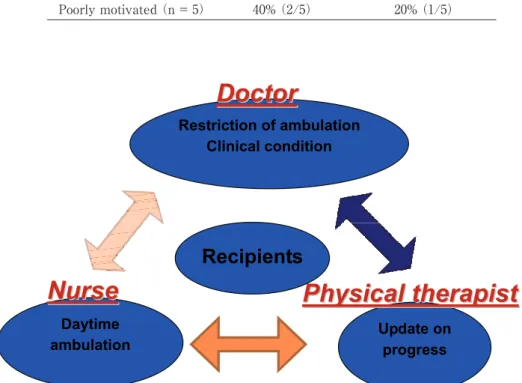
rehabilitation efficiently, it is important to share information about the clinical course and state of ambulation among members of the transplant team, including doctors, nurses, physical therapists, and other key personnel (Fig. 1).
Recipients who received preoperative orientation for liver transplantation tended to walk earlier than the recipients who did not receive preoperative orientation (due to emergency operations; data not shown).
Recipients who underwent emergency liver transplantations were more seriously ill than were recipients with planned liver
transplantations. However, it is important that patients understand their expected postoperative conditions before surgery in order to achieve early ambulation. Indeed, liver transplant-specific preoperative orientation improved patient volition regarding ambulation. Moreover, nurses find it easy to complete preoperative orientations with patients using a pamphlet designed for liver transplantation. Oda et al. asserted that nursing intervention for ambulation could be performed smoothly
6). Improvement in preoperative orientation for patients with planned transplants and clea r communicat ion wit h pat ients
Ambulation Maintenance of sitting posture
(POD)
Walking with aid
(POD)
Independent walking
(POD)
Highly motivated (n = 3) 7, 9, 9 11, 11, 11 11, 13, 13 Poorly motivated (n = 5) 6, 7, 7, 12, 25 7, 10, 11, 12, 33 7, 12, 12, 18, 33
Table 1 Correlation between ambulation and patient motivation
Intervention Rehabilitation Preoperative orientation Highly motivated (n = 3) 100% (3/3) 66.7% (2/3)
Poorly motivated (n = 5) 40% (2/5) 20% (1/5)
Table 2 Correlation between motivation and intervention
Figure 1 Scheme for sharing information about rehabilitation
12
Figure 1
Restriction of ambulation Clinical condition
Do D oc ct t or o r
Daytime ambulation
Nu N u rs r s e e
Update on progress
P P h h y y s s i i c c a a l l t t h h e e r r a a p p i i s s t t
Recipients
S 120 O. Sato, et al.
after emergency transplant surgery will be important in the future. We also recommend that orientation contents be revised to contain information for the recipient’s family (Fig. 2).
In summary, although initiation of independent walking in the hospital ward (early ambulation)
differed according to the general status of the patient, patient-expressed desire for ambulation was found to be a strong factor for ambulation.
Preoperative orientation helps patients understand perioperative management and the clinical course of recovery. Moreover, it is necessary to share information with the rehabilitation team and to assist in the activities of daily living for early ambulation.
References
1)Jensen WA, Rose RM, Hammer SM, Jenkins RL, Benotti PN, Dzik WH, Costllo P, et al. Pulmonary complications of orthotopic liver transplantation.
Transplantation 1986;42:484-490.
2)Ganschhow R, Nolkemper D, Helmke K, Harps E, Commentz JC, Broering DC, Pothmann W, et al. Intensive care management after pediatric
liver transplantation: a single-center experience.
Pediatr Transplant 2000;4:273-279.
3)Rongies W, Stepniewska S, Golinska B, Kenczew- Kolanowska T, Dolecki W, Brudkowska A, Jakimowicz T, et al. Influence of the primary disease on rehabilitation results in the early postoperative period in patients after orthotopic l i v e r t r a n s p l a n t a t i o n . T r a n s p l a n t P r o c . 2009;41:3119-3122.
4)Rongies W, Stepniewska S, Golinska B, Wojtaszek M, Dolecki W, Lewandowska M, Bialoszewski D.
An attempt to assess the influence of primary disease on the results of therapeutic rehabilitation in an early post-operative period in orthotopic liver transplant recipients. Ann Transplant 2008;13:40-43.
5)Katsukawa H, Hatano R, Hagiwara R, Enomoto Y, Matsudo R, Kimura T, Fujinuma K. Benefits of physical therapy to pediatric liver transplantation.
Nihon shirituikadaigaku rigakuryouhou 2004;21:10- 13 in Japanese.
6)Oda C, Nawada Y, Yamashita J, Tanaka Y. The nursing intervention which reduces anxiety about the getting up for an early postoperative period.
Nihon kangogakkai ronnbunnshuu 2008; 39:241- 243 in Japanese.
Figure 2 Preoperative orientation components
13