Hirosaki Med.J. 63:1―11,2012
Hirosaki University Graduate School of Health Sciences
Correspondence: K. Kayama
Received for publication, November 10, 2011 Accepted for publication, December 28, 2011
弘前大学大学院保健学研究科博士後期課程 別刷請求先:嘉山恵子
平成23年11月10日受付 平成23年12月28日受理 ORIGINAL ARTICLE
CURRENT CIRCUMSTANCES AND CHALLENGES OF ORGAN TRANSPLANT COORDINATORS IN JAPAN
Keiko Kayama
Abstract Purpose: This study aimed to determine the current circumstances and challenges facing the Certified Procurement Transplant Coordinator (CPTC) system in Japan and to identify areas for improvement.
Materials and Methods: A questionnaire survey was conducted of 35 practicing CPTCs, 7 former CPTCs, and Organ Transplant Service Officers (OTSOs) in 20 prefectures of Japan.
Results: Practicing CPTCs responded that they felt "anxious about the CPTC employment system", perceived a
"lack of experience based on regional disparities in numbers of organ donors", and wanted to see "improvements in the CPTC training program". These responses were similar to the reasons for resignation provided by former CPTCs. OTSOs responded that they "do not approve" of their current Organ Transplant Support Project (OTSP)
and that there were no evaluation criteria in place to help convince the government to provide project funding.
Conclusion: A CPTC training program that guarantees the status of CPTCs in Japan and reflects current regional circumstances such as numbers of organ donors needs to be established.
Hirosaki Med.J. 63:1―11,2012 Key words: Transplant coordinator; employment system; training program.
原 著
日本における移植コーディネーターの現状と課題
嘉 山 恵 子
抄録 【目的】我が国の臓器獲得移植コーディネーター(Certified Procurement Transplant Coordinator:CPTC)の現 状・実態と問題点を把握し,改善点について検討することを目的とした.
【対象と方法】回答が得られた現職の CPTC として活動している者35名とかつて CPTC として活動していた者 7 名,
47都道府県の臓器移植事業担当者を研究対象者とし,質問紙による調査をおこなった.
【結果】現職の CPTC は「雇用体制への不安」,「臓器提供数の地域格差による経験不足」を感じ,「教育体制の充実」を 求めていた.かつて CPTC として活動していた者の辞職理由も同様であった.臓器移植事業担当者は,臓器移植対策 事業を「評価していない」と回答し,予算獲得のための説得材料となる評価基準はみられなかった.
【結論】CPTC の統一した身分保障を基盤とし,地域の現状に応じた教育体制の構築が必要であると考えられた.
弘前医学 63:1―11,2012 キーワード:移植コーディネーター;雇用体制;教育体制の構築.
2 K. Kayama
Introduction
The Organ Transplant Law adopted in 1997 legalized the donation of organs from brain-dead donors1) and paved the way for the Certified Procurement Transplant Coordinator (CPTCs)
system in Japan. The CPTC system consists of Network Coordinators (NWCs) directly employed by the Japan Organ Transplant Network (JOTNW), which brings together organ donors and recipients, and commissioned local coordinators (LCs) employed by prefectural government agencies. At present, there are approximately 70 active NWCs and LCs. NWCs who pass the JOTNW employment exam can provide organ transplant referral services, while LCs who attend the JOTNW training seminar and pass the written exam are issued with a letter of commission to provide organ transplant referral services. Transplant coordinators (TCs)
are professionals who are responsible for the overall coordination of organ donation as well as for raising awareness of medical transplantation, but their status and qualifications in Japan can hardly be described as organized. The Japanese Government established a TC study group in 1989 that began investigating the necessary qualifications, operations, and training system following the adoption of the relevant laws.
However, the status of TCs has not yet been established in Japan, perhaps reflecting the low number of organ donations. Some regions of Japan have very few organ donors, so some TCs have very little practical experience in coordinating organ donation. In addition, LCs receive instructions on organ donation-related tasks from the JOTNW, but instructions on awareness-raising activities are issued by the affiliated prefectural government agency so their operating standards lack consistency. The Organ Transplant Law was amended in July 2010 with the aim of increasing the number of organ donors in Japan2). However, even if the amendment is
successful in boosting the number of donors, the increased workload will inevitably have to be handled by inexperienced TCs. This study sought to determine the current circumstances and challenges facing the CPTC system in Japan and to identify areas for improvement.
Materials and Methods
1. Survey of prefectural government agencies 1) Survey population
Organ Transplant Service Officers (OTSOs)
from the 47 prefectural governments in Japan, as listed on the official membership directory of the JOTNW published on its website.
2) Survey method
Survey request forms and questionnaires were sent by mail to the 47 prefectural government OTSOs. The questionnaire was kept anonymous to protect the identity of respondents.
3) Survey details
The survey addressed matters relating to organ transplant measures (budgets and evaluation methods) and matters relating to TCs (employment status, employment criteria, description of duties, suggested measures for future establishment of TCs).
2. Practicing TCs 1) Survey population
The survey targeted a total of 70 TCs consisting of 20 network coordinators
(NWCs) employed by the JOTNW and 50 commissioned local coordinators (LCs)
employed by prefectural government agencies.
2) Survey method
The number of NWCs was confirmed and questionnaire forms were distributed via JOTNW's transplant coordination manager. Meanwhile, survey request forms and questionnaires were sent to
3 Transplant Coordinator in Japan
LCs via the manager of their respective affiliated government agencies listed on the JOTNW website. The questionnaire was kept anonymous to protect the identity of respondents.
3) Survey details
The survey examined the current circum- stances (affiliation, employment status, work experience, willingness to continue working as a TC, evaluation by affiliated organization) and operations (experience in coordinating organ donation) of TCs.
3. Former TCs
1) Survey population
The survey targeted 15 consenting former TCs recruited by network sampling via an associate of the authors.
2) Survey method
A survey request form and questionnaire were sent to each of the 15 former TCs.
The questionnaire was kept anonymous to protect the identity of respondents.
3) Survey details
The survey examined the past circumstanc- es (affiliation, employment status, employ- ment duration, evaluation by affiliated orga- nization), reasons for resigning, and current employment status of former TCs.
4. Ethical considerations
This study was conducted with the approval of the ethics committee at the Graduate School of Medicine at Hirosaki University. Study volunteers read the survey request form and indicated their voluntary consent to participate in the study by returning the completed questionnaire. Questionnaires were collected individually by mail.
Results
1. Prefectural government agencies
Twenty of the 47 prefectural government agencies responded to the questionnaire, constituting an effective response rate of 42.6%.
1) Year of commencement of Organ Transplant Support Projects (OTSPs)
A total of 14 OTSPs (70%) were established prior to enactment of the Organ Transplant Law in 1997, while 10 TC positions (50%)
were created from 1997 onwards. The earliest OTSP was initiated in 1980.
2) TC employment criteria
Figure 1 illustrates the employment criteria of TCs, but no age restrictions were adopted.
3) Budgetary measures
While the personnel costs of TCs directly employed by the JOTNW (i.e., NWCs) are
Fig 1 The employment criteria of TCs. There were various criteria by each prefectural government agency, but no age restrictions were adopted.
24
occupation.
Fig 4: Reasons for willingness to continue working as a TC were shown. Most responders answered that they find coordination of organ donation rewarding.
Figure 1.
Others Able to be on-call 24 h/day Consideration of educational & work background (not limited to those with medical qualifications)
Individuals with medical qualifications
(person)
4 K. Kayama
subsidized by the national government, the personnel costs of commissioned TCs employed by prefectural government agencies (i.e., LCs) are funded through the budget of the prefectural government. The present study surveyed the personnel costs and various other costs associated with organ transplant measures (collectively referred to as the 'organ transplant measures budget'). The mean organ transplant measures budget was equivalent to ¥6,575,000 (range, ¥900,000-¥18,952,000).
4) Evaluation of OTSP operations
Evaluation of OTSP operations as a basis for determining the budget for the next fiscal year was carried out by 6 prefectural government agencies, while 11 agencies responded that they did not conduct evaluations or that there no evaluation methods were in place (Fig. 2). Reasons for not conducting evaluations included:
"Evaluation is difficult to perform"; "OTSP operations lay outside the scope of evaluation";
"Organ transplant operations are outsourced";
"Do not perceive the need to evaluate OTSP operations"; and "No clear criteria for evaluating OTSP operations". Reasons for conducting evaluations included: "TC activities";
"Administrative and organ transplant bank steering committee evaluation"; "Evaluation by
OTSP"; and "No evaluation criteria, so proper conduct of OTSP operations was confirmed during audit".
5) Future measures
Thirteen prefectural government agencies
(68.4%) responded that they would maintain their current OTSP operations, while only 1 agency (0.53%) stated that it would "secure TC employment and procure human resources". Reasons for maintaining current operations were: "Don’t recognize the need to increase the number of TCs"; "Budget increase is unlikely"; and "Stringent fiscal conditions".
2. Practicing TCs
Questionnaire responses were received from 35 of the 70 combined NWCs and LCs for an effective response rate of 50%. Specifically, 5 NWCs (14.3%) and 30 LCs (85.7%) responded.
1) Attributes surveyed
Mean employment term was 86.9 months
(range, 4-271 months). Previous work experience was held by 33 respondents
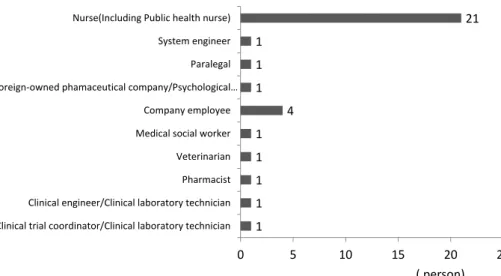
(94.3%), with nursing as the most common former occupation (20 respondents, 60.6%)
(Fig. 3). In terms of the employment status of LCs, 20 respondents (66.7%) were permanent employees and 10 respondents
(33.3%) were part-time employees. All NWC respondents were permanent employees.
Fig 2 Eleven of 17 prefectural government agencies answered that they did not conduct evaluations or that there no evaluation methos on OTSP operations.
25
Don’t conduct evaluations Conduct evaluations No evaluation methods
(person)
5 Transplant Coordinator in Japan
2) Experience in coordinating organ donations Twenty-eight respondents (84.8%) claimed to have experience in coordinating organ donations, while 5 respondents (15.2%) did not. Of those with experience, the majority of respondents (n=15, 53.6%) felt that they did not have adequate experience, while 9 respondents (32.1%) felt that they did have enough experience and 4 respondents (14.3%) were unsure. Reasons given for inadequate experience included:
"This is my third year as a TC, so I don't feel sufficiently experienced "; "The number of organ donations that I have coordinated is low and this is a complex job, so I cannot readily claim to be adequately experienced "; "I have not yet coordinated an organ donation process"; "The number of organ donations is low"; "Personnel who can instruct me are limited and are too busy and I will not get used to the coordination process if I have to wait several years until the next organ donation". Meanwhile, reasons given for adequate experience were: "I have provided support in other areas of the coordination process, in addition to performing my own tasks";
"I have handled about 20 organ donations in 1 year"; and "I have coordinated a number of organ donations, but cannot evaluate the quality of my
own performance".
3) Evaluation of TC operations
In terms of evaluation of TCs by the affiliated organization, 14 respondents (40%) were not evaluated and 10 respondents (28.6%) were unsure, while 11 respondents (31.4%) were evaluated. Of those, 4 respondents (36.4%)
stated that their treatment reflected the results of their evaluation and 5 respondents
(45.5%) stated that their treatment did not reflect their evaluation results, while 2 respondents (18.2%) were unsure and 1 respondent (0.91%) did not provide a response.
4) Willingness to continue working
Twenty respondents (57.1%) stated that they wanted to continue working as a TC, whereas 4 respondents (11.4%) said that they did not want to continue and 11 respondents (31.4%) were unsure. The reasons for willingness to continue working are shown in Figure 4.
5) Potential career path
Respondents were asked about their potential career path as TC based on whether they had the necessary work experience to obtain a certain position. Sixteen respondents
(45.7%) stated that it was "possible", while
Fig 3 Previous work experience s of TCs were shown. Nursing is the most common former occupation.
1 1 1 1 1
4 1 1 1
21
0 5 10 15 20 25
Clinical trial coordinator/Clinical laboratory technician Clinical engineer/Clinical laboratory technician Pharmacist Veterinarian Medical social worker Company employee Foreign‐owned phamaceutical company/Psychological…
Paralegal System engineer Nurse(Including Public health nurse)
( person)
6 K. Kayama
respondents (14.3%) stated it was "not possible" and 13 respondents (37.1%) were
"not sure". One respondent (0.29%) did not provide a response.
6) Support system in response to regional disparities in number of donated organs
While this was a free-answer question, many responses made reference to the training program. Specific responses included: "I would like to see an integrated training program";
"Regional disparities among LCOs are a matter of course, so the training program should be adapted accordingly"; and "Regional disparities presently exist due to differences in individual backgrounds and educational levels". Other responses pertaining to work and the employment system were as follows: "Input is needed on nationally-integrated transplant coordinator operations"; "Compared to NWCs, the position of LCs is unclear and keeping them motivated is difficult "; "Many LCs are only part time and receive low wages, so responsible full- time male or single female employees are needed ";
and "Consideration should be given to improving employment conditions in the event that donor activity were to increase".
3. Former TCs
Questionnaires were sent to 15 former TCs, of whom 7 responded.
1) Professional background of former TCs
Duration of TC employment varied consid- erably from 34 to 204 months, with a mean of 84 months. The most common previous occupation was nursing, but some had no medical-related qualifications.
2) Experience in coordinating organ donations All 7 respondents had experience in coordi- nating organ donations, but 5 respondents
(71.4%) stated that they "did not feel adequately qualified " or were "not sure"
Reasons given for inadequate experience included: "The number of cases was low, so I had to do my best not to forget the minimal operating requirements. I do not feel that I was able to consider the family members' needs"; "It was a very valuable experience, but my responses were inadequate because I lacked sufficient knowledge and experience"; and "Because there were few organ donations". On the other hand, reasons provided for adequate experience included: "JOTNW entrusted me with the entire coordination process, so I was able to gain adequate experience up to my involvement with family members after the organ donation".
3) Reasons for resigning
Many respondents cited the insecure job status as the reason for resigning. Specific reasons included: "Inadequate job status, salary, and benefits"; "The job requires me to work nights and on public holidays"; "I could not
Fig 4 Reasons for willingness to continue working as a TC were shown. Most responders answered that they find coordination of organ donation rewarding.
28
Figure 4.
Find awareness-raising activities rewarding Find coordination of organ donation rewarding
Have a balanced work and social life Other
(person) 2
10 1
3
7 Transplant Coordinator in Japan
balance my work and social life"; "My initial impression of the job differed from reality";
and "The JOTNW training and human resource
(HR) management was underdeveloped, so I did not perceive any future prospects".
4) Future career path based on TC experience Respondents were asked if their careers had advanced after resigning as a TC. Four respondents said "Yes", but all possessed medical-related qualifications, while the 2 respondents that said "No" did not possess any medical-related qualifications.
5) Evaluation of TC operations
Respondents were asked whether they were evaluated by their affiliated organization.
Five respondents (70%) said they were evaluated, but only 2 (40%) felt that their treatment reflected the results of their evaluation.
6) Support system in response to regional disparities in number of donated organs
Responses on improving the training system and support for long-term donors included: "There was no training program when I began, but it has since become quite well established" and: "Training should incorporate practical elements and role-playing". Other responses contained proposals to the JOTNW including "The JOTNW should take the initiative in developing a framework for prefectural government agencies" and
"Competent TCs should be assigned according to regional characteristics such as the number of donated organs", while some addressed the issue of "securing full-time employment and treatment of TCs".
Discussion
Prefectural government agency responses Prior to the Organ Transplant Law of 1997, donation of kidneys from non-heart-beating donors (NHBDs) was performed according
to the 'Cornea and Kidney Transplant Law' enacted in 1974. In 1989, a total of 261 cadaveric renal transplants were performed, with good results in some regions3). The fact that the majority of prefectural government agencies responded that their "OTSP commenced before enactment of the Organ Transplant Law in 1997" can be attributed in part to this background. Considerable differences also existed in the current budget results. The labor costs of LCOs are presently funded by prefectural governments. All operating costs were subsidized by the national government when the Organ Transplant Law was first enacted, but were subsequently covered exclusively by the general budget of prefectural governments from 2003 following the establishment of OTSPs and the granting of greater regional operating autonomy.
Similarities can be seen in the 'Health Promotion Law' enacted in 2003. By adopting a regional approach to operations and HR recruiting needed to maintain and enhance residents' health, local governments effectively promoted the decentralization of power in the field of public health administration4). The same trend will inevitably occur in OTSPs. By coming under the exclusive budget of prefectural governments, differences will no doubt arise in terms of HR costs and benefits. The budget results also showed that while the majority of TCs were full- time employees, disparities were present in HR costs as some regions employ TCs on a part-time basis. The fact that a specific TC wage system could not be identified also speaks to the lack of recognition of TC as a professional occupation.
Moreover, the majority of respondents stated that they did not evaluate OTSPs. The reasons given for this were the difficulty of evaluating
(organ transplants) and the lack of evaluation criteria. Evaluating a business operation typically enables effective procurement of budget funding and facilitates HR allocation and development of the working environment. However,
8 K. Kayama
administrative agencies appear to have great difficulty in determining how to explain the role of TCs and how to gather materials other than data on the number of organ donors that will help to convince the government to provide funding. Although the Organ Transplant Law was amended in 20102), the former law imposed strict requirements on organ donation compared to those of foreign countries, such as the need for written consent from the donor and the exclusion of organ donation from individuals under 15 years old, based on the minimum age at which a person can create a will as stipulated in the Civil Code.
The amended law made organ donation possible even without consent from the individual, as long as there is consent from the family, and enabled pediatric organ donation from individuals under 15 years old. Between February 1999 and September 2011, there were 148 cases of organ donation by brain-dead donors. The number of organ donations in the 5-month post-amendment period of July to December 2010 alone was 62, compared to 86 donations for the entire period from October 1997 to July 2010. The amendment has therefore led to a gradual increase in the number of organ donations from no more than a few cases a year over the past decade. TCs need to find a voice within their affiliated organization and develop the presentation skills to explain why their operations require professional expertise in order to demonstrate just how valuable their work is to society.
Practicing TCs
Practicing TCs came from a wide variety of working backgrounds, partly because medical- related qualifications were not a condition of employment. However, the overwhelming majority had previously worked as nurses. We attribute this trend to the fact that they would have had the opportunity in their capacity as nurses to be involved in medical transplantation in one form or another, and that many aspects of
a TCs work in coordinating the organ donation process, such as providing support to donor family members, can be viewed as an extension of nursing care5), 6). The main reason given by respondents for wanting to continue working as a TC was that they found their work to be rewarding. A mere 30% of respondents were evaluated by their affiliated agency -- a result evidenced by the non-performance of OTSP evaluations by the majority of prefectural government agencies. Meanwhile, experience in coordinating organ donation was probably influenced not only by years of TC experience, but also by regional disparities in the number of organ donations. For example, the number of kidney donations in 2010 in the Kanto Shinetsu region (which includes Tokyo) was 35, whereas the number of donations in the Tohoku region incorporating Aomori Prefecture (where our university is located) was 4. Therefore, instead of coordinating actual organ donations, LCOs located in regions where few organ donations occur spend the overwhelming majority of their time engaged in raising awareness about medical transplantation, such as routinely visiting medical professionals to promote an understanding of organ donation. A framework is needed to allow agencies to evaluate LCOs in these regions with a focus on their awareness- raising activities. While some agencies claimed to evaluate experience in coordinating organ donations on the basis of quantity alone, others stated that evaluation would not be possible if quality was also taken into account. An integrated standard is obviously essential for evaluating organ donor coordination, and even the JOTNW considers years or coordinating experience as part of its standard for issuing letters of commission to LCOs. Adopting a nationally integrated evaluation standard while the current regional disparities prevail, however, would likely prove disadvantageous to LCOs in regions with few organ donations.
9 Transplant Coordinator in Japan
For the questions regarding a support system in response to regional disparities in the number of donated organs, most respondents stated that the current TC training program needs to be improved. This appears to be an urgent request by LCOs with little experience in coordinating organ donations. The Japan Transplant Coordinators Organization (JATCO) serves as a professional association for TCs in Japan and was established in 1991 to conduct member- based training and seminars7). Given the current situation, it may prove expeditious to equip TCs with basic techniques and expertise by having them attend training hosted by organizations such as JATCO. In terms of training, Japan's' 'Certified Clinical Transplant Coordinators'
(CCTCs) are currently developing a system incorporating the necessary qualifications8). Vital organ transplants constitute the vast majority of transplants in Japan, with more than 500 live-donor renal transplants performed as of 1987 and 1,123 performed as of 2009. Live- donor liver transplants initiated in 1989 have exhibited a similar dramatic increase, reaching 5,653 cases as of 2009 (including 3,573 adults)
after peaking at 566 (including 446 adults)
in 2005. The chronic shortage of donors is obviously a factor in these statistics, but the fact that pediatric transplants primarily for congenital biliary atresia began to be covered under Japan's national health insurance (NHI)
scheme in 1998, and the subsequent widening of transplant coverage (except for certain diseases) in 2004 also played important roles9). Meanwhile, nurses played an important role equivalent to that of CCTCs in supporting donor candidates to donate organs voluntarily and without coercion. The first reported death of a living liver donor in Japan occurred in 2003, prompting the Japan Society for Transplantation (JST) to publish a guideline on live-donor liver donation. A survey on living liver donors conducted in 2005 found that few
donors developed post-surgery complications or held anxieties, and proposed the need for CCTCs10), 11). Furthermore, the Declaration of Istanbul in 2008 describes the need to ensure the protection and safety of living donors12). These events all led to the accreditation of CCTCs in 2011 by a committee formed by 8 academic societies, including the JST13). This outcome was aided by the Japanese Nursing Association
(JNA), which provided annual training on organ transplant nursing following enactment of the Organ Transplant Law, and nursing researchers who worked to develop training programs. The fact that most CCTCs are nurses possessing the same basic qualifications simplifies the task of examining training program development and accreditation14). The present study found that Japan's CPTCs come from different professional backgrounds, thus highlighting the lack of uniformity in terms of basic qualifications.
However, given that some CPTCs possess adequate experience and practical knowledge while others do not, a training system needs to be constructed based on a plurality of models.
Former TCs
Like their practicing counterparts, many former TCs are qualified nurses, and transferred to nursing-related organizations after accumulating experience as TCs. Furthermore, most resigned due to insecure job status and subsequently returned to nursing as a relatively stable occupation, so this trend appears set to continue in the future. In terms of experience in coordinating organ donations, many former TCs echoed the sentiments of their practicing counterparts by stating that they did not feel adequately experienced given the limited number of organ donations that they had coordinated. Insecure job status was the most common reason for resigning -- a finding that reflects both the unstable employment structure of TCs and the responses provided by their
10 K. Kayama
affiliated prefectural government agencies. In the free-answer section of the survey, respondents stated that training and HR management by the JOTNW was underdeveloped. The JOTNW was originally created in the mold of the U.S.-based United Network for Organ Sharing (UNOS)
15). UNOS does not provide training to TCs and entrusts this task to a separate organization.
The JOTNW, on the other hand, currently conducts training on organ transplant referral services, but would be better off establishing a more practical training system by outsourcing all training (including training curricula and evaluations) to the aforementioned JATCO.
Transplant coordinators have been active in Japan since the Organ Transplant Law was enacted in 1997, and their work appears set to grow in response to the increased number of organ donations following the 2010 amendment to the law. However, the Organ Transplant Support Projects conducted in each region can hardly be said to be currently evaluated as policies. A practical training standard is also needed to ensure the status of TCs and enable them to fulfill their intended roles. The lack of organ donations in Japan is precisely what makes transmitting practical knowledge and experience to new TCs essential, and establishing a practical training system desirable.
Acknowledgment
This work was supported by a Grant-in-Aid- For the Japanese Ministry of Education, Culture, Sports, Science and Technology Scientific Research (Young Scientists (B) 20790391).
References
1)Kita Y, Aranami Y, Aranami Y. Japanese organ transplant law: a historical perspective. Prog Transplant 2000;10:106-8.
2)Aita K. New organ transplant policies in Japan, including the family-oriented priority donation clause. Transplantation 2011;91:489-91.
3)Japan Organ Transplant Network [cited 2011Sep1].
Available from: http://www.jotnw.or.jp/
4)Health Promotion Law: Law no.103 2002, Japan Ministry of Health Labour and Welfare.
5)Paris D, Smith C, Carlson J, Aussi W, Bak K, Emmett C, Kwan T, et al. A comparison of role expectations and communication styles between transplant coordinator and transplant staff nurses.
J Transplant Coord 1998;8:119-24.
6)Asai T, Hara M, Otawara Y, Ishikawa M, Hirata N, Ogawa M, Takahashi K, et al. Analysis of Perceptions of Non-heart-beating Kidney Donor Families-Fundamental Research in order to Improve the Donor Family Care and Support Provided by Transplant Coordinators-. Jpn J Clin Res Death Dying 2004;27(1):76-80. (in Japanese)
7)Japan Transplant Coordinators Organization [cited 2011Sep10]: Available from: http://www.
jatco.or.jp/
8)Fukushima N. The Manual for Recipient Transplant Coordinators. Tokyo: Nihon Igakukan; 2005. p456-62.
(in Japanese)
9)Japan Society for Transplantation [cited 2011Sep1] : Available from: http://www.asas.or.jp/jst/pdf/
fact2010.pdf
10)Shuda A, Shijiki Y, Soeda E, Tanabe M, Nozoe K.
Suffering and internal struggle of the recipients who received the liver transplant from a living donor. J Jpn Acad Health Sci 2008;10(4):241-8. (in Japanese)
11)Japanese Liver Transplantation Society [cited 2011Sep10] : Available from: http://jlts.umin.ac.jp/
donor_survey_full.pdf
12)Participants in the International Summit on Transplant Tourism and Organ Trafficking convened by The Transplantation Society and International Society of Nephrology in Istanbul, Turkey, 30 April to 2 May 2008. "The Declaration of Istanbul on Organ Trafficking and Transplant Tourism." Kidney Int 2008;74:854-9.
11 Transplant Coordinator in Japan
13)Hayashi Y. The Good news about Recipient Coor- dinators qualifications (in Japanese). J Jpn Acad Transplant Regen Nurs 2011;6:38. (in Japanese)
14)Matten MR, Sliepcevich EM, Sarvela PD, Lacey EP, Woehlke PL, Richardson CE, Wright WR. Nurses’
knowledge, attitudes, and beliefs regarding organ
and tissue donation and transplantation. Public Health Rep 1991;106:155-66.
15)Hiraga S. A new design of transplant network system in Japan. Transplantation Now 1994;7:225- 36. (in Japanese)