• 検索結果がありません。

File Information Type Doc URL DOI Issue Date Citation Author(s) Title

N/A
N/A
Protected

Academic year: 2021

シェア "File Information Type Doc URL DOI Issue Date Citation Author(s) Title"

Copied!
73
0
0

読み込み中.... (全文を見る)

全文

(1)

Instructions for use

Citation 北海道大学. 博士(地球環境科学) 甲第6986号

Issue Date 2004-06-30

DOI 10.14943/doctoral.k6986

Doc URL http://hdl.handle.net/2115/47708

Type theses (doctoral)

File Information uchimoto.pdf

Hokkaido University Collection of Scholarly and Academic Papers : HUSCAP

(2)

KEISUKE Uchimoto

Division of Ocean and Atmospheric Science

Graduate School of Environmental Earth Science, Hokkaido University

April, 2004

(3)

The relationship between form drag and the zonal mean velocity in steady states is investi- gated in a very simple system, a barotropic quasi-geostrophic β channel with a sinusoidal topography. When a steady solution is calculated by the modified Marquardt method keeping the zonal mean velocity constant as a control parameter, the characteristic of the solution changes at a velocity. The velocity coincides with a phase speed of a wave whose wavenumber is higher than that of the bottom topography. For smaller than this critical velocity, a stable quasi-linear solution which is similar to the linear solution exists.

For larger than the critical velocity, three solutions whose form drag is very large exist which extend from the stable quasi-linear solution. It is inferred from the linear solution that these changes of the solution is due to the resonance of higher modes than that of the bottom topography. It is also found that the resonant velocity of the mode whose wavenumber is the same as the bottom topography has no effect on these solutions. When the quiescent fluid is accelerated by a constant wind stress, the acceleration stops around the critical velocity for wide range of the wind stress. If the wind stress is too large for the acceleration to stop there, the zonal current speed continues to increase infinitely. It is implied that the zonal velocity of equilibrium is mainly determined not by the wind stress but by the amplitude of the bottom topography and the viscosity coefficient. This implies that the zonal mean velocity does not change very much when the winds change.

i

(4)

abstract i

1 Introduction 1

2 Model and Methodology 6

2.1 Model description . . . . 6

2.2 Numerical calculations and experiments . . . . 8

2.3 Form drag instability . . . . 9

3 Steady solutions 11 3.1 Approximate solutions . . . 12

3.2 Low-order Models . . . 13

3.2.1 (N, M ) = (1, 3) case . . . 13

3.2.2 (N, M ) = (1, 7) case . . . 15

3.2.3 Resonance of a higher mode . . . 16

3.2.4 Summary . . . 19

3.3 High-order Models . . . 20

4 Numerical experiments 24

5 Summary and Discussion 31

Acknowledgments 36

ii

(5)

References 40

Figures 43

iii

(6)

Introduction

The Southern Ocean is an important region both in terms of the earth’s climate and in terms of the dynamics of currents because of the absence of land barriers in the latitude band of the Drake Passage.

About 71 percent of the earth’s surface is covered with the ocean, and almost 90 percent of the ocean is occupied by the three major oceans, the Pacific, the Atlantic and the Indian Oceans. The Southern Ocean combines the three and makes it possible to exchange water between them. For example, the deep watermass formed in the high- latitude North Atlantic, called the North Atlantic Deep Water, flows southward, and in the Southern Ocean it is transported eastward into the Pacific and the Indian Oceans.

In addition to the water exchange between the three major oceans, the Southern Ocean influences the climate through the meridional overturning. No net southward geostrophic flow can exist in the latitude band of the Drake Passage since there is no net zonal pressure gradient. This limits the heat transport across the latitude band.

The Southern Ocean is unique in its dynamics. There exists the strong eastward flow driven by the westerly wind, which is called the Antarctic Circumpolar Current (ACC). It is one of the strongest currents in the world. Besides the ACC, strong currents exist in the Ocean, which flow near western boundaries of the zonally bounded oceans: the western boundary currents. The dynamics of the ACC and the western boundary currents is quite different. The western boundary currents are a part of the wind-driven circulations in the

1

(7)

zonally bounded oceans. The fundamental dynamics of the circulation was elucidated by Sverdrup (1947). It is called the Sverdrup dynamics after him. The dynamics is governed by the vorticity. The meridional flow in the interior is northward or southward depending on the curl of the wind stress, and to satisfy the mass conservation, the meridional flow opposite to the interior flow exists in the narrow western boundary layer (Stommel, 1948;

Munk, 1950), which is the western boundary current. The keystone is not the wind stress itself but the curl of the wind. Therefore the directions of the winds and the currents in the oceans are not always same.

The ACC is, on the other hand, thought to be driven by the westerly wind stress itself, not by the curl of the wind stress, and the current flows eastward. The dynamics of the current which flows in the same direction as the winds seems easier, but actually the dynamics of the ACC has been problematic. There exists a fundamental problem known as Hidaka’s dilemma. When the transport is calculated in a zonal channel with a flat bottom, it becomes much larger than the observed value or unrealistically large eddy coefficients are needed for the transport to be a reasonable value (Hidaka and Tsuchiya, 1953). The problem is what removes the momentum which is imparted by the winds.

An idea suggested by Munk and Palm´en (1951) is most acceptable now. Munk and Palm´en (1951) proposed that the bottom form drag balances the winds. It was difficult to ascertain it at that time since it was impossible neither to observe accurately enough to calculate the balance nor to conduct numerical experiments. But as abilities and capacities of the computer have highly developed, many numerical experiments with eddy- resolving quasigeostrophic models (for example, McWilliams et al., 1978; Treguier and McWilliams, 1990 ; Wolf et al. , 1991) and with primitive models (for example, FRAM Group, 1991; Klinck, 1992; Gille, 1997) have been performed in the last quarter of a century. These results showed the balance between the winds and the bottom form drag.

This is rephrased from the point of view of meridional overturning as that the northward

Ekman transport by the westerly winds returns as geostrophic flow across the latitude

(8)

band of the Drake Passage (Fig. 1). Net southward geostrophic transports are possible in the zonally unbounded ocean if the bottom is not flat. Actual meridional overturning is, of course, not so simple as Fig. 1. For example, Speer et al. (2000) discussed the meridional flow in the Southern Ocean.

Despite of the results of the numerical experiments, some oceanographers think the transport of the ACC is determined by the Sverdrup dynamics, not by the balance between the wind stress and the bottom form drag. This idea was first proposed by Stommel (1957). Warren et al. (1996) recently asserted this idea and denied the idea of the bottom form drag. Warren et al. (1996) insisted that the equation expressing the balance between the wind stress and the form drag is independent of the transport and that it just states meridional circulation. Olbers (1998) argued against Warren et al. (1996) theoretically and the recent numerical experiments performed by Tansley and Marshall (2001) did not support the Sverdrup dynamics.

Studies on the transport of the ACC have been developed and getting more compli- cated. Gnanadesikan and Hallberg (2000), for example, suggests that thermodynamics as well as dynamics is important. Form drag is, however, not understood well. Even one of the most fundamental problems remains to be solved: when the wind stress balances the form drag, how much can the transport be? We revisit this basic problem. The form drag is expressed as

Z Z η ∂ψ

∂x dxdy,

where ψ is geostrophic stream function, and η is bottom topography. Although actually

the form drag depends on the transport through ψ, apparently it is independent of the

transport and therefore the relation with the transport is hard to understand. In the

present study, we investigate the relation between the transport and the wind stress in

a simple system, a homogeneous quasigeostrophic β channel with a sinusoidal bottom

topography. We do not consider the bottom friction and chose the free slip condition on

the walls of the channel, so that the zonal momentum sink is only the bottom form drag

(9)

in the system (see Section 2.1 for details on the model).

These quasigeostrophic β channels have been used, especially in 1980’s, mainly in studies of meteorological phenomena such as the blocking. A pioneer work was done by Charney and DeVore (1979), who investigated the multiple flow equilibria in quasi- geostrophic barotropic fluid over the sinusoidal bottom topography, and found the exis- tence of multiple equilibria. They also showed that the form drag instability, which is generated by the interaction between the flow and the bottom topography, is important for transition between the two steady solutions. While Charney and DeVore (1979) used a severely truncated low-order model, Pedlosky (1981) treated a similar problem by a weakly nonlinear theory. Yoden (1985) investigated bifurcation properties of a nonlinear system, extended version of the Charney and DeVore system. Mukougawa and Hirota (1986) studied linear stability properties of the inviscid exact steady solution over the bottom topography. Rambaldi and Mo (1984) showed that multiple equilibria are not ar- tificially introduced by the severe truncation. Recently, Tian et al. (2001) have conducted laboratory and numerical experiments and showed the existence of multiple equilibria, the blocked and the zonal flow. The baroclinic systems have also been studied (e.g., Charney and Strauss, 1980; Pedlosky, 1981).

The model used in the present study is the same as that in Rambaldi and Mo (1984)

saving the dissipation. We use a lateral Laplacian diffusion as a dissipation while Rambaldi

and Mo (1984) used a bottom friction. This difference arises from the object; their object

is the atmosphere and our object is the ocean. In the oceans, the horizontal diffusion by

turbulent eddies is thought to be more important than the bottom Ekman friction for large

scale motions. When horizontal diffusion is used, higher modes would work effectively for

the form drag. And the higher the wavenumber of the mode becomes, the more effectively

the mode is damped. Therefore we can anticipate different results originated from the

difference in the dissipation. If we take a Laplacian diffusion in the vorticity equation,

A H ∇ 4 ψ, where A H is the viscosity coefficient, ∇ is the horizontal gradient operator and ψ

(10)

is the geostrophic stream function in a barotropic quasigeostrophic model (see (2.1) and (2.4) in section 2.1), the energy equation for steady state yields

Z Z

U τ dxdy = − Z Z

Uη ∂ψ

∂x dxdy = Z Z

A H ∇ 2 ψ 2

dxdy,

where U is the mean eastward velocity and the wind stress τ is assumed to be spatially constant. This equation suggests that the form drag can be significant when the higher mode coefficients are large, even if A H is small. The zonal mean velocity where a higher mode is amplified may be different from the resonant velocity with the bottom topography.

If so, the form drag can also be amplified at the point, different from the resonance with the bottom topography, which would be thought to play an important role in this system.

The system we consider is so simple that the results are difficult to be applied directly to the real circumpolar current. But the relation between the magnitude of the form drag and the current velocity in a nonlinear system is an interesting subject in geophysical fluid dynamics. The present study can be a step towards a better understanding of the interactions between flow and topography.

The remainder of this paper is organized as follows; the model is formulated in Chapter

2. The steady solutions are shown in Chapter 3. The results of numerical experiments are

shown in Chapter 4. The summary and discussion of this study are provided in Chapter

5.

(11)

Model and Methodology

2.1 Model description

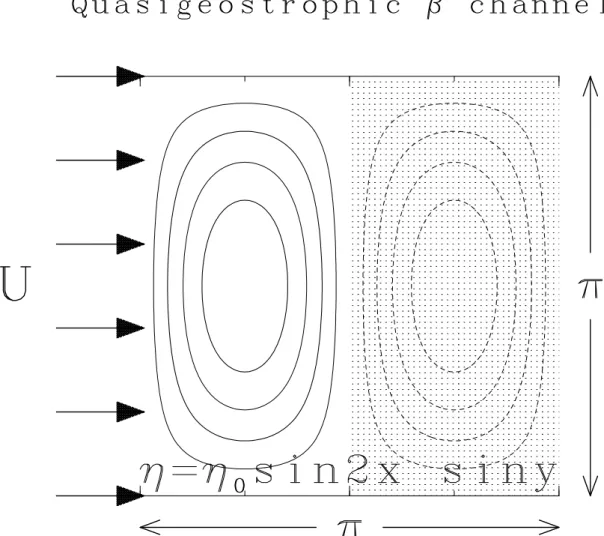
We consider a barotropic quasigeostrophic flow contained within a zonally oriented peri- odic β-channel. The nondimensional width and length of the channel are π, respectively (Fig.2). The nondimensional quasigeostrophic potential vorticity equation for barotropic fluid is

∂∇ 2 ψ

∂t + J ψ, ∇ 2 ψ + βy + η

= − ∂ τ

∂y + A H ∇ 4 ψ, (2.1)

where ψ is the geostrophic stream function whose x and y derivatives give v and −u respectively, t time, ∇ 2 horizontal Laplacian, β the latitudinal variation of Coriolis pa- rameter, the value of which we will set 1/π, η height of the bottom topography, A H the horizontal diffusion coefficient and τ the zonal wind stress. J (a, b) is horizontal Jacobian:

J (a, b) ≡ ∂a

∂x

∂b

∂y − ∂a

∂y

∂b

∂x . In order to highlight the effect of the bottom form drag, we consider as simple a condition as possible;

• the wind stress, τ , is constant and westerly: ∂ τ

∂y = 0, and τ > 0, and

• the bottom topography consists of a single wave: η = η 0 sin 2x sin y.

While our interest is in the transport, in the barotropic model the transport is proportional to the zonal mean velocity, U , which is,

U = 1 S

Z π 0

Z π 0

− ∂ψ

∂y

dx dy,

6

(12)

where S = π 2 is the area of the channel. Therefore we rewrite ψ as ψ(x, y, t) = −U (t)y + φ(x, y, t),

where φ is a stream function which has no contribution to the zonal mean velocity. Then (2.1) is rewritten as

∂ ∇ 2 φ

∂t + J −U y + φ, ∇ 2 φ + βy + η

= A H ∇ 4 φ. (2.2)

The boundary conditions on the southern and the northern walls are free slip condi- tions, that is,

φ = 0 and ∇ 2 φ = 0 at y = 0, π. (2.3)

Since the channel is periodic,

φ(x, y, t) = φ(x + π, y, t).

In a multiply connected domain such as the present channel, the stream function, ψ, is not completely determined by the quasigeostrophic equation (2.1) alone. In the present case, the value of the stream function on the southern wall can be set 0 without any loss of generality, but the value of the stream function on the northern wall, ψ(x, π, t) =

−U (t)π, is not determined. As shown by McWilliams (1977), supplementary conditions are necessary. In the present case, one condition,

dU dt = 1

S Z π

0

Z π 0

η ∂ψ

∂x dx dy + τ , (2.4)

is needed. In deriving (2.4), the boundary condition (2.3) and the assumption that τ

is constant are used. This is the zonal momentum equation averaged by the channel

area, and means that the momentum source is the wind stress, τ , and that the sink is

only the bottom form drag, the first term on the right-hand side of (2.4), for the bottom

friction is neglected. The viscous term is not contained in (2.4) due to the free slip

boundary condition on the walls. This, however, does not mean that the dissipation is

unimportant. The form drag results from the pressure being out of phase with respect to

the bottom topography. The dissipation in (2.2) is responsible for it.

(13)

2.2 Numerical calculations and experiments

Numerical calculations are carried out in spectral forms of (2.2) and (2.4). To obtain the spectral forms, we expand φ in orthogonal functions as follows:

φ =

M

X

m=1 N

X

n=1

φ 2nm +

M

X

m=1

φ 0m

where

( φ 2nm = (A 2nm cos 2nx + B 2nm sin 2nx) sin my φ 0m = Z m sin my

(2.5)

which satisfy the boundary condition (2.3). When they are substituted into (2.2) and (2.4), (2 × N + 1) × M + 1 equations for A 2nm , B 2nm , Z m and U are obtained. Jacobian is, however, calculated at grid points in physical space and then it is expanded to the orthogo- nal functions. The form drag term, 1

S Z Z

η ∂ψ

∂x dxdy, becomes − 1

2 η 0 A 21 due to the orthog- onal relation of the trigonometric function since η = η 0 sin 2x sin y in the present study.

Hereafter a mode with a wavenumber (2n, m) (n = 0, 1, 2, · · · , N ; m = 1, 2, · · · , M ), φ 2nm , is referred to as the (2n, m) mode. The phase velocity is

C 2nm = − β

(2n) 2 + m 2 (n 6= 0). (2.6) Firstly we discuss the steady solution in the next chapter although our concern is to know the zonal mean velocity, U , in the equilibrium when the initially quiescent fluid is accelerated by the constant westerly wind. We treat the zonal mean velocity, U, as a control parameter and numerically solve the transformed equations of

J −U y + φ, ∇ 2 φ + βy + η

= A H ∇ 4 φ. (2.7)

The linear stability properties of the obtained steady solutions are also examined. The method of the linear stability analysis is outlined in Appendix A. Since (2.4) reduces to

τ = − 1 S

Z π 0

Z π 0

η ∂ψ

∂x dx dy = 1

2 η 0 A 21 (2.8)

for steady flow, we can know the wind stress, τ , corresponding to the obtained steady solu-

tion by calculating the right-hand side of (2.8). The method used to calculate a steady so-

(14)

lution is the modified Marquardt method (Levengerg-Marquardt-Morrison method; here- after referred to as LMM). The LMM is outlined in Appendix B (see also the Appendix of Yoden, 1985). The LMM necessitates an initial guess, on which the obtained steady solution depends. Solutions obtained by the LMM are near (similar) ones to the initial guess. The initial guess we mainly use is the inviscid exact solution. Besides those, we use the obtained steady solution as the initial guess, and follow the branch of the steady solution changing the value of the control parameter U .

Secondly we perform numerical experiments in which the zonal mean velocity, U , is permitted to vary, that is, the equations (2.2) and (2.4) are both calculated in the experiments. Initial conditions are at rest. Our main concern is whether the acceleration of the zonal mean velocity stops, and when it stops, whether the time-dependent solution approaches and converges into a stable steady solution if it is obtained by the LMM.

Since U ∂η

∂x acts as the forcing term in the potential vorticity equation (2.2), the (2, 1) mode whose wavenumber is same as the bottom topography is directly excited. It is convenient to introduce a normalized zonal mean velocity U N defined as

U N = U

|C 21 | , (2.9)

where C 21 is the phase velocity of the (2, 1) mode. In the following discussions, we use U N

for the zonal mean velocity. Similarly, the normalized phase speed, |C 2nm | N , is introduced as

|C 2nm | N = |C 2nm |

|C 21 | . (2.10)

2.3 Form drag instability

A stable solution when the zonal mean velocity U is constant is not always stable when U is permitted to vary. Therefore a solution of the numerical experiment do not always converge into a steady solution which is stable when U is constant.

For example, there is an instability known as the form drag instability. It is easily

(15)

decided whether a solution is stable or unstable to the form drag instability without solving an eigenvalue problem as is normally done (Tung and Rosenthal,1985; and Tung and Rosenthal, 1986). We outline it in this section.

Equation (2.2) can be rewritten symbolically as dU N

dt = τ 0 − D(U N ) (2.11)

where τ 0 is the given wind stress and D is the form drag. We assume that there is U N = U N 0 satisfying τ 0 − D(U N0 ) = 0. This U N0 gives the steady solution. The stability characteristic of this solution can be obtained by considering a perturbation of U N , i.e., U N = U N 0 + u 0 . Then (2.11) becomes

du 0

dt = τ 0 − D(U N 0 + u 0 ) ' τ 0 − D(U N 0 ) − dD dU N

U N 0

u 0 = − dD dU N

U N 0

u 0 (2.12)

Therefore, if dD dU N

< 0, the solution is unstable, that is, the solution whose form drag

becomes small with the increase of U is unstable to the form drag instability.

(16)

Steady solutions

In this chapter, steady solutions are discussed. In the first place, two approximate solu- tions in this system are shown: the inviscid exact solution and the linear solution. Next, the steady solutions in nonlinear systems are discussed. Firstly, in section 3.2, we discuss steady solutions in low-order models which are nonlinear but with severe truncation in the orthogonal expansion, (2.5). Such a simple system gives us a clear image on the dynamics. Secondly, in section 3.3, steady solutions in a high-order model in which the truncation number, M and N in (2.5), is large enough that it does not effect a drastic change in the solution are discussed. Steady solutions in these models are calculated with the LMM by using the zonal mean velocity, U N , as the control parameter. The steady solution discussed first is the quasi-linear solution which is near the linear solution. It will be obtained by using the inviscid exact solution as the initial guess in the LMM. Besides, some other solutions are discussed.

It is known that there exist two kinds of modes in this system: an even mode and an odd mode (Yoden, 1985; called S-mode and T-mode). If exp(i2nx) sin my satisfies m + n = even, it is an even mode. Otherwise it is an odd mode. Interactions between even modes make only even modes. As the bottom topography, η = η 0 sin 2x sin y, is an even modes in the present study, no odd modes appear theoretically if the quiescent fluid is accelerated by a constant wind stress. Actually computational errors in numerical integrations make very small odd modes, and they grow when the solution is unstable

11

(17)

to odd modes. Therefore steady solutions consisting of only even modes are mainly calculated in this section, but the linear stability of the obtained solutions is studied both to even modes and to odd modes.

3.1 Approximate solutions

As the exact steady solution of (2.2) cannot be analytically obtained in general, (2.2) is solved numerically with the LMM. Before discussing solutions calculated by the LMM, we introduce two approximate solutions to (2.2).

One is the inviscid exact solution. Since very small A H is considered in the present study, (2.2) might be approximated to

J(−U y + φ, ∇ 2 + βy + η) ≈ 0. (3.1) It is well known that there exists an exact steady solution φ (I) of (3.1),

φ (I) = B 21 (I) sin 2x sin y, where B 21 (I) = η 0

5(U − |C 21 |)

(3.2)

(for example, Mukougawa and Hirota, 1986), where C 21 is defined in (2.6).

The other is a linear solution, which is obtained by considering only the (2, 1) mode, same mode as the bottom topography. The linear solution is

φ (L) =

A (L) 21 cos 2x + B 21 (L) sin 2x sin y,

where

 

 

A (L) 21 = 50A H η 0 U

(25A H ) 2 + 4 {5(U − |C 21 |)} 2 , B 21 (L) = 4η 0 U{5(U − |C 21 |)}

(25A H ) 2 + 4{5(U − |C 21 |)} 2 .

(3.3)

The form drag of the linear solution is

− 1

2 η 0 A (L) 21 = − 25A H η 0 2 U

(25A H ) 2 + 4 {5(U − |C 21 |)} 2 . (3.4)

As A H is very small in the present study, the difference between B 21 (I ) and B 21 (L) is very

little.

(18)

The inviscid exact solution φ (I ) becomes infinity and the linear solution φ (L) becomes huge at U = |C 21 |, which is the resonance with the bottom topography. This implies that these are not approximate solutions to the solution of (2.2) when U ≈ |C 21 |, for the nonlinear terms cannot be neglected. However, the critical U beyond which these solutions fail to approximate to the solution of (2.2) is not known.

3.2 Low-order Models

In this subsection, we show solutions of two low-order models. One is the case with (N, M ) = (1, 3) in (2.5), which includes minimum nonlinear terms, and the other is the case with (N, M) = (1, 7).

At least when U N is much smaller than |C 21 | N , the inviscid exact solution is thought to be approximate solution as stated above. The calculation using the inviscid exact solution as the initial guess in the LMM is carried out from U N ≈ 0 ( when U N = 0, the solution is φ = 0 ) to U N ≈ 1.0 ( when U N = 1.0, the inviscid exact solution disappears). The following discussion and the figures are mainly only for 0 < U N < 0.6 since the stable quasi-linear solution was not obtained for U N > 0.6.

3.2.1 (N, M ) = (1, 3) case

When (N, M ) = (1, 3), the modes included are φ 21 , φ 23 , φ 02 , φ 22 , φ 01 , and φ 03 , the first three of which are even modes and the last three of which are odd modes.

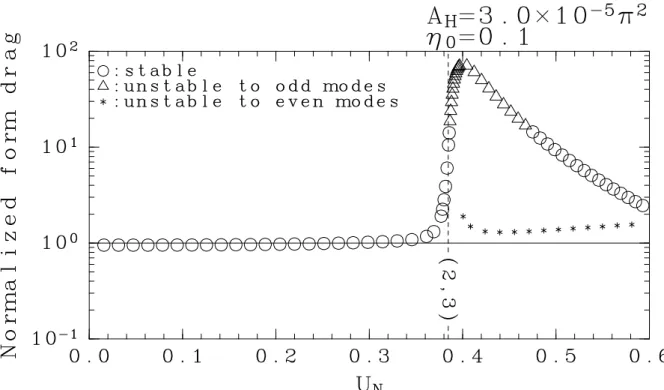
Figure 3 shows the form drag of the obtained steady solution when (η 0 , A H ) = (0.1, 3.0×

10 5 π 2 ). The value of the form drag is normalized by that of the linear solution (3.4), i.e., the normalized form drag is A 21 /A (L) 21 . The vertical axis is a logarithmic coordinate.

A stable solution is plotted by an open circle, , a solution unstable to even modes by

an asterisk, ∗, and a solution stable to even modes but unstable to odd modes by an open

triangle, 4. We obtain the solution whose form drag is near unity using the inviscid exact

solution (3.1) as the initial guess, and obtain the solution whose form drag is far larger

(19)

than the linear one extending the stable quasi-linear solution.

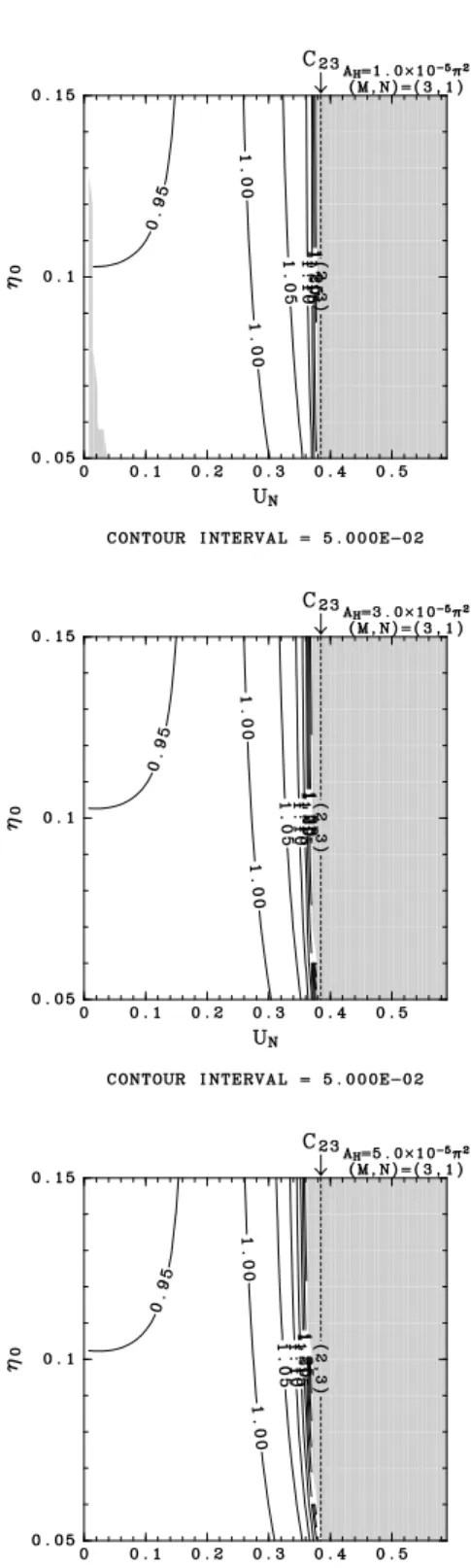
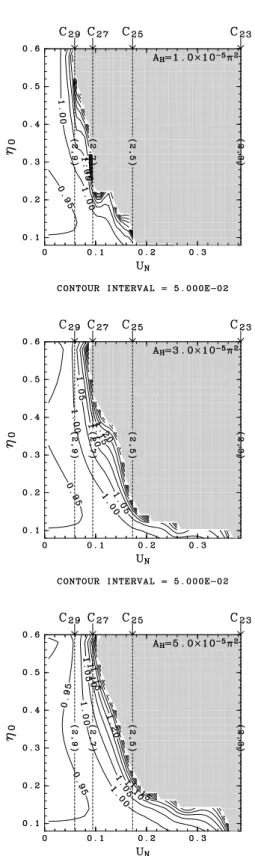
A striking and important feature is that a stable quasi-linear solution is obtained only for U N . |C 23 | N and that the steady quasi-linear solution obtained for U N > |C 23 | N is all unstable. This means that the critical U N beyond which the stable quasi-linear solution is not obtained is |C 23 | N (≈ 0.38), i.e., the phase speed of a higher mode than the (2, 1) mode which is the same mode as the bottom topography. Although the magnitude of the form drag depends on A H and η 0 , the qualitative feature is insensitive to them at least A H

is not much larger than the value adopted here. Figure 4 shows that. Contours in Fig. 4 denotes the form drag of the quasi-linear solution stable to even modes. The value of the form drag is normalized by that of the linear one. The solution whose normalized form drag is equal to or less than 1.5 is regarded to as the quasi-linear solution. The shaded area is where the stable quasi-linear solution is not obtained, i.e., no steady solution is obtained, the obtained quasi-linear solution is unstable, or normalized form drag of the obtained stable solution is greater than 1.5. Three panels are different in the value of A H . The value of A H increase from the top to the bottom: A H = 1.0 × 10 5 π 2 in the top panel, 3.0 × 10 5 π 2 in the middle panel and 5.0 × 10 5 π 2 in the bottom panel. This figure shows that the critical U N is around |C 23 | N independent of η 0 and A H .

Another feature seen in Fig. 3 is that the form drag of the stable quasi-linear solution becomes far larger than the linear one in the vicinity of |C 23 | N . This solution extends as a different solution from the quasi-linear solution for U > |C 23 | N . Therefore two solutions are found for U > |C 23 | N ; the unstable quasi-linear one and the large form drag solution.

While B 21 · η 0 < 0, i.e., the coefficient of sin 2x sin y is opposite to the bottom topography in the former solution, B 21 · η 0 > 0 in the latter solution.

The (2, 1) mode is dominant and other modes are small in the quasi-linear solution,

and therefore the quasi-linear solution is not affected by the low order truncation very

much. In the large form drag solution, on the other hand, other modes than the (2, 1)

mode are not small, and therefore it is thought to be affected by the low order truncation.

(20)

Here, we only note that it is implied that a large form drag solution exists for U N where the quasi-linear solution is unstable. And the detail discussion on the solution whose form drag is far larger than that of the linear one will be in section 3.3 with the high-order model.

3.2.2 (N, M ) = (1, 7) case

In the case with (N, M) = (1, 3), contained waves are substantially only two, (2n, m) = (2, 1) and (2, 3), and the critical velocity is the phase speed of the higher mode, the (2, 3) mode. If there are more higher modes, the phase speeds of other higher modes are also expected to be the critical U N . To confirm this, we calculate the steady solutions with (N, M ) = (1, 7).

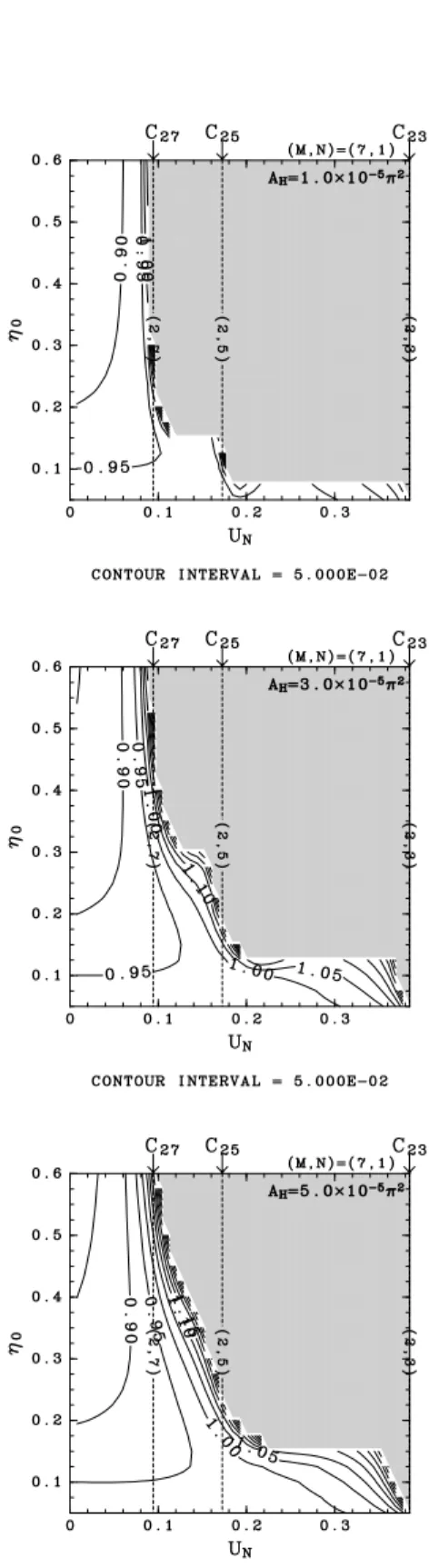
Figure 5 shows contours of the form drag of the quasi-linear solution stable to even modes, the same figure as Fig. 4 except for (N, M) = (1, 7). The value of A H increase from the top to the bottom. The value of the normalized form drag of the stable solution is around unity except near the boundary between the shaded area and the unshaded area.

Near the boundary contours are dense, which means that form drag increase abruptly there.

In Fig. 5, the features seen in the (N, M ) = (1, 3) case are also clearly seen, especially when A H is small. The critical velocity decreases discretely as η 0 increases. When A H = 1.0 × 10 5 π 2 , it is around 0.38 for η 0 < 0.075, 0.17 for 0.075 < η 0 < 0.15, and 0.09 for 0.15 < η 0 . When A H = 3.0 × 10 5 π 2 , it is around 0.38 for η 0 < 0.125, 0.17 for 0.125 < η 0 < 0.3, and 0.09 for 0.3 < η 0 . When A H = 5.0 × 10 5 , it is around 0.38 for η < 0.15 and 0.17 for 0.15 < η 0 < 0.3, and 0.09 for 0.5 < η 0 . The constant values, U N ≈ 0.38, 0.17 and 0.09, correspond to |C 23 |, |C 25 |, and |C 27 |, respectively. That is, the critical velocity moves to the phase speed of a higher mode discretely as η 0 increases.

The fact that the critical velocity is |C 27 | N independent of η 0 for η 0 > 1.5 in the case

of A H = 1.0 × 10 5 π 2 implies that the phase velocities of higher modes can be critical

velocity if they are included in the model, which will be confirmed with the high-order

(21)

model in section 3.3.

As A H increases, especially for larger η 0 , this feature becomes less clear. In the case of A H = 5.0 × 10 5 π 2 , the transition of the critical velocity is less discretely, especially for η 0 > 0.3. The relation between the critical velocity and a phase speed of a wave is unclear.

There is another effect of the increase of A H . As A H increases, the critical velocity moves to the phase speed of a lower mode for the same η 0 . For example, when η 0 = 0.2, the critical velocity is |C 27 | N only when A H = 1.0 × 10 5 π 2 and it is around |C 25 | N when A H = 3.0 × 10 5 π 2 or 5.0 × 10 5 π 2 . It is due to that the higher modes are damped more effectively as A H increase.

As we anticipate, the phase speeds of higher modes can be critical velocity if the mode is included in the model. As the amplitude of the bottom topography becomes larger, the critical velocity moves to the phase speed of a higher mode.

3.2.3 Resonance of a higher mode

It has been shown that the phase speed of a mode whose wave number is higher than the bottom topography is of great importance. Form drag is much larger than that of the linear solution there. It is thought to be due to the resonance of that mode. Here we show its possibility in the linear theory in the simplest case, (N, M) = (1, 3).

The truncated vorticity equations in the case of (N, M ) = (1, 3) can be written as dA 21

dt = 2

5 (β − 5U )B 21 − 2

5 B 21 Z 2 + 18

5 B 23 Z 2 + 2

5 η 0 Z 2 + 2

5 η 0 U − 5A H A 21 , (3.5) dB 21

dt = − 2

5 (β − 5U)A 21 + 2

5 A 21 Z 2 − 18

5 A 23 Z 2 − 5A H B 21 , (3.6) dZ 2

dt = (2B 21 + 1

4 η 0 )A 23 − (2B 23 + 1

4 η 0 )A 21 − 4A H Z 2 , (3.7) dA 23

dt = 2

13 (β − 13U)B 23 + 2

13 (B 21 − η 0 )Z 2 − 13A H A 23 , (3.8) dB 23

dt = − 2

13 (β − 13U)A 23 − 2

13 A 21 Z 2 − 13A H B 23 . (3.9)

Since the steady solution is considered, we neglect the left hand sides of these equations,

(22)

and take U as the control parameter of the system.

To make the problem linearly tractable we assume that the amplitude of the bottom topography and the diffusion coefficient are small:

η 0 = O(ε) = εh, A H = O(ε) = εν,

where ε is a small parameter. Using ε, we expand the dependent variables in the manner of

B 21 =

X

j=0

ε j B 21 (j) . (3.10)

Since the forcing term to this equation set, 2

5 η 0 U , is of order ε, all the dependent variables are equal to or less than O(ε), except when β − 5U = O(ε). Our aim in this section is to show the possibility of the resonance of the (2, 3) mode, and therefore the situation where β − 5U = O(ε) is not treated. Since 2

5 (β − 5U )B 21 and 2

5 η 0 U must be balanced in the first order of (3.5),

B 21 (1) = − hU

β − 5U . (3.11)

Then the lowest order of (3.6) is O(ε 2 ), and therefore A 21 = ε 2 A (2) 21 + O(ε 3 ). Since

− 2

5 (β − 5U )A 21 and −5A H B 21 must be balanced, A (2) 21 = 5 2 · hνU

2 · (β − 5U ) 2 . (3.12)

It should be noted here that the viscosity is indispensable for non-zero A 21 to exist.

The term of − 1

4 η 0 A 21 in (3.7) acts as a forcing term to the equation set of (3.7)–(3.9), the lowest order of (3.7) is O(ε 3 ). Therefore A 23 5 O(ε 2 ), B 23 5 O(ε), and Z 2 5 O(ε 2 ).

When β − 13U = O(1), the magnitude of B 23 must be equal to or less than O(ε 3 ) since other terms than 2

13 (β − 13U)B 23 in (3.8) are equal to or less than O(ε 3 ). And then the

magnitude of A 23 must be equal to or less than O(ε 4 ) in the same way from (3.9). The

other terms than − 1 4 η 0 A 21 and −4A H Z 2 are less than O(ε 3 ) in (3.7). Therefore − 1 4 η 0 A 21

(23)

and −4A H Z 2 must be balanced, and

Z 2 (2) = − 5 2 · h 2 U

2 5 (β − 5U ) 2 . (3.13)

It is interesting that for Z 2 to have this form, the viscosity is important, but Z 2 itself does not depend on the viscosity. Using this Z 2 , from (3.8) and (3.9) the leading terms of A 23

and B 23 , i.e., A (4) 23 and B 23 (3) , can be written as,

A (4) 23 = 5 2 · h 3 Uν {5 2 · U (β − 13U) + 13 2 (β − 4U )(β − 5U )}

2 6 · (β − 5U) 4 (β − 13U ) 2 , (3.14) B 23 (3) = − 5 2 · (β − 4U)h 3 U

2 5 · (β − 13U )(β − 5U ) 3 . (3.15)

These equations imply that A (4) 23 and B 23 (3) become infinitely large as U → β

13 and the expansions above break down. That is, the resonance occurs at U = |C 23 |(= β/13).

When β − 13U = O(ε), equations (3.14) and (3.15) imply that A 23 and B 23 are of O(ε 2 ). Since Z 2 is unchanged in this case, equations for A 23 and B 23 can be obtained as

−uB 23 (2) − 13νA (2) 23 = − 3 2 · 5 2

2 13 β h 3 , (3.16)

uA (2) 23 − 13νB 23 (2) = 0, (3.17) where u = ε 1 2

13 (13U − β ).

This set of equations is the same as that for a forced oscillator with a damping term. In this equation, the forcing term is the term on the right-hand side in (3.16). The solution becomes,

A (2) 23 = 3 2 · 5 2 · 13 · h 3 ν

2 13 · β (13ν 2 + u 2 ) , (3.18) B 23 (2) = 3 2 · 5 2 · h 3 u

2 13 · β (13ν 2 + u 2 ) . (3.19)

The above solution suggests that the viscosity can excite the higher modes through the

nonlinear term and can cause a higher mode wave resonance. In the numerical solutions

discussed in the present study, A H is small but η 0 is not. If we assume A H = O(ε) while

(24)

η 0 = O(1), (3.18) and (3.19) suggest that A 23 and B 23 are of O(ε 1 ) around |C 23 | − U = O(ε). Although such a situation cannot be treated by this linear theory, it can be expected that A 21 and B 21 will strongly be affected by the resonance. So, we may call the phase speed of the higher modes, |C 23 |, the resonant velocity. It is thought that this kind of resonance could occur on higher modes in the higher order models and that the form drag swerves from the linear one around the resonant velocities of those modes.

3.2.4 Summary

In this subsection, the steady solution, mainly the quasi-linear solution, is studied in the low-order models. An interesting feature is found, that is, there exists a critical velocity beyond which the stable quasi-linear solution is not obtained. The critical velocity is not the phase speed of the (2, 1) mode which is the same mode as the bottom topography, but the phase speed of higher modes. Around the critical velocity, the form drag is much larger than that of the linear solution. The critical velocity moves to the phase speed of a higher mode as η 0 increases.

The possibility that the resonance of a higher mode occur is shown in a linear theory.

When U N approaches a phase velocity of a higher mode, the coefficient of that mode can become large, which could be expected to affect the form drag.

The diffusion has mainly two effects. Firstly, as A H increases, the coincidence of the critical velocity with the resonant velocity is unclear, which occurs especially when η 0 is large. Secondly, as A H increases, the critical velocity apt to move to the phase speed of a lower mode when η 0 is same. It is because the higher modes are damped when A H is large. And therefore the resonance of the mode is not thought to occur.

The quasi-linear solution is unstable for U N larger than the critical velocity. It is shown

that there exists a stable solution which gives large form drag and whose coefficient of

sin 2x sin y is same sign as the bottom topography. Since not only the (2, 1) mode but

also other modes are not small in the solution whose form drag is large, this solution is

thought to be affected by the low order truncation. Therefore details of the solution is

(25)

not discussed in this subsection.

3.3 High-order Models

In the previous subsection we study steady solutions of the low-order models. Mainly the focus is on the quasi-linear solution, and find that the critical velocity exists beyond which the stable quasi-linear solution is not found.

In this subsection we show steady solutions of the high-order model calculated by the LMM. First, the quasi-linear solution is investigated by using the inviscid exact solution as the initial guess. Next, other steady solutions than the quasi-linear one are sought. It is expected that a solution whose form drag is larger than that of the linear one exist as in the low-order model of (N, M) = (1, 3) in Fig. 3. These calculations are carried out mainly for 0 < U N < 0.6. It is because the maximum U N for which the stable quasi-linear solution is obtained in the low-order models is around |C 23 | N (≈ 0.38) in even the smallest η 0 case adopted here, and is smaller in the larger η 0 case, so that we anticipate that no stable quasi-linear solution is obtained for U N > 0.6 in the high-order model, either.

We mean the high-order model as the fully nonlinear model in which the sufficiently large truncation numbers, (N, M), is used for accurate computations. The sufficient truncation number depends on parameters in this system. The interaction term between the zonal mean velocity and the bottom topography, U ∂η

∂x , acts as the forcing term in the potential vorticity equation (2.2). Therefore as the amplitude of the topography becomes larger, the truncation number which is necessary for accuracy increases. The truncation number, (N, M), we use is (10, 20) for cases of η 0 5 0.1, (20, 40) for η 0 5 0.5 and (25, 50) for η 0 5 1.0. We use, however, (N, M ) = (10, 20) independent of η 0 in the calculation of the quasi-linear solution (Fig. 6), for higher modes are small in the quasi-linear solution.

The sufficiency of these truncation numbers were checked by comparing the results with those with larger truncation numbers.

Figure 6 shows form drag calculated from steady solutions obtained by the LMM. The

(26)

initial guess is the inviscid exact solution (3.2). The form drag is normalized by that of the linear solution, that is, the normalized form drag is A 21 /A (L) 21 . The stable solution is denoted by solid lines, and the solution stable to even modes but unstable to odd modes is denoted by broken lines. Solutions unstable to even modes are not shown.

It is found that the phase speed of a wave whose wavenumber is higher than that of the bottom topography is the critical velocity also in the high-order model. Form drag swerves from the linear one and increases abruptly around a phase speed. As A H increase, the U N at which the normalized form drag begins to increase from unity goes away from the phase speed of a wave to a little smaller side. In the case of A H = 1.0 × 10 5 π 2 , the normalized form drag swerves abruptly in the very vicinity of the phase speed. When A H = 3.0 × 10 5 π 2 and 5.0 × 10 5 π 2 , the normalized form drag begins to increase less abruptly at a little smaller U N than just the phase speed.

In the case of A H = 3.0 × 10 5 π 2 , the solution is stable to even modes but unstable to odd modes for U N > 0.28 when η 0 = 0.1. The detail of this point will be shown in Fig.

17 and discussed later.

The feature that the critical velocity coincides with a phase speed of a wave and that it moves to phase speeds of higher modes with increase of η 0 can be seen more clearly in Fig. 7. Figure 7 is contours of normalized form drag in the U N –η 0 plane, the same figure as Fig. 4 and Fig. 5. Figures 5 and 7 are very similar. It is inferred that resonance of the higher mode can occur similar to the resonance discussed in section 3.2.3. The equation set for higher modes can be written in a similar form to (3.16) and (3.17) as well.

The notable difference in Figs. 5 and 7 is that |C 29 | N is also the critical velocity

for η 0 > 0.5 in the case of A H = 1.0 × 10 5 π 2 as is expected in section 3.2.2. Besides,

the relation between the critical velocity and a phase speed is a little less clear in the

high-order model than in the low-order model. As seen in the (N, M ) = (1, 7) case, the

relation become less clear as A H increase. Therefor it is thought that nonlinear terms

relating to higher modes acts as a kind of dissipation. Though such differences exist, the

(27)

features seen in the low-order models are also seen in the high-order model. We consider it important to emphasize again that the critical velocity becomes smaller not gradually but discretely; namely the critical velocity is around a resonant velocity of a wave which is higher mode than that of the bottom topography in the high-order model.

These results mean that the quasi-linear solution exists only for very small U N . This implies that the linear approximation is valid only for very small U N ; even in the case of small η 0 the linear approximation is valid only for U N smaller than |C 23 | N , if A H is small.

When we use the inviscid exact solution as the initial guess, the LMM would not find any stable solution for larger U N than the critical velocity. Only an unstable solution is found or any steady solution is not found. As mentioned in section 3.2, this does not necessarily mean that there is no stable solution, and the large form drag solution is expected to exist.

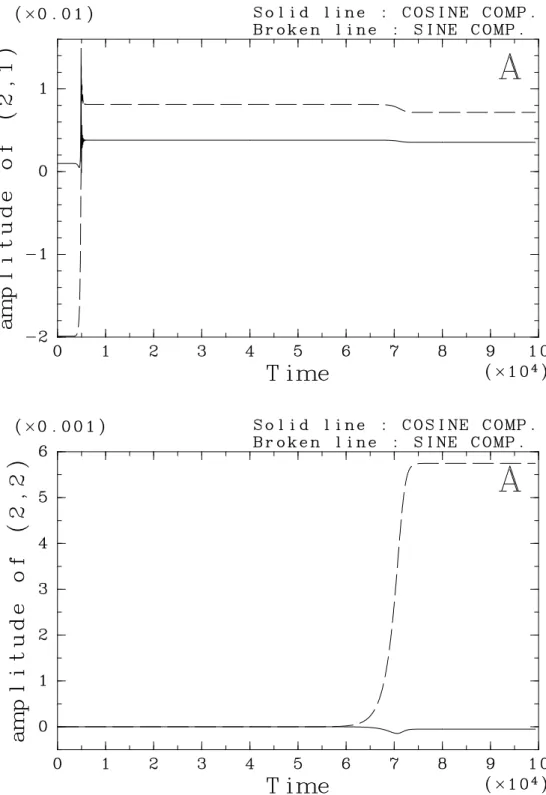
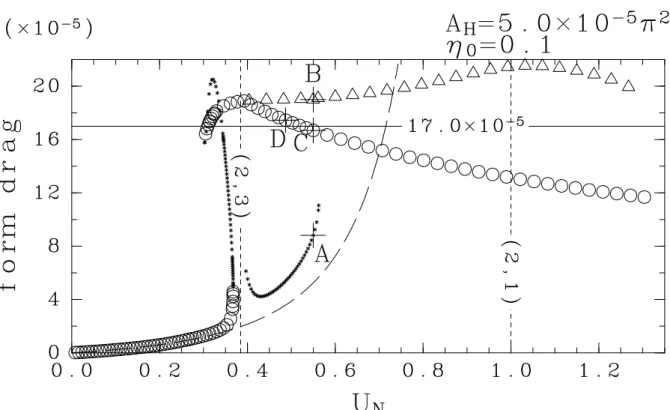
Here, we search a stable solution for U N > |C 23 | N by numerically integrating (2.2) with fixed U N , using the unstable solution obtained by the LMM as the initial condition (the solution labeled ’A’ in Fig. 9) in the case of (η 0 , A H ) = (0.1, 5.0 × 10 5 π 2 ). Figure 8 shows the time series of the coefficients of the (2, 1) and the (2, 2) modes, i.e., A 21 , B 21 , A 22 and B 22 , where the (2, 1) mode is an even mode and the (2, 2) mode is an odd mode.

As the initial state labeled ’A’ in Fig. 9 consists of only even modes, A 22 and B 22 are zero initially. Since the initial condition is a steady solution unstable to even modes, A 21 and B 21 change rapidly, and at t ≈ 6000 the time-dependent solution converges into another steady solution (’B’ in Fig. 9), which also consists of only even modes (the coefficients of (2,2) remain 0). This steady solution is stable to even modes but unstable to odd modes.

Therefore odd modes continue to grow and around t ' 70000 the effect of odd modes makes the transition to another steady solution (’C’ in Fig. 9), which consists of both even and odd modes. This solution is stable to both even and odd modes, so no transition occur from that time on.

With these two steady solutions, one is stable and consists of both even and odd

(28)

modes and the other is unstable to odd modes, being initial guesses, two branches of steady solutions are obtained by the LMM (Fig. 9).

The branch unstable to odd modes (4 in Fig. 9) including the solution ’B’ consists of only even modes, and the stable branch () including the solution ’C’ consists of both even and odd modes. The latter branch is apparently one branch, but actually two branches whose even modes are same and odd modes are reverse sign each other are overlapped. For this system has a symmetry with respect to the odd modes.

As U N becomes smaller, these three (apparently two) branches merge at a point where U N is about 0.4 in the case of Fig. 9, and become a single stable branch consisting of only even modes for U N smaller than the bifurcation point, which is a pitchfork bifurcation.

The single stable branch vanishes at U N ≈ 0.3, a little smaller than that of the bifurcation point. On the other hand, the stable quasi-linear branch exists for U N . 0.37. Therefore two stable steady solutions coexist for a fixed U N in 0.3 . U N . 0.37. These two stable solutions are connected by an unstable branch.

It should also be noted that the resonant velocity of the bottom topography, U N = 1.0, has no effect on the solution characteristics.

Results in cases of other values of A H and η 0 are shown in Fig. 10, including the case shown in Fig. 9. The solutions are plotted for 0 5 U N 5 0.6 in this figure since no drastic change in the solution would occur for U N > 0.6 as is implied in Fig. 9.

Any case in Fig. 10 has three (in fact four) branches: one small form drag branch (the quasi-linear branch) and two (in fact three) large form drag branches one of which is unstable to odd modes.

We can see the abrupt change of the form drag around the critical velocity, though

the change in the case of η 0 = 1.0 is less abrupt. The form drag increases more sharply

and more abruptly around the critical velocity as A H decrease with the same η 0 (in the

same row in Fig. 10) and η 0 decrease with the same A H (in the same column in Fig. 10).

(29)

Numerical experiments

In this chapter we show the results of numerical experiments in which the initially qui- escent fluid is accelerated by the constant wind stress, τ . In the last chapter steady solutions have been discussed with U N fixed. At a steady state the form drag balances with the wind stress as in (2.8). Therefore when the experiments are carried out, it might be anticipated that the steady solutions discussed in the previous chapter is realized.

However, the following uncertainties remain.

(i) The stable solution with U N fixed is not necessarily stable when U N is permitted to vary.

(ii) When U N is accelerated from the rest, there is no guarantees that the acceleration of U N stops at the steady solution obtained in the last chapter, even if the steady solution is stable.

(iii) What will happen, if no stable steady solution corresponding to imposed τ exist?

For example, there is no stable steady solution between 5.0 × 10 5 < τ < 1.6 × 10 4 in Fig. 9.

With regard to item (i), the stable solution when U N is not permitted to vary is unstable when U N is permitted to vary at least if it is unstable to the form drag instability (see section 2.3). Therefore of the stable solutions obtained by the LMM (Fig. 10), at least the asymmetric solutions which exists through a pitchfork bifurcation is unstable when

24

(30)

U N is permitted to vary. For the form drag of that solution becomes small as U N increase.

If a plus perturbation is added to U N in that solution, the solution is accelerated. Since no stable solution is not found for larger U N in Fig. 10, U N increases infinitely and no steady solution will be attained. If a minus perturbation is added to U N , U N decreases. If there is a steady solution for the smaller side of U N which is stable when U N is permitted to vary, the solution will land up this steady solution. If a stable steady solution is not found, the problem comes to item (ii). In the case shown in Fig. 9, we confirmed these expectations, applying the wind stress τ = 1.7 × 10 5 to the solutions labeled ’D’ (Fig.

11) and ’C’ (Fig. 12). When the initial condition is the solution ’D’ in Fig. 9, which is the steady solution for a little smaller side of U N than the steady solution corresponding to

τ = 1.7 × 10 5 , U N decreases and converges into the stable steady solution at U N ≈ 0.31.

The form drag component A 21 (the solid line in the middle panel in Fig. 11) changes a little. Since the steady solution the time-dependent solution converges into consists of only even modes, the coefficients of both the cosine and the sine component of the (2, 2) mode (the lowest panel) become 0. When the initial condition is the solution ’C’, which is the solution for a little larger side of U N , the acceleration does not stop, as shown in Fig. 12.

Of course, the difference in the stability characteristics between a constant U N case and a varying U N case can results from other factors than the form drag instability.

With regard to item (ii), the solutions of the experiments are not necessarily attracted by the stable steady solutions obtained in the last chapter since we do not obtain all steady solutions of this system and since linearly stable solutions are not always nonlinearly stable.

The numerical experiments are carried out for the eight cases shown in Fig. 10. The

results of the numerical experiments is classified into two. The first is the case that any

time-dependent solutions converges and no oscillatory solution is obtained (η 0 = 0.3). The

second is the case that oscillatory solutions are also obtained (η 0 = 0.1). This classification

(31)

seem to results mainly from the steady solutions discussed in the last chapter. When the quasi-linear solution and the large form drag solution are connected by a stable solution, it is the first case. When the two solutions are not connected by a stable solution, it is the second case. In all cases when the imposed τ is small enough for the stable quasi-linear solution to exist corresponding to it, the trajectory is attracted by it. Therefore the zonal mean velocity increases with the increase of the wind stress in this small τ cases. And the acceleration does not stop when the imposed τ is too large. This case is discussed later.

First, we show the results of the former case that no oscillatory solution is obtained.

In this case, the wind-driven solution converges into the steady solution obtained by the LMM in the last chapter. Figure 13 is the example of that case. The upper panel of Fig. 13 is the case of (η 0 , A H ) = (0.5, 3.0 × 10 5 π 2 ) and the lower is of (η 0 , A H ) = (0.5, 5.0 × 10 5 π 2 ). In Fig. 13, the final value of U N in the experiment is denoted by the asterisks, ∗ . The symbols and 4 denote steady solutions obtained by the LMM in the last chapter: denotes a stable solution and 4 denotes a solution unstable to odd modes.

These results imply that the zonal mean velocity of this system in the steady state is mainly determined by η 0 and A H , rather than by τ . The zonal mean velocity becomes almost constant or within a relatively narrow range near a resonant velocity for a wide range of the wind stress since the form drag (equal to τ in the steady state) increase sharply around a resonant velocity in Fig. 10. That is, when the strength of the wind stress changes, the zonal mean velocity does not change very much. When η 0 and/or A H

is large, the form drag increase less sharply around the resonant velocity as stated the

last chapter. So the range of U N is not so narrow in the η 0 = 1.0 case. But even the case

of η 0 = 1.0, U N becomes only about double if τ is made three or four times larger. At

least when η 0 is small, the range is narrow.

(32)

Second, we show the results of cases of η 0 = 0.1 (Fig. 14). In these cases, oscillatory solutions are also obtained. In Fig. 14, the maximum and minimum values of the wind- driven solution are denoted by a pair of large dots, • , when the solution does not converge.

The stability of the quasi-linear solution differs between two panels in Fig. 14.

The lower panel shows the case of (η 0 , A H ) = (0.1, 5.0 × 10 5 π 2 ), the same case as in Fig. 9. In this case no stable solutions are found for 5.0 × 10 5 < τ < 1.6 × 10 4 as the asymmetric solution is unstable to the form drag instability. Not only when the forcing,

τ , is in this range but also when τ = 3.0 × 10 5 and τ = 4.0 × 10 5 , a steady state is not reached, though a stable solution with a fixed U N exists. We confirmed that these steady solutions are unstable when U N is permitted to vary, by the linear stability analysis.

Another interesting point is the difference in the amplitude between the oscillations for

τ > 8.0 × 10 5 and τ < 8.0 × 10 5 . These difference seems to stem from the difference in the structure of solution. For τ < 8.0 × 10 5 , even modes dominate and odd modes does not grow. On the other hand, for τ > 8.0 × 10 5 , odd modes are significant as well as even modes. In the latter case, the oscillation where odd modes are very small occurs first and after the odd modes grow significantly, the amplitude changes. Figure 15 shows an example of the former case. The (2,2) mode, which is an odd mode, does not grow. Figure 16 shows an example of the latter case. For t . 38000, the odd modes, for example the (2,2) mode shown in the lowest panel, continues to grow but remains small.

And around t ≈ 38000 the odd modes grows large enough to change the solution. After then, the amplitude of U N (the top panel) is smaller than before then, and both even modes and odd modes are significant.

The upper panel in Fig. 14 shows the case of (η 0 , A H ) = (0.1, 3.0 × 10 5 π 2 ). In this case, a bifurcation occurs at U N ≈ 0.27 and the quasi-linear solution is unstable to odd modes for U N & 0.27. Figure 17 shows the details of this bifurcation. In Fig.

17, the linear stability is examined by treating U N as a variable unlike the calculations

in Fig. 9 and Fig. 10 where U N is constant. The quasi-linear solution bifurcates into

(33)

three solutions; one unstable quasi-linear solution (symmetric solution) and two stable asymmetric solutions. The two asymmetric solutions overlap in Fig. 17 as in Fig. 9.

When τ corresponding to this quasi-linear solution unstable to odd modes is imposed, i.e., 6.6 × 10 6 < τ < 2.0 × 10 5 , the trajectory is attracted by this unstable solution at first since this solution is stable to even modes. However, since this steady solution is unstable to odd modes, odd modes continue to grow and eventually the trajectory diverge away from it and is attracted by an asymmetric solution. The asymmetric solutions are destabilized for τ > 8.0 × 10 6 . Therefore, when 6.6 × 10 6 < τ < 8.0 × 10 6 , the asymmetric stable state is reached. When 8.0 × 10 6 < τ < 2.0 × 10 5 , on the other hand, the solution is quasi-periodic since the asymmetric solutions are unstable. An example of the latter oscillation is shown in Fig. 18. In this case, the solution approaches the steady state unstable to odd mode around U N ≈ 0.34 and stays for a while there before odd modes grow, and then the oscillation begins. When τ is large, the oscillation is more complex. Whether the oscillatory solution consists of only even modes or of both even modes and odd modes does not depend on τ in this case unlike the case of (η 0 , A H ) = (0.1, 5.0 × 10 5 π 2 ). The oscillatory solution consists of only even modes only when τ = 5.0 × 10 5 (Fig. 19). When τ > 5.0 × 10 5 (the example of τ = 6.0 × 10 5 is shown in Fig. 20) as well as when τ < 5.0 × 10 5 (the example of τ = 4.0 × 10 5 is shown in Fig. 21), the solution consists of both even and odd modes. In the case of

τ = 4.0 × 10 5 (Fig. 21), for t . 190000 odd modes are small and the solution is quasi- periodic consisting of only even modes, and around t ≈ 190000 odd modes grow sufficiently and the oscillation manner changes drastically. In the case of τ = 6.0 × 10 5 (Fig. 20), odd modes grow significantly by t . 30000 and the solution changes. The oscillation is, however, not (quasi) periodic both before and after odd modes grow significantly.

Thus, when the time-dependent solution does not converge, the behavior of the solu-

tion differs according to parameters; whether the solution consists of only even modes or

of both even and odd modes, and whether the oscillation is (quasi) periodic or not. The

(34)

common feature is that the solution is not accelerated far over |C 23 | N , i.e., the oscillation starts soon after U N exceeds |C 23 | N , and that the mean value of the maximum and the minimum U N of the oscillatory solution is within a relatively narrow range.

When the imposed τ is too large, the acceleration does not stop, as easily expected.

Such case can be classified into two. One is the case that no steady solutions corresponding to the given τ are not found; namely cases that τ is very large. In this case the acceleration continues without stopping. The other is the case that the obtained steady solution corresponding to the given τ is unstable to odd modes but stable to even modes. In this case the steady state stable to even modes but unstable to odd modes is realized first.

However, odd modes continue to grow and finally the acceleration restarts. Figure 22 shows an example (the steady solution is referred to the upper panel in Fig. 13). Around t ' 1000, the acceleration stops. Since the U N at t ' 1000 is somewhat larger than that of the steady solution, the deceleration occurs and the quasi-steady state is realized around t ' 4 × 10 3 . But since this state is unstable to odd modes, at around t ' 11 × 10 3 the acceleration restarts after odd modes grow. There are some cases that the acceleration does not stop at a steady solution unstable to odd modes and that U N continues to increase (for examples, τ = 1.35 × 10 3 in the case of (η 0 , A H ) = (1.0, 3.0 × 10 5 π 2 ) and

τ = 2.2 × 10 3 in the case of (η 0 , A H ) = (1.0, 5.0 × 10 5 π 2 )). Although there is such a difference according to parameters, the acceleration does not stop after long time when the corresponding steady solution is unstable to odd modes. The oscillatory solution is not found in this case.

Figure 23 schematically summarizes the behavior of solutions. The stable quasi-linear solution exists for small τ . As τ increases, U N of equilibrium in the experiments be- comes large along the linear solution. When τ becomes larger than a certain magnitude depending on parameters such as A H and η 0 , U N (the mean value of the maximum and the minimum U N in oscillatory cases) does not increase very much or decreases though

τ increases. This occurs at a higher mode resonant velocity. When τ increases further,

(35)

the steady solution corresponding to it becomes unstable to odd modes and therefore the acceleration of U N stops once in most cases but restarts after long time. When τ is too large for steady solutions to exist, the acceleration does not stop.

Figures 24 shows the streamlines (left) and the potential vorticity contours (right) of the steady states in the case of (η 0 , A H ) = (0.5, 3.0 × 10 5 ). When τ = 3.0 × 10 5 (panel (a)), the solution is the quasi-linear one. Both the potential vorticity contours and the streamlines are similar to the ambient potential vorticity contours ( panel (c) in Fig. 25). The cyclonic (anticyclonic) circulation cell exists over the topographic elevation (depression). As τ increases, the circulation cell weakens (panel (b)), the circulation cell of opposite direction appears (panel (c)) and strengthens (panel (d)). The gradient of the potential vorticity over the topographic elevation and depression weakens as τ increases (right panels in Fig. 24). Although the wind stress τ in case (c) is twice as large as that in case (b), for example, the zonal mean velocity is almost same. The circulation cells are strengthened instead of the zonal mean velocity being accelerated.

This feature of the large form drag solution (panel (d)) is qualitatively independent of η 0 , i.e., independent of the existence of the closed ambient potential vorticity contours.

The ambient potential vorticity distribution is shown in Fig. 25. In the case of η 0 = 0.1 the ambient potential vorticity is modified only a little and any contour does not close.

In the case of η 0 = 0.3 any contour does not close either but near the limit of unclosing.

In the case of η 0 = 0.5 some of them close. Figure 26 shows the streamlines (left) and the

potential vorticity of the solution for near the uppermost τ with which the steady state

is reached. The amplitude of the bottom topography, η 0 , increase from the top panel to

the bottom panel. This figure shows the example of cases where any ambient potential

contour does not close (Fig. 25). The circulation cells in the streamlines exist over the

topographic elevation and the depression and their directions are same independent of η 0 .

The size of the cells, however, become large with the increase of η 0 . And the gradient of

the potential vorticity also becomes large. When η 0 = 0.1, it is homogenized well.

(36)

Summary and Discussion

We have studied one of the most basic problems of the form drag in a simple situation, a barotropic quasi-geostrophic β plane channel with a sinusoidal bottom topography, motivated by the recent results and discussions about the form drag in the Antarctic Circumpolar Current. Our main concern is whether the acceleration can stop and, if it can, what value the zonal mean velocity, U N , will result when the fluid at rest is accelerated by a wind stress in the system where the momentum sink is only the form drag.

Before performing numerical experiments in which U N are permitted to vary, we in- vestigate the steady state under the condition that U N is fixed in Chapter 3. When U N

is smaller than a certain value, the stable quasi-linear solution exists. The quasi-linear solution was not obtained or was unstable for U N larger than this U N value, the critical U N . Around the critical U N , the form drag increase abruptly. Although the critical U N

depends on the amplitude of the bottom topography, η 0 , and the horizontal diffusion co- efficient, A H , it is around the phase speed of a wave whose wave number is higher than that of the bottom topography. We refer to this velocity as the resonant velocity of the wave since it is inferred that the resonance of the mode can occur from the linear theory in section 3.2.3. While there are infinite number of the resonant velocities corresponding to the wavenumber, which resonant velocity is chosen depends on η 0 and A H . As the amplitude of the bottom topography, η 0 , which acts as the forcing term, increase, and as the coefficient of the horizontal diffusion, A H , decrease, the critical velocity moves the res-

31

(37)

onant velocity of a higher mode. The diffusion obscures the relation between the resonant velocity and the critical U N , and when η 0 is large the relation also becomes unclear.

Other three solutions than the quasi-linear one are found for larger U N which are strongly nonlinear and give large form drag. Two of them are asymmetric solutions, whose even modes are same and odd modes are opposite each other. Their form drag is the same, and therefore they are overlapped in bifurcation diagrams whose vertical axis is form drag, such as in Fig. 9. They are stable when U N is fixed, but unstable to the form drag instability when U N is unfixed. The other is symmetric solution which is stable to even modes but unstable to odd modes. When η 0 and A H is small, the stable quasi-linear solution and the stable large form drag solution coexist for a fixed U N in some range of U N and those solutions are connected by an unstable solution. Otherwise, the stable quasi-linear solution and the stable large form drag solution is connected by a stable solution. In any case, the form drag of the stable solution increases abruptly when the control parameter U N becomes larger than a critical U N near a resonant velocity.

Next, we carried out a series of numerical experiments in Chapter 4 where the spatially uniform surface stress τ is applied on the resting ocean. In the case that the stable steady solution corresponding to the given τ is obtained when U N is fixed, the zonal flow is accelerated to this U N and becomes steady in most cases, and otherwise oscillates.

Since the form drag changes rapidly around the resonant velocity, the resulting zonal flow velocity achieved in the experiment is near the resonant velocity in a wide range of the surface wind stress τ . When an experiment with larger τ is performed, the U N

cannot land on any steady value but is accelerated infinitely. Although many papers (e.g.,

Rambaldi and Mo, 1984) suggested the importance of the resonant velocity to the (2, 1)

mode whose wavenumber is the same as that of the bottom topography, this velocity has

no effect on the form drag, if the quasi-linear solution turns unstable at a higher mode

resonant velocity. In the case that a stable steady solution was not obtained corresponding

to the imposed τ , a steady state does not occur but an oscillatory state appears. Although

Figure 1: Schematic view of the meridional overturning in the Southern Ocean. The ACC is driven eastward (not shown in the figure)
Figure 2: Model domain. Contours denote the bottom topography. Shaded region is the depression of the topography.
Figure 3: An example of form drag of the steady solution in the low-order model:
Figure 4: Contours of the form drag of the quasi-linear solution stable to even modes calculated with (N, M ) = (1, 3)
+7

参照

関連したドキュメント

In general, Liouville type theorems for stable solutions of nonlinear elliptic equations are usually guaranteed in low dimensional case.. The main purpose of this paper is to obtain

Kraaikamp [7] (see also [9]), was introduced to improve some dio- phantine approximation properties of the regular one-dimensional contin- ued fraction algorithm in the following

Considering singular terms at 0 and permitting p 6= 2, Loc and Schmitt [17] used the lower and upper solution method to show existence of solution for (1.1) with the nonlinearity of

Many traveling wave solutions of nonsingular type and singular type, such as solitary wave solutions, kink wave solutions, loop soliton solutions, compacton solutions, smooth

A wave bifurcation is a supercritical Hopf bifurcation from a stable steady constant solution to a stable periodic and nonconstant solution.. The bifurcating solution in the case

Henry proposed in his book [7] a method to estimate solutions of linear integral inequality with weakly singular kernel.. His inequality plays the same role in the geometric theory

This paper is concerned with the existence, the uniqueness, convergence and divergence of formal power series solutions of singular first order quasi-linear partial

Section 3: infinitely many solutions for quasi-linear problems with odd nonlinear- ities; existence of a weak solution for a general class of Euler’s equations of multiple integrals