Potential for Changes:
Learner-Centered Approaches to Second Language Teaching in Japan
Michael HOLSWORTH Takeshi USUKI Kenta KOSHIBA
Abstract
This paper introduces the idea of adopting a Learner-Centered Approach into second language teaching in Japan. First, it discusses the importance and effectiveness of Learner-Centered Approach based on the previous research. Then, it presents three case studies of courses at the university level that employ the pedagogical approach, and explores how Weimer’s (2013) five key changes can be applied. Finally, recommendations for facilitating the shift from teacher-centered to learner- centered pedagogy are provided.
Keywords: learner-centered, pedagogy, facilitator, content-based, Weimer’s five keys
1. Introduction
The aim of this paper is to present the case for Learner-Centered Approach (henceforth, LCA) into second language (L2) classes at universities in Japan, where traditionally Teacher-Centered Approach (TCA) is still dominant and popular. The main points of this paper are that (i) LCA can shed a new light on L2 education in Japan, (ii) Weimer’s (2013) five keys changes can help realize the pedagogical shift in L2 classes in Japan, and (iii) this pedagogical shift is necessary in order to foster students’ self-efficacy and learner autonomy.
In what follows, the strengths and weaknesses of LCA and TCA will be discussed. According to Schuh (2004, p. 834), TCA is often aligned with “transmission” models of teaching, in which infor- mation or contents of what students are supposed to learn is transferred from a teacher to a learner.
This traditional lecture style of teaching is widespread in Japanese schools and is used to prepare students for entrance examinations and language proficiency tests such as TOEIC. In TCA, the learning contexts, course materials, and expected learner outcomes are set by teachers and deliv- ered to the learners in a one-way communication model. As Schuh (2004, p. 835) notes, typical fea- tures of TCA can be seen when teacher discourse predominant, and course content and assessment stem primarily from textbooks and the curriculum. Furthermore, students traditionally sit in rows
facing the blackboard, and do the same tasks at the same time following the directions of a teacher standing in front of them. In this model, teachers take on a director role, and are under great pres- sure to manage the class, foster student learning, and produce results that meet institutional expec- tations.
In the LCA model, the role of the teacher is vastly different. A teacher functions not as a director but as a facilitator of the class, and learning goals in this model can be achieved by active collabora- tion between the teacher and learners who together determine what learning means and how it can be enhanced within each individual’s experience, capacities and talents (Schuh, 2004, p. 835). There are several models and philosophies that are related to LCA, including project-based learning, active learning, and constructivism, so it is difficult to provide a rigid definition of LCA. The common fea- tures observed are that: (i) the teacher functions as a facilitator of the class, and speaks less than learners, (ii) learners actively and positively study the content with their peers through negotiated learning, and (iii) students reorganize desks and chairs to better conduct group work and other activities. Therefore, learners are considered the center of the lecture, are given more responsibility for their own learning, and take an active role in how they are assessed.
This paper will present a case for LCA as a valuable and effective pedagogy in L2 education at the university level of education in Japan. The organization of this paper is as follows. In Section 2, previous research on LCA is discussed, and it will introduce the argument that LCA meets the L2 English learning needs of students at university. Then, in Section 3, Weimer’s (2013) five key changes are introduced for the pedagogical shift from TCA to LCA are introduced. In Section 4, three case studies focused on university classes that employed LCA, framed in Weimer’s (2013) five key changes, are presented. Finally, Section 5 recommends the steps necessary to develop LCA in English education in Japan.
2. For or Against LCA?
From the previous research, it is still controversial whether LCA is more effective than TCA. This section will therefore review critiques against LCA, and then put forth an argument that LCA in fact meets the demands of English study at universities in Japan.
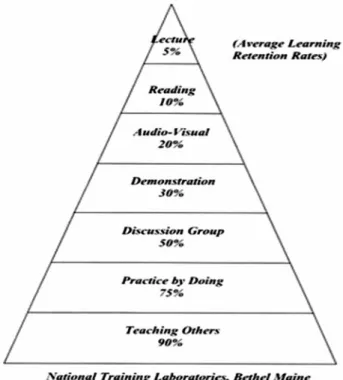
Interestingly, there are arguments for and against LCA, which rely on the same sources and cite the same research: the Learning Pyramid depicted in Figure 1 below.
In this Learning Pyramid, each tier is in a hierarchical relation based on a learner’s retention of what was taught. For example, the amount of what students retain from the Lecture tier is only 5%
of the content, whereas the amount of retention from the Teaching Others tier is 99% of the content.
According to Lalley and Miller (2007), some textbooks promoting active learning methods rely on this pyramid because the pyramid clearly shows that Teaching Others, for example, produces a higher retention rate than presumably passive ways of learning (e.g. Lecture). Lalley and Miller (2007), however, convincingly argue that the Learning Pyramid and the percentage of retention assigned to each tier has no scientific validity. First of all, they argue that the origin of the pyramid is Dale’s Cone of Experience in Figure 2, which in its original version, has no percentages of retention indicated.
Lalley and Miller (2007) also point out that the percentage of retention for each tier in Figure 1, assigned originally by the National Training Laboratories, is also lacking empirical evidence. Inter- estingly, there are also several versions of the Learning Pyramid with different percentages of reten- tion assigned to the each tier (Sousa, 2001). Based on these facts and careful review of each level of the pyramid, Lalley and Miller (2007) conclude that the methods presented in the pyramid should not be seen as hierarchical, but rather as a continuum, and all of the methods are important and effective depending on the context of learning.
The question to consider now is what evidence can support the importance and effectiveness of LCA, once one accepts the fact that the Learning Pyramid has no scientific validity in itself. There is research to support LCA in other subjects (Michael, 2006), but this might not provide direct empiri-
Figure 1. Typical Learning Pyramid (Lalley & Miller, 2007, p. 67)
cal evidence to support the introduction of LCA in L2 English classes at universities. One can assume, however, that the importance and effectiveness of LCA in L2 English education at univer- sity can be verified, or at least supported, by the goals of an English education program. Based on Wallace (2004), Okada (2009) proposes the following six fundamental goals or skills that English education should strive to attain:
a. Read logically, and think critically about the content
b. Listen actively, and identify relevant information from the source
c. Make assumptions, and conduct research using various resources (e.g. library Internet, and etc.)
d. Think logically, and write logical essays
e. Listen to various opinions, and then deliver one’s opinion relevantly and convincingly f. Have responsibility for learning, and study autonomously
(Okada, 2009, p. 23, translated into English by the author) Figure 2. Dale’s Cone of Experience (Lalley and Miller, 2007, p. 65)
As Lalley and Miller (2007) mention, every teaching method presented in the pyramid can be effective depending on the content of the study, so it is perhaps too easy to overgeneralize the efficiency of a particular method to the benefit of either TCA or LCA. Usuki (2010), however, points out that some of the fundamental skills listed above cannot be achieved easily in TCA depending on the content of the study. The skills in (a–b), for example, might be realized even in TCA, and cer- tain skills (c–d) can be fostered by relevant assignments. The skills in (e–f), on the other hands, might be more difficult to achieve in traditional teaching methods. Assuming that LCA can also provide opportunities for students to acquire the basic skills in (a–d), depending on the contents of the study, one can further emphasize the importance and efficiency of LCA. LCA may provide opportunities for students to acquire the skills (e–f), since in a learner-centered class much of the responsibility for learning depends on the leaner and their level of participation. Prince (2004) also points out the same advantages of LCA in a summary of his research on Problem-Based Learning (PBL).
While no evidence proves that PBL enhances academic achievement as measured by exams, there is evidence to suggest that PBL ‘works’ for achieving other important learning outcomes.
Studies suggest that PBL develops more positive student attitudes, fosters a deeper approach to learning and helps student retain knowledge longer than traditional instruction.
(Prince, 2004, p. 229 cited in Weimer, 2013 p. 44–45)
Therefore, based on this research, this paper argues that LCA can play an important and effective role in realizing the goals of English education in Japan. There may be a concern among teachers teaching English in Japan, where TCA is dominant, that introducing LCA to English classes may not work. This should not be taken as a fair or scientific argument against LCA itself, as this type of con- cern can be seen as a perspective against LCA. Furthermore, there are reports on English classes in Japan that present an argument that LCA is effective, and that with LCA teachers can see better learner outcomes compared with traditional lecture style teaching (Murakami, 2015; Usuki, 2010, 2011, to appear).
In the following section, Weimer’s (2013) five key changes, which are needed for the effective implementation of LCA, are presented. These can be used as a guideline for evaluating each case study presented in Section 4.
3. From TCA to LCA: Five Key Changes
Weimer (2013) proposes that five key changes are required for a shift of pedagogy from TCA to LCA.
The first key is the Role of the Teacher. In a traditional class, the teacher’s role is one of a dominant controller over classroom activities and interactions. In LCA, however, the role of the teacher is seen as a facilitator of the class. As mentioned in Weimer (2013), the success of LCA essentially depends on how well the teacher can function as a facilitator of the class, and how he or she can sup- port the learning efforts of students.
The second key is the Balance of Power. Traditionally a teacher’s authority is taken for granted in a classroom. For example, they have the power to control what students do, what content they learn, how much of the content they should cover, and what assignment students need to do to pass the class. In LCA, however, power is shared with students to some extent. Total control is not simply passed over to the students, but students are given control over certain domains and are allowed to make choices (Weimer, 2013, p. 94). Even in LCA classes, content must be covered in a given class, but students can, for example, decide the pace of learning and what activities they do in a class. This second key is rather important to foster the development of autonomous self-directed learners.
The third key is the Function of Content. In a traditional course or curriculum with a textbook, a lot of pressure is placed on the teacher to cover the content in a given amount of time. The result is a schedule driven by content and not by learning. In a LCA classroom, the perspective is completely different. The content of textbook, if any, is not something to be covered but something to be used to achieve two purposes. The first is to build a knowledge base, and the second is to develop learning skills, which lead to deep and lasting learning (Weimer, 2013, p. 123).
The fourth key is the Responsibility for Learning. In LCA, a teacher pushes students to become more responsible for their learning. A learner-centered teacher, for example, lets students experi- ence the consequences of decisions that they make for not coming to class prepared, not studying for an exam, and not contributing to group work (Weimer, 2013, p. 11). In this way, the teacher and students also make an effort to create and maintain a good class climate, which helps motivate stu- dents to accept the responsibility for learning (Weimer, 2013, p. 150).
The final key is the Purpose and Processes of Evaluation. In LCA, the purpose of evaluation is to maximize the learning potential of the learners. Furthermore, the processes of evaluation give students opportunities to develop self-assessment skills and peer-assessment skills by delivering constructive feedback to peers (Weimer, 2013, p. 168).
4. Realizing LCA in Second Language Teaching at Universities in Japan
This section presents three case studies of English classes at universities that employ LCA. It also includes a discussion on how Weimer’s (2013) five key changes can be adapted to the Japanese university context.
4.1. Case 1: LCA in TOEIC Preparation Classes
This section examines the challenge of applying LCA to a TOEIC preparation course at a Japanese university. As stated by Lalley and Miller (2007), each teaching method from the pyramid is effective depending on the content of the study, and it is generally taken for granted that TCA is the most suitable in cases where test score gain is the main learning goal. The most important finding in the case study presented stems from the evaluation of the outcomes of LCA, such as positive attitude towards learning and better retention of contents (Prince, 2004).
4.1.1. Program
This case study was conducted in two university TOEIC classes. The class met for 15 sessions, each lasting 90 minutes, over a spring semester. This class was part of a course, which as a whole, was designed to advance students’ practical English skills measured by TOEIC. In the spring semes- ter, the focus of study was on the reading section of TOEIC, and the fall semester focused on the listen ing section. Thus, over two terms, students focused on all aspects of TOEIC, and they took TOEIC IP at the end of year as a posttest to measure the learning gains.
4.1.2. Participants
There were 21 participants in each class with approximately equal gender representation, and they were from various departments. The students were streamed into different levels based on their TOEIC IP scores. The participants’ scores ranged from 395 to 515 in this case study.
4.1.3. Curriculum
In this course, materials and assessments were established and set, leaving little room for teach- ers to express their individual teaching styles. For example, the assigned textbook was the Official TOEIC Test Workbook vol. 4 (ETS), and the evaluation for the class, as per the syllabus, was set at 30% for students’ active performance in class, 30% for a short quizzes and assignments, and 40% for the final TOEIC IP at the end of the semester.
The first week, teachers shared general information about TOEIC and the usefulness of the profi- ciency test for students’ careers. Following this, the teacher presented a truncated version of the proficiency test to students.
From the second week to the ninth week, each class begins with a 10-minute vocabulary quiz, and
then students solved questions from the textbook that correspond to the reading section (Part 5, Part 6 and Part 7) on TOEIC. After that, group work and pair work begined, and these activities were a type of Cooperative Learning (Barkley, Cross, & Major, 2005; Johnson & Smith, 1998), in which students found logical explanations for each question with their peers. After five minutes of group work, the teacher created five new groups with new members, and students discussed whether the explanation for each question was valid based on what they found in their original groups. Then, students returned to their original group, and review their original explanation based on the new information from peers in the second group. Finally, the teacher asked each group to present their explanations. As the end of the lecture, the teacher took about 15 minutes to practice pronunciation using an English pop song. This practice was intended to develop the accuracy and fluency of English pronunciation, which was introduced into the class as part of the preparation for the listening section of TOEIC in the fall semester. In this activity, students tried to remember each line of the lyrics and sing the song, while the teacher checked their pronunciation one by one (see Usuki, 2013). This activity was engaging and helped to build a good class atmosphere and eventually moved some responsibility for learning to students.
Various other activities to create a good class climate and foster the overall development of English skills for the proficiency test were also introduced. Weeks two through nine were steps to prepare students for LCA, which was then used in the remaining six classes. This change midterm made a smooth shift of pedagogy from TCA to LCA possible.
From the tenth week, each group, four groups in total, was responsible for teaching their peers.
Each group was assigned one part of the TOEIC reading section (e.g. Group A: 10 questions from Part 5, Group B: one passage from Part 6, Group C: one single-passage question from Part 7, and Group D: one double-passage question from Part 7), and prepared handouts, which they presented to the whole class. Thus, each group member was intended to be an expert on the questions of the sec- tion from which they presented. At the beginning of a class, the teacher collected the handouts from each group, and distributed them to everyone in the class. Then, students solved questions in the handouts for 10 minutes. After 10 minutes, the group work started. At this time, the teacher assigned each group a different section from what they had prepared. In this way, the teacher can create an instant expert for each question based on the handouts. After the group consultation, the teacher created five new groups that consist of an instant expert and an expert for each section. In each group, the instant expert played the role of discussion leader, and the expert functioned as a local facilitator. The main responsibilities of the local facilitator in the group were (i) to provide a feeling of safety for the instant expert by keeping a good climate in the group, and (ii) give relevant com- ments or advice, as required. During this activity, the teacher’s role was a global facilitator. They
walked around the classroom, listened to the discussion in each group and gave relevant comments or hints to students as needed. So, the teacher’s duty was to maintain a positive class climate. After this phase, students returned to their original groups, and shared information that they had gained from the previous activity. The final stage of this class was a presentation in front of peers by each expert using PowerPoint. The expert played the role of a teacher (TOEIC expert), and presented the explanation of their assigned part in an interactive way with the audience. The phase should be seen as a reinforcement of what they learned.
In this pedagogy, students had not only a chance to acquire practical skills or strategies to get a higher score on TOEIC but also more important skills such as delivery of messages and logical thinking.
4.1.4. Delivery Method
The method that students play a role as a presenter in a preparation course for TOEIC was first formulated as Delivery Method (DM) in Usuki (2010). Usuki (2010) also discusses the contradiction between each basic skill. Then, he proposes that this contradiction can be overcome by introducing DM as a new pedagogy, which can provide students with additional learning outcomes such as presentation skills. This proposal can be viewed as a case in which Usuki (2010), in fact, indirectly proposes a shift of pedagogy from TCA to LCA.
Usuki’s (2010) DM, however, encounters a typical problem with group activities: students who rely on other group members and who do not actively participate. The case study presented here can overcome this potential problem by introducing a group work method called Jigsaw. Jigsaw is a method in active learning that makes the most use of an information gap, and the effectiveness of the Jigsaw is reported in previous research (Barkley et al., 2005; Murray, 2000). In this case study, Jigsaw was used to employ the role of an instant expert, and as a result, transformed the role of the presenter in DM into a local facilitator in the middle of the activity. Therefore, the introduction of Jigsaw into DM not only helps to ensure that all students are active and contributing, but also facili- tates the transition of the course into a learner-centered class (Usuki, to appear).
4.1.5. Five Key Changes
The first key is the Role of the Teacher. In LCA, a teacher functions as a facilitator in a class. In this case study, with the combination of DM and Jigsaw, the role of teacher was to be a global facilitator, who kept and enhanced a good class climate for learning, and empowered students to participate in the activities. One can deduce that in this way, this case study captured the fundamental aspect of the first key.
The second key is the Balance of Power. Based the curriculum and assessment, the teacher in this case study had the majority of the power. However, the Balance of Power did shift towards the stu-
dents in areas such as activities and assignments, but the majority still remained with the instructor.
The third key is the Function of Content. In LCA, content is not something to be covered, but something that is used to develop students’ knowledge base and learning skills. In the first eight classes, the content of the textbook was used to build a knowledge base of TOEIC, and in the rest of classes the content was used as one source to conduct DM. As described in section 4.1.3., students made handouts based on the textbook, and each class was conducted with these handouts. This helped develop students’ skills such as their ability to analyze questions, manage study time, and communicate effectively in DM.
The fourth key is the Responsibility for Learning. In LCA, students should become more responsi- ble for their learning, and the teacher should be responsible for creating a positive class climate. In the combination of DM and Jigsaw, which created experts and instant experts, students had the major- ity of the responsibility for their learning in contrast to a TCA based class.
The final key is the Purpose and Processes of Evaluation. In LCA, the purpose of evaluation is to maximize the learning potential of the learner, and the process of evaluation should give students opportunities to develop self-assessment skills and peer-assessment skills by delivering construc- tive feedback. This was the most difficult part to be realized in this case study because students did not use any rubric to assess peers concretely, although they did receive implicit feedback from peers through DM. In this regard, the process of evaluation in this class did not meet Weimer’s expectation.
4.1.6. Results & Implications
As is often the case, it is relatively difficult to evaluate the success of a class. To tackle this, a simple questionnaire was conducted on the final day of the semester in order to get student feed- back. The questionnaire consisted of one open-ended question asking students to give their thoughts about the course. The results showed a positive opinion about the use of LCA for this TOEIC prepa- ration course in terms of Prince (2004) cited above. Students’ comments provided strong support for use of LCA. Most of the comments focused on two different activities in the course.
First, students commented on the practice of pronunciation using a pop song at the very end of each class. Overall, the comments were very positive. This is clearly seen from one of the students’
comment:
I really enjoyed taking this course, and I could learn how to study by myself at home. And I think my pronunciation of English improved a lot (self-assessment)
(Translated from Japanese by the author)
Moreover, evidence of students’ engagement in learning through the activity can be observed in the following comment:
This line in the lyrics was really difficult, and I could not pass this line in the lyrics even though I tried about 15 times in total. I feel so bad about this, but I’m glad to see that my pronunciation of English might have improved.
(Translated from Japanese by the author)
In each class students practiced specific lines from the lyrics two or three times. But this student tried to pass the same line for about six classes, demonstrating his determination. Thus, the com- ment clearly demonstrates student engagement.
Second, many students provided comments on the combination of DM and Jigsaw. Their com- ments strongly support the introduction of LCA into this type of course. And at the same time, it supports the idea that each phase of this course followed LCA. Three students commented specifi- cally about the class environment:
I enjoyed participating in this class, and I think this course was the most exciting TOEIC class ever.
The atmosphere of this class was totally different from the TOEIC class that I took last year (taught by a different teacher), and I enjoyed your class a lot.
To be honest, I didn’t feel like coming to the TOEIC class last year (taught by a different teacher), but I was looking forward to participating in your class this year. And I enjoyed making a presentation.
(Translated from Japanese by the author)
These comments support the idea that LCA provides benefits for students since intuitively students may not retain a lot of content when they are not motivated to participate. LCA has clearly created an ideal class climate for learning. In addition, the following comments below support the effective- ness of the combination of DM and Jigsaw in this course.
(In this course) I think I could understand the learning contents more deeply by experiencing choosing and asking questions to peers. Thank you.
I like your lecture! And the content of what I learned in this course retains through the process of thinking the logical explanation with friends in a class.
(Translated from Japanese by the author)
As Prince (2004) mentions, students can feel the retention of what they learned more so than in a TCA. The same point was also mentioned in the following comment:
I think that my understanding about the content became deeper through the presentation and teaching peers in this course. My English skills seems to have improved in the process of making a presentation of the content in front of others and teaching other students, because I needed to understand the questions and explanation deeply for other students.
(Translated from Japanese by the author)
There are several implications that stem from these comments. In DM, students were able to learn how to communicate with others in effective ways. This is supported by comments that show willingness to make a presentation in a class since students cannot enjoy making a presentation securely and confidently without acquiring those presentation skills. This is obviously a benefit of indirect learning that DM was originally designed for (Pausch, 2007). Furthermore, students acquired self-management skills for learning, since in this course each group made a presentation that required them to manage themselves to prepare materials including handouts and PowerPoint.
As such, these learning outcomes meet what Okada (2009) discusses as basic skills that English education in university should foster.
Finally, one limitation of this case study relates to the Balance of Power and the Purpose and Pro- cesses of Evaluation in Weimer’s (2013) five keys. In this course, the teacher primarily controlled the assessment and evaluation. This may be unavoidable given the design of the course. A potential solution to this has already been presented in Usuki (2011). He introduces an interactive assess- ment system called Feedback Loop, designed to give students feedback and to develop their assess- ment skills. Feedback Loop is a rubric to evaluate students’ handouts and presentations in DM.
Therefore, introducing Feedback Loop in the combination of DM and Jigsaw can be one way to address this limitation.
4.2. Case 2: LCA in a Japanese-English Translation Course
This section presents a case study that focuses on an English translation course that was offered at a mid-sized regional university in Japan. It explores how aspects of LCA were applied in the
course, and examines how the five key principles help to identify issues that may need to be addressed in the future.
4.2.1. Program
The translation course was a spring semester elective subject offered by the English department to second, third, and fourth year English majors. It consisted of 1.5 contact hours per week over a 15-week semester (22.5 hours). The primary aims of the course were to acquaint students with the practice of translation and to introduce them to basic translation techniques. The course was also designated as an “English lecture” subject, which meant that classroom activities and discussion were conducted in English. Therefore, the development of the students’ English ability was an equally important objective.
4.2.2. Participants
A total of 33 students took part in the course in the 2015 academic year. The student cohort was comprised mostly of second and third year students. The syllabus recommended a TOEFL score above 430 to enroll in the course, but this rule was not strictly enforced. Consequently, the students’
language level was diverse. While some were advanced-level learners who were hoping to become professional translators in the future, others were upper-beginner or intermediate learners seeking to improve their English ability.
4.2.3. Curriculum
The curriculum followed a relatively structured syllabus, although minor adjustments were made to the topics and texts depending on the students’ competence, interests, and enrollment numbers.
The assessment was also fixed and consisted of weekly Moodle reflection comments, four transla- tion tasks, a group translation presentation, and a final exam. The discussion below will focus on the four translation tasks and the accompanying classroom activities, which are directly relevant to Eng- lish language education and the topic of this paper.
Over the course of 15 weeks, students completed four assessed translations tasks. The texts for these assessments were taken from various genres, including fiction, business letters, news articles, and advertisements. Each source text was approximately 200 to 300 words (English into Japanese) or 400 to 600 characters (Japanese into English) in length and distributed to the students one week prior to the due date. The students were responsible for individually translating the text outside of class. No limitations were placed on the resources or strategies that the students could employ.
Thus, they were encouraged to refer to dictionaries, use the Internet to conduct research, find paral- lel texts (i.e. similar texts in the same genre), consult friends and teachers, and use any other means they felt necessary in order to produce an appropriate translation.
The translations needed to be accompanied by a one to two-page “translator’s diary,” in which the
students were expected to write about the research conducted, problems encountered, strategies used, and any linguistic or cultural differences that they became aware of through the assignment.
This diary aimed to help students to reflect on the translation process and provided them with an opportunity to justify and defend their translation choices. The instructor marked both the transla- tion and the diary using a rubric, and gave detailed, individual feedback on the translations.
When the assignments were returned to the students in class, they were put into pairs to go over the instructor’s written comments and give each other feedback on their translations. The class was then split into two groups, with each group forming a semicircle around a moveable whiteboard. A student was randomly chosen from each group to act as a facilitator, who initiated a group discussion on the text and the translation issues that were raised during the pair work. The student facilitators encouraged their peers to suggest solutions to these problems and share their translations with the class. During this time, the instructor went around the room to help keep the students on track and to assist the facilitators by pointing out interesting comments that could be elaborated. Finally, to conclude the class, both groups were brought together for a class discussion led by the instructor. A focus was given to clarifying any translation issues that both groups had in common and to talk about any issues that still remained unresolved.
While other in-class activities were conducted throughout the semester, the class generally fol- lowed the format described above. Thus, a large part of the class was devoted to class discussions and to pair, group, and class collaborations, which encouraged active participation by the students.
4.2.4. Five Key Changes
With regard to Weimer’s (2013) call for a shift in the Role of the Teacher, it can be observed that in this particular course, the teacher’s role was indeed that of a facilitator, who aided the students’ dis- cussions, kept them on track, and made sure each student was given equal opportunities to speak.
However, this shift in the teacher’s role was not always successful. Especially early in the semester, student-led discussions sometimes resulted in long periods of silences, perhaps because the stu- dents were unacquainted with LCA. In such cases, the instructor took on a more assertive role in initiating questions, eliciting responses and providing evaluations, thus reverting to the Initiation- Response-Evaluation sequence (Rampton & Harris, 2014) common in classrooms that employ TCA.
However, as the semester progressed, student appeared to increasingly become more confident in collaboratively solving translation issues, rather than waiting for the “correct” answer from the instructor.
In terms of Balance of Power, a large part of the power remained with the instructor, who decided the assessment, course structure, and educational objectives. This may have been in part due to the university’s academic policies, which set requirements regarding workload, assessment and out-
comes. However, students were allocated power in how they approached the translations. At times, they took on the role of the expert when sharing their translation strategies with their partners or with the class. As the students became more confident, some of them challenged the feedback and comments given by the instructor, which resulted in active discussions on multiple ways to translate a particular lexicon or discourse.
With regard to the Function of Content, the priority of this course was placed not on the transmis- sion of content knowledge, but rather on the proactive exploration of linguistic and cultural issues through translation. Thus, the purpose of the translation activities was not only to acquaint students with English texts of various genres, but also to consolidate their ability to critically analyze texts and to develop their linguistic mediation skills—skills that can be transferred to real-life situations and other learning contexts.
From the perspective of the Responsibility for Learning, a majority of the class time was devoted to collaborative translation work and group discussions. In these discussions, the students were responsible for determining the translation issue to be covered, reaching a consensus on how to solve it, and presenting the solution in a logical, convincing manner. Moreover, the learner-centered design meant that the amount students could get out of the course depended largely on how actively they participated and how well they could work together to create an environment that was condu- cive to learning.
Finally, although the five key principles suggest a change in the Purpose and Processes of Evalua- tion, the assessment in this course was grade-oriented and completed exclusively by the teacher.
However, peer assessments were utilized as part of class activities as described above. It was identi- fied that, if peer assessments are to be used as part of the formal assessment for the course, care needs to be taken to minimize disparities between markers, for example, by creating a detailed rubric that can assist students identify what they need to look for.
4.2.5. Discussion and Implications
Overall, student feedback for the course was positive and the course evaluation was above the faculty and department average. In particular, the students seemed to enjoy the opportunity to discuss their translations in groups, which engaged them in peer-to-peer learning. For example, in a reflection comment that students posted on Moodle after every class, a student made the following comment:
When translating the text, I learned that we should make sure to retain the character’s person- ality and to make the translation match the melody so that kids can sing along, too. When we discussed the translation in two groups, someone commented that the translation should also
match the mouths of the characters.
(Translated from Japanese by the author)
It appears that the student was able to gain new insight through her interactions with other stu- dents. Similarly, other comments also pointed to the importance of student interactions as a source of knowledge:
When I looked at the feedback for my first assignment, I realized that I misinterpreted a lot more things than I had realized. Also, I thought it was very meaningful to share information with classmates because each of them had very good translations.
(Translated from Japanese by the author)
The learner-centered discussions thus seemed to provide the student with a space to explore multiple solutions, which she may not have noticed in TCA. These comments, taken together, appear to suggest that effective learning can indeed occur through pedagogy that allocates power to the students, positions the teacher as a facilitator, and fosters a collaborative environment. Yet, it remains a matter of further empirical investigation whether these positive comments do in fact lead to better learning outcomes.
Furthermore, the case study also revealed the challenges of implementing Weimer’s (2013) five key changes into the university context in Japan. Firstly, while it seems that the shift in the Role of the Teacher was indeed achievable in classroom activities as observed above, shifts in the Balance of Power was relatively more difficult to implement. Academic policies of the university place signifi- cant restrictions on the structure of the course, workload, and weighting of assessments, leaving only a limited amount of space for students to negotiate these aspects with the teacher.
Secondly, as mentioned briefly above, although peer assessment worked effectively as classroom activities to prompt discussion and to draw out students’ opinions, using it as a formal assessment tool requires careful planning. Assessment can have a significant impact on a student’s GPA, which in turn may influence his or her chances of a scholarship or a study abroad. Therefore, allocating power to the students in this aspect may lead to disputes over fairness, unless assessment criteria are made clear.
Lastly, if classroom interactions are cultural phenomena (Vanish, 2008) and if “competence” is a social (Gee, 1996; Street, 1995) and cultural construct (Bourdieu, 1977) an uncritical adoption of LCA—underlined by western philosophies of equality and equal participation—may result in the teacher imposing particular ideologies of learning onto the students. Especially since the five key
changes can easily be misread as a call to prioritize productive skills over receptive ones and artic- ulateness over reticence, the importance of awareness towards the dimensions of power that a pedagogical shift may invoke cannot be overstated. Therefore, while this case study agrees in princi- ple with the preceding and subsequent case studies in the positive outcomes of learner-centered pedagogy, it concludes by suggesting a need for a more critical view of LCA.
4.3. Case 3: LCA and Content Based Instruction
This case study highlights the process and outcome of a student-centered content-based course focusing on international understanding through the topic of Fair Trade. In this course, students had to negotiate with the instructor the terms of learning, coursework, materials, projects, assessment, and evaluation. This method of learning has been demonstrated to be effective in boosting motiva- tion, willingness to communicate, and overall enjoyment of learning. This course focused on Eng- lish, but also other skills highly sought after in the workplace, such as critical thinking, negotiation, group work, public speaking, financial organization, marketing, communication, accountability, and responsibility.
4.3.1. Program
The class met for 15 sessions each lasting 90 minutes over a single university fall term. It allowed the teacher to highlight their own expertise or interests, and to delve into topics that are considered outside the box of traditional second language learning. The focus of the course discussed in this course was “International Understanding through Fair Trade”.
4.3.2. Participants
In this study, the participants included 12 students from the foreign language department of a Japanese university. They were second, third, and fourth year students and consisted of six females and eight males. This course was an open elective for foreign language majors, however, it did not have a language ability prerequisite. The participants in this study had TOEIC scores that ranged from 250–550 points.
4.3.3. Curriculum
In this course the expectations, evaluation and assessments, learning materials and projects were negotiated and agreed upon by the teacher and participants. The teacher first introduced the course topic, Fair Trade, in the first week by way of a group discussion about the concepts of fair and unfair.
This was followed up with a PowerPoint presentation to introduce and orient students with the orga- nization Fair Trade International. The organization, which began in 1988, provides an alternative approach to traditional forms of trade. It is based on the development of a partnership between the producers of various products and the end consumers of these products. Products associated with
Fair Trade include coffee, tea, chocolate, sugar, wine, cotton, bananas, spices, and even gold.
In the second week, students started making some decisions about the direction of the course. It was in this class that the instructor negotiated with the students on what they would do throughout the term, and how they would be evaluated. This was done in a round-table setting using as much English as possible. This round-table style aimed to minimize any teacher-student power issues, and encouraged participation in the group discussion by all members of the class. From this discussion, it was agreed that the students would give two presentations about Fair Trade. In addition, students also decided to organize one special event and to have a final exam. The special event would be a Fair Trade Café, and would give them real life exposure to what they were studying. Through further teacher-student negotiation it was decided that each presentation would account for 30% of the final grade, the event would account for 20% and the final exam would account for 20%. Students had the choice of presenting in pairs or individually for the two presentations. The first presentation topic was about Fair Trade and specific products that are associated with the organization. The second presentation topic focused on the context of Japan specifically. Students decided that research about companies and products available in Japan should be highlighted and presented. The event the stu- dents decided on was called “Fair Trade Café”. It involved selling various Fair Trade products in the university cafeteria over a three-day period in order to raise awareness of Fair Trade within the stu- dent population and to raise funds for charity. Lastly, the final exam focused on what students learned about Fair Trade.
4.3.4. Presentation 1 & 2
Each presentation was conducted in English. However, the grade rubric included a content com- ponent in addition to a language component. This helped to accommodate the variety of English ability amongst the students. The presentations had no time limit imposed, but each presenter was expected to speak for a minimum of five minutes. Class time was given for research, group discus- sions, and preparations for the presentations. The first presentation focused on products and their relationship to Fair Trade. The teacher also set some other content criteria such as the reasons for social or economic problems related to the product, why the product is associated with Fair Trade, and what Fair Trade does for the product. Since the second presentation involved research about the Japanese context and Fair Trade, students were encouraged to do research outside of class time.
Many students visited shops, called or emailed companies, and spoke with distributors who were involved with Fair Trade products available in Japan.
4.3.5. Fair Trade Café
The three-day Fair Trade Café was held during the lunch hour in the university café. The teacher provided a framework with timelines, university requirements, and rules that were to be observed.
The students first selected a leader, and then brainstormed ideas of what the event should include and what products should be sold. Next, they divided themselves into three main groups. The first group focused on acquiring the necessary supplies for the event. These included coffee, paper cups, chocolate, stick-sugar, and cream. The second group focused on posters and other promotional mate- rials that would be used such as menus and flyers. The final group was responsible for creating a student survey, administering it during the event, and following up with any questions by other students. The teacher was responsible for contacting Fair Trade Japan and ordering various materials to help promote the event such as Fair Trade t-shirts, posters, flyers, stickers, and clear file-folders.
In order to assist the students develop a sense of responsibility, the students were made responsi- ble for the amount of products and supplies needed, and to determine their exact costs upfront. They then set the prices for the products, and determined how much must be sold in order to break even or make a profit. It was made very clear to the students that the initial costs would be paid by the university, however, by the end, those costs were to be paid back from the profits. This pressure added to their motivation and commitment to the success of the event. In other words, if they did not make enough profit to pay back the university for the upfront costs, they would be responsible for the difference. To help support them, the university provided the equipment needed for the event such as a venue, tables, chairs, a coffee maker, and other supplies such as tape and so on.
This event was the most ambitious part of the course and it was the first time for students to organize this type of event. Therefore, the teacher took a guiding role providing feedback, managing timeline constraints, and giving decision-making support. This experience provided students with exposure to accountability and responsibility for their own decisions.
4.3.6. Five Key Changes
The first key is the Role of the Teacher. With respect to this study, teachers do less telling and students to more discovering. This empowers students to learn from and with each other.
The second key change centers around a shift in the Balance of Power. In the context of this study, the power shift is seen in two forms. The first form is in allowing the students to make group decisions about the course evaluation and assessment process, and in having a say in choices that affect the course content. The second form is encouraging the teacher to relinquish some of the decision-making power to the students. This requires faith in students to learn, yet it does not always succeed.
The third key change is the Function of Content. There is often pressure to complete a set amount of content in a given timeline often leads to the sacrifice of activities that may help develop learning skills and learning in general. The end result is that this produces learners with a lot of knowledge,
but without the ability to demonstrate it or apply it to other contexts (Ramsden, 1998). In this study, rather than explicitly providing the content to learners, students used the opportunity to develop their learning skills by discovering and discussing the results of their own research on a topic selected by the teacher. In other words, the students determined the specific content, and the teacher only provided the general framework to guide their development and learning.
The fourth key change is the Responsibility for Learning. In this study, the input from both stu- dents and teacher were used in the construction of the class, and students were willing to accept responsibility for their learning. Students negotiated for content and evaluation elements with a clear understanding of the expectations and consequences of both success and possible failure.
The fifth key change looks at the Purpose and Processes of Evaluation. In this study, evaluation came from three areas; self-assessment, peer-evaluation, and teacher evaluation. Self-assessment focused on areas of motivation, personal learning and achievements. Peer evaluation focused on group interaction and results of group work. Teacher evaluation came from the assessment of pre- sentations and reports targeting language assessment and group interaction.
4.3.7. Results
To assess the success of this course and its content, this study used two separate surveys. The first survey was created and distributed by the students. The survey identified if students who came to the café were aware of Fair Trade, if they learned about Fair Trade from this event, and if they enjoyed the chocolate and coffee sold. The second survey was produced by the instructor and given to the students in the Topic Study course in order to identify if they saw value in the course content, in a student-centered learning experience, and if they would like to participate in a course that offered more student-centered learning in the future.
All of the students who participated in the course completed the survey. It was administered on the final day of the course. The survey used a 4 point Likert scale where 1 = strongly disagree, 2 = disagree, 3 = agree and 4 = strongly agree. Due to the small sample size, a statistical analysis could not be performed; rather, descriptive statistics from the survey and excerpts from the open- ended comments from the participants were explored. Overall the mean score ranged from 3.25 to 4, and the average standard deviation of 0.42. It should be noted that none of the participants responded with a score of 1 to any of the survey questions. This suggests that this course met the needs of the participants in a positive and meaningful way.
As part of the survey, students were asked an open-ended question about their opinion on the course, the project, the café event, and any other aspects they wished to comment on. Below are some examples that represent the overall feeling of students who participated in the course. One student wrote:
Student lead style is important because with just teacher talking and student listening, then the end of the class many students are sleeping. But this style of learning means everyone is talk- ing, feeling fun, is interested. So that is why I like Fair Trade course.
This is an example that shows how the learners were motivated to participate and enjoy taking part in the classroom environment. Another student wrote: “This type of course is very rare in Japan, and we should have the Fair Trade Café every year”. This comment highlights that student-lead courses are simply not the norm in Japanese universities. It also touches on the positive reaction the student had towards this course. A third student wrote:
The course content was very good. This university doesn’t have student-lead style classes, so it was fun. The two research projects were good. We could learn about Fair Trade and more.
The Fair Trade Café was also good. I enjoyed it very much and I think other students did too.
This student mentions two important points. First, the “Fair Trade and more” comment implies that they learned about the Fair Trade organization, but it hints at the fact that other learning also occurred. This could possibly include English language and other communication, and organization and presentation skills. An example demonstrating the learning of transferable skills gained from the course comes from a student, who wrote:
I had a great experience through the Fair Trade. I enjoyed this course and had valuable activi- ties. I wanted to take such a great course. I will use this course in my future for sure.
It is clear that all of these comments are positive. It should be noted that the excerpts selected for this paper represent the population of surveys. None of the comments on any survey were inter- preted as negative or critical of the course content or learner-centered teaching style.
4.3.8. Implications
As observed in this case study, it appears that the shift from teacher-centered teaching to a stu- dent-centered learning experience can have profound effects on learner motivation, attitudes, and ultimately their learning outcomes. From this case study, one can conclude that by making key changes to employ LCA, the teacher can shift the decision-making process to include the students and engage them to negotiate more of the course content and evaluation processes.
In addition, students learned how to organize themselves, work in groups, understand the impor- tance of cost and profit margins, marketing and communication skills, and other employable assets—
all of which are employable skills. Institutions and teachers who are looking for effective methods of instruction that provide learners with practical employable skills should perhaps consider imple- menting LCA.
To conclude, this represents a case where learner-centered course design had a positive effect on the participants’ language learning and overall learning experience. This study suggests that stu- dents appreciate the opportunity to have a larger say in their learning, and that they are very recep- tive to LCA. In addition, the participants expressed a desire to have more courses that involve them in the decision making process. This expression by learners shows that teachers can involve learn- ers through negotiation in course content, tasks and assignments, and assessment and evaluation to foster a greater motivation to learn.
4.4. Summary of Three Case Studies
In the previous subsections, three LCA-oriented case studies have been presented, and they have been evaluated following Weimer’s (2013) five key changes. Each class was designed to teach differ- ent contents in the university curricula, but they indeed captured the fundamental aspect of LCA. It is especially worth pointing out that each case study was successful in shifting the teacher’s role into that of a facilitator, giving responsibilities for learning to the students, and using a textbook or teaching materials to develop learning skills in addition to a knowledge base. These examples show that there is potential for realizing LCA in various types of university courses in Japan.
Two key changes in Weimer’s (2013) framework, however, invoke further needs for fundamental developments or changes in university education. In the presented case studies, it seemed that the Balance of Power and the Purpose and Processes of Evaluation were the most difficult components to realize in each course because of the need to maintain particular standards that were in line with university policy, which inhibited changes in these aspects. As the first two case studies suggest, partially implementing peer-assessment, or at the very least involving students in part of the evalu- ation process, can be used as an initial step in addressing this problem. In the future, considering ways of redesigning university curricula may be needed in order to pursue further developments of LCA in university education (Cullen et al, 2012).
5. Further Application of LCA in L2 Classes at Universities in Japan
As one can see from the three case studies presented, the application of LCA in the Japanese uni- versity context is an achievable goal that can produce positive results. It is certainly a lofty goal of any teacher, department, or institution to introduce change that will challenge both the teacher and
the learner. However, this paper has shown that the results and learning outcomes from LCA are promising. This is not to say that tertiary institutions or instructors need to reject all other pedago- gies. LCA can give them the tools and framework needed to keep pace with the changing needs and demands of earners.
There are two main areas that the authors feel need to be developed in order for LCA to be suc- cessfully implemented in Japanese universities. The first area is the professional development of teachers, both new and in service. The principles of learner-centered teaching need to be taught to teachers through hands on experience. The second area is the need for change in institutional think- ing. This would require institutions to rethink existing expectations about evaluation, curriculum design, and desired educational outcomes. In order to achieve this change, appropriate policies and support from both teachers and institutions are needed.
Future research in the area of LCA is clearly needed in order see its full potential. This may include research on the effects of teacher-learner negotiation on motivation, various methods of assessment and evaluation that promote LCA, and teacher training to develop learner-centered teaching practices. Since the case studies presented above are based on practice and observations, further empirical studies that focus on the effects of LCA and its applicability to other contexts and levels would provide a fruitful avenue for future research.
References
Barkley, E. F., Cross, K. P., & Major, C. H. (2005). Collaborative learning techniques: A handbook for college faculty.
San Francisco: John Wiley & Sons Inc.
Bourdieu, P. (1977). The economics of linguistic exchanges. Social Science Information, 16(6), 645–668.
Cullen, R., Harris M., & Hill, R. R. (2012). The learner-centered curriculum: design and implementation. San Fran- cisco: Jossey-Bass.
Gee, J. P. (1996). Social linguistics and literacies: Ideologies in discourses. London: Taylor and Francis.
Johnson, D. W., & Smith, K. A. (1998). Cooperative learning returns to college. Change, 30, 26–35.
Lalley, J. P., & Miller, R. H. (2007). The learning pyramid: Does it point teachers in the right direction? Educa- tion, 128(1), 64–79.
Michael, J. (2006). Where’s the evidence that active learnign works? Advances in Physiology Education, 30(4), 159–167.
Murakami, A. (2015). Daigaku kyouiku-ni okeru project-based learning : Jissen houkoku. [Project-based learning in college education: A report]. Gengo Bunka Gakkai Ronshuu, 44, 331–337.
Murray, S. (2000). Don’t just sit there ... Getting students to change places in class. Modern English Teacher, 9(4), 49–52.
Okada, K. (2009). General-de academic-na kyoutsuu kyouiku eigo to wa?: Daigaku-ni okeru jissen-kara-no teigen.
[What is general and academic english education?: A suggestion from practice at university]. Eigo Kyoiku, 57(1), 22–24.
Pausch, R. (2007). Really achieving your childhood dream. Retrieved November 22, 2009, from http://download.
srv.cs.cmu.edu/~pausch/
Prince, M. (2004). Does active learning work? A review of research. Journal of Engineering Education, 93(3),
223–231.
Rampton, B., & Harris, R. (2014). Change in urban classroom culture and interaction. Working Papers in Urban Language and Literacies, 128, 1–26.
Ramsden, P. (1998). Studying learning: Improving teaching. In P. Ramsden (Ed.), Improving learning: New per- spectives. London: Kogan.
Schuh, K. L. (2004). Learner-centered principles in teacher-centered practice? Teaching and Teacher Education, 20, 833–846.
Sousa, D. A. (2001). How the brain learns: A classroom teacher’s guide (2nd ed.). California: Corwin Press.
Street, B. (1995). Social literacies: Critical approaches to literacy in development, ethnography and education. Lon- dong: Longman.
Usuki, T. (2009). Daigaku eigo kyouiku-ni okeru “head fake” no jissen. [Realizing “head fake” in English educa- tion at university]. FULERC: Annual Review of Language Learning and Teaching, 8, 63–78.
Usuki, T. (2010). Daigaku eigo kyouiku-ni okeru ESP-no ehin shiten: parareru moderu-wo kiban-to shita kougi-no jissen. [A new stream of ESP classes in English education at university]. FULERC: Annual Review of Language Learning and Teaching, 9, 121–136.
Usuki, T. (2011). ESP-no shin shiten: Arekara ichi nen go. [A new stream of ESP: After one year ...]. FULERC:
Annual Review of Language Learning and Teaching, 10, 43–52.
Usuki, T. (2013). Daigaku eigo kyouiku-ni okeru “head fake”-no chousen: Ooninzuu kurasu-de no kojin shidou guruupu gakushuu katsudou-no juuyousei. [A challenge of “head fake” in English education at univer- sity]. FULERC: Annual Review of Language Learning and Teaching, 12, 197–210.
Usuki, T. (to appear). Daigaku eigo kyouiku-ni okeru learner-centered approach-no jitsugen. [Realizing learner- centerd approach in English education at university]. FULERC: Annual Review of Language Leanring and Teaching, 14.
Vanish, V. (2008). Interactional patterns in Singapore’s English classrooms. Linguistics and Education, 19, 366–
377.
Wallace, M. (2004). Study skills in English. Cambridge: Cambridge University Press.
Weimer, M. (2013). Learner-centered teaching: Five key changes to practice (2nd ed.). San Francisco: Jossey-Bass.