
Report
Relaxation and luminescence processes in photo-excited phosphorescent Pt
2+-compound N^N^C-Pt(Cl)
Nadeer ALJAROUDI Taiju TSUBOI Faculty of Engineering, Kyoto Sangyo University, Kamigamo, Kyoto 603-8555, Japan
Abstract
Numerical analysis is made for the photoluminescence (PL) lifetime and intensity of cyclomet- alated Pt
2+-compound N^N^C-Pt(Cl), by taking into account non-radiative relaxations among three zero-field splitting substates of triplet T
1state and energy dissipation from the substates to unexcit- ed neighboring N^N^C-Pt(Cl) and by solving the rate equations for the three substates. From the fitting between the calculated and observed temperature dependences of PL lifetime and intensity, large zero-field splitting of 90 cm
-1and short radiative lifetime of 1 . 9 μ s were obtained. It is sug- gested that the energy dissipation is responsible for the decrease of PL intensity with increasing temperature.
1. Introduction
Display based on organic light emitting diode (OLED) is the best candidate for creating flexi- ble, full-color and thin flat-panel display, because it is more functional than the current liquid-crys- tal flat-panel display. The most peculiar advantage is the possibility of roll-up display on the curved surface. The OLED display is considered as a near-future display with high performance includ- ing high brightness, fast response, light weight and low voltage operation.
The OLED display is an application of electroluminescence generated from the emitting layer in the multi-layer structured OLED device. Organic semiconducting materials are used in not only the emitting layer but also other layers such as electron and hole transport layers.
Phosphorescent molecules are more interested as the emitting materials than the fluorescent
ones because the formation ratio between fluorescent singlet and phosphorescent triplet excitons
is 1:3, therefore the harvesting of triplets is expected to increase luminescence quantum efficien-
cy. The efficiency depends on the spin-orbit coupling in the phosphorescent molecules which is enhanced by the heavy metal ions. Organometallic compounds with Ir
3+(d
6) and Pt
2+(d
8) are cur- rently known as good phosphorescent OLED materials. Especially Ir-compounds are promising because of wide emitting color tunability and high quantum efficiency. The emitting range extends from ultraviolet to red, depending on the chemical structure and ligand molecules around the metal ion.
Of various organometallic phosphorescent molecules, fac tris(2-phenylpyridine) iridium [Ir(ppy)
3] and platinum octaethyl porphyrin (PtOEP) are the most popular emitters. Multi-layer OLEDs with PtOEP red emitter, however, show much weaker luminance than those with Ir(ppy)
3green emitter. This is confirmed by comparison of luminance of PtOEP OLED with that of Ir(ppy)
3OLED which has the same multilayer structure as the PtOEP OLED. For example, we obtained the luminance of 7500 cd/m
2at applied voltage of 10V in OLED #Ir1, while 40 cd/m
2in OLED #Pt2 at the same 10 V [1]. The two OLEDs have similar device structure as follows.
#Ir1: ITO/α-NPD/2.9wt%Ir(ppy)
3:CBP/BCP/Alq
3/Al
#Pt2: ITO/α-NPD/7wt%PtOEP: CBP/BAlq/Alq
3/LiF/Al
In these OLEDs, the organic phosphors PtOEP and Ir(ppy)
3are doped in the same 4,4’-N,N’-dicar- bazole-biphenyl (CBP). No energy transfer from PtOEP and Ir(ppy)
3guests to the CBP host occurs because these emitting T
1states locates below the T
1state of CBP at 2.56 eV.
In this paper, to understand the reason of low luminance in PtOEP, we study electronic states of another Pt-compound, cyclometalated Pt
2+-compound that shows high phosphorescence intensi- ty.
Fig. 1
Chemical structures of PtOEP, N^C^N-Pt(Cl) and N^N^C-Pt(Cl).
2. Optical properties of cyclometalated Pt
2+-compounds
There are two cyclometalated Pt
2+-compounds. One is terdentate N^C^N-coordinating 1,3- di(pyridyl) benzene ligand Pt(Cl), the other is N^N^C-coordinating 6-phenyl-2, 2’-bipyridine ligand Pt(Cl), which are called N^C^N-Pt(Cl) [2] (or Pt(dpb)Cl [3]) and N^N^C-Pt(Cl) [2], respectively.
These compounds have Cl at one of the four coordinate of Pt. N^C^N-Pt(Cl) emits phosphores- cence band with a peak at 497 nm, while N^N^C-Pt(Cl) at 557 nm. The chemical structure is shown in Fig. 1. The symmetry of Pt
2+in N^C^N-Pt(Cl) is C
2v, which is lower than that of PtOEP.
Therefore the ligand field splitting of d electrons of Pt
2+is wider than the case of PtOEP. It is expected that, unlike the case of PtOEP, the b
2glevel of Pt
2+is located close to the π level of lig- and, leading to mixing of the two orbitals. In fact strong mixing of the d orbital and π orbital is found by the TDDFT calculation for N^C^N-Pt(Cl) [3]. As a result we can expect high phospho- rescence intensity for this compound.
Unlike the case of OLED with PtOEP doped in CBP (40 cd/m
2for at applied voltage of 10 V), much intense EL luminance is certainly obtained in OLED with N^C^N-Pt(Cl) doped in CBP, e.g.
about 17000 cd/m
2at 10 V, and in OLED with N^N^C-Pt(Cl) doped in CBP, about 7000 cd/m
2at the same 10 V [23]. The OLED structure is
ITO/α-NPD/3wt%Pt-compound: CBP/BCP/Alq
3/LiF/Al,
Fig. 2
Temperature dependences of the calculated PL lifetimes for N^N^C-Pt(Cl), compared with the meas- ured PL lifetimes (open and closed circles and triangle) which were obtained from Ref.[2].
Calculation is made with E
13= 90 cm
-1, E
12= 5 cm
-1, k
1=1/(3.05x10
-5) s
-1, k
2=1/(2.05x10
-5) s
-1,
k
3=1/(1.9x10
-6) s
-1, K
1=2.02x10
3s
-1, K
2= K
3=1.01x10
5s
-1, K
D3=2.25x10
6s
-1, E
D3=140 cm
-1and A
D3=1.0x10
-4.
which is similar to the OLED #Pt2.
The phosphorescence lifetime of N^C^N-Pt(Cl) is about 6.8 μs and the photoluminescence quantum efficiency is 60 % at room temperature [2]. These values gives 11 μ s as the radiative life- time τ
r, which is one order shorter than τ
rof PtOEP, indicating that the spin-orbit interaction is much stronger in N^C^N-Pt(Cl) than in PtOEP. In this way we understand that local symmetry around Pt
2+is important factor to give much higher electroluminescence luminance.
3. The triplet T
1state of N^N^C-Pt(Cl)
High luminance of N^C^N-Pt(Cl) and N^N^C-Pt(Cl) is caused by stronger spin-orbit couplng due to lower Pt
2+symmetry than the case of PtOEP. Phosphorescence arises from the electronic transition from the lowest-energy triplet state T
1because the photo-excited molecules finally relax to this T
1state. Strong spin-orbit coupling gives rise to increase zero-field splitting (ZFS) in the three substates 1, 2 and 3 of the T
1state, because ZFS is predominantly due to the second-order effect of spin-orbit interaction [4,5]. To estimate the zero-field splitting, we need temperature dependence of three phosphorescence decay times at wide temperature range [6].
The photoluminescence (PL) decay times and intensity were measured for N^C^N-Pt(Cl) and N^N^C-Pt(Cl) doped in polycarbonate (PC) at 8-300 K [2]. Three decay components are
Fig. 3
Temperature dependence of the calculated PL intensity for N^N^C-Pt(Cl), compared with the meas-
ured PL intensity (closed circle) which was obtained from Ref.[2]. Calculation is made with the same
E
ij, k
i, K
i, K
D3, E
D3and A
D3(i,j=1,2,3) values used in Fig. 2.
observed in N^N^C-Pt(Cl). They decrease with increasing temperature from 8 K as plotted in Fig.
2. The PL integrated intensity also decreases ; the intensity at 300 K reduces to 25 % of the intensi- ty at 8 K as plotted in Fig. 3.
We analyse the observed temperature dependences of the PL decay times and intensity. The decrease of PL intensity with increasing temperature from 8 K indicates that the excited energy in the T
1state is not confined in the guest. We assume that energy dissipation from the T
1state of
Fig. 4
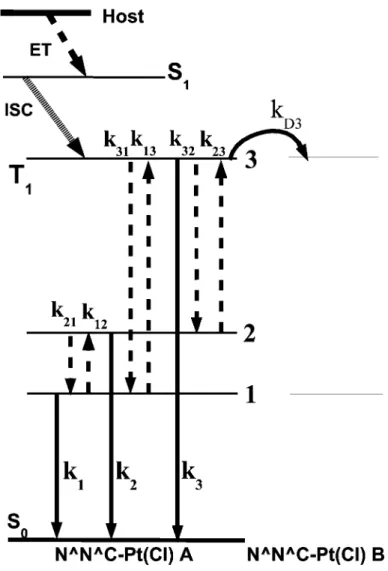
Schematic energy level diagram for the excited spin-singlet and emitting triplet substates 1, 2 and 3 of
the T
1state in N^N^C-Pt(Cl), together with the relaxation processes in the substates after excitation
in the host molecule. Straight arrow indicates the radiative transition, while broken arrow indicates
the non-radiative transitions.Energy dissipation from the substate 3 of excited molecule A to the sub-
state 3 of neighboring N^N^C-Pt(Cl) molecule B is also shown.
the excited N^N^C-Pt(Cl) into the T
1state of its neighboring unexcited N^N^C-Pt(Cl).
Figure 4 shows the schematic energy level diagram of the triplet state and the relaxation processes in the T
1state leading to the emission of phosphorescence from N^N^C-Pt(Cl). In this figure are shown the radiative transition rates k
1, k
2and k
3from the 1, 2 and 3 substates to the ground state, respectively, the non-radiative transition rate k
21from the 2 to 1 substate, and the reverse non-radiative transition rate k
12from the 1 to 2 substates, etc [7].
The relaxation among the substates is made by spin-phonon process, so that the spin-phonon transition rate from the substate 1 to the substate 2, k
12, is given by k
12=K
1n
21, where n
21is the occupancy number of the effective phonon modes given by n
21=[exp(E
21/kT)-1]
-1, E
21means the energy separation between the substates 1 and 2, K
1is a coupling constant which reflects the interaction between the substates 1 and 2 [7]. The same formulae are applied to k
23and k
13; k
23=K
2n
32with n
32=[exp(E
32/kT)-1]
-1, k
13=K
3n
31with n
31= [exp(E
31/kT)-1]
-1, where K
2is the coupling con- stant between the substates 1 and 3, and K
3is the coupling constant between the substates 2 and 3.
When the energy dissipation is included in the relaxation in the T
1state, the rate equations for the populations N
i(t) (i=1,2,3) of the substates 1, 2 and 3 at time t at temperature T are given by
(1)
where k
Dimeans the energy dissipation rate from the substate i of the T
1state to the same sub- state i of the T
1state of unexcited neighboring N^N^C-Pt(Cl). Taking into account that each susb- state has adiabatic potential parabola in the configurational coordinate, the dissipation rate k
Diis given by
k
Di= K
Di[A
Di+exp(-E
Di/kT)] (2)
where K
Diis coupling parameter between two guest molecules, A
Diis parameter due to tunneling of the excited energy from the excited to unexcited molecules, and E
Diis thermal activation ener- gy to overcome the potential barrier between the neighboring molecules [8].
The emission intensity of N^N^C-Pt(Cl) at time t is given by
I
T(t)=k
3N
3(t)h ν
3+ k
2N
2(t) h ν
2+ k
1N
1(t) h ν
1(3)
where h ν
iis photon energy of luminescence from the substate i. The emission intensity is derived
by integrating Eq. 3 in time range from zero to infinity.
4. Temperature dependences of PL lifetimes and intensity
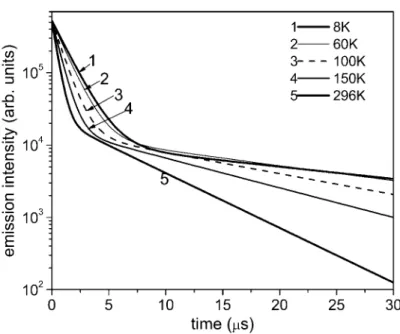
We solved the rate equations (Eq. 1) numerically and try to fit the calculated PL lifetimes and intensity to the measured ones. We calculated the time-dependence of populations N
i(t) and inten- sity I
T(t), then estimated the lifetimes from the I
T(t) curve. Calculation was done by changing the parameters k
i, K
i, E
ij, K
Di, E
Diand A
Di(i,j=1,2,3) values variously under the initial condition of N
3(t)=1, N
1(t)=N
2(t)=0 at t=0.
Three PL lifetimes τ
PL1, τ
PL2, τ
PL3(τ
PL1> τ
PL2> τ
PL3) are estimated from the calculated transient decay curve I
T(t) as shown in Fig. 5. Good fit of not only the temperture-dependence of the calcu- lated three τ
PLito the measured PL lifetime but also the temperature-dependence of the calculated PL intensity to the measured PL intensity was obtained by choosing E
13= 90 cm
-1, E
12= 5 cm
-1, k
1=1/(3.05x10
-5) s
-1, k
2=1/(2.05x10
-5) s
-1, k
3=1/(1.9x10
-6) s
-1, K
1=2.02x10
3s
-1, K
2= K
3=1.01x10
5s
-1, K
D3=2.25x10
6s
-1, E
D3=140 cm
-1and A
D3=1.0x10
-4as shown in Figs. 2 and 3. From the k
1, k
2, and k
3values, it is obtained that the radiative lifetimes of the substates 1, 2 and 3 (τ
r1, τ
r2and τ
r3) are 30.5, 20.5 and 1.9 μ s, respectively.
Fig. 5
Time dependence of the calculated I(t) for N^N^C-Pt(Cl) at various temperatures. Calculation is
made with the same E
ij, k
i, K
i, K
D3, E
D3and A
D3(i,j=1,2,3) values used in Fig. 2.
Fig. 6
Temperature dependences of the calculated PL lifetimes for N^N^C-Pt(Cl), compared with the meas- ured PL lifetimes (open and closed circles and triangle) which were obtained from Ref.[2].
Calculation is made with E
13= 90 cm
-1, E
12= 5 cm
-1, k
1=1/(3.05x10
-5) s
-1, k
2=1/(2.05x10
-5) s
-1, k
3=1/(1.9x10
-6) s
-1, K
1=2.02x10
3s
-1, K
2= K
3=1.01x10
5s
-1, K
D1=2.25x10
6s
-1, E
D1=230 cm
-1and A
D1=1.0x10
-4.
Fig. 7
Temperature dependence of the calculated PL intensity for N^N^C-Pt(Cl) in various cases of energy
dissipation, compared with the measured PL intensity (closed circle) which was obtained from
Ref.[ 2 ]. Calculation is made under no dissipation (curve 2 ), dissipation from only the substates 1 and
3 (curve 3 and 4 , respectively), and dissipation from all the substates in the cases (A) and (B) of Fig. 8
(curves 5 and 6 ).
We tried fitting using energy dissipation from each of the substates 1 and 2 and from all the substates, but we could not obtain good fitting in both the PL decay times and intensity; for exam- ple, see Fig. 6 and curve 3 of Fig. 7 that were obtained from the calculation under dissipation from only the substate 1. When we neglect the dissipation from all the substates, i.e. k
Di=0, the PL inten- sity is never changed for variation of temperature (curve 2 of Fig. 7) although a good fitting is obtained between the calculated and measured PL lifetimes except τ
PL1at high temperatures as shown in Fig. 9.
Fig. 8
Temperature dependences of the calculated PL lifetimes for N^N^C-Pt(Cl), compared with the meas-
ured PL lifetimes (open and closed circles and triangle) which were obtained from Ref.[2]. Calculation
is made for two cases of (A) E
13= 90 cm
-1, E
12= 5 cm
-1, k
1=1/(3.05x10
-5) s
-1, k
2=1/(2.05x10
-5) s
-1,
k
3=1/(1.9x10
-6) s
-1, K
1=2.02x10
3s
-1, K
2= K
3=1.01x10
5s
-1, K
D1= K
D2= K
D3=2.25x10
6s
-1, E
D1=230 cm
-1, E
D2=223
cm
-1, E
D3=140 cm
-1, and A
D1= A
D2= A
D3=1.0x10
-4(curve 1) and (B) E
13= 90 cm
-1, E
12= 5 cm
-1,
k
1=1/(3.05x10
-5) s
-1, k
2=1/(2.05x10
-5) s
-1, k
3=1/(1.9x10
-6) s
-1, K
1=2.02x10
3s
-1, K
2= K
3=1.01x10
5s
-1, K
D1=
K
D2= K
D3=2.25x10
5s
-1, E
D1=230 cm
-1, E
D2=223 cm
-1, E
D3=140 cm
-1, and A
D1= A
D2= A
D3=1.0x10
-4(curve 2).
5. Discussion
Radiative lifetimes of the substates 1, 2 and 3 (τ
r1, τ
r2and τ
r3) are 140, 11 and 0.75 μ s, respectively, for Ir(ppy)
3[9,10]. The lowest-energy substate 1 has much longer lifetime than the others. The same result was obtained for N^N^C-Pt(Cl). The T
1state mixes with the singlet states by the spin-orbit coupling. According to the TDDFT calculation for Ir(ppy)
3, the upper substates 2 and 3 mix with the singlet states S
4and S
5, while the substate 1 has no mixing with singlet state, resulting in longer radiative lifetime [4]. The same seems to be true for N^N^C-Pt(Cl) although the TDDFT calculation has not been undertaken yet.
The ZFS E
13is estimated to be 90 cm
-1for N^N^C-Pt(Cl) in the present study. This value is comparable to the ZFS of 83.5 cm
-1for Ir(ppy)
3. The amount of ZFS varies from 0.1 to 211 cm
-1, depending on the phosphorescent molecules [11]. From the relatively large ZFS in N^N^C-Pt(Cl), we confirm strong SO coupling as the case of Ir(ppy)
3. This is consistent with short radiative life- time of 1.9 μ s estimated for the upper substate 3. Taking into account that most fluorescent non- metallic organic molecules have radiative lifetime of order of 10 s for the T
1state, metal ion in organometallic molecules gives rise to reduction of the lifetime by the SO coupling due to mixing of metal d-orbital to the ligand π-orbital.
Fig. 9
Temperature dependences of the calculated PL lifetimes for N^N^C-Pt(Cl), compared with the meas- ured PL lifetimes (open and closed circles and triangle) which were obtained from Ref.[2].
Calculation is made with E
13= 90 cm
-1, E
12= 5 cm
-1, k
1=1/(3.05x10
-5) s
-1, k
2=1/(2.05x10
-5) s
-1,
k
3=1/(1.9x10
-6) s
-1, K
1=2.02x10
3s
-1, K
2= K
3=1.01x10
5s
-1and k
Di=0 (i=1,2,3).
When N^N^C-Pt(Cl) is relaxed to the upper substate 1 of the T
1state after laser excitation, three relaxation processes occurs ; (1) spin-phonon relaxation with rates k
ijamong the three sub- states, (2) radiative transition with rates k
ifrom the substates, and (3) energy dissipation with rates k
Dito neighboring N^N^C-Pt(Cl). Optical properties such as PL line shape, decay time and intensity are determined by competition and balance among three rates. In N^N^C-Pt(Cl) k
Diwas estimated to be larger than k
ij. This indicates that intermolecular interaction is stronger in N^N^C- Pt(Cl) than the spin-phonon relaxation.
References
[ 1 ] T. Tsuboi and M. Tanigawa, Thin Solid Films 438 - 439 ( 2003 ) 301 .
[ 2 ] T. Tsuzuki and S. Tokito, Proc. Int. Super-Functionality Organic Devices, IPAP Conf. Series 6 ( 2005 ) 99 . [ 3 ] W. Sotoyama, T. Satoh, H. Sato, A. Matsuura and N. Sawatari, J. Phys. Chem. A 109 ( 2005 ) 9760 . [ 4 ] K. Nozaki, J. Chinese Chem. Soc. 53 ( 2006 ) 101 .
[ 5 ] Y. Komada, S. Yamauchi and N. Hirota, J. Phys. Chem. 90 ( 1986 ) 6425 . [ 6 ] T.Tsuboi and N.Aljaroudi, Opt. Materials 27 ( 2005 ) 1859 .
[ 7 ] T.Tsuboi and N.Aljaroudi: Jpn. J. Appl. Phys. 44 ( 2005 ) 591 . [ 8 ] T. Tsuboi, J. Lumin. 119 - 120 ( 2006 ) 127 .
[ 9 ] T. Tsuboi and N. Aljaroudi, Phys. Rev. B 72 ( 2005 ) 125109 .
[ 10 ] W.J. Finkenzeller and H. Yersin: Chem. Phys. Lett. 377 ( 2003 ) 299 .
[ 11 ] H. Yersin, SPIE Proc. Vol. 5214 ( 2004 ) 124 .
第 5 号

![Fig. 2 Temperature dependences of the calculated PL lifetimes for N^N^C-Pt(Cl), compared with the meas- meas-ured PL lifetimes (open and closed circles and triangle) which were obtained from Ref.[2].](https://thumb-ap.123doks.com/thumbv2/123deta/6868762.2247449/3.774.173.603.555.883/temperature-dependences-calculated-lifetimes-compared-lifetimes-triangle-obtained.webp)
![Fig. 3 Temperature dependence of the calculated PL intensity for N^N^C-Pt(Cl), compared with the meas- meas-ured PL intensity (closed circle) which was obtained from Ref.[2]](https://thumb-ap.123doks.com/thumbv2/123deta/6868762.2247449/4.774.165.606.573.904/temperature-dependence-calculated-intensity-compared-intensity-closed-obtained.webp)
![Fig. 6 Temperature dependences of the calculated PL lifetimes for N^N^C-Pt(Cl), compared with the meas- meas-ured PL lifetimes (open and closed circles and triangle) which were obtained from Ref.[2].](https://thumb-ap.123doks.com/thumbv2/123deta/6868762.2247449/8.774.168.603.122.449/temperature-dependences-calculated-lifetimes-compared-lifetimes-triangle-obtained.webp)
![Fig. 8 Temperature dependences of the calculated PL lifetimes for N^N^C-Pt(Cl), compared with the meas- meas-ured PL lifetimes (open and closed circles and triangle) which were obtained from Ref.[2]](https://thumb-ap.123doks.com/thumbv2/123deta/6868762.2247449/9.774.156.619.378.728/temperature-dependences-calculated-lifetimes-compared-lifetimes-triangle-obtained.webp)
![Fig. 9 Temperature dependences of the calculated PL lifetimes for N^N^C-Pt(Cl), compared with the meas- meas-ured PL lifetimes (open and closed circles and triangle) which were obtained from Ref.[2].](https://thumb-ap.123doks.com/thumbv2/123deta/6868762.2247449/10.774.162.611.120.455/temperature-dependences-calculated-lifetimes-compared-lifetimes-triangle-obtained.webp)
