Effect of light irradiation distance during intermediate polymerization on depth of cure and hardness of
indirect composite
Kota Okamura
Nihon University Graduate School of Dentistry, Major in Fixed Prosthodontics
(Directors: Prof. Hideo Matsumura and Assist. Prof. Hiroyasu Koizumi)
Introduction
The use of indirect composites has become increasingly common during the last decade.
They are used for resin-veneered restorations, superstructure of implant prostheses, metal-free restorations, and fixed partial dentures (FPDs). According to previous reports,1-5 water absorption and solubility of a new generation of composites has been reduced, and wear resistance has been considerably improved.
It is important for these materials that light polymerization should be performed appropriately in order to facilitate sufficient physical properties. Direct composite materials are substantially polymerized by means of a quartz-tungsten-halogen (QTH) or a light-emitting diode (LED) light source, whereas indirect composite materials are polymerized with both visible and ultraviolet light sources. During the layering process, an intermediate polymerization unit equipped with a visible light source is frequently applied.
This is due to the fact that the presence of an oxygen-inhibited layer, generated with the use of a visible light source, is indispensable for layering and bonding different shades of indirect composite materials.6 Radiation energy and exposure time period also affect post-polymerization properties of indirect composite materials.1-14 The light sources employed for polymerization of indirect composites are xenon flash lamps, fluorescent tubes, halogen lamps, and metal halide lamps.7-14
Light intensity is in general inversely proportional to the square of the distance between the light source and the material surface to be light-exposed. This study evaluated the influence of distance between a halogen lamp and an indirect composite material surface on the depth of cure and Knoop hardness number of the material.
Materials and Methods Materials
The materials used in this study are summarized in Table 1. An indirect composite material (Signum Ceramis DA2, Heraeus Kulzer Japan Co., Ltd., Tokyo, Japan) was assessed.
The material consists of 55% inorganic filler, 15% prepolymerized filler, and 30%
bifunctional monomers.15 A single-lamp intermediate light polymerization unit equipped with a halogen lamp (Sublite S, Shofu Inc., Kyoto, Japan) was used for polymerizing the composite material.
Spectroradiometry
A spectroradiometer (USR-40d-14R/40-d16, Ushio Inc., Tokyo, Japan) was used to determine relative light intensity emitted from the light source. The distance between the lamp aperture and the composite specimen surface was set at 10, 20, 30, and 40 mm.
Measurements were performed per 1 nm wavelength between 200 and 800 nm for 60 s of exposure time period. The relative light intensity value measured for each distance was converted to cumulative light energy values.
Depth of cure
A cylindrical stainless steel split mold 4 mm in inner diameter and 8 mm in height was coated with a thin layer of separator (Estenia C&B CR Sep III, Kuraray Noritake Dental Inc., Tokyo, Japan) before being filled with the composite material. A cover glass (Tempax, Matsunami Glass Ind., Ltd., Osaka, Japan) was used to apply pressure via a resin compression sheet (polyethylene film, GC, Tokyo, Japan) in order to flatten the light-exposed surface of the material during light exposure. The distance between the lamp aperture and the composite specimen surface was set at 10, 20, 30, and 40 mm. Six specimens were prepared for each condition. After 60 s of light exposure, an unexposed period of 8 minutes was
ensured to maintain identical temperature of pre-polymerization material surfaces. The depth of cure of the composite material was measured in accordance with ISO 4049.16 After light exposure, the unpolymerized layer of the specimen was removed with alcohol-treated gauze, and the length of the hardened cylinder of the composite material was measured with a digital micrometer (MDC-SB, Mitutoyo Corp., Kawasaki, Japan).12,14
Knoop hardness testing
A piece of filter paper (Whatman Filter Paper 5, GE Healthcare Japan, Tokyo, Japan) and a Teflon mold (10 mm in inner diameter and 2 mm in height) were placed on a glass plate. A thin layer of a separator (Estenia C&B SEP III) was applied to the inner surface of the mold.
The mold was filled with the composite material. Pressure was applied to a glass plate and a piece of plastic film during polymerization of the material. After light exposure, the polymerized specimens were sliced in half using a low-speed rotary diamond saw (IsoMet, Buehler, Lake Bluff, IL, USA). The light-exposed surface was ground flat to 200 μm in thickness to remove oxygen-inhibited layer. Specifically, both the ground and cut surfaces were identically wet-ground with water-resistant abrasive paper (WetorDry Sheet, 2000 grit, 3M, St. Paul, MN, USA). The specimens were then polished with a series of diamond pastes (metaDi, Buehler; particle diameters 3.0, 1.0, and 0.25 μm) and felts. A microhardness tester (HMV-1, Shimadzu Corp., Kyoto, Japan) was used to measure the Knoop hardness of the specimen. The measurement of the specimen was performed at one point on the light-exposed surface and at seven points in the central part of the cut surface. The interval was 0.2 mm from the top to the bottom direction, and a loading schedule applied to the specimen was set at 490.3 mN (HK0.05) for 30 s. Six specimens were prepared for each condition.
Temperature measurements
Temperature of the composite specimen surface during light exposure was determined with a temperature logger (Ondotori TR-71UI, T&D Corp. Matsumoto, Japan). The sensor was placed on the top of the specimen surface perpendicularly to the light exposing direction with the irradiation distances of 10, 20, 30, and 40 mm. The temperature after 60-s light exposure was recorded for eight specimens.
Statistical analysis
The Kolmogorov-Smirnov test was applied to the experimental results for the assessment of normality (SPSS Version 16.0 for Windows, SPSS Inc., Chicago, IL, USA). When normality was not observed, a multiple comparison was performed using the Steel-Dwass test (Kyplot5.0, KyensLab, Tokyo, Japan). When normality was observed, Levene’s test was carried out to confirm equality of variance, after which one-way analysis of variance and a multiple comparison using Tukey’s HSD test were performed (SPSS). The significant levels were set at 0.05 for all testing.
Results
Figure 1 shows the relative light intensity of the halogen lamp determined with different lamp-specimen distances. Spectral irradiance exhibited a gentle curve with a peak at around 515 nm for all conditions, and showed the highest value when the distance between the lamp and the specimen surface was 20 mm. Since a wavelength peak was also detected at around 580 nm for all conditions, this study focused on the 400-600 nm wavelength ranges, which includes the maximal absorption wavelength of camphorquinone (CQ) visible-light initiator (470 nm). It was confirmed that light energy, i.e., integral values of relative light intensity within the 400-600 nm wavelength range was the highest (41.3 mW/cm2) when the lamp-material distance was 20 mm.
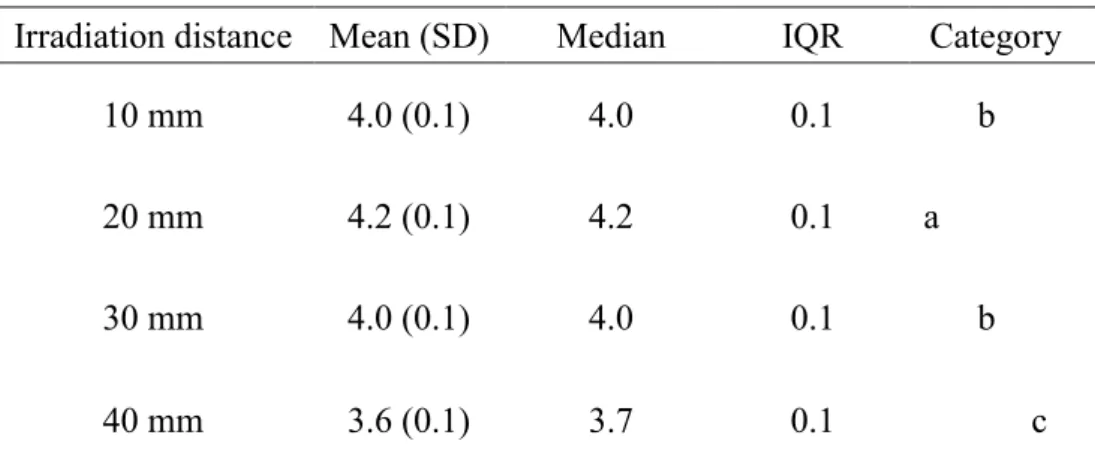
Table 2 shows the results depth of cure determination. They correlated well with relative light intensity, with the greatest mean depth of 4.2 mm when the distance between the lamp and the specimen was 20 mm. The mean value of other specimens was 4.0 mm for 10- and 30-mm distances, and 3.6 mm for the 40-mm distance.
Table 3 shows Knoop hardness number (KHN) values for the top surface of the specimens. The greatest Knoop hardness number (53.1) was generated when the distance between the lamp and the specimen was 20 mm. The value was significantly higher than that of other specimens; 46.4 for 30 mm, 46.0 for 10 mm, and 41.3 for 40 mm. Figure 2 shows the KHN values obtained from the longitudinal section of the specimens. Hardness gradually decreased with increasing distance from the material surface.
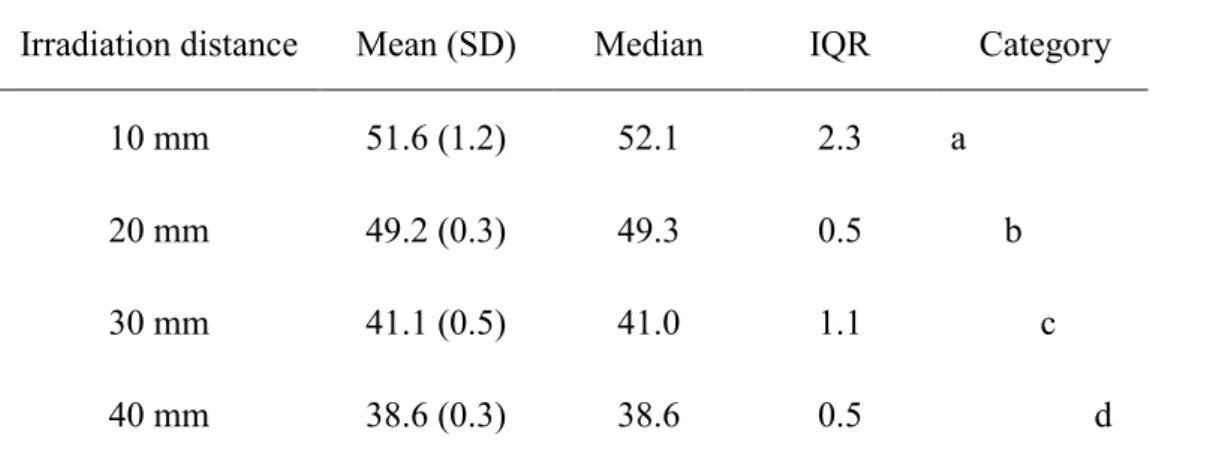
Temperature of light-exposed surfaces is summarized in Table 4. The temperature after light exposure was highest (51.6˚C) when the distance between the lamp and the specimen was 10 mm, followed by 49.2˚C for 20 mm, 41.1˚C for 30 mm, and 38.6˚C for 40 mm.
Discussion
Factors affecting properties of indirect composites are divided into two categories;
material composition and polymerization condition. Sobrinho et al.7 reported that there were differences in hardness between the light-exposed surface and inner areas when the exposure time period was short.7 However, when the duration of light exposure was gradually increased, polymerization proceeded throughout the entire specimen during the longer exposure times. Also, differences in hardness almost disappeared.7 The current study fixed the exposure time period as 60 s, and focused on the relation between the lamp-material distance and the post-polymerization material properties.
Although the author performed the experiment under the hypothesis that light intensity is inversely proportional to the square of the distance from the light source, the results were somewhat different. This may be derived from the fact that the halogen lamp of the Sublite S unit is equipped with a reflector for the enhancement of light intensity at a specific distance from the aperture.
Experimental results showed that relative light intensity, depth of cure, and Knoop hardness number was highest when the distance between the lamp and the specimen surface was set at 20 mm. The results suggest that the reflector of the halogen lamp is designed for maximizing the light energy at about 20 mm distance from the aperture.
Determination of temperature revealed that the heat energy emitted from the lamp was highest at the 10 mm distance from the aperture. It has been reported that the conversion of indirect composite materials primarily irradiated with QTH lamps and LED lamps is temperature dependent.17-21 From the results of the current experiments and the literature, it is reasonable to consider that the high-temperature around the halogen light source is not a negative factor for improvement in properties of indirect composite materials. Also, the author speculates that accumulation of heat energy, i.e, temperature rise for the 150 W halogen lamp is dependent on the distance between the halogen light source and the material
surface. This may be derived from accumulation of the radiant heat from the halogen lamp as well as the reflected heat from the lamp reflector.
Within the limitation of the current experimental settings, it can be concluded that the distance between the halogen lamp and the composite material to be polymerized should be set at approximately 20 mm, when the material is polymerized with an intermediate polymerization unit equipped with a representative 150 W halogen lamp.
References
1. Tanoue N, Atsuta M, Matsumura H. Properties of a new photo-activated composite polymerized with three different laboratory photo-curing units. J Oral Rehabil 2003; 30:
832-6.
2. Koizumi H, Satsukawa H, Tanoue N, Ogino T, Nishiyama M, Matsumura H. Effect of metal halide light source on hardness, water sorption and solubility of indirect composite material. J Oral Sci 2005; 47: 165-9.
3. Satsukawa H, Koizumi H, Tanoue N, Nemoto M, Ogino T, Matsumura H. Properties of an indirect composite material polymerized with two different laboratory polymerizing systems. Dent Mater J 2005; 24: 377-81.
4. Murakami M. Surface properties of an indirect composite polymerized with five laboratory light polymerization systems. J Oral Sci 2009; 51: 215-21.
5. Shimane T, Endo K, Zheng JH, Yanagi T, Ohno H. Wear of opposing teeth by posterior composite resins - evaluation of newly developed wear test methods. Dent Mater J 2010;
29: 713-20.
6. Matsumoto Y, Furuchi M, Oshima A, Tanoue N, Koizumi H, Matsumura H. Effect of preliminary irradiation on the bond strength between a veneering composite and alloy.
Dent Mater J 2010; 29: 84-8.
7. Sobrinho LC, Goes MF, Consani S, Sinhoreti MA, Knowles JC. Correlation between light intensity and exposure time on the hardness of composite resin. J Mater Sci Mater Med 2000; 11: 361-4.
8. Arikawa H, Kanie T, Fujii K, Ban S, Takahashi H. Light-attenuating effect of dentin on the polymerization of light-activated restorative resins. Dent Mater J 2004; 23: 467-73.
9. Tanoue N, Murakami M, Koizumi H, Atsuta M, Matsumura H. Depth of cure and hardness of an indirect composite polymerized with three laboratory curing units. J Oral Sci 2007; 49: 25-9.
10. Yazici AR, Kugel G, Gül G. The Knoop hardness of a composite resin polymerized with different curing lights and different modes. J Contemp Dent Pract 2007; 8: 52-9.
11. Tango RN, Sinhoreti MA, Correr AB, Correr-Sobrinho L, Consani RL. Effect of veneering materials and curing methods on resin cement Knoop hardness. Braz Dent J 2007; 18: 235-9.
12. Moore BK, Platt JA, Borges G, Chu TM, Katsilieri I. Depth of cure of dental resin composites: ISO 4049 depth and microhardness of types of materials and shades. Oper Dent 2008; 33: 408-12.
13. Hirata M, Koizumi H, Tanoue N, Ogino T, Murakami M, Matsumura H. Influence of laboratory light sources on the wear characteristics of indirect composites. Dent Mater J 2011; 30: 127-35.
14. Nishimaki M. Depth of cure and hardness of indirect composite materials polymerized with two metal halide laboratory curing units. J Oral Sci 2012; 54: 121-5.
15. Alves PB, Brandt WC, Neves AC, Cunha LG, Silva-Concilio LR. Mechanical properties of direct and indirect composites after storage for 24 hours and 10 months. Eur J Dent 2013; 7: 117-22.
16. ISO 4049: Dentistry - Polymer-based filling, restorative and luting materials, 4th edition, ISO Copyright office, Geneva, 2009, pp. 14-5.
17. Hofmann N, Hugo B, Klaiber B. Effect of irradiation type (LED or QTH) on
photo-activated composite shrinkage strain kinetics, temperature rise, and hardness. Eur J Oral Sci 2002; 110: 471-9.
18. Tarle Z, Knezevic A, Demoli N, Meniga A, Sutaloa J, Unterbrink G,et al. Comparison of composite curing parameters: effects of light source and curing mode on conversion, temperature rise and polymerization shrinkage. Oper Dent 2006; 31: 219-26.
19. Atai M, Motevasselian F. Temperature rise and degree of photopolymerization
conversion of nanocomposites and conventional dental composites. Clin Oral Investig 2009; 13: 309-16.
20. Guiraldo RD, Consani S, De Souza AS, Consani RL, Sinhoreti MA, Correr-Sobrinho L.
Influence of light energy density on heat generation during photoactivation of dental composites with different dentin and composite thickness. J Appl Oral Sci 2009; 17:
289-93.
21. Yondem I, Altintas SH, Usumez A. Temperature rise during resin composite polymerization under different ceramic restorations. Eur J Dent 2011; 5: 305-9.
Table 1. Materials assessed
Material/Trade name Manufacturer Lot
Indirect composite Composition*
Signum Ceramis (DA2) Heraeus Kulzer
Japan Co., Ltd. 010139
70 wt% 0.04-2.0 μm hybrid fillers (SiO2, Ba·Al·Si glass), 30 wt% urethane and triethylene glycol dimethacrylates
Polymerizing unit Light source
Sublite S Shofu Inc. 0707 Halogen lamp
JCR 110V 150 W×1
*Quoted from Alves et al.15
Table 2. Depth of cure (mm) of the composite material
Irradiation distance Mean (SD) Median IQR Category
10 mm 4.0 (0.1) 4.0 0.1 b
20 mm 4.2 (0.1) 4.2 0.1 a
30 mm 4.0 (0.1) 4.0 0.1 b
40 mm 3.6 (0.1) 3.7 0.1 c
n=6; SD, Standard deviation; IQR, Interquartile range; Identical letters indicate that the values are not statistically different (p>0.05).
Table 3. Knoop hardness number (KHN) of the composite material
Irradiation distance Mean (SD) Median IQR Category
10 mm 46.0 (0.7) 45.9 1.3 b
20 mm 53.1 (4.1) 53.5 6.1 a
30 mm 46.4 (2.0) 46.5 4.1 b
40 mm 41.3 (2.0) 41.3 3.3 c
n=6; SD, Standard deviation; IQR, Interquartile range; Identical letters indicate that the values are not statistically different (p>0.05).
Table 4 Temperature (˚C) of the composite material surface
Irradiation distance Mean (SD) Median IQR Category
10 mm 51.6 (1.2) 52.1 2.3 a
20 mm 49.2 (0.3) 49.3 0.5 b
30 mm 41.1 (0.5) 41.0 1.1 c
40 mm 38.6 (0.3) 38.6 0.5 d
n=8; SD, Standard deviation; IQR, Interquartile range; Different letters indicate that the values are statistically different (p<0.05).
Fig. 1. Relative light intensity of the 150 W halogen lamp Lamp-specimen distance; 10, 20, 30, and 40 mm