Product Naming in the Classroom:
A Case Study of Word Formation
Darrell HARDY
Abstract
This paper presents data collected from students from a product naming project where groups were responsible for naming four novel products. The product names were then analyzed and compared to a set of standard values for how new words typically enter the English language. This paper also discusses briefly how new words enter a language and the word formation process as it applies to the English language. Finally,implications of the results are discussed and consideration is given to how students could benefit by such product naming projects and having explicit knowledge about the word formation process in English.
1. Introduction
The English language,like any living language,is constantly undergoing change to adapt to the needs of English speakers to communicate with other English speakers in an ever-changing world. In order to keep up with the times, the English lexicon must somehow expand to accommodate a vast array of new innovations and concepts ranging from consumer products to computers and internet technology;from modern literature to medical research. These changes are not strictly for native speakers but also for second language speakers who use English as a common language to communicate with people in different parts of the world. The fact that the English language has become the Lingua Franca of world communication has resulted in even more pressure for the language to evolve and adapt with the times.
If there is such a demand for new words, the obvious question then is where do these new words come from?Is there a process for making new words to accommodate gaps in the lexicon that result from change and innovation?If there is a process,do speakers of the language,or in this case speakers of English as a Foreign Language, intuitively understand and can apply the process?
The answer is yes, there is a process and I will summarize the common ways in which new
words come into being. To answer the final question,a group of English as a Foreign Language students were asked to name four unusual products in a product naming activity. The resulting names were then analyzed yielding interesting results. In this article,I will talk about the results and the implications.
2. Changing Lexicon:Semantic Change, Borrowing and Word Formation
In order to accommodate the demand for new lexicon,Algeo and Pyles (1993)claim there are three general sources from where new words emerge:semantic change,where pre-existing words take on new meaning;borrowing,the process of adopting foreign loan words;and word formation which is the creation of new words from pre-existing word elements or morphemes. Each of these processes will be explained in greater detail below.
Semantic change refers to a number of processes that are responsible for changing the meaning of a word from its original sense to a new, sometimes completely different meaning.
Some of the processes are gradual,perhaps taking several generations whereas others occur more rapidly. For example,the word ʻmouseʼwhich commonly means ʻ small rodentʼhas taken on the additional meaning of a ʻcomputer periphery devise used for inputʼin a short period of time.
Commonization is the term given when common words are used to represent new objects or ideas as the above example demonstrates. Commonization is a very popular method used in product naming, for example automobile manufacturers often name their new car models with common names such as ʻMustangʼ,ʻForesterʼand ʻSwiftʼwith the intent of portraying their products with the favorable image that the name implies.
To understand how semantic change occurs however, it is important to understand that a word has both meaning and connotations. For example,the words ʻ motherʼ,ʻmomʼ,ʻmaʼ,and ʻold ladyʼare synonymous;however,each have different connotations ranging from formal,casual to slang. Changes in meaning and/or connotation often result in words having different meanings from their cognates.
One of the main mechanisms for change in meaning is through generalization and specializa- tion. Generalization and specialization occur when the variables to which the word refers to are either decreased (generalization) or increased (specialization). For example in Old English the word ʻtailʼwas likely to mean ʻhairy caudal appendageʼlike that of a horse. Over the years the variable of hairiness has been dropped giving the meaning of the word greater scope, thus the
Product Naming in the Classroom:A Case Study of Word Formation 252
word in Modern English simply means ʻcaudal appendageʼ. An opposite example is that of the word ʻmeatʼwhich in Old English referred to ʻ fleshʼas it does today but was also used in the general sense to refer to ʻfoodʼ. Another interesting example is the difference in meaning of the word ʻcornʼin the UK and North America. ʻCornʼwas originally used to refer to ʻ grainʼincluding wheat, barley, oats and other cultivated cereal grains and in the UK the word still carries this meaning, whereas in North America ʻcornʼhas become specialized to refer to ʻ maizeʼ.
There are various other ways a transfer of meaning occurs in words. One example is the use of metaphors such as with the word ʻfootʼto refer to the base or lowest point as in ʻ foot of a mountainʼor ʻfoot of a treeʼ. Also, the meaning of the word ʻ footʼhas been adapted to mean a form of measurement (approximate length of a human foot):this is an example of metonymy where a word takes on an additional meaning to refer to a type of measurement. The term synesthesia refers to a transfer of meaning from one sensory faculty to another as in ʻ These flowers smell sweetʼ. Also a change in meaning may come about from an association of ideas.
For example, the word ʻpenʼcomes from the Latin ʻpennaʼwhich means ʻfeatherʼ. Since feather quilts were used as early ink writing instruments, the word ʻ penʼwas adopted to refer to newer mechanical ink writing instruments.
Other factors which change the meaning and use of words result from changes in connotation.
A word may either gain respectability (amelioration) or fall out of grace (pejoration). For example, the word ʻvulgarʼwhich currently means ʻ rudeʼor ʻobsceneʼcomes from the Latin
ʻvalgusʼto mean ʻcommon peopleʼ. The Latin ʻnesciusʼmeaning ʻignorantʼhas had a better fate evolving to the current word ʻniceʼto describe a pleasant personality. An interesting agent for pejoration which may result in the loss of use of a word and /or the use of a ʻbetterʼsounding word or phrase, referred to as euphemism, is because of a taboo against talking about the object or concept the original word refers to. A good example of taboo and the use of euphemisms is with the subject of death which is generally a sensitive topic in most cultures. In English,euphemisms such as ʻpass awayʼare used instead of the cold hard ʻ dieʼ.
Also,the meaning of words may vary among groups. For example,the word ʻsmartʼmeans ʻintelligentʼbut in the U.K. it also carries the meaning of being fashionable. Itʼs interesting to note that the loanword ʻsumatoʼin Japanese comes from the English ʻ smartʼ;however,the word has come to mean ʻslenderʼ.
Semantic change, though an important agent in the evolving English lexicon, is insufficient
to provide the vocabulary necessary to meet the demand for new words. A different strategy which has had a profound effect on the English language since it became the common language in most parts of Britain some time between 500 AD to 700 AD, has been the introduction of loanwords from foreign languages. The volume of loanwords introduced from foreign languages such as French, Greek and Latin through the process of borrowing, is profound. It is estimated that more than half of the total number of words in English can be traced to foreign cognates.
With such a high number of loan words it is natural to question the integrity of the English language;however, it is important to remember that loan words have been adapted to English pronunciation and must conform to English grammatical rules. Also, there is a distinction between popular loanwords which are commonly used in everyday oral communication such as
ʻdinnerʼ(from French), ʻalcoholʼ(from Arabic)and ʻpianoʼ(from Italian)and learned loanwords which have been adopted for scholarly purposes and are used less frequently. Finally,even with the high number of loanwords, the majority of high frequency words used in daily life have descended from Old English.
Several languages have had an impact on the English lexicon throughout history, often providing sets of words to fill in newly created gaps in the lexicon. Initially, Latin words were introduced into Old English via British Celts who acquired these words from the Romans. Some examples are,ʻcityʼ,ʻmonasteryʼand ʻharborʼto name a few. Scandinavian words influenced the English lexicon as the Vikings repeatedly occupied large portions of England from the ninth century to the eleventh century and integrated with its inhabitants. The greatest contribution to the English language is the ʻthʼthird person pronouns such as ʻ theyʼand ʻthemʼwhich are of Scandinavian origin.
Perhaps the greatest influence a foreign language has had on English began with the battle of Hastings in 1066 in which the Normans from Northern France invaded and conquered England.
While English remained the tongue of the common folk, French became the official language which was used in monarchy,aristocracy and official affairs. The vast number of loanwords from French is overwhelming and in many cases filled huge gaps of the lexicon where no prior words existed or displaced Old English words. For example,there are many words of French origin in the above mentioned fields such as ʻattorneyʼ,ʻchancellorʼand ʻ princeʼ. During the time after the Norman Conquest many French loanwords for food (e.g., ʻ beefʼ, ʻporkʼ) and food preparation
(ʻfryʼ, ʻroastʼ)came into common use.
254 Product Naming in the Classroom:A Case Study of Word Formation
In Modern English,since the 16 century,many loan words of Greek and Latin origin came into the English lexicon to describe higher learning such as in medicine and literature. For example,the field of science has depended heavily on Latin roots,as in the word ʻ Biologyʼ(study of life), as a source of names. Even today English continues to borrow words from foreign languages. With the prominence of Japan and the Japanese language,even Japanese loan words such as ʻkaraokeʼ, ʻtsunamiʼ, and ʻsushiʼhave entered English dictionaries.
The third and perhaps most important way for new words to come into common use is through the formation of new words by changing and/ or combining elements of existing words.
This process of word formation is the linguistic principal often used when creating new words for new consumer products or naming new enterprises. Also, Plag (2003)suggests that some of the processes described below are used intuitively by speakers to create new words in order to communicate if the appropriate word is not found in oneʼ s mental lexicon.
According to Kodani (2000), in order to understand how the word formation process works, it is important to understand that English words can either be simple words or complex words.
Simple words such as ʻgoodʼ,ʻbookʼorʻgoʼare considered simple since they cannot be divided into smaller parts. Complex words on the other hand consist of a base unit, usually a simple word,
another base unit and/or other units of meaning,morphemes,which may or may not be indepen- dent words. For example the word ʻtextbookʼwhich is a compound noun (two words joined together to make a new word)is a complex word as is the word ʻ unbelievableʼwith the base word
ʻbelieveʼjoined with the prefix ʻun-ʼto give this word the opposite meaning and the suffix ʻ-ableʼ changing this word from a noun to an adjective. The two above examples are examples of two of the most common methods for creating new words:compounding and affixation.
According to Algeo & Pyles (1993),compounding at 40% is the most common technique for forming new words. As mentioned before, a compound is formed when two independent words are combined to create a new word with a meaning different from the component words.
Compounding is very common in English and compound words are found in all parts of speech.
Compound words are spelled in three different ways:solid,hyphenated,or open (e.g.,ʻgreenhouseʼ, ʻlaid-backʼ, ʻpost officeʼ) though often there are discrepancies and variations in spelling even among dictionaries. With respect to pronunciation the first element is usually stressed indicating a close relationship between the elements. In a relatively new field, such as computers,there is a demand for new words to name new devices,concepts and actions;therefore,it is not surprising to find examples of compound words (e.g., ʻfloppy discʼ , ʻhard driveʼ, ʻtouch typeʼ, etc.).
The second most common form of word creation,affixing,is the combination of words with either a prefix, suffix or both to form a new word. Many affixes cannot exist as independent words thus affixing is different from compounding. The affixes found in Modern English either originate from Old English or are of foreign origin, especially from Latin, French or Greek.
Prefixes change the mean of the base word such as ʻun-ʻwhich gives the opposite meaning as in ʻunluckyʼor ʻuncontrollableʼ. Suffixes on the other hand change the form of a word to a different part of speech. For example, the suffix ʻ-lyʼchanges an adjective to an adverb as in ʻ slowʼto
ʻslowlyʼ. (see Quark et al. (1985)for a comprehensive list of affixes).
Perhaps the third most common way new words are introduced to language is known as functional shift in which the unaltered form of a word is used in a different part of speech.
Probably the most common function shift is from verb to noun for example,ʻtake a walkʼorʻhave a talkʼ.
Another source of new words comes from the process of shortening which include clipping, initialisms (alphabetism and acyonyms) and blending. The tendency to shorten long words is common and in some cases the clipped form of a word may completely supplant the original form altogether. For example, it is probably more common to refer to an advertisement in North America as an ʻadʼ(ʻadvertʼin the UK)rather than advertisement. Also it is highly unlikely to hear a person refer to a pair of ʻpantsʼby the unclipped form, ʻ pantaloonsʼ.
Another form of shortening is the use of the first letters from words in a phrase where each letter is pronounced individually. Words of this sort usually stand for an idea,group or institution such as ʻBBCʼ(pronounced ʻbee-bee-ceeʼ)for British Broadcasting Corporation. An acronym is a similar type of abbreviation;however, instead of pronouncing each letter individually, the set of letters is pronounced as a word. For example ʻ NATOʼ, the abbreviated form for ʻNorth Atlantic Treaty Organizationʼis pronounced ʻNay-toeʼ .
Blending,which as the name implies,is the blending of two existing words to form one new word. Typically,blending is used to create a new word to describe a combination of things,ideas or an intermediate form. Common words that have resulted due to blending include ʻ smogʼ
(ʻsmokeʼ+ ʻfogʼ)and ʻbrunchʼ(ʻbreakfastʼ+ʻlunchʼ).
In discussing the formation of new words,it is interesting to note that the actual creation of
256 Product Naming in the Classroom:A Case Study of Word Formation
words (root creations)without any association with existing words or morphemes is quite rare.
One classic example of a root creation is the word ʻKodakʼcreated by George Eastman to name his company and product. Eastman claimed that word is completely arbitrary (Algeo & Pyles
(1993)) One interesting class of root creations, echoic words, are words based on sound such as the words ʻburpʼand ʻsplashʼ. Echoic words are quite common is some languages such as Japanese;however, they are rarely found in English.
3. The Project:Product Naming
3.1 Overview
In groups of four, students were given four pictures of unusual objects (unusual inventions)
(see appendix 1)and were asked to provide three names for each object and give a reason for each name. This project took place in the spring of 2004.
3.2 The Subjects
The subjects were students at Kanda Gaigo Kakuen which is a language college in central Tokyo. The class consisted of 16 students (15 female and 1 male)most of whom were 19 years old. The studentsʼL1 is Japanese and their approximate English language ability is upper-
beginner/low-intermediate (TOEIC 350‑450)
3.3 Procedure
The students were arranged in groups of four and given a handout (see appendix 2)and were told to follow the steps outlined on the handout:
Step 1:Take a look at the inventions and decide what their uses could be.
Step 2:Work with a partner and decide on three possible names for each product. You can choose any names you want but you have to give the reason why you chose a particular name.
Step 3:You are going to review the names created for the products by other groups. In your group,decide on the best name (you cannot choose one of your groupʼ s names!).Give the reason why you chose this name.
3.4 Data
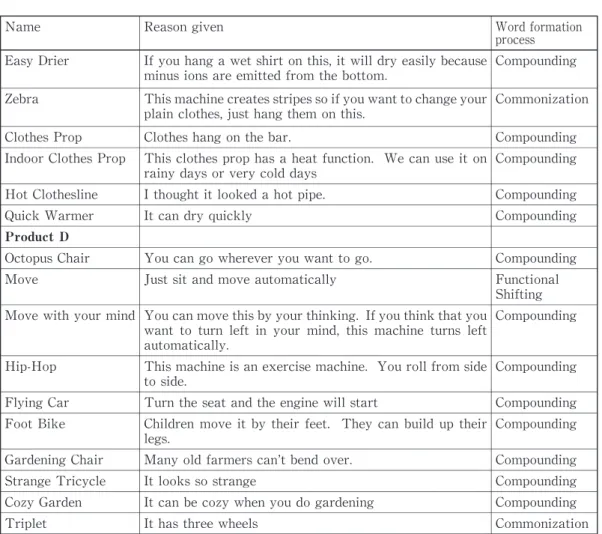
Name Reason given Word formationprocess
Table 1:Student Data
Product A
Compounding
While you listen to music you can clean your room Music Cleaner
Compounding
You can find someone, if you put a CD ROM which includes his/her Picture. The stick part is a camera.
Searching Machine
Compounding (Commonization) You can use ordinary light and outdoor light.
Light and Left
Compounding
You can record sounds from two side microphones Portable Recorder
Borrowing
(scarecrow in Japanese)Because this looks like an ostrich so if you put it up in a rice field you can scare away birds Kaka-shi
PWC (portable world component)
The big antenna can receive radio from all over the world. Shortening
Cocktail Shaker Compounding
Compounding
It looks like a speaker
Potable Component
Borrowing
(Compounding) The parts of mop spin
Korokoro Mop
Borrowing (Blending) DAS means duster, KIN means cloth in Japanese
Daskin
Compounding
It cleans shoes
Shoes Duster
Product B
Stone Key Ring You will not lose your keys because it weighs 2 kg. Compounding
Secret Object If you have an important key you can hide it inside the
strange object Compounding
Compounding
It can store keys in this stone Key receiver
Blending
“SE”means security, “COM”means company.
Secom
Compounding
Put in a key and put in your garden. Other people wonʼ t think itʼs a key.
Security Stone
Compounding
This stone can hide a room key Dummy Stone
Compounding
This stone changes into a big house.
Big House
Compounding
Put the key into the lock the Bookstone will talk to you.
Bookstone Doll
Compounding
You never forget if you put your key in the stone Key-Keep
Compounding
If you put your important things in this, it will never break.
Precious Protector
Compounding
Pocket+Monster
Pocket Monster
Commonization
It looks like a UFO. Pink Lady is a group of singers who sing UFO
Pink Lady
Blending
Polish+shoes
Polishoes
Compounding
It makes a person who loses his/her key happy.
Smile Stone Product C All-Around
Clothesline You can hang wet shirts on this to dry even fish Compounding
258 Product Naming in the Classroom:A Case Study of Word Formation
Word formation process Reason given
Name
Compounding
It can dry quickly
Quick Warmer Product D
Compounding
This clothes prop has a heat function. We can use it on rainy days or very cold days
Indoor Clothes Prop
Compounding
I thought it looked a hot pipe.
Hot Clothesline
Commonization
This machine creates stripes so if you want to change your plain clothes, just hang them on this.
Zebra
Compounding
Clothes hang on the bar.
Clothes Prop
Compounding
If you hang a wet shirt on this, it will dry easily because minus ions are emitted from the bottom.
Easy Drier
Hip-Hop This machine is an exercise machine. You roll from side to side.
Compounding
Move with your mind You can move this by your thinking. If you think that you want to turn left in your mind, this machine turns left automatically.
Compounding
Flying Car Turn the seat and the engine will start Compounding Compounding
You can go wherever you want to go.
Octopus Chair
Functional
Shifting Just sit and move automatically
Move
Foot Bike Children move it by their feet. They can build up their legs.
Compounding
Gardening Chair Many old farmers canʼt bend over. Compounding Compounding
It can be cozy when you do gardening Cozy Garden
Commonization
It has three wheels
Triplet
Compounding
It looks so strange
Strange Tricycle
[Note:the term standard is used here to refer to a set of values derived over years ofresearch with new word creation among native speakers of English. The term “stan- dard”used here does not imply that the same experiment using the same pictures was used for a group of native speakers as a control.]
Total 41
Commonization 3 7.30 No Data0
5
4.9
2
7.3
17
2.4
8
2.4
(Percent) (Percentage)
Standard
Test Results
28
0 40
75.6
31
Compounding
0
Affixation
Test Results
Type
(Number)
Shortening 1
Shifting 1
Borrowing 3
Blending 2
0
Creating
Table 2:The Distribution of Student Generated Results vs. Standard Distribu tion of New Words (Taken from The Origins and Development of the English Language by Thomas Pyles and John Algen. P. 285)
-
4. Results
After the product naming activity, the student generated product names were collected and the process of how the words were formed was determined. (see table 1). Table 2 shows The Distribution of Student Generated Results vs. the Standard Distribution of New Words (Taken from The Origins and Development of the English Language by Thomas Pyles and John Algen.
P. 285). The results from this project are significantly different from the standard in many respects;however, there are some similarities. As with the published values, compounding was the most common way of making new words;however,the test results were significantly higher
(75.6% verses 40%)indicating that the students obviously had a strong conscious or subconscious preference to this method of word formation. Examples of borrowing are slightly more than expected (7.3% verses 2%) and the result for blending is approximately consistent with the standard value (4.9% verses 5%). There were no examples of creating which corresponds to the standard indicating that original names are indeed rare.
On the other hand, fewer words than expected were formed by affixation, shifting or shortening, giving the opposite indication: the students generally avoided these strategies.
Examples of shifting and shortening are fewer than expected;however,the sample size of names created is considerably small which could have skewed the results somewhat. There were no examples of affixation out of the 41 product names collected which is surprising considering it is the second most common occurring form of new word creation according to the standard.
5. Discussion
There are several possible reasons why the student generated results are different from the standard. First of all, the subjects are all native speakers of Japanese with limited language ability in English,therefore their knowledge of the different methods on how to create new words is limited. Most native speakers lack explicit knowledge on how to create new words but have gained implicit knowledge through extensive exposure. In the standard, affixing accounts for 28% of the new words created by native speakers whereas none of the new words generated by the students fall under this category. The reasons for this,in my opinion,is that the students lack explicit knowledge about affixes in English along with a limited vocabulary in general preventing them from forming their own hypotheses.
The vast majority of the new words created by the students was through compounding and this is no surprise as it is the most common way to create new words even among native speakers.
260 Product Naming in the Classroom:A Case Study of Word Formation
Compounding is common in many other languages, including Japanese which explains the studentsʼpreference to this method of word formation. In fact, Jackenoff (2002) suggests compounding is one of the most fundamental mental strategies for word formation where there is a natural tendency for speakers to combine words for the economy of communication. Also compounding in English is common in Japan as evident by consumer products such as ʻ walkmanʼ,
ʻsuper dryʼ, etc.
The data for borrowing was higher than the standard data which is to be expected since it would seem reasonable to assume that the students would consider using their native language in the naming process. It is interesting to note that one of the examples, ʻ Korokoro Mopʼis a compound made up of the Japanese word ʻkorokoroʼ(to spin)and the English word ʻ mopʼ.
As for implications in the classroom, it would be reasonable to expect that explicit knowl- edge of the word formation process would benefit students learning English as a Foreign Language, particularly knowledge of affixes. Kodani (2000)agrees with this assumption stating that even if affixes are incorrectly used such as ʻ miscookedʼthe meaning would in all likelihood still be conveyed.
Clearly, knowledge of affixes greatly expands a studentʼs vocabulary; however, there is another way this knowledge should improve comprehension. The ability to guess the meaning of words through context is a valuable skill and the knowledge of affixes should provide students with a necessary tool to do so. For example,if a student were to come across an unknown word such as ʻantiestablishmentʼ, knowledge that the prefix ʻ antiʼmeans against and the suffix ʻmentʼ
changes a verb to a noun,the student should have a better chance of guessing the meaning of this word in context.
Over the last twenty years communicative language teaching has emphasized language instruction which focuses on communication rather than the explicit instruction of grammar.
Students usually benefit from communicative language learning, such as task based activities, especially in speaking fluency. However, in an appropriate situation, such as a course which emphasizes reading skills,explicit instruction on the word formation process,especially affixing,
should help to increase vocabulary along with providing students with additional skills,including a greater ability to guess the meaning of new words in context.
Reference:
Algeo, J. & Pyles, T.(1993).The Origins and Development of the English Language., 4 ed.(pp.237-311) Orlando, Fl:Harcourt College Publishers.
Jackendoff,R.(2002).Foundations of Language: Brain, Meaning,Grammar,Evolution.(pp.231-264)Oxford:
Oxford University Press.
Kohli, C. & LaBahn, D.W. (1997).Observations: Creating effective brand names; a study of the naming process.Journal of Advertising Research, 37,(pp.110-127).
Kodani,S.(2000).English Words: Word-formation & Evaluative Words.(pp.39-148)Japan:Ryukoku Gakkai.
Plag, I. (2003).Word Formation in English. Cambridge:Cambridge University Press.
Tierney, B. (ed.)(1990).Unusual Inventions.(p.25, 36,42,43)Toronto:Double Day.
Quirk, R., Greenbaum S., Leech, G. & Svartuik, J. (1985).A Comprehensive Grammar of the English Language.(pp.1310-1362;1518-1539)London & New York:Longman.
Weekley, E.(1967).An Etymological Dictionary of Modern English. New York:Dover.
262 Product Naming in the Classroom:A Case Study of Word Formation
Product D
Product C
Product B
Product A
Appendix 1:Products
Appendix 2:
Product Naming
Back ground:Your company has just invented several new products and itʼs your job,along with your partners, to name these products.
Step 1:Take a look at the inventions and decide what their uses could be.
Step 2:Work with a partner and decide on three possible names for each product.You can choose any names you want but you have to give the reason why you chose a particular name.
Step 3:You are going to review the names created for the products by other groups. In your group, decide on the best name (you cannot choose one of your groupʼ s name!).Give the reason why you chose this name.
Product A
Name Reason
1.
2.
3.
Product B
Name Reason
1.
2.
3
Product C
Name Reason
1.
2.
3.
264 Product Naming in the Classroom:A Case Study of Word Formation
Product D
Name Reason
1.
2.
3.
Final Choices Reason
Product A:
Product B:
Product C:
Product D:
(論文掲載順は,原則として図書の日本十進分類法に従う)
宮 井 勢都子 人文学部教授
梅 山 香代子 人文学部教授
鎌 田 信 男 現代経営学部教授
前 原 正 美 人文学部教授
中 井 和 敏 現代経営学部教授
横 山 和 子 現代経営学部教授
中 村 寿太郎 現代経営学部教授
李 新 建 現代経営学部准教授
石 川 勝 現代経営学部教授
泰 松 範 行 人文学部専任講師
阿 南 大 人文学部兼任講師
セーラ・ルイーザ・バーチュリ 現代経営学部専任講師
アンドリュー・ブーン 人文学部専任講師
トラン・ヌーイエン 英語教育開発センター特別講師
キャラ・フィリップス 英語教育開発センター特別講師
坂 本 ひとみ 人文学部教授
マイケル・スタウト 英語教育開発センター特別講師
クレア・テイラー 英語教育開発センター特別講師
松 本 純 一 人文学部教授
ダレル・ハーディー 英語教育開発センター特別講師
『東洋学園大学紀要』編集委員会
委員長 扇 令 子 委 員 梅 山 香 代 子 荻 間 寅 男 勝 田 薫 鞍 谷 雅 敏 櫻 田 淳 高 橋 尚 子 対 馬 宏 長 原 和 子 西 川 栄 子 前 原 正 美 宮 井 勢 都 子
東洋学園大学紀要 第 17号
2009年3月 15日 発行
発 行 所 東 洋 学 園 大 学 本郷キャンパス
〒113‑0033
東 京 都 文 京 区 本 郷 1 ‑26‑3 電 話 03‑3811‑1696(代) 流山キャンパス
〒270‑0161
千 葉 県 流 山 市 鰭 ヶ 崎 1660 電 話 04‑7150‑3001(代)
印 刷 所 株式会社 青 文 社 電 話 03‑5292‑6151 東洋学園大学 2009