District, Nanjing, China
著者 Meng Junyu, Kametani Yoshihiro journal or
publication title
Science and technology reports of Kansai University = 関西大学理工学研究報告
volume 61
page range 19‑28
year 2019‑03‑20
URL http://hdl.handle.net/10112/16882
19 Science and Technology Reports of Kansai University No. 61, 2019
Children's Living Space:
A Case Study in Gulou District, Nanjing, China
Junyu Meng1* and Yoshihiro Kametani2 (Received December 12, 2018)
Abstract
The school district system, which compels children to attend primary and secondary schools based on their place of residence, was implemented in 19 major cities across China in 2014. This has resulted in Chinese parents who are focused on the education of their children making housing purchases that enable their children to access the school of their choice. Through a field investigation and interview survey of 19 households in Gulou District, Nanjing, China, this study clarifies the preferred conditions of the parental purchase of commercial housing in a school district as well as children's room planning. The utilization of the house by children is also investigated and analyzed.
1. Introduction
In recent years, “school district housing” has become a hot topic in Chinese real estate. A
“school district house” is the new name for commercial housing in specific primary and secondary school districts that have arisen as a result of the combined influence of China's education system and the real estate market. School district housing has been continuously popular since the Chinese education department implemented the school district system1)2) in 2014. Nineteen major cities in the country provide equal education for primary and secondary school students. The school district system compels children to attend primary and secondary schools based on their place of residence. This has resulted in Chinese parents who are focused on the education of their children making housing purchases that enable their children to access the school of their choice. This study clarifies the preferences of parents when purchasing commercial housing in a school district as well as children's room planning. The utilization of the house by children is also investigated and analyzed.
2. Research Methods 2.1 Outline of Residents (Fig. 1)
Nineteen households in Gulou District, Nanjing, were surveyed. All had children who were studying at primary school and were between 6 and 12 years old. We conducted a local survey and an interview survey of these 19 households in July 2017.
1 Doctoral Student, Department of Architecture, Faculty of Environmental and Urban Engineering, Kansai University
2 Professor, Department of Architecture, Faculty of Environmental and Urban Engineering, Kansai University, Dr Eng.
Fig.1 Survey of the households
2.2 Field Survey
In the field survey, the living spaces, such as the studying, eating, sleeping, resting, and playing areas, were observed and investigated by us in order to better understand the reality of the children's lives in the house, especially the daily lives of the children. The layout of the households in terms of the space and furniture configurations related to the children were also recorded.
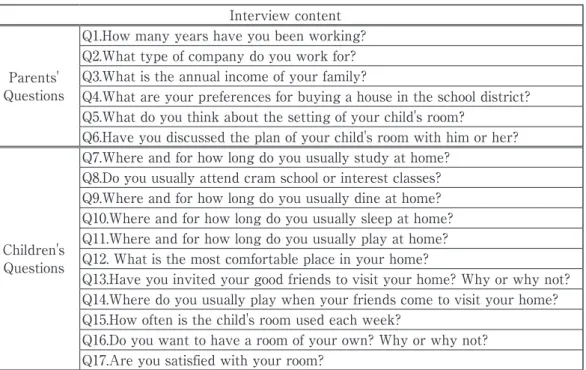
2.3 Interview Survey (Table 1)
After our field study, we conducted a survey of the parents and children of the households.
For questions related to parents, we consulted them in regard to buying a house and the layout of the child's room. For questions related to children, we learned of the utilization of house space by children in daily life as well as when making friends outside of school.
21 Children's Living Space:
A Case Study in Gulou District, Nanjing, China
Table 1. Interview Content Interview content
Parents' Questions
Q1.How many years have you been working?
Q2.What type of company do you work for?
Q3.What is the annual income of your family?
Q4.What are your preferences for buying a house in the school district?
Q5.What do you think about the setting of your child's room?
Q6.Have you discussed the plan of your child's room with him or her?
Children's Questions
Q7.Where and for how long do you usually study at home?
Q8.Do you usually attend cram school or interest classes?
Q9.Where and for how long do you usually dine at home?
Q10.Where and for how long do you usually sleep at home?
Q11.Where and for how long do you usually play at home?
Q12. What is the most comfortable place in your home?
Q13.Have you invited your good friends to visit your home? Why or why not?
Q14.Where do you usually play when your friends come to visit your home?
Q15.How often is the child's room used each week?
Q16.Do you want to have a room of your own? Why or why not?
Q17.Are you satisfied with your room?
3. Field Survey Results 3.1 Family Structure (Table 2)
Among the 19 households, five households have two generations living together, four of whom have a grandmother living with them. Three households have two children.
Table 2. Family Structure
Household number Family Structure (●yes, ○no) Child's age
1 ●father ●mother ●son ○daughter ○grandfather ○grandmother 11 2 ●father ●mother ●son ●daughter ○grandfather ○grandmother 5 months/12 3 ●father ●mother ○son ●daughter ○grandfather ○grandmother 11 4 ●father ●mother ○son ●daughter ○grandfather ○grandmother 9 5 ●father ●mother ●son ○daughter ○grandfather ○grandmother 10 6 ●father ●mother ●son ●daughter ●grandfather ●grandmother 9/13 7 ●father ●mother ○son ●daughter ○grandfather ○grandmother 10 8 ●father ●mother ●son ○daughter ○grandfather ●grandmother 10 9 ●father ●mother ○son ●daughter ○grandfather ●grandmother 12 10 ●father ●mother ●son ○daughter ○grandfather ○grandmother 10 11 ●father ●mother ○son ●daughter ○grandfather ●grandmother 9 12 ●father ●mother ●son ○daughter ○grandfather ○grandmother 9 13 ●father ●mother ○son ●daughter ○grandfather ○grandmother 11 14 ●father ●mother ●son ○daughter ○grandfather ○grandmother 11 15 ●father ●mother ○son ●daughter ○grandfather ●grandmother 10 16 ●father ●mother ○son ●daughter ○grandfather ○grandmother 10 17 ●father ●mother ○son ●daughter ○grandfather ○grandmother 9 18 ●father ●mother ○son ●daughter ○grandfather ○grandmother 11 19 ●father ●mother ●son ●daughter ○grandfather ○grandmother 12/13
3.2 Housing Scale (Table 3)
Most of the households surveyed lived in residences built between 1980 and 1990 that had six or seven floors and were mid-rise/high-rise condominiums. The room type was mainly two or three bedrooms. With the increase in building age, the area of home use continued to increase, but the area of each room in the house did not change significantly. This is considered a result of the shift in housing research in China from floor area problems to housing performance problems in the mid-1980s.
Table 3. Housing Scale
Completion date
1970s 1
Total area (m2)
Below 60 5
1980s 4 60~90 9
1990s 11 90~120 2
2000s 3 More than 120 3
total 19
Layout
two bedroom 10 Number of floors
in the building
Multi-storey house(4~6) 10 three bedroom 8
Mid- to high-rise housing 9 four bedroom 1
Unit: Household
3.3 Children's Room (1) Space for common use
Each of the children in the 19 households had their own room. In households with two children, each child had their own room. Among households with two children, however, parents arranged for their children to study in the same place because they are expected to help each other in their studies. As shown in Figure 2, the younger brother's study area was situated in his sister's room. Figure 3 shows a case where the daughter's study area was shared with the father. In the field investigation, however, we found that, as shown in Figure 4, although the younger brother's study area was designated to be in his sister's room, he actually studied in the living room. During the interview with the sister, we learned that when they studied together, her study effectiveness decreased, and an independent study area was thus deemed necessary.
Son’sstudy area Daughter’sstudy area
Bathroom Dinig Room B
B
D
D
Father’s working space (Parents’ Room) Daughter’sstudy area
(Parents’ Room)
Bathroom B
B
LD
Fig.2 No.6 household Fig.3 No.2 household
23 Children's Living Space:
A Case Study in Gulou District, Nanjing, China
(2) Sleeping places outside the child's room
As shown in Figure 5, the child's room is now the father's bedroom, and the child and mother sleep in the parents' room. The child's room is only used as a study area. As shown in Figure 6, the child sleeps in a small bed on the side of the parents' room. The child's room is only used for studying, and the bed in the child's room is now unused. As shown in Figure 7, the child and grandmother sleep in the grandmother's room, and the child's room is used for study and rest.
(3) Bunkbed
In the survey, we found that all parents purchased beds for their children, and four of them purchased bunkbeds for their children (Figure 8). Some of the bunkbeds were used to allow parents to take care of their sleeping children at night, and some were used for children's friends and families, and for relatives who come to visit overnight. As shown in Figure 9, they also served as a place for children to play.
Living·Dining room Son’s room
Daughter’s room
Commonstudy area
Bathroom B
Bathroom B
Fig.4 No.19 household
(Now the father’s bedroom)Child’s Room Parents’ Room (Sleeping with the mother)
Parents’ Room (Sleeping with the parents) Child’s Room (Used for studying only)
Grandmother’s Room (Sleeping with the grandmother) Child’s Room (used for studying and resting)
Fig.5 No.7 household(Sleeping in parents'room)
Fig.6 No.16 household(Sleeping in the parents'room)
Fig.7 No.9 household
(Sleeping in the grandmother's room)
Fig. 8No.3 household (Sharing with families)
Fig. 9No.8 household (Used as playing space) (4) Children's room position
As shown in Table 4, most parents use the best room in the house as the parents' room, and the second-best room as the children's rooms. This is because most of China's housing is dominated by collective housing, and a house in a housing complex cannot guarantee that all of them will be built in the south.
Table 4. Children's room position
Room user The best room The second-best room
One or both parents 8 6
children 5 8
One or both grandparents 1 1
Other rooms 5 0
Unit: people
4. Interview Survey Results 4.1 Parents' Questions (Q4~Q6)
(1) Q4 “What is your preference in regard to buying a house in the school district?” The answers to this question are shown in Table 5. In terms of school conditions, only two priority
25 Children's Living Space:
A Case Study in Gulou District, Nanjing, China
conditions were given, namely, “house should be close to school” and “house in the desired school district that children can be enrolled in.” In terms of housing, there are many preferences for parents, such as “intermediate level,” “total area,” “number of rooms,” “light conditions,” etc. In order to meet the needs of family members, most parents will give priority to housing with two or three rooms. In the selection of housing level, the middle level is the optimal consideration for most parents, but there are some households who choose the bottom floor to accommodate the physical condition of the cohabiting grandparents and some households who prefer the top floor in order to reduce the purchase price. As for the environment surrounding the house, “the sanitation environment inside the housing complex is good” and “the public facilities surrounding the housing complex are substantial” are the preferred conditions for parents. Five households responded that, “the house needs to be close to the grandparents' home” was their preferred condition.
Table 5. Priority criteria for housing purchase
The priority criteria for purchasing
houses
In terms of
school In terms of housing In terms of environment surroundingthe housing
complex Other
house should be close to school (9)
intermediate levels (7) There is a kindergarten in the housing complex (1) The sanitation environment inside the housing complex is good (6)
the house need to be close to the grandparents' home (5) top floor (1)
bottom floor (1) house in the
desired primary school district (18)
light conditions (5) total area (6)
the household is just a temporary to live (2)
the orientation of
housing (4) The public facilities surrounding the housing complex are substantial (7) number of room (9)
house in the desired primary school district (1)
form of layout (1) the house need to
be close to the parents' company (1)
transaction price (2)
The convenience of transportation is high (2) ventilation (1)
parking space (1)
( ): number of households
(2) As for Q5 “What do you think about the setup of your child's room?,” parents responded that they would set up a child's room for their child before primary school enrollment in order to cultivate the child's independence. The reasons for the choice of the child's room mainly included the area of the room (9 households), the orientation of the room (5 households), the lighting conditions (5 households), and whether or not there was a balcony (2 households). The reason for not choosing a room connected to a balcony relates to the safety issue of children falling from balconies.
(3) In terms of question: Q6 “Have you discussed the planning of the child's room with the child?,” more than half of the parents (11/19 households) had discussed this topic with their children. Most of the large furniture in the children's room was chosen by the parents, however. The child's opinion was only taken into consideration for the purchase of small decorations. Parents believe that their children are still too young to have the ability to choose and judge.
4.2 Children's Questions (Q7~Q14)
(1) In terms of Q7 “Where and how long do you usually study at home?,” approximately
60% (12/19 households) of the children answered that they would like to study in their own room. The living room is the second choice place for children to study. Some of the children go to their grandparents' homes or nursery class for study after school. The daily learning time with the children tends to be around three hours.
(2) As for Q8 “Do you usually attend cram school or interest classes?,” there were only four children who responded that they had not participated in such classes. Most children attended more than two classes or classes of interest every week. Piano class was one of the most popular interest classes for the students.
(3) In terms of Q9 “Where and how long do you usually dine at home?,” in addition to the four households who answered that their children usually ate at the grandparents' home, the children of other families answered that their child ate in the dining room. This is one of the reasons why parents want to give priority to the condition that the house needs to be close to their children's grandparents' house.
(4) In terms of Q10 “Where and how long do you use to sleep at home?,” more than 60%
(12/19 households) of the children slept in their own room. Sleeping with their parents was a reward for children who achieved excellent results in exams. Among the five households in which two generations lived together, the children in three households slept with their grandmother.
(5) As for Q11 “Where and how long do you usually play at home?,” the living room and the children's room were often used for play. In the interview, children reported that they chose to go outdoors to get proper exercise every week.
(6) As for Q12 “Where is the most comfortable place in your home?,” 8 of the 19 households said that it was the child's room. Children who went to their grandparents' home after school responded that the most comfortable place was their grandparents' home. As shown in Figure 10, places where children feel comfortable at home are not places that they often use for play.
Washroom (Reading a magazine)
No.12 household
Parents’ room (Reading a book) No.6 household
Child’s room (Reading a book) No.13 household
Living room (Playing balance car)
No.8 household
Living room (Watching TV) No.13 household Fig. 10Comfortable place
27 Children's Living Space:
A Case Study in Gulou District, Nanjing, China
(7) As for Q13 “Have you invited your good friends to visit your home?,” there were three children who responded that they would not invite a friend over. There were several reasons given for this, such as his/her room was so messy that he/she felt bad to invite friends over, they had just moved here and had not yet made friends, they did not want to invite friends to come over, and so on. When children invited their friends to visit their home, in most cases, more than two friends would be invited over.
(8) As for Q14 “Where do you usually play when your friends come to visit your home?,”
among the answers, the living room and the children's room were places in which children often played. When children get together, they spend most of their time watching TV and playing with electronic devices, such as mobile phones, computers, and so on. We did not receive an answer in regard to children studying together.
5. Conclusions
1. When seeking to enable children to enter the preferred school, parents do not care about the age of the housing construction in the school district. Whether or not the housing is located in the expected school district is the first priority for parents. In addition, parents set up children's rooms for their children before entering primary school in order to foster the children's independence. The design of the children's room is planned by parents. Parents take the best room and give the second-best room to their child(ren).
2. More than 60% of children study and sleep in their own rooms. In the children's rooms, parents bought the desks and beds. “A child's room is for both studying and sleeping” was the consensus of parents in terms of children's room design.
3. Children who go to the grandparents' home after school also have dinner at the grandparents' home. Children believe that the grandparents' home is the most comfortable place. This is one of the reasons why parents consider it a priority that their house is close to the children's grandparents' house.
4. The living room and the child's room are where children most often play at home and are also places where their friends play when they visit. When children get together, they spend most of their time watching TV and playing electronic devices, such as mobile phones and computers.
References
1) Ministry of Education of the People's Republic of China, Executive Suggestion about Further Doing Well in an Exemption to the Nearest Entrance to Junior High School from Primary School, Teach Basic [2014]1, 2014.1
2) Ministry of Education of the People's Republic of China, Notice about Further Doing Well in an Exemption to the Nearest Entrance to Compulsory Education in Key City, Teach Basic [2014]1, 2014.1
3) Wenyan CAO, Yasushi NAGASAWA and Tetsuro YAMASHITA, Living PATTERNS OF ELDERLY IN MID-RISE WALK-UP APARTMENT DWELLINGS COMPLEXES IN TIANJIN, A study on dwellings planning for the urban elderly in China, J. Archit. Plann. Environ. Eng., AIJ,
No.490, 73-81, 1996.12
4) Guozhen YAN, The Probe about the Design of Architecture of the Interior Living Space in Welfare Center for Children, Nanchang University, 2009.06
5) Xiao'ou LU, Furniture, Organizing a Living Space and Arrangement of Functional Area of Activity for Children, Journal of Shenyang Institute of Aeronautical Engineering, No.04, ISSN:1007-1385, 87-90, 2000.12