Original
Phase I Trial of Pemetrexed in Combination with Carboplatin Followed by Pemetrexed Maintenance Therapy in Elderly Patients with Advanced Non-small
Cell Lung Cancer
Sayo Soda, Ryo Arai, Hiroshi Ito, Nobuhiko Uchida, Yuka Shimizu, Ryosuke Koike, Yusuke Nakamura, Meitetsu Masawa, Tomoko Okutomi, Hiroaki Okutomi, Hiroko Morita,
Tatsuya Yokoyama, Taiji Watanabe, Naoya Ikeda, Taichi Shiobara, Yumeko Hayashi, Tomoe Funakoshi, Masaaki Miyoshi, Kazuyuki Chibana, Akihiro Takemasa, Yasuo Shimizu
*Department of Pulmonary Medicine and Clinical Immunology, Dokkyo Medical University School of Medicine
SUMMARY
Introduction: A phase I trial was conducted to evaluate the feasibility of pemetrexed in combination with carboplatin followed by pemetrexed maintenance therapy in elderly patients with advanced non-small cell lung cancer (NSCLC). The primary objective of this study was to determine the maximum tolerated dose (MTD) and the recommended dose (RD) of pemetrexed in combination with carboplatin.
Methods:Chemotherapy-naïve elderly 13 patients (age, ≥70 years) with stage IIIB/IV non-squamous NSCLC were enrolled and received pemetrexed 500 mg/m2 and carboplatin at an area under the curve
(AUC)dose of 5 mg/ml/min(level 1)or 6 mg/ml/min (level 2). Pemetrexed with carboplatin was adminis- tered on day 1 of the 21-day cycle. The treatment schedule consisted of four cycles of pemetrexed with carboplatin. Patients who did not have progressive disease after completion of four cycles subsequently received pemetrexed maintenance therapy (500 mg/m2 every three weeks) until disease progression or unacceptable toxicity was noted.
Results:Three patients were enrolled in level 1, in which no dose-limiting toxicity(DLT)was observed.
The carboplatin dose was escalated to AUC 6. Two of 3 patients treated in level 2 had grade 4 thrombocy- topenia of DLT. MTD was determined as level 2. Consequently, pemetrexed 500 mg/m2 with carboplatin AUC 5 was recommended as the dose for elderly patients with advanced non-squamous NSCLC. An addi- tional 7 patients who received RD showed no DLT. Nine of 13 patients received 4 cycles of combination therapy, and 5 patients were continuously treated with pemetrexed maintenance therapy. Six patients achieved a partial response, and another 6 showed stable disease. The response rate and disease control rate were 46.2% and 92.3% , respectively. The median progression-free survival for the enrolled patients was 134 days (95% CI, 95 to 231 days), and the median overall survival was 346 days (95% CI, 151 to 549 days).
Conclusions:The combination therapy of pemetrexed 500 mg/m2 with carboplatin AUC 5 followed by pemetrexed maintenance therapy showed no severe adverse events and was feasible and well- tolerated for elderly patients with advanced non- squamous NSCLC.
Keywords: elderly, advanced non-small cell lung cancer, carboplatin, peme- trexed, maintenance therapy Received September 18, 2019;accepted September 27, 2019
Reprint requests to:Yasuo Shimizu MD. PhD.*
Department of Pulmonary Medicine and Clini- cal Immunology, Dokkyo Medical University School of Medicine, Kitakobayashi 880, Mibu, Tochigi 321-0293, Japan.
INTRODUCTION
Lung cancer remains the current leading cause of global cancer deaths. For unresectable non-small cell lung cancer (NSCLC), chemotherapy entailing doublet therapy with a platinum-containing drug and a third- generation anticancer drug is the leading modality and constitutes the standard treatment regime1). In Japan, treatment strategies for lung cancer changed drastically upon the approval of pemetrexed (PEM)
in 2009. A randomized phase III trial of PEM plus cis- platin (CDDP) and gemcitabine (GEM) plus CDDP demonstrated non-inferiority between the two groups, but the subanalysis showed that the PEM plus CDDP group significantly extended the survival of patients with non-squamous cell carcinoma2). Consequently, doublet therapy with PEM and CDDP has become the standard treatment for advanced NSCLC and non- squamous cell carcinoma.
The efficacy of chemotherapy in elderly patients with advanced NSCLC has been proven in the ELVIS study, a comparative investigation of single-agent vinorelbine (VNR) and best supportive care (BSC), and subsequently, single-agent therapy with VNR or GEM, or the combination of these agents, has been performed frequently as an evidence-based treatment approach3〜6). In a phase III clinical trial of docetaxel
(DOC) and VNR conducted in Japan, the DOC group had a median survival time (MST) of 14.3 months7), and because of this high efficacy, DOC monotherapy has become another standard treatment. On the other hand, the superiority of combination chemotherapy with a platinum-based agent in elderly patients with advanced NSCLC has been suggested by a trial involving the sub-analysis of ECOG-5592 in 20028), the CALGB report in 20029), and a trial involving the sub-analysis of ECOG-1594 presented at the Ameri- can Society of Clinical Oncology meeting in 200310).
Owing to advances in chemotherapy agents and medical equipment, outpatient chemotherapy with an emphasis on the quality of life of patients has become mainstream cancer treatment in recent years, and the use of carboplatin, as a platinum-containing agent, in combination therapy with PEM is expected to rise in the future because of its superior user-friendliness.
A phase II clinical trial of doublet therapy with
PEM and carboplatin has recommended the combina- tion as an effective treatment regimen because of the relatively mild hematologic and nonhematologic toxici- ty11,12). In Japan, even though the use of PEM at 500 mg/m2 and carboplatin at the area under the curve
(AUC) 6 in patients younger than 75 years has been recommended13), the safety of doublet therapy with carboplatin in elderly individuals has yet to be demon- strated.
Therefore, the primary objective of this study was to perform a phase I clinical trial involving elderly Japanese patients with advanced NSCLC to determine the recommended doses of PEM and carboplatin.
METHODS
PatientsPatients were enrolled if they met the following cri- teria:age ≥70 years, histologic diagnosis of non- squamous and non-small cell lung cancer, stage IIIB or IV disease, measurable lesions, performance status
(PS)of 0 or 1 on the Eastern Cooperative Oncology Group scale with a life expectancy of at least 12 weeks, no prior chemotherapy and/or radiotherapy for the primary lesion, adequate organ function based on a white blood cell count ≥3,000/µL and £12,000 µL, absolute neutrophil count ≥1,500 µL, platelet count ≥100,000/µL, hemoglobin ≥9.0 g/dL, total serum bilirubin £2.0 mg/dL, aspartate aminotransfer- ase and alanine aminotransferase <2.5×the institu- tional upper limit of normal, serum creatinine(s-Cr)
£1.2 mg/dL, and PaO2 ≥60 mmHg. Patients meeting any of the following criteria were not eligible to enroll in the study:serious underlying medical conditions, such as uncontrolled diabetes and hypertension, active infection, symptomatic brain metastases, peripheral neuropathy ≥grade 2, massive pleural effusion or asci- tes, or cerebrovascular disease. The study protocol was approved by the institutional review board of the Dokkyo Medical University C-229-01, and written informed consent was obtained from all enrolled patients.
Study Design
Table 1 shows the drug dosage levels used in this study. PEM was administered at 500 mg/m2 through- out the study. AUC is determined by the area under
the curve of drug concentration in time course, and an indicator of the amount of medicine taken into the body as shown mg・min/mL. The dose of carboplatin
(mg/mL/min)was set at AUC 4 for level 0, AUC 5 for level 1, and AUC 6 for level 2, and dosages were calculated using Calvert’s formula. The trial started from level 1 with 3 patients. If none of the patients developed dose-limiting toxicity (DLT) in the first cycle, the next level trial with a higher dose of carbo- platin was started. In the case of DLT in 1 of 3 patients, the trial was repeated at the same level with an additional 3 patients. In the case of DLT in 2 or more patients, either before or after the addition of 3 patients, the trial was downgraded to level 0. If DLT was observed in 1 or none of 6 patients, the trial was upgraded from level 1 to level 2. Six patients were registered at level 2, and if DLT was observed in more than 2 patients, the dose used in the level 2 trial was considered the maximum tolerated dose (MTD).
In the case of only 1 patient with DLT, the dose was considered the recommended dose (RD). In the case of shifting to level 0, 6 patients were registered, and the trial was terminated if DLT was observed in more than 2 patients. If DLT was observed in only 1 patient, the dosage used in the level 0 trial was con- sidered the RD.
DLT Definition
Patients treated in the first cycle were evaluated to determine whether they had developed DLT. DLT criteria included grade 4 neutropenia, febrile neutro- penia, grade 4 thrombocytopenia, required platelet transfusion, Grade 3 or higher non-hematologic toxici- ty (except for nausea, vomiting, anorexia, fatigue, or alopecia), and dissatisfaction with the administration criteria within 29 days. The National Cancer Institute Common Terminology Criteria for Adverse Events
(NCI CTCAE) version 3.0 was used to grade the tox-
icity of every treated cycle. Patients with DLT criteria received reduced doses of combination therapy in subsequent cycles.
Treatment Schedule
PEM dissolved in 100 mL of physiological saline was administered via 10-min intravenous drip, followed by 30-min intravenous drip of carboplatin in 250 mL or more of dextrose solution or physiological saline. One treatment cycle lasted 3 weeks, with drug administra- tion on the first day, and a total of 4 cycles were per- formed, followed by PEM monotherapy every 3 weeks as long as no disease progression or intolerable adverse events occurred. During the trial, patients also received daily oral administration of 0.5 mg/day of folic acid and intramuscular injection of 1 mg vita- min B12 every 9 weeks. Patients needed to fulfill the following criteria to be eligible for a next cycle:PS of 0 or 1;hemoglobin level of ≥9.0 g/dL, white blood count of ≥3000/µL, neutrophil count of ≥1500/µL, platelet count of ≥1.0×10⁵µL, non-hematologic toxici- ty grade £2 (excluding nausea/vomiting, anorexia, general malaise, fatigue, and alopecia, PaO2 of ≥60 mmHg, and a s-Cr level of £1.2 mg/dL). The dose of PEM was reduced from 500 to 400 mg/m2 and that of carboplatin from AUC 5 to 4 (or 6 to 5) in the case of an adverse event corresponding to DLT or in the case of any of the following side effects after drug adminis- tration:grade 4 leukopenia, neutropenia, or thrombo- cytopenia;required platelet transfusion;febrile neu- tropenia;grade 2 or higher renal, hepatic, cardiac, or pulmonary failure;or grade 2 or higher neural impairment. If the above criteria were not fulfilled 2 weeks after the scheduled date of drug administration or if, after dose reduction, another set of adverse events warranting dose reduction was developed, the administration of drugs was terminated.
Table 1 Carboplatin Dose Escalation
Level Pemetrexed(mg/m2) Carboplatin(AUC mg/mL/min)
0 500 4
1a 500 5
2 500 6
a Dose escalation started with dose level 1.
Patient Evaluation
PS, physical findings, clinical findings (hematologic, serum biochemical, and urinalysis profiles), and imag- ing findings (chest X-ray and computed tomography)
were evaluated in each patient. Hematologic examina- tion was performed, in principle, twice a week. Serum biochemistry, urinalysis, and chest X-ray were per- formed more than once a week, and tumors were evaluated at least every 2 cycles. In accordance with the response evaluation criteria in solid tumors guide- lines, tumor response to treatment was classified as complete response (CR) for the best overall response or partial response(PR), and each response rate was calculated. Progression-free survival(PFS)was defined as the interval between study registration and disease progression or death from any cause, which- ever came first, while overall survival(OS)was defined as the interval between study registration and death from any cause. In case of surviving patients or those lost to follow-up, the study termination date was the last day of survival confirmation. PFS and OS were determined using the Kaplan-Meier method.
Adverse reaction rates were used as a safety index, and the number of treated cases (safety-evaluable cases), regardless of the eligibility of patients and duration of the study, was used as a denominator to obtain the rate of worst grades in the entire study period.
RESULTS
Patient CharacteristicsA total of 13 patients (11 men and 2 women) were registered for the study between July 2007 and Sep- tember 2011. Table 2 shows patient characteristics, including the median age of 76 years (range, 70−83 years). Histological findings were 11 adenocarcinomas and 2 large cell carcinomas. Four and nine patients were 0 and 1 on the Eastern Cooperative Oncology Group (ECOG) PS Scale, respectively. All patients were diagnosed with stage IV with any distant metas- tasis. Epidermal Growth Factor Receptor (EGFR)
gene mutation testing revealed exon 19 deletion in one of the adenocarcinoma patients.
Recommended Dose
Three patients were enrolled in the level 1 trial
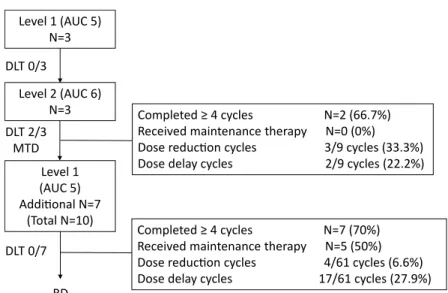
with no indication of DLT and were therefore trans- ferred to level 2 where the dose of carboplatin was increased to AUC 6. Two of the 3 enrolled patients developed DLT with grade 4 thrombocytopenia, but no platelet transfusion. These patients were quickly recovered to grade 0. Consequently, carboplatin AUC 6 and PEM 500 mg/m2 at level 2 were determined to be the MTD, and AUC 5 carboplatin and 500 mg/m2 PEM at level 1 became the RD. Because of the recom- mendation by the Efficacy and Safety Evaluation Committee, we enrolled 7 additional patients (total of 10 patients) at the RD level and proceeded to evalu- ate drug safety. No DLT was observed in these patients (Figure 1).
Dose-Intensity
Treatment delivery at each level is shown in Table 3. At level 1, a total of 10 patients (the initial 3 and an additional 7) received PEM 500 mg/m2 and carbo- platin AUC 5. The total number of treatment cycles was 61, with a median value of 5.5 cycles (range, 3−
13) for each patient. Dose reduction was performed
(in line with the guidelines) in 4 cycles (6.6%)
because of 2 cases of grade 4 neutropenia, 1 case of grade 4 thrombocytopenia, and 1 case of anemia. We also experienced dose delay in 17 cycles (27.9%), hematologic toxicity in 13 cycles (21.3%), and non-
Table 2 Patient Characteristics
Number of patients 13
Age, years
Median (range) 76(70-83)
Gender
Male 11
Female 2
Performance status
0 4
1 9
Stage
IIIB 0
IV 13
Histology
Adenocarcinoma 11
Large cell carcinoma 2
Epidermal growth factor receptor mutation
positive 1
negative 12
hematologic toxicity in 4 cycles (6.6%). Hematologic toxicity included neutropenia in 7 cycles, decreased hemoglobin in 4 cycles, and thrombocytopenia in 6 cycles. With regard to non-hematologic toxicity, increased AST/ALT and s-Cr levels were noted in 2 cycles each.
At level 1, dose intensity was 79.0% with PEM and 80.5% with carboplatin. At level 2, PEM 500 mg/m2 and carboplatin AUC 6 were administered to 3 patients. The total number of treatment cycle was 9, with a median value of 4 (range, 1−4) for each patient. Dose reduction occurred in 3 cycles (33.3%)
Table 3 Treatment Delivery
Level 1 (n=10) Level 2 (n=3)
Cycles
Total 61 9
Combination therapy 37 9
Maintenance therapy 24 0
Median (range) 5.5 (3-13) 4 (1-4)
Completed ≥4 cycles (%) 7 (70%) 2 (66.7%)
Received maintenance therapy 5 (50%) 0
Maintenance therapy cycles
Median (range) 3 (2-9) ─
Dose reduction cycles (%) 4 (6.6%) 3 (33.3%)
Adverse events(cycles) Grade 4 Neutopenia (2) Thrombocytopenia (3)
Grade 4 Thrombocytopenia (1)
Grade 2 Hemoglobin decrease (1)
Dose delay cycles (%) 17 (27.9%) 2 (22.2%)
Adverse events (cycles) Neutropenia (7) Thrombocytopenia (2)
Leukopenia (6) Hemoglobin decreased (2)
Thrombocytopenia (6)
Hemoglobin decreased (4)
AST/ALT increased (2)
Cr increased (2)
Dose intensity (%)
Pemetrexed 79.0 80.0
Carboplatin 80.5 80.8
Figure 1 Dose escalation profile and the treatment delivery Level 1 (AUC 5)
N=3
DLT 2/3 MTD DLT 0/3
DLT 0/7
Level 2 (AUC 6) N=3
Level 1 (AUC 5) Additional N=7
(Total N=10)
RD
Completed ≥ 4 cycles N=7 (70%) Received maintenance therapy N=5 (50%) Dose reduction cycles 4/61 cycles (6.6%) Dose delay cycles 17/61 cycles (27.9%) Completed ≥ 4 cycles N=2 (66.7%) Received maintenance therapy N=0 (0%) Dose reduction cycles 3/9 cycles (33.3%) Dose delay cycles 2/9 cycles (22.2%)
due to thrombocytopenia, and dose delay occurred in 2 cycles (22.2%) due to thrombocytopenia and decreased hemoglobin. Although drug administration without dose reduction or delay was possible in 1 patient, the other 2 patients developed grade 4 throm- bocytopenia during the first cycle, thus corresponding to DLT. Even though one of the patients continued treatment with a reduced dosage, the other patient withdrew from the study by request.
Nine of the 13 patients completed 4 cycles of dou- blet therapy with PEM and carboplatin. Of those, 5 received PEM maintenance therapy, but the other 4 did not because of disease progression. At RD (level 1), 7 patients (70%) completed 4 cycles of doublet therapy, and 5 patients (50%) received maintenance therapy. The median treatment cycle number of PEM monotherapy was 3 cycles (range, 2−9 cycles).
Safety of Combination Therapy
Grade 3/4 hematologic toxicity in 10 patients treat- ed at level 1 with carboplatin AUC 5 included 4 cases of leukopenia (40%), 5 cases of neutropenia (50%), 2
cases of decreased hemoglobin (20%), and 1 case of thrombocytopenia (10%). The patients quickly recov- ered without developing febrile neutropenia or with- out requiring blood transfusion. As shown in Table 4, no grade 3/4 non-hematologic toxicity was observed.
Although 3 patients developed grade 2 bronchial infection, they recovered quickly with appropriate antibiotics.
At level 2 with the administration of carboplatin AUC 6, there was 1 case (33.3%) each of grade 3 neutropenia and decreased hemoglobin, and 2 cases
(66.7%) of grade 4 thrombocytopenia which corre- sponded to DLT. With regard to non-hematologic tox- icity, there was 1 case of grade 3 anorexia.
Safety of Maintenance Therapy
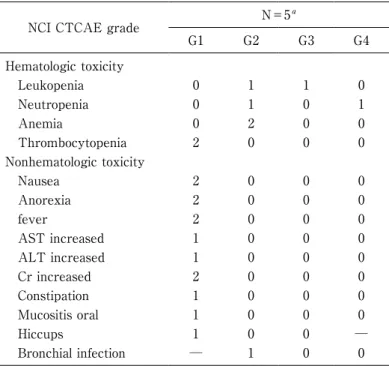
Five patients treated with carboplatin AUC 5 were further treated with PEM maintenance therapy.
There was 1 case each of grade 3 leukopenia and grade 4 neutropenia;however, only grade 1/2 non- hematologic toxicity was observed, as shown in Table 5. Furthermore, no lethal toxicity or treatment-related Table 4 Adverse Events of Combination Therapy
NCI CTCAE grade Level 1 (n=10) Level 2 (n=3)
G1 G2 G3 G4 G1 G2 G3 G4
Hematologic toxicity
Leukopenia 1 3 4 0 0 3 0 0
Neutropenia 0 3 3 2 0 2 1 0
Anemia 3 4 2 0 0 2 1 0
Thrombocytopenia 6 3 0 1 1 0 0 2
Non-hematologic toxicity
Fatigue 5 0 0 ─ 2 0 0 ─
Nausea 0 4 0 0 0 3 0 0
Vomiting 1 0 0 0 0 0 0 0
Anorexia 3 5 0 0 0 2 1 0
Rash 3 0 0 0 1 0 0 0
fever 1 0 0 0 2 0 0 0
AST increased 1 3 0 0 1 0 0 0
ALT increased 1 2 0 0 0 0 0 0
Cr increased 3 0 0 0 1 0 0 0
Constipation 5 1 0 0 2 0 0 0
Diarrhea 1 0 0 0 0 0 0 0
Mucositis oral 2 0 0 0 0 0 0 0
Hiccups 2 0 0 ─ 0 0 0 ─
Bronchial infection ─ 3 0 0 ─ 0 0 0
Neuralgia 1 0 0 ─ 0 0 0 ─
deaths were observed.
Antitumor Effect
Of the 13 patients enrolled in the study, 12 complet- ed at least 2 treatment cycles and were evaluated for antitumor effect. The remaining 1 patient developed grade 4 thrombocytopenia DLT in the first level 2 cycle. Honoring the request of the patient, the trial was terminated after 2 cycles, and the patient was placed under BSC without antitumor effect assess- ment. As shown in Table 6, 6 patients (46.2%) treat- ed with carboplatin AUC 5 (5 patients) or AUC 6 (1 patient) had PR. Another 6 patients treated with car- boplatin AUC 5 (5 patients) or AUC 6 (1 patient)
had stable disease (SD). No patients had CR or pro-
gressive disease (PD), while 1 patient was not evalu- able. The response rate and disease control rate were 46.2% and 92.3% , respectively. Median progression- free survival was 134 days (95% CI, 95 to 231 days)
(Figure 2), and median survival time was 346 days
(95% CI, 151 to 549 days) (Figure 3).
DISCUSSION
This study was conducted a dose escalation assess- ment of PEM and carboplatin in elderly patients (age,
≥70 years) with non-squamous NSCLC and deter- mined the RD to bePEM 500 mg/m2 with carboplatin AUC5. No unacceptable toxicity or fatal adverse events were observed at this RD. Antitumor effects were favorable with a response rate of 46.2% and a Table 5 Adverse Events of Pemetrexed Maintenance Therapy
NCI CTCAE grade N=5a
G1 G2 G3 G4
Hematologic toxicity
Leukopenia 0 1 1 0
Neutropenia 0 1 0 1
Anemia 0 2 0 0
Thrombocytopenia 2 0 0 0
Nonhematologic toxicity
Nausea 2 0 0 0
Anorexia 2 0 0 0
fever 2 0 0 0
AST increased 1 0 0 0
ALT increased 1 0 0 0
Cr increased 2 0 0 0
Constipation 1 0 0 0
Mucositis oral 1 0 0 0
Hiccups 1 0 0 ─
Bronchial infection ─ 1 0 0
a All patients treated PEM maintenance therapy were received in level 1.
Table 6 Antitumor Effect
Level 1(n=10) Level 2(n=3) Total(n=13)
Complete response 0 0 0
Partial response 5 1 6
Stable disease 5 1 6
Progressive disease 0 0 0
Not evaluate 0 1 1
Response rate 50.0% 33.3% 46.2%
Disease control rate 100% 66.7% 92.3%
disease control rate of 92.3% , and PEM maintenance therapy was tolerable.
In a phase III randomized trial for the second-line treatment of advanced NSCLC, PEM proved as effec- tive as DOC and showed a favorable adverse event profile14). In addition, a phase III trial comparing PEM plus carboplatin and GEM plus carboplatin doublet therapy showed that the PEM plus carboplatin group had significantly fewer cases of grade 3/4 leukopenia and thrombocytopenia, albeit with no significant differ-
ence in survival duration, demonstrating the safety and the favorable toxicity profile of the combination therapy15). A multicenter randomized phase III trial of PEM plus carboplatin and DOC plus carboplatin dou- blet therapy presented at the 2011 World Conference on Lung Cancer showed significantly longer survival without grade 3 or 4 toxicity in the PEM plus carbo- platin group16). These results clearly demonstrate the safety of PEM, with a prospect for the use in elderly patients. Compared with single-agent DOC, PEM was Figure 3
Overall survival for elderly patients with advanced non-small cell lung cancer receiving pemetrexed in combination with carbo- platin followed by pemetrexed maintenance therapy. Median overall survival was 346 days (95% CI, 151 to 549 days).
Figure 2
Progression-free survival for elderly patients with advanced non- small cell lung cancer receiving pemetrexed in combination with carboplatin followed by pemetrexed maintenance therapy. Median progression-free survival was 134 days (95% CI, 95 to 231 days).
found to be effective in elderly patients with previous- ly treated advanced NSCLC17), indicating good effica- cy, even as a first-line treatment.
A randomized phase III trial (IFCT-0501) was con- ducted to compare carboplatin and weekly paclitaxel doublet chemotherapy with VNR or GEM monothera- py in elderly patients with advanced NSCLC (age, 70
−89 years;PS, 0−2). Median survival time was 10.3 and 6.2 months in the doublet chemotherapy and monotherapy group, respectively, showing that the doublet therapy extended survival time significant- ly18). However, potential toxic death became an issue of doublet chemotherapy because of a significantly higher treatment-related death rate (6.62%) com- pared with the monotherapy group (1.83% , p=
0.035). Because Japanese patients have a higher adverse reaction rate than European and North American patients when treated with an equal amount of anticancer agents19), we conducted this clinical trial to reveal the tolerability of doublet che- motherapy used as first-line treatment in elderly Jap- anese patients.
Although 3 patients treated with carboplatin AUC 5 at level 1 did not develop DLT, thrombocytopenia occurred as the DLT during the level 2 trial with car- boplatin AUC 6. Even with the RD of carboplatin AUC 5, dose delay cycles were as high as 27.9% , of which 2 1 . 3% was due to hematologic toxicity.
Although dose intensity was almost maintained, it might have been necessary to adjust the dosing inter- val in the dose delay cases due to myelosuppression.
In actual clinical settings, however, it is possible to continue therapy in cases of prolonged myelosuppres- sion by extending the dosing cycle, for example, from 3 weeks to 4 weeks and by maintaining dose intensity.
Single-agent PEM maintenance therapy after induc- tion therapy with PEM plus CDDP extended survival time with favorable efficacy and safety in a phase III trial (the PARAMOUNT study)20). In the present study, 5 patients were further treated with single- agent PEM maintenance therapy, with a median cycle value of 3 cycles (range, 3−9 cycles). There were no dose reductions or delay cycles, and patients were able to continue until disease progression without ter- mination due to adverse events. Because of no unex- pected adverse events, even in elderly lung cancer
patients, PEM maintenance therapy can be considered a highly tolerable treatment.
Despite the small sample size, the phase I trial had favorable antitumor effects with a response rate of 46.2% and a progression-free survival time of 4.5 months. These results suggest that PEM with carbo- platin doublet therapy is a promising treatment when compared, although not directly, with DOC alone treatment which showed a median PFS value of 5.4 months in a phase III clinical trial of DOC with VNR conducted in Japan7) and with carboplatin plus week- ly paclitaxel treatment with a median PFS value of 6.1 months in IFCT-050118).
In Japan, a phase III trial (JCOG0803/WJOG4307L)
in elderly patients with advanced NSCLC failed to show improved overall survival with DOC plus CDDP doublet therapy (divided-dose administration of d1, 8, 15) as a first-line treatment compared with standard monotherapy with DOC (single-dose administration of d1)21). On the other hand, the carboplatin plus pacli- taxel group had significantly extended survival time in the IFCT-0501 study mentioned earlier. This dis- crepancy might have been due to the sample popula- tion of elderly patients over 70 years old with diverse patient characteristics. Patients over 70 years of age with a PS of 0 or 1 in the JCOG0803/WJOG4307L study received divided doses of DOC plus CDDP and did not exhibit the survival advantage for the fraction- ated administration of doublet therapy. Treatment strategies in elderly patients have been controversial, and individualized care must be provided. Because it has become difficult to select patients based on age and PS, a comprehensive functional assessment meth- od is needed.
PEM has fewer side effects compared with other anticancer agents, and a carboplatin doublet and sub- sequent maintenance therapy with PEM provide a useful treatment method with a high tolerability in elderly patients. The results of phase III trial (ESO- GIA-GFPC 08-02)22) of different treatment options in elderly patients over the age of 70 are reported. The comprehensive geriatric assessment based treatment failed to improve the survival outcomes of elderly patients with advanced NSCLC, but slightly reduced treatment toxicity. In clinical practice, elderly patients with advanced NSCLC are heterogeneous population
with baseline organ dysfunctions. In recent reports23,24), the combination therapy of carboplatin and PEM is well tolerated, feasible for elderly patients with advanced NSCLC. However, it is difficult for clini- cal physicians to evaluate the vulnerability of elderly patients with advanced NSCLC. Therefore, this study gives the further strength of feasibility of this combi- nation therapy in clinical practice.
In conclusion, this study enrolled physically fit elderly patients over 70 years of age with a PS of 0 or 1 and fully functional major organs. We determined the RD in these elderly patients with advanced non- squamous NSCLC to be PEM 500 mg/m2 with carbo- platin AUC 5. This RD was tolerable, and no fatal adverse events were observed in the doublet or main- tenance therapy. This trial conducted the dose-escala- tion assessment in elderly patients with advanced non-squamous NSCLC, and the present findings will be useful for the development of treatment guidelines for ever-increasing cases of lung cancer in the elderly.
Acknowledgments. We especially thank all of the patients and families. We shall be grateful to Prof.
Yoshiki Ishii for useful discussion on study design and results. S.S, R.A wrote the manuscript, collecting and analysis the data. Y.S wrote the manuscript and analy- sis the data. H.I, N.U, Y.S, R.K, Y.N, M.M, T.O, H.O, H.M, T.Y, T.W, N.I, T.S, Y.H, T.F, M.M, K.C and T.A collected the data and participated the useful discus- sion.
Conflict of Interest
The authors declare that they have no conflict of interest.
REFERENCES
1) Pfister DG, Johnson DH, Azzoli CG, et al:American Society of Clinical Oncology treatment of unresect- able non-small-cell lung cancer guideline:update 2003. J Clin Oncol 22:330-353, 2004.
2) Scagliotti GV, Parikh P, von Pawel J, et al:Phase III study comparing cisplatin plus gemcitabine with cis- platin plus pemetrexed in chemotherapy-naive patients with advanced-stage non-small-cell lung cancer. J Clin Oncol 26:3543-3551, 2008.
3) Effects of vinorelbine on quality of life and survival of
elderly patients with advanced non-small-cell lung cancer. The Elderly Lung Cancer Vinorelbine Italian Study Group. J Natl Cancer Inst 91:66-72, 1999.
4) Frasci G, Lorusso V, Panza N, et al:Gemcitabine plus vinorelbine versus vinorelbine alone in elderly patients with advanced non-small-cell lung cancer. J Clin Oncol 18:2529-2536, 2000.
5) Gridelli C, Perrone F, Gallo C, et al:Chemotherapy for elderly patients with advanced non-small-cell lung cancer:the Multicenter Italian Lung Cancer in the Elderly Study (MILES) phase III randomized trial. J Natl Cancer Inst 95:362-372, 2003.
6) Ricci S, Antonuzzo A, Galli L, et al:Gemcitabine monotherapy in elderly patients with advanced non- small cell lung cancer:a multicenter phase II study.
Lung Cancer 27:75-80, 2000.
7) Kudoh S, Takeda K, Nakagawa K, et al:Phase III study of docetaxel compared with vinorelbine in elderly patients with advanced non-small-cell lung cancer:results of the West Japan Thoracic Oncology Group Trial (WJTOG 9904). J Clin Oncol 24:3657- 3663, 2006.
8) Langer CJ, Manola J, Bernardo P, et al:Cisplatin- based therapy for elderly patients with advanced non-small-cell lung cancer:implications of Eastern Cooperative Oncology Group 5592, a randomized trial. J Natl Cancer Inst 94:173-181, 2002.
9) Rocha Lima CM, Herndon JE 2nd, Kosty M, et al:
Therapy choices among older patients with lung car- cinoma:an evaluation of two trials of the Cancer and Leukemia Group B. Cancer 94:181-187, 2002.
10) Langer CJ, Vangel J, Schiller DP, et al:Age-specific subanalysis of ECOG 1594:fit elderly patients (70−
80 yrs) with NSCLC do as well as younger pts (<70 yrs). Proc Am Soc Clin Oncol 22, 2003 (abstract 2571).
11) Zinner RG, Fossella FV, Gladish GW, et al:Phase II study of pemetrexed in combination with carboplatin in the first-line treatment of advanced non-small cell lung cancer. Cancer 104:2449-2456, 2005.
12) Scagliotti GV, Kortsik C, Dark GG, et al:Pemetrexed combined with oxaliplatin or carboplatin as first-line treatment in advanced non-small cell lung cancer:a multicenter, randomized, phase II trial. Clin Cancer Res 11:690-696, 2005.
13) Okamoto I, Takeda K, Daga H, et al:Dose-escalation
study of pemetrexed in combination with carboplatin followed by pemetrexed maintenance therapy for advanced non-small cell lung cancer. Lung Cancer 70:168-173, 2010.
14) Hanna N, Shepherd FA, Fossella FV, et al:Random- ized phase III trial of pemetrexed versus docetaxel in patients with non-small-cell lung cancer previously treated with chemotherapy. J Clin Oncol 22:1589- 1597, 2004.
15) Gronberg BH, Bremnes RM, Flotten O, et al:Phase III study by the Norwegian lung cancer study group:pemetrexed plus carboplatin compared with gemcitabine plus carboplatin as first-line chemother- apy in advanced non-small-cell lung cancer. J Clin Oncol 27:3217-3224, 2009.
16) Rodrigues-Pereira J, Kim JH, Magallanes M, et al:A randomized phase 3 trial comparing pemetrexed/car- boplatin and docetaxel/carboplatin as first-line treat- ment for advanced, nonsquamous non-small cell lung cancer. J Thorac Oncol 6:1907-1914, 2011.
17) Weiss GJ, Langer C, Rosell R, et al:Elderly patients benefit from second-line cytotoxic chemotherapy:a subset analysis of a randomized phase III trial of pemetrexed compared with docetaxel in patients with previously treated advanced non-small-cell lung cancer. J Clin Oncol 24:4405-4411, 2006.
18) Quoix E, Zalcman G, Oster JP, et al:Carboplatin and weekly paclitaxel doublet chemotherapy compared with monotherapy in elderly patients with advanced non-small-cell lung cancer:IFCT-0501 randomised, phase 3 trial. Lancet 378:1079-1088, 2011.
19) Gandara DR, Kawaguchi T, Crowley J, et al:Japa- nese-US common-arm analysis of paclitaxel plus car-
boplatin in advanced non-small-cell lung cancer:a model for assessing population-related pharmacoge- nomics. J Clin Oncol 27:3540-3546, 2009.
20) Paz-Ares LG, de Marinis F, Dediu M, et al:PARA- MOUNT:Final overall survival results of the phase III study of maintenance pemetrexed versus placebo immediately after induction treatment with peme- trexed plus cisplatin for advanced nonsquamous non- small-cell lung cancer. J Clin Oncol 31:2895-2902, 2013.
21) Abe T, Takeda K, Ohe Y, et al:Randomized phase III trial comparing weekly docetaxel plus cisplatin versus docetaxel monotherapy every 3 weeks in elderly patients with advanced non-small-cell lung cancer:the intergroup trial JCOG0803/WJOG4307L.
J Clin Oncol 33:575-581, 2015.
22) Corre R, Greiller L, Le Caër H, et al:Use of a Com- prehensive Geriatric Assessment for the Manage- ment of Elderly Patients With Advanced Non-Small- Cell Lung Cancer:The Phase III Randomized ESOGIA-GFPC-GECP 08-02 Study. J Clin Oncol 34:1476-1483, 2016.
23) Takeoka H, Yamada K, Azuma K, et al:Phase I study of carboplatin combined with pemetrexed for elderly patients with advanced non-squamous non- small cell lung cancer. Jpn J Clin Oncol 44:472-478, 2014.
24) Tamiya A, Tamiya M, Shiroyama T, et al:Dose escalation study of carboplatin-pemetrexed followed by maintenance pemetrexed for elderly patients with advanced nonsquamous nonsmall-cell lung cancer.
Ann Oncol 24:980-985, 2013.