Automation, Lean Production, Industrie 4 . 0 : The Trajectory of the German Model
Ulrich Jürgens
1 .Introduction
2 .The 1980s: the industry at the crossroads
3 .Impact of Lean Production on the trajectory of the German model 4 .Impact of IoT on the German trajectory
5 .New societal challenges in Germany 6 .Summary and Conclusions
1.Introduction1)
Currently, the beginning of a new era is being heralded in view of a coming wave of new technologies based on high speed computing and the internet. It is expected that this means far reaching changes in all walks of life. While the question of speed of transformation and the future of work is a matter of controversies, this paper takes a more grounded approach by discussing preliminary evidence for changes of work practices in an industrial setting in Germany.
The central question is about the implications of these changes for the trajectory for company level production systems and, in a wider perspective, for the “German model of production” as a whole. The focus is on developments in the automotive industry in Germany, with some comparative references to developments in Japan.
Theory-related, the paper takes up aspects of the debate carried out in the 1990s about varieties of capitalism and the resilience of certain national models in continuing their specific trajectories (Hall/Soskice 2001). Core features of the “German model” are firstly the strong influence the labour unions and works councils on issues of shopfloor management based on legally stipulated rights of codetermination and, secondly, the role of a special type of skilled workers („Facharbeiter“) as well as the vocational training system („Duale Berufsausbildung“) these workers receive over several years at the
1 ) I am happy and I feel honored to contribute to the „Festschrift“ for Professor Nakagawa Yoichiro.
Together with Professor Ikeda Masayoshi from Chuo University, we have carried out quite a number of research projects together in Japan and Germany over a period of almost thirty years.
beginning of their career. While it would be wrong to equalize their work with that of the classical craftsman, the breadth of the skills of the Facharbeiter and their autonomy in carrying out their work is idealized as “good work”. At the same time their training, according to the state of the art of technology in their domains, provides them with the knowledge and readiness to work in “high-tech” environments.
With regard to the concept of national models of production, one strand of the discussion in the 1990s was about the claim of a group of authors around a research programme at the Massachusetts Institute of Technology (MIT)(Womack et al. 1989) of a superiority of production management practices of Japanese car manufacturers vis-à-vis Western companies. The researchers made their own synthesis under the name “Lean Production” (LP). The claim that it was unavoidable for Western companies to adopt that system (“one best way”) was disputed by the international network of researchers Gerpisa,2) which elaborated the concept of “productive models” (cf. Boyer/Freyssenet 2002). This concept is based on the view of models as the result of sustainable governance compromises between the interests of actors of markets, of labour and the requirements of a productive organisation on the level of companies. In addition to comparative analyses of company or national models, a more dynamic view was developed by the Gerpisa group. The underlying assumption: these models develop along certain trajectories over time responding in specific ways to challenges or events in their environment. This will be the perspective taken in this paper.
The content in the following is organized into four sections: Section 2 deals with debates in the 1980s and early 1990s about the automation strategy of carmakers and alternative production systems. Section 3 describes the reception of LP in Germany, which seemed to not fully acknowledge the superiority of the Japanese model of production. Section 4 discusses the possible impact of Industrie 4.0 on the German model on the basis of early user cases. Section 5 raises the issue of the demographic situation and of the trend toward further work time reductions as drivers of 4.0 applications in the future.
2.The 1980s: the industry at the crossroads
In Western industrial countries the 1980s were a decade in which previous production and work practices were questioned and companies were open to new approaches. It looked like the auto industry in particular was breaking away from Taylorism and Fordism (cf. Jürgens 1993).
In view of the future of work three alternative approaches were discussed: the automation strategy, humanization of work, and the Japanese model.
2 ) Groupe d’Etude et de Recherche Permanent sur l’industrie et les Salariés de l’Automobile. The network was found in 1981 by French researchers.
Firstly, the automation strategy: Stimulated by the progress in the field of microelectronics (ME) in the 1970s the debate3) about automation and its consequences for employees and the society as a whole, flared up again. It was widely expected that with ME the potential of computer-based machinery with regard to performance and flexibility could be dramatically increased. Particularly high expectations were directed towards industrial robots. They seemed to be very suited for the automation of assembly operations, which had remained almost as the last bastion of manual work by 1980. At the same time the degree of automation in other areas was thought to also increase: an OECD-study of 1983 forecasted that in the German car industry arc welding would be automated at a rate of 100 percent by 1990; spot welding at 81 percent; machine tool loading and unloading at 70 percent; press work at 46 percent; and assembly operations at 40 percent. (OECD 1983: 81)
The forecasts about other countries in the study were even more upbeat when it came to assembly operations. Thus, a Delphi forecast for the United States undertaken by the American Society of Manufacturing Engineers predicted the following trends (OECD 1983:
58):
・by 1982 5 per cent of all assembly systems will use robotic technology;
・by 1985 20 per cent of labour in final assembly of automobiles will be replaced by robots an automated system;
・by 1988 50 per cent of labour in small-component assembling will be replaced by automation;
・by 1990 development of sensory technique will enable robots to approximate human capability in assembly.
The Japan Industrial Robots Association expected that the degree of automation of final car assembly would increase to between 35 and 75 percent until the year 2000 (Arai 1989: 133). Some of these forecasts overestimated the actual development by far as the
hindsight shows.
In Germany, in view of the expected wave of automation and corresponding with the high importance attached to the role of the Facharbeiter and the vocational training system, companies and public institutions introduced encompassing reforms creating new occupations and modernizing existing training programmes (Deissinger 1996). These measures thereby paved the way for automation.
The second approach was based on the assumption that the improvement of working conditions in the end would result in an increase of productivity (cf. Matthöfer 1977). Critique of the working conditions - especially of assembly line work given rising
3 ) An earlier debate took place in the late 1950s/early 1960s.
expectations of the post-war baby boom generation with respect to work - led to a worldwide debate about the need for the “humanisation of work”, which was spearheaded by labour unions and in state policies. Companies found it hard to recruit new personnel if they did not introduce such measures, because of strapped labour markets, as well as high rates of absenteeism and fluctuation. The lead model for humanised work systems in the 1970s/80s was Sweden with the new generation of plants mainly at Volvo. Here a kind of escalation took place which reached a climax with the famous Uddevalla plant which abolished the assembly line and standard takt time without compromising performance
(Sandberg ed. 1995).
The Uddevalla plant stood for the most advanced realization of the principles of job enlargement and job enrichment. It was bad luck however that it emerged during the height of the euphoria about Lean Production, which is why it was dismantled soon after it started production. It had no chance to prove itself. The German car companies had introduced new forms of work in some areas but retreated from most of them during the 1990s and reinstalled the “classical” short-cycled assembly line. The advent of lean production from this background therefore was regarded as a “Roll Back” by work reformers inside and outside the companies (Jürgens 1997).
The instances few companies saw new forms of work with job enlargement and enrichment as alternatives to automation, however. In Germany in most cases, measures to humanise work focussed on ergonomic aspects (strain and stress factors and the improvement of the working environment) at the workplace. Automation thereby offered the opportunity for the works councils to flank these measures with improvements of working conditions. For instance, when Volkswagen began to introduce industrial robots, a kind of a “tit for tat” rule was established: for each robot installation aiming primarily at improving efficiency, another installation should be introduced primarily with the aim to ergonomically improve working conditions. This rule is still followed today.
Despite the fact that the humanisation policy corresponded closely with labour union demands, the IG Metall, the powerful German union for employees in the metal and electrical industries, decided to take up the fight for the shortening of the workweek (from 40 to 35 hours). In the beginning the demand for a reduction of worktime was made in the context of the humanisations of work debate. Thus, a break-time per each hour (eight minutes per hour) for employees working under an incentive wage scheme was demanded and achieved following three weeks of striking.
In regard to the reduction of the weekly working hours (from 40 hours to 35) were not even willing to negotiate-a limit of the German model approach of compromising had been reached. This time the conflicts lasted three months with intermittent strikes and employers reacting by lock outs. In the end both sides accepted a settlement formulated in a conciliatory process. In return for a much smaller step of worktime reduction the employers achieved some of their demands for flexibility in allocating the working time
over different groups of employees and to introduce working schedules which allow the utilization of the invested machinery. The goal of a 35 hours week was reached only after several rounds of negotiations in the following year until it was finally introduced in 1995.
The events in the early 1980s laid the ground for a particular path which despite the trend toward convergence around the LP paradigm fostered dynamics of divergence.
The third approach was to emulate practices which had evolved in Japan and which seemed to underly the miraculous success of Japanese companies. In the early 1980s it was still a mystery to most industry observers in the West what exactly was behind it.
This was even more true for German companies than for US-American. In 1980 a first report from Ford of Europe circulated in management as well as union circles. The title
“After Japan” signalled the message the authors had concluded from what they had found. The report contained astounding observations about the differences of productivity and the working practices of automotive plants in Japan and in the West, which the rapporteurs themselves found “unbelievable”.
The most efficient car plant of Ford in Europe needed 3 times as many employees to produce one car than the Japanese plant; as to engines, one employee produced 9 engines in the Japanese engine plant, only 2 in the case of Ford, the changeover times for presses at a Ford plant were 3 to 4 hours compared to 5―6 minutes in a Japanese plant.
How could these differences be explained? How could the Japanese achieve their such out-of-the-world performance levels? A slide of the report summarized:
・high level of technology
・rational deployment of employees
・minimal waste
・practically no strikes
・motivation and loyalty towards the company.
The listing of factors reflected the dominant opinion in the West at that time which saw technology as most important factor. This view was questioned when more detailed studies were made. Thus Abernathy/Clark/Kantrow pointed out in an article that based on their research technology actually played a small role. Much more important were aspects of process design and the structuring of jobs (Abernathy et al. 1981). The authors calculated that aspects of process design explained 40 percent of the difference of productivity between Western and Japanese companies; further 18 percent were explained by differences of job structures; 12 percent by workforce management and absenteeism; only then came process automation, i.d. technology, with 10 percent. The remaining factors were quality-systems (9 percent), product design (7 percent) and work intensity (4 percent).
Thus, technology plays a marginal role. Almost 60 percent are explained by the two
factors: process design and the structuring of jobs. The first relates to the strict flow lay out with just in time delivery and very little stocks of work in progress and materials, and to the principle of first-time-right production, the second to team working and to the on- the-job training system aiming at “multi-skilling” of the workforce.
In particular with regard to the “job structure” factors there was little knowledge in German companies of the actual practices of team work and training in Japan and the MIT-study was of little help here as the authors dealt with these aspects only superficially.
Coming back to the issue of technology as an explaining factor. Does this mean that Japanese companies in their production plants use less technology than Western companies?
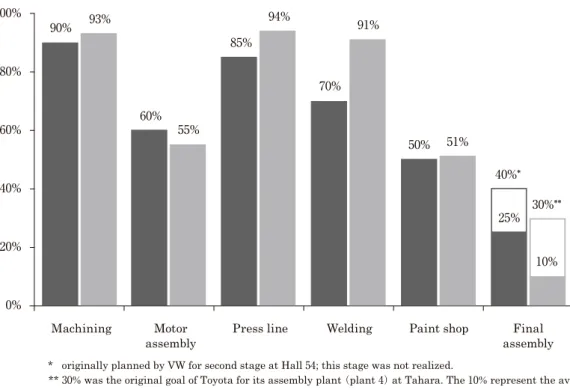
Figure 1 compares the degree of automation of major production sections at Volkswagen’s main plant in Wolfsburg in the mid of the 1980s with the average of the most advanced production lines of these section at the major Japanese car companies in the early 1990s. It turns out that for most of the sections there was not much difference at
Figure 1 Degree of automation of production sections in a German automobile company and in major Japanese car companies around 1990
100% 90% 93%
85%
94%
70%
91%
50% 51%
40%*
25%
10%
30%**
60% 55%
80%
60%
40%
20%
0%
Machining Motor
assembly Press line Welding Final
assembly Paint shop
* originally planned by VW for second stage at Hall 54; this stage was not realized.
** 30% was the original goal of Toyota for its assembly plant (plant 4) at Tahara. The 10% represent the av- erage of the Japanese carmakers.
Note: Comparison of the most highly automated production sections of German around 1985 (left column) and Japanese (right column) auto companies around 1995. The German data are from Vokswagen’s main plant in Wolfsburg, the Japanese data represent the average of the production sections of eleven Japa- nese OEMs.
Source: Fujimoto (1997: 64―66); Granel (1985: 16―19).
this time. The level of automation at the Japanese companies in most cases was a bit higher which can be explained by the time difference between the two data sets. In the early 1990s they would have been higher also in the case of VW, where the data is from 1985. On the other hand - if the Japanese data would be based just on the most advanced company case (as VW representing the German situation) the level there would have been higher. In any case, the majority of the production sections already were approaching the point of “full automation” in the German as well as the Japanese company cases.
In most sections there was no obvious “systemic” difference between the car producers of both countries with regard to their level of automation. The one exception in Figure 1 relates to the assembly operations, the final stages of car assembly. At Volkswagen an ambitious strategy to raise the degree of automation had been adopted in the late 1970s.
A first step in this regard was made in the first half of the 1980s with an increase to 25 percent automation degree of its final assembly operations (Hall 54) at its main plant in Wolfsburg with the aim of a further increase to up to 40 percent. The Japanese car manufacturers by the early 1990s averaged around 10 percent. In fact, the leading companies Toyota and Nissan had been planning to follow the example of Volkswagen by the late 1980s. Toyota, for instance, was planning for an automation degree of 30 percent at its assembly plant in Tahara. According to Fujimoto (1997: 214) the planning was influenced by such automated assembly plants as VW’s Hall 54 in Germany and Fiat’s Cassino plant in Italy.
According to a report written by a research group of the IG Metall visiting the Tahara plant (IG Metall research group 1993) the increase of automation was mainly motivated by humanisation related goals. The assembly work was carried out on skids which were equipped with lifting and turning devices. In this way the height of the vehicle to be worked on could be adjusted as was best suited for the individual worker and the car body could be turned by 90 degrees to provide more space for more complex work tasks und save walking time between the vehicles.
All in all, regarding automation degrees, the differences between the national models seemed to hardly make any difference. Most areas of production were already highly automated at the beginning of the 1990s with the assembly areas lagging but on the way towards high automation also. The production systems of both countries seemed to be on full course toward convergence. The next chapter will show to what extent this was really happening.
3.Impact of Lean Production on the trajectory of the German model In the 1990s, the Lean Production message was discussed controversially in German companies and in the wider public as was the case almost everywhere in industrial and industrialising countries at this time. Company managers of German firms went on
pilgrimage to Japan to get first-hand evidence of the authentic practices of Japanese companies, in particular of the Toyota Production System (TPS). In general, German companies seemed to be slower accepting and implementing the Japanese concepts because some of these concepts squarely contradicted their own previous practices and beliefs than other countries.
As to the wider concept of a German model of production the strong influence of the labour unions and the works councils and the role of Facharbeiter were mentioned in the introduction as characteristic features. The view of the Facharbeiter as the core workers implicated the danger of demarcations between occupational groups as could be observed in the case of British and US-American plants. In Germany during the years of turbo- growth from the late 1950s onwards when companies began to recruit the so called “guest workers” there was a tendency towards a division labour which assigned the simple and strainful and, in terms of job security, precarious work to the foreign workers while the German Facharbeiter carried out the more complex tasks of assuring quality and solving problems. This tendency did not develop to a distinctive production system because the inward flow of Gastarbeiter was stopped by the government at the end of the 1970s .
The employment of precarious workers and the dealing with them by shop floor management remains an issue in the debate of productions systems also in the case of Japan. With the employment of workers on fixed-term contracts Japanese companies have been using precarious workers since the 1950s, German companies emulated this employing agency workers when the government had liberalised labour markets in the 2000 decade. With regard to the core workforce, however, many Japanese companies were more inclusive in their shop floor management and HR systems. They involved rank and file workers in problem solving activities of various kinds and provided lifelong personal development opportunities. These practices received attention from German companies much later than the operational concepts.
With the arrival of Lean Production/Japanese concepts the role of the Facharbeiter- system and the importance attached to the apprenticeship-based training system was discussed critically. The critique was that the system was frontloading new entrants with technical knowledge and capabilities even though it was not clear when they were needed, and, if needed, they might have become obsolete due to technical progress. On the other hand, the system provided workers with knowledge about the newest technical developments before they started to work in their areas. In the end, the Facharbeiter- system persisted and became part of the new production systems that companies defined for themselves. Also, the second pillar of the German model, the codetermination system, persisted, and was even strengthened in the course of adopting the Japanese/LP practices.
Many other elements of Japanese productions systems or Lean Production were embraced wholeheartedly by German companies such as the just-in-time principle, the
first-time-right principle (Jidoka), teamwork and other shop floor management practices even though at varying degrees of emphasis and in different forms at the various companies (cf. Jürgens 2004). For a period of time, the concern for questions of technology and automation became secondary, process flows were redefined and optimized with shop floor workers being involved in kaizen activities. One of the areas which was transformed early was in the field of supplier relations by introducing a tiered structure of system- suppliers and their subsidiaries. The degree of vertical integration thereby was reduced but not to the extent of the Japanese companies. In the supply chains, the restructuring toward a system of tiered subsidiaries did not evolve in a way similar to Japan. The same is true for production structures such as U-shaped lines, which during the 1970s had diffused all over the supplier sector in Japan, as the author learnt from research carried out together with Ikeda, Masayoshi and his team in the 1990s (cf. Nishiguchi/Ikeda 1994).
By the early 2000s, the excitement about the Japanese production concepts had faded.
Germany companies codified their systems, however hybridized and marked by compromises. The term “wholistic productions systems” reflects this philosophy, emphasising the formalisation of practices, no matter the origin or underlying assumptions, in order to achieve consistency and control over supply chains and international production networks. One example of diverging tendencies was concerning the issue of assembly automation discussed earlier.
The plans to increase automation of assembly operations at the end of the late 1980s were abandoned to a large extent by the Japanese companies, when the “Three K”- protests against working conditions in industrial work had dwindled down. From then on, assembly operations in Germany and Japan seemed to be on a different track. Thus, the degree of automation at VW’s Hall 54 remained at around 30 percent until today - and it is expected that given the increasing prevalence of Industrie 4.0 this degree will increase in the future - it remained low or even was further reduced at the Japanese companies.
At Toyota seemingly the decision was taken to leave assembly mostly manual and recently, this tendency even was taken a step further. At its newest assembly plant set up in Takaoka, Aichi prefecture, the degree of automation is almost nil (cf. Schmitt 2019). Except for just one robot work is done manually supported however by many human assist devices; the emphasis of the planners for this plant was on flexibility not only regarding the scope of different models which can produced here but also in regard to volume fluctuations. The vehicles are placed on platform carriers each of which can be moved independently. In case of a reduction of demand the line can easily be shortened be reducing the number of these platforms or the other way round if demand goes up.
There are no fixed stations on the line, previous fixed equipment was put on wheels or made movable in other ways so that lines can be rearranged quickly. The goal of the factory of the future as it is called at Toyota is to make operations faster and slimmer and thereby reducing the impact of sudden and possibly dramatic shifts of demand on profits
and employment levels as it happened in case of the Corona crisis although this nobody could have foreseen.
Summarizing, the Japanese/LP-model had a strong and probably lasting impact on practices of German companies. At the same time, central pillars of the German model persisted. The process in which the transformation took place was not so much a break with previous practices but rather a layering process which can best be understood by what Abo, Tetsuo had described so aptly in his research about transplants, as hybridization. (Abo ed. 1994; see also Boyer et al. eds. 1998)
4.Impact of IoT on the German trajectory
At this stage it is too early for definite conclusions. Therefore, only some first observations will be discussed in the following.4) Industrie 4.0 basically refers to the introduction and diffusion of the internet of things, which promotes the networking of parts, transport carriers, machines, and measurement instruments between each other in the course of manufacturing and assembly operations, and the use of assistance systems that provide information in the work process in a situation-specific and real-time manner. This enables new forms of digital process analysis, control, and optimization based on real-time information exchange, big data, and machine learning (Kagermann 2014).
What becomes evident from early on is that the Lean Production turn of the German companies is not being questioned. First practical examples show a continuation rather than deviation regarding its main principles.
The literature also emphasises the compatibility of both approaches, and lean production is even seen as a prerequisite for the successful introduction of Industrie 4.0
(cf. Dombrowski et al. 2017; Schlick et al. 2014; Rüttimann/Stöckli 2016; Meier 2017; Buer et al.
2018). In their comparison of lean production and Industrie 4.0, Schlick et al. (2014, p. 76)
state “that neither the goal of optimization nor the areas to be optimized will change in the context of Industrie 4.0.” Rüttimann and Stöckli (2016, p. 499) recommend that production managers implement lean production instead of waiting for the “promised land” of Industrie 4.0. The latter, they state, is “the topping on that cake. It makes Lean Production more flexible; whether it makes it faster, smoother, and more stable and more accurate has to be proven” (ibid., p. 500).
Accounts of Industrie 4.0 often refer to the new technologies’ potential to improve working conditions. In addition to ergonomic improvements, particular emphasis is placed on aspects of autonomy. The “Implementation Recommendations” of the German Academy of Science and Engineering and (Acatech) and a networking institution
4 ) This section draws from an earlier co-authored article cf. Butollo et al. (2018).
(Forschungsunion) of company experts and academics which consults the German government in this field, one of the founding documents of Industrie 4.0, are one such example:
“It is highly likely that work in Industrie 4.0 will place significantly higher demands on all employees in terms of complexity, abstraction, and problem solving. In addition, employees will be required to have very high levels of self-direction, communicative skills, and self-organization abilities. In short: Employees’ subjective skills and potential will face even greater challenges. This offers opportunities for qualitative enrichment, interesting work contexts, increasing individual responsibility, and self-development.” (Acatech/Forschungsunion 2013, p. 57)
This claim reemphasises images of good work inherent in the skilled-worker ideal.
Let us look at a few exemplary cases in different production areas whether this claim is justified. In the following, some use cases in different areas of production, logistics and assembly work will be discussed.
The first group of cases is from areas of logistics and assembly work. Even if these areas are often characterized as low- or semi-skilled work, the mobilisation of employees’
informal experiential knowledge plays an important role there. Due to the quality requirements, and complex process chains, logistics and assembly are under increasing pressure to prevent errors in order-picking and component assembly. Assistance systems are now expected to help get this problem under control.
In internal logistics operations in industrial enterprises so-called pick-by-light and pick-by-voice assistance systems have been used for some time already. They indicate to the picking staff the articles to be selected via light signals or computer-generated voices.
Examples of 4.0 technologies that support such approaches are pick-by-vision systems supported by data glasses. In addition to identifying picking errors, the main goal of introducing these pick-by-vision technics according to the engineering literature is to reduce picking times (Baumann 2013).
Obviously, the introduction of these assistance systems does not aim at increasing autonomy, personal responsibility, and self-development as claimed by the statement quoted above. Instead, inscribed in the assistance systems, there is a logic that aims to generate adherence to preplanned, optimised courses of action in executing their work.
Even in a scenario, in which assistance systems adapt flexibly to the needs of employees and focus on the provision of process-related information, their impact on learning might by problematic. Empirical data from use cases shows that learning effects in work settings where digital assistance systems were used for training might be weaker than expected because employees just let themselves be guided by the technology without being actively engaged in the operational details. In addition, the use of assistance
systems raises the question of how the application of such technologies shapes the experiences and thereby the ideas employees can contribute to improvement processes. It seems likely that employees will tend to focus on the functioning of the assistance systems themselves, rather than the production processes as such.
A second group of cases refers to areas of work that have traditionally required high levels of skill and work experience. It is reasonable to expect that the new data-based process optimisation techniques will lead to a decrease in repair and maintenance activities, currently still undertaken by highly qualified and experienced groups of employees. This work has been hard to standardise, as it affords instant reactions to very specific problems that so far could barely be predicted in advance.
This also applies to the occupational category of workers whose task is to control areas of automated equipment („Anlagenführer“).5) This is one of the new jobs in production areas, which appeared in the influential book of the industrial sociologists Kern and Schumann as examples of a trend towards the reprofessionalisation of work (Kern/
Schumann 1984). In one of the use cases in the context Industrie 4.0 described by Butollo et al. (2018), the introduction of a new order management and production control concept used by an automotive electronics supplier went hand in hand with changes of the work organisation. Prior to the changes, each production line in the factory was operated by Anlagenführer, who were responsible for monitoring, maintenance, and also material supply for his or her line. Under the new system, specialised teams now take care of monitoring/problem solving, maintenance and material supply. Every worker is equipped with a tablet computer and the order management and production control system informs the teams (ideally: in real time) if a problem occurs in the production process or in the supply chain. The system should automatically recognise which employees are available and qualified for the task. While each team is responsible for a specific task (e.g., process monitoring or maintenance), all workers in a team should be able to take care of each of the production lines. The aim is to achieve greater flexibility and better utilisation of the Anlagenführers working time. The impact on skill requirements is ambiguous. A polarisation of skill requirements between the teams can be observed, because material supply tasks can now also be allocated to semiskilled workers. In the area of problem solving and maintenance, however, skill requirements have increased because workers must be familiar with a range of different equipment.
Self-diagnostic systems in machines are already highly developed. With Industrie 4.0 concepts, so-called IoT gateways (internet-of-things interfaces) are gaining in importance, i.e., software systems that bring together and display sensor data in real time. In this
5 ) A translation of Anlagenführer to English is difficult. Kern/Schumann have translated them as
“systems controller” which seems rather misleading because of different meanings of the word
‘control’. Therefore, the German term is used here.
way, immediate action can be taken, or preventive measures can be planned. Within comprehensive process management and support IT-systems, data from many production lines are combined and can serve as a base for new process optimisation measures.
The “smart maintenance” approaches discussed in the context of Industrie 4.0 take this development one step further (Acatech 2015; Günther et al. 2015). Günther et al. (2015: 20)
emphasise that the maintenance profession is moving away from the image of the
“machine whisperer” and towards a focus on data analytics. The concept of “smart maintenance” formulated by Acatech emphasises the possibility of centralising equipment monitoring and problem-solving processes resulting from the new quality of data availability and the opportunities offered by real-time data analysis. In such maintenance centres, university-trained engineers work together with data analysts.
Maintenance personnel themselves follow the instructions from the maintenance centre and would therefore require less experience and technical knowledge:
“From this maintenance center, the operational workers who have completed a basic qualification as generalists or generalists in maintenance would be individually guided in their work. In conjunction with the use of suitable assistance systems, this approach compensates for workers’ lack of experience or qualifications and enables them to be deployed throughout the field.” (Acatech 2015, p. 24)
Although these approaches are still in their infancy, there are signs that such a standardisation of activities is underway.
While the tradition of lean production emphasises the combination of data-based analysis with competence development and shop floor experience, such an emphasis is absent in the discussion about Industrie 4.0 applications. The concept of “smart maintenance” rather suggests making such investments in shop floor knowledge superfluous through technology.
However, it is doubtful whether this technology-fixated approach will work. At the very least, experience with previous automation processes suggests that the elimination of experience and learning opportunities through data-based process control, monitoring, and optimisation can lead to a lack of human problem-solving competences in the event of unexpected system failures (Bainbridge 1983).
A third group of cases examples are from approaches to modularised production using cyber-physical systems in assembly. It is emphasised that such approaches would grant leeway for a more innovative work design, since they supposedly represent a departure from tight coupling of processes in assembly line work. The scope and limits of these approaches can be illustrated by a pilot project at Audi (Audi 2018). There, the vehicles are to be placed on automated guided transport systems and provided with information on the possible sequence of the assembly steps. On the basis of this information, the
vehicles themselves “decide” to which assembly station they will go to next, taking into account the capacity utilization of the station, the traffic situation, and other relevant factors. This will potentially create a self-regulating system.
Efficiency gains are expected from the fact that each vehicle seeks its optimum path through production, which means unnecessary steps can be skipped, for example, when a part is not needed for a particular model. The assembly stations can thus be optimally utilized. Disruptions at individual stations due to malfunctions also do not necessarily have to affect the entire production flow.
One of the goals of the project, according to Audi, is to increase the autonomy of employees in assembly. The intention is that each of the future assembly stations will be responsible for a complete work task (for example, the assembly of the cockpit). To enable this, the principle of a standard takt time will be abandoned. The duration of the work cycle will instead depend on the quantity and content of the tasks and range between one and four minutes. Compared to the highly rationalised assembly line work following a uniform cycle time, this should offer the possibility of increasing the quality of work. At the same time, the intention is to create scope for managing stressors and for improving the working conditions for older or disabled employees. The flexibility of the system should also reduce stress potential, if, for example, employees are missing and work at individual stations takes longer, or, if an error has to be rectified. The approach developed at Audi and at other German car makers under the name of “Matrix-Production” reminds of the “new forms of work” inspired by the Swedish model, which were implemented in German companies also in the 1980s and 1990s.
The new assembly approaches could theoretically lead to an enrichment of the work tasks at the stations with indirect activities integrated into the teams including problem solving and other tasks. Nevertheless, since this model is also subject to cost and profit considerations, it is at least unclear to what extent the promises of autonomy offered by this sociotechnical path are actually realised. It is true that in the case of modular production described here, the strict interdependence of all processes on the assembly line is loosened up, but it is misleading to interpret this as a departure from flow production.
The reorganisation of the assembly line could even open up scope for an intensification of work. After all, the processes can now be timed much more flexibly and the activities at the individual stations can be bundled in such a way that the “idle times,” in which employees wait for the next task, are reduced and work is thus intensified.
A fourth group of cases considered here is related to the assembly of parts mostly in the supplier area. In one of the leading German system suppliers a “multiproduct assembly line” was developed, which was also intended to serve as a model for other plants of the company. Basically, it is a U-shaped line with nine workstations. It can be flexibly adjusted to different capacity requirements by adding or withdrawing workers. At the time of the observation, there were two female operators working at the line. In the first
workstation, the workpart is inserted in a fixture so that it is firmly positioned. The fixture is marked by a RFID6)-chip. The picking of the parts is controlled by light signals
(pick to light). If a wrong part is picked the subsequent operations on the line will be blocked.
A bluetooth device facilitates the integration of the individual worker into the assembly system. Employees log on to the workstation via this device, which stores information about their height, physical characteristics, and their specific previous work experience.
This information is used to adapt the workstations to this employees’ individual requirements. Depending on the level of his or her experience, this device projects the sequence of work steps and, if necessary, instruction videos, design drawings etc. in a more or less detailed manner down to the worktop. Above her or his head cameras are placed observing the execution of the elementary work tasks. They indicate whether the work is performed correctly or not. The system also makes sure that the work is done according to the pre-planned standard time. In this way, standardised work is guaranteed by work design. The control of individual performance is a matter of high sensitivity in German plants. Thus, it was made sure that data can only be evaluated without identifying the individuals. The danger that the possibility to control the individual worker and sanction his or her working performance, personal behaviour, attitude will be exploited is real. Given the strong role of the labour union and works councils it should be possible to prevent such cases to a large extent.
The design of this U-shaped assembly line 4.0 is particularly suited for a situation of high fluctuation and, at the same time, the need for versatility for multi-process work.
The next section will take up this point.
Summarising: Industrie 4.0 projects tend to rest on the assumption that the increasing importance of data-based process control will reduce the relevance of experiential knowledge and devalue the competences of shop floor employees. An important challenge for the organisation of work is therefore the design of new forms of employee participation, the approaches taken so far have been inadequate.
5.New societal challenges in Germany
The challenges that will be addressed now result from demographic developments and from a trend towards increasing differentiation and individualisation of working times.
As to the demographic development, the German economy is facing a serious shrinking of the working age population which will aggravate from the mid-2020 onwards. In the 1980s the baby boomers needed jobs. Under these conditions, automation was a serious problem. In the 2020s, these age cohorts are going into retirement. Germany faces a
6 ) Radio Frequency Identification.
reduction working age population by almost 25 percent.7) Now, there is a chance that automation can become less of a problem but part of the problem solution (cf. IGZA 2019).
As to working time, Germany was the pioneering country to reduce working time in anticipation of job losses due to automation in the 1980s. In the automobile industry the goal of a 35-hours week was reached in the middle of the 1990s. At Volkswagen, in a situation of severe crisis, the weekly working time was even reduced to around 28 hours per week (this lasted from 1994 to 2008). Taking into account high absenteeism due to vacation, sickness and other reasons, the individual work time is almost in reach of the 15 hours week Keynes had predicted in 1930 (or the 1.000 yearly working hours Fourastié predicted in 1960). This does not mean to say that the economic problem has been resolved as Keynes thought, but this is not the path of the argument pursued here.
The trend towards the shortening of overall working hours was accompanied by a tendency of an increasing individualisation of working time - not just by employer’s choice regarding, for instance, part time work, but increasingly as a matter of individual choice. In view of the expected rise in productivity due to the introduction of Industrie 4.0 the IG Metall has again taking the lead, asserting the right of the individual to ask for a shortening of working time. The 2018 collective agreement stipulates the right for temporary reduction of the weekly working time of 28 hours and the right of shift workers to choose whether to take the shift premium either by money or by additional free time.
The reduction plus individualisation of working time has severe implications for shop floor management. While ever stricter schedules are being made with regard to the availability of parts and materials for the production process, the availability of personnel with the right competence and experience is becoming ever more difficult to assure. In addition, the workforce has to be distributed over multiple shifts in order to secure maximum usage time of machinery and equipment. According to own observations this is one of the major concerns of shop floor supervisors and a cause for stress and frustration on a daily basis on the shop floor in German plants. The example of the U-shaped line equipped with Industrie 4.0 techniques which provide individualised learning opportunities for workers corresponding to different levels of knowledge or work experience has shown the potential of these techniques to cope with such problems due to shorter working hours and absences resulting from choices by the employees.
6.Summary and Conclusions
In the last fifty years, the German model of production experienced quite a number of challenges in the course of which it had to be adapted and re-orientated several times.
7 ) The working age population will shrink from 49 million in 2018 to 37 million in 2040, according to a Working Paper of the Institut für die Geschichte und Zukunft der Arbeit (IGZA 2019).
This was achieved largely without giving up its basic features as described in this paper.
The account, due to the limits of space here, could give a brief sketch the development based on limited case study evidence.
Automation was an important driver of the development. It is also a relevant factor for improving productivity. A rising degree of automation can indicate company- or country- specific capabilities. As the paper has shown, the profile of the degrees of automation in different areas of automobile production did not differ much during the first half of the time period analysed.
The arrival of Lean Production/ Japanese production concepts had a deep impact and led to considerable changes, in particular in the field of productive organisation. As was described, the German companies relied on their group of Facharbeiter, engineers and technical staff. Thus, the concepts of involving rank and file workers in problem solving activities and giving more responsibility to the shop floor (like, for example, in quality control), constitutes a relevant reform and can become the source of innovation. Another impulse of reform from which the German system can benefit is its emphasis on personnel development including rank and file workers. Thus, in fact, the learning from Japan (partially via the MIT) may have an “energizing” effect if these elements are kept alive and kicking.
However, the analysis of the way Industrie 4.0/IoT technics are implemented raises doubts as to whether this momentum will be kept up in the future. The majority of the use cases focus on standardising and simplifying the human work. There was little evidence for attempts to support rank and file kaizen activities such as could be observed by the other at company visits in Japan 2019 (cf. Holst et al. 2020).
The same is true also with regard to other aspects, one of which is discussed at the end of this paper. The demographic development (not only) in Germany is about to change the situation in the companies and on the shop floor dramatically in the near future. It is not automation which will be the driver of transformative change so much as demographics.
This aspect could only be touched upon briefly here. Together with rising expectations regarding the quality of work, there is also in increase of demands for flexibility of working time patterns in the short and long term, tailored to individual needs and preferences and of the reduction of working time in general. Concepts of learning and knowledge accumulation based mainly on long term experience can no longer hold. This insight should not become an argument for additional standardisation and simplification however, the objective must be to foster learning opportunities and rank and file involvement throughout the production organisation.
Literatures
Abernathy, W. J., Clark, K. B., & Kantrow, A. M. (1981): The new industrial competition, in: Harvard Business Review, 59(5).
Abo, T. ed. (1994): Hybrid Factory. The Japanese Production System in the United States, Oxford:
Oxford University Press.
Acatech (2015): Smart Maintenance für Smart Factories. Munich/Berlin: Acatech.
Acatech/Forschungsunion (2013): Umsetzungsempfehlungen für das Zukunftsprojekt Industrie 4.0.
Berlin: Acatech.
Arai, T. (1989): Forecast of Assembly Automation in the Automobile Industry. Technological Progress in Robotics, in: Technological Forecasting and Social Change Vol. 35: pp. 133―148.
Bainbridge, L. (1983): “Ironies of automation.” Analysis, Design and Evaluation of Man-Machine Systems, in: Automatica, 19(6), pp. 775―779.
Baumann, H. (2013): Order Picking Supported by Mobile Computing (Dissertation). Bremen:
University of Bremen.
Berggren, C. (1992): Alternatives to Lean Production. Work Organization in the Swedish Auto Industry, Ithaca NY, ILR Press.
Boyer, R., Charron, E., Jürgens, U., Tolliday, S. eds. (1998): Between Imitation and Innovation. The Transfer and Hybridization of Productive Models in the International Automobile Industry, Oxford etc.: Oxford University Press.
Boyer, R., Freyssenet M. (2002): The Productive Models. The Conditions of Profitability, Houndsmills, Basingstoke, Hampshire and New York: Palgrave Macmillan.
Buer, S.-V., Strandhagen, J. O., Chan, F. T. (2018): The Link between Industrie 4.0 and Lean Manufacturing: Mapping Current Research and Establishing a Research Agenda, in:
International Journal of Production Research 56(8), pp. 1―17.
Butollo, F., Jürgens, F. Krzywdzinski, M. (2018): From Lean Production to Industrie 4.0. More Autonomy for Employees? WZB - Discussion Paper, SP III 2018―303, Oktober 2018.
Deissinger, T. (1996): Germany’s Vocational Training Act: Its Function as an Instrument of Quality Control within a Tradition-Based Vocational Training System, in: Oxford Review of Education, Vol. 22, No. 3 (Sep., 1996), pp. 317―336.
Dombrowski, U., Richter, T., Krenkel, P. (2017): Interdependencies of Industrie 4.0 & Lean Production Systems: A Use Cases Analysis, in: Procedia Manufacturing 11, pp. 1061―1068.
Fourastie, J. (1975): The Causes of Wealth. Translated and edited by Theodore Caplow. Glencoe, Ill.:
Free Press, 1960.
Fujimoto F. (1997): Strategies for Assembly Automation in the Automobile Industry, in: Shimokawa, K., Jürgens, U., Fujimoto, T., Tranforming Automobile Assembly. Experience in Automation and Work Organization, Berlin etc.: Springer Verlag, pp. 211―236.
Granel, M. (1985): Auswirkungen des Robotereinsatzes auf die Arbeitsorganisation, in: REFA- Nachrichten, 38. Jg., H.4 pp. 15―21.
Günther, G., Benisch, M., Dankl, A., Isopp, J. (2015): Roadmap der Instandhaltung 4.0. Salzburg:
Salzburg Research.
Hall, P., Soskice, D., eds. (2001): Varieties of Capitalism. The Institutional Foundations of Competitive Advantage, Oxford: Oxford University Press.
Herkommer, G. (2017): Audi - Die Zukunft heißt ‘Modulare Montage’, in: Computer & Automation, 8.2.
2017, downloaded from the Internet 1.7. 2020.
Holst, H., Aoki, K., Herrigel, G., Jürgens, U., Mokudai, T., Müller, M., Schaede, C., Schröder, M., Sinopoli, R. (2020): Gemba Digitalisierung - wie japanische Automobilunternehmen IoT- Technologien einsetzen, in: Zeitschrift für wirtschaftlichen Fabrikbetrieb - ZWF, Heft 9.
IG Metall research group (1993): Site report from a visit of a research group from the IG Metall of 1993, Joint project of IG-Metall and JAW, Comparison of the working and living conditions in the steel, electro and automobile industries May 1993.
Institut für die Geschichte und Zukunft der Arbeit (IGZA)(2019): Deutschland und Europa 2040:
Arbeitsmarkt und Rendite, Demografie und Digitalisierung. (Stand 13. Juni 2019).
Jürgens, U. (1997): Rolling Back Cycle Times: The Renaissance of the Classical Assembly Line in the 1980s, in: Shimokawa, K., Jürgens, U., Fujimoto, T., Tranforming Automobile Assembly.
Experience in Automation and Work Organization, Berlin etc.: Springer Verlag, pp. 225―273.
Jürgens, U. (2004): An Elusive Model-Diversified Quality Production and the Transformation of the German Automobile Industry, in: Competition and Change, Vol. 3, No. 4, pp. 411―423.
Jürgens, U., Krywdzinski, M. (2016): New Worlds of Work. Varieties of Work in Car Factories in the BRIC Countries, Oxford: Oxford University Press.
Jürgens, U., Malsch, T., Dohse, K. (1993): Breaking from Taylorism. Changing forms of work in the Automobile Industry, Cambridge: University Press.
Kagermann, Henning (2014): Chancen von Industrie 4.0 nutzen, in: Bauernhansl, T., ten Hompel, M., Vogel-Heuser, B. eds. 2014: Industrie 4.0 in Produktion, Automatisierung und Logistik.
Wiesbaden: Springer VS, pp. 603―614.
Kern, H., Schumann, M. (1984): Das Ende der Arbeitsteilung? Rationalsierung in der industriellen Produktion: Bestandsaufnahme, Trendbestimmung, München: C.H. Beck.
Keynes, J. M. (1930): Economic Possibilities for our Grandchildren, in: Keynes, J. M., Essays in Persuasion, New York: W.W. Norton & Co. pp. 358―373.
Matthöfer, H. (1977): Humanisierung der Arbeit und Produktivität in der Industriegesellschaft. Köln:
Europäische Verlagsanstalt, Köln. EVA.
Meier, K.-J. (2017): Lean QRM 4.0 - Das Beste aus Lean Production, QRM und Industrie 4.0 vereint in einem gemeinsamen Managementansatz, in: Koether, Reinhard/Meier, Klaus-Jürgen eds. 2017:
Lean Production für die variantenreiche Einzelfertigung. Wiesbaden: Springer, pp. 119―135.
Nishiguchi, T., Ikeda M. (1994): How does supplier’s process innovation occur in Japan? Wharton School of the Univerity of Pennsylvania, Dept. of Management, WP 94―02.
Rüttimann, B., Stöckli, M. (2016): Lean and Industry 4.0 - Twins, Partners, or Contenders? A Due Clarification Regarding the Supposed Clash of Two Production Systems, in: Journal of Service Science and Management 9, pp. 485―500.
Sandberg, A. ed. (1995): Enriching Production. Perspectives on Volvo’s Uddevalla plant as an alternative to lean production, Aldershot etc.: Avebury.
Schlick, J., Stephan, P., Loskyll, M., Lappe, D. (2014): Industrie 4.0 in der praktischen Anwendung, in:
Bauernhansl, Thomas/ten Hompel, Michael/Vogel-Heuser, Birgit eds. 2014: Industrie 4.0 in Produktion, Automatisierung und Logistik. Wiesbaden: Springer, pp. 57―84.
Schmitt, B. (2019): Inside Toyota’s Takaoka #2 Line: The most flexible line in the world, The Drive,
downloaded June 17th. 2020, https://www.thedrive.com/tech/26955/inside-toyotas-takaoka-2-line- the-most-flexible-line-in-the-world
Womack, J. P., Jones, D. T., Roos, D. (1989): The Machine that Changed the World, New York etc.:
Rawson and Associates.
(Professor, Dr., Social Science Research Institute Berlin (WZB))