1
博士学位論文
高齢女性の歩行特性並びに靴の履用効果に関する 動態力学的研究
文化学園大学 大学院
生活環境学研究科被服環境学専攻 青木 識子
2016
年1
月2
Thesis for the Degree of Doctor of Philosophy
The dynamic mechanical study of the walking of elderly women and the effects of wearing shoes at
walking
AOKI SATOKO
Department of Clothing Environment Graduate School of life Environment Research
Bunka Gakuen University Tokyo, Japan
Jan, 2016
I
RH
.D
.Thesis
The dynamic mechanical study of the walking of elderly women and the effect of wearing shoes at
walking
Satoko Aoki Department of Clothing Environment Graduate School of life Environment Research Bunka Gakuen University Supervised by Prof . Ph . D . Teruko Tamura
Abstract
Japan is now an aging society. Needless to say, research for promoting a
safe and active life for the elderly, and for products that assist with the
activities of the elderly are important issues. Until now, walking studies of
elderly people have been carried out in various fields. In recent years,
analyses of a combination of temporal, spatial and mechanical parameters
II
using a 3D motion analysis system has become common. Much dynamic mechanical research has been conducted on hip joints, knee joints and ankle joints. However, research on other joints such as the talocrural joint and toe joints are rare.In studies on the effects wearing the shoes, subjects usually consist of young persons. Few studies have been done using elderly people as subjects.
In this research, we attempted to analyze the joint torque including that of the talocrural and toe joints in order to obtain detailed information about the walking habits of elderly people. The purpose of this study is to clarify the difference in walking between elderly people and young people
,and the effects that wearing shoes have on the different age groups through a complex study using 3D motion analysis and EMG analysis.
This thesis consists of the following six chapters.
Chapter1. Introduction
In Chapter 1, purpose and background literature for this study are described.
Chapter2. Examination of physical function of the elderly by thickness of muscle and balance ability
In Chapter 2, we measured body composition with Tanita height and
weight scales, and muscle and fat thickness using an Ultrasonic measuring
device
.The measurement points were the front of the thigh, the back of the
thigh, front of the lower body, and the back of the lower body. In addition, we
III
examined the stability in the standing position of the two groups using the calculated postural stability evaluation index (IPS) based on the measured value of the center of gravity.
Body composition measurements showed an increase in fat and a decrease in muscle as one ages. In addition, muscle thickness of the elderly group was significantly less than that of the young group. This means that muscle thickness decreases by aging. Moreover, IPS of the elderly group was significantly smaller than that of the young group. It was found that the reduced stability of the elderly group is due to the shorter distance in moving the center of gravity and a reduction of the stability limit.
Chapter3. Comparison of barefoot walking of the elderly group and young group by 3D motion analysis system
In Chapter 3, we clarify the features of barefoot walking of the two groups by using a floor force plate and a 3D motion analysis system. Analysis items are the trajectory in the up-down and right-left directions of the amplitude of the marker of the toe and heel, the joint angles of the lower body, the floor reaction force, and the joint torque of the lower body.
The trajectory in the right-left direction of the amplitude of marker of the
elderly group was significantly larger than that of the young group. This
indicates that the amplitude of the trunk of the elderly group is large. The
floor reaction force in the right-left direction of the elderly group increased to
the outside. This reflects an increase in the amplitude of the trunk. The hip
joint angle of the elderly group was significantly smaller than that of the
IV
young group, and the elderly group had a forward-bent posture. In the stance phase, the knee joint angle of the elderly group was significantly smaller than that of the young group. In the contact period, the ankle joint of the elderly group was significantly bigger than that of the young group, and the toe height of the elderly was small. In the contact period, the hip joint torque of the elderly group was larger than that of the young group. This showed that the load of the hip joint of the elderly is large in the contact period. In the propulsive period, the value of the knee joint load of the elderly group did not rise, and the elderly could not increase it by using the knee joint. In the acceleration period, the subtalar joint angle of the elderly group was significantly smaller than that of the young group. This explained the reduction of kicking force of the elderly. The increase in amplitude in the right-left direction of the elderly group is due to the reduced ability of the elderly to move their center of gravity. The load of the hip joint of the elderly group is large in the contact period, and the elderly cannot increase it using their knees, due to reduced flexibility.
Chapter4. Comparison of the effect of wearing shoes of the elderly group and the young group by 3D motion analysis system
In Chapter 4, we clarify the effects of wearing shoes for the two groups
using 3D motion analysis and EMG analysis. We chose three samples
representing different shapes with no heels: shoes for the elderly, sneakers
and toning shoes. We added pumps with 3cm heels. Analysis items are the
trajectory in the up-down and right-left directions of the amplitude of the
V
marker of the toe and heel, the joint angles of the lower body, the floor reaction force, and the joint torque of the lower body.
The amplitude in the right-left direction of the young group increased when wearing shoes. In contrast, the amplitude in the right-left direction of the elderly group did not change when wearing shoes. The right-left direction floor reaction force of the young group increased to the outside, reflecting an increase in amplitude. The difference in the hip joint angle during the stance phase was smaller between the elderly group and the young group when wearing shoes. This is believed to be the effect of the sole correction. The knee joint torque of both group in the propulsion phase increased when wearing shoes. This showed that there was an increase in the force exerted by the knee joint when wearing shoes. In the acceleration period, the toe joint torque of the young group was weakened by the restraint of shoes. This indicates that the kicking power of the young is weakened. The young group can flexibly respond to the instability caused by wearing shoes, which the elderly are unable to do. Therefore, the difference between the barefoot condition and wearing shoes among the elderly group was small. The knee joint torque of the two groups in the promotion period rose when wearing shoes. The hip angle is corrected by the sole, and the body can easily move in the forward direction. In addition, the propulsion force of the knee was greater. On the other hand, the right and left amplitude and the right and left direction floor reaction force ware different between the two groups.
Wearing shoes reduces the stability. The right-left amplitude of the young
group increased when wearing shoes. The young group can respond to the
VI
instability by moving their center of gravity. On the contrary, the right-left amplitude of the elderly group did not increase, due to a limited ability to move their center of gravity.
Chapter5. Comparison of lower limb muscle activity during walking of the two groups
In Chapter 5, we clarify the lower body muscle activity of barefoot walking and walking using shoes of the two groups by using EMG analysis. In Chapters 3 and 4, we examined differences in walking of the two groups.All operations are those caused by muscle activity, so muscle activity is likely the cause of differences between the groups. The measurement points are the rectus femoris, biceps femoris, tibialis anterior, gastrocnemius inside, and gastrocnemius outside. The samples are shoes for the elderly, sneakers, toning shoes and pumps.
The muscle activity of the thigh of the elderly group was higher until the
center of gravity changed from foot contact. The muscle activity of the thigh
of the young group over the same period did not increase as significantly as it
did in the elderly group. The muscle activity of the lower leg of the elderly
group was higher until kick off from foot contact. The muscle activity of the
lower leg of the young group was focused on moving the center of gravity in
Midstance period. In walking using shoes, wearing shoes affected the muscle
activity of the lower leg in both groups. In the young group, the muscle
activity of the lower leg is higher in all periods during the one-gait cycle,
especially when toning shoes and pumps are worn. In the elderly group, no
VII
differences were observed according to shoe type. In addition, the muscle activity of the elderly group increased only in the deceleration period. In chapter 4, we stated the young group can flexibly respond to the instability caused by wearing shoes, which the elderly cannot do. In this study, it was found that the muscle activity of the young group controls the lower limbs when shoes are worn, thus aiding balance. On the other hand, the elderly group cannot control the muscle activity of the lower limbs, so they need all of their lower body muscles to maintain their balance.
Chaptre6. Summary
In Chapter 6, the results obtained in this study were summarized and issues to be considered in the future were discussed.
In the present thesis, we clarified the differences in walking of the two
groups
,and the effects of wearing has using 3D motion analysis and EMG
analysis. The stability of the elderly group in the standing position is lower
than that of the young group, due to the reduced ability of the elderly to
move their center of gravity. In the contact period, the height of the toes of
the elderly group is lower than that of the young group, because the joint
flexibility of the elderly is reduced. Moreover, the amplitude right-left
direction of the elderly group increased outward due to a reduced ability to
maintain their balance and use their knee joints. These are features of
barefoot walking of the elderly group. The effect of wearing shoes that were
common in the two groups were an increase in toe height during the contact
VIII
period and an improved driving force by the knee joint. Wearing appropriate footwear prevents stumbling. The amplitude of the right-left direction of the young group increased when wearing shoes, but that of the elderly group did not change. This suggests that the young group was able to respond to instability by moving their center of gravity. On the other hand, the elderly group was not able to move their center of gravity to offset their instability.
These factors need to be considered when designing shoes. When choosing
samples, we chose shoes that the elderly can easily wear. In so doing, we
selected samples that were similar in design and construction. Therefore, we
did not fully consider the differences between the samples. Based on the
results obtained in this study, it was clarified that research and development
of shoes that compensate for a reduction in the sense of balance among the
elderly is required.
IX
目次
Abstract・・・・・・・・・・・・・・・・・・・・・・・・・・・・・・・・・・・・ I
目次・・・・・・・・・・・・・・・・・・・・・・・・・・・・・・・・・・・・・IX
List of Tables
・・・・・・・・・・・・・・・・・・・・・・・・・・・・・・・・・XII
List of Figures
・・・・・・・・・・・・・・・・・・・・・・・・・・・・・・・・XIII
第1章 序論
1.1
緒言1.1.1
高齢化社会の現状・・・・・・・・・・・・・・・・・・・・・・・・・1
1.1.2
高齢者のADL
について・・・・・・・・・・・・・・・・・・・・・・2
1.1.3
高齢者の身体機能・・・・・・・・・・・・・・・・・・・・・・・・3 1.2
研究の文献的背景1.2.1
歩行とは・・・・・・・・・・・・・・・・・・・・・・・・・・・・4
1.2.2
歩行評価のパラメータ・・・・・・・・・・・・・・・・・・・・・・5
1.2.3
歩行研究の歴史・・・・・・・・・・・・・・・・・・・・・・・・・9
1.2.4
高齢者の歩行分析・・・・・・・・・・・・・・・・・・・・・・・・10
1.2.5
加齢による筋量・筋厚の変化と身体機能の関係・・・・・・・・・・・13
1.3
本論文の目的1.3.1
歩行分析の課題・・・・・・・・・・・・・・・・・・・・・・・・・15
1.3.2
履物の履用効果の検討・・・・・・・・・・・・・・・・・・・・・・16
1.3.3
本研究の意義・・・・・・・・・・・・・・・・・・・・・・・・・・16
1.4
本論文の構成・・・・・・・・・・・・・・・・・・・・・・・・・・・・17
引用文献・・・・・・・・・・・・・・・・・・・・・・・・・・・・・・・19
第2章 高齢者の筋厚・平衡機能にみる身体機能の変化
2.1
緒言・・・・・・・・・・・・・・・・・・・・・・・・・・・・・・・26 2.2
筋・脂肪厚の計測と重心動揺計測2.2.1
被験者・・・・・・・・・・・・・・・・・・・・・・・・・・・・28
2.2.2
実験方法2.2.2.1
筋厚・脂肪厚の計測・・・・・・・・・・・・・・・・・・・・・28
2.2.2.2
重心動揺計測・・・・・・・・・・・・・・・・・・・・・・・・ 302.2.3
統計処理・・・・・・・・・・・・・・・・・・・・・・・・・・・ 312.3
結果2.3.1
筋厚・脂肪厚の測定結果・・・・・・・・・・・・・・・・・・・・・32
2.3.2
静的バランス感覚の測定結果・・・・・・・・・・・・・・・・・・35
2.4
考察・・・・・・・・・・・・・・・・・・・・・・・・・・・・・・・42
X
2.5
要約・・・・・・・・・・・・・・・・・・・・・・・・・・・・・・・ 43 引用文献・・・・・・・・・・・・・・・・・・・・・・・・・・・・・・・ 44第3章 高齢群と若年群の素足歩行についての三次元動作解析による比較
3.1
緒言3.1.1
歩行周期変数についての研究・・・・・・・・・・・・・・・・・・・46
3.1.2
動態力学的分析について・・・・・・・・・・・・・・・・・・・・・ 463.2
高齢者の素足歩行の三次元動作解析3.2.1
被験者・・・・・・・・・・・・・・・・・・・・・・・・・・・・48
3.2.2
実験方法3.2.2.1
測定手順・・・・・・・・・・・・・・・・・・・・・・・・・49
3.2.2.2
解析・・・・・・・・・・・・・・・・・・・・・・・・・・・51
3.2.2.4
統計処理・・・・・・・・・・・・・・・・・・・・・・・・・53
3.3
結果3.3.1
マーカの軌跡・・・・・・・・・・・・・・・・・・・・・・・・・・54
3.3.2
関節角度・・・・・・・・・・・・・・・・・・・・・・・・・・・・65
3.3.3
床反力・・・・・・・・・・・・・・・・・・・・・・・・・・・・・72
3.3.4
関節トルク・・・・・・・・・・・・・・・・・・・・・・・・・・・78
3.4
考察3.4.1
時間的・空間的パラメータ・・・・・・・・・・・・・・・・・・・・88
3.4.2
力学的パラメータ・・・・・・・・・・・・・・・・・・・・・・・・89
3.5
要約・・・・・・・・・・・・・・・・・・・・・・・・・・・・・・・92
引用文献・・・・・・・・・・・・・・・・・・・・・・・・・・・・・・・93
第4章 高齢群と若年群における靴の履用効果の比較
4.1
緒言・・・・・・・・・・・・・・・・・・・・・・・・・・・・・・・95 4.2
高齢者の靴履用時の三次元動作解析4.2.1
被験者・・・・・・・・・・・・・・・・・・・・・・・・・・・・96
4.2.2
実験方法4.2.2.1
試料・・・・・・・・・・・・・・・・・・・・・・・・・・・97
4.2.2.2
測定手順・・・・・・・・・・・・・・・・・・・・・・・・・97
4.2.2.3
解析・・・・・・・・・・・・・・・・・・・・・・・・・・・99
4.2.2.4
統計処理・・・・・・・・・・・・・・・・・・・・・・・・・99
4.3
結果4.3.1
マーカの軌跡・・・・・・・・・・・・・・・・・・・・・・・・・・100
4.3.2
関節角度・・・・・・・・・・・・・・・・・・・・・・・・・・・・116
XI
4.3.3
床反力・・・・・・・・・・・・・・・・・・・・・・・・・・・・・ 1264.3.4
関節トルク・・・・・・・・・・・・・・・・・・・・・・・・・・・ 1334.4
考察・・・・・・・・・・・・・・・・・・・・・・・・・・・・・・・146 4.5
要約・・・・・・・・・・・・・・・・・・・・・・・・・・・・・・・149
引用文献・・・・・・・・・・・・・・・・・・・・・・・・・・・・・・・150
第5章 高齢群と若年群の歩行時下肢筋活動の比較
5.1
緒言・・・・・・・・・・・・・・・・・・・・・・・・・・・・・・・152 5.2
歩行時下肢筋活動の測定5.2.1
被験者・・・・・・・・・・・・・・・・・・・・・・・・・・・・153
5.2.2
実験方法5.2.2.1
測定筋・・・・・・・・・・・・・・・・・・・・・・・・・・153
5.2.2.2
測定手順・・・・・・・・・・・・・・・・・・・・・・・・・154
5.2.2.3
試料・・・・・・・・・・・・・・・・・・・・・・・・・・・155
5.2.2.4
解析・・・・・・・・・・・・・・・・・・・・・・・・・・・155
5.2.2.5
統計処理・・・・・・・・・・・・・・・・・・・・・・・・・156
5.3
結果5.3.1
素足歩行時の筋活動・・・・・・・・・・・・・・・・・・・・・・・157
2.3.2
靴履用時の筋活動・・・・・・・・・・・・・・・・・・・・・・・・171
5.4
考察・・・・・・・・・・・・・・・・・・・・・・・・・・・・・・・181 5.5
要約・・・・・・・・・・・・・・・・・・・・・・・・・・・・・・・186
引用文献・・・・・・・・・・・・・・・・・・・・・・・・・・・・・・・189
第6章 研究の総括・・・・・・・・・・・・・・・・・・・・・・・・・・・・・・
191
謝辞・・・・・・・・・・・・・・・・・・・・・・・・・・・・・・・・・・・・・
197
XII
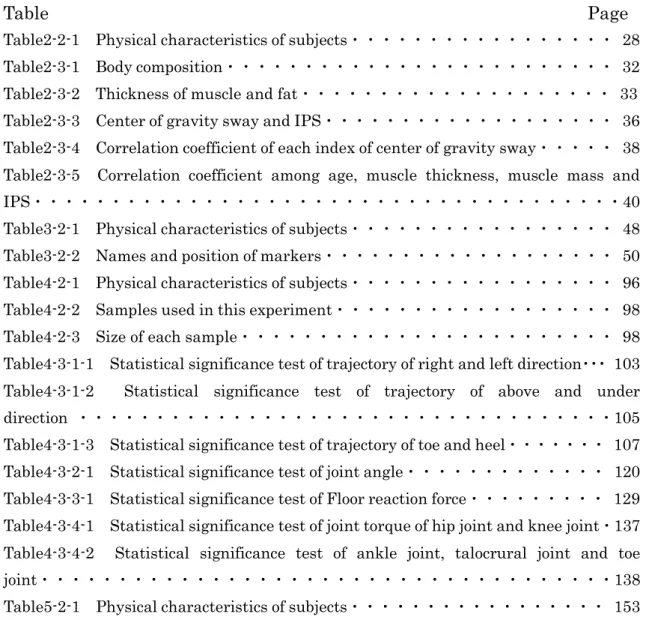
List of Tables
Table Page
Table2-2-1 Physical characteristics of subjects・・・・・・・・・・・・・・・・・ 28 Table2-3-1 Body composition・・・・・・・・・・・・・・・・・・・・・・・・・ 32 Table2-3-2 Thickness of muscle and fat
・・・・・・・・・・・・・・・・・・・・33 Table2-3-3 Center of gravity sway and IPS
・・・・・・・・・・・・・・・・・・・36 Table2-3-4 Correlation coefficient of each index of center of gravity sway
・・・・・38 Table2-3-5 Correlation coefficient among age, muscle thickness, muscle mass and IPS
・・・・・・・・・・・・・・・・・・・・・・・・・・・・・・・・・・・・・・40 Table3-2-1 Physical characteristics of subjects
・・・・・・・・・・・・・・・・・48 Table3-2-2 Names and position of markers
・・・・・・・・・・・・・・・・・・・50 Table4-2-1 Physical characteristics of subjects
・・・・・・・・・・・・・・・・・96 Table4-2-2 Samples used in this experiment
・・・・・・・・・・・・・・・・・・98 Table4-2-3 Size of each sample
・・・・・・・・・・・・・・・・・・・・・・・・98 Table4-3-1-1 Statistical significance test of trajectory of right and left direction
・・・103 Table4-3-1-2 Statistical significance test of trajectory of above and under
direction
・・・・・・・・・・・・・・・・・・・・・・・・・・・・・・・・・・・105
Table4-3-1-3 Statistical significance test of trajectory of toe and heel
・・・・・・・107 Table4-3-2-1 Statistical significance test of joint angle
・・・・・・・・・・・・・120 Table4-3-3-1 Statistical significance test of Floor reaction force
・・・・・・・・・129 Table4-3-4-1 Statistical significance test of joint torque of hip joint and knee joint
・137 Table4-3-4-2 Statistical significance test of ankle joint, talocrural joint and toe
joint
・・・・・・・・・・・・・・・・・・・・・・・・・・・・・・・・・・・・・138
Table5-2-1 Physical characteristics of subjects
・・・・・・・・・・・・・・・・・153
XIII
List of Figures
Table Page
Figure1-1-1 Classification of factors of falls・・・・・・・・・・・・・・・・・・・ 3 Figure1-2-1 Configuration of one gait cycle defined by Murray・・・・・・・・・・・5 Figure1-2-2 Configuration of one gait cycle defined by Perry
・・・・・・・・・・・・7 Figure1-2-3 The ratio of the double support phase and single support phase
・・・・9 Figure1-2-4 Spatial parameters(Step width, stride, toe angle, foot orientation angle,
walking angle)
・・・・・・・・・・・・・・・・・・・・・・・・・・・・・・・・・9
Figure2-2-1 General use diagnostic ultrasound imaging system PROSOUND
SDD-3500
・・・・・・・・・・・・・・・・・・・・・・・・・・・・・・・・・・・29
Figure2-2-2 Measurement position of the thickness of the muscle
・・・・・・・・・29 Figure2-2-3 Center of gravity sway meter
・・・・・・・・・・・・・・・・・・・・30 Figure2-2-4 Calculation method of IPS
・・・・・・・・・・・・・・・・・・・・・31 Figure2-3-1 Comparison thickness of muscle and fat between young and elderly
・・34 Figure2-3-2 Comparison of contour area of center of gravity sway between young and
elderly
・・・・・・・・・・・・・・・・・・・・・・・・・・・・・・・・・・・・37
Figure2-3-3 Comparison of maximum value of the moved distance of the center of gravity, Area of stability limit and IPS between young and elderly
・・・・・・・・・37 Figure2-3-4 Relationship of age and muscle and IPS
・・・・・・・・・・・・・・・41 Figure3-2-1 Position of marker on body
・・・・・・・・・・・・・・・・・・・・・50 Figure3-2-2 Recording situation of standing and walking
・・・・・・・・・・・・・51 Figure3-2-3 Definition of joint angle by Kine analyzer
・・・・・・・・・・・・・・52 Figure3-2-4 3 direction definition of the floor reaction force by Kine analyzer
・・・52 Fig.3-2-5 Musculoskeletal model with SIMM
・・・・・・・・・・・・・・・・・・53 Figure3-3-1-1 Locus of the amplitude of marker
・・・・・・・・・・・・・・・・・55 Figure3-3-1-2 Locus of marker of toe and heel on the right foot
・・・・・・・・・・56 Figure3-3-1-3 Result of Locus of right and left direction of Top.Head of each subject 57 Figure3-3-1-4 Result of Locus of right and left direction of R.Shoulder of each
subject
・・・・・・・・・・・・・・・・・・・・・・・・・・・・・・・・・・・・58
Figure3-3-1-5 Result of Locus of right and left direction of R.Asis of each
subject
・・・・・・・・・・・・・・・・・・・・・・・・・・・・・・・・・・・・・59
Figure3-3-1-6 Result of Locus of above and under direction of Top.Head of each
subject
・・・・・・・・・・・・・・・・・・・・・・・・・・・・・・・・・・・・・60
Figure3-3-1-7 Result of Locus of above and under direction of R.Shoulder of eac
subject
・・・・・・・・・・・・・・・・・・・・・・・・・・・・・・・・・・・・・61
Figure3-3-1-8 Result of Locus of above and under direction of R.Asis of each
XIV
subject・・・・・・・・・・・・・・・・・・・・・・・・・・・・・・・・・・・・・ 62 Figure3-3-1-9 Result of Locus of above and under direction of R.Toe on the right foot of each subject・・・・・・・・・・・・・・・・・・・・・・・・・・・・・・・・・・ 63 Figure3-3-1-10 Result of Locus of above and under direction of R.Heel on the right foot of each subject・・・・・・・・・・・・・・・・・・・・・・・・・・・・・・・・・ 64 Figure3-3-2-1 Change of 3 joint angle during one gait cycle on bare foot・・・・・・67 Figure3-3-2-2 Comparison of stick picture during one gait cycle between young and elderly・・・・・・・・・・・・・・・・・・・・・・・・・・・・・・・・・・・・ 68 Figure3-3-2-3 Result of hip joint angle of each subject・・・・・・・・・・・・・・・ 69 Figure3-3-2-4 Result of knee joint angle of each subject
・・・・・・・・・・・・・70 Figure3-3-2-5 Result of ankle joint angle of each subject
・・・・・・・・・・・・・・71 Figure3-3-3-1 Changes of floor reaction force in 3direction during one gait cycle one
bare foot
・・・・・・・・・・・・・・・・・・・・・・・・・・・・・・・・・・・・74
Figure3-3-3-2 Result of floor reaction force of before and back direction of each
subject
・・・・・・・・・・・・・・・・・・・・・・・・・・・・・・・・・・・・・75
Figure3-3-3-3 Result of floor reaction force of right and left direction of each
subject
・・・・・・・・・・・・・・・・・・・・・・・・・・・・・・・・・・・・・76
Figure3-3-3-4 Result of floor reaction force of above and under direction of each
subject
・・・・・・・・・・・・・・・・・・・・・・・・・・・・・・・・・・・・・77
Figure3-3-4-1 joint torque of right lower legs in one gait cycle on bare foot
・・・・・80 Figure3-3-4-2 Result of flexion of hip joint torque of each subject
・・・・・・・・・・81 Figure3-3-4-3 Result of abduction of hip joint torque of each subject
・・・・・・・・82 Figure3-3-4-4 Result of rotation of hip joint torque of each subject
・・・・・・・・83 Figure3-3-4-5 Result of knee joint torque of each subject
・・・・・・・・・・・・・84 Figure3-3-4-6 Result of ankle joint torque of each subject
・・・・・・・・・・・・85 Figure3-3-4-7 Result of talocrural joint torque of each subject
・・・・・・・・・・86 Figure3-3-4-8 Result of toe joint torque of each subject
・・・・・・・・・・・・・87 Figure4-3-1-1 Locus of right and left direction during one gait cycle
・・・・・・・102 Figure4-3-1-2 Locus of above and under direction during one gait cycle
・・・・・・・104 Figure4-3-1-3 Locus of trajectory of toe and heel during one gait cycle
・・・・・・・106 Figure4-3-1-4 Result of Locus of right and left direction of Top.Head of each
subject
・・・・・・・・・・・・・・・・・・・・・・・・・・・・・・・・・・・・・108
Figure4-3-1-5 Result of Locus of right and left direction of R.Shoulder of each
subject
・・・・・・・・・・・・・・・・・・・・・・・・・・・・・・・・・・・・・109
Figure4-3-1-6 Result of Locus of right and left direction of R.Asis of each
subject
・・・・・・・・・・・・・・・・・・・・・・・・・・・・・・・・・・・・・110
XV
Figure4-3-1-7 Result of Locus of above and under direction of Top.Head of each subject・・・・・・・・・・・・・・・・・・・・・・・・・・・・・・・・・・・・・ 111 Figure4-3-1-8 Result of Locus of above and under direction of R.Shoulder of each subject・・・・・・・・・・・・・・・・・・・・・・・・・・・・・・・・・・・・・ 112 Figure4-3-1-9 Result of Locus of above and under direction of R.Asis of each subject・・・・・・・・・・・・・・・・・・・・・・・・・・・・・・・・・・・・・ 113 Figure4-3-1-10 Result of Locus of above and under direction of R.Toe on the right foot of each subject・・・・・・・・・・・・・・・・・・・・・・・・・・・・・・・・ 114 Figure4-3-1-11 Result of Locus of above and under direction of R.Heel on the right foot of each subject・・・・・・・・・・・・・・・・・・・・・・・・・・・・・・・・・ 115 Figure4-3-2-1 Change of 3 joint angle during one gait cycle in elderly group・・・・ 118 Figre4-3-2-2 Change of 3 joint angle during one gait cycle in young group
・・・・119 Figure4-3-2-3 Comparison of stick picture during one gait cycle of elderly
・・・・・121 Figure4-3-2-4 Comparison of stick picture during one gait cycle of young
・・・・・122 Figure4-3-2-5 Result of hip joint angle of each subject
・・・・・・・・・・・・・・123 Figure4-3-2-6 Result of knee joint angle of each subject
・・・・・・・・・・・・・124 Figure4-3-2-7 Result of ankle joint angle of each subject
・・・・・・・・・・・・・125 Figure4-3-3-1 Changes of floor reaction force in one gait cycle of elderly group
・・・127 Figure4-3-3-2 Changes of floor reaction force in one gait cycle of young group
・・・128 Figure4-3-3-3 Result of floor reaction force of before and back direction of each
subject
・・・・・・・・・・・・・・・・・・・・・・・・・・・・・・・・・・・・・130
Figure4-3-3-4 Result of floor reaction force of right and left direction of each
subject
・・・・・・・・・・・・・・・・・・・・・・・・・・・・・・・・・・・・・131
Figure4-3-3-5 Result of floor reaction force of above and under direction of each
subject
・・・・・・・・・・・・・・・・・・・・・・・・・・・・・・・・・・・・・132
Figure4-3-4-1 Changes of joint torque in one gait cycle of elderly group
・・・・・・135
Figure4-3-4-2 Changes of joint torque in one gait cycle of young group
・・・・・・136
Figure4-3-4-3 Result of flexion of hip joint torque of each subject
・・・・・・・・・139
Figure4-3-4-4 Result of abduction of hip joint torque of each subject
・・・・・・・140
Figure4-3-4-5 Result of rotation of hip joint torque of each subject
・・・・・・・・141
Figure4-3-4-6 Result of knee joint torque of each subject
・・・・・・・・・・・・・142
Figure4-3-4-7 Result of ankle joint torque of each subject
・・・・・・・・・・・・143
Figure4-3-4-8 Result of talocrural joint torque of each subject
・・・・・・・・・・144
Figure4-3-4-9 Result of toe joint torque of each subject
・・・・・・・・・・・・・145
Figure5-2-1 Measurement position of EMG・・・・・・・・・・・・・・・・・・・ 154
Fig.5-2-2 State of the experiment・・・・・・・・・・・・・・・・・・・・・・・155
XVI
Figure5-3-1-1 Integrated EMG value of right lower legs in 6 period during one gait cycle on bare foot・・・・・・・・・・・・・・・・・・・・・・・・・・・・・・・・ 160 Figure5-3-1-2 Result of the rectus femoris of each subject in the elderly group
・・・161 Figure5-3-1-3 Result of the rectus femoris of each subject in the young group
・・・162 Figure5-3-1-4 Result of the biceps femoris of each subject in the elderly group
・・・163 Figure5-3-1-5 Result of the biceps femoris of each subject in the young group
・・・164 Figure5-3-1-6 Result of the tibialis anterior of each subject in the elderly group
・・165 Figure5-3-1-7 Result of the tibialis anterior of each subject in the young group
・・166 Figure5-3-1-8 Result of the gastrocnemius inside of each subject in the elderly
group
・・・・・・・・・・・・・・・・・・・・・・・・・・・・・・・・・・・・・167
Figure5-3-1-9 Result of the gastrocnemius inside of each subject in the young
group
・・・・・・・・・・・・・・・・・・・・・・・・・・・・・・・・・・・・・168
Figure5-3-1-10 Result of the gastrocnemius outside of each subject in the elderly
group
・・・・・・・・・・・・・・・・・・・・・・・・・・・・・・・・・・・・・169
Figure5-3-1-11 Result of the gastrocnemius outside of each subject in the young
group
・・・・・・・・・・・・・・・・・・・・・・・・・・・・・・・・・・・・・170
Figure5-3-2-1 Percentage of EMG at wearing Shoes for elderly based on EMG at
barefoot
・・・・・・・・・・・・・・・・・・・・・・・・・・・・・・ ・・・・・172
Figure5-3-2-2 Percentage of EMG at wearing Sneaker based on EMG at
barefoot
・・・・・・・・・・・・・・・・・・・・・・・・・・・・・・・・・・・・173
Figure5-3-2-3 Percentage of EMG at wearing Toning shoes based on EMG at
barefoot
・・・・・・・・・・・・・・・・・・・・・・・・・・・・・・・・・・・・174
Figure5-3-2-4 Percentage of EMG at wearing Pumps based on EMG at barefoot
・・175 Figure5-3-2-5 Result of the rectus femoris of each subject in the elderly group
・・・176 Figure5-3-2-6 Result of the rectus femoris of each subject in the young group
・・・177 Figure5-3-2-7 Result of the biceps femoris of each subject in the elderly group
・・・178 Figure5-3-2-8 Result of the biceps femoris of each subject in the young group
・・・179 Figure5-3-2-9 Result of the tibialis anterior of each subject in the elderly group
・・180 Figure5-3-2-10 Result of the tibialis anterior of each subject in the young group
・・181 Figure5-3-2-11 Result of the gastrocnemius inside of each subject in the elderly
group
・・・・・・・・・・・・・・・・・・・・・・・・・・・・・・・・・・・・・182
Figure5-3-2-12 Result of the gastrocnemius inside of each subject in the young
group
・・・・・・・・・・・・・・・・・・・・・・・・・・・・・・・・・・・・・183
Figure5-3-2-13 Result of the gastrocnemius outside of each subject in the elderly
group
・・・・・・・・・・・・・・・・・・・・・・・・・・・・・・・・・・・・・184
Figure5-3-2-14 Result of the gastrocnemius outside of each subject in the young
XVII
group・・・・・・・・・・・・・・・・・・・・・・・・・・・・・・・・・・・・・ 185
1
第1章
序論
1 1.1
緒言1.1.1
高齢化社会の現状現在、日本における高齢化が急速に進んでいる。厚生労働省の平成
27
年版高齢社会白書1)によると、我が国の総人口は平成
26
年10
月の時点で1
億2,708
万人であったが、そのう ち65
歳以上の高齢者人口は、過去最高の3,300
万人であった。世界保健機構(WHO
)の 定義によると、65
歳以上の高齢者人口が総人口に占める割合のことを高齢化率といい、高 齢化率が7
%を超えた社会を「高齢化社会」、14
%を超えた社会を「高齢社会」、21
%を超 えた社会を「超高齢社会」という。日本の高齢者が総人口に占める割合は26.0
%と過去最 高となっており、我が国は現状として超高齢社会にある。現在の日本の平均寿命は、男性80.21
歳、女性86.61
歳であり、2060
年には女性では平均寿命が90
歳を超えると予測されている。
2015
年には、いわゆる「団塊の世代」(昭和22
~24
年に生まれた人)が65
歳 以 上となったが、今後も高齢者の人口は増加するとされ2042
年に3,878
万人で ピークを迎 え、その後は減少に転じると予想されている。しかし、日本の出生率は年々低くなってお り、同時に少子化の問題が解消されなければ、高齢化率は上昇していくと考えられ、2060
年には高齢化率は39.9
%に達し2.5
人に1
人が65
歳以上、75
歳以上では4
人に1
人の26.9
% となるとされている。平均寿命の延長と少子化が重なったことにより、欧米をはじめとす る先進国のなかでも日本の高齢化は他に例を見ない早いペースで進んでいる。平均寿命の延長にともなって、現在「健康寿命」という言葉が注目を集めている2,3)。健 康寿命とは、健康上の問題のない状態で日常生活を送れる期間を指す。平均寿命が男女と もに
80
歳を超える一方、健康寿命は平成25
年時点で男性が71.19
歳、女性が74.21
歳で あり平均寿命とのあいだには約10
年の差がある。この役10
年間、要介護として何らかの 介助を受けて生活していかなければならない。少子高齢化の進むわが国では、介護職員の 不足は深刻な問題である。加えて、医療費の増加は税制の大きな負担となる。これらのこ とを踏まえると、重篤な介護状態にある高齢者を減らしていくことが必要であり、国民全2
体の健康寿命の延長は大きな課題である。1.1.2
高齢者のADL
についてADL(Activities of Daily Living)
は一般的に“日常生活動作”と訳され、日常生活の中で おこなっている基本的動作、具体的には食事や排泄、整容、移動、入浴等の行為、行動の ことを指す。特にリハビリや介護の世界においてADL
は重要な概念であり、QOL(Quality
of Life)
、つまり生活の質とも深く結び付いている。ADL
能力を維持するために日頃から健康的で活動的な生活を送ることが大切である。
植屋ら4)は高齢者
310
名を対象に、体力テストおよび文部科学省のADL
テストとWHO
のQOL
テストを実施し、高齢者の体力とADL
とQOL
の関連を相互的に分析した。結果 として、体力得点の高いものはADL
およびQOL
の得点も高く、ADL
の得点が高いものはQOL
の得点も高くなり、3
者の間にはきわめて重要な相互関係があると述べている。加え て、体力・ADL
・QOL
は高齢者自身の日常生活習慣と大いに関係しており、規則正しい食 生活や運動、外泊といった積極的な生き方が好影響を及ぼすとしている。その他にも、高 齢者の体力・ADL
・QOL
についてその関連を述べた論文は多く見受けられる 5),6),7),8)。 太湯ら9)は高齢者を対象にADL
と歩行機能の関係を分析した。ADL
の総合得点は年齢が高 くなるにつれて低くなり、歩行能力は同じ高齢者でも60
歳代と80
歳以上で差があると述 べた。また、80
歳以上では一日の平均歩数が顕著に低下し運動不足の生活になりやすいた め、意識して歩く習慣をつけ歩数を維持することで、入眠しやすさや運動不足、足の衰え の防止につながると述べている。このように、高齢者の運動・歩行能力と、ADL
およびQOL
は深く関わっており、高齢者の外向的な生活を支えることがADL
やQOL
の向上、ひいて は健康寿命の延長につながると考えられる。3 1.1.3
高齢者の身体機能高齢者が要介護と認定される原因は様々あるが、骨折・転倒に起因するものが全体の約
1
割 10)と言われている。さらに転倒は高齢者の死亡原因の上位に位置し、国際的に重視され 活発な議論がなされてきた11)。江藤11)は転倒の要因について外的要因と内的要因に分けて 考察している。外的要因については、照明不良や不慣れな道、障害物といった周囲の環境 に起因するものに加え、履物の不適合なども挙げられる。内的要因は身体的な要因、心因 性、環境認知の障害に大分される(
このうち薬物の使用を身体的な内的要因とするか、身体 に作用する外的要因とするかは文献により解釈が異なる)
。身体的な問題のなかには歩行運 動系の問題が含まれる。Fig.1-1-1 Classification of factors of falls
11)2009
年には日本整形外科学会より、運動器の障害による要介護の状態や、要介護のリス クを示すロコモティブシンドローム(Locomotive Syndrome
,運動器症候群)
という言葉が提 唱された。菱井ら 12)は加齢による身体機能の低下による転倒歴と、運動器症候群に関する スクリーニングテストであるロコチェックとの関連を調査した。菱井らの結果では、転倒 歴のある者はない者にくらべて「家の中で躓いたり滑ったりする」の項目の該当率が有意 に高くなった。また、躓きや滑りは筋力やバランス力などの総合的な身体機能が関係する とし、躓きや滑りに引き続く転倒を回避する能力(
体幹の筋力や下肢関節の柔軟性)
も関与し4
ていると述べている。加えて、ロコチェックの該当設問が易転倒者のスクリーニングとな りうる可能性を示した。その他、加齢による身体機能の衰えと、転倒について検討した研 究は多い。井上ら 13)は高齢者を対象に体力テストと転倒歴の調査を行い、転倒歴のある高 齢者では特に脚力が弱く、後傾姿勢を維持・拡大する傾向機能が衰えていると考察してい る。また、池添ら 14)は、高齢者の転倒歴と筋力と平衡機能について調査し、転倒には平衡 機能より下肢筋力の関連が強いと述べており、転倒と脚筋力の関連についても述べた。今 本ら 15)は骨量減少が見られる高齢者に対して重心動揺計による平衡機能の測定を行い、閉 眼時重心動揺の変化が生じた場合は転倒・骨折のリスクが高まると指摘している。
歳をとり、身体機能が衰え、動作に変化が生じ、転倒などの事故に発展する、という流 れがあることは様々な文献からも明らかである。高齢者が転倒した際の状況としては、外 出やスポーツなどの活動中であることが圧倒的に多い。しかし屋外での活動は、高齢者に とって体力維持や社交など生活の中で重要な役割を担っており、屋外活動を安全にサポー トできる環境づくりが高齢者の
ADL
やQOL
の維持のためには重要である。そして、転倒 事故を防ぐためにも、高齢者の身体機能や歩行に着目した研究はこれからも広く求められ ると予想される。1.2
研究の文献的背景1.2.1
歩行とは動物が位置を移動するための運動を移動
(
ロコモーション:locomotion)
という16)。鳥類の 飛び方や魚類の泳ぎ方も“ロコモーション”の一つであり、我々人類は直立姿勢で二足移 動を行う。人間の二足歩行による移動には歩行・走行・跳躍の3
種類があり、なかでも歩 行は、人間が日常的に最も多く行う移動動作である。歩行とは、足底と接地する床面との摩擦を支えとして、左右の下肢を交互に支点としな がら身体を前方へと推進させる運動である。人間の歩行は振子運動に例えられ、身体を持
5
ち上げるエネルギーと前方へ推進するエネルギーを交互に変換しながら効率よく行われる
17)。人は、目的に応じて速さを調節しながら自動的に歩行していく。この普段我々が無意識 のうちに行っている歩行は自然歩行
(natural walk)
と呼ばれる。この他に、測定の際に速さ を一定に保つ以外は被験者が自由に行う歩行を自由歩行(free walk)
といい、速さに加え歩幅 や歩行率なども統制した歩行を強制歩行(forced walk)
と言う。1.2.2
歩行評価のパラメータ人の歩行はさまざまな面から評価することができる。代表的なものとしては、時間的パ ラメータ、空間的パラメータ、力学的パラメータなどがある。歩行は片方の踵が接地して から再び接地する
1
スライドの繰り返しであり、解析においてもこの1
スライドに着目し たものが用いられることがほとんどである。時間的なパラメータの代表的なものに歩行周期がある。歩行の周期は下肢の運動を基準 にして示される。歩行分析における歩行一周期の一般的な区分は、先に述べた
1
スライド(
片 脚の踵が接地してから同脚の踵が再び接地するまでの2
歩分)
を立脚相(stance phase)
と遊脚相
(swing phase)
に区切ったものであり、立脚相と遊脚相の間で蹴りだしがおこり、支持脚が入れ替わることを繰り返していく18)。
Fig.1-2-1
にはMurray
19)の提唱する歩行一周期 の成り立ちを示す。Fig.1-2-1 Configuration of one gait cycle defined by Murray
Stance phase 立脚相 60%
Mid stance period
立脚中期 16‐40%
Contact period
接地期 0‐16% Propulsive period
推進期 40‐60%
0 10 20 30 40 50 60 70 80 90 100
Acceleration Period 加速期
Deceleration Period 減速期 Mid swing period
遊脚中期
Swing phase 遊脚相 40%
HL (Heel Leave)
踵離地 HS
(Heel Strike) 踵接地
FFL (Front Foot Load )
前足部荷重
TO (Toe Off) 足尖離地
HS (Heel Strike)
踵接地 蹴り出し
6
立脚相と遊脚相はさらに細かく区分され、立脚相は周期の始めから接地期、立脚中期、
推進期に分けられ、遊脚相は加速器、遊脚中期、減速期からなる。
Murray
の歩行一周期に おける各期間の詳細については、以下のとおりである。 立脚相:歩行周期の前半
60
%を占める。歩行時の体重負荷時におこる。 接地期
(Contact period /
以下CP)
:立脚相を構成する三つの区分のうち最初に発生する。立脚相のうち
27%
を占める(
歩行全体では約16%)
。 立脚中期
(Mid stance period / MSt)
:立脚相を構成する三つの区分のうち中間に発生する。立脚相のうち
40%
を占める(
歩行全体では約24%)
。 推進期
(Propulsive period / PP)
:立脚相を構成する三つの区分のうち最後に発生する。立脚相のうち
33%
を占める(
歩行全体では約20%)
。 遊脚相:歩高周期の約
40%
を占める。歩行時の非体重負荷時におこる。 加速期
(Acceleration period / AP)
:遊脚相を構成する三つの区分のうち最初に発生する。脚部が身体の後方にある。
遊脚中期
(Mid swing period / MSw)
:遊脚相を構成する三つの区分のうち中間に発生する。脚部はほぼ身体の直下にある。
減速期
(Deceleration period / DP)
:遊脚相を構成する三つの区分のうち最後に発生する。脚部が身体よりも前方に振り出されている。
歩行周期の要素については、ランチョ・ロス・アミーゴ国立リハビリテーションセンタ ーの医師である
Perry
がMurray
のものとは異なる新たな定義を示しており 20)、Murray
の定義との違いは、歩行周期を踵接地や離地などの事象で表記せず、期間で表す点である。さらに対側下肢の挙動も併せて歩行周期の表記に用いている点も大きな特徴である。以下
に
Perry
の提唱する歩行周期区分の詳細を記す。 初期接地
(Initial Contact / IC)
:観測脚の接地の瞬間(
歩行周期の0
%)
。7
荷重応答期
(Lording Response / LR)
:IC
から反対脚の爪先離地まで(
片脚支持期の始ま り)
。 立脚中期
(Mid Stance / MSt)
:LR
から反対脚下腿下垂位まで。 立脚終期
(Terminal Stance / TSt)
:MSt
から反対脚のIC
まで。 前遊脚期
(Pre Swing / PSw)
:反対脚のIC
から観察脚のつま先離地まで。 遊脚初期
(Initial Swing / ISw)
:観察脚のつま先離地から、両脚下腿の交差まで。 遊脚中期
(Mid Swing / MSw)
:両脚下腿交差から観測脚下腿下垂位まで。 遊脚終期
(Terminal Swing / TSw)
:観測脚下腿下垂位からIC
まで。Fig.1-2-2 Configuration of one gait cycle defined by Perry
Perry
の提唱した歩行分析の定義やメカニズムは世界的にも認知され、国際的な学術誌でも用いられている。日本においても10年ほど前から普及してきている 17)。しかし、それ 以前の文献においては
Murray
の提唱した区分が基準として用いられる場合がほとんどで8
あり、現在においても
Murray
の定義は一般的な歩行周期の定義と言って差し支えない。本論文でも
Murray
の定義に従って分析を行った。その他の区分では、歩行周期を両脚が接地している両脚支持期と片脚だけが接地してい る片脚支持期とに分け、それぞれの期間は歩行周期に占める割合で算出する方法もある。
また、歩行周期とは逆に、単位時間内のストライド数を表したものを歩行率
(
ケイデンス)
という。片脚の踵接地から他方の脚の踵接地までを1
歩とし、歩行率は歩/
分で算出される。空間的なパラメータは、被験者の足部、あるいは身体全体の動きから観測されるものと して、次のような項目が挙げられる。
1
ストライドにおける脚の水平方向の進行距離であるストライド幅(重複歩距離、スト ライド長) 一歩の距離である歩幅
遊脚中のつま先と床との距離(フットクリアランス、つま先高
)
重心位置の変化
関節角度の変化
ストライド幅を歩行周期で割った歩行速度
右足と左足のあいだの踵の距離である歩隔
接地時の足先の中心線からの開きの角度である歩角
重心の左右の変化
9
Fig.1-2-3 The ratio of the double support phase and single support phase
Fig.1-2-4 Spatial parameters
(Step width, stride, toe angle, foot orientation angle, walking angle)
近年活発に用いられている指標として力学的パラメータがある。床反力計を用いて測定 する床反力や、床反計のデータと三次元動作解析の剛体リンクモデルを組み合わせて算出 される関節負荷量
(
関節モーメント・関節トルクパワー)
などがそれに当たる。さらに高度な 解析として、複雑な筋骨格モデルを組み合わせて推定される筋張力などもある。1.2.3
歩行研究の歴史歩行を始め人の運動は、運動学、運動力学、力学、生理学など様々な視点からとらえる ことができる。歩行についても人々は古くから関心を寄せ、さまざまな研究がおこなわれ てきた 16)。
19
世紀の前半にWeber
兄弟は望遠鏡やクロノメータを用いて歩行の運動学的 分析を数多く試みてきた。また、フランスの生理学者Marey
は連続写真を運動分析に応用 し、19
世紀の写真技術の進歩とともに、現在のシネマトグラフによる研究へと発展した。10
さらに
Marey
は空気圧を利用し足底圧を測定する方法(
現在の歩行分析における床反力の基礎
)
や、一枚の写真に運動を姿勢の時間的変化として記録するクロノフォトグラフィなど を生みだした。19
世紀の後半にBraune
とFischer
は冷凍死体の体節の重心を測定し、振 り子運動の法則を応用し身体部分の慣性などを決定し、人の体における運動力学的分析の 道を開いた。これらの研究を経て、19
世紀に運動を記録して分析する運動の力学的分析が 確立していった。1.2.4
高齢者の歩行分析加齢に伴う歩容変化の研究としては
Murray
ら21)がその先駆けとなった。Murray
らは20~87
歳の男性64
名を対象に、世代による歩行周期変数の変化について分析した。これに追随した多くの研究がおこなわれ、それらの多くで
Murray
らの結果は支持され時間的・空間的パラメータにおける高齢者の歩行特徴の多くが明らかとなった。