氏名(本籍) 学位の種類 学位記番号 学位授与の日付 学位授与の要件 学位論文題目 きょ ぶんせい 許 文成(中国) 博士(薬学) 論博第366 号 令和2 年 3 月 19 日 学位規則第4 条第 2 項該当
Inhibitory effects of Boui-derived alkaloids on human T cells and their synergic effects on steroid pharmacodynamics
論文審査委員 (主査)教授 平野 俊彦 教授 北垣 邦彦 教授 三巻 祥浩 教授 大野 尚仁
論文内容の要旨
INTRODUCTIONT cells are a key component of the adaptive immune system, which act as both coordinators and effectors of immunity. However, when activated inappropriately due to cell-intrinsic or cell-extrinsic factors, T cells contribute to a wide spectrum of diseases such as T-cell acute lymphoblastic leukemia (T-ALL), autoimmune disorders, or organ transplant rejection. Despite of improved supportive care, the prognosis of patients with glucocorticoid (GC) resistant T‑ALL who fail to obtain a complete hematological remission or those whose disease relapses after a transient initial response remains poor. Approximately 30% of the patients receiving kidney transplantation show no or inadequate response to the GC therapy, which is an important risk factor for inferior renal allograft outcome. Taking together with the above clinical problems, it is worthy to develop new therapeutic approaches.
Japanese Pharmacopeia (17th edition). Sinomenine (SN) is the main active alkaloid of herbal plant Sinomenium acutum (Thunb.) (日本産防已). The present study evaluated the potential additive effect of SN on GC pharmacodynamics in vitro to suppress the proliferation of human T lymphocytes. Cepharanthine (CEP) is another bisbenzylisoquinoline alkaloid isolated from the plant Stephania cepharantha Hayata, and has been clinically used in Japan. I also investigated the anti-proliferative efficacies of CEP on human T cells.
CHAPTER ONE Tetrandrine (TET) and cepharanthine (CEP) induce apoptosis through caspase cascade regulation, cell cycle arrest, MAPK activation and PI3K/Akt/mTOR signal modification in steroid resistant human leukemia Jurkat T cells
TET and CEP significantly inhibited cell viabilities and induced apoptosis of Jurkat cells in dose- and time-dependent manner (Fig. 1A). TET or CEP not only upregulated the expression of initiator caspases such as caspase-8 and 9, but also increased the expression of effector caspases such as caspase-3 and 6. P53 and Bax were both upregulated by the treatment of TET and CEP. However, TET and CEP paradoxically increased the expression of anti-apoptotic proteins such as Bcl-2, Mcl-1 and p-NF-κB. Cell cycle arrest at S phase accompanied by increases in the amounts of cyclin A2 and cyclin B1, and a decrease in cylcin D1 amount in cells treated with TET or CEP will be another possible mechanism. JNK and p38 were activated by treatment with TET or CEP. The PI3K/Akt/mTOR signaling pathway modification appears to play significant role in the Jurkat cell apoptosis induced by TET or CEP. Moreover, TET and CEP seemed to downregulate the expressions of p-PI3K and mTOR in an independent way from Akt, since these two drugs strongly stimulated the p-Akt expression (Fig. 1B). Although methylprednisolone (MP) alone showed little cytotoxicity on Jurkat cells, ng/mL grade of MP decreased the IC50 values of TET and CEP
Fig. 1 Apoptotic efficacies and underlying mechanisms of TET or CEP on GC resistant human leukemia Jurkat cells. (A) Dose-dependent curves of TET and CEP on Jurkat cell proliferation. (B) Possible underlying mechanisms for the action of TET or CEP. CHAPTER TWO
Tetrandrine potentiates the steroid pharmacodynamics in mitogen-activated peripheral blood mononuclear cells of healthy subjects
TET decreased the IC50 value of MP significantly (Fig. 2A-B), while it showed little
toxic effect, on concanavalin A-activated PBMCs. TET inhibited the function of P-glycoprotein to increase the concentration of intracellular MP. Meanwhile, TET with or without MP suppressed the phosphorylation of MAPK to facilitate MP inhibitory effect on the T-cell proliferation. Moreover, the combination of TET and MP showed stronger inhibitory effect on IL-6 secretion, which means that IL-6/ERK1/2 cascades could be other possible action target of TET to potentiate GC sensitivity in the mitogen-activated T cells (Fig. 2C).
Fig 2. Potentiating effects of TET on MP pharmacodynamics and underlying mechanisms in mitogen-activated PBMCs. (A)
Dose-dependent curves of TET and MP. (B) MP IC50 values
CHAPTER THREE Immunosuppressive efficacy of tetrandrine combined with methylprednisolone against mitogen-activated peripheral blood mononuclear cells of hemodialysis patients
TET potentiates the MP immunosuppressive pharmacodynamics to inhibit T cell mitogen-stimulated proliferation of PBMCs obtained from hemodialysis patients in vitro (P<0.05). According to these observations, it seems to be possible to combine MP and TET for treatment of patients to reduce the MP therapeutic dose and thus decline its side effects. The IC50 values of MP in combination with TET significantly correlated with CRP
concentrations of hemodialysis patients (P<0.05). Whereas, the pharmacological efficacy of TET and/or MP did not correlate with patient ages, durations of hemodialysis, white blood cell counts, or serum creatinine concentrations.
CHAPTER FOUR
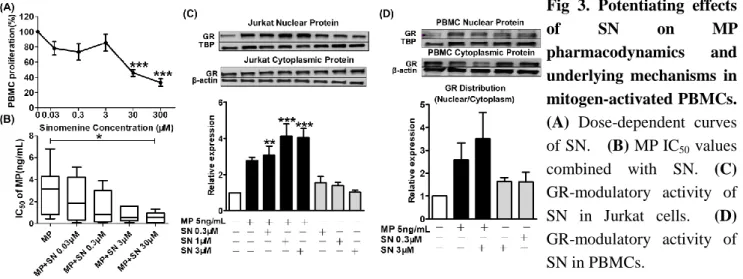
Plant-derived alkaloid sinomenine potentiates steroid pharmacodynamics in mitogen-activated human peripheral blood mononuclear cells by regulating the translocation of glucocorticoid receptor
SN significantly decreased the IC50 values of MP and thus enhanced the
Fig 3. Potentiating effects
of SN on MP
pharmacodynamics and
underlying mechanisms in mitogen-activated PBMCs. (A) Dose-dependent curves
of SN. (B) MP IC50 values combined with SN. (C) GR-modulatory activity of SN in Jurkat cells. (D) GR-modulatory activity of SN in PBMCs.
CONCLUSION TET and SN, isolated from Chinese Boui and Japanese Boui respectively, inhibit the proliferation of mitogen activated human PBMCs and potentiate GC pharmacodynamics by GR translocation modification via different signaling pathways. TET and CEP show cytotoxic effects on GC resistant human leukemia Jurkat T cells by inducing apoptosis via multiple signaling pathways. TET combined with GC is a possible candidate for treatment of patients with GC resistant T-ALL and several autoimmune diseases.
PUBLICATIONS