Introduction
Sustainable Development Goals (SDGs) re-emphasized the importance of primary health care (PHC) and addressed the importance of universal health coverage to achieve broader health-related goals 1). Outbound and inbound medical healthcare services have become general concepts around the world because of increasing
population movement 2).
Human resource development for healthcare services is one of the constraints to appropriate healthcare service provision. Medical and healthcare personnel should be trained with a wider global outlook, including cultural competencies. With the exception of Japan, industrialized countries have historically accepted a
1 Nagasaki University Graduate School of Biomedical Sciences 2 Jinju Health College
A study on undergraduate nursing studentsʼ perspective of healthcare provision for foreign nationals: a survey on Japanese and Korean
university students
Mayumi OHNISHI 1, Junichi TANAKA 1, Mika NISHIHARA 1 Jong Yul LEE 2, Hyun Nam GO 2, Kanako MORIFUJI 1
Abstract
Aim: This study was performed to examine associations between nursing studentsʼ knowledge and interest regarding foreign nationalsʼ medical health challenges and international exchange experience among Korean and Japanese undergraduate nursing students.
Methods: An anonymous self-administered structured questionnaire survey was conducted among 200 Korean nursing students in April 2016, and 78 Japanese nursing students in August 2015; both groups were in their 4th year of study at a university. The questionnaire elicited responses related to knowledge and interest regarding foreign nationalsʼ medical health challenges in Korea or Japan, likelihood of caring for foreign nationals as nurses, and experience related to international exchange.
Results: A total of 183 (91.5%) Korean students and 68 (91.9%) Japanese students participated in this study. Among Korean students, 120 (65.6%) reported being aware of foreign nationalsʼ medical health challenges, while only 23 (33.8%) Japanese participants gave this response. There were significant differences in knowledge and interest scores regarding foreign nationalsʼ medical health challenges according to experience of international exchange in both Korean and Japanese study participants
(Mann–Whitney U test, P = 0.001, P = 0.003, respectively). Korean study participants demonstrated recognition of medical health care provision for foreign nationals as nurses regardless of international exchange experience level (Mann–Whitney U test, P = 0.841), although international exchange experience level was significantly related to recognition of medical health care provision for foreign nationals as nurses among Japanese nursing students (Mann–Whitney U test, P = 0.030).
Conclusions: Korea and Japan have similar characteristics, such as homogenous and monoculture countries until recently. However, this study demonstrated differences in sensitivity and recognition regarding medical healthcare provision for foreign nationals among Korean and Japanese nursing students. It is necessary to assess the factors responsible for this difference, to prepare nursing students for medical healthcare provision in the global society.
Health Science Research 30 : 1-10, 2017
Key Words : global health, international exchange, nursing student, Korea, Japan Received 23 February 2017
Accepted 12 May 2017
number of migrants from diverse regions and countries, and the training of health care personnel has included cultural competencies 3-5). Several previous studies demonstrated disadvantages of health status among migrant and ethnic minorities due to language barriers and their lower socioeconomic status 6-10). According to the Japanese Ministry of Justice, there were about 2.23 million registered at the end of year 2015 and 62,818 non-registered foreign residents as of January 1st, 2016, in Japan, representing about 1.8% of the Japanese population. Acceptance in society and medical health care provision for ethnic minorities, including foreign residents, are not sufficiently mature in Japan compared to other industrialized countries 11-15). A previous study indicated that the current service and support system for foreign residents does not function appropriately in the majority of municipalities in Japan, especially those with low densities of foreign residents 16). In addition, nursing education programs in Japan are not sufficiently equipped to provide health care personnel with training in cultural competency 17). A previous study showed that the majority of nursing students understood the likelihood of caring for foreign nationals in medical health service provision, although they did not have interest in the associated issues 18). Nursing students that participated in international exchange tended to show greater interest in international/global issues, including foreign nationalsʼ medical health challenges 18). On the other hand, South Korea (Korea) became a member of the Organisation for Economic Co-operation and Development (OECD) in 1996, and the degree of Korean economic development has doubled over the past two decades. According to the Korean Legal Department, there were about 1.89 million foreign residents in Korea, representing about 3.7% of the Korean population in 2015, compared to a figure of 1.5%
in 2005. The Korean Tourism Organization reported that 8.1 million foreigners visited Korea as tourists in the first half of 2016, representing an increase of 21%
compared with the first half of 2015.
The number of foreign residents has also increased in Korea by international marriage over these two decades, although Korea was a homogenous country until recently, similar to Japan 19). These international marriages bring female migrants mainly from Asian countries, including Vietnam, China, and others 19), and these women showed several health challenges, such as ill mental health, low health-related quality of life, and inappropriate dietary intake 20-24). They also experienced language barriers resulting low health
literacy 25). Sexual risk-taking behaviors among homosexual migrants 26), and higher risk of fatal injury among migrant workers 27) have also been reported in Korea.
Although culturally and racially homogeneous countries before globalization, both Korea and Japan have experienced challenges in the provision of healthcare to foreigners and migrants in recent decades.
Korea and Japan also are not anglophone countries, and learning English is difficult for people from both countries. Therefore, the influences of experience of international exchange on nursing studentsʼ knowledge and interest regarding foreign national medical health challenges were compared between Korea and Japan.
This study was performed to assess Korean and Japanese nursing studentsʼ perspectives regarding provision of healthcare to foreign nationals as part of readiness to become a professional nurse in the global era.
Methods
An anonymous self-administered structured questionnaire survey was conducted among 200 Korean nursing students in April 2016, and 78 Japanese nursing students in August 2015; both groups were in their 4th year of study at a university. The study participants in both countries were from a nursing university located in a provincial city. The questionnaire elicited responses related to knowledge and interest regarding foreign nationalsʼ medical health challenges in Korea or Japan, likelihood of caring for foreign nationals as nurses, and experience related to international exchange (Box 1). The level of interest regarding foreign nationalsʼ medical health challenges was evaluated using a visual analog scale (VAS: 0 – 100 mm) in the questionnaire.
The details of the questionnaire and calculation of international exchange score were described in a previous report that presented data only from Japanese undergraduate nursing students 18). The questionnaire was prepared in Japanese for the previous study 18), and translated into Korean from the English version, which is shown in Box 1.
This study was approved by the ethical review board of Nagasaki University Graduate School of Biomedical Sciences (authorization number: 16020482) regarding data from Japanese undergraduate nursing students, and by the dean of Jinju Health College regarding Korean undergraduate nursing students. The study participants were informed about the objectives of the study, both orally and in written documents, and were asked to participate voluntarily. Submission of the
completed questionnaire was considered to indicate agreement to participation in the study.
Results
A total of 183 (91.5%) Korean participants and 68 (91.9%)
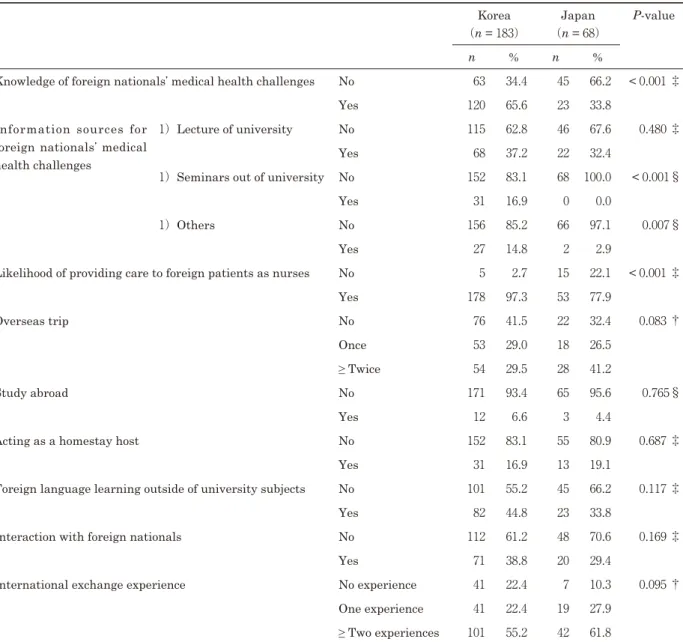
Japanese participants completed the questionnaire survey. Table 1 shows a comparison of knowledge and interest regarding foreign nationalsʼ medical health challenges and international exchange experience between Korean and Japanese undergraduate nursing students. While 120 (65.6%) Korean study participants indicated having knowledge of foreign nationalsʼ medical health challenges, only 23 (33.8%) Japanese study participants reported such knowledge (chi-square test, P < 0.001). Among the Korean study participants, 68
(37.2%) responded that they received knowledge of foreign nationalsʼ medical health challenges through
formal education at university, while only 22 (32.4%)
of the Japanese study participants reported receiving such information. The numbers of nursing students that answered affirmatively regarding the likelihood of providing health care to foreign nationals as nurses were 178 (97.3%) in Korea and 53 (77.9%) in Japan, and this difference was statistically significant (chi-square test, P < 0.001).
The means and standard deviation (SD) of visual analog scale (VAS) score regarding interest in foreign nationalsʼ medical health challenges were 56.2 (29.9)
among Korean study participants with a median of 50, and 44.0 (25.2) among Japanese study participants with a median of 44. There was a statistically significant difference regarding interest in foreign nationalsʼ medical health challenges between Korean and Japanese study participants (Mann–Whitney U test, P = 0.004). Box 1. Questionnaire to evaluate nursing studentsʼ knowledge and interest regarding foreign nationalsʼ medical health challenges and experience of international exchange
1. Have you heard about foreign nationalsʼ medical health challenges in Japan? (Yes, No)
2. If you answered “Yes” to question 1, where did you hear about foreign nationalsʼ medical health challenges?
(Multiple choice)
1) Lecture at university 2) Seminar out of the university 3) Other (Specify: ) 3. What is your level of interest regarding foreign nationalsʼ medical health challenges? Please indicate your current level
of interest with an × mark.
Interest No interest
4. Do you predict a probability of providing care to foreign nationals as a nurse? (Yes, No) 5. Please answer if you have experienced international exchange below.
5-1.Have you experienced overseas trips?
1) None 2) Once 3) Twice or more 5-2.Have you experienced studying abroad? (Yes, No)
5-3.Have you experienced acting as a homestay host? (Yes, No)
5-4.Have you had an opportunity to learn a foreign language other than that included in the university curriculum? If so, please specify the mode of learning such as English conversation school, Skype lessons with foreigners, study of TOIEC, and others.
1) Yes (Specify: ) 2) No
5-5.If you have additional experience of interacting with foreign nationals, including international exchange meetings and events, etc., please specify below.
( ) International exchange experience score was calculated by totaling the scores for all questions from 5-1 to 5-5, and ranged from 0 to 6.
Answers regarding question 5-1 were divided into three categories, i.e., “no,” “once,” and “twice or more,” which were given scores of 0, 1, and 2, respectively. Responses of “no” or “yes” to questions 5-2 to 5-5 were given scores of 0 and 1, respectively.
On question 5-5, a score of 1 was given when the study participants responded as having experienced one or more episode of international interaction.
The study participants were divided into three groups according to VAS score regarding foreign nationalsʼ medical health challenges: low interest group, ≤ 33; medium interest group, 34 – 66; and high interest group, ≥ 67.
The means and SD of international exchange scores were 2.0 (1.7) with a median of 2 among Korean study participants, and 1.9 (1.4) with a median of 2 among Japanese study participants. There was no statistically significant difference regarding international exchange score between Korean and Japanese study participants
(Mann–Whitney U test, P = 0.677).
The results of associations between knowledge of foreign nationalsʼ medical health challenges in Korea and Japan and international exchange experience among Korean and Japanese undergraduate nursing students are shown in Table 2. Among Korean study
participants, 63 (52.5%) students that learnt a foreign language in addition to university language subjects were significantly more aware of foreign nationalsʼ medical health challenges (chi-square test, P = 0.004), although there was no such observation among Japanese study participants (chi-square test, P = 0.081). Table 3 shows the associations between interest regarding foreign nationalsʼ medical health challenges and international exchange experience by country.
Study participants with experience of studying abroad showed higher levels of interest in foreign nationalsʼ medical health challenges in Korea (Cochran–Armitage trend test, P = 0.084) and in Japan (Cochran–Armitage trend test, P = 0.041). Study participants that learnt a foreign language outside of university subjects also showed greater interest in foreign nationalsʼ medical
Table 1. Comparison of knowledge and interest regarding foreign nationalsʼ medical health challenges and international exchange experience between Korean and Japanese undergraduate nursing students
Korea
(n = 183)
Japan
(n = 68)
P-value
n % n %
Knowledge of foreign nationalsʼ medical health challenges No 63 34.4 45 66.2 < 0.001 ‡
Yes 120 65.6 23 33.8
Information sources for foreign nationalsʼ medical health challenges
1) Lecture of university No 115 62.8 46 67.6 0.480 ‡
Yes 68 37.2 22 32.4
1) Seminars out of university No 152 83.1 68 100.0 < 0.001§
Yes 31 16.9 0 0.0
1) Others No 156 85.2 66 97.1 0.007§
Yes 27 14.8 2 2.9
Likelihood of providing care to foreign patients as nurses No 5 2.7 15 22.1 < 0.001 ‡
Yes 178 97.3 53 77.9
Overseas trip No 76 41.5 22 32.4 0.083 †
Once 53 29.0 18 26.5
≥ Twice 54 29.5 28 41.2
Study abroad No 171 93.4 65 95.6 0.765§
Yes 12 6.6 3 4.4
Acting as a homestay host No 152 83.1 55 80.9 0.687 ‡
Yes 31 16.9 13 19.1
Foreign language learning outside of university subjects No 101 55.2 45 66.2 0.117 ‡
Yes 82 44.8 23 33.8
Interaction with foreign nationals No 112 61.2 48 70.6 0.169 ‡
Yes 71 38.8 20 29.4
International exchange experience No experience 41 22.4 7 10.3 0.095 †
One experience 41 22.4 19 27.9
≥ Two experiences 101 55.2 42 61.8 Cochran–Armitage trend test (†), Chi-square test (‡), or Fisherʼs exact test (§).
health challenges in Korea (Cochran–Armitage trend test, P = 0.010) and in Japan (Cochran–Armitage trend test, P = 0.076).
Table 4 presents the associations between likelihood of providing care to foreign nationals as nurses and international exchange experience. Among Japanese study participants, there was a greater overall level of international exchange experience indicating an awareness of the likelihood of providing care to foreign nationals as nurses (Cochran–Armitage trend test, P = 0.030), although this was not the case among Korean study participants (Cochran–Armitage trend test, P = 0.724).
Table 5 shows factors related to interest score regarding foreign nationalsʼ medical health challenges
(VAS score) and international exchange experience score. A significantly higher interest score regarding foreign nationalsʼ medical health challenges was observed in both Korean and Japanese study participants that had knowledge of these challenges (Mann–Whitney U test, P = 0.001 and P = 0.003, respectively). However, there was no significant difference in international exchange experience score depending on knowledge of foreign nationalsʼ medical health challenges among either Korean (Mann–Whitney U test, P = 0.697) or Japanese study participants (Mann–Whitney U test, P = 0.119). The Japanese study participants that responded affirmatively to a likelihood of providing healthcare to foreign nationals as nurses demonstrated greater interest in foreign nationalsʼ medical health challenges (Mann–Whitney U test, P = 0.001) and higher international exchange experience scores (Mann–
Whitney U test, P = 0.030), although no such differences were observed among Korean study participants.
Regardless of interest in foreign nationalsʼ medical health challenges and international exchange experience, Korean study participants predicted the likelihood of healthcare provision to foreign nationals as nurses, because only 5 (2.7%) reported no predicted likelihood of providing care foreign nationals as nurses.
Discussion
The Korean study participants had a greater rate of responding that they were aware of foreign nationalsʼ medical health challenges than the Japanese study participants, and the Korean students also demonstrated a higher degree of interest in foreign nationalsʼ medical health challenges than the Japanese students. However, there was no significant difference between the Korean and Japanese students regarding level of exposure
regarding foreign nationalsʼ medical health challenges through formal education in the university. The Korean students had likely been exposed to foreign nationalsʼ medical health challenges by not only formal educational sources, but also by the media and general information sources. There may be a rapid increase in the ratio of foreign residents over this decade in Korea, and there will be both formal and informal influences due to this transition. The Korean students were also likely to be more sensitive to the issues of foreign nationalsʼ medical health challenges, even though their level of exposure regarding foreign nationalsʼ medical health challenges was the same as that of the Japanese students.
The study participants that learnt foreign languages outside of formal university education tended to having greater knowledge regarding foreign nationalsʼ medical health challenges, but other factors related to international exchange experience did not contribute to having such knowledge in both Korean and Japanese students.
Meanwhile, the Japanese students with international exchange experience tended to show a greater interest in foreign nationalsʼ medical health challenges, although only those with foreign language learning experience showed such a tendency among Korean students. The Japanese students with a higher level of international exchange experience were likely to be more sensitive and to recognize foreign nationalsʼ medical health challenges, but the Korean students may acknowledge these challenges regardless of their level of international exchange experience.
The study participants with higher levels of international exchange experience had a greater awareness of the likelihood of providing care to foreign patients as nurses among the Japanese students, but there was no such tendency among the Korean students. As mentioned above with regard to knowledge and interest regarding foreign nationalsʼ medical health challenges, the Korean students may be sensitive to this issue due to globalization and its influence on medical healthcare provision regardless of individual international exchange experience. Nishito et al. 28) reported that nursing students participating in international exchange programs, including overseas study trips, demonstrated interest in international/global health. In addition, more than 60% of nursing students responded affirmatively regarding the necessity of obtaining foreign language skills for working as a nurse in the future, with 90%
giving “communication with foreign patients” as the reason. Unfortunately, the motivation for learning English does not continue for a long period after
international study trips among Japanese students 18). Among the Korean students, general exposure regarding globalization and its influences on medical healthcare provision, and increasing sensitivity to recognizing such trends in general education may be important to standardize cultural sensitivity and borderless medical healthcare provision.
This study had several limitations. First, this study was conducted in only one university from each county, and the sample size of two universities was not well balanced, because the student capacity of each university is different. The authors did not evaluate the details of nursing education programs from the two universities included in the study, and did not assess the relationship between formal nursing educational contents and the study outcomes. Therefore, it is not appropriate to generalize the findings of this study to all nursing students in Korea and/or Japan. This was a cross-sectional study, and therefore conclusions cannot be made regarding the causal relations between interest in foreign nationalsʼ medical health challenges and international exchange experience. The authors also did not evaluate the study participantsʼ English and other foreign language capacity or other aspects of cultural competencies, such as general communication skills, acceptance of different values, preparedness toward unpredicted conditions, etc. Therefore, the authors could not comprehensively assess nursing studentsʼ capability to provide care to patients of other nationalities in Korea and Japan.
Conclusions
In general, Korean nursing students recognized the necessity of providing medical healthcare services to foreign nationals regardless of their interest and level of international exchange experience. The majority of Japanese nursing students understood the likelihood of providing care for foreign nationals in medical health service provision, although they did not have a strong interest in this issue. In addition, the Japanese nursing students that participated in international exchange tended to show an interest in international/
global issues, including foreign nationalsʼ medical health challenges. Both Korea and Japan have similar characteristics, such as homogenous and monoculture country until recently. In addition, both universities involved in this study are located in provincial cities, and not the capitals of the respective countries. However, this study demonstrated differences in sensitivity and recognition regarding medical healthcare provision
for foreign nationals between Korea and Japan. It is necessary to assess the influence of general society regarding globalization and to assess the details of formal nursing educational programs in both countries.
Acknowledgments
The authors are grateful to all of the students for their participation in this study.
References
1 ) Pettigrew L M, De Maeseneer J, Anderson M I, Essuman A, Kidd M R, Haines A: Primary health care and the Sustainable Development Goals.
Lancet, 386: 2119-2121, 2015.
2 ) Snyder J, Johnston R, Crooks VA, Morgan J, Adams K. How Medical Tourism Enables Preferential Access to Care: Four Patterns from the Canadian Context. Health Care Anal, 2016. [Epub ahead of print]
3 ) Le Q, Kilpatrick S: Vietnamese-born health professionals: negotiating work and life in rural Australia. Rural Remote Health, 8(4):1062, 2008.
4 ) Melamed E, Wyatt L E, Padilla T, Ferry R J Jr:
Patient-based cultural competency curriculum for pre-health professionals. Fam Med, 40(10):726- 733, 2008.
5 ) Worrell-Carlisle P. J: Service-learning: a tool for developing cultural awareness. Nurse Educ, 30(5): 197-202, 2005.
6 ) OʼCampo P, Burke JG, Culhane J, Elo IT, Eyster J, Holzman C, Messer LC, Kaufman JS, Laraia BA: Neighborhood deprivation and preterm birth among non-Hispanic black and white women in eight geographic areas in the United States.
American Journal of Epidemiology, 167:155-163, 2008.
7 ) Liu R, So L, Quan H: Chinese and white Canadian satisfaction and compliance with physicians. BMC Family Practice, 8:11, 2007.
8 ) Millett C, Gray J, Bottle A, Majeed A: Ethnic disparities in blood pressure management in patients with hypertension after the introduction of pay for performance. Annals of Family Medicine, 6:490-496, 2008.
9 ) Lindstrom DP, Hernández CH: Internal migration and contraceptive knowledge and use in Guatemala.
International Family Planning Perspectives, 32:146-153, 2006.
10) He N, Wong FY, Huang ZJ, Ding Y, Fu C, Smith BD, Young D, Jiang Q: HIV risks among two types
of male migrants in Shanghai, China: money boys vs. general male migrants. AIDS, 21:A73-S79, 2007.
11) Maeno M, Sakuyama M, Motoyama S, Matsuo H:
Ethnic disparities in perioperative management among foreigners residing in Japan. Clin Exp Obstet Gynecol, 39(4):442-447, 2012.
12) Noda F: Mental health issues affecting ethnic minorities in Japan. Psychiatry Clin Neurosci, 52:S367-369, 1998.
13) Murphy-Shigematsu S: Cultural psychiatry and minority identities in Japan: a constructivist narrative approach to therapy. Psychiatry, 63(4):371- 384, 2000.
14) Ohara-Hirano Y, Kawata C: Sociodemographic factors affecting access to and utilization of health care by Filipino workers in Japan. Nihon Koshu Eisei Zasshi, 47(7):602-609, 2000.
15) Yamamura J, Sawada T: A study on tuberculosis cases among over-staying foreigners. Kekkaku, 75
(2):79-88, 2000.
16) Hotta M, Ali M, Ushijima H, Lee S, Nakamura Y, Shigeta M, Kobayashi N: Situational analysis of maternal and child health services for foreign residents in Japan. Pediatr Int, 49(2):293-300, 2007.
17) Serizawa A: Developing a culturally competent health care workforce in Japan: implications for education. Nurs Educ Perspect, 28(3):140-144, 2007.
18) Nishihara M, Tanaka J, Manago Y, Sakata K, Kubo N. Ohnishi M. Japanese undergraduate nursing students with international exchange experience anticipate a probability of providing care to foreign nationals as a nurse. Health Science Research, 29:73-80, 2017.
19) Kim HS. Social integration and heath policy issues for international marriage migrant women in South Korea. Public Health Nurs, 27(6):561-70, 2010.
20) Kim JA, Yang SJ, Kwon KJ, Kim JH. Predictive factors of depression among Asian female marriage
immigrants in Korea. Nurs Health Sci, 13 (3):275- 81, 2011.
21) Kim GS, Kim B, Moon SS, Park CG, Cho YH.
Correlates of depressive symptoms in married immigrant women in Korea. J Transcult Nurs, 24
(2):153-61, 2013.
22) Kim HS, Kim HS. Depression in non-Korean women residing in South Korea following marriage to Korean men. Arch Psychiatr Nurs, 27(3):148-55, 2013.
23) Chae SM, Park JW, Kang HS. Relationships of acculturative stress, depression, and social support to health-related quality of life in Vietnamese immigrant women in South Korea. J Transcult Nurs, 25(2):137-44, 2014.
24) Hwang JY, Lee SE, Kim SH, Chung HW, Kim WY.
Psychological distress is associated with inadequate dietary intake in Vietnamese marriage immigrant women in Korea. J Am Diet Assoc, 110(5):779-85, 2010.
25) Yang SJ, Chee YK, An J, Park MH, Jung S. Analysis of Validity and Reliability of the Health Literacy Index for Female Marriage Immigrants (HLI- FMI). Asia Pac J Public Health, 28(4):368-81, 2016.
26) Jung M, Kwon D, Oh JY. Associated with differences in sexual risk-taking behaviors among migrants in South Korea. J Immigr Minor Health, 2015 DOI: 10.1007/s10903-015-0300-3
27) Cha S, Cho Y. Fatal and non-fatal occupational injuries and diseases among migrant and native workers in South Korea. Am J Ind Med, 57(9): 1043-52, 2014.
28) Nishito T, Tsukinoki R, Cardenas X, Kobayashi M, Kobatashi T: Nursing Studentsʼ Views on International Exchanges in the Nursing Education.
Osaka Medical College Journal of Nursing Research, 4:96-104, 2014.
Table 2. Associations between knowledge of foreign nationalsʼ medical health challenges and international exchange experience among Korean and Japanese undergraduate nursing students Knowledge of foreign nationalsʼ medical health challenges in Korea or Japan Korea(n =183)Japan(n =68) No (n =63)Yes (n =120)P-valueNo (n =45)Yes (n =23)P-value n%n%n%n% Overseas tripNo2539.75142.50.915†1328.9521.70.225† Once2031.73327.52044.4834.8 ≥ Twice1828.63630.01226.71043.5 Study abroadNo6196.811091.70.223§4395.62295.71.000§ Yes23.2108.324.414.3 Acting as a homestay host No5485.79881.70.488‡3782.21878.30.694‡ Yes929.02218.3817.8521.7 Foreign language learningNo4469.85747.50.004‡3373.31252.20.081‡ Yes1930.26352.51226.71147.8 Interaction with foreign nationalsNo4063.57260.00.645‡3373.31565.20.487‡ Yes2336.54840.01226.7834.8 International exchange experiencesNo experience1930.22218.30.488†920.0313.00.163† One experience812.73327.51431.1417.4 ≥ Two experiences3657.16554.22248.91669.6 Cochran–Armitage trend test(†), Chi-square test(‡), or Fisherʼs exact test(§). Table 3. Associations between interest in foreign nationalsʼ medical health challenges and international exchange experience among Korean and Japanese undergraduate nursing students Interest in foreign nationalsʼ medical health challenges in Korea or Japan(Visual Analog Scale: VAS) Korea(n =183)Japan(n =68) Low (n =47)Medium (n=66)High (n =70)P-valueLow (n =25)Medium (n =30)High (n =13)P-value n%n%n%n%n%n% Overseas tripNo1736.23553.02434.30.890832.0826.7215.40.059 Once1225.51624.22535.71248.01240.0430.8 ≥ Twice1838.31522.72130.0520.01033.3753.8 Study abroadNo4595.76497.06288.60.084251002996.71184.60.041 Yes24.323.0811.400.013.3215.4 Acting as a homestay host No4187.25481.95781.40.4402288.02686.7753.80.026 Yes612.81218.21318.6312.0413.3646.2 Foreign language learningNo3370.23654.53245.70.0101976.02066.7646.20.076 Yes1429.83045.53854.3624.01033.3753.8 Interaction with foreign nationalsNo3063.84466.73854.30.2442080.02273.3646.20.044 Yes1736.22233.33245.7520.0826.7753.8 International exchange experiencesNo experience1327.71725.81115.70.461520.0620.017.70.064 One experience510.61827.31825.71040.0620.0215.4 ≥ Two experiences2961.73147.04158.61040.01860.01076.3 Cochran–Armitage trend test