Reading Aloud in English
Mikako Imamura
Introduction
In Japan, people have few chances to use English in their daily life so few people can use English well, especially when speaking. When Japanese people speak English, they may pay attention to many things, for example, grammar, pronunciation and intonation.
Therefore, they often pause to check their correctness even when the place of the pause is unnatural . However, according to, my homestay mother , this makes it difficult for native English speakers to understand. One of my native-speaking English teachers claimed that Japanese learners do not pause at appropriate places when they read English sentences aloud so it is not easy to understand what they are reading.
According to Suzuki (2009), when people read aloud in English, it is important to be careful about the place and length of pauses for listeners to understand easily. Other studies have shown relationships between listening comprehension and pauses (Ikegami, 2012; Sugai, 2007; Uchida, Kikuchi, Nakaune, Maekawa and Ishizuka, 2002) and differences between learnersʼ and native speakersʼ evaluations of speech data with native- and non-native-like pause patterns (Ishizaki, 2004; Tsurutani, 2010).
Pauses therefore appear to be important when speaking, reading and listening to English. This study focuses on Japanese university studentsʼ pauses when reading aloud in English and the effect of practicing with and without guidance on appropriate places for pauses.
Literature review
Yamazaki (2007) investigated the effects of teaching pauses and pitch individually and combined on reading aloud by Japanese university students. Reading aloud samples were collected from three English native speakers and 15 university students. The
東京女子大学言語文化研究( )26(2017)pp.1‑17
themselves reading aloud before and after a teaching session. Yamazaki measured the length of pauses in learnersʼ pre- and post-teaching reading aloud samples and compared them with the native speaker readings. In the post-teaching recording, the lengths of pauses in all the treatment groups were longer than in the first recording and closer to those of the native speakers. The group that had practiced with information on both pauses and pitch had the greatest improvement, and the group that had information on pitch only had the lowest. Interestingly, the group with information on pauses only also showed improved pitch, indicating that focusing on pauses influences pitch positively.
The effects also transferred to the reading of a new text in all groups.
Several studies have looked at the effects of pauses on listening comprehension.
Sugai (2007) investigated the effects of inserting pauses on listening comprehension by high and low proficiency learners of L2 English. In this study, high and low English proficiency university learners studying English were divided into two groups. One group did a listening comprehension test with a normal listening passage, while the other group did it with the same passage but with lengthened pauses. He found that there were differences depending on learner proficiency level. High-level learners performed better with pauses but not the lower level learners.
Uchida et al. (2002) studied the influence of speech speed and pauses on listening comprehension. Participants were 652 Japanese university students. Uchida et al. edited the listening passages in pre-second to pre-first levels of English Language Proficiency Tests (Eiken) and the Test of English for International Communication (TOEIC), changing the speed and length of pauses. They made four variations of the passages:
original and reduced speed with original and lengthened pauses. The results showed that there were no remarkable differences between the comprehension scores with the four varieties of the test.
Ikegami (2012) researched the relationship between listening comprehension and the effects of pauses and speech speed. The participants were 24 Japanese university students at different levels of English proficiency studying for the Test of English for International Communication (TOEIC), so he chose materials from a textbook for TOEIC. Ikegami edited a long-passage listening comprehension recording from the TOEIC textbook, changing the speed and inserting pauses between phrases. He created
four listening passages: original speed with no inserted pauses, 80% original speed with no inserted pauses, original speed with inserted pauses, and 80% original speed with inserted pauses. He found that middle level learnersʼ scores improved a little when listening to the reduced speed passage without inserted pauses but not those of high or low level learners. High level learnersʼ scores improved when they listened to the original speed passage with inserted pauses. This suggests that slower speed speech helps lower level learners, and inserting pauses improves only high-level learnersʼ scores.
There have been several studies that have shown differences between the effects of pauses on the evaluations of speech data by native speakers and L2 learners. Tsurutani (2010) showed that there were differences in judgement of the appropriateness of pitch and pause length between Japanese native speakers and Australian learners of Japanese. Three groups, high-level L2-Japanese learners, low-level L2-Japanese learners and Japanese native speakers, judged 24 Japanese sentences with four combinations of correct and incorrect pitch, and correct and incorrect pause length read aloud by Australian learners of Japanese. The results showed that all the groups considered length of pause more important than pitch, especially the high-level learners. Low-level learners did not appear to consider pitch to be important. The two learner groups also tended to consider tone and fluency (speech rate) more important than the native speakers and therefore judged reading slowly as bad.
Ishizaki (2004) found that when Japanese native speakers read aloud, pause patterns influence ease of listening but when learners read aloud, it did not. She used four spoken texts: a recording of a text read aloud by a Japanese native speaker, the same native-speaker recording but with a learner-like pause pattern, a recording by a learner of L2 Japanese, and the same learner recording but with a native speaker-like pause pattern. Nine Taiwanese learners whose first language was Chinese, and Japanese native speakers rated the recordings. All the assessors judged the native speaker recording with learner-like pauses to be inferior to the original native speaker recording, particularly the Japanese native speaker judges. The Japanese native speakers also had very similar evaluations of all four recordings, perhaps because they
because they did not use similar pause patterns and/or they were so focused on understanding the content that they did not notice the pause pattern. The learnersʼ evaluations of the two learner recordings were almost the same, indicating that the pause pattern did not influence ease of listening.
From the above research, it is clear that pauses and place of pause helped listenerʼs comprehension. Native speakers and high-level learners however are more sensitive to them than low-level learners. This may mean that low-level learners do not pay attention to pauses when they speak and listen. Therefore, if low-level learners learn that pauses are important for native-speakers to understand them, practicing native- speaker-like pause placement might help them improve their speaking skills. This is the focus of this study.
Present study
Previous studies have shown that pauses are important in that they are related to comprehensibility and comprehension but it is unclear if practicing pauses alone is effective in helping learners to pause in more native-like ways. Yamazakiʼs (2007) study had three weak points. First, it is unclear if the participantsʼ reading actually became more native-like after practice. The length of pauses may have become longer but this does not necessarily mean the speech had native-like naturalness . Second, it is unclear that the effectiveness of practice would be long lasting or not. Third, it took a lot of time to teach each student individually, which is not practical in most teaching situations. In this study the goals are to evaluate the naturalness of the reading aloud and to find whether a simple, practical technique for indicating pauses in texts is effective in helping learners sound more natural . The research questions were:
1. Is practicing reading aloud a text marked with slashes (/) to indicate appropriate places for pauses effective in improving pause placement, intonation and pronunciation when reading aloud?
2. Does the above influence the reading aloud of a new (unpracticed) text?
3. Is there a long term effect?
Subjects and Methods Participants
Learners
The participants in this study were 65 Japanese university students who had studied English for at least 7.5 years. They were randomly assigned to one of two groups. One group practiced reading aloud focusing on place of pause (Pause Group).
The other group practice freely (Non-pause Group). However, because of a computer malfunction and incomplete data from some of the participants, only the data from 18 was analyzed.
Raters
Four experienced, native-speaking English university teachers acted as raters. One was female and three male. They had lived in Japan between 8 and 20 years and taught English for between 12 and 24 years. All were speakers of a variety of North American English.
Instruments Reading text
The participants read two short English paragraphs, Part A and Part B, taken from by O. Henry. The length of Part A was 71 words and Part B 70 words.
Both parts had seven sentences. This text was used in a textbook for first-year high school students in Japan, and it was therefore assumed that it would be easy for the participants to understand and that none of the words in it would be difficult for them to pronounce. The only change made to the text was to change the name of the main
character from to the more familiar .
Two written versions of Part A were prepared. One was marked with slashes to indicate the place of pauses, while the other had no such markings. The material given to the participants is shown in Appendices A to C.
A recording was made of Part A read aloud by a visiting American student. This was used as the model reading and was the basis for deciding on the position of the pause slashes in the text for the pause group.
Evaluation rubric
A scoring rubric for judgements of places of pauses, intonation and pronunciation was made referring to Rcampus (n. d.) and STUDYLIB (n. d.) and checked by an experienced native English-speaking teacher (Appendix D). A rubric was thought to be important because a study by Araki, Hiraishi and Jyou (2013) indicated that native English speakersʼ judgements may not be consistent and may be influenced by factors such as their age and/or speech style.
Procedures
Speakers recorded themselves three times (Table 1). The first recording (Time 1) was made with no practice although the participants had an opportunity to check the meanings and/or pronunciations of words in Part A in a dictionary. For the second recordings (Time 2), the participants first listened to a model reading of Part A and practiced for ten minutes by themselves. The Pause group practiced reading the text with pauses indicated by slashes. The non-pause group practiced using the text without any indication of the places for pauses. Each participant had a computer with
software and a headset. Thus, they were able to practice and record themselves, and see their pause and pitch patterns. After the ten minutes practice, they recorded themselves reading their copy of the text. Next, all the participants were given Part B without slashes and, after checking the meaning and/or pronunciation of any unknown words, they recorded themselves reading it without practice. The fourth and fifth recordings were done a month later (Time 3). The participants read Parts A and B without practice.
The four native English speakers (a, b, c, and d) each evaluated a sample of the
Table 1: Recording schedule Recording Text Time Condition Date First Part A 1 No practice June 9 Second Part A 2 Practice June 9 Third Part B 2 No practice June 9 Fourth Part A 3 No practice July 7 Fifth Part B 3 No practice July 7
recorded data for place of pause, intonation and pronunciation (Table 2). They were assigned samples of the data because the total amount of data was too great for individual raters. To make it possible to find inter-rater reliability, there was overlap (Table 2). The raters each judged four or five participantsʼ Part A recordings at Time 2 and one other recording by each participant. Altogether, each rater listened to 34 data samples data in random order.
Data analysis
To investigate inter-rater reliability, correlations were calculated between raters for each rating category, place of pause, pronunciation and intonation. Descriptive statistics of the groups (Pause and Non-pause) were calculated and a Mixed Effects Model was run on the data with participant, text and rater treated as random effects and group, text and time treated as fixed effects.
Results
Reliability of ratings
The correlations between raters for place of pause, pronunciation and intonation are shown in Tables 3, 4 and 5, respectively. In general, the correlations tend to be weak, and in some cases negative, which indicates that there was little consistency among the raters. This is also reflected in low Cronbach alphas for the ratings: 0.46 for place of pause, 0.53 for pronunciation and 0.60 for intonation. In other words, the data is noisy, and the results of this study might not be clear.
Table 2: Participants' recordings rated by each rater D
I t n a p i c i t r a P
1-5 6-10 11-14 15-18 Part A, Time 1 a b c d Part A, Time 2 a,b,c,d a,b,c,d a,b,c,d a,b,c,d Part B, Time 2 b c d a Part A, Time 3 c d a b Part B, Time 3 d a b c
Place of pause
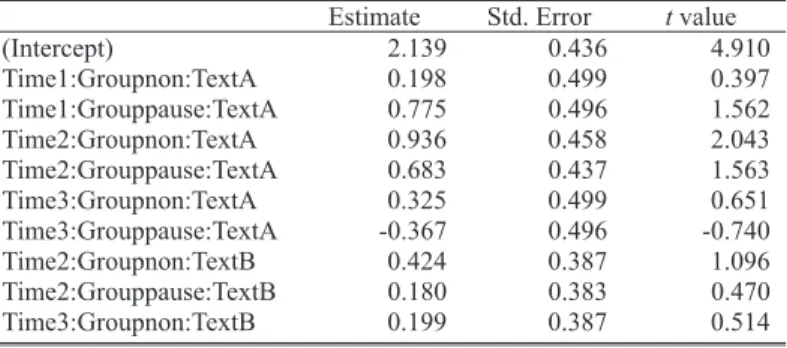
Table 6 and Figure 1 show that, at Time 1, the mean rating for Part A in the Pause Group was 3.00 but after practice (Time 2), it had dropped to 2.82. The mean rating for the Non-pause Group however improved from 2.40 (Time 1) to 3.08 (Time 2). This indicates that practicing without an indication of the places of pauses may be more effective than practicing with this information. However, the results of mixed effects modelling indicate that this interaction effect is not statistically significant (Table 7).
At Time 1 with an unpracticed Part A, the Pause Groupʼs mean score (3.00) was higher than that of Non-pause Group (2.40), while, with an unpracticed Part B (Time 2), the mean rating for the Pause Group was 2.29, which was lower than that of the Non- pause Group (2.60) (Table 6 and Figure 1). This suggests that practice with information about where to pause may have a negative influence, although the results of mixed effects modelling (Table 7) indicate that the group changes are not statistically significant.
The mean ratings for the Pause Groupʼs readings of Part A fell from 2.82 at Time 2 Table 3: Correlations between raters for place of pause ( = 17)
b c
a
b -0.239 (p = 0.355) 0.365 (p = 0.150)
d -0.135 (p = 0.604) 0.158 (p = 0.546) 0.359 (p = 0.157) c 0.518 (p = 0.033)
Table 4: Correlations between raters for pronunciation ( = 17) b
c a
c 0.368 (p = 0.146)
b -0.062 (p = 0.812) 0.192 (p = 0.461)
d 0.665 (p = 0.004) 0.343 (p = 0.177) 0.171 (p = 0.511)
Table 5: Correlations between raters for intonation ( = 17) b
c a
c 0.459 (p = 0.064)
b 0.470 (p = 0.057) 0.098 (p = 0.707)
d 0.064 (p = 0.809) 0.154 (p = 0.556) 0.032 (p = 0.903)
Table 6: Descriptive statistics for ratings of place of pause
Table 7: Results of Mixed Effects Model with ratings of place of pause (mixed effects only)
Time Group Text N Mean SD
1 non A 10 2.40 0.84
1 pause A 7 3.00 1.00
2 non A 40 3.08 0.94
2 pause A 28 2.82 0.77
3 non A 10 2.40 0.52
3 pause A 7 1.71 0.76
2 non B 10 2.60 1.07
2 pause B 7 2.29 0.95
3 non B 10 2.30 1.06
3 pause B 7 2.14 0.69
Figure 1. Interaction plots of place of pause by group by text
e u l a tv r o r r E . d t S e t a m i t s E
0 1 9 . 4 6
3 4 . 0 9
3 1 . 2 )
t p e c r e t n I (
Time1:Groupnon:TextA 0.198 0.499 0.397 Time1:Grouppause:TextA 0.775 0.496 1.562 Time2:Groupnon:TextA 0.936 0.458 2.043 Time2:Grouppause:TextA 0.683 0.437 1.563 Time3:Groupnon:TextA 0.325 0.499 0.651 Time3:Grouppause:TextA -0.367 0.496 -0.740 Time2:Groupnon:TextB 0.424 0.387 1.096 Time2:Grouppause:TextB 0.180 0.383 0.470 Time3:Groupnon:TextB 0.199 0.387 0.514
to 1.71 at Time 3, while those of the Non-pause Group fell from 3.08 at Time 2 to 2.40 at Time 3 (Table 6 and Figure 1). In other words, the positive effects of practice in the Non-pause Group had disappeared by Time 3, while the Pause Groups performance had become even worse. Mixed effects modelling (Table 7) appears to indicate that the drops in the Pause Groupʼs performance from Time 1 and 2 to Time 3 are statistically significant. With Part B, the mean ratings of both groups dropped from 2.60 to 2.30 in the Non-pause group and from 2.29 to 2.14 in the Pause Group. However, mixed effects modelling (Table 7) indicates that there are no statistically significant group-related differences.
Intonation
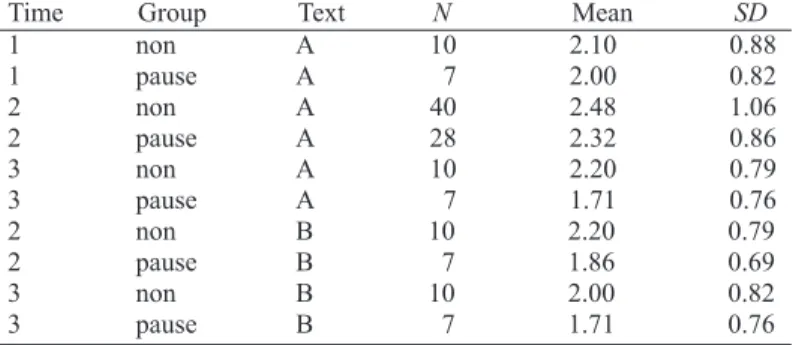
With Text A, the mean score of the Pause Group was 2.00 at Time 1, rising to 2.32 at Time 2, and then falling to 1.71 at Time 3. The Non-pause group followed a similar pattern, rising from 2.10 at Time 1 to 2.48 at Time 2, and then falling back to its Time 1 level of 2.10 (Table 8 and Figure 2). There was no statistically significant group by time interaction, but the simple effect of time was significant (Table 9). This suggests that both kinds of practice, with and without place of pause information, led to improved intonation but this did not last over time. With Text B, both groupsʼ ratings fell, from 1.86 at Time 2 to 1.71 at Time 3 in the Pause Group and from 2.20 to 2.00 in the Non- pause Group. There were no significant differences.
Table 8: Descriptive statistics for ratings of intonation by time by group (mixed effects only)
Time Group Text N Mean SD
1 non A 10 2.10 0.88
1 pause A 7 2.00 0.82
2 non A 40 2.48 1.06
2 pause A 28 2.32 0.86
3 non A 10 2.20 0.79
3 pause A 7 1.71 0.76
2 non B 10 2.20 0.79
2 pause B 7 1.86 0.69
3 non B 10 2.00 0.82
3 pause B 7 1.71 0.76
Pronunciation
With Text A, the mean pronunciation rating of the Pause Group was 2.71 at Time 1, dropped to 2.57 at Time 2 and continued to fall to 2.29 at Time 3 (Table 10 and Figure 3). In contrast, the Non-pause groupʼs mean rating rose from 2.40 at Time 1 to 2.60 at Times 2 and 3. None of the differences was statistically significant (Table 11). With Text B, the Pause Groupʼs score rose from 1.57 at Time 2 to 2.00 at Time 3, while Non-pause Groupʼs score fell from 2.40 at Time 2 to 2.20 at Time 3. There did appear to be a statistically significant effect for group with Text B but not for the group by time interaction.
Figure 2. Interaction plot ratings of Intonation by text by time by group
Table 9: Results of Mixed Effects Model with ratings of intonation e
u l a tv r o r r E . d t S e t a m i t s E
0 8 1 . 4 1
2 4 . 0 2
6 7 . 1 )
t p e c r e t n I (
Time1:Groupnon:TextA 0.307 0.432 0.710 Time1:Grouppause:TextA 0.146 0.429 0.341 Time2:Groupnon:TextA 0.713 0.388 1.837 Time2:Grouppause:TextA 0.560 0.363 1.543 Time3:Groupnon:TextA 0.470 0.433 1.085 Time3:Grouppause:TextA 0.025 0.429 0.058 Time2:Groupnon:TextB 0.355 0.377 0.940 Time2:Grouppause:TextB 0.068 0.373 0.182 Time3:Groupnon:TextB 0.322 0.377 0.854
Table 10: Descriptive statistics for ratings of pronunciation by time by group by text
Time Group Text N Mean SD
1 non A 10 2.40 0.70
1 pause A 7 2.71 0.76
2 non A 40 2.60 0.81
2 pause A 28 2.57 0.79
3 non A 10 2.60 0.84
3 pause A 7 2.29 0.49
2 non B 10 2.40 0.52
2 pause B 7 1.57 0.53
3 non B 10 2.20 0.79
3 pause B 7 2.00 0.58
Figure 3. Interaction plot of ratings of pronunciation by text by time by group
Table 11: Results of Mixed Effects Model with ratings of pronunciation (mixed effects only)
e u l a tv r o r r E . d t S e t a m i t s E
1 8 4 . 6 7
1 3 . 0 2
5 0 . 2 )
t p e c r e t n I (
Time1:Groupnon:TextA 0.359 0.353 1.018 Time1:Grouppause:TextA 0.626 0.359 1.743 Time2:Groupnon:TextA 0.548 0.306 1.790 Time2:Grouppause:TextA 0.519 0.291 1.786 Time3:Groupnon:TextA 0.537 0.353 1.518 Time3:Grouppause:TextA 0.257 0.359 0.716 Time2:Groupnon:TextB 0.295 0.338 0.873 Time2:Grouppause:TextB -0.521 0.344 -1.514 Time3:Groupnon:TextB 0.201 0.337 0.596
Discussion and Conclusions
This study was based on Yamazaki (2007) but was different in the way the native- likeness of reading was judged and gave different results. First, the immediate effect of practice with information on the placing of pauses was inconsistent with Yamazakiʼs study. In her study, learnersʼ measured pause lengths became more native-like after practice with pause information, but ratings of pause placement in this study indicated that they were less native-like. This was in contrast to the group which practiced without information on placement of pauses. In other words, practice with pause information appears to be detrimental. Somewhat similarly, Yamazakiʼs study showed a positive influence on reading a new text but the results of this study were somewhat inconclusive for both groups. The long term effects, which were not investigated by Yamazaki, were very poor with learnersʼ reading performance in both groups falling below their pre- and post-practice levels. Results were also inconclusive for intonation and pronunciation, although intonation initially improved in both groups while pronunciation deteriorated in the Pause Group.
One problem that may also have contributed to the inconclusive findings was poor inter-rater reliability. This suggests that the ratersʼ understanding of the rubrics was inconsistent. In addition, one of the raters was teaching all the participants, so the rator knew their voices and about their English speaking abilities, which may have influenced his judgements.
Finally, another possible reason for these differences is the type of data used.
Yamazaki analyzed physical properties, length of pause and change of pitch, whereas this study used judgement data of place of pause, intonation and pronunciation. It is not clear how these are related, and future research could investigate the relationship between these different kinds of data.
References
Araki, N., Hiraishi, N., & Jyou, T. (2013). Eigo wo bogo to suru kyouin to gakusei ni yoru nihonjin eigo onsei no hyouka [Evaluation for Japanese English speech by teachers and students
whose first languages are English]. , 161‑175.
Ikegami, M. (2012). The relationship between the stage of development of studentʼs listening
(1‑1), 59‑88.
Ishizaki, A. (2004). Pause wa kikiyasusa ni donoyouni eikyousuruka ‒nihongo bogowasya to nihongo gakusyuusya no ondoku siryou wo mochiita chikaku jikken- [What effect do pauses have on listenability?; A reaction to recitations by a native Japanese speaker and by a learner of Japanese as a second language]. , 90‑101.
(n.d.). iRubric: Reading aloud rubric. (2017, September 27) Retrieved from https://
www.rcampus.com/rubricshowc.cfm?code = G96CX9&sp = yes&
. (n. d.). Reading Aloud Rubric. (2017, September 27) Retrieved from http://
studylib.net/doc/7003117/reading-aloud-rubric
Sugai, K. (2007). The pausing effects on Japanese EFL learnersʼ listening comprehension.
(9), 47‑54.
Suzuki, J. (2009). Ondoku koso ga subete no kihon- ondokushidou de seito no eigoryoku wo koujyou saseru tame no Q & A- [Reading aloud is a foundation -Q & A for improvement of studentsʼ English skills by teaching reading aloud-]. (9), 10‑12.
Tsurutani, T., Tsukada, K., & Ishihara, S. (2010). Perapera ni naritai? -Dainigengo gakusyuusya no chikaku- [What does a fluent speaker mean for non-native listeners? Perception of L2
Japanese listeners]. (3), 66.
Uchida, T., Kiuchi, K., Nakaune, N., Maekawa, S., & Ishizuka, T. (2002). Effect of temporal structure and mode of presentation on item characteristics on an English listening
comprehension test. 1‑11.
Yamasaki, K. (2007). Second language prosody: to help students sound better.
Appendix A
〈Part A〉 録音①
John Smith was a true adventurer. There were few evenings when he did not go out looking for something different. He was always interested in what might be waiting around the next corner.
One evening John was walking slowly along a street in the older part of the city. Many people were walking along the street that night. Some were going home. Others were going to have dinner at some restaurant.
練習・録音②
モデルリーディングを聞き、スラッシュ( / )が書かれている位置でポーズ(間、休止)を入れ ることを意識して音読練習してください。// は / よりも長いポーズであることを示していま す。練習時間は10分間です。
John Smith / was a true adventurer. // There were few evenings when he did not go out looking for something different. // He was always interested in what might be waiting around the next corner.
// One evening / John was walking slowly along a street / in the older part of the city. //
Many people were walking along the street that night. // Some / were going home. // Others were going to have dinner / at some restaurant.
〈Part B〉 録音③
He passed a busy restaurant and saw next to it an open door. Above the door was a sign for a doctorʼs office. A very large man stood at the door. He was offering cards to those who passed by. John had seen such people before. The card would show the name of the doctor in the office on the third floor. John took it quickly without looking at it.
ご協力ありがとうございました。
Appendix B
〈Part A〉 録音①
John Smith was a true adventurer. There were few evenings when he did not go out looking for something different. He was always interested in what might be waiting around the next corner.
One evening John was walking slowly along a street in the older part of the city. Many people were walking along the street that night. Some were going home. Others were going to have dinner at some restaurant.
練習・録音②
モデルリーディングを聞き、 度目の録音の時よりも自分の納得がいく音読ができるように
< Part A >を練習してください。原稿は今用いた上のものをそのまま使ってください。練習 時間は10分間です。
〈Part B〉 録音③
He passed a busy restaurant and saw next to it an open door. Above the door was a sign for
a doctorʼs office. A very large man stood at the door. He was offering cards to those who passed by. John had seen such people before. The card would show the name of the doctor in the office on the third floor. John took it quickly without looking at it.
ご協力ありがとうございました。
Appendix C
〈Part A〉 録音①
John Smith was a true adventurer. There were few evenings when he did not go out looking for something different. He was always interested in what might be waiting around the next corner.
One evening John was walking slowly along a street in the older part of the city. Many people were walking along the street that night. Some were going home. Others were going to have dinner at some restaurant.
〈Part B〉 録音②
He passed a busy restaurant and saw next to it an open door. Above the door was a sign for a doctorʼs office. A very large man stood at the door. He was offering cards to those who passed by. John had seen such people before. The card would show the name of the doctor in the office on the third floor. John took it quickly without looking at it.
ご協力ありがとうございました。
Appendix D
○ Please answer the questions about yourself.
1. What kind of English do you speak? (e.g. British English, American English)
( )
2. How long have you lived in Japan?
( ) years
3. How long have you taught English? ( ) years
○ Please listen to each voice data and score each category (below) using this scale.
1 2 3 4 Pronunciation Difficult to under-
stand, is struggling or mispronounces most words.
Speaks clearly; mis- pronounces some words.
Pronounces most of the words correct- ly and speaks clear- ly.
Pronounces all words correctly and speaks clearly.
Pauses The reader does not seem to recog- nize the relation- ships among words and words groups.
The reader may recognize the re- lationships among words and words groups.
The reader mostly pauses at appropri- ate places in the text.
The reader consis- tently pauses at appropriate places in the text.
Intonation Rarely adequate tone.
Does sound mono- tone, artificial or exaggerated.
Adequate tone some of the time.
Occasionally does sound monotone, artificial or exagge- rated.
Adequate tone most of the time.
Does not overdo it or exaggerate.
Does not sound monotone or artifi- cial.
The student keeps the required tone.
Does not overdo it or exaggerate.
Does not sound monotone or artifi- cial.
要 旨
本研究 ー 特化 練習 英文音読能力 関係性 調 。先行研究
、菅井(2007) 池上(2012) ー 位置 聞 取 影響 、山崎(2007)
ッチ・ ー 練習 音読能力 向上 示 。本研究 山崎(2007) 研究方法
参考 実験 行 、日本人大学生 音読学習者 。 ー 位置 スラッシュ 示 テキスト
用 ー 意識 音読練習 ルー 、本文 書 テキスト 用 各自
自由 音読練習 ルー 分 、練習 前後 音声 録音 。 人
英語母語話者 、 ー 位置・発音・イントネーション 観点 点数 付 音読能力 推
移 調 。 結果、各自 自由 音読練習 行 ルー 得点 練習後 得点 上 、 ー
正 位置 置 能力 向上 見 。一方 、 ー 意識 練習 ルー 向上
見 、得点 練習後 方 低 。 、音読 際 ー 意識 過 、自然
音読 思 。 、本研究 評価者 間 得点 付 方
、 結果 大 影響 与 統計的 関係 言 ータ 少 、
ー 特化 練習 英文音読能力 関係性 明確 。