Biases in commercial appraisal-based property price indexes in Tokyo
∗−Lessons from Japanese experience in Bubble period−
Chihiro Shimizu† ,Kiyohiko G.Nishimura‡ ,Tsutomu Watanabe§ Oct 15, 2012
Summary
This paper seeks to investigate the nature and magnitude of the distortion in ap- praisal land price information according to change in the market, with a special focus on the Government’s Published Land Prices. In Japan, there is an item of land price in- formation, the so-called Koji-Chika (PLPS: Published Land Price Information System), that is a survey of fair market value by qualified appraisers. The valuation error of this land price information was analyzed using the following method. First, hedonic price indexes were constructed based on both actual transaction prices and the Published Land Prices, they were then compared to detect possible distortions in the governmen- tal price information. The possibility of structural change in the Japanese real estate markets was also studied and its effect on price indexes was considered. Analysis of the Tokyo metropolitan area took place between 1975 and 1999. Large and systematic discrepancies between actual transaction prices and the Published Land Prices were identified, which might suggest that there are serious problems with the governmental information system. It is believed that it is necessary to consider this issue in the context of the entire real estate appraisal system in Japan.
Key Words:Hedonic approach; Structural change; Valuation eroor problem; Smooth- ing problem; Client influence problem; Appraisal based price indexes; Transaction based price indexes; Public land prices
JEL Classification :R33
1 Introduction
The boom and bust of property prices during the age of the so-called bubble economy affected the economy in general as well as all aspects of life in Japan and its economic system.
∗This paper was presented at “the International Conference on Commercial Property Price Indicators”, organized by Eurostat, ECB, IMF and BIS, OECD (5/10-11,2012,Frankfurt- Germany). We would like to thank Erwin W. Diewert, Bert Balk, Mick Silver and Neil Crosby for discussions and comments. The second author’s contribution was mostly made before he joined the Policy Board. This research is a part of the project on “The Evolution of the Property Price Indexes” funded by a JSPS Grant-in-Aid for Scientific Research (B 23330084).
†Correspondence: Chihiro Shimizu, Reitaku University & The University of British Columbia, Kashiwa, Chiba 277-8686, Japan. E-mail: [email protected].
‡The deputy Govenor, Bank of Japan
§The University of Tokyo
We wondered how much property prices had risen in the boom period and subsequently fallen in the post bubble period.
This might seem to be a very simple question, but at the height of the bubble and amid the subsequent abrupt collapse process, no one was able to answer it. As a result of this, many problems arose with respect to policy management during the bubble era and especially following the collapse of the bubble. The most typical problem was the one surrounding financial institutions’ disposal of bad loans. Since no real estate price index/real estate price information existed that made it possible to capture real estate market conditions, it was not possible to calculate correct bad loan debt amounts, and it took a long time until policy measures were implemented, including the injection of public funds. This was a major factor leading to the prolonged economic stagnation known as the “lost decade.”
This does not mean, however, that there were no real estate price indexes in Japan during the bubble era and the subsequent period of collapse. Multiple real estate price indexes were published by the private and public sectors. The Japan Real Estate Institute’s Urban Land Price Index is one of Japan’s leading real estate price indexes. Originating as a real estate market survey prior to World War II1, this index has been published since 1955. In the public sector, the Published Land Price has been published since 1970 by the Ministry of Land, Infrastructure, Transport and Tourism. In other words, even during the bubble era and the subsequent period of collapse, real estate price indexes existed.
In that case, the question of why these real estate price indexes were not effective in policy management during the bubble era and the subsequent collapse process is a vital one.
The most significant factor is that the results shown by these real estate indexes diverged significantly from both the transaction price levels and trends being observed by participants in the actual market. What was the cause of this?
One cause suggested during the series of policy-related discussions following the bubble’s collapse was that there were significant errors in the real estate appraisal value (prices) forming the raw data for creating the indexes. That is, neither the Urban Land Price Index nor the Published Land Price were indexes created with actual transacted prices; instead, they were based on the appraisal value determined by real estate appraisers (appraisal- based indexes). Generally, in the case of “price indexes,” prices transacted on the market are used. However, as is evident in the case of Japan, in the creation of real estate price indexes – especially commercial real estate price indexes – that it is not unusual for real estate appraisal value to be used. It is not only the Japanese Urban Land Price Index and Published Land Price – commercial real estate price indexes published in China and Korea are also based on real estate appraisal value. Investment Property Databank (IPD), which supplies property return (income return and capital growth) indexes for 24 countries, focusing on the UK, creates its indexes based on appraisal value.2)The NCREIF capital value(real estate prices) index – a leading U.S. real estate investment index – is also, like
1Surveying for Urban Land Price Indexes began on a trial basis in 1926 by “Nihon Kangyo Ginkou”(Japan National Industrial Bank).
2) For details of IPD’s real estate investment index, see http://www1.ipd.com/Pages/default.aspx.
IPD’s index, a real estate investment index based on appraisal evaluation amounts.3) In recent years, on the other hand, commercial price indexes based on transaction prices have also come to be published, such as the U.S. Moody’s/REAL Commercial Property Price Index (CPPI) and the MIT/CRE Transaction Based Index (TBI).4)In addition, IPD is developing a transaction price-based index.5)
Thus, an important point that arises with regard to the creation of commercial real estate price indexes is the question of selecting the data, along with the issue of the calculation method. The question is whether to use transaction price data, to use real estate appraisal value, or to select a different method.6)
Focusing on Japan’s bubble era, the aim of this paper is to statistically clarify problems that occur with Japan’s commercial real estate price indexes, as well as to outline issues relating to the preparation of future commercial real estate price indexes. Specifically, we will clarify the accuracy of the commercial real estate price indexes able to be used during the bubble era and the extent to which they were distorted.
First, with regard to real estate price index creation, we will outline how real estate appraisal value came to be used in Japan. The first reason is the problem of limited data.
Commercial real estate and industrial real estate transactions in particular are extremely few in number compared to other asset/service or housing transactions, and collecting sufficient data is difficult. The second reason is the problem of heterogeneity inherent in the real estate market. Heterogeneity is especially pronounced for commercial real estate. As a result of this, advanced quality adjustment must be performed when aggregating such data. In terms of the problem of insufficient data, it is not just a problem of there not being enough data to perform aggregation; since the liquidity is extremely low, it also involves the problem of there being the possibility of observing only one specific transaction.
Specifically, a large amount of prime Japanese commercial land is owned by big corpo- rations, such as former zaibatsu conglomerates, and it is extremely rare for transactions involving this land to occur; on the other hand, transactions involving small- and medium- scale commercial real estate occur frequently. In such a case, there is a possibility that the problem of sample selection bias will occur when creating real estate price indexes.
In order to avoid these problems, real estate price indexes were constructed by performing quality adjustment using a real estate appraisal evaluation method and determining the real estate transaction price even if the transaction did not occur. In light of this, the question that arises is why indexes using real estate appraisal value deviated from the market con- ditions in the bubble era and the bubble collapse era. To answer this, it is necessary to outline the relationship between “real estate appraisal value,” “market prices,” and “trans- action prices.” The problems that may be foreseen shall here be broadly categorized into:
a) problems of defining the price determined by real estate appraisers, and b) technical
3) NCREIF: (http://www.ncreif.org/)
4) http://web.mit.edu/cre/research/credl/rca.html
5)For details of IPD’s transaction price-based index, see Devaney and Diaz (2009).
6)With regard to problems surrounding data selection and calculation methods, refer to Diewert, et al.
(2012).
problems.
First, let us look at the former. Many discussions have been held both in Japan and abroad surrounding real estate appraisal value. In Japan, the real estate appraisal value set by real estate appraisers should determine the “fair value.” And as far as the concept of “fair value” is concerned, discussion of whether it is the “ideal value (sollen)” or the “actual value (sein)” that should be evaluated has been ongoing for a long time. The current definition, revised in 2002, defines “fair value” as the “fair value representing the market value that would be produced in a market meeting conditions assumed to be reasonable in the present socio-economic circumstances for real estate that has marketability.” In other words, insofar as is possible, the price transacted on the market – i.e., the “actual value” – should be evaluated.
Meanwhile, prices are categorized under the following definitions in England: the actually transacted price (comparables), the market price, and the investment value or worth.7) In the U.S., appraisal value fall under the definition of the “most probable price.”8)In Germany, there is a pronounced tendency for real estate appraisers to determine what they consider the “ideal price” rather than reflecting market fluctuations. As a result of this, it is known that the appraisal value has a strong tendency to diverge from the market price. In light of this, as far as real estate appraisal value are concerned, we are confronted with the following problem: the nature of the prices that are sought varies by country.9)
The next issue is technical problems. A number of studies have been conducted concerning the gap between real estate appraisal evaluations and market prices. Looking at past studies, one can see that the following issues occur with respect to real estate appraisal value: the so-called “valuation error” problem, “smoothing” problem, and “client influence” problem.
Cole, Guilkey and Miles (1986),Jeffries (1997),Shimizu and Nishimura(2006) for example, statistically checked the difference between transaction prices and appraised values. Crosby (2000) is an international comparison study of impact on valuation accuracy caused by different social structure in each country. Geltner, Graff and Young (1994), Geltner (1997, 1998),Bowles, McAllister, and Tarbert (2001) dealt with the impact of appraisal error to property index and pointed out time-lag structure in appraisal-based index.
7)For details see, Royal Institution of Chartered Surveyors (RICS), RICS Valuation – Professional Stan- dards
Incorporating the International Valuation Standards, March 2012
8)”The most probable price (in terms of money) which a property should bring in a competitive and open market under all conditions requisite to a fair sale, the buyer and seller each acting prudently and knowledgeably, and assuming the price is not affected by undue stimulus. Implicit in this definition is the consummation of a sale as of a specified date and the passing of title from seller to buyer under conditions whereby: the buyer and seller are typically motivated; both parties are well informed or well advised, and acting in what they consider their best interests; a reasonable time is allowed for exposure in the open market; payment is made in terms of cash in United States dollars or in terms of financial arrangements comparable thereto; and the price represents the normal consideration for the property sold unaffected by special or creative financing or sales concessions granted by anyone associated with the sale.”(Appraisal Institute, (2002))
9)The International Valuation Standards Council (IVSC) defines the market price as “the estimated amount for which a property should exchange on the date of valuation between a willing buyer and a willing seller in an arm’s-length transaction after proper marketing wherein the parties had each acted knowledgeably, prudently, and without compulsion” and is attempting to move forward with the international standardization of real estate appraisal evaluation systems. However, there are many countries that are not complying with this movement, including Japan and South Korea.
In addition to technical aspect in appraisal practice, the independency of appraisers is another serious issue. Gallimmore and Wolverton (1997), Kinnard, Lenk and Worzala (1997) and Wolverton (2000) suggested the possible bias caused by clients and appraisal fee related to appraised value.In other words, with respect to appraisal value, there is a problem of the price being distorted due to the client influencing the real estate appraisal. This is known as the Client Influence Problem.
It is possible that Japan’s commercial real estate price indexes have not functioned prop- erly due to distortion of real estate appraisal value caused by this kind of problem. As a result, careful judgments are required when creating commercial real estate price indexes and employing real estate appraisal value. On the other hand, there are many problems even if transaction prices are employed. As explained earlier, since there is an insufficient amount of data for creating indexes and considerable heterogeneity, it is necessary to establish a method for adjusting quality.
In our opinion, our discussion should be based on transaction price information since transaction prices are resources of all property price information. We summarised types and characteristics of property price information and explained its statistical meaning. Then we developed a price index through the Hedonic Approach based on transaction price infor- mation in Tokyo area. For commercial sector, the database was constructed on transaction information in three core Wards in Tokyo, namely Chiyoda-Ward, Chuo-Ward and Minato- Ward. In those areas, we collected historical transaction information as many as possible.
And finally, an empirical analysis was undertaken between the hedonic-based index and two most frequently used property price information in Japan. One isPublished Land Pricepro- duced by the MLIT and the other isUrban Land Price Index by Japan real Estate Institute.
Above all, we compared the transaction-based index with another hedonic-based index on Published Land Price information so that we can analyse bias of appraisal-basedPublished Land Price.
2 Type and characteristics of real estate price informa- tion: Data source for the Commercial Property Price Indexes
We have several kind of information on property price. This was once described as a situation of “four prices for one commodity”. Thus, it is necessary to make it clear what
“property price” means, what kind of information is available and what characteristics the information has.
2.1 Multi prices for one property
We have property price information published by government offices. They arePublished Land Price(PLP)andSales comparablesby the MLTI,Land Price Survey(LPS) by each pre-
fecture,Land value for Inheritance Tax by National Tax Office andLand value for Property Tax by each municipal office.
Additionally, private company or think tanks have produced their own research. They are;Nikkei Real Estate Information has been issued by Nikkei Business Publications,Urban Land Price Index(ULPI) by Japan Real Estate Institute, IPD Property Index(IPD) by the Investment Property Databank,ARES J-REIT Property Index(ARES) by The Associ- ation fro Real Estate Securitization, and MUTB-CBRE Real Estate Investment Index by Mitsubishi-UFJ Trust Bank & CB Richard Ellis (See, Table1).
The information is divided into two categories. The first one includes the index of which object is to observe land price change in time series. The second one consists of information, which provides with estimated land price in certain areas.
As for the former, Urban Land Price Index had been the only single index available for long time, but new indexes such asIPD Property Index,ARES J-REIT Property Index and MUTB-CBRE Real Estate Investment Index have recently joined the group. The method- ology of index construction ofUrban Land Price Index(ULPI) and the latter three indexes are entirely different. TheULPI estimates the ternds of Land prices, and the other indexes measure the investment return; income rerurn, capital return and the total return(income return + capital return). And, theULPI have appraised the certain sites(Land) half-yearly to produce their ULPI while the other property informations; PLP, LPS and tax purposed assessed value aim to investigate price level on either appraisal value, market estimate or transaction information.
In addition, reporting of theMUTB-CBRE Real Estate Investment Index ceased in 2010.
Similarly, the STB Research Institute, which published the firstSTIX real estate investment index in Japan in 1997, ceased reporting of the index in 2008 because it had become difficult to obtain the raw data. Besides these, reporting of theSumitomo Life Insurance Research Institute Index published by the Sumitomo Life Insurance Research Institute ceased with the institute’s demise. From 2000 to 2005, when expansion of the real estate investment market was anticipated, there was a glut of commercial real estate price indexes. However, from 2005 to 2010, companies continued to go out of business or ceased performing index provision activities. Furthermore, since they were calculated using differing methods, the trends showed by the indexes varied and this caused confusion among users.
There are significant lessons to be learned from this. First, there is the issue of compara- bility. Results calculated separately using different methods lack comparability and lead to confusion. In view of this, when it comes to attempts to develop internationally comparable indexes, insofar as is possible, a common calculation method must be used. Second, it is extremely important to ensure the stability and continuity of index provision by building them into policy management. In view of this, the Japanese experience makes it clear that the public sector should assume a major role as a leading administrator of real estate price indexes.
Table 1: Commercial Real Estate Price Information in Japan
Survey Organisation Type1 Type2 Frequency Availability*
Published Land Price Survey The Ministry of Land, Trafic and
Infrastructure Appraisal Price & index Annual 1970 Land Price Survey Prefectural and city goverments Appraisal Price Annual 1975
Assesed value for Inheritance Tax National Tax Administration
Agency Assessment Price Annual 1963
Assesed value for Fixed Asset Tax Municipal governments Assessment Price Every three years 1950 Sales Comprables Ministry of Land, Infrastructure,
Transport and Tourism Transaction Price Monthly 2006**
Nekkei Real Estate Information Nikkei Business Publications, Inc Transaction Price Monthly 2002 Urban Land Index Japan Real Estate Association Appraisal Index Bi-annually 1955
IPD Property Index IPD: Investment Property Databank Appraisal Index Monthly 2001
ARES JREIT Property Index
The Association fro Real Estate
Securitization Appraisal Index Quarterly 2001
MUTB-CBRE Real Estate Investment Index
Mitsubishi-UFJ Trust Bank & CB
Richard Ellis Appraisal Index Yearly 1968
**Sales comparables are owned Appraisal Association before 2006.
*Availability means that the data is available from this year.
2.2 Transaction price & comparables, appraised value& value for tax purposes
We have a few types of property price such as Transaction Price, Appraised Price and Price for Tax and investigate these in detail in this section.
2.2.1 Transaction prices and transaction data
Generally, price means transaction price in economic activities. However, we must bear in mind the fact that there is a gap between the Asking Price and Contract Price in the property market since each transaction price is decided finally through individual negotiation (Shimizu, Nishimura and Watanabe (2011)).
It is very difficult to collect transaction price information in Japan compared to western countries. However, there is transaction price information, which is called Transaction Comparables or Torihiki Jirei in Japanese. These sales comparables are basic information for thePublished Land Prices Surveyand collected by MLIT. The process of collecting those comparables depends on local practices and the purpose of collection. A typical case can be described as follows.
When a real estate transaction is realized, the buyer notifies the Land Registry and reg- isters the real estate. In western countries such as the U.S. and the UK, the real estate
price is recorded in the registry at this stage, but in Japan, China, South Korea, Taiwan, etc., the price is not recorded in the registry. As a result, it is necessary to investigate real estate prices separately. The registry office sends the information as a registration comple- tion letter to MLIT. Then, MLIT sends questionnaires to buyers to get transaction price information. However, the data in registry does not include any information about a prop- erty’s characteristics. The qualified appraisers add other information such as site condition including the width of facing roads, grade of road, the nature of and distance to the nearest station, city planning regulations and conditions on transactions. Then they keep it as a transaction comparable record and share it with each other.
In some western countries such as the U.S., UK, Germany and France, the transaction price information is systematically collected and disclosed through a formal land registration system. However, in these countries, although real estate price data is recorded, data related to real estate characteristics is not prepared. As a result, if attempting to calculate a real estate price index using price data based on the registry, one faces many problems with respect to quality adjustment.
2.2.2 Appraised price
Since many real estate characteristics are examined when determining a real estate ap- praisal value and the noise that occurs with various transactions is removed, appraisal value data is easy to use in calculating real estate price indexes. In particular, since it is possible to continue observing the price at a fixed point, there is no need for quality adjustment. How- ever, it has been suggested that divergence of real estate appraisal evaluations from market conditions could be a problem. Accordingly, we will take a look at real estate appraisal value.
In July 1980, prior to the occurrence of the real estate bubble, the Japan Association of Real Estate Appraisal defined “fair value” as “referring to the fair value representing the market value that would be produced in a rational free market for real estate that has marketability,” and stated that this is the “value realized when market conditions are communicated sufficiently and multiple buyers and sellers with no ulterior motivation exist in a market where supply and demand are able to operate freely with no market control.”10) However, this definition required revision during the bubble era.
In 1990, at the peak of the bubble, it was still defined as “fair value representing the market value that would be produced in a rational free market for real estate that has marketability,” while evaluation was performed in a manner that would suppress soaring real estate prices. In this context, significant divergence arose between real estate appraisal value and transaction prices. This supported the notion that the “ideal value” should be determined using a price that diverges from the market conditions. However, when real
10)In 1964 (Showa 39), when the modern appraisal evaluation system was inaugurated, “fair value” was defined as the “fair value that it is presumed would be realized in cases where the real estate has existed for a reasonable period of time in the general free market and the market conditions are communicated sufficiently to sellers and buyers, who also have no ulterior motive,” which strongly contradicts the price formed by the market.
estate prices are determined based on this notion, the problem of market control occurs.
Accordingly, in 2002, after the collapse of the bubble, the definition was changed to the “fair price representing the market value that would be produced in a market meeting conditions assumed to be reasonable in the present socio-economic circumstances for real estate that has marketability.” In other words, insofar as is possible, appraisers should target the price that will be transacted on the market when performing evaluations.
This kind of discussion offers extremely important pointers when attempting to create real estate price indexes using real estate appraisal value. Even if one looks only at Japan, the definition of the price that should be represented by appraisal value changes over time.
In addition, in the case of attempting international comparisons, definitions vary among the respective countries and prices are determined based on different methods. In such a case, it is not possible to create internationally comparable indexes.
Meanwhile, the series of discussions surrounding real estate appraisal value has provided many important pointers when it comes to considering the transaction prices of commercial real estate. It has been suggested that, in commercial real estate market transactions, the transacted price level may change significantly based on the characteristics of different sellers and buyers, rather than transaction prices being determined by a competitive market.
In other words, this suggests the possibility that these transaction prices are not prices determined by a large number of market participants.
2.2.3 Land prices for tax purposes
There are a few property-related taxes and assessments. Each municipal head has carried out the valuation for local property tax. The prefectural governor has undertaken the valuation for property acquisition tax. While the director of the tax office does valuation for inheritance tax and gift tax, the local tax officer estimates the value for registration tax.
Because the purpose and underlying market of each assessment differs, it is pointed out that the value was unbalanced against each other.
This created problems in assessment of local property tax and inheritance tax of which valuation was undertaken by individual municipal governments and their respective officers.
The assessment was not well balanced between local governments as well as property types in a government. Also there were significant gaps in assessed values between two taxes, which developed into a serious social problem especially during the Bubble period in Japan.
Then they indicated that coordination of this assessment was necessary in the Land Basic Law 1989 and Comprehensive Land Policy Promotion Outline 1991. Since 1992 the value for inheritance tax is set at 80% of the level of the Published Land Price while the value for property tax aims to be 70% of the Published Land price level. The situation is more complicated in property tax where the assessment value is not always the taxable value.
In order to avoid sudden increases in tax charges, the assessment value has been smoothed through a rate of burden adjustment. The taxable value, affected by previous values, has still been lopsided. In 1999, the ratio between taxable value and assessment value was,
on average, 51.17% for commercial land. (This ratio is called the contribution ratio in local public finance.) However, the ratio is more than 20% and less than 40% for 27.1% of commercial land. In the extreme case for 1.5% of commercial land, it is only under 20%
during the Bubble period. 11)
As shown above, it is the Published Land Price that gives a base for public property valuation. It is also the base of valuation for private transaction. Consequently, the accuracy of the published land value affects all appraised land value in Japan.
2.3 Published Land Price and Urban Land Price Index - charac- teristics
In this section, we summarize the characteristics of thePublished Land Pricestatistics by MLIT and theUrban Land Price Index by Japan Real Estate Institute.
2.3.1 Published Land Price
ThePublished Land Pricewas established in 1970 and its purpose is to give a benchmark to land transactions in general and to help estimate the fair amount of compensation for those who give their land for public welfare so that a fair land price is achieved. Put into a more detailed manner, the Price would be used as a benchmark for land transactions in private deals; a property appraisal; a valuation for public land acquisition; an estimate for compensation for compulsory land acquisition; a price check for land transactions in the Land Use Planning Law; and an acquisition price in the Land Use Planning Law. In practice, it represents an official land price.
The fair market value of each surveyed site per square meter is published as of January 1st each year (Rule 1 of Article 2-2). The Land Appraisal Committee instructs two qualified appraisers to undertake each site and then decide on the public price (Article 2-1).
The subject area for this survey is described in Article 2-1 of the Published Land Law (No.
49 Showa 44 as Urban Planning Area designated by Article 4-2, Town Planning Law (Law No. 100, Showa 43 excluding Area Under Regulation designated by Article 12-1, National Land Planning Law (Law No. 92, Showa 49).
The appraisers use three approaches: Comparison Approach, Income Capitalization Ap- proach and Cost Approach and conciliate the estimated price by each approach (Article 4). In practice, however, the value based on the Comparison Approach is heavily weighted when valuing a matured urban site, although they have been said to put more weight on the Income Approach in recent years.
From a statistical point of view, the error incurred in this survey has decreased in theory as the number of samples has increased. However, the number of appraisers responsible for the survey has not increased with the number of samples and hence the error incurred for each survey site can be bigger (there are 26,000 samples in 2011). The land price has not
11)According to the Ministry of Public Management, Home Affairs, Posts and Telecommunications.
been adjusted once published and the error has accumulated over time. A survey site is replaced when the cumulative gap is too big to ignore. Consequently, only a small number of survey sites have long-term historical records to observe.
2.3.2 Urban Land Price Index
The Japan Real Estate Institute has published theUrban Land Price Index. Its aim is to survey average fluctuations of land prices in urban areas all over Japan on a macro scope.
It is a rare land price index by which we can understand long-term trends of prices.12) The methodology is described below.
The qualified surveyors in the Institute undertake valuation of selected points in 230 cities twice a year. Then the indexes are calculated based on the appraised value of each point. They classify the urban areas of each city into commercial area, residential area and industrial area. Each area is divided into three ranks as Upper, Middle and Lower. They assume a representative plot in each rank. Additionally, they survey the highest land price of each city. Each city has ten surveyed points generally.
The characteristics of this index are: it is based on appraised value, is a long-term land price index only available since pre-war period and aims to survey land price trend. How- ever, it is impossible to validate how the samples are representative and accurate since the information of the samples is not fully disclosed. Additionally, the valuation error in a single sample can have significant impact since they have only 10 samples in each city.
Furthermore, when the same site is evaluated on an ongoing basis, if there were significant errors in the price level at the time of the previous survey, it is often necessary to correct them. This provides an important pointer with respect to appraisal-based indexes such as the IPD Property Index and ARES Property Index. These indexes are calculated based on ongoing appraisal evaluation amounts for the same properties. Also, when calculating the price fluctuation rate at a point in time “t”, even if significant errors are found in the appraisal evaluation amounts at the point in time, correction is not conducted at a point in time of “t−1”. In this case, errors accumulate over time and correcting them becomes extremely difficult. The Published Land Price has also frequently faced the same problem during periods of price fluctuation, such as the bubble era. In the case of the Published Land Price, past appraisal evaluation errors were resolved by changing survey points. We believe this experience is an important issue when considering appraisal-based indexes.
2.4 Error in appraisal
It has been pointed out that there is a gap between the Published Land Price Index and Urban Land Price Index, and ‘intrinsic’ market price since they are both based on appraised land values(Shimizu and Nishimura(2006),(2007)).
12)Nippon Kangyo Bank started this index in September 1936 (Showa 11) and Japan Real Estate Institute has taken it over since March 1959 (Showa 34).
We have known that there are three types of potential valuation errors. It is important to understand these to analyse appraised values(Shimizu and Nishimura,(2006)).
2.4.1 Valuation error 1 - Market change: Lack of information and valuation error
First of all, in our valuation practice, the comparison approach weights more than other approaches. The valuation accuracy depends on the number of comparables available, their precision and accuracy. Generally, fewer transactions happen when the market changes with much uncertainty. The accuracy of valuation is more fragile when fewer comparables are available in the property market, which is originally not so liquid. It is more likely to make errors in choosing information when the market turns into a different stage. It is highly likely for the appraiser to mistakenly choose wrong comparables for an appraisal when the prices drastically rise or fall.
Each transaction has various confidential conditions. This makes it difficult to judge if the “abnormal” actual prices are results of a particular condition of the deal or if they are signals of market change. Then not a few transactions are regarded as abnormal samples and ignored. In other words, there is a high possibility for appraisers to omit “abnormal prices” when they evaluate a “fair value.” Consequently the appraisers cannot sensitively respond to price change when the market moves faster than the appraisers can recognize.
According to Gallimmore and Wolverton (1997), appraisers tend not to pick up comparables which do not follow the past trend but to choose comparables with the smallest change.
2.4.2 Valuation error 2: The highest price?
The next issue occurs when they undertake valuation of a property in an area where few transactions have taken place for years. For example, the appraisal of a property demands good imagination when located in a premium area where head offices of major listed com- panies concentrate. The same is the case for the valuation of the best properties in the area since they are rarely traded. In these cases, the valuation largely relies on the valuer’s skill of analysis and imagination rather than using relevant evidence available. This may lead to a big difference when a transaction in the area actually occurs.
For example, the land price of a site in the Ginza area becomes a matter of discussion as the most expensive site location in Tokyo or Japan. It is imaginable that the valuation of the site would have a larger error than that of a site of average price.
2.4.3 Valuation error 3: Valuation on a future date
The effective date of the Published Land Price valuation is January 1st each year. Their estimates rely on the comparables which are derived from transactions that occurred several months prior to the date of valuation. The appraisers need to do a time-adjustment for
comparables to fill the gap between the transaction date of the comparables and the valuation date. The bigger the market change, the more likely it is for the appraisers to make an error in their judgment of the time-adjustment rate as well as the estimated price. For the valuation of thePublished Land Price on January 1st each year, the appraisers should adjust a comparable for five months if the transaction happened in July of the previous year. Similarly, they have to adjust the comparable for another five months based on the Land Price Survey by each prefecture on July 1st each year should the transaction happen in February.
On some occasions, the error caused by the time-adjustment doubles in a year. The valuation for thePublished Land Pricemay comprise errors. One type of error is to misread the market, which leads to the wrong selection of comparables. The other is caused by wrong time adjustment of the comparables. We have pointed out possible valuation errors derived from our appraisal system. Further to the above, it is possible that the appraisers are reluctant to lower thePublished Land Pricein financially vulnerable local governments since their income depends on property tax linked to the Published Land Price. The appraisal committee is under pressure when they lower the price. There is another possibility that the Published Land Price has been kept high so that public bodies can purchase land for public purposes easily without having any disputes from landowners. This is an issue on independency of appraisers from their instructors as Gallimmore and Wolverton (1997), Kinnard, Lenk, and Worzala (1997) and Wolverton (2000) suggested.
We have given the Published Land Price as an example of this kind of error, but the same kind of problem is faced with the securitization real estate appraisal evaluations employed by IPD and ARES. This is because when it is not possible to know the transaction price at a specific point of time when evaluating that point, it is inferred from past transaction prices.
2.4.4 Valuation error 4: Client influence problem
There is also the possibility of price correction being performed due to pressure from clients. The issue of interference from clients in real estate appraisal value (the Client Influence Problem) has arisen within the securitization market in particular. This is because, at the time of sale/purchase, the buyer and seller’s interests are in conflict. This problem occurs most notably in the following two cases. The first case is appraisal evaluations when a loan is issued from a financial institution. In this case, the person in charge at the financial institution that wishes to issue the loan and the applicant who wishes to receive the loan have a shared motivation to direct the market price upward. The second case is when ongoing appraisal is performed for an investment fund. In cases where the investment performance and the operating company’s revenue are linked, there is an incentive to direct the price upward. This tendency has been especially pronounced during phases when prices are declining. Also, unlike selling/buying, when the market has entered a downward phase, fund managers have encouraged real estate appraisers to maintain prices at a high level,
since there are no parties with conflicting interests (Shimizu, 2010).13) What’s more, this kind of problem has been reported not only in Japan but also in the UK (Crosby, Lizieri and McAllister, 2009).
3 Precision of appraisal-based property price indexes - Empirical analysis
Now, through empirical analysis, we will clarify the extent of the divergence that exists between transaction prices and appraisal value for the Tokyo commercial real estate market, including the bubble era.
In an accurate analysis of the land price trend, we need to observe a transaction-price based index which reflects differences in quality of different properties. In this section, firstly we constructed such time-series index. Secondly we established an index based on Published Land Priceby the same methodology. Then we compared those indexes to clarify characteristics of the underlying land price information. Additional comparison withUrban Land Price Index was also carried out.
3.1 Database construction
The number of vacant land transactions is not so large. The majority of real estate is traded in the form of land and building. MLIT had collected transaction price information including both land and building values in response. Then they remove the value of building from the total transaction price to reach the land price. 14)
We have constructed our database to bear statistical analysis as described below.
The information on the Published Land Price has been more digitized and is easier to obtain in recent years. We can obtain a lot of information for each site: address, registered lot number and residential location; price in that year as well as in the previous year and inflation rate; site shape including area size and width to depth ratio; road conditions such as width of road, direction and pavement condition; utility facilities such as water supply, drainage and gas supply; traffic conditions such as the nearest station and the proximity to the station; planning specifications such as designated land use, floor to site ratio, building coverage ratio, height regulation and land use of the surrounding area. We added the accessibility to CBDs in order to cope with a wide range of investigated areas.
13)In order to address this kind of problem, a securitization real estate appraisal evaluation monitoring system was set up within the Ministry of Land, Infrastructure, Transport and Tourism, and real estate appraisers are guided and supervised via on-the-spot inspections. One of the authors, Chihiro Shimizu, chaired a committee Working Group and dealt with this issue from 2008 to 2011. The cases indicated here are typical cases, but many different cases in which clients interfere have been observed. In addition, the aforementioned system drew upon discussions of the Carlsberg Committee in the UK. Professor Neil Crosby provided valuable advice concerning its administration.
14)Diewert, Haan and Hendriks (2010) Hedonic,The vacant land method,The construction cost method.
Glaeser and Gyourko (2003), Gyourko and Saiz (2004) and Davis and Palumbo (2008) Davis and Heathcote (2007). The construction cost method.
Secondly, we collected actual sales transaction data. This data is, as we explained, open only to qualified appraisers. Most of this data has been recorded on paper and it is difficult for us to obtain long-term historical records. In this study we have collected 8,315 commercial land transaction records for Chiyoda Ward, Chuo Ward and Minato Ward.
In the process of dealing with paper-based records,15) we have ignored double-counted data and data with special contract conditions. Then the data was digitized. Many of them still lack important variable data such as site area, road width, the nearest station and proximity to the station and floor to site ratio.16) We have filled in the site area in samples after 1987 using the Land Registration Notice from Land Transaction Data.17)
Additionally, measurement errors can be seen for the width of road, the nearest station and proximity to the station as well as floor to site ratio. We have plotted the samples on a GIS map using Zenrin’s Residential Map and Road database, then re-measured those figures.
Thus, 1,738 samples of commercial land transactions and 2,897 samples of residential land transactions are excluded to make the totals 6,577 and 7,991 respectively.18)We disregarded sample selection bias due to lack of information on bias.
3.2 Construction of hedonic land price index – Basic Models
We constructed the hedonic land price index based on the database described above and analyzed its time trend. There is no central property market as such and every property is different from each other.
In the Published Land Price survey, they have appraised the same sites repeatedly with some exceptions, but most of all sites have not been transacted. In transaction data, the same sites have not been sold and purchased repeatedly. Each sample has different qualities in terms of size, width of road, floor to site ratio, nearest station and proximity to the station and CBD.
These differences cause problems when we established the index. Take for example the case where we try to compare price trends with an index made using average transaction prices each month. If transactions concentrate in city centers where sites are on main streets and close to the station or CBD area, the average price in that month can be higher even if the general property market shows a downward movement. Therefore we need to control quality differences of properties when we compare the property markets in a time-series.
To control the differences in qualities, there are two approaches. One is the Repeat Sales Approach and the other is the Hedonic Approach. In our study, we did not use the repeat sales approach because there was not a sufficient amount of samples. Additionally, the
15)We found out that quite a few data has identical location and data of transactions with different transaction land prices. This is due to the difference in estimates of building value as explained later.
16)This fact is crucial for the creditability of the transaction data collected by the appraisers. It is urgently required that the authorities tackle this issue.
17)Land Registration Notice has been digitized in each prefecture since 1987. We used the data from the Tokyo Metropolitan Government office.
18)The reasons for this exclusion are first we could not plot its location on the map since the information was not accurate enough and secondly we could not identify the transactions from the Land Registry Notice records. Due to such, we could not measure the distance to the station and CBD.
repeated transactions were very likely to be short-term speculative. We therefore used the hedonic approach.
We have developed a multiple linear regression model to explain land price/LP by prox- imity to the nearest station and CBD, surrounding environment, site size, floor to site ratio and so on. Then we established a land price index based on the price model.
The model is described as follows.
logLPit=a0+∑
i
a1ilogXi+∑
k
a2kDk+∑
i,k
a3ik(logXi) (RDk) +∑
t
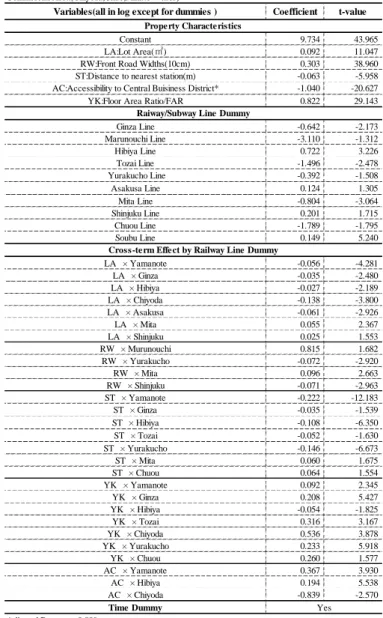
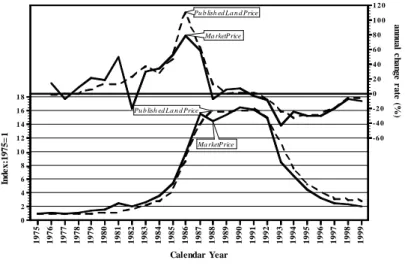
a4tDt+ε (1) Table 2 and Table 3 show the results of the Transaction Price Model and the Published Price Model respectively. Figure 1 indicates quarterly price change estimates with a time dummy factor.
In the Transaction Price Model, the adjusted R2 is 0.889. The adjusted R2 in the Pub- lished Price Model is 0.919. Both models fit substantially well, especially the Published Price Model.
The Published Price Model explains better than the Transaction Price Model. We sup- pose that one of the reasons is that transaction price data reflects actual conditions in the market and individual negotiations. This suggests that the Published Price data has been substantially adjusted in cross section thorough the appraisers’ filter.
3.3 Comparisons: Transaction Price-based Index and other indexes
In this part, we compared the Transaction Price-based Index (TPI) with the Published Price-based Index (PPI). In order to view general trends, we assumed one function through the subject period and ignored the possible structural change of the function, which we will deal with in a later section. Then the TPI is compared with theUrban Land Price Index.
3.3.1 TPI and PPI
First, for commercial land prices, Figure1 shows that PPI followed TPI with a certain lag since 1983 when land prices increased. Second, PPI rose while TPI dropped in 1982. This leads to filling the lag between two indexes. The same is true to 1986. The jump of price this year is likely to reflect the fact that the published price did underestimate the price change in the previous year. This suggests that we must be very careful when estimating market trends using published price statistics.
Third, Figure 1 shows PPI rose steadily between 1987 and 1992 while TPI looks as though the price fell in 1988 and picked up in 1999. This explanation fits better for those who got involved in the market at that time. In fact it is possible to prove by TPI that the asset price bubble started from the Tokyo area followed by the Osaka area and the Chubu (Central) area to other local cities then flooded back to Tokyo again.
Table 2: Transaction price-based Index
Dependent Variable:Log of Transaction Land Price per square Meter .Method of Estimation:OLS Variables(all in log except for dummies ) Coefficient t-value
Constant 9.734 43.965
LA:Lot Area(㎡) 0.092 11.047
RW:Front Road Widths(10cm) 0.303 38.960
ST:Distance to nearest station(m) -0.063 -5.958
AC:Accessibility to Central Buisiness District* -1.040 -20.627
YK:Floor Area Ratio/FAR 0.822 29.143
Ginza Line -0.642 -2.173
Marunouchi Line -3.110 -1.312
Hibiya Line 0.722 3.226
Tozai Line -1.496 -2.478
Yurakucho Line -0.392 -1.508
Asakusa Line 0.124 1.305
Mita Line -0.804 -3.064
Shinjuku Line 0.201 1.715
Chuou Line -1.789 -1.795
Soubu Line 0.149 5.240
LA × Yamanote -0.056 -4.281
LA × Ginza -0.035 -2.480
LA × Hibiya -0.027 -2.189
LA × Chiyoda -0.138 -3.800
LA × Asakusa -0.061 -2.926
LA × Mita 0.055 2.367
LA × Shinjuku 0.025 1.553
RW × Murunouchi 0.815 1.682
RW × Yurakucho -0.072 -2.920
RW × Mita 0.096 2.663
RW × Shinjuku -0.071 -2.963
ST × Yamanote -0.222 -12.183
ST × Ginza -0.035 -1.539
ST × Hibiya -0.108 -6.350
ST × Tozai -0.052 -1.630
ST × Yurakucho -0.146 -6.673
ST × Mita 0.060 1.675
ST × Chuou 0.064 1.554
YK × Yamanote 0.092 2.345
YK × Ginza 0.208 5.427
YK × Hibiya -0.054 -1.825
YK × Tozai 0.316 3.167
YK × Chiyoda 0.536 3.878
YK × Yurakucho 0.233 5.918
YK × Chuou 0.260 1.577
AC × Yamanote 0.367 3.930
AC × Hibiya 0.194 5.538
AC × Chiyoda -0.839 -2.570
Time Dummy Adjusted R square=0.889
Number of Observations=6,577
*Distance measured by time(minuites) required from nearest railway/subway station to major terminals (Tokyo,Shibuya,Shinjuku,Ikebukuro,Ueno,Kasumigaseki,Ootemachi)
Base Line=Yamanote
Yes Cross-term Effect by Railway Line Dummy
Property Characteristics
Raiway/Subway Line Dummy Commercial Area(Chiyoda,Chuo,Minato Wards)
Table 3: Published Price-based Index
Dependent Variable:Log of Published Land Price per square meter.Method of Estimation:OLS Variables(all in log except for dummies ) Coefficient t-value
Constant 11.883 29.046
LA:Lot Area(㎡) 0.175 14.894
RW:Front Road Widths(10cm) 0.312 18.719
ST:Distance to nearest station(m) -0.255 -18.733
AC:Accessibility to Central Buisiness District* -0.244 -2.397
YK:Floor Area Ratio/FAR 0.330 7.795
LA × Ginza -0.087 -3.774
LA × Hibiya -0.098 -4.113
LA × Chiyoda 0.070 6.136
LA × Asakusa -0.082 -8.215
LA × Mita 0.056 4.141
LA × Shinjuku -0.522 -5.090
LA × Soubu -0.124 -1.599
RW × Tozai 0.068 3.106
RW × Shinjuku 0.354 5.794
ST × Yamanote 0.055 8.338
ST × Ginza -0.053 -6.218
ST × Hibiya -0.032 -3.603
ST × Asakusa 0.055 5.246
ST × Mita -0.036 -2.623
ST × Soubu -0.047 -2.461
YK × Shinjuku 0.280 4.011
AC × Ginza -1.041 -4.486
AC × Hibiya -0.129 -2.189
Time Dummy Adjusted R square=0.919
Number of Observations=1,712
*Distance measured by time(minuites) required from nearest railway/subway station to major terminals (Tokyo,Shibuya,Shinjuku,Ikebukuro,Ueno,Kasumigaseki,Ootemachi)
Commercial Area(Chiyoda,Chuo,Minato Wards)
Property Characteristics
Cross-term Effect
Yes
Base Line=Yamanote
0 2 4 6 8 1 0 1 2 1 4 1 6 1 8
1975 1976 1977 1978 1979 1980 1981 1982 1983 1984 1985 1986 1987 1988 1989 1990 1991 1992 1993 1994 1995 1996 1997 1998 1999
-6 0 -4 0 -2 0 0 2 0 4 0 6 0 8 0 1 0 0 1 2 0
Ma rketPrice Pu b lish ed La n d Price
Ma rketPrice Pu b lish ed La n d Price
Index:1975=1
Calendar Year
annual change rate (%)
Figure 1: Transaction price-based index and Published Price-based Index
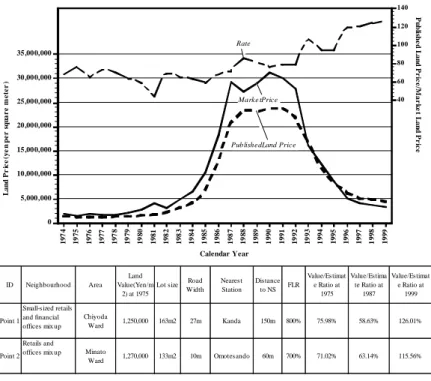
During the bubble burst economy, there was a big difference in the degree of price drop in 1993 between the commercial land price indexes. The PPI looks as if it tried to fill the gap since 1983. Currently, they argue that the level of the published price is beyond that of the market price. The indexes support this argument. The reason is that the published price did not reflect the fall of the market price fully in 1993 and still it has been behind.
The published price rose at a similar degree to the increase of the ratio of published price to transaction price. Consequently, PPI in this period shows that they made amends of their underestimation in the previous years and the inflation rate did not reflect the actual market movement. During the bubble economy, as was in the commercial land index, PPI chased TPI with some time lag.
3.3.2 TPI and Urban Land Price Index
We move to our analysis of the commercial land index in the biggest six cities with the Urban Land Price Index (indexes are adjusted as 1990=100).
First, Figure 2 describes two commercial land price indexes that illustrate totally different patterns. The samples of transaction price index come from the three core wards of Tokyo as opposed to the six biggest cities for ULPI. This clearly appears in the bubble years when the sharp price rise happened in the core wards of Tokyo followed by the surrounding wards, urban cities and further local areas.
ULPI has been heavily smoothed when the inflation rate is dispersed between surveyed areas since they have given no weighing for the samples. Consequently, care must be taken