Communication Strategy Research Among Japanese EFL Learners
BURROWS,Christian FacultyofEducationforFutureGenerations DepartmentofClassroomManagement 次世代教育学部学級経営学科 C.バロウズ
抄 録:Thisresearchrepresentsayear-longlongitudinalstudyintotheaffectsofcommunication strategyinstructiononspeakingproficiency.ThepaperreplicatesresearchcarriedoutbyNakatani (2005)andaimstoequipJapaneseEFLlearnerswiththelinguisticandproblem-solvingskillsto overcomelinguisticbarriers.Thefindingsindicateclearlythatinfluenceofprominentsocio-cultural factorshavetobeconsideredinordertomaximizethefulleffectivenessofstrategyuse.
キーワード:communicationstrategies,speakingproficiency,problem-solvingability Overview
Asmall-scalepilotstudywasconductedtorefinethe researchinstrumentsanddatacollectionprocedures tobeemployedinthefull-scalePh.D.experiment.
The objective was the replication of Nakatani’s 2005paperexaminingtheextentofcommunication strategy use on Japanese EFL learners speaking proficiency. The research replicated Nakatani’s paperintermsofresearchobjectives,methodological procedures, and teaching targets. Additionally, it examined the extent communication strategy- basedinstructioninfluencedJapaneseEFLlearners in their attempts to overcome linguistic barriers.
Unlikemuchofpreviousresearch,oftenconducted withtask-determinedactivities,thisresearchpaper evaluatedtherelationshipbetweencommunication strategies and their application during authentic interaction. Adhering to Nakatani’s strategy training,studentsparticipatingintheexperiment groupreceivedadditionalinstructiononCSuseand itspracticalbenefits,inadditiontostandardEnglish instruction. Findings, however, contrast with thoseofNakatani,andonlytentativelysupportthe teachingofcommunicationstrategies.Itisproposed thisresultsfromanover-relianceonreduction-type communicationstrategiesduetocognitiveretrieval
difficultieswhichstemfromsocio-culturalinfluences.
Introduction
Recognition of variance within ‘transitional competenceʼ(Corder,1967:166)promptedinitial researchintolearnertechniquesemployedduring languagedevelopment.Theresultingisolationof internal strategies resulted in the identification, classification, and description of communication strategies (CSs) representing a learner reliance on compensatory techniques to accomplish their communicative goal. Early empirical studies (Selinker,1972;Taroneetal.,1976)focusedonthetypes oflearnercompensationduetoinadequatelinguistic competence,predominantlyaddressingstructuralor descriptiveanalysisoferroranalysis.Recognitionof thiscompetence,termedcommunicativecompetence by Hymes (1972), derives from Chomsky’s distinction between the underlying knowledge of alanguagestructure,fromtheapplicationofthat knowledgetolanguageuse.Subsequentresearch (Rubin, 1990) advocated teaching the techniques to those less proficient in order to reveal the processesundertakenbymoreprodigiouslearners.
ConsiderableresearchintoCSacquisition,inaddition totheinfluenceexertedonlanguagedevelopment
日本人学習者間のコニュニケーション戦略の研究
has been conducted predominantly with learners fromindividualisticcountries(Hofstede,2005),whose L2(bothgrammatically,typologically)andlearning experiencessharecommonfeatureswiththosefrom theL1country.Thedistinctiondrawbetweenthese two culture models proposed by Hofstede (2005) showsthatindividualdifferencesinpatternsofCSs usecanbeattributedtocognitivestyle(Littlemore, 2001), for example, Japanese learners’ lack of
“proceduralknowledge”toassistthemanagementof interactionsproactivelyandeffectively(Ross,1998).
Therefore,learnersmoreversedinteacher-centered learningapproaches,andfacedwithagrammatically oppositeL1,arelikelytoexperiencemoredifficulty adjustingtothedemandsintheuseandacquisition oftheseskills.
Although substantial evidence (Faerch & Kasper, 1983;Willems,1987;O’Malley,1987;Tarone&Yule, 1989)corroboratesCSsteachabilityandacquisition, theorderofacquisition,howtheCSsaresystemized, andtheselectiveprocessremainslessexplored.It remainsunclearifsomeareacquiredandemployed at the same rate, or in stages according to their cognitivedifficulty,easeofuse,orlearnerfamiliarity.
Does a selective cognitive process occur which differentiates between the different skills due to cognitive, cultural or linguistic complexity? Are someselectedattheexpenseofothers,anddoany posedifficultiesforJapaneselearners?Theextent towhichJapaneselearnersselect,use,andacquire linguisticCSandtherationale(ifany)behindtheir choicesarethefocusofthisresearchpaper.
Research Questions
Fourmajorresearchquestionsaddressedtheeffects ofCSinstructiontoJapaneseEFLlearnersengaged inauthenticinteraction.Multipledataprocedures wereemployedtoassessthepresenceofcomparable similaritiesamonglearnersforstrategyacquisition.
While the assumption that learners can acquire CSs,thedegreeoftheireffectivenessonspeaking performanceisnotwithinthescopeofthisresearch.
Thespecificresearchquestionsaddress:
1. CSs influence on improvement in linguistic proficiency.
2. ThedegreeofCSsutilizationduringauthentic interaction.
3. Ifimprovementbeaccountedforbytheuseof CS.
4. JapaneseEFL’sCSadoptionandtheextentof socio-culturalinfluencesonthischoice.
Setting and subjects
ThereplicationstudywasconductedfromOctober 2010 to August 2011 at the private International PacificUniversity(IPU),Japan.Twenty-fivethird- yearundergraduatestudents(tenmalesandfifteen females;averageage:20)participatedassubjects intheexperiment.Allstudentswereenrolledin a 15-week Advanced Oral Communication class (90 minutes per week). IPU university equates to a British teacher-training college, with the majority of graduates receiving teaching licences andprogressingtopositionsinprimaryeducation.
TheAdvancedOralCommunicationcourseaimsat equippingstudentswiththelanguagecompetency tobecomeEnglishlanguageteachers,inadditionto thelinguisticcompetencetoteachintheL2.English language classes at the university are streamed accordingtostudentplacementscoresonawritten Englishexam(SLEP)takenatthecommencementof thesemester.OverallEnglishspeakingproficiency ranged from high-beginner to low intermediate, (TOEICscoresrangingfrom350to450;0-990score range).Consistentwithfalse-beginners,adetailed knowledgeofEnglishgrammarrulesbeliesweak speakingproficiency,despiteincreasingemphasis placed on communicative language classes at secondaryschoolsinJapan.Eachstudent,whohad completed6yearsEnglishstudypriortouniversity, took a speaking proficiency test (IELTS scale) conductedbytheauthor,withresultsbeingverified byafellownativeEnglishspeakingteacher.Results fromthelevelcheck(t=1.437,p=0.159)indicatean evenleveldistributionbetweenboththecontroland theexperimentclass.Thecorrelationbetweenthe
oralpretestandtheplacementtestwas0.123using thePearsonproduct-momentcorrelationstatement ofthestatisticalrelationshipbetweenthetwosetsof scores.Theaveragescoreforboththeexperimental andcontrolgroupswas83%(mean:68%,SD:8.2).
Teaching procedures
The Advanced Oral Communication syllabus was adhered to for both groups, in addition the experimentalgroupalsoundertooksupplementary traininginCSsinstructionthroughoutthecourse.
CSsinstructionwasexplicit,andstudentsinformed that CSs represent skills which can be employed to assist speaking performance. Each skill was incorporated into activity training and practiced toovercomelinguisticbarriersduringinteraction.
These skills included achievement and reduction strategies and were chosen as they covered the widest range of CSs. Upon course completion interactionfrombothgroupswasevaluated.
Data Collection Instruments and Procedures
The nature of authentic interaction necessitates a combination of multiple assessment methods for empirical data collection. Statistically proven measurements of linguistic features (e.g. word count) addressed the observed interaction, while underlying cognitive processes were evaluated throughextensivestudentfeedback.Althoughthe limitationsofassessmentproceduresarerecognized, each provides important insights regarding the observable and unobservable data required an overall evaluation of linguistic and cognitive influencesexertedduringCSsuse.
The Pretest Interview.
Initial evaluation of overall linguistic proficiency tookplacethroughpairedstudentinteraction.To allow an impressionistic evaluation of student Englishspeakingproficiencytheelicitationmethod composed of student interviews. The questions, providedinadvance,elicitedopinionsontopicswith
immediacytouniversitylife.Itwasexplainedthat no‘correct’answerexistedintermsofopinion,and students were encouraged to express themselves freely.Torelieveaffectivefactors(studentanxiety, nervousness) it was also clarified that the data contributed to the author’s private research and wouldnotaffectfinalassessment.Theinterviews werevideo-recordedandcarriedoutinaseparate classroom with only the author observing the interaction.Allinteractionswerelatertranscribed anddetailsofthediscoursewereanalysedforthe followingquantitativedata:
a. Thequantityofspeechproducedperstudent peranswer(wordsperc-unit)
b. TheextenttowhichCSsusewasexhibitedin studentresponses
Theratingassignedrepresentedanimpressionistic ratingofthestudent’soveralllinguisticproficiency according to the IELTS grading scale which evaluates performance on a 1~9 scale (the scale focusesonthelearner’sfluency,abilitytointeract withtheinterlocutor,andflexibilityindeveloping dialogue).Astheauthortookpartintheevaluation, and in recognition that several years’ residence in Japan enables me to comprehend aspects of communicationsomeoneunaccustomedtoJapanese learnersmaynotperceive,oneindependentnative Englishteacheratthesameuniversitywasaskedto co-rateusinganidenticalscale.Theteacherrated asampleofaudiorecordingsoftheinteractionsto minimize student recognition student influencing evaluation.
The posttest interaction.
Uponcoursecompletionafinalobservedinteraction wascarriedout.Inidenticalconditionstopretest interviews, interactions were conducted in a separate classroom with only two students and theauthorpresent.Video-recordingallowedscore verificationbyindependentraters.Tocombatthe significance of rehearsed answers, a significant factor which occurred in the initial interview,
onlygeneraltopicoutlineswhichwouldbeasked about were provided in advance. Without an element of preparation it was felt that linguistic proficiencywouldnotbesufficienttoprovidethe datarequired.Anidenticalscaleemployedtoassess languageabilitywasemployedinbothinterviews.
Independentraterswereaskedtowatchasample ofinteractionsandallocateascorefrom0~9.No informationwasprovidedbeforehandandtheraters were informed to only offer an impressionistic assessmentofstudents’overallspeakingproficiency.
Studentswerenotadvisedhowtoanswerinorder toensuretheelicitationofthekindofdatasought in the study. Different tasks for the pre- and posttest were employed to avoid improvement of scoresthroughfamiliarizationwiththetestcontent.
Cards contained hypothetical situations, and studentswereexpectedtocontinuetheinteraction until an acceptable conclusion had been reached.
The interrater reliability of the pre- and posttest estimatedbyCronbach’salphawas0.863and0.765,a highdegreeofcoefficiency.
Stimulated recall interview.
TheunobservablenatureofnumerousCSsdictates thatcomprehensivedatacollectionisunobtainable through observation entirely. Surface evidence fromobservationsfailtoyieldinsightintothecovert strategicthinkingofthespeakeras:
[…]itisnoteasytogetinsidethe‘black box’ofthehumanbrainandfindoutwhat is going on there. We work with what wecanget,which,despitethelimitations, providesfoodforthought[…](p.54)(Grenfell andHarris,1999)
Torevealtheunderlyingcognitiveprocessesand cognitivefunctioningafurthercognitiveassessment method was additionally employed. Immediately uponcompletionoftheinteractionstudentswere askedtoreflectontheirthoughtprocesses,strategic thinking and how they answered during the discourse.ThequestionsrelatedtoCSsuseandany
communicativeproblemsencountered,particularly regarding the message they wished to convey and what was eventually conveyed. Students wereinformedtoverbaliseonlywhattheyclearly remembered without guessing or inferring. The immediacyofthequestionnairewastorecordinitial reactions when the information was most salient.
Studentswerealsoinformedonlytoprovidedetails of thought processes during the interview, and notassessmentoftheinteraction.Thequestions pertained to communication problems and CSs duringtheinterviewstage.
Results and Discussion
Resultsofthequantitativeanalysisofdataattained arepresentedbelow.Thesepertainspecificallyto thefourresearchquestionsalreadystated.That is,CSsinfluence;CSsutilization;theextentofCSs adoption.
Research Questions 1 :
The impact of strategy use on overall improvement in linguistic proficiency.
Analysisoflanguageproficiencymodificationduring bothpre-andposttestwasconductedusingpaired- samplesttest(two-tailed)(seeTable1).Thefindings revealthat,unlikeNakatani’sconclusionsshowing significanttraininggroupimprovement(gain:1.38), resultsshowamoremodestgaininspeechscores (meangain:0.63,t=3.03,p<0.4).Revealingly,the averagegainforthecontrolgroupsurpassedthat ofNakatani’sresearch(gain:0.25)whichsuggests improvementwithouttheneedforCSinstruction.
ThedifferencebetweenthegainsforNakatanifor thetwogroupswas1.08comparedwith0.47which reveals less CSs acquisition and use among the experimentalgroup.Thisappearsdespitethefact thatNakatani’sstudentsappeartobeconsiderably lowerlevel.
An alternative means of quantitatively assessing performance includes analyzing the length and grammaticalcomplexityoftestresponses.Speech productionreferstothequantity(words)students useintheiranswers.Thedurationofanswers(c-unit) has been shown as a means of assessing overall oralcompetence.Theresults(seeTable2)indicate theproblemofunder-elaborationamongstudents.
Reflectingasocio-culturalinfluenceitillustratesa reluctanceoflearnerstousethetestopportunityto displaytheirlinguisticability.Conversely,without constant questioning, the learner relies on the minimuminformationtoconveytheirmessage.
Table 1. Results of t tests on Test Score Gains between the Two Groups Group
Pretest Posttest
Df M(SD) M(SD) Gain t p
n
StrategyTraining 21 4.00 4.63 0.63 3.03 .04
Group 18 (0.86) (0.72) 0.38 0.89 0.87
(n=20) 3.65 4.03
ControlGroup (0.67) (0.60)
(n=20)
Table 2. Comparison of the Two Group’s Production Rate on Pre- and Posttest by t tests StrategyTrainingGroup ControlGroup
(n=20) (n=20)
M SD M SD t p
Pretest 1.89 0.51 1.67 0.58 0.9 ns
Posttest 1.99 0.47 1.88 0.67 0.87 ns
Research Questions 2 : Student CSs use during interaction
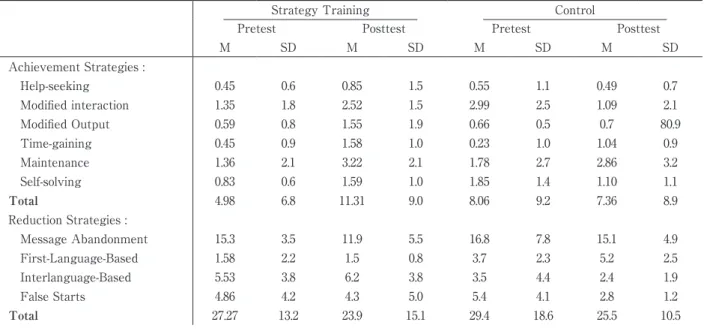
Aspartoftheanalysisofstudentspeechproduction, theextenttowhichrecordableCSswereemployed was also measured. It is recognized that the reliability of measurement is partially subjective and that reliability and accuracy of CSs use can significantly influence data analysis. However, resultsindicateaclearpreferenceforreduction-type strategies. Whether this represents a deliberate choiceofthelearners,ortheresultoflackofsuccess at cognitive retrieval processing ability requires clarification.
Table 3. Means and Standard Deviations of Strategy Use on Pre- and Posttest
StrategyTraining Control
Pretest Posttest Pretest Posttest
M SD M SD M SD M SD
AchievementStrategies:
Help-seeking 0.45 0.6 0.85 1.5 0.55 1.1 0.49 0.7
Modifiedinteraction 1.35 1.8 2.52 1.5 2.99 2.5 1.09 2.1
ModifiedOutput 0.59 0.8 1.55 1.9 0.66 0.5 0.7 80.9
Time-gaining 0.45 0.9 1.58 1.0 0.23 1.0 1.04 0.9
Maintenance 1.36 2.1 3.22 2.1 1.78 2.7 2.86 3.2
Self-solving 0.83 0.6 1.59 1.0 1.85 1.4 1.10 1.1
Total 4.98 6.8 11.31 9.0 8.06 9.2 7.36 8.9
ReductionStrategies:
MessageAbandonment 15.3 3.5 11.9 5.5 16.8 7.8 15.1 4.9
First-Language-Based 1.58 2.2 1.5 0.8 3.7 2.3 5.2 2.5
Interlanguage-Based 5.53 3.8 6.2 3.8 3.5 4.4 2.4 1.9
FalseStarts 4.86 4.2 4.3 5.0 5.4 4.1 2.8 1.2
Total 27.27 13.2 23.9 15.1 29.4 18.6 25.5 10.5
Research Questions 3 :
Can any improvement be accounted for by the use of CS?
If so, how does CS use effect speaking proficiency.
Inordertoassesswhetheranycorrelationexisted between students who performed well on the posttest(scoresover85%)andCSuse,acorrelation study was conducted. The results (see Table 4) indicatesastrongcorrelationbetweenthestudents’
testperformanceandCSsemployment.Thissupports thetheoryofthebeneficialinfluenceonspeaking performancethroughCSsuse.
Research Questions 4 :
JapaneseEFL’sCSadoptionandtheextentofsocio- culturalinfluencesonthischoice.
Within the framework of psycholinguistic theory of speech production, the learners experienced problemsinallphasesofspeechproduction,from conceptualizationtoarticulation(Levelt,1989,1993, 1999 ; de Bot, 1992 ; Dornyei & Kormos, 1998).
Based on the definition of CSs as the learners’
“conscious plans” to deal with communication barriers, the identification of CSs (based on the studentfeedback)clearlyindicatedtheirintention todealwiththeproblem.However,thedatashows ahighpreferenceforavoidancestrategieswhichis consistentwithotherresearchfindings.Theauthor hypotheses that this is the result of a conscious decision to overcome mental retrieval difficulties that could be more prevalent in collectivist countries.Basedonthelexicalaccesstosyntaxand morphophonologyinLevelt’smodel,learnerscould avoidusingtheproblematiclexicalitemandemploy avoidance techniques as compensation for this failure.
Conclusion
It is proposed that if Japanese EFL learners are awaretouseCSsitcanoffergreateropportunities to improve their speaking proficiency through development of an understanding of how to overcomethesebarriers.However,counteracting this theory exist numerous socio-cultural factors which also exert a significant influence on the languagelearningprocess.Thelanguagedistance betweenEnglishandJapaneseensuresthatlearners ofbothlanguageswillencounternumerousdifficulties duringdiscourseduetothelackofsimilaritywhich existsbetweenthetwolanguages.Fromtheresults ofthispaperandotherresearchintocommunication problemsitisclearthatmostproblemsoccurdue tolinguisticrelateddifficulty.Asmanyas90%of CSs(Satou,2008)areselectedtodealwithlexical problems.Howlearnerscopewiththesedifficulties dependsontheirabilitytoprocesswordretrieval duringtheplanningstageofwordproduction.The extenttowhichsocio-culturalfactorsinfluencethis processrequiresclarification,especiallyintermsof collectivistlearnerlearningexperiences.
References
Corder, S. P. (1967). The significance of learners’
errors.IRAL,5,161-170.
Færch,C.,&Kasper,G.(Eds.).(1983a).Strategies in interlanguage communication.London:Longman.
Dornyei, Z., & Kormos., J. (1998). Problem- solvingmechanismsinL2communication:A psycholinguisticperspective.StudiesinSecond LanguageAcquisition,20(3),349-385.
Hofstede, G. (2005). Cultures and organizations. - software of the mind (2nd ed.). New York : McGrawHill.
Hymes, D. (1972). On communicative competence.
InJ.B.Pride&J.Holmes(Eds.),Sociolinguistics (pp.269-293).Harmondsworth:Penguin.
Littlemore, L. (2001). Metaphoric competence : A languagelearningstrengthofstudentswitha holistic cognitive style?TESOL Quarterly, 35, 459-491.
Levelt,W.J.M.(1989).Speaking.Cambridge,Mass.:
Table 4.
Correlation between posttest scores and communication strategy use
Achievement Reduction strategies strategies
r r
Experimental 3.02 4.56
group
Control 2.96 3.59
group
M.I.T.Press.
Levelt,W.J.M.(1993).Thearchitectureofnormal spokenlanguageuse.InG.Blanken,J.Dittmann, H. Grimm, J. C. Marshall, & C. W. Wallesch (Eds.),Linguistic disorders and pathologies : An international handbook(pp.1-15).Berlin:Walter deGruyter.
Nakatani,Y.(2005).Theeffectsofawareness-raising training on oral communication strategy use.
Modern Language Journal,89,76-91.
Selinker,L.(1972).Interlanguage.IRAL,10(3),209-231.
Tarone, E. (1977). Conscious communication strategiesininterlanguage:Aprogressreport.
in
H.Brown,C.Yorio&R.Crymes(Eds.),OnTESOL
’77 (pp.194-203). Washington, D. C. : TESOL.
Tarone, E., & Yule, E. (1989).Focus on the language learner. Oxford : Oxford University Press.