Sub Title
Cerebral responses to infant-directed speech and the effect of talker
familiarity
Author
直井, 望(Naoi, Nozomi)
皆川, 泰代(Minagawa Kawai, Yasuyo)
小林, 愛(Kobayashi, Ai)
山本, 淳一(Yamamoto, Junichi)
小嶋, 祥三(Kojima, Shozo)
Publisher
三田哲學會
Publication
year
2009
Jtitle
哲學 No.121 (2009. 3) ,p.147- 158
Abstract
A number of behavioral studies suggest that infant-directed speech
(ID) plays a more important role in facilitating both: a) speech
perception, and b) infant social interactions than does
adult-directed speech (AD), and hence that ID contributes to subsequent
social and language development. However neural substrates that
may underlie these ID functions have not been examined. The
present study examined cerebral hemodynamic responses to ID in
48 infants (3-13 months of age) using near-infrared spectroscopy
(NIRS). Japanese sentences uttered by the infants own mothers and
by unfamiliar mothers were used to record activations in temporal
and frontal area separately. Increased activations were observed
predominantly in infants left and right temporal areas when they
listened to ID rather than to AD when both involved voices of their
own and unfamiliar mothers. In contrast, significantly greater
activations were observed in the frontal area when infants listened
to ID produced by their own mothers, not when ID arose from
unfamiliar mothers. Together, these findings suggest that: a) ID, but
notadult directed speech, increases cerebral activity in the temporal
area of infants whether produced by a familiar or unfamiliar voice;
and b) ID specific to the voice of an infant's own mother facilitates
activity in the frontal areas.
Notes
特集 : 小嶋祥三君退職記念
投稿論文
Genre
Journal Article
Cerebral Responses to Infant-directed Speech and
the E#ect of Talker Familiarity
Nozomi Naoi, Yasuyo Minagawa, Ai Kobayashi, Jun-Ichi Yamamoto, and Shozo Kojima
A number of behavioral studies suggest that infant-directed speech (ID) plays a more important role in facilitating both: a) speech perception, and b) adult-infant social interactions than does adult-directed speech (AD), and hence that ID contributes to subsequent social and language development. However neural substrates that may underlie these ID functions have not been examined. The present study examined cerebral hemodynamic responses to ID in 48 infants (3ῌ13 months of age) using near-infrared spectroscopy (NIRS). Japanese sentences uttered by the infants῎ own mothers and by unfamiliar mothers were used to record activations in temporal and frontal area sep-arately. Increased activations were observed predominantly in in-fants῎ left and right temporal areas when they listened to ID rather than to AD when both involved voices of their own and un-familiar mothers. In contrast, significantly greater activations were observed in the frontal area when infants listened to ID pro-duced by their own mothers, not when ID arose from unfamiliar mothers. Together, these findings suggest that: a) ID, but not
1 慶應義塾大学文学部ῌ2日本科学技術振興機構ῌ CRESTῌ3 慶應義塾大学社会学研 研究科
投 稿 論 文
近赤外分光法を用いた対乳児音声に
関与する脳反応の検討
直 井 望1, 2῍皆 川 泰 代1῍小 林 愛3῍山 本 淳 一1, 2῍小 嶋 祥 三1, 2 ῏147ῐadult directed speech, increases cerebral activity in the temporal area of infants whether produced by a familiar or unfamiliar voice; and b) ID specific to the voice of an infant’s own mother fa-cilitates activity in the frontal areas.
対乳児音声とは
大人が乳幼児に語りかける際の語りかけにはある特定のパタ῍ンの変化 が見られῌ 大人に話かける場合と比較してῌ 全般的にピッチが高いῌ ピッ チの変化幅が大きく抑揚が豊かであるῌ テンポがゆっくりであるῌ 発話が 短く休止が長いῌ などの特徴が見られる (Fernald & Simon, 1984; Snow & Ferguson, 1977; Stern, Spieker, Barnett, & MacKain, 1983; Stern, Spieker, & MacKain, 1982).このようなῌ 乳幼児に話かける際に特徴的 な音声を対乳児音声 (infant-directed speech) と呼ぶ (Cooper & Aslin, 1990, 1994; Pegg, Werker, & McLeod, 1992; Werker & McLeod, 1989).
選好聴取法などの行動指標を用いた先行研究の結果ῌ 乳児はῌ 大人に話 かけるときの音声 ῏以下ῌ 対成人音声とするῐ と比較して対乳児音声に選 好を示すことが通言語的に明らかになっている (Fernald, 1989; Pegg et al., 1992; Werker & McLeod, 1989).さらにῌ 乳幼児はῌ 話し手が女性 の場合だけでなくῌ 男性の場合においてもῌ 対成人音声と比較して対乳児 音声を選好することからῌ 対乳児音声は話し手の性別にかかわらず選好さ れるようである (Pegg et al., 1992; Werker & McLeod, 1989). 対乳児音 声への選好はῌ 生後すぐから見られる (Cooper & Aslin, 1990) がῌ 選好 の程度は子どもの月齢によって変化しῌ 生後 7῎9 ヶ月においてῌ 対乳児 音声への選好が減少しῌ 生後 11 ヶ月以降から再び対乳児音声が選好され るという U 字型の発達パタ῍ンを示す傾向があることが示唆されている (Hayashi, Tamekawa, & Kiritani, 2001).
を用いた検討が行われている῍ それらの研究の知見からῌ 対乳児音声は単 語や節の分節化を促進することが示唆されている (Kemler Nelson, Hirsh-Pasek, Jusczyk, & Cassidy, 1989; Thiessen, Hill, & Sa#ran, 2005).ま たῌ 対乳児音声においてῌ 母音が強調されて構音されることが通言語的に 見られるがῌ 母親が母音を強調して構音する程度が高い母親の子どもはῌ 生後 6῏12 ヶ月の音韻弁別能力が高いことが示唆されておりῌ 母子間の 交互作用における対乳児音声の使用がῌ 乳幼児の後の言語発達を促進する 可能性が示唆されている (Kuhl et al., 1997; Liu, Kuhl, & Tsao, 2003)῍
対乳児音声が乳児の発達に及ぼす効果についてはῌ 言語獲得との関連だ けでなくῌ 社会性の発達との関連が示唆されている῍ 対乳児音声は対成人 音声と比較して乳児の注意を引くことが示されている (Cooper & Aslin, 1990, 1994; Fernald, & Simon, 1984; Pegg et al., 1992; Stern et al., 1982; Werker & McLeod, 1989).またῌ 乳児はῌ 対乳児音声に対して対 成人音声と比較して笑顔などのポジティブな情動を示すことが報告されて いる (Fernald, 1989; Werker & McLeod, 1989). これらの知見からῌ 対 乳児音声はῌ 乳幼児の発達においてῌ 1) 乳幼児の音声知覚ῌ 言語理解を 促進しῌ 2) 社会的相互作用を促進するῌ という 2 つの効果を持つことが 考えられる῍
対乳児音声の神経基盤に関する研究
対乳児音声がῌ 対成人音声と比較してῌ 乳児の注意を引きῌ ポジティブ な情動を引き出しῌ さらにῌ 音声言語処理を促進するのであればῌ それに 対応した脳機能の変化が起こることが推測される ῐ直井῎山本ῌ 2007ῑ῍ しかしῌ 対乳児音声処理の神経基盤について検討を行った研究は少ない῍ Dehaene-Lambertz, Dehaene, & Hertz-Pannier (2002)は生後 2῏3 ヶ月 齢の乳児においてῌ 対乳児音声刺激を順行再生した刺激と逆行再生した刺 激を提示している間の脳活動をῌ fMRI を用いて検討した῍ その結果ῌ 音が提示されていない無音条件と比較するとῌ 順行条件と逆行条件の両条件 において左側頭葉で大きな活動が見られた῍ またῌ 近赤外分光法 (Near In-frared Spectroscopy; NIRS)を用いた検討によってῌ 生後 2῎5 日の新生 児においてῌ 順行再生された対乳児音声を聴取している条件でῌ 無音条 件ῌ 逆行再生条件と比較してῌ 左側頭葉の活動が上昇することが示されて いる (Pena et al., 2003). しかしῌ これらの研究はῌ 対成人音声と対乳児 音声に対する脳反応の比較は行っていない῍
乳幼児を対象にῌ 対成人音声と対乳児音声聴取時の脳活動を比較した研 究はほとんどない῍ Zangl & Mills (2007) はῌ ERP を用いた研究におい てῌ 既知語が対乳児音声と対成人音声で提示された場合ῌ 生後 6 ヶ月児 と 13 ヶ月児はῌ 左半球に有意に高振幅の陰性電位 (N600῎800) を示し た῍ またῌ 生後 13 ヶ月児はῌ 既知語に対して左側頭と左頭頂領域に有意 に高振幅の陰性電位 (N200῎400) を示した῍ Saito et al. (2006) はῌ NIRSを用いた研究によってῌ 新生児がῌ 自分の母親によって同じ物語が 対乳児音声と対成人音声で読まれた刺激を聴取したときῌ 対乳児音声条件 においてῌ 対成人音声条件と比較して有意に前頭の活動が上昇したという 結果を得ている῍ しかしῌ より年長の乳幼児においてῌ 対成人音声と対乳 児音声の聴取によって前頭部の脳反応にどのような違いが見られるかにつ いては明らかになっていない῍ またῌ Saito et al. (2006) はῌ 各参加児の 母親の音声のみを刺激として用いていることからῌ 対乳児音声を聴取時の 前頭部の脳活動の上昇がῌ 対乳児音声の話し手が乳児にとって親近性の高 い母親の音声を聴取した場合にのみ見られるのかῌ 話し手の親近性にかか わらず見られるのかは明らかになっていない῍
対乳児音声に対する脳活動の検討
そこでῌ Naoi et al. (under revision) はῌ 健常乳幼児を対象にῌ 同じ 文章が対乳児音声ῌ または対成人音声によって読まれた刺激を用いῌ 対乳
児音声に関与する脳反応をῌ 側頭部および前頭部において NIRS を用い て計測しῌ その神経基盤について検討を行った῍ またῌ 乳児が自分の母親 の音声を聴取した ῑ自分の母ῒ 条件とῌ 未知の母親の音声を聴取した ῑ未
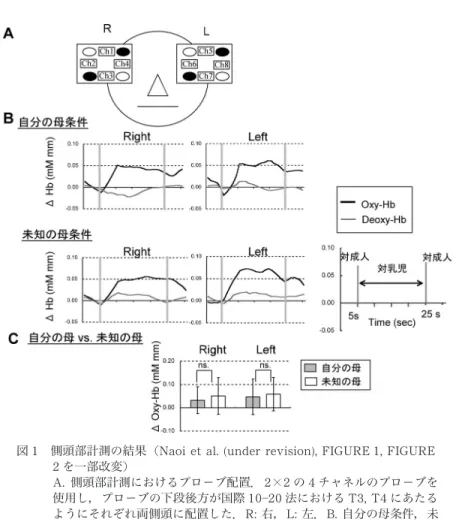
図 1 側頭部計測の結果 ῏Naoi et al. (under revision), FIGURE 1, FIGURE 2を一部改変ῐ A. 側頭部計測におけるプロ῎ブ配置῍ 2ΐ2 の 4 チャネルのプロ῎ブを 使用しῌ プロ῎ブの下段後方が国際 10ῌ20 法における T3, T4 にあたる ようにそれぞれ両側頭に配置した῍ R: 右ῌ L: 左῍ B. 自分の母条件ῌ 未 知の母条件におけるῌ 左右側頭部の Oxy-Hb, および Deoxy-Hb の変 化῍ 左右各 4 チャンネルの反応の平均値を図示した῍ 自分の母条件ῌ 未 知の母条件の両条件においてῌ 対乳児音声が提示されている区間におい てῌ 有意な Oxy-Hb の上昇が見られた῍ C. 自分の母条件ῌ 未知の母条 件における対乳児音声への反応῍ Oxy-Hb の変化量に話し手の効果は見 られなかった῍ ῏151ῐ
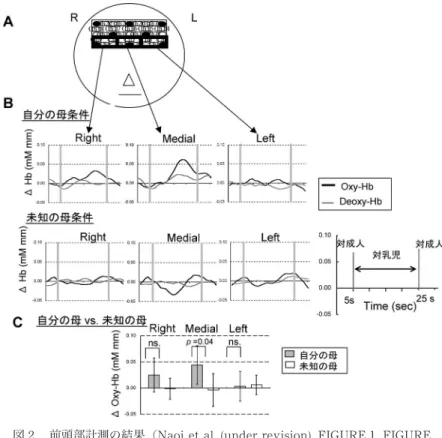
図 2. 前頭部計測の結果 ῏Naoi et al. (under revision), FIGURE 1, FIGURE 3を一部改変ῐ A. 前頭部計測においてはῌ 3ῑ5 の 22 チャンネルのプロ῎ブをῌ 下段 が Fp1ῌFp2 ラインに相当するように配置した῍ またῌ Fp1ῌFp2 ライ ンと鼻根と後頭極を結んだラインが交差する点をプロ῎ブの中心とし た῍ R: 右ῌ L: 左῍ B. 前頭左右ῌ および中央部の Oxy-Hb, および De-Oxy-Hbの変化῍ 前頭下部を右 (Ch4, Ch8, Ch9), 中央 (Ch2, Ch3, Ch7), 左 (Ch1, Ch5, Ch6) の 3 領域に分けῌ それぞれ 3 つのチャンネルを平均 した値を図示した῍ 前頭中央部においてῌ 自分の母条件においてのみῌ 対乳児音声が提示されている区間においてῌ 有意な Oxy-Hb の上昇が 見られる῍ C. 自分の母条件ῌ 未知の母条件における対乳児音声への反 応῍ 前頭中央部において話し手の効果が見られῌ 自分の母条件におい てῌ 未知の母条件よりも有意に高い Oxy-Hb の上昇が見られる῍ ῍ Naoi et al. (under revision) の図を一部を改変῍
知の母条件ῑ を比較した῍ その結果ῌ 側頭部の計測においてはῌ 自分の 母ῌ 未知の母の両条件においてῌ 左右側頭部においてῌ 対成人音声と比較 して対乳児音声に対してῌ 有意な酸化ヘモグロビン (Oxy-Hb) の上昇が見 られた῍ 側頭部計測においてはῌ 対乳児音声に対する脳活動にῌ 話し手の 親近性の効果は見られなかった ῏図 1ῐ῍ またῌ 前頭部計測の結果においてはῌ 自分の母条件においてのみῌ 前頭 中央部においてῌ 対成人音声と比較して対乳児音声に対して有意に Oxy-Hbの上昇が見られた῍ 未知の母条件においてはῌ 右前頭部ῌ 前頭中 央部ῌ 左前頭部のいずれにおいてもῌ 対成人音声と比較して対乳児音声に おいてῌ 有意な Oxy-Hb の上昇は見られなかった῍ またῌ 対乳児音声へ の脳活動をῌ 話し手条件間で比較するとῌ 前頭中央部においてのみῌ 自分 の母条件でῌ 未知の母条件と比較して有意に高い Oxy-Hb の変化が見ら れた ῏図 2ῐ῍ またῌ 年齢の主効果が有意な傾向にありῌ 7῎9 ヶ月群にお いてῌ 4῎6 ヶ月群ῌ 10῎13 ヶ月群よりも有意に高い Oxy-Hb の変化量 がみとめられた῍
考察と展望
Naoi et al. (under revision)の結果からῌ 側頭部計測においてῌ 自分の 母ῌ 未知の母両方の対乳児音声に対してῌ 対成人音声と比較して左右聴覚 野近傍の有意な賦活が見られた῍ この結果はῌ fMRI や NIRS を用いた先 行研究においてῌ 対乳児音声に対して側頭部の有意な賦活が見られた結果 と一致する (Dehaene-Lambertz et al., 2002; Pena et al., 2003)῍ しか しῌ 対乳児音声に対する脳活動の左右側性化 ῏ラテラリティῐ について はῌ 先行研究においてはῌ 生後すぐから左側頭領域との関連が示唆されて いる (Pena et al., 2003; Zangl & Mills, 2007) がῌ 本研究においてはῌ 対 乳児音声に対してῌ 左右両側頭部で有意に高い活動が見られた῍ 先行研究 と本研究において見られるラテラリティの違いについてはῌ 刺激の提示方
法やῌ 刺激の音響的特性の違いがかかわっていることが考えられる῍ 音声 刺激へのラテラリティの割合はῌ 刺激の音響的特徴によって変化すること が示唆されている (Dehaene-Lambertz et al., 2005; Minagawa-Kawai, Mori, Hebden, & Dupoux, 2008; Poeppel, 2003)῍ 全般的にῌ 音韻のよ うに持続時間が短く急速に変化する分節的特徴は左半球優位にῌ プロソ ディのようにῌ 持続時間が長い超分節的特徴はῌ 右半球優位に処理される ことが示されている (Perkins, Baran, & Gandour, 1996; Poeppel, 2003)῍ 先行研究においてはῌ 無音条件と順行再生条件ῌ または順行再生条件と逆 行再生条件が比較されていたためῌ 刺激の分節的特徴に対する反応とし てῌ 左半球優位の活動が示されていたことが考えられる῍ 本研究において はῌ 対成人音声刺激と対乳児音声刺激で同じ文章刺激を用いたためῌ 対成 人音声刺激と対乳児音声刺激の分節的特徴の違いは先行研究と比較して小 さいと考えられる῍ よってῌ 対乳児音声刺激と対成人音声刺激間の音響的 違いが主にῌ 対乳児音声の特徴である高い平均ピッチや大きいピッチレン ジなどのプロソディの側面に見られῌ 右側頭部においても有意な活動が見 られた可能性も考えられる῍ 前頭部計測においてはῌ 自分の母条件においてῌ 対乳児音声に対して正 中線上の前頭中央部に有意に高い賦活が見られた῍ またῌ 前頭中央部にお いてῌ 側頭部計測においては見られなかった話し手の親近性の効果が見ら れῌ 話し手が自分の母である場合にῌ 未知の母の場合よりも活動が大き かった῍ NIRS を用いた先行研究ではῌ 新生児においてῌ 自分の母親の対 乳児音声に対して対成人音声と比較して有意に高い賦活が前頭部において 示されている (Saito et al., 2003)῍ 本研究の結果はῌ より月齢の高い乳幼 児を対象に同様の結果を得た῍ またῌ 対乳児音声に対する前頭部の賦活に 話し手の親近性が効果を持つことを明らかにした῍ ERP 研究においてῌ 生後 4 ヶ月児が自分の母と未知の女性の声に対して有意に異なる脳反応 を示すことが報告されている (Purhonen, Kilpelainen-Lees,
Valkonen-Korhonen, Karhu, & Lehtonen, 2004)῍ これらのことからῌ 生後 12 ヶ 月前後の乳幼児はῌ 対乳児音声ῌ 対成人音声という話し方の違いだけでな くῌ 話し手についても敏感であることが示唆された῍ このような話し手に 対する敏感性はῌ 母子間の相互作用の安定や愛着の形成に役立っているこ とが考えられる῍ 母親を対象とした fMRI 研究においてῌ 母親が自分の乳 児の写真を見ているときにῌ 未知の乳児を見ている条件と比較して有意に 高い脳活動が前頭部において得られている (Nitschke et al., 2004)῍ さら にῌ NIRS を用いた研究によってῌ 母親が自分の乳幼児の笑顔の動画を観 察している条件においてῌ 未知の母親の乳幼児の笑顔を観察している条件 と比較して有意に高い前頭の活動が捉えられただけでなくῌ 乳幼児がῌ 自 分の母親の笑顔を観察しているときにῌ 未知の母親の笑顔を観察している 条件と比較して有意に高い前頭部の活動が示された (Minagawa-Kawaiet al., in press)῍ 本研究ではῌ 聴覚刺激を用いてῌ 乳幼児を対象に検討を 行った結果ῌ 前頭中央部において自分の母親の対乳児音声への反応が見ら れῌ この領域が母子の情緒的結びつきに関係している可能性が示唆され た῍ 今後ῌ 父親や祖父母などῌ 母親以外の子どもにとって親近性の高い話 し手と母親が話し手である条件を比較する必要があるだろう῍ 最後にῌ 対乳児音声への脳活動とῌ 乳児の月齢との関連を考察する῍ 行動実験の結果からῌ 音韻や抑揚に対する側頭部の脳反応が乳児の月齢に よって変化することが示唆されている (Furuya & Mori, 2003; Homae et al., 2006, 2007; Minagawa-Kawai Mori, Naoi, & Kojima, 2007; Sato et al., 2003)῍ しかしῌ 本研究においてはῌ 左右側頭部における脳活動にῌ 年齢の効果は見られなかった῍ 一方ῌ 前頭部計測の結果についてはῌ 生後 7῏9 ヶ月において 4῏6 ヶ月児ῌ 10῏13 ヶ月児よりも有意に高い賦活が 示された῍ 行動実験においてはῌ 対乳児音声への選好はῌ 生後 4῏6 ヶ月 から 7῏9 ヶ月の間に徐῎に減少しῌ 10 ヶ月を過ぎる頃に再び選好が見 られるようになるという U 字型の発達を示すことが報告されている ῐ155ῑ
(Hayashi et al., 2001)῍ 本研究ではῌ 対乳児音声への脳活動のピ῏クは生 後 7ῐ9 ヶ月でありῌ 逆 U 字型のパタ῏ンを示したことからῌ 行動実験と NIRSによる脳活動の結果は一致していない῍ 今後ῌ 乳児期の対乳児音声 への行動指標ῌ 脳機能の指標における反応性がどのように関連しているの かῌ またῌ 後の言語獲得や社会性の発達とどのように関連するかについて の縦断的研究が必要である῍
謝
辞
本研究はῌ JST/CREST および慶應義塾大学人文 GCOE ΐ論理と感性 の先端的教育研究拠点 の支援を受けて行われた῍ またῌ 本研究はῌ 第一 著者の博士論文の研究の一部として行われῌ デ῏タの一部は 2006 年の第 11回認知神経科学会研究にて発表しῌ 現在論文として査読中である῍ 研 究にご協力いただいたお子さんῌ 保護者の方῎には深く感謝いたします῍ 小嶋祥三先生にはῌ NIRS の使用からῌ デ῏タ解析および論文作成に至る までῌ 熱心にご指導いただいたことをῌ ここに厚く御礼申し上げます῍ 引 用 文 献Cooper, R. P. & Aslin, R. N. (1990). Preference for infant directed speech in the first month after birth. Child Development, 61, 1584ῌ1595.
Cooper, R. P. & Aslin, R. N. (1994). Developmental di#erences in infant atten-tion to the spectral properties of infant-directed speech. Child Develop-ment, 65, 1663ῌ1677.
Dehaene-Lambertz, G., Dehaene, S., & Hertz-Pannier, L. (2002). Functional neuroimaging of speech perception in infants. Science, 298, 2013ῌ2015. Fernald, A. (1989). Intonation and communicative intent in mothers speech
to infants: Is the melody the message? Child Development, 60, 1497ῌ 1510.
Fernald, A. & Simon, T. (1984). Expanded intonation contours in mothers’ speech to newborns. Developmental Psychology, 20, 104ῌ113.
proc-essing measured by multi-channel near-infrared spectroscopy (NIRS). Brain and Nerve, 55, 226῍231.
Hayashi, A., Tamekawa, Y., & Kiritani, S. (2001). Developmental changes in au-ditory preferences for speech stimuli in Japanese infants. Journal of Speech, Language, and Hearing Research, 44, 1189῍1200.
Homae, F., Watanabe, H., Nakano, T., Asakawa, K., & Taga, G. (2006). The right hemisphere of sleeping infant perceives sentential prosody. Neuroscience Research, 54, 276῍280.
Kemler-Nelson, D. G., Hirsh-Pasek, K., Jusczyk, P. W., & Cassidy, K. W. (1989). How the prosodic cues in motherese might assist language learning. Journal of Child Language, 16, 55῍68.
Kuhl, P. K., Andruski, J. E., Chistovich, I. A., Chistovich, L. A., Kozhevnikova, E. V., Ryskin, V. L. et al. (1997). Cross-language analysis of phonetic units in language addressed to infants. Science, 277, 684῍686.
Liu, H.-M., Kuhl, P. K., & Tsao, F.-M., 2003. An association between mothers’ speech clarity and infants’ speech discrimination skills. Developmental Science, 6, F1῍F10.
Minagawa-Kawai, Y., Matsuoka, S., Dan, I., Naoi, N., Nakamura, K., & Kojima, S. (in press). Prefrontal activation associated with social attachment: Facial-emotion recognition in mothers and infants Cereb Cortex. Minagawa-Kawai, Y., Mori, K., Hebden, J., & Dupoux, E. (2008). Optical
imag-ing of infants neurocognitive development: Recent advances and per-spectives. Developmental Neurobiology, 68, 712῍728.
Minagawa-Kawai, Y., Mori, K., Naoi, N., & Kojima, S. (2007). Neural attune-ment processes in infants during the acquisition of a language-specific phonemic contrast. Journal of Neuroscience, 27, 315῍321.
直井 望῎山本淳一 (2007)῍ 乳児への語りかけῌ対乳児音声への発達心理学的ア プロ῏チῌ῍ 小児科ῌ 48, 419῍425.
Naoi, N., Minagawa-Kawai, Y., Kobayashi, A., Takeuchi, K., Nakamura, K., Yamamoto, J., & Kojima, S. (under revision). Cerebral responses to infant-directed speech and the e#ect of talker familiarity.
Nitschke, J., Nelson, E., Rusch, B., Fox, A., Oakes, T., & Davidson, R. J. (2004). Orbitofrontal cortex tracks positive mood in mothers viewing pictures of their newborn infants. NeuroImage, 21, 583῍592.
Pegg, J. E., Werker, J. F., & McLeod, P. J. (1992). Preference for infant-directed
over adult-directed speech: Evidence from 7-week-old infants. Infant Be-havior and Development, 15, 325ῌ345.
Pena, M., Maki, A., Kovac, D., Dehaene-Lambertz, G., Koizumi, H., Bouquet F. et al. (2003). Sounds and silence: An optical topography study of lan-guage recognition at birth. Proceedings of the National Academy of Sci-ence of the United States of America, 100, 11702ῌ11705.
Perkins, J. M., Baran, J. A., & Gandour, J. (1996). Hemispheric specialization in processing intonation contours. Aphasiology, 10, 343ῌ362.
Poeppel, D., 2003. The analysis of speech in di#erent temporal integration windows: Cerebral lateralization as asymmetric sampling in time. Speech Communication, 41, 245ῌ255.
Purhonen, M., Kilpelainen-Lees, R., Valkonen-Korhonen, M., Karhu, J., & Lehtonen, J. (2004). Cerebral processing of mother’s voice compared to unfamiliar voice in 4-month-old infants. International Journal of Psy-chophysiology, 52, 257ῌ266.
Saito, Y., Aoyama, S., Kondo, T., Fukumoto, R., Konishi, N., Nakamura, K. et al. (2007). Frontal cerebral blood flow change associated with infant-directed speech (IDS). Archives of Disease in Childhood Fetal & Neonatal Edition, 92, F113ῌF116.
Snow, C. E. & Ferguson, C. A. (1977). Talking to children: Language input and ac-quisition. Cambridge: Cambridge University Press.
Stern, D., Spieker, S., Barnett, R. K., & MacKain, K. (1983). The prosody of ma-ternal speech: Infant age and context related changes. Journal of Child Language, 10, 1ῌ15.
Stern, D., Spieker, S., & MacKain, K. (1982). Intonation contours as signals in maternal speech to prelinguistic infants. Developmental Psychology, 18, 727ῌ
735.
Thiessen, E. D., Hill, E. A., & Sa#ran, J. R. (2005). Infant-directed speech facili-tates word segmentation. Infancy, 7, 53ῌ71.
Werker, J. F. & McLeod, P. J. (1989). Infant preference for both male and female infant-directed talk: A developmental study of attentional and a#ective responsiveness. Canadian Journal of Psychology, 43, 230ῌ246. Zangl, R. & Mills, D. L. (2007). Increased brain activity to infant-directed