Life force in the tree of knowledge:
How curiosity & interest predict language learning attitudes and intentions
Oliver Smith
・Abstract
外国語としての英語(EFL)を教える日本および世界中の教員は、生徒をどの ようにして夢中にさせるかという問題にしばしば直面する。生徒を夢中にさせ る方法があるとすれば、それは好奇心と関心を刺激することである。本研究は、
私立男子高校生285人にリッカート尺度を用いたアンケートを実施し、その デ ー タ を 分 析 し た も の で あ る。Smith(2019a) に よ っ て 導 出 さ れ た Curiosity in English Studies(CiES)という構成概念とYashima(2009)
のInternational Posture(IP)という構成概念において、重複する分散が見 られたため、本論文ではまず初めに主成分分析を通じて二つの構成概念をどう すれば容易に分離できるか調査した。するとCiESの10個あった尺度が7個に 減少した。次に重回帰分析を通じて、CiESとIPそれぞれの分散がどのくらい Kashdan, Disabato, Goodman, & McKnight’s(2020)の多次元好奇心 尺度(5DCR―適応バージョン)に寄与するかを確認すると、CiESにおいて 決定係数は0.23、IPでは0.29となった。さらに、IPとCiESが英語の「学習 努力の意図」の尺度に対してどの程度寄与するのか重回帰分析によって確認し た結果、過半数をわずかに超える0.51であった。これらの関係性は、CiESと IP構成概念は共に EFL 教育において役立つ教育ツールであり、学生の好奇心 や関心を引き出し夢中にさせる可能性があることを示している。
English as a foreign language (EFL) teachers in Japan and across the world are often faced with the problem of how to engage their students. One potential control lever to increase student engagement is through stimulating curiosity & interest. This study analyzed Likert- scale questionnaire data from 285 students at an all boys high school in Japan. It first examined through principal components analysis how a construct developed by Smith (2019a), labelled ‘Curiosity in English Studies’(CiES), could be parsimoniously separated from Yashima's (2009) construct of ‘International Posture’(IP), with which it had overlapping variance. CiES was reduced from ten scale items down to seven. Then, through multiple regression analyses, CiES and IP were analyzed to see how much of their respective variances could be attributed to dimensions of trait curiosity from an adapted version of Kashdan, Disabato, Goodman, & Mcknight's (2020) multi-dimensional curiosity scale, the 5DCR, which for CiES was 23% and for IP 29%. In a final regression model IP & CiES were assessed as to how much explanatory variance they provided together to an ‘intended learning effort’ scale, for which just over a majority of the variance was accounted for at 51%. These relationships suggest that both the CiES and IP constructs can be useful conceptual tools for setting up the conditions in EFL classrooms for the growth and flourishing of student curiosity, interest and engagement.
◦Introduction
For many students in secondary education in Japan and elsewhere, English can be a mere curriculum obligation, and beyond passing
instrumental hurdles, such as university entrance exams, the subject may hold little intrinsic value. As an antidote to apathy, many second language acquisition (SLA) researchers are investigating motivation and engagement in EFL education, so that students may discover their own meaning in their studies.
In terms of education generally, the positive influence of curiosity and interest is fairly well established. It is most conspicuous in young children, but there appear to be plentiful positive associations throughout life, such as with creativity (Schutte & Malouff, 2019), academic test performance (Wavo, 2004), academic persistence (Neblett, Philip, Cogburn & Sellers, 2006; Lake 2013), along with improving retention of information (Kang et al, 2009), plus deeper levels of comprehension and better recall of key details leading to better learning outcomes (Schiefele, 2009).
In the field of SLA, since Gardner's (1985; 2010) tripartite construct of integrativeness― imbued with both curiosity and interest toward knowing more about a language, its speakers and their associated culture ―epistemic curiosity and interest have often been present as unemphasized corollaries in many L2 motivational studies: in Kruidenier & Clément's (1986) work highlighting knowledge and friendship orientations; subsequently, the work of Noels, Pelletier, Clément, & Vallerand (2000) found positive correlations between intrinsic motivational needs (in particular one termed ‘knowledge’) and learning intentions; in the evolution on from integrativeness and orientations in Yashima and associates (Yashima, 2000; 2002; 2009;
Yashima, Zen-Nishide & Shimizu, 2004) work on international
posture. More recently they have appeared conspicuously front-and- centre in research, such as in work by: Houghton (2014), finding that p e r c e i v e d i n f o r m a t i o n g a p s l e d t o c u r i o s i t y i n f l u e n c i n g undergraduates' desires to experience and know more about other countries, thus helping the development of their intercultural communicative competence; Dhanapala & Hirakawa (2016), who found that positive reading behaviours correlated strongly with the curiosity and sense of challenge that students had for what they were reading, which also positively associated with comprehension; Tin (2016) dedicated a book to interest in language learning and teaching; more recently Mahmoodzadeh & Khajavy (2019) developed a Language Learning Curiosity Scale, and in multiple regression analysis found it was a significant predictor of students' willingness- to-communicate (WTC).
This particular study seeks to investigate how certain aspects of curiosity and interest in learning English― in a new construct scale developed by Smith (2019a), ‘Curiosity in English Studies’(CiES) ― relate to and can be differentiated from Yashima's (2009) construct of ‘International Posture’ (IP); how psychological curiosity constructs in the form of Kashdan et al's (2020) revised multi-dimensional scale of curiosity (5DCR) predict CiES & IP; finally, how much variance in a measure of intended learning effort toward English studies can be accounted for by IP and CiES together. Given how central both curiosity and interest are to this study they must first be explicated, and some of the more pertinent literature in the field of SLA relating to them detailed.
◦Literature Review
Curiosity & Interest
Before describing any differences between curiosity and interest, it should be highlighted that in everyday usage it is common for them to be used with essentially the same meaning― to how many would the statement, “I'm curious about how to do Zen meditation,” register as a significantly different semantic proposition to, “I'm interested in how to do Zen mediation”? For some researchers curiosity and interest are related, but ultimately separate psychological constructs, such as Hidi (2006) who suggests that curiosity is closer to a trait of personality with interest being a unique situational and/or individual, motivational variable dependent on an object. Tin (2016) also suggests that in the SLA literature the term ‘interest’ has emerged with particular linguistic features such that it is more associated with objects, whereas curiosity is more associated with people. Then there are researchers like Silvia (2006) who at times seems to actively use interest and curiosity interchangeably― indeed, in a comprehensive review of the literature on curiosity, Grossnickle (2016) states that across the psychological field the two terms are very often used synonymously.
This study takes the position that some have put forward (e.g., Bowler, 2010; Murayama, Fitzgibbon & Sakaki, 2019) that the two constructs are deeply intertwined and should be considered together.
It may be helpful to proceed with the analogy of a tree where, if a seed successfully germinates in the ground, it becomes a shoot and roots, developing into a fully fledged tree with deep roots
underground and reaching up with many branches holding thousands of leaves― the seed, roots, branches and leaves are all quite different from a morphophysiological viewpoint, but they are all part of the same tree. The same may be said of
curiosity & interest
, so it may not be feasible or necessary to segregate them.Litman (2005, p. 793) provides a base conceptual definition of
curiosity
as, “... a desire to know, to see, or to experience that motivates exploratory behaviour directed towards the acquisition of new information...” Kashdan & Silvia (2009, p. 270) also define curiosity as, “...the recognition, pursuit, and intense desire to explore novel and challenging information,” that has the function for a person (p. 271),“...to learn, explore and immerse oneself in the activity that initially stimulated the person's interest.”Interest
is described by Hidi (2006) in the title of her paper as “a unique variable,” in which she describes it as a psychological state and motivational variable arising in an individual's mind toward objects of interest (p. 70) “...characterized by increased attention, concentration and affect...,” while also, “...a relatively enduring predisposition to re-engage with particular content such as objects, events and ideas...” Hidi explains it has been described in the literature as coming in two main forms of a ‘situational’ or as a more enduring ‘individual’ flavour. Hidi and Renninger (2006) put forth a four-stage model of interest that seemed to incorporate both forms, whereby, in the first phase,short-term situational interest
is triggered by some object (environmental, textual, informational feature, etc), which if meaningful enough may develop into the second phase ofmaintained situational interest.
If positive affect, prior knowledge and values sufficiently align, this becomes phase three―emerging individual interest
, which can then through “...curiosity questions or self-set challenges... (p. 115)” become a well developed,long-term individual interest.
We could then, at the surface level, suggest there is a locus of meaning for curiosity closer to a trait for exploration of the novel, with interest more centered around (re-)engaging attentional focus on objects of interest. At a deeper level, the neuroscienctist Panksepp (2010, p. 537) claimed that deep-rooted in all mammalian brains there are, “...at least seven primary-process (basic) emotional systems
― SEEKING, RAGE, FEAR, LUST, CARE, GRIEF (formerly PANIC), and PLAY...” (all-capitals in his style denoting their primary nature).
On SEEKING he states:
“When fully aroused, SEEKING fills the mind with interest and motivates organisms to effortlessly search for the things they need, crave, and desire. In humans, this system generates and sustains curiosity from the mundane to our highest intellectual pursuits (p.
537-538).”
In an educational setting the main form of curiosity or interest would be toward knowledge, for which Litman and colleagues (Litman, 2005, 2008; Litman & Jimerson, 2004) have been largely responsible in developing a differentiation of epistemic curiosity into scales of
interest-type
curiosity anddeprivation-type
curiosity.Interest-type
curiosity is exploration driven by the induction of positive affect― i.e.,simply enjoying delving into a topic and gaining new information and/or deeper understanding. The
deprivation-type
, after being crystallized by Loewenstein (1994), had been the dominant view of curiosity as a feeling of negative affect in the form of tension or uncertainty that is relieved by closing the specific knowledge gap causing it, in a similar way to hunger being relieved by eating.Grossnickkle's (2016, pp. 26-29) overview also gives a number of different species of curiosity dyads including:
interest-type
vsdeprivation-type
;trait
vsstate
; and alsodepth
vsbreadth
, where breadth is related to limited investigations of a wide range of topics, whereasdepth
is a more focused exploration of a limited number of topics. Fordepth curiosity
, as the topics one explores become more interrelated, narrow in focus and repeated, it is unclear where a borderline could sit between this and the more focussed re- engagements that Hidi (2006) labelsindividual interest
.Given how closely related the constructs of curiosity and interest are, Murayama, Fitzgibbon & Sakaki (2019) have proposed a reward learning model, whereby the distinctions between species of curiosity or interest lose relative importance and all are subsumed under their process model of knowledge acquisition. A rough thumbnail sketch of which is; an extraneous factor sparks awareness of a knowledge gap, which in interaction with an individual's personality traits, beliefs, value systems, etc, generates information seeking behavior to close the gap, likely leading to the acquisition of knowledge. The new knowledge is evaluated based on the level of how rewarding the experience of its acquisition was, which then modifies beliefs and
value expectations for further information; potentially leading to more awareness of information gaps, generating new questions, and therefore more information seeking behaviour; alternatively some kind of appraisal occurs that no more information is necessary leading to an end of the cycle. Within this process loop, all forms of curiosity and interest may be subsumed into overall information seeking behaviour.
Relating to epistemic drive, this research therefore does consciously use the terms
curiosity & interest
together as deeply interrelated in the sense that they are both motivational drivers operating through deeply-laid mammalian mental circuits pertaining to knowledge a c q u i s i t i o n ― l e a v e s a n d r o o t s t h a t m a y h a v e d i f f e r i n g morphophysiologies, but are both integral to the same processes helping to grow trees of knowledge in particular fields; in this case relating to English language learning.From Intrinsic Motivation and Curiosity Dimensions, to SLA Several authors (Silvia, 2006; Kashdan et al, 2009; Tin, 2016) have also pointed out that a term frequently used synonymously with both curiosity & interest is ‘intrinsic motivation.’ Deci & Ryan (1985) developed their model of intrinsic motivation as the motivational empyrean of Self Determination Theory (SDT), which they explain (Ryan & Deci, 2017) consists of the three psychological driving needs of:
autonomy
, relating to a sense of self-endorsement in what one is doing;relatedness
as a feeling of connection and belonging to others and social groups;competence
in having a sense of proficiency and mastery, both in terms of practical and theoretical knowledge. Fromcompetence
, curiosity & interest manifest themselves in the striving for greater ability through the acquisition of greater knowledge and understanding. There would seem to be overlap then, between curiosity & interest and intrinsic motivation, particularly within the competence need, but different dimensions of curiosity do not relate in a uniform manner with each of the SDT needs, with some having little or no correlation.Kashdan & associates (Kashdan, Rose, & Fincham, 2004; Kashdan et al, 2009; Kashdan et al, 2018) have been iteratively refining how to measure dimensions of curiosity. This culminated in the Five- dimensional Curiosity Scale Revised (5DCR― Kashdan et al, 2020), which was built upon both their own previous work and a range of other literature and scales in the field. The 5DCR consists of the following dimensions:
Joyous exploration
is interest-type curiosity as exploration marked by positive affect.Deprivation sensitivity
is curiosity driven by the desire to relieve negative affect caused by knowledge gaps.Stress tolerance
is a dimension of curiosity stemming from appraisal views of curiosity (Silvia & Kashdan, 2009) where an individual may appraise a stimuli according to three basic criteria: novelty, complexity and tolerability― this last aspect is a necessary addition as something may be appraised as shockingly new and/or extremely complex, which may engender feelings of stress and anxiety, thus leading to avoidance behaviours rather than approach and exploration.
Social curiosity
coming in two newly separated forms― in previous incarnations this was one, unified dimension (Kashdan et al, 2018).General social
curiosity
, which is a broad disposition for openly obtaining information about the social world and understanding other people, moderately correlating with the personality trait of extraversion.Covert social curiosity
on the other hand, while also oriented toward finding out information about other people, with no significant correlations with extraversion, is social curiosity of a more surreptitious manner, manifesting in behaviours such as gossip or eavesdropping. The final dimension of the 5DCR isthrill seeking
, which is curiosity directed toward exhilarating, adventurous, often risky experiential pursuits― one can imagine cave divers or urban explorers as being high in this dimension.In their convergent and discriminant validity analyses of the 5DCR, Kashdan et al (2020, p. 8) found measures of satisfaction in the three SDT needs of intrinsic motivation correlated in moderate to modest degrees with both joyous exploration and stress tolerance― primarily with competence, then belonging (relatedness), then autonomy.
Perhaps unsurprisingly, general social curiosity also correlated to modest degrees, principally with belonging, then competence and autonomy. The other dimensions of the 5DCR, deprivation sensitivity, covert social curiosity and thrill seeking, had very modest (r= <.2) to no statistically significant SDT need correlations. While the construct of intrinsic motivation does have some overlap with dimensions of curiosity, there are points of distinction. Therefore the construct of SDT intrinsic motivation may be considered as, not quite a paternal twin, but a close sibling of curiosity & interest, so may serve as a rough, imprecise proxy guide for potential curiosity & interest relationships in the literature.
Twenty years ago in investigating the motivations of English speaking psychology students learning L2-French at a Canadian university, Noels et al (2000) applied an adapted SDT-based model with potentially even more overlap with curiosity & interest. This model had been developed mainly by two of the co-authors, Vallerand &
Pelletier, with intrinsic motivation needs distilled for academic settings―
knowledge
,accomplishment & stimulation
. The three-item Likert scales measuringknowledge
(Noels et al, 2000, p. 85) included statements on language learning relating to the pleasure of knowing more, the satisfied feeling of knowing new things and enjoying “…acquiring knowledge about the L2 community and their way of life”
― seemingly resonating with the joyous exploration (interest-type) curiosity of the 5DCR (Kashdan et al, 2020). This
knowledge
aspect moderately correlated to another multi-item scale,intention to continue
(learning) the L2, suggesting curiosity & interest have apositive association with language learning intentions.
International Posture & Curiosity in English Studies
Work developing the construct of
international posture
(IP) was mostly done in the Japanese context by Yashima and associates (Yashima, 2000; 2002; 2009; Yashima, Zen-Nishide & Shimizu, 2004), where learning English is seen as a bridge, not only to the English speaking world, but also as a tool of communication with regional neighbours. Yashima (2013, p. 39) defines IP as attitudes of“…openness towards dissimilar others and a willingness to approach them as well as interest in an international vocation and in global affairs.” Such attitudes are a source of motivation influencing both communicative behaviours and knowledge acquisition. Yashima's
(2009) scale design shows the elements of the model, where IP is composed of two pairings of sub-scales: ‘attitudinal behavioural propensity,’ including A) an
inter-group approach/avoidance tendencies
sub-scale where people may desire relationships with people from other national groups, plus B) aninterest in international activities/vocation
sub-scale, which relates to a desire to work abroad, or participate in overseas volunteer programs; the second of the pair, ‘knowledge orientation’ is comprised of C) aninterest in international news
and global affairs sub-scale, plus D)having things to communicate
where people actively desire to exchange opinions regarding transnational issues with international others. This construct has been found to be a core influence in students' motivations, intentions and affect toward learning English in Japan (Yashima, 2009; Piggin, 2010; Aubrey & Nowlan, 2013) and in other national contexts (Lamb, 2004; Kormos, Kiddle & Csizér, 2011―though they used an alternative scale to Yashima).
Looking at the composition of the IP scale, not least of all in the knowledge orientation aspect, the construct model seems intuitively imbued with epistemic and experiential curiosity & interest; a proposition with support in the literature. Yashima (2009) found that among 191 Japanese high school students IP moderately correlated with a scale of intrinsic motivation adapted from Noels et al (2000).
While Nishida & Yashima (2017) performed a cluster analysis on data from 2,665 first year university students in Japan and found three clusters, in each of which the levels of intrinsic motivation and international posture corresponded with each other. Through student focus groups and subsequent principal components analysis, Smith
(2019a) developed a scale, labelled
Curiosity in English Studies
(CiES), that highlighted aspects eliciting curiosity in studying English:linguistic features (grammar, pronunciation, etc); outward oriented, non-specific cultural interest; class content. In multiple regression analyses on data from 269 Japanese secondary level male and female students, Smith found that both IP and CiES correlated with each other to a very high degree (r= .79), and had moderate-to-high amounts of their variance explained by Kashdan et al's (2018) previous five-dimensional curiosity scale, the 5DC (IP R2= .40; CiES R2= .52), in particular by the
joyous exploration
dimension. While the IP construct measures an outward, global outlook, it does not make direct reference to culture or linguistic features. It was considered that, given the development of the CiES scale, the results of the regression analyses, along with the view that cultural aspects can and should be a consciously present part of language classrooms (e.g., Byram, 1997; Kramsch, 2013), IP & CiES can be usefully viewed together. In tandem they were very strong predictors (R2= .72) of a measure ofintended learning effort
(adapted from Ryan, 2009), with most of the explanatory variance accounted for by the CiES construct.Present Study
From Smith's (2019a) study several questions arose. The first of which was the fact that from Kashdan et al's (2018) 5DC both the deprivation sensitivity and social curiosity scales did not reach acceptable scale reliability levels. In the case that they could be reliably employed, would they have any significant effect when included in the regression models? This has added relevance given
the further evolution into Kashdan et al's (2020) 5DCR. Another question related to further analysis on Smith's (2019a) data set (uncommented on as it was not part of the original research questions) suggesting CiES and IP shared significant variance and that it may be possible under factor analysis to reduce them down to two intermixed factors. Can they be combined or more adequately partitioned? It was also a question as to whether such a high amount of explanatory variance in the regression models could be found in a different population sample. Hence this study has been designed to answer the following research questions:
1) Do the construct scales of CiES & IP share significant variance such that they can be reduced down from 30-items total and combined, or can they be cleanly separated?
2) To what degree does the 5DCR have predictive power in relation to CiES & IP (separately or in combination)?
3) To what extent do CiES & IP together predict intended learning effort?
•Methodology
Participants
For this current study a Japanese language paper questionnaire was administered at a private high school for boys in Tokyo in January of 2020. This school is an academically competitive environment and only if students meet the required standards, can they progress onto a prestigious, connected university― where their desired departmental destinations are more often in science, economics or politics, rather
than in languages. This population of teenage males seem to be largely driven in their English classes by instrumental, future university oriented factors. Indeed, in a literature review of gender differences in L2 motivation, Henry (2011, p. 12) states that “...where gender differences have been found, results consistently reveal more pronounced integrative motives among females.” ‘Integrative motives’ likely infused with curiosity & interest, stemming from the work of Gardner (1985― as mentioned above in the introduction).
Ryan (2009, p. 136) also found a statistically lower mean difference in integrativeness and intended learning effort for males at secondary level compared to females. Also, along a similar vein, Yashima et al (2009, p. 52) state, “Post hoc analyses indicated that female students show significant higher mean scores for intrinsic motivation...”
Therefore, given the high school male population sample in this study, should statistically significant results be found, with potentially lower integrative/intrinsic motivations compared to other mixed or solely female populations, any results obtained here may be in the lower ranges. Nonetheless, even lower range results would imply a reasonable likelihood of a stronger presence of the relationships between the constructs being found in other populations.
The potential respondent group consisted of four 1st-year classes (15-16yrs olds) and four 2nd-year classes (16-17yrs olds), giving a potential respondent pool of 323. Due to both absences and some questionnaires returned unable to be used― either through incompletion or giving the same response for every item ―the final number of useable, completed questionnaires totalled 285. This is broken down into 135 1st-year and 150 2nd-year respondents. The
vast majority of the students in the sample have Japanese as their first language, some of whom had lived abroad (returnees) and a very small percentage were foreign nationals studying in Japan with another first language (but with strong enough Japanese language ability to enter the school). Precise data was not able to be collected on this however, as there was a guarantee of anonymity for all respondents and such data may have made their identities obvious in some classes. Instead data was collected on how long people had experience of being abroad, as shown in Table 1 below. Smith (2019a) had previously found little difference in controlling for this data point, and as Japanese high schools in major cities often include students from China, Korea, the Philippines, etc, it was not considered necessary to do so in this sample either.
Table 1: The amount of time selected by respondents for how long
they had ever spent outside of Japan (choices 1, 2, 3 & 4 were preceded by the phrase, “A number of…”).
0 - Never 1 - Days 2 - Weeks 3 - Months 4 -Years No Data Total
96 79 55 9 31 15 285
Instruments
Smith (2019a) used a questionnaire, which piloted many of the scales used here in another high school context, the statistical results of which directly influenced the design of the questionnaire used here.
As stated above, Smith (2019a) had reliability issues with Kashdan et al's (2018) original 5DC scales of the deprivation sensitivity and the (previously, singular, unified version of) social curiosity dimensions,
both with Cronbach's alpha scores below .60― the suggested standard minimum (Dörnyei & Taguchi, 2009; Hair, Black, Babin, &
Anderson, 2014). While the evolution into the 5DCR (Kashdan et al, 2020) removed at least one item from each curiosity dimension, reducing them down to four-items each, given the issues that emerged in Smith (2019a), it was considered appropriate to either re- use the same five item scales from that study, or to also select additional items from the antecedent literature that the 5DC/5DCR had derived from to obviate potential reliability issues. While the minimum Cronbach's α score is regarded as .60, Lance, Butts, &
Michels (2006, pp. 205-206) cite Nunnally (1978) who affirmed .70 as the lower bound for exploratory research, so, in precaution, any construct scale from Smith (2019a) that was below .70 had scale items added. In an abundance of caution, two additional items were also appended to each of the newly differentiated, 4-item pair of social curiosity scales from Kashdan et al, (2020). Additional scale items were selected balancing two criteria: a) statistical strength in the original source literature; b) conceptual appropriateness and understandability for Japanese high school students. It was considered that with five or six item scales, if need be, item deletion may be used to improve scale reliability while also aiming to maintain construct validity. Those scales that were evidently reliable (> .70) have been unaltered from Smith (2019a) in their composition.
Nonetheless, while the scales are based on the overall constructs of the updated 5DCR (and previous 5DC), because of the addition of items here, the set of curiosity dimension scales used in this study are hereafter referred to as the 5DC(R+) in order to make the distinction clear. For a full list of items please see below for CiES and IP (Table
2), and the appendix for all others (both in English and Japanese):
•The 5DC(R+)― where not specified, all 5DC(R+) items were previously adapted from Kashdan et al's (2018) 5DC, translated into Japanese and used in Smith (2019a)―consisting of the dimensions of: joyous exploration with five items; deprivation sensitivity using three items originally from Kashdan et al's (2018) 5DC, plus one new item devised for appropriateness in the high school context by Smith (2019a), along with two additional items drawn from Litman &
Jimerson (2004); stress tolerance, five items; general social curiosity, consisting of four items from Kashdan et al (2020), plus two additional items from Renner (2006); covert social curiosity, consisting of four items from Kashdan et al (2020), plus one item from Renner (2006) and one item from Litman & Pezzo (2007); five items of thrill seeking used in Smith (2019a), plus one item from Zuckerman (2014).
•Curiosity in English studies (CiES) ten items from Smith (2019a).
• International posture (IP) 20-items from Yashima (2009― as previously used in Smith 2019a & b).
•Intended learning effort, seven items adapted from Ryan (2009―
as previously used in Smith 2019a).
Because there may be questions raised over the differences between Kashdan et al's (2020) 5DCR and the 5DC(R+) used here, within the limitations of a short questionnaire (items covering three sides of A4) in combination with correlations between the scales above, three constructs from the SLA field were added to support the validity of the 5DC(R+) dimensions and also the CiES scale. These are similar to
the validity measures used by Mahmoodzadeh & Khajavy (2019) for their Language Learning Curiosity scale: WTC and anxiety. Six items of L2-Student-WTC used previously in Smith (2019b― derived from Ryan 2009) were used as a convergent measure. In Yashima (2009), WTC was also found to correlate positively with both IP and intrinsic motivation. Two discriminant measures consist here of: English speaking anxiety, six items adapted from Ryan (2009) as used by Smith (2019a) who found it had no positive correlations with the 5DC and negative correlations with stress tolerance; English comprehension anxiety, six items adapted from a factor found in Yashima et al's (2009) factor analysis of Horwitz, et al's (1986― as cited in Yashima et al, 2009) Foreign Language Classroom Anxiety Scale. Their factor analysis produced five factors, with factor three relating to anxiety toward “
not understanding everything taught in class
(p. 50),” with negatively loading items reverse-scored in this scale. Smith (2019a) proposed this form of epistemic anxiety should negatively correlate with both CiES, IP and the 5DC (or at least likely produce no positive correlations), especially with stress tolerance.In their original studies, the 5DC (Kashdan et al, 2018), 5DCR (Kashdan et al, 2020) and IP (Yashima, 2009) had used a 7-point Likert response format, and also CiES had been unified into 7-points (Smith 2019a), whereas Yashima et al (2009) had comprehension anxiety on a 5-point format, while WTC (Smith, 2019b) and the other scales― all derived from Ryan (2009) ―were all on a 6-point format.
In this study all items were put onto a 7-point response format for the following reasons. Allen and Seamen (2007) state that with an even 6-point scale it forces a response when a neutral answer may be
more appropriate. Chyung, Roberts, Swanson & Hankinson (2017) highlight that neutral answers are appropriate when respondents are familiar with the topic, which in this case is their own attitudes, and forcing a position may give biased results. They also state that as wide a scale as possible is optimal. Foddy (1994) cites several studies that suggest if the number of response options go up, reliability and construct validity are not negatively affected, and goes on to to conclude that a 7-point scale is best. Dawes (2008) found that comparing 5-point, 7-point and 10-point response formats “...none of the three formats is less desirable from the viewpoint of obtaining data that will be used for regression analyses (p. 8).” Finally, Hartley (2013) suggests there can be confusion and mistakes made when transitioning from one response scale to another. Therefore, for the above reasons, and given that reliability should be adequately assessed with Cronbach's α scores, with validity checked in correlation analysis, in order to efficiently integrate everything in randomized order into one short questionnaire, all items were put onto a 7-point response format.
Procedures
All new or additional items and scales were first translated into Japanese by the researcher, then checked by a native speaker for fidelity, accuracy and naturalness. The full set of all items were then checked by two other Japanese native speaker teachers of English, then put into questionnaire format in random order and piloted on a group of 19 high school students outside of the respondent pool for any issues of understanding or clarity, from which none were reported.
The questionnaire set was then submitted to the participant school
authorities to be checked and for permission to conduct the study, which was granted. A paper questionnaire was then given to the four 1st-year and four 2nd-year classes in the final fifteen minutes of regular lessons in the third week of the final school term in January.
Explanations of the research were given both in verbal and written form by the researcher, with its voluntary nature emphasized. The filling in of the anonymous questionnaire was taken as consent given to use the responses. Data from the 285 useable questionnaires was then input into SPSS 25 for statistical analysis as presented below.
•Results & Discussion
Principal Components Analysis
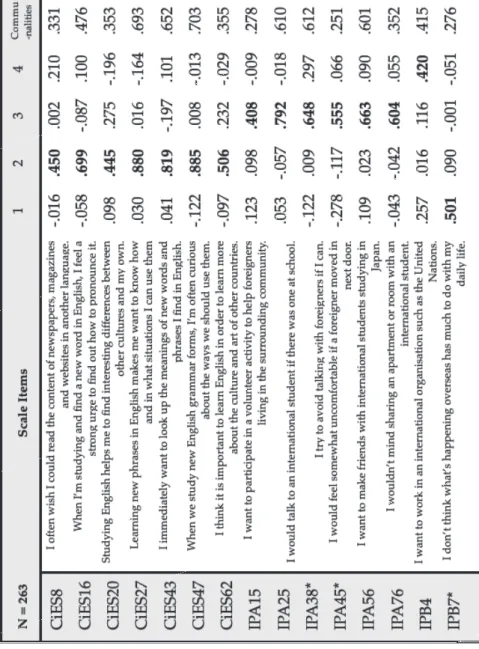
To answer the first research question regarding how much the constructs of CiES and IP overlap and whether some form of reduction and unification or disentanglement would be prudent, a factor analysis was performed. Hair et al (2014, p. 105) state that for the purposes of data reduction, the most appropriate form of factor analysis would be principal components analysis (PCA), which was performed on the 20 IP scale items and the ten CiES items (Table 2).
After listwise deletion of any missing data points, initially N= 261―
Hair et al (2014, p. 100) advise having a ratio of at least 5:1 in terms of observations to variables, of which this data set is comfortably over with a ratio approaching 9:1. An initial unrotated solution then drew out seven factors based on eigenvalues over 1. The resulting scree plot did not give a clear indication of how many factors to retain. Instead, as advised by Pallant (2011), a parallel analysis was
run (using an online engine: https://analytics.gonzaga.edu/
parallelengine/). This indicated that the first four eigenvalues from the dataset exceeded the criterion values generated by the parallel analysis (using the recommended, default 100 random correlation matrices and 95th percentile of eigenvalues). Therefore a four component solution was selected. Parallel analysis showed that a four component solution was appropriate in each of the subsequent rounds of PCA after item deletion.
The initial four-component solution accounted for 51.4% of the cumulative variance. This is only just above the lower bound for social science research suggested by the UCLA Institute for Digital Research and Education (n.d.) of >50%, though this improved slightly in each round. Regarding tests of factorability the Kaiser-Meyer-Olkin (KMO) measure of sampling adequacy was at .90, which suggested excellent factorability (Field, 2009, p. 647). Bartlett's test of sphericity was also highly significant (Chi-sq= 3641.79, df= 435, p <.001), and values off-the-diagonal in the anti-image correlation matrices were also almost all approaching zero or low, further suggesting good suitability for analysis (Tabachnick & Fidell, 2013. p. 667). After three rounds of PCA and item removal, a final solution was found (N=
263) with factorability indicators remaining at good levels throughout (KMO= .89; Bartlett's, Chi-sq= 3184.98, df= 351, p <.001). In each round a four-component structure solution was converged on in five iterations. Given the expected correlations between extracted components, promax rotation was employed with the component pattern matrix analyzed to assess structure. The final solution in Table 2 below accounted for 52.37% of the cumulative variance.
Table 2: (1/2) The third and final rotated component matrix of the
PCA:
Table 2: (2/2) Cont.:
As can be seen in the final pattern matrix, component-2 filled solely with CiES items, and three components filled with IP items broadly sorted in a relatively expected manner across the construct's subcomponents: component-1 mainly filled with loadings of both knowledge orientation aspects,
interest in international news
(IPC) andhaving things to communicate
(IPD); component-3 mostly filled withinter-group approach/avoidance tendencies
(IPA); component-4 with interest ininternational activities/vocation
(IPB). The only anomalies within the IP construct were IPB7 loading onto component-1 and IPD46 loading onto component 3. These anomalous loadings within the IP construct were largely of no consequence as mean results of all the IP items were subsequently calculated for further analysis, and the main purpose was to see where CiES and IP overlap. Hair et al (2014, p. 115) class component loadings of .35 or over as significant for sample sizes of around 250.Therefore either where loadings were below this, or where CiES & IP items cross-loaded, it was deemed appropriate to delete items. In the first round of PCA, CiES85 was removed with loadings under .35 on all components, while CiES67 was removed for significantly loading only onto component-1. In round two, while CiES74 reached the criteria of loading significance on component-2 at .46, it also had a proportionally high cross-loading onto component-4 at .33, so it was considered appropriate to also remove it.
The final solution produced a relatively clean, simple structure, as described by Brown (2009) whereby all components have the majority of their non-loading items registering at low values or approaching zero. This final matrix also fits the conceptual containers
into which the constructs are considered to grow based on the key features of what the CiES construct are thought to be (linguistically and culturally oriented) and the previous work done in developing the IP construct. It would be likely that those items more focused on curiosity toward linguistic features would not cross-load, whereas CiES67 & CiES74 conceptually have overlap with interest in foreign affairs and the knowledge orientation of IP generally. It is curious as to why CiES85 did not load to significant degrees onto any
Table 3
: Scale basic statistics (scale reduction indicated in parentheses):
(N = 285)
Scales Abbrev--iation Mean Std.
Dev
Skewness (Std Error
.14)
Kurtosis (Std Error
.28)
Cronbach’s Alpha (α)
Joyous Exploration
JE 5.01 0.96 -0.35 0.62 .68
Deprivation
Sensitivity (4 items)
DS 4.49 1.05 -0.36 0.39 .60
Stress Tolerance
ST 3.41 1.06 0.56 0.67 .73
General Social
Curiosity
GSC 5.05 0.82 -0.27 0.52 .66
Covert Social
Curiosity
CSC 4.57 1.01 -0.08 0.05 .65
Thrill Seeking
TS 4.40 1.20 -0.13 -0.22 .80
Curiosity in English
Studies (7 items)
CiES 4.66 1.09 -0.28 0.30 .81
International Posture
IP 3.99 0.97 0.13 0.31 .88
Speaking English
Anxiety
SEAnx 4.97 1.12 -0.58 0.31 .76
Comprehension of
English Anxiety
CEAnx 4.33 1.04 -0.30 -0.30 .70
L2-Willingness to
Communicate
WTC 3.92 1.28 0.19 -0.43 .84
Intended Learning
Effort
ILE 4.06 1.10 0.00 -0.27 .81
component. Perhaps, it's because “other people's way of thinking” is too vague to relate to either CiES or any of IP's sub-components.
Nonetheless, the end result suggests that the PCA achieved parsimonious separation of the CiES and IP constructs by reducing down the CiES scale to seven items and leaving IP in its original form.
Basic Scale Statistics & Reliability:
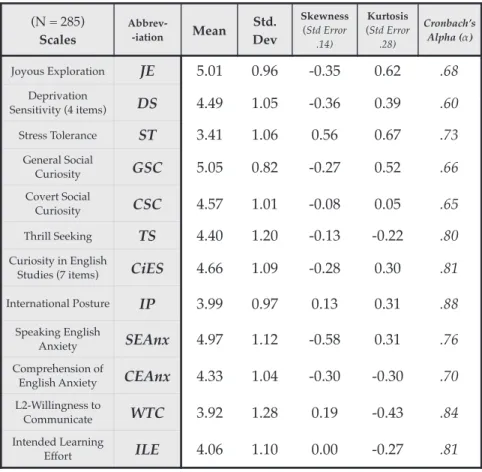
Based on the results of the PCA, the full set of data (N= 285) was then analyzed resulting in the basic statistics as shown in Table 3 above. Peat & Barton (2014) state that for skewness and kurtosis, values of between -1 and +1 indicate normality. Most of the scales produced Cronbach's α scores at or approaching .70. Although, even with additional items, both the social curiosity aspects of the 5DC(R+) were just under and unable to have their scores improved by item deletion. The DS scale, initially had an α score of .53, however, with two items deleted (DS28 & DS69― see Appendix) it only just improved to the minimum of .60 (rounded up from .596,).
This construct previously had the lowest internal reliability in Smith (2019a) at .49, also in Kashdan et al's (2020) test-retest checks of reliability, their 4-item DS dimension had the lowest scores of all the 5DCR dimensions and was the only one to be below .70 (2-months=
.62, 8-months= .61). This suggests a further redesign may be advisable for subsequent use in the Japanese high school context, as expanded on below. As such DS is used here with a certain amount of caution with regard to its internal consistency.
Correlations & Validity:
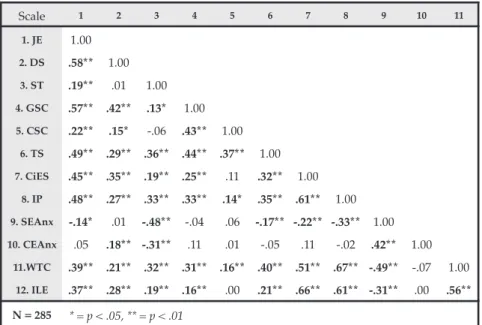
Within the correlation results below in Table 4, the relationships between the 5DC(R+) dimensions largely follow the inter-5DCR correlation pattern of results in Kashdan et al (2020, p. 6). Also for the 5DC(R+) and for the added convergent and discriminant validity constructs, WTC, SEAnx & CEAnx, results were largely as expected.
WTC was thought to positively correlate with all of IP, CiES and the 5DC(R+), which it does. Both anxieties were also thought to either have negative or no significant positive correlations with the CiES, IP and the 5DC(R+) scales, which they do― in particular with stress tolerance, given how it should work in an opposite way to anxieties.
Comprehension anxiety did correlate positively, albeit to low degrees, with deprivation sensitivity. This actually conceptually fits however,
Table 4
: Correlations between scales and validity measures.
Scale 1 2 3 4 5 6 7 8 9 10 11
1. JE 1.00 2. DS .58** 1.00 3. ST .19** .01 1.00 4. GSC .57** .42** .13* 1.00 5. CSC .22** .15* -.06 .43** 1.00
6. TS .49** .29** .36** .44** .37** 1.00 7. CiES .45** .35** .19** .25** .11 .32** 1.00
8. IP .48** .27** .33** .33** .14* .35** .61** 1.00 9. SEAnx -.14* .01 -.48** -.04 .06 -.17** -.22** -.33** 1.00 10. CEAnx .05 .18** -.31** .11 .01 -.05 .11 -.02 .42** 1.00
11.WTC .39** .21** .32** .31** .16** .40** .51** .67** -.49** -.07 1.00 12. ILE .37** .28** .19** .16** .00 .21** .66** .61** -.31** .00 .56**
N = 285 * = p < .05, ** = p < .01
as deprivation-type curiosity should be driven by a desire to alleviate a sense of tension or anxiety caused by a knowledge gap, so it is appropriate for it to correspond to a sensitivity to comprehension anxiety. With there being no obviously inexplicable correlations, these results support the validity of the constructs in this context.
Regression Analyses
For multiple regression analyses, Tabachnick & Fidell (2013, p. 159) suggest the rule of thumb of exceeding at least n > 50 + 8m (where
‘n’= sample size, & ‘m’= number of independent variables), for which the sample size here is comfortably over in each model. All three regression models met the six basic assumptions of multiple regression: significant linear correlations between the dependent and independent variables; reasonable multicollinearity levels between independent variables (correlations < .80, variance inflation factors <
10, tolerance scores > .2); independence of the residuals with Durbin- Watson statistics around 2.00; no overly influential outliers with Cook's distance levels all below 1.00; normal distribution of the residuals in the P-P plots; reasonable homoscedasticity in the scatterplots of the standardized residual distributions. Also, with low p-values in the ANOVA results for each model, we can conclude that the independent and dependent variables have non-random relationships.
All three models were generated using the standard ‘enter’ method in SPSS, which applies all the independent variables simultaneously to work out what unique variance they may each contribute to the model. In order to assess the explanatory power of the of the overall
models, this research uses the suggested interpretations of R2 for social science data from Ferguson (2009, p. 533), whereby .04 is the recommended minimum, .25 is considered a moderately predictive model, and .64 would signify a large amount of variance explained.
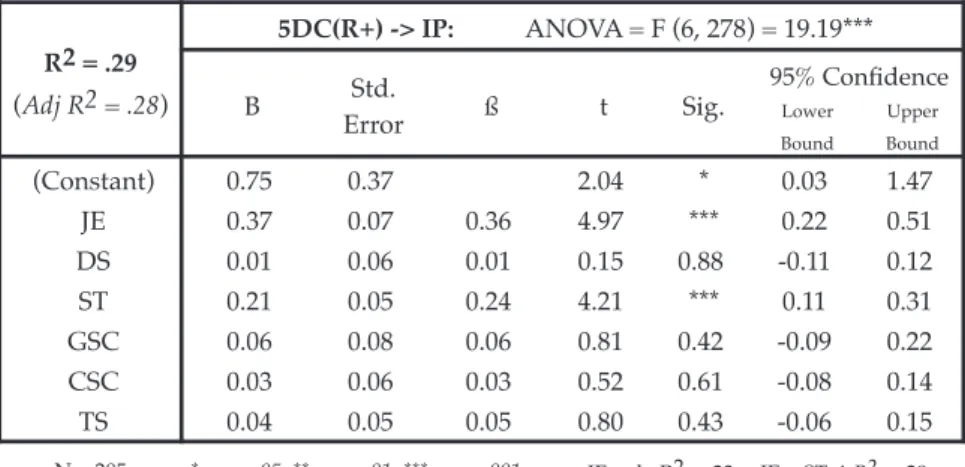
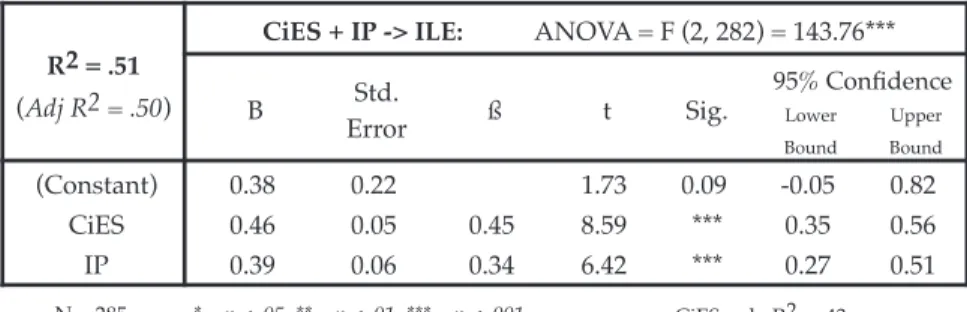
The models shown in Tables 5 & 6 give us answers to the second research question, while Table 7 answers the third.
Table 5: Regression model 1
R2 = .23 (Adj R2 = .22)
5DC(R+) -> CiES: ANOVA = F (5, 279) = 16.99***
B Std.
Error ß t Sig. 95% ConÞdence
Lower Bound
Upper Bound
(Constant) 1.72 0.40 4.28 *** 0.93 2.51
JE 0.36 0.09 0.31 4.15 *** 0.19 0.53
DS 0.16 0.07 0.15 2.33 * 0.03 0.29
ST 0.10 0.06 0.10 1.70 0.09 -0.02 0.21
GSC -0.07 0.09 -0.05 -0.77 0.45 -0.24 0.11
TS 0.10 0.06 0.11 1.71 0.09 -0.02 0.22
N = 285 * = p < .05, ** = p < .01, *** = p < .001 JE only R2 = .20, ∆ R2 JE + DS = .21
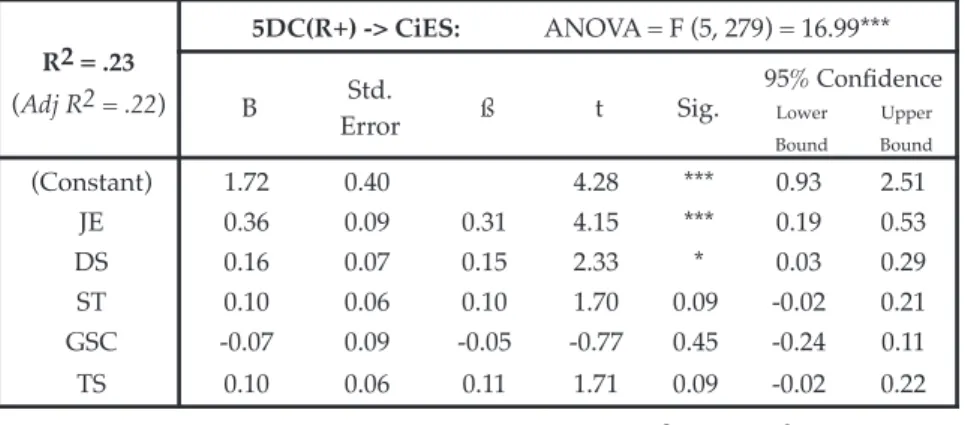
In Table 5, JE is the most influential variable from the 5DC(R+) in terms of supplying unique explanatory variance to CiES (β= 0.31 , p
<.001), with DS the next ( β = 0.16, p <.05)― CSC was left out from the model here with no significant correlation in Table 4. That the two dimensions traditionally thought of as the core of curiosity would have relationship with a subject focused curiosity may not be surprising. However, while DS alone as the only independent variable gives an R2 of 12%, when added to the model here it only contributes around 1% of additional unique variance not already accounted for by JE. Mahmoodzadeh & Khajavy (2019) in comparing the Likert
scale mean scores of the interest (5.44) and deprivation (4.45) parts of their Language Learning Curiosity Scale also concluded that
“...learning curiosity is mainly a feeling of interest than a feeling of deprivation (p. 340).” ST & TS also have p-values and confidence interval results that suggest the null hypothesis is implied here, but may not be so tightly embraced in their cases. The whole model accounts for 23% of the variance, so the 5DC(R+) can therefore be considered a moderate predictor for CiES according to the R2 criteria of Ferguson (2009).
Table 6: Regression model 2
R2 = .29 (Adj R2 = .28)
5DC(R+) -> IP: ANOVA = F (6, 278) = 19.19***
B Std.
Error ß t Sig. 95% ConÞdence
Lower Bound
Upper Bound
(Constant) 0.75 0.37 2.04 * 0.03 1.47
JE 0.37 0.07 0.36 4.97 *** 0.22 0.51
DS 0.01 0.06 0.01 0.15 0.88 -0.11 0.12
ST 0.21 0.05 0.24 4.21 *** 0.11 0.31
GSC 0.06 0.08 0.06 0.81 0.42 -0.09 0.22
CSC 0.03 0.06 0.03 0.52 0.61 -0.08 0.14
TS 0.04 0.05 0.05 0.80 0.43 -0.06 0.15
N = 285 * = p < .05, ** = p < .01, *** = p < .001 JE only R2 = .23, JE + ST ∆ R2 = .29
In Table 6 for the 5DC(R+) relations to IP, JE again is the most influential independent variable ( β = 0.36, p <.001), with ST very clearly the second ( β = 0.24, p <.001). In this case JE by itself supplies 23% of the explanatory power, with ST adding another 6%.
Smith (2019a) did also find that JE had a significant relationship with IP. He did not, however, find a significant positive correlation
between ST and IP. Yet, an orientation toward the world, wanting to know more information about it and have experiences in it has great potential to give rise to touching things new, different, challenging and stress inducing. Therefore, a positive association with stress tolerance seems likely, if not necessary. Overall this model also accounted for a moderate amount of explanatory variance in IP at 29%.
While both models are somewhat lower in R2 values than Smith (2019a: IP R2= .40; CiES R2 = .52), and more variance was explained in the IP model than in CiES here― which may be down to the CiES scale having had three items removed ―the models here do also show clear predictive relationships from dimensions of the 5DC(R+) to IP & CiES with most of the predictive power coming from JE in both cases.
Table 7: Regression model 3
R2 = .51 (Adj R2 = .50)
CiES + IP -> ILE: ANOVA = F (2, 282) = 143.76***
B Std.
Error ß t Sig. 95% ConÞdence
Lower Bound
Upper Bound
(Constant) 0.38 0.22 1.73 0.09 -0.05 0.82
CiES 0.46 0.05 0.45 8.59 *** 0.35 0.56
IP 0.39 0.06 0.34 6.42 *** 0.27 0.51
N = 285, * = p < .05, ** = p < .01, *** = p < .001 CiES only R2 = .43
In Table 7, trying to answer the third research question as to how CiES and IP together associate with intended learning efforts, the more significant independent variable was CiES (β= 0.45, p <.001),
with IP (β= 0.34, p <.001) adding about 8% of explanatory variance not already accounted for by CiES. To speculate why CiES has more explanatory influence, it may be that in IP the direction of interest is more oriented toward the world, for which English is an avenue of access. Thus, from the overview of the IP construct, English may be viewed more as a means to an end, rather than a direct aim of intention. Whereas, for CiES the focus is on both interest in connecting to other cultures through English and aspects of the language itself, so may be more closely aligned with the direction of drive from the engine of intrinsically motivating factors and therefore more proximate to intentions toward learning English. Variance explained in the model accounting for a majority of just over 51%
can be classed as having moderate-to-strong predictive power. While it is not quite as strong as the result of 72% from Smith (2019a), the two results certainly point in the same direction, with CiES providing most of the explanatory variance, further suggesting that CiES and IP do have valuable predictive relations with EFL learning intentions.
The results here give further statistical support to the conjecture that there are robust associations at the two layers of:
• Layer 1: Trait curiosity dimensions of the 5DC(R+)―> Individual curiosity & interest relating to studying the subject of EFL (IP &
CiES).
• Layer 2: Individual curiosities & interests in studying EFL (IP &
CiES) ―> Intended learning effort toward EFL.
It must be stated that the layers here do not represent clear,
directional causal relations― there could certainly be feedback, reciprocal relationships, or hidden, confounding factors. Nonetheless, they do contain statistically strong, predictive correlations in terms of both the overall models and for individual variables, which, even if slightly lower, are relatively consistent with those from Smith (2019a).
Implications for the Classroom
The robust relationships in Layer 2 above imply that the conceptual domain captured within the frames of CiES and IP together―
epistemic orientation toward the language and other cultures;
international activities and potential personal associations;
transnational issues and discussions about them ―are highly likely to be useful in influencing study intentions in the classroom. It seems probable, for example, that compared to dry formulaic drilling of grammar and vocabulary points devoid of any wider meaning, if it is possible to relate those linguistic learning points to intercultural situations, transnational cultural fields (e.g., food, sports, etc), potential international work/activity scenarios, or topics relating to global issues (e.g., climate change, technology and humanity, etc), it would be of more motivational benefit and salience to learners.
The Layer 1 associations would also seem to have ramifications for classroom strategies. Joyous exploration having the most predictive power for both CiES and IP, is about exploration and discovery, so within the limitations permitted in a classroom setting or lesson plan, allowing students to freely explore particular topics and the language surrounding them may be a useful strategy with which to augment curricula. This is something for which task-based (Pluck & Johnson,
2011) or open-inquiry project based pedagogies (Zion & Sadeh, 2007) would seem very well suited, especially for those students with high levels of the trait dimension.
Levels of deprivation sensitivity were also shown to be related to CiES, though to a lesser degree than joyous exploration. To conjecture as to why this may be the case, let us compare it to hunger for some food― to which deprivation-type curiosity has been compared (Loewenstein, 1994) ―vs. liking a particular food, which may be a closer analogy to interest-type curiosity. When one is hungry for or craves a particular food in a given a moment, the eating of the target food, if of a satisfactory amount and quality, sates the momentary desire and the hunger or craving subsides. When one likes, or has a passion for a particular food, say for example sushi, one can spend a year traveling around Japan sampling all the locally available sushi varieties and still be ready to go on searching for and eating more. That is to say, as Litman (2005) suggests, that deprivation-type curiosity seems to more associated with
wanting
, which is more on-or-off in the moment, whereas interest-type curiosity seems more similar toliking
, which often persists in the longer term. Therefore, with deprivation sensitivity oscillating on and off, it may be of a higher intensity in the moment, but more limited in frequency and influence― in coming online, or not aroused at all in some classes, particularly if the content covered is too easy. A more dynamic, in-the-moment affective nature may also relate to why its scale has a relatively low Cronabach's α score of internal consistency as a trait here. As such a scale item redesign may focus respondents on imagining deprivation feelings in the present (e.g., If I were talkingwith my teacher and I felt my phone vibrate with a notification, I would feel a strong urge to look at it). Therefore, a stronger association between more sustained interest-type curiosity trait and CiES and IP would make sense.
Interest-type and deprivation-type curiosity do correlate with each other to moderate-to-high degrees however (Table 4 above― also in Kashdan et al, 2018; Kashdan et al 2020), and an increase in one is likely to lead to an increase in the other, so utilizing deprivation-type curiosities could potentially feed into a growing, wider sense of joyous exploration in English, while feelings of joyous exploration would allow for greater potentiality of deprivation sensations to arise.
One example of how to elicit deprivation-type curiosity sensations may be in how teachers present linguistic features. To again take a dry grammar point, instead of directly writing it on a blackboard and explaining it, we could instead first present part of a sentence and ask the students how to best finish it, or present a common grammar error and ask them how it should be corrected. This would likely engender a two-pronged deprivation sensation in students: a desire to know the correct answer, along with a desire to know if their own answer was correct. Wong et al (2020) also suggest riddles, quizzes, and expectation violations can be used to highlight to students their knowledge-gaps.
Stress tolerance was also shown to relate to IP. This finding adds to the body of knowledge suggesting that helping Japanese students, particularly those low in levels of stress tolerance, to reduce and encourage resilience to their anxieties is important in their studies.
Attention should perhaps be paid as to how to ameliorate stresses relating to the outside world and to interactions with people from other cultures.
It should be stated that the 5DC(R+) aims at measuring trait level curiosity and can say little of dynamic in-the-moment situational states in classes, which would be of interest in looking at the interplay between joyous exploration and deprivation sensitivity, or other dimensions, and how they may change over a term of study, or even a single class. Nonetheless, Panksepp (2004) explains that curiosity &
interest appear more as relatively stable traits as opposed to passing states, where the arising of state curiosity has stronger positive interrelationships to overall trait curiosity than state-trait correlations of other feelings such as anxiety or anger. He claims that curiosity is more tonically engaged than intermittently activated. He describes the tone as “...akin to that invigorated feeling of anticipation we experience when we actively seek thrills and other rewards (p. 145).”
With those people, then, who rate highly across the curiosity dimensions, they are likely prone to have curiosity & interest manifest more in classes and likely to have higher levels of CiES and IP, which relate to higher levels of learning intentions.
Yet, there may also be hope in the fact that trait dimensions of curiosity only have moderate associations with CiES and IP because there are likely other things that account for the variance of IP &
CiES, e.g., other personality traits, dispositions, previous experiences, plus aspects that teachers can have influence over: positive class atmosphere and interactions; class group-level motivations; attitudes
to the wider learning environment; etc.
To conclude, stimulating curiosity & interest as much as possible would appear to have great motivational value for teachers to utilize in their classes. There has been some more general research on how teachers and schools can educe and maintain individual interest in students, and to develop curiosity more generally. Schiefele (2009) highlights how instructional programs seeking to increase interest in subjects emphasize the connection to student's everyday lives, prior knowledge and outside general interests. Tin (2016) suggests creating interest profiles for students and classes to which teachers can relate class content. Slot et al (2020) found in a study of 90 adolescents that interest was registered in relation to the following psychological mechanisms/processes (often in combination): objects of interest associated with biographical identification; chronotopical captivation (i.e., in stories developing over time); setting goals; progress valuation;
engagement appreciation (i.e., being relaxed, having fun― often with friends, family, community); substantive participation (i.e., putting effort into something). Almost all those mechanisms/processes resonate with the intrinsic motivational needs in Self Determination Theory. Several authors (Wong et al, 2020; Schiefele, 2009; Kashdan
& Fincham, 2004) also state that creating an environment where need fulfillment of autonomy, relatedness and competence can thrive, helps curiosity & interest bloom. A combination of applying these concepts along with making connections to the conceptual domain within and around the frames of CiES and IP would likely be of great benefit to helping students to develop curiosity & interest and to find meaning in their English studies.
•Limitations & Future Directions
Limitations
There were several limitations to this study. The first is that while a number of the 5DC(R+) curiosity scales dipped under Cronbach's α -scores of .70, the deprivation sensitivity scale in particular only just rounded up to .60 after having two items deleted, even after additional items had been included. This does bring its reliability as a scale into question here. Within the limitations of the questionnaire only three validity measures were able to be included. While there were no anomalies and the scales behaved largely as predicted, other 5DC(R+) dimensions also had additional items included, so they might also be questioned as to whether they were really measuring the same thing as Kashdan et al's (2020) 5DCR. Finally, the data generated here was cross-sectional correlation data from a specific population. Therefore, these results may not be easily generalizable to other populations in dissimilar educational contexts.
Future directions
The results here suggest further questions that would be beneficial to pursue. Firstly, how do curiosity & interest, and in particular interest- type and deprivation-type curiosities, dynamically evolve over time (a year, term or within a single class)? In terms of class content, what specific topics can engender the most (or least) curiosity & interest, in particular those in relation to the conceptual fields of the CiES and IP constructs, and why? What are the most effective, non-disruptive methods for selecting and integrating those curiosity & interest generating topics into classes and curricula? Finally, a foundational