Mariko FUJIMOTO Kyoto University
Abstract: This article is about human wildlife conflicts in western Tanzania. In northern Tanzania, the latest protected areas, called Wildlife Management Areas (WMAs), have been established around major national parks since 2006. Although WMAs started from the idea that local people get economic benefits in return for wildlife conservation, they need to undergo difficult and complex procedures to establish WMAs. In almost all cases, community-based-organizations (CBOs) are built with support from international non-governmental organizations (NGOs). In some WMAs, local people are alienated from their land or natural resources for their livelihood, and some friction is occurring.
In western Tanzania, there are two national parks (NPs) and surrounding villages. I analysed four human-wildlife conflicts (HWCs) in Kigoma Region located beside Lake Tanganyika. In Kigoma Region, there are poor business opportunities despite the rich wildlife and two national parks. There are no WMAs and the community-based conservation activities differ from those in northern national park surroundings.
However, there is a preferred relationship between local residents and local authorities, including Tanzania National Park authorities (TANAPA). What should be considered is what brings community-based conservation to the local community and what conservation is.
Keywords: Local residents, Human wildlife conflicts, National Park, Tanzania, Community
1. Introduction
In Tanzania, there are some kinds of wildlife protected areas including 16 national parks. Those wildlife protected areas covers over 30% of the total national land surface. On the one hand, wildlife is one of the most important
resources to draw tourists and to earn foreign currency for Tanzanian government. On the other hand, HWCs are a serious issue for local people living around wildlife protected areas (Kideghesho 2008; Dickman 2010).
Wildlife resources have been under the control of the central government since the colonial era in Tanzania. The current of wildlife conservation globally has been derived from the wilderness philosophy of North America at the end of the 19th-century (Nash 1967). In this period, forest conservation had spread and the habitats of human and wildlife had been divided all over the world. In Tanzania, the Serengeti National Park was established in 1951 as the first national park. The Tanganyika government enacted the National Park Ordinance in 1959, which was a precursor of the present TANAPA.
The fortress conservation philosophy, based on wilderness and protectionism, was taken up by the central government after independence in many African countries. In Tanzania, the Wildlife Conservation Act was enacted in 1974. However, this act empowered the central authority to stipulate that wildlife is state property and wildlife use by local people is restricted. They were prohibited from hunting and killing wild animals even if they experienced crop or livestock damage, or were physically attacked by wildlife. Local residents bore some of the costs for wildlife conservation without receiving the economic benefits brought about by wildlife tourism in the 1970s. Nevertheless, some wildlife species declined and resource depletion occurred throughout Tanzania.
In the 1980s and 1990s, a new wildlife conservation paradigm, community-based conservation (CBC) had arisen globally (Western et al. 1994).
During this period, many development assistance projects were invoked in the name of sustainable development throughout Africa, and decentralization and delegation were promoted (Chambers 1983). The trend of returning the profit from wildlife to the local people who live in the neighbourhood of the wildlife habitat grew rapidly. In 1998, the Tanzanian government established the Wildlife Policy of Tanzania (WPT) based on the idea that the wildlife conservation activities outside of protected areas should generate benefits for villagers and communities (Nelson et al. 2007). In this policy, the government recommended WMAs legislation. In 2002, wildlife conservation regulations had been constituted, and the next year, the process of WMA establishment had been decided. WMA is new protected area built and managed by local people. WMA started as a democratic and seemingly bottom-up movement in wildlife conservation. To establish a WMA, however, the procedure is complicated and legally difficult. The process consists of 10 steps including 1) the Village Assembly should agree to form a WMA, 2) the village forms a CBO and registers
it at the Ministry of Home Affairs, and 3) the CBO prepares a Strategic Plan and so on. Finally, the Ministry of Natural Resources and Tourism (MNRT) declares a designated WMA in the government gazette. Subsequently, several more steps are involved in the process to start commercial activities in the WMA. Most local residents cannot achieve progress in these complicated procedures by themselves.
In 2012 to the present, there have been 17 WMAs registered that have relationships with international NGOs, such as WWF, AWF, and GTZ (WWF 2014). These international NGOs assist in organizing CBOs and managing the WMA (Levine 2002). AWF held an international symposium entitled Conservation is good business in 2003 at Washington DC. This might reveals that for international big NGOs, conservation means not primary wildlife preservation but business . There are WMAs that create conflicts between CBOs and local residents (Igoe & Croucher 2007; Nelson & Blomley 2010;
Benjaminsen et al. 2013).
The wildlife policy in Tanzania has been planned by assuming benefits are to be derived from the major northern tourist circuit, including the Serengeti National Park and Ngorongoro Conservation Area. In this area, there are many well-known animals, such as lions, elephants, giraffes and other large mammals and many tourists visit for the sake of game drives. Some WMAs have been built in this area with the motivation of inviting these tourists to the village lands and thus generating village income. Igoe & Croucher (2007) pointed out that in Burunge WMA located adjacent to Serengeti National Park, local residents are alienated from the natural resources for their livelihood, and it appears the business of conservation , moreover, one village chief of seven villages in WMA asserted that the process to establish WMA was top-down not participatory.
There are conflicts within local community and between villages in WMA. In this article, I try to consider the present wildlife conservation policy through reviewing cases of HWCs in western Tanzania on the shores of Lake Tanganyika; here the circumstances are different from the major northern tourist circuits. I will illustrate the ways of coping with HWCs by multiple actors and the relationships between them in Kigoma Region where two national parks are located.
2. Study Site
I conducted my field research at some villages in Kigoma Rural District bordering the Mahale Mountains National Park and Kigoma town. I was doing research about the traditional culture there, which is based on the ethnic language of the indigenous Tongwe ethnic group, of the Mahale Mountains.
Here, I heard of some cases of HWCs in the villages and spoke with local residents, the park rangers, the village chief, and the park warden of Mahale Mountains National Park about them.
Kigoma Region
Kigoma Region, Tanzania is one of the most distant areas from the main city, Dar es Salaam. Kigoma town is located on the eastern shore of Lake Tanganyika.
It is small but an important point for traffic and trading among neighbouring countries. It includes the terminal station of the Tanzania Railways from Dar es Salaam by way of Dodoma and Tabora, and the airport connects Dar es Salaam, Mwanza, and Bujumbura (Burundi). Kigoma port is the centre of the inland waterway and links countries bordering Lake Tanganyika; it is also the home port of the oldest cargo passenger ship in commission in the world the Liemba that was constructed in 1913 by Germany. Even now, the Liemba provides significant transport for local people living at the lakeshore villages to ship their harvests and fish products to Kigoma town, and to stock commodities from there.
Kigoma Region is not linked to the national electricity grid. It consists of the Kigoma Urban District and Kigoma Rural District. The former area depends on the small diesel-based power station and electric power failure occurs frequently. The latter area has not yet been served with electricity at all.
Moreover, the cell phone network is not available in most of Kigoma Rural Districts.
There are two national parks in Kigoma Region: Gombe Stream and Mahale Mountains. Foreign tourists come to these parks to engage in the chimpanzee trekking activities in the forest. Unlike the northern tourist circuit, which includes the Serengeti National Park, the Ngorongoro Conservation Area, and other parks where tourists enjoy safari drives with four-wheeled vehicles, the two national parks in western Tanzania provide walking safaris for chimpanzee observation. Gombe national park is located to the north of Kigoma town. It takes about 20 minutes to get to Gombe from Kigoma town by local boats.
Mahale National Park, however, is far from Kigoma town and takes more than 15 hours travel time because of the poor access. There are no roads from Kigoma town to Mahale National Park and surrounding villages. Therefore, for local people as well, the only available transport is either the local wooden boats with outboard motor or the Liemba cruise along the waterways once every two weeks.
Outline of Mahale Mountains National Park and Chimpanzee Trekking Tourism
Mahale Mountains National Park was established in 1985. It is located about 130 km south of Kigoma town and covers 1613km . The western boundary of the park is edged with a 1.6 km wide strip of Lake Tanganyika. Since 1961, the Japanese research group, KUAPE (Kyotu University African Primatological Expedition) has investigated the natural environment, wildlife habitat, and cultural aspects of the Mahale Mountains for the indigenous ethnic groups (Nishida 1990, 2011). Even now, the Japanese research team, MMCRP (Mahale Mountains Chimpanzee Research Project), mainly consisting of Kyoto University researchers, is continuing with chimpanzee research. One chimpanzee group called M-group has been habituated to human observers. The object of both the scientific research and chimpanzee trekking activities for tourists is the M-group chimpanzees consisting of about 60 individuals. The chimpanzee is one of the most closely related animals to human beings; therefore, the prevention of zoonotic diseases is a serious problem on which to use the resources of tourism.
In Mahale, chimpanzee deaths caused by a flu-like disease have occurred during the period of long-term research (Hosaka, 1995; Hanamura et al. 2008). To prevent zoonotic diseases and excessive stress on tourists, the following regulations were introduced for chimpanzee trekking activities: (1) Maintain a distance of at least 10m from the chimps at all times, (2) Always wear a mask (provided by your guide) over your nose and mouth when you are close (<50m) to chimps, (3) No more than six visitors (plus one guide) are permitted close to the chimps at any one time. If another group is with the chimps when you arrive, please wait at a spot chosen by your guide, at least 250m away from the animals, (4) Maximum viewing time is one hour, and so on (TANAPA 2014).
Although chimpanzee trekking is an attractive activity for foreign tourists, it is difficult to promote and entertain as many tourists as on the northern tourist circuit. The difficulties are caused by the biological characteristics of the chimpanzees, the geographical remoteness from Dar es Salaam, and the poor transport and infrastructures in Kigoma Region. Figure 1 shows the map of the study sites.
Visitors Number to the Western Chimpanzee NPs and Northern Major NPs
As mentioned above, Kigoma Region is one of the remotest areas from Dar es Salaam; the main target animal of the western NPs is the wild chimpanzees.
Because they are the most closely related animals to human beings, it is necessary to control the number of tourists who visit them to prevent zoonotic diseases.
Figure 1. Map of the study sites
For these reasons, the number of tourists visiting the Gombe and Mahale national parks are smaller than those visiting the northern national parks. Table 1 shows the number of visitors to major northern and western parks. The number of tourists to Mahale National Park is only about 10% of the total who visit the Serengeti National Park. In Mahale, there are three privatized camping facilities and one guest house managed by TANAPA. The tourist capacities of the western national parks are limited by biological and geographical factors. It can be said that these conditions restrain the movement to establish WMAs.
Table 1. Number of visitors to northern and western national parks
2005/06 2006/07 2007/08 2008/09 2009/10 2010/11 northern Serengeti 130,683 135,614 145,141 108,236 128,873 162,501
NPs Manyara 95,626 102,834 112,786 85,622 100,691 120,208
Tarangire 68,972 72,687 86,966 94,608 57,628 89,592
western Gombe 742 772 854 1,895 1,267 1,239
NPs Mahale 1,223 1,182 1,281 1,186 1,306 1,686
3. Wildlife Conservation Policies and Tourism in Tanzania Wildlife Conservation Institutions in Tanzania
In Tanzania, there are different institutions for wildlife conservation. Table 2 shows the jurisdiction of each wildlife conservation institution in Tanzania. All wildlife resources in Tanzania are controlled by MNRT. Under the MNRT, there are TANAPA, the Ngorongoro Conservation Area Authority, and the Wildlife Division. Under the Wildlife Division, some institutions are managed by the local authorities.
As of 2012, 17 WMAs have been gazetted throughout Tanzania; however, there are no WMAs in Kigoma Region. In the protected area, local authorities carry out wildlife management, such as giving hunting permission and patrolling for illegal human activities on the village land.
Table 2. Jurisdictions of protected areas in Tanzania
Restriction of Human Activities in the Protected Area
In the protected areas, human activities are restricted at each level. Table 3 shows the restrictions. In national parks, all human activities are prohibited. In game reserves, only tourist hunting is permitted based on the hunting application applied for by foreign tourists. Even in the open areas, Tanzanian residents must obtain a license and permission for hunting. Within the village lands, local people also need to apply in advance to the game officer, who has the authority to accept and examine applications for hunting permission.
Hunting Fees for Each Animal Species
The hunting fees for each animal species are provided in the wildlife conservation regulations in Tanzania. Table 4 shows the hunting fees for residents and tourists. For some species, only tourist hunting fees are provided for in the legislation. In the protected areas and open areas where the hunting can be carried out, all people need to get permission and pay a hunting fee
district/ district/ village/
ward village CBO
Ngorongoro Game Wildlife
Conservation Controlled Management
Area Area Area (WMA)
Administrators Park Officer Administrative Officer Game Officer Scout
TANAPA(Tanza nia National
Parks)
Ngorongoro Conservation Area Authority
National Park Game Reserve
Jurisdiction
MNRT (Ministry of Natural Resource and Tourism) Wildlife Division district
Institutions Open Area
according to the animal species. Even when local people receive crop raiding damage, they must apply in advance for hunting permission to the game officer.
Table 3. Restriction of human activities in each protected area
1 Only the Maasai people are allowed these activities within the protected area.
2 All people need to obtain a license and permission, and pay the hunting fees.
3 WMA is the supra-village institution. The village assembly and village council participate in the determination on how to use lands and wildlife resources.
Source: The Wildlife Conservation Act, 2009 (MNRT)
Table 4. Hunting fees for major animal species
*1USD=1,787Tshs. (March 2015 present)
Settlement Cultivation Grazing Resident hunting Tourist hunting National Park
Ngorongoro Conservation Area 1 1 1
Game Reserve 2
Game Controlled Area 2 2
Open Area 2 2
Wildlife Management Area (WMA) 3 3 3 3 3
Resident citizen Resident non- citizen
(Tshs.) (Tshs.) (USD) (Tshs.) *
elephant
(tusk weight 18.0-21.4kg) - - 15,000 26,805,000
elephant
(tusk weight above 21.5kg) - - 20,000 35,740,000
lion - - 4,900 8,756,300
leopard - - 3,500 6,254,500
buffalo 10,000 20,000 1,900 3,395,300
nile crocodile - - 1,700 3,037,900
hippo - - 1,500 2,680,500
bushback-male 40,000 80,000 600 1,072,200
bush pig 40,000 80,000 420 750,540
Warthog 25,000 50,000 450 804,150
red colobus monkey - - 360 643,320
yellow baboon - - 110 196,570
guinea fowl 6,300 12,600 30 53,610
Species Tourist
4. Cases of Human-Wildlife Conflicts (HWCs) Case 1: Chimpanzee came to Kalya Village
A solitary female chimpanzee came to the Kalya secondary school in Kalya Village in March 2008. For three days, she continued to stay in the village. There are no mobile phone networks at Kalya village, so people informed the headquarters of Mahale NP through the radio at the branch office of TANAPA within the village and asked how to cope with the chimpanzee s appearance.
Table 5 shows the processes involved in this incident.
In some areas in Africa, chimpanzee attacks on humans have been reported (Goodall 1986; Wrangham et al. 2000; McLennan 2008; Hockings et al. 2010).
Goodall (1986) reported that chimpanzees at Gombe attacked a human child for prey; therefore, local people feared wild chimpanzees and felt anxiety when they were observed within human living spaces. Although in central and western Africa, chimpanzees and other great apes are sometimes used for consumption as bush meat, in Tanzania; most people do not have that custom (Ogawa et al.
2006).
Table 5. Outline of the human-wildlife conflict: Case 1.
Local people only wanted the chimpanzee to leave the village. After four days, the TANAPA ranger and the MMCRP staff came to Kalya Village by the waterway. Around ten villagers and the arriving team tried to catch the chimpanzee by using the fishing net at the beach. Although they succeeded in
Time Line The progress of case 1
mid-March, 2008 Solitary female chimpanzee appeared at Kalya secondary school.
For 3 days, she stayed in the village.
3 days later Local people informed HQ of Mahale NP, TANAPA by radio call.
next day TANAPA park ranger and MMCRP staff came to Kalya village by a boat.
next day Park Warden called a veterinary at the Gombe NP.
2 weeks later MMCRP staff gathered wild chimpanzee food and sent it to HQ.
(beginning of April)She was in good health. TANAPA rangers transferred and released her at the southern boundary of the Mahale NP.
Local people and arriving team caught her with a fishing net and put her into a wooden box. But she escaped at Kalya beach. People caught her with the fishing net again. An elder man sufferd injuries on his arm. TANAPA ranger put her into the boat cabin and transferred her to HQ. Local people demanded 100,000 Tshs as reward for their cooperation. TANAPA paid 60,000 Tshs.
Although TANAPA and MMCRP staff gave her some fruits, she didn't eat certain foods from the village such as papaya, sugar cane, tomato. She ate only some sugar cane and wild fruits from the forest.
catching her and putting her into a wooden box, she escaped from the gap in the lattice of the box. They tried again and one elderly man was bitten on his arm.
Finally, they put her into the cabin of the boat and sent her to the headquarters of Mahale National Park. Local people who participated in catching the chimpanzee demanded Tsh 100,000 to reward their cooperation. TANAPA paid them in total only Tsh 60,000, which people divided equally. The injured man did not receive medical expenses.
The next day, the park warden of Mahale NP called the veterinarian of Gombe National Park and asked her to come to Mahale to check the health of the captured chimpanzee. In Mahale, the full-time veterinarian is absent and the veterinarian of Gombe holds the post concurrently. Although the female chimpanzee was in good health and confirmed to be about 10 12 years old, she refused to eat the food offered, such as tomato and papaya but ate a little sugarcane. TANAPA staff asked the MMCRP staff to collect and bring some wild fruits that M-group chimpanzees in the forest prefer to eat. MMCRP staff collected these fruits from the wild and delivered them. Because she ate the wild fruits, it was supposed that she was wild rather than tamed by humans and had lost her way in the process of migrating from her birth group to another group.
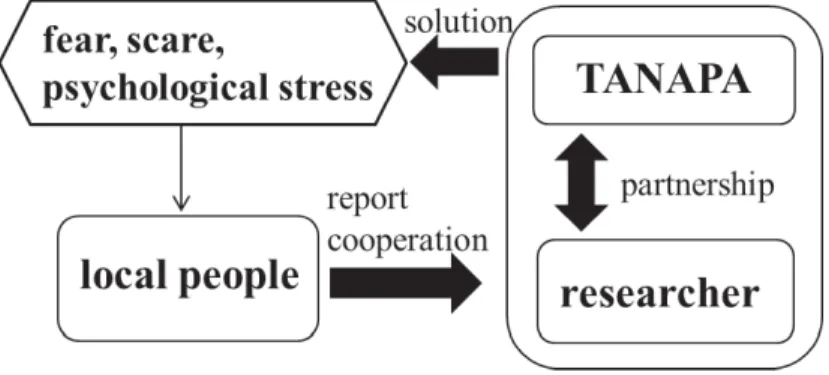
Chimpanzee groups are patrilineal and female adolescents must migrate after sexual maturation. Two weeks later, the female chimpanzee was released at the southern part of Mahale National Park by a TANAPA ranger. Figure 2 shows the process of coping with this human-wildlife conflict. Three actors: local people, TANAPA, and the researcher played their role in this wildlife conservation case.
Figure 2. Outline of process involved in coping with the human–wildlife conflict: Case 1
This incident shows that the local people feel that TANAPA has the first responsibility for the problem of wild animals and they trust TANAPA rangers.
Moreover, TANAPA staff have strong trust in the research team of MMCRP.
Japanese researchers and their team know the chimpanzees behaviour and feeding habits. It can be said that all actors, local people, TANAPA, and the research team built suitable relationships and recognized the proper actions to take to address the accidental human-wildlife encounter, and especially the chimpanzee s situation.
Case 2: Crop raiding by hippopotami and illegal trapping by a local resident
In the beginning of April 2012, a man living in Nkonkwa Village to the north of Mahale NP suffered his crop being raided by hippos. They came to his maize field every night and his harvest was seriously damaged. Although he knew the regulations and laws about wildlife conservation and hunting, he tried to set a wire trap for them. This was metal wire placed on a stump. After three months, at the beginning of July, a hippo with a wired stump on her neck appeared in Sitolo Bay. People noticed the hippo because of the noisy sound that was made by the fishing boats hitting each other on the beach in spite of the lack of wind.
When people went to confirm the cause of the shaking fishing boat, they found the hippo struggling between the two boats, unable to pass because of the wired stump on her neck. There was a juvenile hippo near the trapped female. People tried to help her, but she resisted being approached and touched. People then informed the HQ of Mahale NP and game officer who executed a permit to kill the animals based on the application. Although in this case, the man who set the trap did not apply to hunt the hippo, the villagers had to cope with the incident and inform the game officer who talked with the village chief. Many local people asserted that there were no ways to deal with the situation except to kill the hippo. They wanted to eat the meat. Although the game officer judged that there was nothing to do but shoot her, he had trouble with his gun and could not use it. He informed the police station at Mgambo, a neighbouring village. Eventually a police officer came to the site with his gun. Before he used it, he reported the incident to TANAPA HQ at Mahale NP. The park warden and rangers instructed the police and the game officer not to shoot the hippo. TANAPA asserted that even when the animal appear outside the national park, wildlife could move and come into the national park at any time, and TANAPA had total responsibility for the wildlife if the incident occurred around the national park.
TANAPA moored the hippo on their boat and transferred her to HQ. The
juvenile followed the boat to HQ. The next day, TANAPA called the Gombe NP veterinarian and asked her to come to Mahale NP to investigate. After four days, she went to Mahale and checked the health of the hippo. The veterinarian offered to use the tranquilizer gun and take off the wired stump while the hippo was asleep. They tried this but the hippo was surprised and struggled violently.
Finally, the wired stump broke away and she and her offspring left for Lake Tanganyika. Table 6 shows the process of this case, and Figure 3 shows the process of coping with this human wildlife conflict case.
Table 6. Outline of a human-wildlife conflict: Case 2.
Figure 3. Outline of process involved in coping with the human–wildlife conflict:
Case 2.
This case indicated that many actors, including local people, game officers, police, and TANAPA participated in the decision-making process of coping with the human wildlife conflict. It appears as a very complex and extensive process with all actors asserting their own opinion based on their position. The man who set
date The progress of case 2
1/4/2011 A villager laid a wired trap on the stump for a hippo at Katumbi village.
A few days later a hippo was caught in the trap.
But hippo escaped with wire and tree stump on her neck.
3/7/2011 The hippo with wired stump came to Sitolo bay.
Many local residents gathered and suggested to kill her. The chief of village informed a game officer.
Game officer came to the site but could not determine the ways of coping. He reported to TANAPA.
TANAPA ranger came to the site, and he reported to police. A policeman came with his gun. People requested to kill it but TANAPA rejected the demand and finally transferred the hippo to the HQ.
4/7/2011 TANAPA called to the veterinary of Gombe NP.
8/7/2011 The veterinary came and try to shoot tranquilizer gun but she failed and hippo got up a panic. Hippo cut the wire by herself and escaped in the lake.
the trap without a permit was not blamed for his illegal act. Regulation and laws about wildlife conservation need to be implemented equally to prevent illegal hunting and poaching. On the other hand, it is necessary to cope with human wildlife conflicts from the various viewpoints of those involved: victims of crop raiding, animal hunting administration, those concerned with human safety, and wildlife conservation officials.
Case 3: Cargo damage by a hippo on the Liemba
In January 2012, a solitary male hippo prodded the cargo-passenger ship, Liemba at Kigoma port. The hippo struggled and damaged some cargo on the deck of the ship. The crew of the vessel reported to the police by mobile phone and a police officer came to Kigoma port to shoot the hippo. He decided to shoot him quickly. There was considerable cargo in the vicinity, and especially dried fish bought by merchants from the Democratic Republic of Congo. If the policeman had spent a long time figuring out how to cope with this incident, the damage of the lost cargo would have grown. After the hippo was shot, the police officer called the game officer to inform him about the incident. The game officer came to Kigoma port and decided to sell the hippo meat. It was officially sold at 4,000 Tsh/ kg at once. This was a very reasonable price and many local people who were present on the occasion were able to buy it.
Figure 4. The oldest cargo–passenger ship, the Liemba
Figure 5. Cargo and passengers on the deck of the Liemba
Case 4: A child killed by a crocodile at Kigoma Station
In May 2012, a ten-year-old boy was killed by a crocodile. He was waiting for the train at Kigoma station of the TRC (Tanzania Railway Corporation) to go to Tabora with his mother. Although the train usually left for Dodoma at 11 o clock, the departure time was delayed frequently. This resulted in many passengers waiting for the train for a long time at the station and, because there is not enough waiting space and benches, passengers waited outside the railway station. The mother and son also waited the train outside of the station building. The boy was tired and played at the lakeside alone while his mother rested in the shade of a tree.
Suddenly a big crocodile appeared from the lake, captured the boy, and pulled him into the lake. Some people noticed the crocodile and tried to help the boy, but they disappeared into the lake quickly. The mother cried and shouted for people to call police and help her son. The station attendant came and called the police; one police officer came to Kigoma Station with his gun, but could not find either the crocodile or the boy. Afterwards, the mother sought compensation from the TRC because her son was killed owing to the delay of the train and the inadequate waiting space at Kigoma Station. People said the TRC would accept her demand. Cases 2 and 3 occurred within a 5-month period although local people said that these terrible human wildlife conflicts at Kigoma
town rarely occurred. Figure 8 shows the outline of the process to cope with the human wildlife conflict in cases 3 and 4.
Figure 6. Kigoma station building of the TRC (Tanzania Railway Corporation)
Figure 7. The rail side point where a 10-year-old boy was taken away by a crocodile
Figure 8. Outline of the process to cope with the human–wildlife conflict:
Cases 3 and 4.
5. Discussion
In this paper, I analysed the ways of coping with the HWCs encountered by multiple actors in Kigoma Region, Tanzania. These four cases appear to show that local residents who do not have some official position or commission can assert their opinion equally to local authorities such as the game officer, TANAPA, and the police. It can be said that they have an appropriate relationship based on mutual trust between the villagers and local authorities. As human-wildlife conflicts bring people some disturbance or damage, local authorities manage them flexibly rather than giving rigid responses, such as consistently protecting or killing wild animals in every case. They choose the relevant way of coping after considering the various circumstances and different actors opinions in the decision-making process. In case 2, there was an illegal issue that a villager set a wired trap for the hippo without permission. However, the police and the game officer took this into consideration given the crop raiding damage he had received; consequently, the hippo did not die and the villager was exempted from the legislative measure. Among local residents, there are no social distinctions among the CBO leader, the CBO board members, and the non-CBO members of the community; it seemed that all villagers could offer their opinions frankly. In some previous reports about participatory conservation or human-wildlife conflicts in Africa, radical resistance activities by local people toward local authorities or wild animals have been illustrated (Peluso 1993;
Nishizaki 2004; Holmes 2007). Human-wildlife conflicts often emerge as the human-human conflicts among multiple stakeholders (Dickman, 2010; Redpath et al., 2014). It is remarkable that in the HWCs discussed here, local residents seem to appreciate that they should report TANAPA quickly even if the
incidents related to wildlife occur in the village. Although local people often criticize TANAPA and wildlife conservation policies in their daily conversation, they recognize TANAPA and the other local authorities as the subject responsible for wildlife issues. Neumann (1998) showed that local people in the Meru community attempt to build social relationships of reciprocity with national park officials based on the local moral economy. In rural communities in Tanzania, people seem to share the perception of insiders with whom they can negotiate with face to face over everyday matters. Although TANAPA officials in Mahale NP sometimes come from the remote regions rather than from the local community, local residents can build equal relationships with them because of poor infrastructure such as electric services, mobile phone networks, and roadways from urban areas, all of which oblige TANAPA officials to depend on them when troubles occur on site. These poor infrastructural circumstances may be behind the more progressive community-based wildlife conservation such as WMAs. As stated above, in addition to the poor infrastructure, the biological reasons for tourism objectify animals and the geographical conditions make this area of low attractiveness for investors and tourist companies. International NGOs intervene only in the conservation projects within NPs and I had never heard of the plan to establish WMAs in this area, namely, that there are poor business opportunities in spite of the adjacent villages to the national park. This might look like a disadvantage for local residents compared to the people who live around major northern parks. The characteristics of moral community that Tanzanians naturally have remain, and they remain unbothered by the disruption of the community caused by community-based organizations. Today, community-based conservation has spread globally and it is regarded as reasonable that CBC is a preferable form of conservation for local people because of the economic benefits it brings from tourism activities. We become accustomed to measure wildlife conservation from an economic perspective. Is conservation a business? It might be the complicated and circuitous daily practices that have been achieved by accommodating different interests among multiple actors.
Acknowledgements
I wish to thank TANAPA, COSTECH (Commission for Science and Technology, Tanzania) and Kigoma Regional and District Authority for some kinds of cooperation to my research. I appreciate Dr. Gen Yamakoshi for valuable comments for earlier manuscripts. This study was supported by Grant-in-
Mariko Fujimoto and Grant-in- Yamakoshi.
References
Benjaminsen T. A., M. J. Goldman, M. Y. Minwary & F. P. Maganga 2013. Wildlife Management in Tanzania: State Control, Rent Seeking and Community Resistance, Development and Change 44(5): 1087-1109.
Chambers, R. 1983. Rural Development: Putting the Last First. London, Longman.
Dickman, A. J. 2010. Complexities of Conflict: The Importance of Considering Social Factors for Effectively Resolving Human-Wildlife Conflict, Animal Conservation 13:
458-466.
Goodall, J. 1986. The chimpanzee of Gombe: patterns of behavior. Harvard University Press.
Hanamura, S., M. Kiyono, M. Lukasik-Braum, T. Mlengeya, M. Fujimoto, M. Nakamura
& T. Nishida 2008. Chimpanzee Deaths at Mahale Caused by a Flu-like Disease, Primates 49(1): 77-80.
Hockings, J. K., G. Yamakoshi, A. Kabasawa & T. Matsuzawa 2010. Attacks on Local Persons by Chimpanzees in Bossou, Republic of Guinea: Long-Term Perspectives, American Journal of Primatology 72:887-896.
Holmes, G. 2007. Protection, Politics and Protest: Understanding Resistance to Conservation, Conservation and Society 5(2): 184-201.
Hosaka K 1995. Epidemics and Wild Chimpanzee Study Groups. Mahale: A Single Flu Epidemic Killed at Least 11 Chimpanzees, Pan Africa News 2(2): 3-4.
Igoe, J. & B. Croucher 2007. Conservation, Commerce, and Communities: The Story of Community-Based Wildlife Management Area in Tanzania s Northern Tourist Circuit, Conservation and Society 5(4): 534-561.
Kideghesho, R. J. 2008. Co-existence between the Traditional Societies and Wildlife in Western Serengeti, Tanzania: Its Relevancy in Contemporary Wildlife Conservation Efforts, Biodiversity Conservation 17: 1861-1881.
Levine, A. 2002. Convergence or Convenience? International Conservation NGOs and Development Assistance in Tanzania, World Development 30(6):1043-1055.
McLennan M. R. 2008. Beleaguered Chimpanzees in the Agriculture District of Hoima, Western Uganda, Primate Conservation 23:45-54.
Nash, R. F. 1967. Wilderness and American Mind. New Haven, Yale University Press.
Nelson F., R. Nshala & W. A. Rodger 2007. The Evolution and Reform of Tanzanian Wildlife Management, Conservation and Society 5 (2): 232-261.
Nelson F., & T. Blomley 2010. Peasants Forest and the King s Game? Institutional Divergence and Convergence in Tanzania s Forestry and Wildlife Sectors. In F.
Nelson ed. Community Rights, Conservation and Contested Land: The Politics of Natural Resource Governance in Africa. London, Earthscan, pp.79-105.
Neumann, R. P. 1998. Imposing Wilderness: Struggles over Livelihood and Nature Preservation in Africa. Berkeley, University of California Press.
Nishida, T. 1990. A Quarter Century of Research in the Mahale Mountains: An Overview. In T. Nishida ed. The Chimpanzees of the Mahale Mountains: Sexual and Life History Strategies. Tokyo, University of Tokyo Press, pp 3 35.
Nishida, T. 2011. Chimpanzees of the Lakeshore: Natural History and Culture at Mahale.
Cambridge, Cambridge University Press.
Nishizaki, N. 2004. Resisting Imposed Wildlife Conservation: Arssi Oromo and the Senkelle Swayne s Hartebeest Sanctuary, Ethiopia, African Study Monographs 25(2):
61-77.
Ogawa, H. T. Sakamaki & G. Idani 2006. The Influence of Congolese Refugees on Chimpanzees in the Lilanshimba Area, Tanzania, Pan Africa News 13(2): 21-22.
Peluso, N. 1993. Coercing Conservation? The Politics of State Resource Control, Global Environmental Change 3(2): 199-218.
Redpath, S. M., S. Bhatia & J. Young 2014. Tilting at Wildlife: Reconsidering Human-Wildlife Conflict, Oryx :1-4. doi: 10.1017/ S0030605314000799
TANAPA 2014. Mahale Mountains National Park, CHIMP VIEWING REGULATIONS
http:/ / www.tanzaniaparks.com/ mahale.html (I accessed on 20th Nov. 2014)
Western, D., S. C. Strum & R. M. Wright 1994. Natural Connections: Perspectives in Community-based Conservation. Washington DC., Island Press.
Wrangham, R. W., M. L. Wilson, B. A. Hare & N. D. Wolfe 2000. Chimpanzee Predation and the Ecology of Microbial Exchange, Microbial Ecology in Health and Disease 12:186-188.
WWF 2014. Tanzania s Wildlife Management Areas: A 2012 Status Report. Dar es Salaam, WWF.