メモリ・アクセスパターン保護の設計と評価
仲野, 有登
http://hdl.handle.net/2324/2236252
出版情報:Kyushu University, 2018, 博士(工学), 課程博士 バージョン:
権利関係:
Access Pattern Protection
Yuto Nakano
December, 2018
Department of Infomatics
Kyushu University
Content
Summary 1
Summary (Japanese) 3
1 Introduction 6
1.1 Background . . . 6
1.2 Contribution of This Paper . . . 6
1.3 Organisation of This Paper . . . 7
2 Security Issues in Software Protection 9 2.1 Threats against Software and its Data . . . 9
2.1.1 Memory Dump . . . 9
2.1.2 Cold Boot Attack . . . 10
2.1.3 Cache Timing Attack . . . 11
2.1.4 ptrace System Call . . . 12
2.1.5 Vulnerabilities . . . 13
2.2 Related Works . . . 14
2.2.1 Oblivious RAM . . . 14
2.2.2 Oblivious Data Structures . . . 22
2.2.3 Oblivious Parallel RAM . . . 23
2.2.4 Private Information Retrieval . . . 23
2.2.5 Difference between ORAM and PIR . . . 27
2.2.6 Hardware-assisted Control Flow Obfuscation . . . 28
3 Key Extraction Attack 32 3.1 Introduction . . . 32
3.2 Background: RSA and AES . . . 34
3.2.1 RSA Description . . . 34
3.2.2 AES Description . . . 35
3.3 Attack Scenarios and Key Extraction Attack . . . 36
3.3.1 Attack Scenarios . . . 36
3.3.2 Attack against RSA . . . 37
3.3.3 Attack against AES . . . 38
3.4 Process Peeping Tool (PPT) . . . 39
3.5 Key Extraction from Memory Dump . . . 40
3.5.1 RSA . . . 43
3.5.2 AES . . . 45
3.6 Conclusion of This Chapter . . . 47
4 Lightweight Access Pattern Protection 48 4.1 Introduction . . . 48
4.2 Access Pattern Protection Problem . . . 51
4.3 Our Scheme for Memory Access Pattern Protection . . . 53
4.3.1 Assumptions . . . 53
4.3.2 Set-up . . . 54
4.3.3 Instance 1: Construction with Secure Memory . . . 55
4.3.4 Instance 2: Construction without Secure Memory . . . 58
4.3.5 Applying to Other Structures . . . 58
4.4 Security Analysis . . . 59
4.4.1 Access Pattern Hiding . . . 59
4.4.2 Parameters: Size of Secure Memory and History Table . . . 61
4.4.3 How much dummy data should we use? . . . 62
4.4.4 Access Timing Hiding . . . 62
4.4.5 Copying More Than Two Blocks . . . 63
4.5 Comparison . . . 64
4.6 Small Example of Proposed Scheme . . . 67
4.7 Implementation Issues . . . 68
4.7.1 Managing Data in Buffer Using Flags . . . 68
4.7.2 Constructing Secure Region . . . 69
4.7.3 Reducing Storage Overhead . . . 72
4.7.4 Implementation Result . . . 73
4.8 Performance Comparison with Path ORAM . . . 74
4.9 Conclusion of This Chapter . . . 75
5 Active Attack against ORAM 77 5.1 Introduction . . . 77
5.2 Preliminaries . . . 79
5.2.1 Side Channel Attack against ORAM . . . 79
5.2.2 Ren et al.’s Active Attack . . . 79
5.3 Identifying Dummy Blocks . . . 80
5.3.1 Identifying Dummy Blocks in Square Root ORAM . . . 82
5.3.2 Identifying Dummy Blocks in Our Proposal . . . 82
5.4 Identifying Access Pattern . . . 84
5.4.1 Identifying Access Pattern in Square Root ORAM . . . 85
5.4.2 Identifying Access Pattern in Hierarchical ORAM . . . 86
5.4.3 Identifying Access Pattern in Our Proposal . . . 86
5.4.4 Identifying Access Pattern in Path ORAM . . . 87
5.5 Experiment . . . 87
5.6 Countermeasures . . . 93
5.6.1 Parallelism . . . 93
5.6.2 Integrity Checking . . . 94
5.7 Conclusion of This Chapter . . . 94
6 Application of ORAM 96 6.1 Volume Encryption . . . 96
7 Conclusion 98
Acknowledgements 101
References 103
Index 116
List of Publications 117
List of Figures
2.1 Heartbleed Description . . . 13
2.2 Overview of ORAM . . . 15
2.3 Data Structure of Path ORAM . . . 20
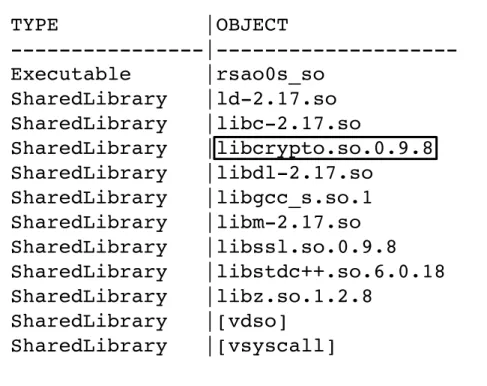
3.1 List of libraries used by RSA sample program. The boxed library is for cryptographic operations. . . 41
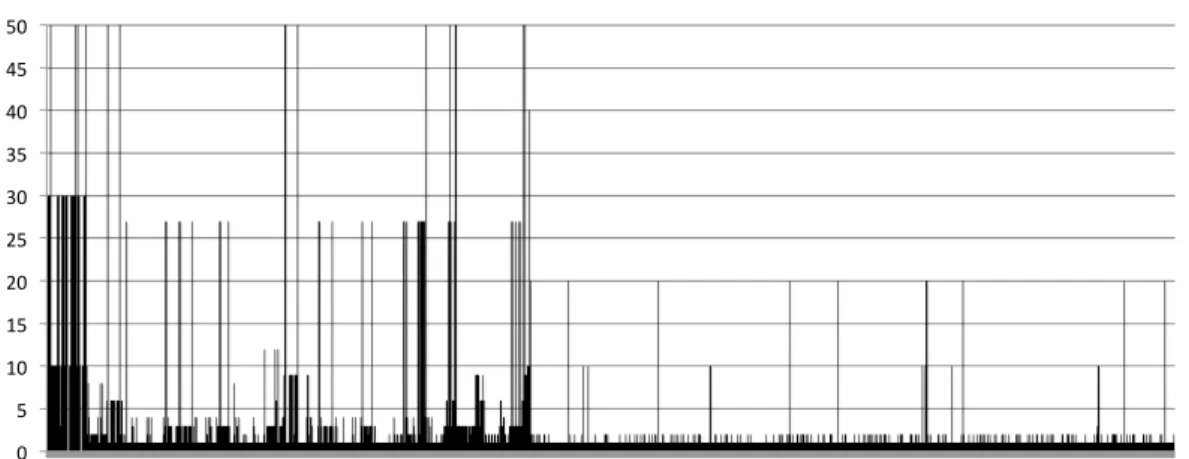
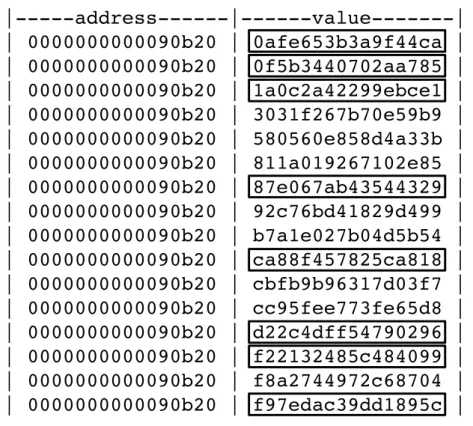
3.2 Values referred from RAM when we iterate RSA encryption and decryp- tion ten times . . . 42
3.3 Recovered value of the RSA key . . . 45
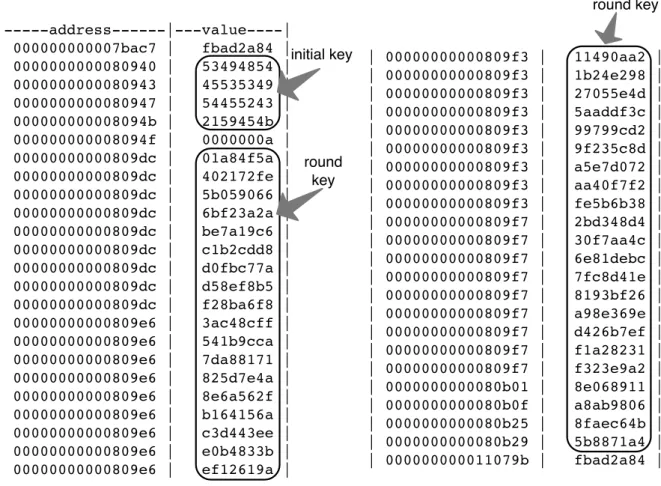
3.4 Recovered value of the AES secret key . . . 46
4.1 The number of blocks (x-axis) and (y-axis) when m = 128, `h = 512 and δ = 20. . . 65
4.2 Our Scheme . . . 67
4.3 Constructing Secure Area Using Obfuscation . . . 69
4.4 Performance Evaluation in Various Settings . . . 73
5.1 Modifying bucket 4 . . . 88
List of Tables
2.1 ptrace . . . 13
2.2 Comparison of ORAM and related schemes . . . 30
2.3 Comparison of PIR . . . 31
3.1 Experimental environment . . . 42
3.2 The watch list of functions for RSA decryption and AES encryption . . . 43
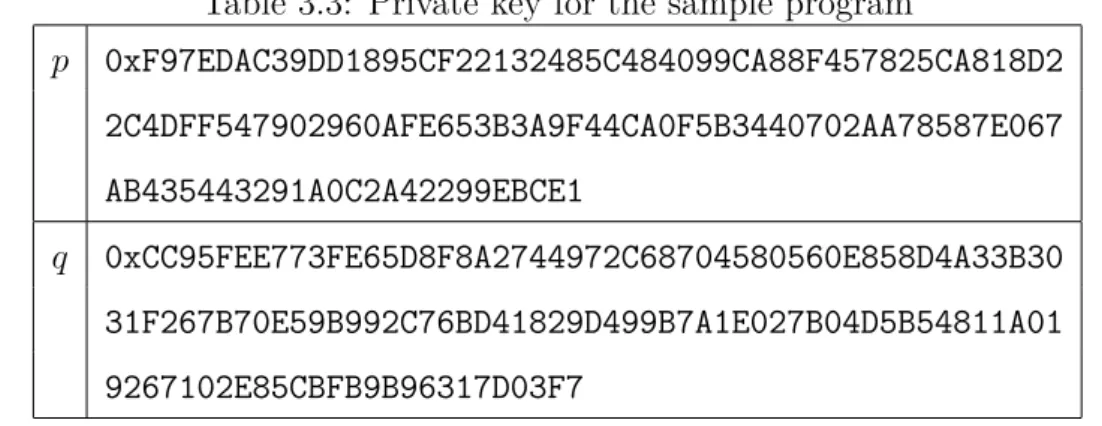
3.3 Private key for the sample program . . . 44
4.1 Summary of Difference between ORAM and Our Proposal . . . 51
4.2 Performance of Path ORAM . . . 74
4.3 Performance of Proposed Scheme . . . 75
5.1 Probabilities that the adversary can detect dummy blocks . . . 81
5.2 Modified Bytes and Affected Rounds in AES Encryption when ORAM Storage is Encrypted . . . 90
5.3 Modified Bytes and Affected Rounds in AES Encryption when ORAM Storage is NOT Encrypted . . . 91
Summary
When program is executed, data that is necessary for the execution is temporary stored on RAM. There are several known attacks against data on memory and they are major concern to software protection. Another concern is bugs which can cause information leakage. Oblivious Random Access Machine(ORAM) can mitigate these threats and protect sensitive data on memory. ORAM can hide an access pattern made by a program and it can protect data from an adversary who can observe memory.
However, ORAM incurs large overhead and does not suit for the practical use. In this thesis, we propose more efficient scheme and evaluate the security of ORAM against stronger adversary.
Chapter 1 describes background of the research as well as main contributions and organisation of the thesis.
Chapter 2 describes threats against software and summarises ORAM researches.
In Chapter 3, we consider an attack using memory dump. When the adversary tries to extract secret data from dumped data, it is required to search entire data. Our proposed attack utilises the access pattern, more precisely the number of accesses, to efficiently extract secret data. We take RSA as an example and demonstrate the private key can be extracted when encryption and decryption of random data are iterated 10 times with fixed key. We also demonstrate the secret key of AES can also be extracted when encryption of random data is iterated with fixed key.
In Chapter4, we propose a lightweight access pattern protection scheme. The large overhead of ORAM is mainly caused by the re-shuffling of data blocks. The proposed scheme achieves its lightweightness by omitting this re-shuffling. Even when the re-
shuffling is not applied, accesses occur only once can be hidden. However, accesses occur multiple times need to be hidden. The proposed scheme records history of accesses and operates dummy accesses based on the history. These dummy accesses makes it possible to hide the access pattern without re-shuffling. Moreover, we propose solutions of issues for the efficient management of data, the construction of secure region and the efficient usage of storage. We implement the propose scheme and show it outperforms the existing scheme by around 5 times.
In Chapter 5, we consider the security of ORAM under a stronger adversary. In general, the security is evaluated under the adversary who only observes the access and does not modify data on memory. This type of adversary is called passive. Another stronger type is called active who can also modify data on memory and we propose an active attack against ORAM. In the attack, the adversary first saves the initial state of the program and executes the program step-by-step while recording all transition of the internal states and output. Then, he modifies one of the data block and executes the program step-by-step. During this execution, the adversary compares the internal state and output to those when the modification is now applied. If any difference to the behaviour of the program is detected, the adversary records in which step the difference is occurred and the modification. By iterating this procedure to all data blocks, the adversary can reveal the access pattern even if ORAM is applied. We apply this attack to AES implemented with Path ORAM and show where the secret key is stored.
In Chapter 6, we consider the application of ORAM to a storage encryption. The encryption can provide confidentially to data stored in storage, but it alone cannot hide the existence of the encrypted data. There is a solution to hide the existence of encrypted volume however, it fails against an adversary who can observe the access pattern to the volume. When access to the encrypted volume is made through ORAM, its pattern can be hidden from the adversary.
In Chapter 7, we conclude the thesis.
Summary (Japanese)
メモリ・アクセスパターン保護の設計と 評価
ソフトウェアの実行に必要なデータはメモリ上に一時的に格納されるため、これを 狙った攻撃がいくつか知られており、ソフトウェアに対する大きな脅威となっている。
また、ソフトウェアの脆弱性によって重要なデータが漏洩することも懸念される。ソフ トウェアが扱う機密情報を保護するためには、これらの脅威への対策が必要であり、そ の一つとしてOblivious Random Access Machine(ORAM)が提案されている。ORAMを 利用することで、攻撃者がメモリを監視できたとしても、メモリアクセスのパターンを 秘匿することが可能であり、ソフトウェアが扱う情報を保護することが可能となる。し かし、既存のORAMはオーバーヘッドが大きいという課題があった。そこで、オーバー ヘッドを削減した手法を提案するとともに、従来よりも強い攻撃者に対するORAMの 安全性評価を行う。
第1章では、背景について述べ、成果および構成について説明する。
第2章では、ソフトウェアに対する脅威について述べ、対策として提案されている ORAMの研究動向を整理する。
第3章では、メモリダンプを用いた攻撃の効率化手法を検討する。メモリダンプに よってソフトウェアが利用するデータを取得することが可能であるが、メモリ上のすべ てのデータの検索が必要であるという課題があった。そこで、ソフトウェアのアクセス を観測することでデータの検索を不要とする攻撃を示す。具体的にはソフトウェアが行 うメモリアクセスについて、各アドレスへのアクセス回数を数え上げることで検索を不 要とする。例として、RSAを対象に、鍵を固定し乱数の暗号化と復号を繰り返し実行す
る。この時、鍵が格納されているアドレスに対してアクセスが集中することを示す。実験 では暗号化・復号の処理を10回繰り返した場合に、鍵の特定が可能である。また、AES を対象とした実験では鍵を固定し、乱数の暗号化を行った場合に、秘密鍵の特定が可能 である。
第4章では、従来のORAMに比べて高速なメモリ・アクセスパターン保護手法の提 案を行う。既存手法はORAMストレージ内のデータを一定周期でシャッフルする必要 があり、処理負荷が高いという課題があった。そこで、一定周期のシャッフルを省略す ることで高速化を実現する。シャッフルなしの場合でも、ソフトウェア実行中に1度し かアクセスされないデータについては、安全性を確保可能である。しかし、ソフトウェ ア実行中に複数回アクセスされるデータは、ソフトウェアにとって必要なアクセスであ る可能性が高く、保護する必要がある。そこで、提案手法では、アクセスの履歴を記録 しておき、各アクセスにおいて、履歴として登録されているデータに対してダミーのア クセスを実行する。これによって、定期的なシャッフルを行わずに、アクセスパターン を秘匿することを可能にし、高速化を実現する。さらに、提案手法を実装する際の課題 となる、データの効率的な管理手法、安全な領域の構築手法、ストレージの効率的な利 用手法、について解決策を示す。さらに、既存手法に比べて最大約5倍高速であること を実験的に示す。
第5章では、より強い攻撃者に対してORAMの安全性評価を実施する。一般的に ORAMの安全性は、アクセスパターンを監視するだけで、データの変更は行わない攻撃
者(受動的な攻撃者)を想定して評価されている。しかし、攻撃者はデータの変更も可能
であることが多く、データを変更可能な攻撃者(能動的な攻撃者)に対する安全性評価が 課題であった。そこで、能動的な攻撃に対するORAMの安全性を評価する。攻撃者は、
ソフトウェアの初期状態を記録し、さらに内部状態と出力を記録しながら1ステップず つ処理を実行する。その後、ソフトウェアを初期状態に戻し、データを1つ選択し、それ を変更する。その後、ソフトウェアの挙動に変化が生じるかどうかを確認しながら、1ス テップずつ実行する。挙動に変化が生じた場合、どのデータを変更した場合にどのステッ プで変化が生じたかを記録し、初期状態に戻す。この操作をすべてのデータに対して繰 り返すことで、各データがどのステップで利用されるかが特定可能である。PathORAM を適用したAESに対して本手法を適用し、鍵の格納先を特定可能であることを示す。
第6章では、ORAMの適用先としてPC等のストレージの暗号化を挙げ、研究の動 向をまとめる。単にストレージ全体を暗号化しただけでは、暗号化領域の存在を秘匿す ることはできず、何らかの情報が保管されている可能性を攻撃者に対して秘匿できない。
そこで暗号化領域の存在そのものを秘匿する機能を実現したソフトウェアが公開されて いるが、アクセスのパターンを攻撃者が観測可能な場合は、暗号化領域の存在を検知可 能であることが指摘されている。暗号化領域の存在を攻撃者から秘匿するためには、暗 号化領域へのアクセスパターンを秘匿する必要があり、このためにORAMが活用され ている。
最後に、第7章で得られた成果に関するまとめを行う。
Chapter 1 Introduction
1.1 Background
Attacks against software are now major threats. In these attacks, the sensitive infor- mation can be leaked even if underlying cryptographic primitives are secure. Moreover, as the software becomes more and more complex, the chance of critical bugs being in- cluded inside the software becomes higher. These bugs sometimes can be exploited by an adversary.
As cloud storage services are getting common, many users outsource their data to a cloud server.
1.2 Contribution of This Paper
We discuss current status of security issues in software protection in Chapter 2.
Especially software that deals sensitive information.
In order to show these threats are critical, we propose key extraction attack against RSA and AES in Chapter 3. In the proposed attack, we closely observe the memory accesses performed by RSA and AES. During the attack, we set the private key for RSA and the secret key for AES remain fixed while input messages are randomly generated.
Then, iterate encryption and decryption and check the number of accesses to each ad- dress. The result shows that in both cases some of the addresses are accessed a lot more
often than the others. We extract values from these addresses and confirm that the extracted values match the keys.
Oblivious RAM (ORAM) schemes can mitigate these threats, however, they impose large computational overhead and not realistic in practical use. To reduce the overhead of ORAM, we propose lightweight scheme in Chapter 4. The main idea behind the proposed scheme is to use the history of accesses. In ORAM schemes, it is important all blocks are only accessed once during an epoch (between oblivious shuffle) otherwise the information can be leaked. Our proposal arrows any block to be accessed more than once by performing dummy accesses to blocks which have been before. This allows us to omit oblivious shuffle and achieve a lightweight scheme. We also apply some techniques to improve the performance of our scheme. Then we evaluate the performance with various parameter settings and compare with one of the most efficient scheme.
The security of ORAM schemes are usually considered against passive adversaries, whose ability is limited only to observe the access. Considering a scenario in which ORAM scheme is used for software protection, the user himself can be the adversary and tries to extract sensitive information embedded inside the executable binary of software.
In this scenario, the user (i.e. adversary) has more ability than the passive adversaries, that is modifying data stored on ORAM. We consider the security of ORAM under active adversaries and propose two attacks in Chapter 5.
We discuss two applications of ORAM schemes in Chapter 6. The first one is to secure multi-party computation and the second one is to volume encryption. In both applications, hiding access pattern, which is realised with ORAM, is the key to achieve the security requirements. Finally, we summarise research results in Chapter 7.
1.3 Organisation of This Paper
The background and purpose of this research are shown in Chapter 1. Trends and issues in recent ORAM research are shown in Chapter 2. An efficient key extraction attack is shown in Chapter 3. A lightweight memory access pattern protection scheme
is addressed in Chapter 4. Some techniques to improve empirical performance of the proposed memory access pattern protection scheme and performance evaluation are also given in Chapter 4. Active attacks against ORAM schemes are shown in Chapter 5. As an application of ORAM, disk encryption is discussed in Chapter 6. Finally, a summary of my research results is given in Chapter 7.
Chapter 2
Security Issues in Software Protection
2.1 Threats against Software and its Data
Attacks against the privacy and the protection of sensitive data in memory are an area of on-going research. In this section, we study various attacks covered in the existing research that are strongly related to our work.
2.1.1 Memory Dump
Memory dump is usually used for debugging programs especially to detect buffer overflows. It also can be used to attack programs. During the execution of the program, its data is temporally stored in RAM and any process with the same privilege as the user executing the program or a root privilege can access that region. If the program is an encryption/decryption program, the decryption key must be stored in RAM and it is possible for the adversary to dump the contents in the RAM and search for the key. On Linux systems, dd or ptrace() can be used to dump memory. We can also access the memory of a running process that runs with different privileges than the user, assuming root is not involved, by using Linux capabilities. By giving the user a capability for the particular program, the user will be able to execute it without the normally required privilege. However, setting capabilities to a program/process requires, initially, root privileges or an appropriate capability.
On operating systems which use virtual memory, part of or entire memory contents of a program are sometimes moved from main memory to secondary storage (i.e. the hard disk drive). If the adversary can access the region of a disk where the pages are stored, it is easy to read the content of memory. Another possibility that the memory content can be stored on the disk is core dump. When a process is unexpectedly stopped, the memory image of that process is saved as a core file in order for debugging. The adversary can access the core file and try to analyse the memory image.
Maartmann-Moe et al. [58] presented a key recovery attack with memory dumping.
Their attack exploits the fact that key representation in memory has a certain structure:
the 128-bit original key is followed by the remaining 1280-bit expanded key in case of AES-128. Once the memory is successfully dumped, the attacker can search 128-bit original key candidates. Then the attacker applies the key schedule algorithm for all candidates. Only the correct candidate returns 1280-bit values which is identical to the values on memory. The authors also applied the same idea to attack Serpent and Twofish.
2.1.2 Cold Boot Attack
The cold boot attack is very similar to the memory dump. It involves reading an image of the RAM without needing root privilege. When RAM module is subject to cold temperatures (e.g., -50◦C), it takes several minutes (5-10 minutes) for its image to degrade – this is a property that can be used to recover the contents of the memory even when power to the memory module has been switched off. Halderman et al. [48]
demonstrated by using this low temperature characteristic that it is possible to extract the disk encryption key from a target computer. The attack proceeds in the following steps:
1. freeze the DRAM module while the computes is on or in sleep mode, 2. power off the computer,
3. boot the computer with a custom OS that extracts entire data in DRAM to an external drive,
4. Identify the decryption key from acquired RAM image, and 5. decrypt the hard drive.
Mülleret al.[65] demonstrated the cold boot attack against an Android smartphone.
Android version 4.0 and upwards support disk encryption so that users can encrypt their personal data. Their tool, called the Frost (Forensic Recovery of Scrambled Telephones), can recover the encryption key from the RAM. The attacker first installs the tool in the recovery partition of the phone, and boots the phone from the recovery partition. Frost can then recover the encryption keys from the RAM and decrypt the user’s partition. It can also recover PINs with a brute force attack.
2.1.3 Cache Timing Attack
Brumley and Boneh [14] demonstrated that the RSA private key can be extracted from an OpenSSL-based web server. Their attack used the timing difference of Mont- gomery reduction [64] and multiplication routines. Due to the nature of Montgomery reduction and Karatsuba [51], the required time for decryption changes depending on the ciphertext C. At first, the attack guesses C and decrypts possible combinations of the 2nd and 3rd most significant bits. The decryption time shows two spikes, which are respectivelyQ andP in OpenSSL. This information is used to refine the guess ofC and iterate the same steps until |Q|/2 (whereQis of |Q| bits in length) most significant bits of Qare recovered. Following that, |Q|/2least significant bits of Q can be factorised by Coppersmith’s algorithm [21].
It has been shown that a private key for the GnuPG RSA decryption can be recovered with a cache timing attack [97]. Their attack, called Flush + Reload attack, targets the L3 cache where the attack program and the victim programs share pages. The attack program can ensure that the specific memory line is evicted from the cache and monitor the access of the victim program to the memory line. The attack consist on three steps:
1. The attack program “flushes” the cache,
2. The attack program waits for the victim program accesses the memory line, 3. The attack program “reloads” the memory line while measuring the time required
to execute it.
When the attack program reloads the memory line in the third step, the required time will be different depending on whether the victim program accessed that particular memory line or not. This time difference can be used to recover the private key for RSA. The same attack can be applied to recover a secret nonce for EC-DSA [96].
More recently security issues were found in speculative executions of modern CPUs called Spectre (referred as CVE-2017-5753 and CVE-2017-5715) and Meltdown (referred as CVE-2017-5754). Spectre exploits the branch prediction and Meltdown exploits out of order execution.
2.1.4 ptrace System Call
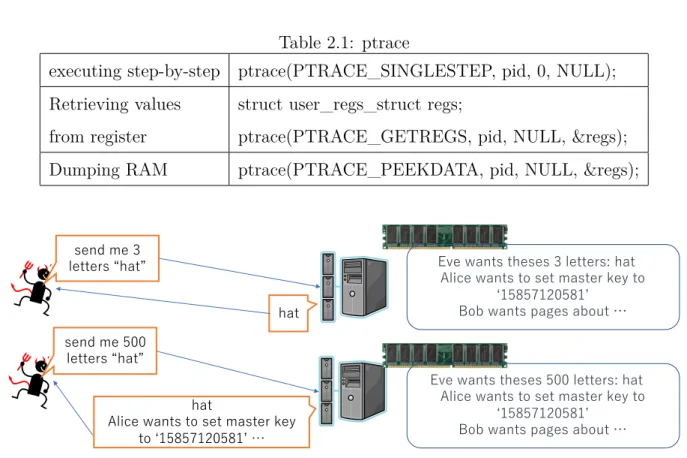
The ptrace() system call enables one process (the “tracer”) to observe, control the execution of another process (the “tracee”), examine and change the tracee’s memory and registers. It is primarily used to implement breakpoint debugging and system call tracing. Table 2.1 summarises options ofptrace. Other thanptrace()system call, there are several other system calls that may help the adversary to monitor the process and its access to memory, such as ltrace() for monitoring dynamic libraries and strace() for system calls.
There is a mode called PTRACE_SINGLESTEP in ptrace, which can load a program or can be attached to an existing program. The PTRACE_SINGLESTEP mode allows the attacker to execute the program step-by-step. We can also acquire the values stored in the CPU registers in each step such as program addresses, register values of operand and values in RAM pointed to by the registers by using a PTRACE_PEEKDATAmode.
executing step-by-step ptrace(PTRACE_SINGLESTEP, pid, 0, NULL);
Retrieving values struct user_regs_struct regs;
from register ptrace(PTRACE_GETREGS, pid, NULL, ®s);
Dumping RAM ptrace(PTRACE_PEEKDATA, pid, NULL, ®s);
send me 3 letters “hat”
hat send me 500
letters “hat”
hat
Alice wants to set master key to ʻ15857120581ʼ…
Eve wants theses 3 letters: hatat Alice wants to set master key to
ʻ15857120581ʼ Bob wants pages about …
Eve wants theses 500 letters: hatat Alice wants to set master key to
ʻ15857120581ʼ Bob wants pages about …
Figure 2.1: Heartbleed Description
2.1.5 Vulnerabilities
Vulnerabilities in software are often critical to the security of the system. In 2014, a critical bug called heartbleed , referred to as CVE-2014-0160, has been found in OpenSSL TLS Heartbeat extension [81], which makes for the attacker to recover 64 kilobytes of memory at a time [20]. If cryptographic keys are contained in this region, the adversary can retrieve these keys. Figure 2.1 describes the attack. In the attack, the adversary can send a request to repeat a word of his choice to check if the server is up. The request sent to the server also contains the length of the word, which the adversary can set arbitrary.
In the example of Fig. 2.1, the requested word is ’hat’ whose length is three, however, the adversary can disguise its length is 500. Then, the adversary will receive ’hat’ and 497 letters which are stored next to ’hat’.
2.2 Related Works
This section summarise researches on ORAM and its related areas.
2.2.1 Oblivious RAM
Protecting sensitive information inside software has been a major concern for all software developers. Many software protection mechanisms have been proposed such as obfuscation mechanisms and combination of secure hardware. Many of those mechanisms are, however, ad-hoc and not based on theoretical foundations.
Pippenger and Fische [74] showed that a Turing Machine can be made oblivious.
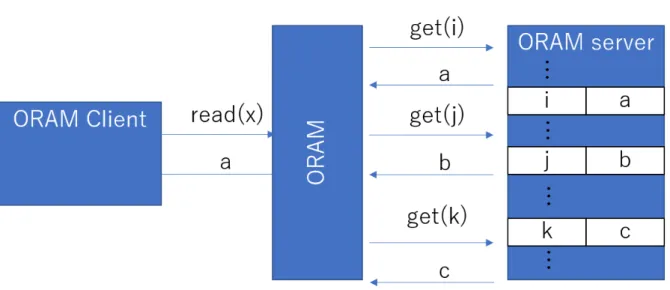
Here an oblivious machine was defined as the movements of the head was independent of the input to the machine and a fixed function of time. Goldreich [39], later extended by Goldreich and Ostrovsky [40], considered oblivious in RAM model and proposed Oblivious RAM (ORAM) for software protection. By using ORAM schemes, one can execute a program in a way that a polynomial-time adversary can only know how long it takes to finish the program even if the adversary can observe memory contents and accesses during execution. A brief overview of ORAM is given in Fig. 2.2. When a ORAM client,i.e. CPU, wants a data blockawhich is stored in the addressx, the client request to perform read(x) to ORAM. Then ORAM translates the operation into a set of operations, in this example these are get(i), get(j) and get(k), and performs them to ORAM server i.e. RAM in order to retrieve the blocks a, b and c. Finally the block a is sent to the CPU. Because of the translation made by ORAM, the adversary who can closely observe physical accesses to RAM cannot distinguish if the given accesses have a certain pattern or not. The application of ORAM to realise a private access to remote servers has also been considered, for example [92, 55]. Goldreich and Ostrovsky proposed two main constructions, called square root solution and hierarchical solution.
After the first proposal of ORAM, several improvements have been proposed and many applications using ORAM schemes have been proposed, for example [1, 92, 73, 12, 25, 82, 46, 53, 55, 85, 87, 93, 88]. Improvements typically arise from the use of
Figure 2.2: Overview of ORAM
different data structures and hash function schemes, more efficient sorting algorithms (for the oblivious shuffling), and the use of secure local (client) memory. Currently, the best amortised overhead is O(log2N/log logN) presented in the work of Kushilevitz et al. [53] whose security is based on the one-way function.
Batcher’s sorting network [8] can be used for oblivious re-shuffling. Given a per- mutation π, Batcher’s sorting network moves data in the address i to the address π(i) in a way that all operations are independent of data and the permutation. During the sorting, two blocks are first read for the comparison, then they are swapped, if they are not sorted, before rewritten. Sorting N blocks requires NdlogNe2 comparisons, which leads to the computational cost of O(Nlog2N) for re-shuffling.
One can show that the combination of the scanning method described above, and frequent oblivious re-shuffling can provide a high level of memory access pattern privacy protection. In particular, the re-shuffling following level overflow ensures that a data item is not visited twice in the same level (for 2 ≤ i ≤ logN) using the same hash function hi. We note however that it was shown in the work of Kushilevitz et al. [53]
that the choice of hash function may still leak information to adversaries.
Despite much recent progress, where the asymptotic efficiency as well as the con-
stant terms of ORAM solutions have been improved (making it particularly attractive for remote storage access pattern protection), current solutions remain inefficient for preventing leakage of relatively limited-in-size memory access pattern. In these cases, the constant terms involved in the computational complexity make the overhead unac- ceptably high. This motivates the proposal of other methods, which while not achieving the same level of protection as ORAM, offer low computation (and storage) overheads, and may therefore achieve both security and performance levels acceptable in practice.
Suppose that we are accessing the data ‘a’ several times in the ORAM. The Read(a) process searches for ‘a’ in the set of (At ∪Pt) where At indicates all element in the top level and Pt indicates the path which is determined by the hash function h(a) and h(dummy). At the next access to ‘a’, the read operation searches for ‘a’ in the set of (At+1∪Pt+1). Here, we have to consider two cases: 1) re-shuffle has been done or 2) re-shuffle has not been done.
1. Since the re-shuffle has not been done, we are using the same hash functions. But,
‘a’ must be in the top level, and search dummy location for the lower levels. Hence Pt and Pt+1 have no correlation.
2. Since the re-shuffle has been done, new hash functions are chosen. Therefore Pt and Pt+1 have no correlation.
As shown,PtandPt+1 are indistinguishable. AndAtandAt+1are also indistinguishable, since the all data always is accessed in the top level. Therefore the adversary cannot tell if ‘a’ is being accessed more than once. Re-shuffling the elements is critical for the security of ORAM, but it is also critical for the cost of ORAM.
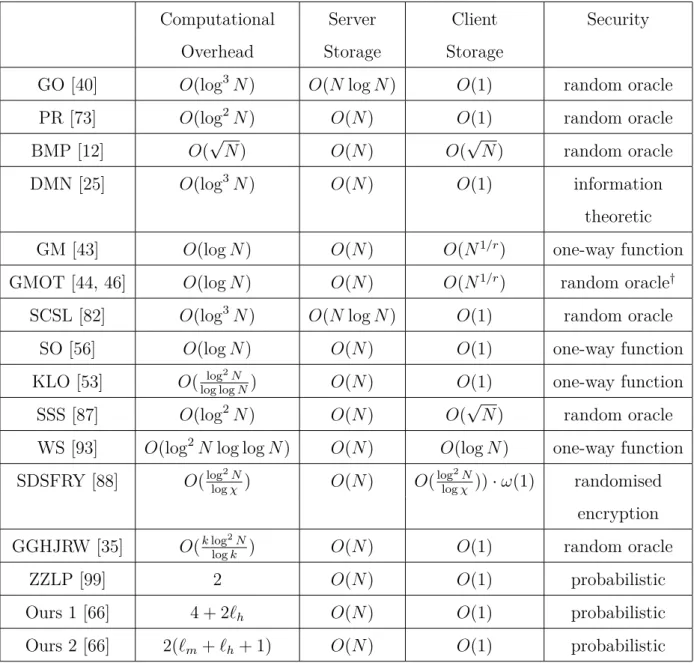
Comparison of computation overhead, storage overhead and security is summarised in Table 2.2. As shown in Table 2.2, the security of SDSFRY [88] is based on the randomised encryption. It is an encryption algorithm which uses randomness on the encryption and resulting ciphertexts correspond to the same plaintext are indistinguishable from one another. In the following sections, we describe some of ORAM schemes more in detail.
2.2.1.1 Square Root ORAM
The square root solution attaches area called shelter, which can contain√
N blocks, to main memory and adds √
N dummy blocks. Then original N data blocks and √ N dummy blocks are permuted by the secret permutation π. When the client accesses to data blockx, one first scans entire shelter to check ifxis inside the shelter. If the block is already inside the shelter, the dummy block will be copied to the shelter. Otherwise, the block x will be copied from π(x). As proposed by Zahur et al. [98], the need of dummy blocks can be eliminated by performing the copy of real blocks from random addresses instead of the copy of dummy blocks.
As one block is copied to the shelter at each access, the shelter gets full after √ N accesses. Once the shelter gets full, new permutation π0 is chosen and all blocks are re-shuffled according to π0, which requires O(Nlog2N) computation. On each access, O(√
N) physical accesses are required. Therefore, the amortised overhead is given by O(√
Nlog2N). The amortised overhead can be optimised by setting the shelter size to Θ(√
NlogN). The security of this scheme is based on an one-way function. The one- way function is a function which can be easily computed in one-way, that is computing y = f(x) for given x, however, computing the other way, that is f−1(y) for given y, is computationally infeasible.
2.2.1.2 Hierarchical ORAM
In the hierarchical solution for RAM with N items, the data structure is organised inn=O(logN)levels consisting of hash-tables with2i buckets (1≤i≤n), each bucket containing O(logN) items. The storage requirement is therefore O(NlogN). Data is mapped into the levels using different secret hash functionshi, known by the client only.
An element r is read with the read(r) operation as follows:
1. Scan the entire first level.
2. If the element is not found, then for each level i (2 ≤ i ≤ n), compute j = hi(r) and read thej-th bucket in the level ibuffer, until the requested element is found.
3. Once the element is found (including during the scan of the first level), continue with the procedure in step 2. by reading a dummy location in each level i given byhi(dummy ◦t), where t is a counter.
4. The entire first level is scanned again, and the element r is written to the first level.
When we wish to update an element r with the write(r, x) operation, we perform the read(r) procedure as above, but insert the new value xinto the first level at the step 4.
It follows that the number of access operations for a data item request (either read or write) is O(log2N).
Because of the writing in step 4, buffer levels eventually overflow with data. Indeed, after 2i requests, the buffer at level i will be full, and its full contents are moved down to level i+ 1. Every time content is moved to a lower level, all data in both levels are permuted and a new random hash function is chosen. This process requires the re- shuffling of data, which needs to be doneobliviously. This is the most complex component of the construction, and is the main factor in its (amortised) complexity overhead.
Based on the constructions above, the Goldreich’s scheme [40] requiresO(NlogN)in storage, and has amortised computation overhead ofO(log3N)per query using the AKS algorithm for the oblivious sorting [2]. Due to the very large constants, the complexity is considered O(log4N) in practice (by using Batcher’s sorting network [8]).
2.2.1.3 Path ORAM
Recently the third construction called the tree construction is proposed by Shi et al. [82]. It has an N-element database in a binary tree of depth logN. Each node in the tree has a bucket which can store k data items. Their scheme uses O(NlogN) storage at the server. The client needs O(1) memory and computation complexity is O(log3N). The scheme is proven secure given the access to a random oracle. Later, the tree construction is optimised by Gentry et al. [35]. The optimisations can reduce the storage overhead by an O(k) factor and computation complexity by an O(logk) factor,
where k is a security parameter.
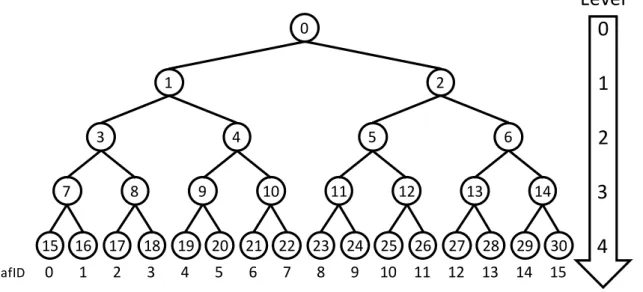
Path ORAM is one of the most efficient scheme [88]. Data in Path ORAM is also maintained as a binary tree of the height L and it has 2L leafs. Each node is called a bucket and always stores Z blocks. When the number of the data blocks is less than Z, dummy blocks will be padded. It also has a secure area in whichstash and position map are stored. The stash acts like a shelter in square root ORAM and it can hold up to C blocks. The position map is a table relating the leafs and blocks inside each leaf. The data structure of Path ORAM is shown in Fig. 2.3.
When a data blocka is accessed, Path ORAM retrieves that leaf`has the data block a from the position map. Then it accesses the path to leaf ` and copies all data blocks into the stash. The data block a is now in the stash, it accesses a. After the access, choose new leaf `0 and update the position map. Also all data blocks in the stash are evicted into the buckets on path `0. Dummy blocks are filled an empty space in the buckets on path `0. When the block a is retrieved from the server, it is always written back to a new random location. Therefore, the sequence of accesses, from the server’s view point, is indistinguishable from the random sequence.
Stefanov et al. also proposed a recursive Path ORAM for reducing the size of the position map which has to be stored in the secure area. The recursive Path ORAM has X ORAMs; ORAM0, ORAM1, . . ., ORAMX where ORAM0 contains the data blocks, and ORAMi+1 contains the position map for ORAMi. Each recursion compress the size of the position map by a constant factor, and it can be compressed to O(1) after a logarithmic number of recursion.
2.2.1.4 GORAM
Maffei et al. [59] presented a framework for privacy preserving cloud storage called GORAM. In GORAM, the user can store his data to cloud storage, and share data with other users with selectively allowing read and write accesses. Moreover these access patterns are oblivious from the server. In the original ORAM scheme and most of the following works only consider the single and honest client. On the other hand, Maffei et
!" !# !$ !% !& '( '! '' ') '* '" '# '$ '% '& )(
$ % & !( !! !' !) !*
) * " #
! '
(
(
! ' )
*
( ! ' ) * " # $ % & !( !! !' !) !* !"
.,/012
Figure 2.3: Data Structure of Path ORAM
al. considered multiple and possibly malicious clients and provided security proofs.
2.2.1.5 Circuit ORAM
When ORAM is used as a building block to realise a secure multi-party computation, its circuit size is critical to the performance of the resulting MPC. Though Path ORAM is one of the most efficient scheme, its eviction is complex and is not as efficient in terms of its circuit size as expected. Circuit ORAM is also a tree-based scheme, like Path ORAM, but with simpler eviction and can be implemented as a small circuit [90]. The eviction of Circuit ORAM, the client first chooses one block and keeps it. Then it can be evicted to somewhere along the path. The eviction algorithm is initiated from the bottom of the tree (i.e. leaves). It first searches a new path where the block can be contained, and move the block from the current path to the new path. If there is not such block, the eviction algorithm chooses different path. Each logical access to a block is translated to the access to a random path, retrieving part is proved to be indistinguishable from the random sequence. The eviction algorithms are also proven to be indistinguishable from the random sequence. Circuit ORAM is later extended to Circuit OPRAM to support parallelism [15].
2.2.1.6 Ring ORAM
Ren et al. [75] proposed Ring ORAM which achieves online bandwidth of O(1) and the amortized overall bandwidth is independent of the bucket size. Ring ORAM is also a tree-based ORAM and shares its characteristics with Path ORAM [88] and SSS ORAM [87]. Server storage of Ring ORAM is organised as a binary tree and each bucket in the tree can hold up to Z +S blocks where Z is the number of real blocks and S is the number of dummy blocks. The client storage is consisted of a position map and a stash.
The main difference between Path ORAM and Ring ORAM in accessing ORAM server is that Ring ORAM only reads one block from each bucket while Path ORAM reads all blocks. Hence Ring ORAM achieves smaller overhead. In order to fulfil the security requirement even when only one block is accessed in the bucket, each bucket will be shuffled after it runs out of un-accessed dummy blocks. Another difference is in an eviction. In Path ORAM, the eviction is performed for every access while Ring ORAM is every A accesses where A is a public parameter. As the result, Ring ORAM outperforms Path ORAM by2.7×.
2.2.1.7 PRO-ORAM
Tople et al. [89] proposed PRO-ORAM which achieves constant latency to hide a pattern of read accesses. While it only protects read access, it achieves constant latencies per access. The key idea of PRO-ORAM is to decompose read access into ‘access’ and
‘shuffle’ and to prepare two separate copies of data. One copy, called active array, is used to perform access operation. The other copy, called next array, is used to perform shuffle operation, and resulting state after√
N accesses can be active array for the next epoch. They also utilise trusted hardware on the server side to delegate access and shuffle operation. Their scheme can be useful when clients repeat read-only accesses to data on the clouds after the initial upload. There are several services which fit in this model, for example photo sharing services, document sharing services and music/video streaming
services, where the content owners upload their own contents to the cloud and other users consumes them.
2.2.1.8 PIR-MCORAM
Despite many proposals of ORAM schemes, majority of these schemes focused on a single client scenario. There is only a few schemes which support multi honest clients scenario. Maffei et al. [60] proposed PIR-MCORAM, one of the schemes that supports multi client. PIR-MCORAM also considers malicious clients.
2.2.2 Oblivious Data Structures
Despite the latest progress in the research of efficient ORAM schemes, even the most efficient scheme incurs relatively large overhead and it is not efficient enough for a practical use. The overhead is due to protecting arbitrary access patterns and it can be reduced if one considers only the specific pattern. Wang et al. [91] considered access patterns with a certain degree of predictability and proposed two techniques to make data structures and algorithms oblivious. Their proposal is asymptotically and empirically more efficient compared to ORAM. In their proposal, sequence of accesses is considered as a graph, called the access pattern graph, in which each node corresponds to memory cell and edges correspond to accesses. When the access pattern graph is a rooted tree with bounded degree, a parent node has pointers to its children. Then the location of children can be retrieved by accessing the parent node, hence no need to lookup the position map to locate the children. This is called the pointer-based technique. Another one is called locality-based technique. This is for the access pattern graph of a low doubling dimension. In this graph, nodes are partitioned into clusters and clusters keep pointers to their neighbouring clusters. When accessing a data block in the cluster, data blocks in the neighbouring clusters will be pre-fetched. This makes sure that for the following accesses, required data blocks are already in the client’s storage.
2.2.3 Oblivious Parallel RAM
One of the limitations of ORAM is that the protected program cannot be paral- leled even if the original program can enjoy large improvement in terms of performance.
Boyle et al. [13] proposed Oblivious Parallel RAM (OPRAM) to overcome this limita- tion. When transforming ORAM into OPRAM, multiple CPUs may perform accesses to the same address, which leaks information that these CPUs are requesting the same data. In order to avoid the collision of accessing addresses, Boyle et al. made only the representative CPU perform the real access and distribute the data block to other CPUs. In tree-based ORAM, the data block will be re-inserted to the root node after the access. If the same policy is applied to the OPRAM, the root node can be easily overflown. Instead of re-inserting to the root node, their scheme re-inserts to nodes in levellogm. After insertingm blocks,m flush operations will be applied to push inserted blocks down towards leaves.
Inspired by the work of Boyle et al. [13], Chen et al. [16] presented an OPRAM scheme based on Path ORAM. First they proposed Subtree-ORAM, which only support single client, but does support multiple access at a time. Then extend it to Subtree- OPRAM. In Subtree-OPRAM, all clients emulate the Subtree-ORAM and interact each other. They also presented a generic transformation turning any (single-client) ORAM scheme into an OPRAM scheme.
2.2.4 Private Information Retrieval
Emerging of cloud storage services enables users to store and access their data very easily. Moreover, users can store huge data which is too large to store locally. However, it also raises a new security challenge, which is how to protect user’s privacy. When the user request data to the server, the server will notice which data the user wants.
The server might be curious about the user’s request and try to extract user’s private information. Encryption can provide confidentiality of data, however, sometimes it is not sufficient. For instance, if the particular file is accessed very often, it implies that
file is more important for the user than the ones accessed less often. An adversary may try to delete those files.
Private Information Retrieval is a technology that allows clients to query a database in a way that even the database cannot learn anything about the clients’ queries. A trivial solution is to download everything every query. This solution, however, is impractical due to a high communication overhead and a high storage overhead at the client side.
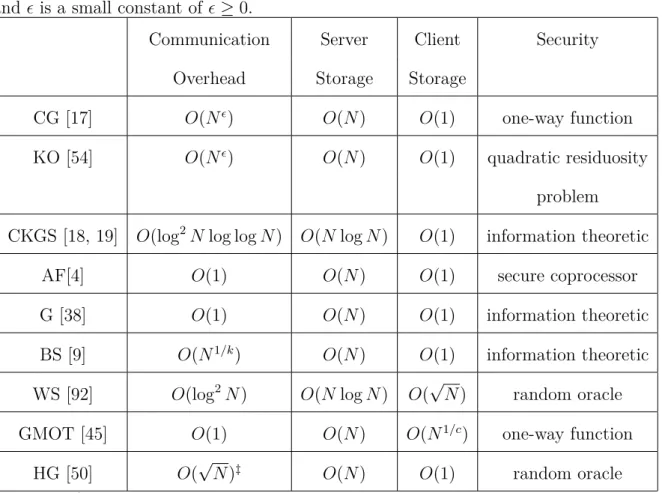
There are two PIR schemes: computational PIR (CPIR) [17, 54] and information theoretic PIR (ITPIR) [19]. In the CPIR, the client queries the database an encrypted query and the server returns the encrypted result to the client in order to prevent the computationally limited server from learning anything about the query. For example, Chor and Gilboa’s scheme [17] and Kushilevitz and Ostrovsky’s scheme [54] requireO(N) server storage for storing data of size N, the same as evaluated in ORAM schemes, and communication overhead is O(N). We evaluate the efficiency of PIR schemes in terms of the communication cost, not the computational cost, as the efficiency is generally measured by the communication cost. The security of Chor and Gilboa’s scheme is based on an one-way function and Kushilevitz and Ostrovsky’s one is based on the hardness of deciding quadratic residuosity. An integer q is called quadratic residue (QR) if there exists an integerxsuch thatx2 =q mod n, andqis called quadratic non-residue (QNR) otherwise. It is considered hard to predicate ifqis QR or QNR whennis a product of two distinct prime numbers of equal length. On the other hand, the ITPIR can offer perfect security, that is, the server cannot acquire any information about the client’s query even if the server has unlimited computational resources and unlimited time. In order to achieve the ITPIR, usually multiple servers are required and these servers are assumed not to collude. The t-private `-server PIR can information theoretically guarantee the privacy of the query even if up to t out of ` servers collude. Beimel and Stahl [9] introduced a notation calledt-privatek-out-of-`PIR in whichkout of`servers need to respond and up to t servers may collude without compromising the security. In addition they examined a situation that v out of k servers can return incorrect answers, due to a malicious servers or database failure, which is termed as t-private v-Byzantine-robust k-out-of-`
PIR. Chor et al. [18, 19] have proposed several schemes. Their proposals enable the client to retrieve one bit with O(√
N) communication cost in a simple `-server scheme, O(N1/`)communication in a general`-server scheme and 13(1 +o(1))·log2N·log log(2N) communication cost in 13logN+ 1-server scheme. Their scheme is information theoretic secure.
After the first proposal of PIR [18], several improvements in terms of communi- cation cost have been shown [83, 84, 4, 9, 38, 92, 45, 26]. The scheme proposed by Goldberg [38] requires O(N) server storage and O(1) communication overhead, and is information theoretic secure. This scheme was implemented as an open-source project on SourceForge [37]. Smithet al.[83, 84] proposed a scheme with a tamper-proof device.
The client sends the secure coprocessor (SC) with encrypted query. The SC receives the query and decrypt it. Then the SC reads the entire database and get the requested data item. When returning the data item to the client, the SC encrypts the item and send it back to the client. Williams and Sion [92] proposed a single-server PIR with an ORAM and a secure coprocessor. The communication and computational complexities of their scheme is O(log2N) andO(√
N)client storage is required. The security of their scheme is proven when it has the access to a random oracle. Devet et al. [26] improved the scheme presented by Goldberg [38] and evaluated the performance of the scheme. They showed that their implementation was several thousands times faster than Goldberg’s scheme [38].
Bao et al. [6] and Schnorr et al. [80] independently proposed similar PIR schemes using homomorphic encryption. Their schemes requires only O(1) computation to be done on-line. The idea of the schemes is to do as many operations as possible off-line to achieve practical on-line overhead. However, because of heavy off-line computation, the client has to wait until the server is ready to be queried, and this latency may make the schemes less practical. The schemes work as follows: When the client wants to obtain a data item, which is encrypted with the servers secret key and publicly available, first the client download the item and encrypts it with the client’s secret key. After the encryption at the client, the client sends the item to the server and asks to remove the
server’s encryption. Finally, the client obtain the data item by decrypting one’s own encryption.
Asonov and Freytag’s scheme [4] also assumes the SC inside the server and SC first shuffles the entire database according to a random permutation π. When the client request the data item i1, the SC fetches the item from π(i1). This only requires O(1) of computation and communication. For the second query of requesting the itemi2, the SC first has to readπ(i1)and then readπ(i2). Wheni1 =i2 (the second and the first query request the same data item), the SC reads π(i1) and a random item in order to hide the fact that the client is reading the same data item twice. Therefore, for the n-th query, the SC has to read all previously read items before reads π(in). At a certain point, the SC has to pick a new permutation π0 and shuffle the database with π0.
The PIR schemes can protect user’s privacy from an honest-but-curious servers. How- ever, PIR schemes can not offer a protection from a dishonest user. Gertner et al. [36]
proposed a symmetric private information retrieval (SPIR) that prevents the user from learning additional information. Henry et al. [49] considered an application of SPIR for e-commerce and proposed a protocol that extended the PIR scheme [38] to a priced symmetric private information retrieval (PSPIR). Their PSPIR scheme maintain user’s anonymity and does not leak any information about the record of user’s purchases.
Recently implementations of CPIR and evaluating performances on real environments are attracting more attentions. Melchor and Gaborit [63, 62] proposed a lattice-based new scheme with a reasonable communication cost and with computational complexity being improved by a factor of one hundred. Later, Olumofin and Goldberg [70] imple- mented the lattice-based scheme and evaluated the performance. They demonstrated that the overhead of Olumofin and Goldberg’s scheme was 10 to 1000 times smaller than the trivial scheme (i.e. downloading entire database). Ding et al. [28] proposed a PIR scheme, which does not require full-shuffle of the database. By shuffling only a portion of the database, their scheme achievesO(logN)communication cost,O(1)runtime com- putation cost, andO(p
NlogN/k)overall amortized computation cost per query, where k is the trusted cache size.
Recent schemes can outsource the database to untrusted servers and yet can protect both the privacy of the database owner and clients. Huang and Goldberg [50] proposed a scheme for outsourcing Private Information Retrieval. Their scheme requires O(√
N) computational overhead and the server stores O(√
N)data. The security of the scheme is proven when it has the access to a random oracle. They also implemented their scheme and evaluated the performance. When the client updates 1MB record in the 1 TB database, an amortised end-to-end latency is smaller than 300 ms.
The comparison of PIR schemes is summarised in Table 2.3. In Table 2.3, we com- pared communication overhead of schemes since they are generally evaluated by commu- nication overhead1, while ORAM schemes are evaluated by computational overhead.
2.2.5 Difference between ORAM and PIR
The target of both ORAM and PIR is the same: how to efficiently protect the pattern of accesses. The main difference is that (full functional) ORAM supports both the read and write operations to RAM (or server) while PIR usually consider only the read operation. As the functionality of PIR is limited compared to ORAM, PIR tends to be more practical, in terms of communication and storage cost, than ORAM. PIR works very well when one server or cloud operator provides a large database and many clients want to download part of the database in a privacy preserving manner. Video and audio streaming services are good applications of PIR, where providers upload their video and/or audio files to the cloud and subscribers enjoy the contents while hiding their privacy. However, as PIR does not support write operation, it does not work well in some services for example file hosting services where clients upload their files and they often update part of their files. Neither does PIR work well when a software developer wants to protect his/her software from reverse engineering. ORAM is usually less practical than PIR in terms of performance, however, ORAM supports bothreadand write operations. Hence ORAM is suitable for protecting access pattern in a database
1All literatures referred in Table 2.3 evaluate their own scheme in terms of the communication overhead, except Huang and Goldberg’s scheme [50]
which is often updated and a software protection.
PIRs usually offer less functionality (i.e. protection only for read accesses) than full functional ORAMs, hence they are lighter than ORAMs and oppose smaller overhead.
Because of their lightweightness, PIRs are more attractive for users who wish to hide only their reading pattern. Some ORAM schemes are practical and their applications to realise a private access to remote servers have also been considered. Our scheme is as light as one of the most efficient PIRs, our scheme can be used instead of PIRs without sacrificing performance.
2.2.6 Hardware-assisted Control Flow Obfuscation
ORAM constructions remain too expensive to be implemented on embedded proces- sors. Zhuang et al. [99] proposed a practical, hardware-assisted scheme for embedded processors, with low computational overhead. Theircontrol flow obfuscation scheme for embedded processors employs a small secure hardware obfuscator (called shuffle buffer) to hide program recurrence. We give a brief description of the scheme below; for more details, refer to [99].
Letn be the size (in blocks) of memory, and mn be the size of the shuffle buffer.
The shuffle buffer is within the CPU trusted boundary, i.e. it is considered secure local storage (cache), and an adversary is not able to observe access pattern in the shuffle buffer. As in other parts of this paper, we assume that data is stored encrypted and access operations consist of sequential read and write operations. A random permutation is initially applied to data before loading it to RAM. The scheme then works as follows.
1. The first m blocks in memory are moved to the shuffle buffer.
2. When making a request for a data item, if the block is found in the shuffle buffer, access the block.
3. If the block is not found in the shuffle buffer, pick a random block in the shuffle buffer and swap it with the requested data block in memory (the accessed data item is now in the shuffle buffer).
4. When the program finishes its entire process, the full contents of shuffle buffer are written back into memory.
Note that item 3. implies that the permutation used to map data in memory is dynamically modified as the program runs. Although the dynamic secret permutation helps to protect the privacy of individual items being accessed (or being repeatedly accessed), it also means that the scheme needs to make use of a block address table to map data items into memory (describing the permutation at time t). As a result there is the storage requirement of size O(n) within the trusted environment to represent this mapping (albeit with constant <1).
The scheme trades security for low overhead. Besides the costs of having a secure on-chip buffer, the scheme trivially leaks information about access of data items during execution of program. In fact, the lack of memory access in step 2 indicates that when step 3 is executed, one knows the exact block being accessed (the one in memory, being brought into the buffer). Thus a step 2 followed by a step 3 indicates that the data items being accessed are definitely distinct (i.e. there is no 2-recurrence at this particular stage). Likewise, a step 3 followed by a step 2 indicates a 2-recurrence with probability 1/m. Furthermore, an access in memory to a data item which was previously swapped out from the buffer indicates with high probability the existence of repeated access to a particular data. These could be confirmed by running the program several times.
Despite the limitations of the proposal, it adds a very low overhead to the program execution (besides the read/write and encryption/decryption overhead, only an extra read/write operation due to cache misses). We will adapt some of the ideas from this scheme in our proposal.
Table 2.2: Comparison of ORAM and related schemes. r is a small constant of r > 1.
B is a size of data block (B =χlogN). `m and `h are respectively the size of buffer and history table. k is the security parameter whose typical setting may be k∈[50,80].
Computational Server Client Security
Overhead Storage Storage
GO [40] O(log3N) O(NlogN) O(1) random oracle
PR [73] O(log2N) O(N) O(1) random oracle
BMP [12] O(√
N) O(N) O(√
N) random oracle
DMN [25] O(log3N) O(N) O(1) information
theoretic
GM [43] O(logN) O(N) O(N1/r) one-way function
GMOT [44, 46] O(logN) O(N) O(N1/r) random oracle†
SCSL [82] O(log3N) O(NlogN) O(1) random oracle
SO [56] O(logN) O(N) O(1) one-way function
KLO [53] O(log loglog2NN) O(N) O(1) one-way function
SSS [87] O(log2N) O(N) O(√
N) random oracle WS [93] O(log2Nlog logN) O(N) O(logN) one-way function SDSFRY [88] O(loglog2χN) O(N) O(loglog2χN))·ω(1) randomised
encryption GGHJRW [35] O(kloglog2kN) O(N) O(1) random oracle
ZZLP [99] 2 O(N) O(1) probabilistic
Ours 1 [66] 4 + 2`h O(N) O(1) probabilistic
Ours 2 [66] 2(`m+`h+ 1) O(N) O(1) probabilistic
† This can be realised without a random oracle by using the work of Damgård et al. [25]
Table 2.3: Comparison of PIR. ` is the total number of servers and k is the minimal number of servers which are available at the time of retrieval. c is a constant of c ≥ 2 and is a small constant of ≥0.
Communication Server Client Security
Overhead Storage Storage
CG [17] O(N) O(N) O(1) one-way function
KO [54] O(N) O(N) O(1) quadratic residuosity
problem CKGS [18, 19] O(log2Nlog logN) O(NlogN) O(1) information theoretic
AF[4] O(1) O(N) O(1) secure coprocessor
G [38] O(1) O(N) O(1) information theoretic
BS [9] O(N1/k) O(N) O(1) information theoretic
WS [92] O(log2N) O(NlogN) O(√
N) random oracle
GMOT [45] O(1) O(N) O(N1/c) one-way function
HG [50] O(√
N)‡ O(N) O(1) random oracle
‡ They evaluated the scheme in terms of computational overhead.
Chapter 3
Key Extraction Attack
3.1 Introduction
The growth of various services on the Internet has given rise to a dramatic increase in the information that is exchanged over Internet protocols. Sensitive information in pri- vate e-mails, confidential documents, e-commerce and other financial transactions need to be guarded against eavesdropping. In order to protect the communication between two network hosts, the Secure Sockets Layer [33] and Transport Layer Security [27]
(SSL/TLS) are commonly used. OpenSSL1 is the one of most commonly used open source libraries for the SSL and TLS protocols. The core library offers implementations for various cryptographic algorithms such as Blowfish [79], Camellia [3], AES [67], SHA- 1 [68], SHA-2 [68], RSA [78], DSA [69] and Elliptic Curve [52] and other utility functions.
The library is implemented in the C programming language and available for Windows as well as all Unix-based operating systems such as Linux, Mac OS X and Android.
Recently, a critical bug, referred to as CVE-2014-0160, has been found in OpenSSL TLS Heartbeat extension [81], which makes for the attacker to recover cryptographic keys by reading 64 kilobytes of memory at a time [20].
Any unauthorised access to cryptographic keys constitutes a security breach. Tamper- proof devices [22, 100, 99] and obfuscation [7, 57, 41] can be used when a program is not
1See: https://www.openssl.org/.
running but not during program execution. It is well-known that the cryptographic keys are present in the random access memory (RAM) during the execution of a program;
a knowledge that an adversary can use to extract the keys from the RAM [48, 58, 65].
Protecting the keys or any other valuable information from unauthorised access during program execution is an important area of on-going research. Oblivious RAM schemes and related works, such as [39, 40] can protect the RAM access patterns of programs from unauthorised access. However, these schemes require trustworthy and secure CPUs for the protection, and cannot prevent attacks where the attacker can access the CPU and extract information such as operations, access to memory addresses of operations and values stored in those addresses.
In this chapter, we present a new attack method that can extract a private key for RSA and a secret key for AES from dumped memory image. Then we implement a tool called the Process Peeping Tool (PPT) to demonstrate the attacks against RSA and AES. The PPT enables us to analyse the structure and behaviour of the target program by observing its memory use. The PPT can also statistically analyse the data that is acquired from the RAM, that is, when a function inside the target program makes request to a certain data blocks, the PPT can record which function made the request to which data block and how many times the access is made. Thus, it enables the attacker to determine cryptographic keys by observing memory accesses made by cryptographic functions. We use the PPT to extract cryptographic keys (both for RSA and for AES) from sample programs, which use the OpenSSL library. In the key recovery attack against RSA, we iterate through cycles of encryption and decryption and observe the memory values, which the decryption function accesses. Assuming that the private key remains fixed during the execution of the program, the number of accesses to the key grows as we iterate through encryptions and decryptions. The key can be extracted by observing the accesses to memory. In the case of AES, we encrypt a random number with one fixed secret key and observe the memory values accessed by the encryption process.
We demonstrate that the secret key can be extracted by observing the memory access patterns. The address of any shared libraries has to be public for the PPT to be able
to analyse the program. Using a static library and deleting symbol information makes it harder for the attacker to obtain the keys. However, the keys can still be extracted once the attacker determines the functions that need to be observed. Although, adding dummy data and/or dummy operations also make the attack harder, the keys can be extracted with the help of additional information. Even when dummy data and dummy accesses are added, these can be distinguished from the actual data since the dummy data and accesses do not affect the output of the program.
3.2 Background: RSA and AES
In this section, we briefly describe the basics of the two encryption algorithms: the RSA [78] asymmetric cipher and the AES [67] block cipher.
3.2.1 RSA Description
RSA was invented by Rivest, Shamir and Adleman [78] as one of the first practical public key cryptography. The security of RSA is based on the difficulty of factoring the product of two large prime numbers. Now, it is the most widely used public key cryptosystem and also used as the standard public key cryptography for SSL/TLS. RSA consists on three algorithms: key generation, encryption and decryption. A pair of keys consisting of the public key and the private key can be generated in the key generation algorithm. In the key generation, one first finds two prime numbers p and q, and let N =pq and φ(N) = (p−1)(q−1). Then one chooses e which satisfies E < φ(N) and gcd(E, φ(N)) = 1. The public keys are D and N, and the private key can be given by D = E−1 modφ(N). With the public key, one can encrypt a plaintext M with a public exponent E and modulus N as ciphertext C ← ME mod N. The ciphertext is decrypted as M ←CD mod N, whereD is a private exponent.
The Chinese Remainder Theorem (CRT) is often used to perform these exponentia- tion operations and it is also used in OpenSSL library. The exponentiation is computed in two steps: