九州大学学術情報リポジトリ
Kyushu University Institutional Repository
ゲーム理論と通信網の安全性への最大充足可能性ア プローチ
廖, 暁鵑
https://doi.org/10.15017/1441264
出版情報:Kyushu University, 2013, 博士(工学), 課程博士 バージョン:
権利関係:Fulltext available.
Kyushu University
Doctoral Thesis
Maximum Satisfiability Approach to Game Theory and Network Security
Author:
Xiaojuan Liao
Supervisor:
Prof. Ryuzo Hasegawa
A thesis submitted for the degree of Doctor of Engineering
in the
Graduate School of Information Science and Electrical Engineering
January 2014
Abstract
The problem of determining whether a propositional Boolean formula can be true is called Boolean Satisfiability Problem (SAT). Maximum Satisfiability Problem (MaxSAT), as well as its extensions: partial MaxSAT, weighted MaxSAT, and weighted partial MaxSAT, are optimization versions of the famous SAT problem. To date, there have been a variety of MaxSAT applications such as planning and scheduling. This thesis is concerned with a well-suited way of representing and solving real-world problems with MaxSAT, in terms of multi-agent systems and cryptographic areas.
Generally, a propositional Boolean formula is expressed in Conjunction Normal Form (CNF), which is a conjunction of clauses that are disjunctions of literals. A literal is either a positive or negative Boolean variable. Weighted partial MaxSAT (WPM) distinguishes clauses between hard and soft, where each soft clause is associated with a positive weight. The WPM problem is to satisfy all hard clauses and maximize the sum of weights of all the satisfied soft clauses. The fact that WPM only identifies positive weights sometimes becomes impediment to solve problems where positive and negative weights co-exist. To avoid this difficulty, in this thesis, an extended WPM (EWPM) for handling non-zero weights is presented and the relationship between EWPM and WPM solution is examined. The design of EWPM paves the way for a wider range of WPM applications.
One application of EWPM is the coalition structure generation problem (CSG), which tries to partition a set of agents into coalitions so that the total sum of payoffs of all coalitions is maximized. One of the difficulties for solving the CSG problem is that the size for representing the payoffs of possible coalitions is exponential to the number of agents. Recently, a new breakthrough has been achieved by representing the CSG prob- lem concisely in a set of rules, where each rule is assigned to a non-zero payoff. With the compact representation schemes, the CSG problem has been significantly scaled up.
This thesis provides two WPM encodings for solving the CSG problem in compact rep-
resentation schemes, making use of rule relations and agent relations respectively. The
rule relation-based WPM encoding is derived from the existing optimization framework-
s, while the agent relation-based WPM encoding is a brand-new encoding drawing on
the developed EWPM. Both encodings validate the effectiveness of the WPM solvers in
solving the CSG problem, and the agent relation-based WPM encoding exhibits more
desirable performance than the other one.
iv If all soft clauses in WPM have weight 1, the problem is regarded as partial MaxSAT.
The goal of partial MaxSAT is to satisfy all hard clauses and the maximal number of soft
clauses. In this thesis, the potential of partial MaxSAT is exploited for reconstructing
corrupted keys of advanced encryption standard (AES), which is typically extracted from
dynamic random access memory. An AES key is a series of 0-1 bits closely related to
each other. The relations among key bits are naturally expressed with a set of Boolean
formulas, and thus the problem of rectifying the faults in the corrupted AES key schedule
is able to be formulated as a Boolean satisfiability problem. Traditionally, the AES key
recovery is achieved by SAT solvers, based on the assumption that all memory bits
decay from the charged state to the ground state. However, this assumption does not
hold in realistic case where the majority of memory bits decay to the ground state while
a small fraction of bits flip in the opposite direction. This thesis follows the realistic
setting by taking the reverse flipping into consideration, and encodes the problem of AES
key recovery into partial MaxSAT. Experiments demonstrate that the partial MaxSAT
encoding can greatly improve the efficiency of AES key recovery from corrupted key bits.
Acknowledgements
First of all, I would like to acknowledge the China Scholarship Council (CSC) for award- ing me the state scholarship, which covered all my living stipend in Japan during my Ph.D course. Thanks to this scholarship, I could fully devote myself to the research.
I would like to thank my supervisor Prof. Ryuzo Hasegawa for his support of my research and Ph.D study. Without his supervision and help, this work would not be possible. His dedication to research and patience for students will always be an example for me to follow. I gratefully thank Prof. Hiroshi Fujita for his constructive suggestions and support during my study in Hasegawa-Fujita Lab. I am heartily indebted to Prof.
Miyuki Koshimura for his patient and expert guidance throughout the course of the research described in this thesis. Without the numerous discussions with him, the results presented in this thesis would never have existed. I would also like to thank Prof. Makoto Yokoo and Prof. Einoshin Suzuki for taking the time to read my thesis and giving me precious comments.
I would like to express my sincere appreciation to Prof. Makoto Yokoo and his students for their kind and generous help of my research. My sincere appreciation is extended to Dr. Tadashi Araragi for being my external advisor and providing a lot of perspicacious comments about my research. Besides, I would like to thank my collaborator Dong Hao for his valuable comments and suggestions. I would like to show my deep gratitude to Hiroshi Kihara for giving me kind help on my research. I would also like to thank Dr.
Fagen Li for providing me with the valuable research knowledge and advice.
I would like to express sincere thanks to all members of Hasegawa-Fujita Laboratory.
You have been remarkable source of inspiration for many ideas developed in this thesis.
I am really glad to have collaborated with you all. I am grateful to my colleagues and friends at Kyushu University: Rong Huang, Leyuan Liu, Yichao Xu, Chengming Li and Hao Zhu. I am very fortunate to have met up, discussed and worked with you during my Ph.D course. Thank you for all your support on research and living
Finally I would like to thank my parents, my husband, and all my friends for their love and encouragement. Without their help and understanding, I certainly would not have been able to finish this thesis.
v
Contents
Abstract iii
Acknowledgements v
Contents vi
List of Figures xi
List of Tables xiii
1 Introduction 1
1.1 Research Area . . . . 1
1.1.1 SAT and MaxSAT . . . . 1
1.1.2 The CSG Problem . . . . 3
1.1.3 Recovering AES Keys from a Cold Boot Attack . . . . 5
1.2 Thesis Contribution . . . . 6
1.3 Thesis Organization . . . . 7
2 Preliminary 11 2.1 SAT, MaxSAT and Its Extension . . . 11
2.2 MaxSAT Algorithms . . . 14
2.3 CNF Encodings . . . 16
2.3.1 Transformation by Boolean Algebra . . . 17
2.3.2 Transformation by Tseitin Encoding . . . 18
2.4 Game Theory . . . 20
2.4.1 Non-cooperative game . . . 20
2.4.2 Cooperative game . . . 21
2.4.3 Game Theory Applied in Network Security . . . 22
3 Extending MaxSAT to Deal with Negative Weights 25 3.1 Weighted Partial MaxSAT . . . 26
3.2 Extended Weighted Partial MaxSAT . . . 26
3.2.1 EWPM-to-WPM Transformation . . . 26
3.2.2 Redundancy in Transformation . . . 29
vii
Contents viii
3.2.3 Considerations . . . 30
3.3 Chapter Summary . . . 31
4 MaxSAT Encoding for the CSG Problem based on Rule Relations 33 4.1 Coalition Structure Generation (CSG) . . . 34
4.1.1 Characteristic Function Game . . . 34
4.1.2 Partition Function Game . . . 36
4.2 Related Works . . . 38
4.2.1 An Overview . . . 38
4.2.2 Direct Encoding . . . 39
4.3 WPM Encoding on Rule Relations . . . 42
4.3.1 Encoding Positive Value Rules . . . 42
4.3.2 Encoding Positive Value Embedded Rules . . . 44
4.3.3 Encoding Negative Value Rules . . . 47
4.3.4 Encoding Negative Value Embedded Rules . . . 49
4.4 Evaluation . . . 51
4.4.1 Generating Problem Instances . . . 51
4.4.2 Selecting Appropriate Solvers . . . 52
4.4.3 Results . . . 53
4.5 Chapter Summary . . . 54
5 MaxSAT Encoding for the CSG Problem based on Agent Relations 57 5.1 WPM Encoding on Agent Relation . . . 58
5.1.1 Agent Relation . . . 58
5.1.2 Encoding Positive Value (Embedded) Rules . . . 60
5.1.3 Encoding Negative Value (Embedded) Rules . . . 62
5.2 Evaluation . . . 64
5.3 Chapter Summary . . . 66
6 MaxSAT Encoding for Recovering AES Key Schedules 69 6.1 Cold Boot Attack and AES . . . 70
6.2 Reltaed Works . . . 71
6.3 Modeling Bits in AES-128 Key Schedules . . . 73
6.4 SAT/ MaxSAT Encoding for Recovering AES-128 Key Schedules . . . 75
6.4.1 Recovery with SAT under the Realistic Assumption . . . 76
6.4.2 Recovery with MaxSAT under the Realistic Assumption . . . 77
6.5 Experiment and Comparison . . . 80
6.5.1 Generating Problem Instances . . . 80
6.5.2 Selecting Appropriate Solvers . . . 81
6.5.3 Results . . . 82
6.6 Chapter Summary . . . 86
7 Conclusions and Future Works 89 7.1 Efficient MaxSAT Encoding . . . 89
7.2 Future Works . . . 91
Contents ix A Complete File for Example 4.7 in WPM Input Format 93 B Complete File for Example 4.8 in WPM Input Format 97 C Complete File for Example 5.2 in WPM Input Format 103 D Complete File for Example 5.3 in WPM Input Format 105
E A Sample of Sbox Expressed in ANF 107
Bibliography 113
List of Related Publications 125
List of Figures
4.1 Graphical representation of Example 4.5 . . . 41
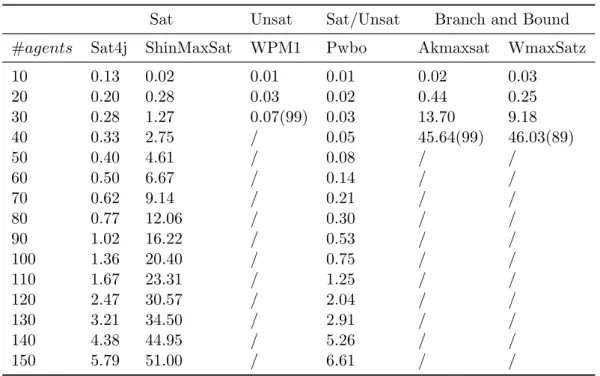
4.2 Average computation time of RWPM and direct encoding [75, 111] . . . . 54
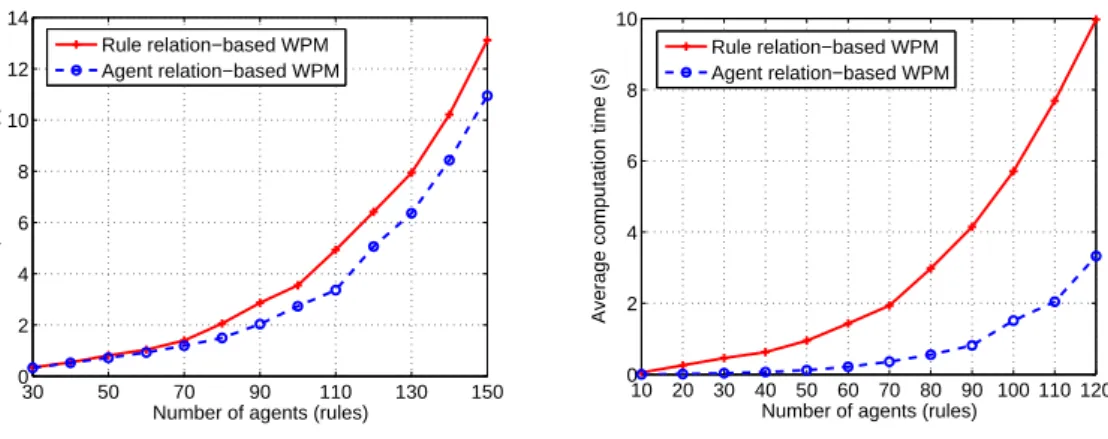
5.1 Average computation time of RWPM and AWPM . . . 66
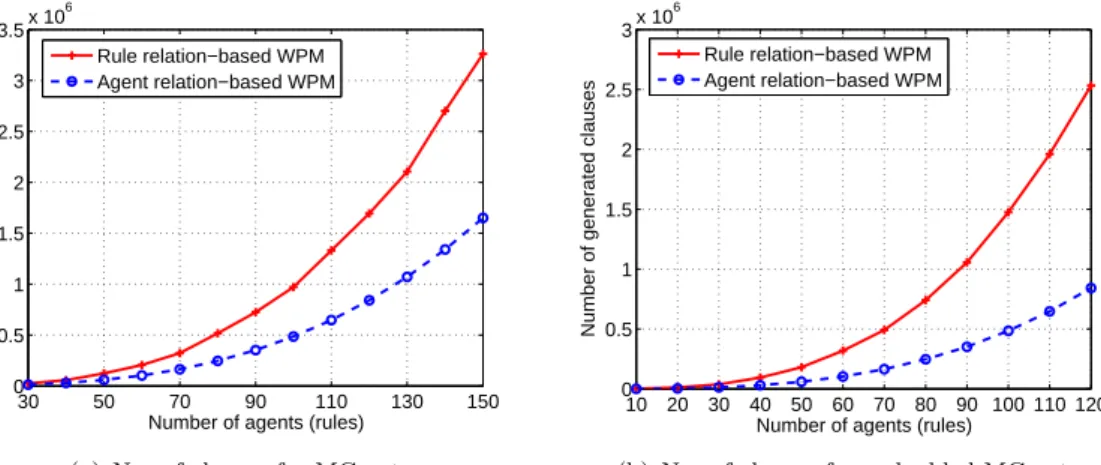
5.2 Number of Boolean variables in RWPM and AWPM . . . 67
5.3 Number of clauses in RWPM and AWPM . . . 67
6.1 Diagram of AES-128 key expansion in adjacent two rounds . . . 73
xi
List of Tables
4.1 Average wall-clock time (seconds) required for RWPM in MC-nets . . . . 53 4.2 Average wall-clock time (seconds) required for RWPM in embedded MC-
nets . . . 53 5.1 Average wall-clock time (seconds) required for AWPM in MC-nets . . . . 65 5.2 Average wall-clock time (seconds) required for AWPM in embedded MC-
nets . . . 65 6.1 Average runtime (seconds) required for MaxSAT Solvers . . . 82 6.2 Average runtime of SAT/MaxSAT approaches at δ
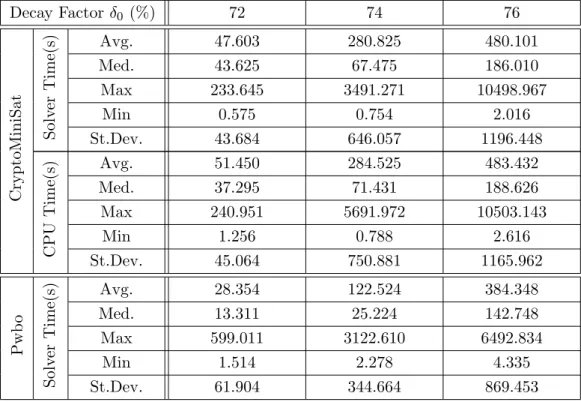
1= 0.1% . . . 82 6.3 Runtime statistics of SAT/MaxSAT approaches with 1 reverse flipping
error . . . 84 6.4 Runtime statistics of SAT/MaxSAT approaches with 1 reverse flipping
error (cont’d) . . . 84 6.5 Runtime statistics of SAT/MaxSAT approaches with 2 reverse flipping
errors . . . 85 6.6 Runtime statistics of SAT/MaxSAT approaches with 2 reverse flipping
errors (cont’d) . . . 85
xiii
Chapter 1
Introduction
Many problems that arise in the real world are difficult to solve partially because they present computational challenges. Furthermore, it is often important to find not just any solution to the problem, but the best one from all feasible solutions according to some objective. In this case, the problem falls into the class of optimization problems.
If an optimization problem is represented as discrete variables, it is known as a com- binatorial optimization problem. Maximum Satisfiability (MaxSAT), as an advanced tool for solving combinatorial optimization problem, has been applied to a wide range of practical areas.
This thesis is about the application of MaxSAT to multi-agent systems and cryptographic areas. More in particular, weighted partial MaxSAT is employed for solving the coalition structure generation problem, one of the main challenges in coalition formation. In addition, the potential of partial MaxSAT is exploited for reconstructing corrupted AES key schedule images, a series of 0-1 bits extracted from dynamic random access memory.
This chapter provides an overview of the problems that will be addressed in the rest of the thesis and gives a brief summary of the thesis contributions.
1.1 Research Area
1.1.1 SAT and MaxSAT
A Boolean formula is used to represent a Boolean function, where the definition domain and the value field are both in B = {T ure, F alse}. A Boolean variable takes only the
1
Chapter 1. Introduction 2 two values in B . If a Boolean variable is bounded with a Boolean value, it is said to be assigned a value, otherwise, it is free, which means it is not assigned a value. Given a Boolean formula, the problem of determining whether there exists a variable assignment that makes a Boolean formula evaluate to true is called the satisfiability problem.
A propositional Boolean formula is a Boolean formula that only contains logic operations and, or and not. Typically, a Boolean propositional formula is expressed in Conjunctive Normal Form (CNF), also known as Product of Sum (POS) form. A formula in CNF consists of a conjunction (logic and) of one or more clauses. A clause is a disjunction (logic or) of one or more literals, and a literal is an occurrence of a Boolean variable or its negation.
A variable assignment satisfies a literal x if x takes the value of 1 and satisfies a literal
¬x if x takes the value 0. A variable assignment satisfies a clause if it satisfies at least one literal of the clause, and satisfies a CNF formula if it satisfies all clauses of the formula.
Boolean Satisfiability Problem (SAT) determines whether there exists a variable assign- ment that makes a propositional Boolean formula evaluate to true. In other words, the SAT problem for a CNF formula tries to find a variable assignment that satisfies all the clauses in a Boolean propositional formula. If such an assignment exists, the formula is satisfiable, otherwise, the formula is unsatisfiable. SAT problem is the first known NP-complete problem proven by Stephen Cook in 1971 [19], and is one of the most important and extensively studied problem in computer science.
Maximum Satisfiability (MaxSAT) is a generalization of the Boolean Satisfiability prob-
lem. MaxSAT tries to find a variable assignment that satisfies the maximum number of
clauses in a CNF formula. There are several variants of the MaxSAT problem: partial
MaxSAT, weighted MaxSAT, and weighted partial MaxSAT. In partial MaxSAT prob-
lem for a CNF formula, some clauses are declared to be relaxable or soft and the rest
are hard. The problem is to find a variable assignment that satisfies all the hard clauses
and the maximum number of soft clauses. Weighted MaxSAT, where each clause has a
bounded positive numerical weight, is to find a variable assignment that maximizes the
sum of weights of satisfied clauses. Weighted Partial MaxSAT (WPM) is the combina-
tion of partial MaxSAT and weighted MaxSAT. In WPM, each soft clause is associated
with a positive numerical value. Solving WPM corresponds to finding an assignment
that satisfies all the hard clauses and maximizes the sum of weights of satisfied soft
clauses (or equivalently, that minimizes the sum of weights of unsatisfied soft clauses).
Chapter 1. Introduction 3 1.1.2 The CSG Problem
Coalition formation is an important capacity in multi-agent systems. It is a funda- mental type of interaction that involves the creation of coherent groupings of distinct, autonomous agents in order to efficiently achieve their individual or collective goals. In general, coalition formation is composed of three main activities [76]:
• Coalition structure generation: finding a coalition structure, i.e., an exhaustive set of mutually disjoint coalition, so that the performance of the entire system is optimized.
• Teamwork: optimizing the performance of each individual coalition.
• Payoff distribution: dividing the gains from cooperation among agents so as to meet certain positive or normative criteria.
Coalition structure generation (CSG) [97] is the main research issue in coalition forma- tion of multi-agent systems. It means partitioning a set of agents into exhaustive and disjoint coalitions, where each coalition is assigned a real-valued payoff. This partition is called a coalition structure. Solving the CSG problem is to find a coalition structure such that the total value of all the coalitions is maximized. Two concrete examples of the CSG problem are shown as follows.
Example 1.1. Let us consider coalition formation among three autonomous agent-robots a
1, a
2, and a
3. The payoffs of possible coalitions are listed as follows.
• If a
1works alone, the payoff of 1 is achieved.
• If a
2works alone, the payoff of 0 is achieved.
• If a
3works alone, the payoff of 0 is achieved.
• If a
1and a
2work together, the payoff of 1 is achieved.
• If a
1and a
3work together, the payoff of 1 is achieved.
• If a
2and a
3work together, the payoff of 1 is achieved.
• If a
1, a
2and a
3work together, the payoff of 2 is achieved.
It indicates that a
1is able to secure the payoff of 1 if acting alone, while a
2and a
3produce nothing if performing separately. Besides, no pair of cooperating agents achieves
any value added except a
2and a
3who are able to lead to the payoff of 1 if they work
together. There are two optimal partitions of these three agents. The first one is the
Chapter 1. Introduction 4 grand coalition, i.e, a
1, a
2and a
3perform cooperatively. The other one is to assign a
2and a
2to the same group while let a
1work alone. The total values of these two partitions are both 2.
Example 1.2. Let us consider coalition formation among the three autonomous agent- robots a
1, a
2, and a
3again. The payoffs of coalitions are almost the same as that in Example 1.1, except that the following condition is incorporated.
• The performance of a
1improves by an additional 0.5 when facing the cooperation of a
2and a
3.
In this case, the value of coalition {a
1} is different in {{a
1}, {a
2, a
3}} than in {{a
1}, {a
2}, {a
3}}. When considering the payoff of {a
1}, the formation of other coalitions should be taken into account, i.e, whether a
2and a
3are assigned to the same coalition.
These two examples provide an overview of two types of the CSG problem. In Example 1.1, the value of a coalition is independent of how other coalitions are formed, while in Example 1.2, the value of a coalition is affected by the formation of other coalitions.
This effect is known as externality from coalition formation. Clearly, the CSG problem with externalities is more complicated that the problem without externalities as more possible coalitions are needed to be examined. Currently, the majority of works have been devoted to solving the CSG problem without externalities, while only a few works have been designed for solving the problem with externalities.
The difficulty of solving the CSG problem lies in the exponentially increasing number of possible solutions (i.e., coalition structures), with O (n
n) for n agents. Furthermore, the representation size for enumerating the payoffs of possible coalitions is also considerably large, O (2
n) for CSG without externalities, and O (n
n) for CSG with externalities [87].
To date, the state-of-the-art algorithms are able to solve the CSG problem with only a dozen of agents.
The large representation size of the CSG problem could be alleviated by employing
compact representation schemes. To date, a variety of such schemes have been devel-
oped, e.g., marginal contribution nets (MC-nets) [43], synergy coalition groups (SCGs)
[18], SCGs in multi-issue domains [17], and embedded MC-nets [69]. In these concise
representation schemes, the CSG problem is expressed in a set of rules, in the form of
condition → value, which could represent all possible mappings between coalitions and
the corresponding values. Thus solving the CSG problem amounts to maximizing the
Chapter 1. Introduction 5 sum of values of rules where the corresponding conditions satisfy some constraints. With these concise representation schemes, the CSG problem can scale up significantly under some off-the-shelf optimization algorithms. If the weighted rules and constraints are respectively encoded into soft clauses and hard clauses, the CSG problem is formulated as a weighted partial MaxSAT problem. The only obstacle to adopt MaxSAT solvers is that the value of a coalition is either positive or negative, while the weight in weighted partial MaxSAT must be positive.
1.1.3 Recovering AES Keys from a Cold Boot Attack
Dynamic random access memory (DRAM) is the main memory used in most modern computers. Most security practitioners assumed that a computer’s memory is erased almost immediately when it loses power, or that whatever data remains is difficult to retrieve without specialized equipment. This assumption has been declared incorrect in 2008 [34]. The observed fact is, after power is lost, DRAM retains its contents for several seconds at room temperature, and for minutes or even hours if the chips are kept at low temperature. This feature of DRAM is called DRAM remanence. Residual data can be recovered using simple, nondestructive techniques that require only momentary physical access to the machine.
Encryption systems typically store the encryption keys in RAM to speed up the retrieval of keys, which opens a door to attackers to retrieve the encryption keys by cutting power to the memory. If attackers are forced to cut power to the memory for too long, the contents of memory will become corrupted. Confronting with the corrupted keys, attackers have developed algorithms to correct errors in private and symmetric keys.
Advanced Encryption Standard (AES) is a worldwide prevalent symmetric cryptographic
algorithm nowadays. The recovery of AES keys is usually achieved by exploiting the
redundancy of key material inherent in cryptographic algorithms. An AES key refers to
a key schedule consisting of multiple round keys. According to the AES key expansion
algorithm [31], all these round keys are computed from an initial key that is relatively
short compared to the entire key schedule. This implies that the round keys contain
a large amount of redundancy. In other words, bits in the round keys are so strongly
constrained with each other that an attacker may recover the entire key schedule even if
he knows only some parts of the key bits. Besides, the relations that have to be satisfied
between the round key bits are naturally expressed in a set of Boolean formulas, which
could be reformulated as Boolean propositional formulas. Therefore, it is possible to
Chapter 1. Introduction 6 employ SAT or MaxSAT solvers to recover the AES key schedule, as long as a moderate amount of key bits is available. The occasions of employing SAT or MaxSAT solvers are distinguished by the different assumptions adopted in the key recovery.
According to the observation of DRAM remanence, the probability of decaying to the ground state approaches 1 as time goes on, while the probability of flipping in the opposite direction remains relatively constant and small (around 0.1% observed in [34]).
In other words, given a section of memory contents after power is removed, most bits in the charged state that remain in the memory are correct because the probability of flipping from the ground state to the charged state is quite tiny. This tiny probability is sometimes neglected and thus all the memory bits in the ground state after extracted from memory are correct without any exception. This is called perfect assumption, on which based the key recovery problem is modeled as a SAT problem. On the other hand, if the reverse flipping is taken into consideration, recognized as realistic assumption, the problem can be modeled as partial MaxSAT, in which the probabilistically correct bits are modeled as soft clauses.
1.2 Thesis Contribution
This thesis contributes to applying MaxSAT to solve the CSG problem and recover AES key schedules by providing added values to the following points:
Extending WPM to deal with negative weights. In weighted paritial MaxSAT (WPM), it is natural to limit the weights of soft formulas in the positive domain be- cause the original intention of MaxSAT is maximizing the number of satisfied formulas.
However, there are some applications expressed as formulas with both positive and neg- ative weights. For example, in the CSG problem that are represented by a set of rules, the values of these rules can be both positive and negative. In this context, we have extended the WPM to deal with negative weights, referred to as extended WPM (EW- PM), thus any propositional Boolean formulas with non-zero weights could be handled by an off-the-shelf MaxSAT solver. Moreover, in order to solve EWPM instances with WPM solvers, we have presented transformation from EWPM to WPM and examine the relationship between EWPM and WPM solutions.
Solving the CSG problem with WPM. Traditionally, to represent a characteristic
function or partition function in the CSG problem, a naive solution is to enumerate the
payoffs to each set of agents, thus requiring space exponential to the number of agents
Chapter 1. Introduction 7 in the game. This is prohibitive when the number of agents is large. In order to conquer the problem of exponentially growing representation size, recent works have made use of compact representation schemes and scaled up the CSG problem significantly.
Inspired by the recent works that employ the concise representation schemes, we have encoded the CSG problem into Boolean propositional formulas, which could be handled by existing WPM solvers. Specifically, our encodings are composed of two methods.
The first one, named rule relation-based WPM encoding, is directly derived from the existing works [75, 111]. The results obtained confirm the effectiveness of our encoding and show that WPM could be successfully applied to the CSG problem. Our second method, called agent relation-based WPM encoding, managed to further improve the performance, which saves the computation time by more than half compared to the rule relation-based WPM encoding.
Recovering AES key schedules with MaxSAT. In a true cold boot attack observed by Halderman [34], with time goes on after power is removed, most memory bits decay from the charged state to the ground state, with only a small fraction, around 0.1%, flip to the charged state. This is the realistic assumption for a cold boot attack. However, in many previous works, the decay direction is assumed only from the charged state to the ground state with no bit flipping in the opposite direction. We call it perfect assumption.
In this thesis, we have extended the previous SAT-based approach [49], which could only recover AES keys under perfect assumption, to adapt the realistic assumption. Moreover, we have recast the problem of AES key recovery under the realistic assumption as a partial MaxSAT problem. Specifically, all bits in the charged state are encoded as soft clauses, and the relations that have to be satisfied between different round key bits are encoded as hard clauses. Experiments show that the MaxSAT approach is significantly superior to the SAT approach, which is tuned from the previous work [49].
1.3 Thesis Organization
The organization of this thesis is as follows. Chapter 2 provides an introduction to
the preliminaries used in the remainder of the this thesis, including concepts related to
MaxSAT, various techniques used for MaxSAT solving, and encodings that transform
from a propositional formula to CNF formula. MaxSAT solving techniques play a crucial
role to improving the efficiency of problem solving, and the choice of CNF encoding is as
Chapter 1. Introduction 8 important as that of MaxSAT solving algorithms, since currently, many MaxSAT solvers are designed to solve problems represented typically in CNF formulas.
In Chapter 3, the standard weighted partial MaxSAT (WPM) is extended for handling not only positive weights but also negative weights. The original intension of the exten- sion is to describe the real-world problems that are associated with both positive and negative values, and then employ the off-the-shelf WPM solvers to these problems. To this end, this chapter first shows the way of transforming from extended WPM (EWPM) to the standard one, and provides a rigorous proof on the relation between EWPM and WPM solutions.
Chapter 4 presents a WPM encoding on solving the coalition structure generation (CSG).
The encoding provided in this chapter is directly derived from the previous work by Yokoo et. al [111]. First an overview of the previous work that is the most related to our encodings is provided, which has been shown sound and more efficient than other works. This forms the basis for the WPM encoding discussed subsequently. A procedure to encode the previous work into WPM formulas is provided, including the encoding of the basic CSG problem as well as its extension. Experiments are used to show the efficiency and scalability of the WPM encoding.
Chapter 5 provides a brand-new WPM encoding for the CSG problem, taking advantage of the EWPM-to-WPM transformation described in Chapter 3. The notion of agent re- lations is introduced and the encodings of the CSG problem based on agent relations are defined. In the rest of this chapter, the WPM encoding towards solving the CSG prob- lem with positive values and negative values are discussed step by step. Experimental data and comparison results are provided to validate the effectiveness of the proposed encoding.
In Chapter 6, two propositional logical encodings for recovering AES key schedules is provided. There are two different assumptions for key recovery, i.e., perfect assumption and realistic assumption. Perfect assumption assumes all memory bits tend to decay to the ground state after power is removed, while in the realistic assumption, the phe- nomenon of decaying to the ground state and flipping to the charged state may co-exist.
The works for recovering the AES keys under different assumptions are analyzed. Since
the realistic assumption is more suitable for the real-world case, this chapter presents t-
wo approaches for recovering AES keys under realistic assumption, with SAT and partial
MaxSAT solvers respectively. Experiments are provided to demonstrate the effectiveness
of the proposed approaches.
Chapter 1. Introduction 9
Finally, Chapter 7 contains a summary of this thesis and a discussion of some future
research directions that may be worth exploring.
Chapter 2
Preliminary
The purpose of this chapter is to set the basic concepts and notations of the Maximum Satisfiability (MaxSAT) problem and game theory. This chapter consists of four sec- tions. The first section introduces the basic formal concepts on SAT, MaxSAT, partial MaxSAT, weighted partial MaxSAT, and weighted partial MaxSAT. In Section 2.2, the algorithms for solving MaxSAT are outlined. The third section describes the techniques for transforming from a Boolean propositional formula to Conjunction Normal Form (CNF). Finally, in Section 2.4, an overview of game theory is provided.
2.1 SAT, MaxSAT and Its Extension
A Boolean formula is a string that represents a Boolean function. A Boolean function is a function of the form: B
k→ B, where B = {T rue, F alse} is a Boolean domain and k is the arity of the function. Usually T rue and F alse are represented by 1 and 0 respectively. A propositional Boolean formula is a Boolean formula that only contains logic operations and, or and not (sometimes called negation or complement), symbolized as ∧, ∨ and ¬, respectively. Some examples of propositional Boolean formulas are listed as follows:
(a ∧ b) ∨ (a ∧ ¬c) ∨ (b ∧ c ∧ d) (a ∨ b) ∧ (a ∨ ¬b ∨ ¬c) ∧ (c ∨ ¬a) (b ∨ ¬c) ∧ (a ∨ ¬c) ∨ b
11
Chapter 2. Preliminary 12 A Boolean propositional formula can be expressed in Conjunctive Normal Form (CNF), also known as Product of Sum (POS) form. A formula in CNF consists of a conjunction (logic and) of one or more clauses. A clause is a disjunction (logic or) of one or more literals, and a literal is an occurrence of a Boolean variable or its negation. An example of a propositional Boolean formula in CNF is φ = (b ∨ ¬c) ∧ (a ∨ ¬c) ∧ b, which is also can be represented by a set of clauses as φ = {b ∨ ¬c, a ∨ ¬c, b}, or an assemble of literal sets like φ = {{b, ¬c}, {a, ¬c}, {b}}. In this thesis, a CNF formula is denoted by a set of clauses, i.e., conjunction is omitted.
The problem of determining whether there exists a variable assignment that makes a propositional Boolean formula evaluate to true is called Boolean Satisfiability Problem (SAT). In other words, the SAT problem tries to find a variable assignment to a CNF formula that satisfies all the clauses in a Boolean propositional formula. If such an assignment exists, the formula is satisfiable, otherwise, the formula is unsatisfiable.
Example 2.1. φ = {a ∨ b ∨ ¬c ∨ d, a ∨ ¬b ∨ ¬c, a ∨ b, ¬d, d} is a Boolean propositional formula in CNF. This formula contains five clauses: (a ∨ b ∨ ¬c ∨ d), (a ∨ ¬b ∨ ¬c), (a ∨ b), (¬d), and (d). The first clause (a ∨ b ∨ ¬c ∨ d) contains four literals, i.e., a, b, ¬c, and d. This formula is unsatisfiable because the last two clauses are conflicting, which means they cannot be satisfied at the same time.
SAT problem is the first known NP-complete problem proven by Stephen Cook in 1971 [19] and independently by Leonid Levin in 1973. The proof shows how every decision problem in the complexity class NP can be reduced to the SAT problem for CNF for- mulas. That the SAT problem is NP problem briefly means that there is no known algorithm that efficiently solves all instances of SAT, and it is generally believed that no such algorithm can exist. A class of algorithms to efficiently solve a large enough subset of SAT instances is called SAT solver, which is useful in various practical areas such as circuit design and automatic theorem proving, as well as solving problems in comput- er science. Extending the capabilities of SAT solving algorithms is an ongoing area of progress. However, no current such methods can efficiently solve all SAT instances.
The last decade has witnessed a dramatic speed-up of SAT solvers: problems with thou-
sands of variables are now solved in milliseconds by state-of-the-art SAT solvers. One
of the main reasons for such remarkable improvements is the wide range of SAT appli-
cations. Examples include software verification [16, 44], model checking of finite-state
systems [11, 102], AI planning in artificial intelligence [91, 99], as well as cryptographic
Chapter 2. Preliminary 13 areas that have been on the rise in recent years [49, 80]. In addition to practical appli- cations, the extension of SAT has also attracted much attention, such as Satisfiability Modulo Theories (SMT) [7], Quantified-Boolean Formulas (QBF) [56], and Maximum Satisfiability (MaxSAT) [38, 58]. Readers may refer to [66] for more applications of SAT.
Given a Boolean propositional formula, if it is unsatisfiable, SAT solvers only report that no solution exists, without any information on unsatisfiable instances. However, assignments violating a minimum number of constraints, or satisfying all the compulsory (hard) constraints and as many optional (soft) constraints as possible, can be consid- ered as acceptable solutions in real-life scenarios. To cope with this limitation of SAT, MaxSAT and its extensions, such as partial MaxSAT and weighted MaxSAT, are be- coming an alternative for representing and efficiently solving over-constrained problems [12].
The MaxSAT problem for a CNF formula is the problem of finding a variable assignment that maximizes the number of satisfied clauses. MaxSAT is often used to mean Min- UNSAT, because finding an assignment that maximizes the number of satisfied clauses is equivalent to finding an assignment that minimizes the number of unsatisfied clauses.
MaxSAT is useful to measure the extent of unsatisfiability of a CNF formula.
Three extensions of MaxSAT are more well-suited for representing and solving over- constrained problems: partial MaxSAT, weighted MaxSAT, and weighted partial MaxSAT.
In a partial MaxSAT instance, each clause is labeled either hard or soft. The hard clauses must be obligatorily satisfied, while the soft clauses can be unsatisfied. The goal of solving the partial MaxSAT instance is to satisfy all hard clauses and the maximal number of soft clause. The partial MaxSAT problem is easily extended to a SAT problem if all the clauses are hard, and a MaxSAT problem if all the clauses are soft.
Example 2.2. Given a partial MaxSAT instance φ = {[a] , [¬a ∨ ¬b] , (b ∨ c)}, the first and second clause, enclosed by “[ ]”, are hard clauses, and the third clause, enclosed by
“( )”, is a soft clause. To satisfy the hard clauses, a and b are forced to be 1 and 0 respectively. Based on the assignment of a and b, the true assignment of c has to be 1 so that the soft clause can be satisfied.
A weighted MaxSAT instance is expressed in weighted CNF, where each clause is as-
signed a positive integer. The problem is to find a truth assignment that maximizes the
sum of weights of satisfied clauses. In a special case, if the weights of all the clauses in
weighted MaxSAT is equal to one, the problem is regarded as a MaxSAT problem.
Chapter 2. Preliminary 14 Example 2.3. A weighted MaxSAT instance φ = {(a, 2) , (¬a ∨ ¬b, 3) , (b ∨ c, 4)} has three weighed clauses holding weights 2, 3, 4 respectively. All of the three clauses can be satisfied by assigning 1, 0, 1 to a, b, c respectively, which leads to the maximal sum of weights of satisfied clauses.
The weighted partial MaxSAT (WPM) is the combination of partial MaxSAT and weighted partial MaxSAT. A WPM instance distinguishes hard and soft clauses, where each soft clause is assigned a positive integer. Solving the WPM instance is to satisfy all hard clauses and maximize the sum of weights of satisfied soft clauses. The definition of WPM can be easily extended to partial MaxSAT, where all soft clauses have weight 1, and weighted MaxSAT, where no clauses are hard.
Example 2.4. Given a WPM instance φ = {[a] , [¬a ∨ ¬b] , (b ∨ c, 2) , (b ∨ ¬c, 7)}, the first and second clause, enclosed by “[ ]”, are hard clauses, while the third and fourth clauses, enclosed by “( )”, are soft clauses. To satisfy the hard clauses, a and b are forced to be 1 and 0 respectively. Based on the assignment of a and b, the true assignment of c is preferred to be 0 so that the weight 7 can be earned, which is larger than the other case that the gain is merely 2.
Many important problems can be naturally expressed as MaxSAT, including academic problems such as Max-Cut or Max-Clique, as well as problems from many industrial do- mains. Concrete examples include the following domains: routing problems [115], hard- ware debugging [15, 63, 95], software debugging [46, 47], scheduling [51, 113], planning [20, 48, 92, 116], probabilistic reasoning [78], electronic markets [96], etc. Additionally, many problems originally formulated in other optimization frameworks can be easily reformulated as MaxSAT, such as the Pseudo-Boolean Optimization framework [1], the Weighted CSP framework [55] and the MaxSMT framework [74]. Readers may refer [71]
for more applications of MaxSAT.
2.2 MaxSAT Algorithms
The last two decades have witnessed significant progress in the development of theoret-
ical, logical and algorithmic aspects of MaxSAT solving, as well as new and appealing
research directions such as exploring the impact of modeling on the performances of
MaxSAT solvers [6]. Early theoretical MaxSAT research provided insights in the com-
plexity of the problem [9, 77]. Moreover, the MaxSAT evaluation [28], which was firstly
Chapter 2. Preliminary 15 held in 2006, plays as a driving force for motivating the development of novel MaxSAT technologies.
Generally speaking, there are two approaches for MaxSAT solving techniques: approx- imation algorithms that compute near-optimal solutions, and exact (or complete) algo- rithms that compute optimal solutions.
Heuristic local search algorithms are the foundation of early practical works to find near- optimal solutions. Whereas many exact MaxSAT solvers use a local search algorithm to compute an initial assignment of variables, these algorithms do not guarantee to find the optimal solution. That is why this class is referred to as incomplete solvers. The approximation of a MaxSAT solution is usually measured by a factor that is bounded by a constant α or a slowly growing function of the input size. Given a constant α, an algorithm is α-approximation for a maximization problem if it provides a feasible solution in polynomial time which is at least α times the optimum, considering all the possible instances of the problem [12]. A number of improvements have been achieved on the performance guarantee, from 1/2, proposed in 1974 [45], to 0.7584, proposed in 1995 [33]. Later on, a limit on approximability was proved by H˚ astad [42] that unless NP=P, no approximation algorithm for MaxSAT can achieve a performance guarantee better than 7/8. This theory was proved again in [50], showing that the constant 7/8 is tight.
Recently, semidefinite programming has been shown quite promising for approximating MaxSAT solutiosn. Readers may refer to [3] to learn more about how to approximate MaxSAT with semidefinite programming.
The exact algorithms can be classified into two approaches. The one follows a branch and bound (BB) algorithm and applies several techniques tailored to MaxSAT. Another one makes use of a state-of-the-art SAT solver as an inference engine, referred to as SAT-based approach.
Many contemporary exact MaxSAT solvers follow a BB algorithm [2, 13, 24, 39, 54,
62, 82, 83, 114], which ensures the minimal number of unsatisfied clauses in a MaxSAT
problem. Given a MaxSAT instance φ, BB explores a search tree that represents the
space of all possible assignments for φ in a depth-first manner. At every node, BB
compares the upper bound (U B ) with the lower bound (LB). U B is the best solution
(i.e., the minimum number of falsified clauses) found so far for a complete assignment,
and LB is the sum of the number of clauses which are falsified by the current partial
assignment plus an underestimation of the number of clauses that will become unsatisfied
f the current partial assignment is completed. If LB ≥ U B, the algorithm prunes the
Chapter 2. Preliminary 16 subtree below the current node and backtracks chronologically to a higher level in the search tree. If U B < LB, the algorithm tries to find a better solution by extending the current partial assignment by assigning one more variable. The value of U B after the search of entire tree is the optimal number of unsatisfied clauses in φ.
SAT-based approach uses a SAT solver to iteratively search for satisfiable subsets of clauses within certain constraints. SAT-based solvers are further classified into two categories: satisfiability-based [10] and unsatisfiability-based [5, 64].
For a satisfiability-based solver, given a MaxSAT instance φ = {C
1, . . . , C
n}, a new variable b
iis added to each clause C
i(1 ≤ i ≤ n). b
iis called a blocking variable. Solving the MaxSAT problem for φ is to minimize the number of blocking variables that evaluate to true, called true blocking variables, in φ
0= {C
1∨b
i, . . . , C
n∨b
n}. The minimal satisfied assignment is searched by iterative calls to a SAT solver, summarized as follows [52].
First run the SAT solver on φ
0without any constraints to get an initial model and count the number k of true blocking variables in the model, then add a constraint to limit the number of true blocking variables to less than k, and run the solver again. If the problem is unsatisfied, k is the optimal solution. Otherwise, the process is repeated with the constraint that limits the number of true blocking variables to a smaller integer. This process terminates when the problem becomes unsatisfied.
For an unsatisfiability-based solver, given a MaxSAT instance φ, the following process is iterated until φ is satisfiable: First run a SAT solver on φ. If φ is unsatisfiable, extract an unsatisfiable subset U S = {C
1, . . . , C
m} from φ and introduce m new blocking variables b
i(1 ≤ i ≤ m). Then, replace C
iwith C
i∨ b
i(1 ≤ i ≤ m) and add a constraint P
mi=1
b
i= 1 to build a new φ. If φ is satisfiable, the iteration terminates. The number of iterations indicates the number of falsified clauses in the original φ.
2.3 CNF Encodings
Before a combinational problem or combinational optimization problem can be solved
by SAT or MaxSAT solvers, it must usually be transformed to CNF, which has the
advantage of being a very simple form, leading to easy algorithm implementation and
a common file format. However, after being transformed to CNF, the formula may
lose a great deal of structural information. To conquer this drawback, solvers for non-
CNF problems have been devised [72, 81, 105, 106]. These techniques can yield great
improvements on certain structured problems but CNF currently remains the norm [12].
Chapter 2. Preliminary 17 This section describes techniques for transforming from a propositional formula to CNF, including transformation by Boolean algebra and Tseitin encoding. A propositional formula is a formal expression that denotes a proposition, which is a statement telling either true or false.
2.3.1 Transformation by Boolean Algebra
Boolean algebra is the subarea of algebra in which the values of the variables are the truth values true and false. It is fundamental in the development of computer science and digital logic, as well as in set theory and statistics [35].
The main operations in Boolean algebra are and, or, and not. These basic operations can be taken as a basis for other derived Boolean operations that can be built up from them by composition, the manner in which operations are combined or compounded.
Some examples of derived operations composed from the basic operations are shown as follows.
x → y = ¬x ∨ y
x ⊕ y = (x ∨ y) ∧ ¬ (x ∧ y) x ≡ y = ¬ (x ⊕ y)
The operation x → y is called material implication. If x is true then the value of x → y is taken to be that of y. However, if x is false, the value of x → y is constantly true regardless of that of y. x ⊕ y is called exclusive or. It excludes the possibility of x and y taking the same truth value. In other words, the value of x ⊕ y is true just when x and y have different truth values. x ≡ y, the complement of exclusive or, is equivalence or Boolean equality. The value of x ≡ y is true just when x and y have the same value.
A propositional formula can be transformed to a logically equivalent CNF formula by using the rules of Boolean algebra. Take the example of a propositional formula [107], shown as follows.
Example 2.5. Let us consider the following propositional formula:
(a → (c ∧ d)) ∨ (b → (c ∧ e))
Chapter 2. Preliminary 18 The implications can be decomposed:
((a → c) ∧ (a → d)) ∨ ((b → c) ∧ (b → e)) The conjunctions and disjunctions can be rearranged:
((a → c) ∨ (b → c)) ∧ ((a → c) ∨ (b → e)) ∧ ((a → d) ∨ (b → c)) ∧ ((a → d) ∨ (b → e)) The implications can be rewritten as disjunctions, and duplicated literals are removed:
(¬a ∨ ¬b ∨ c) ∧ (¬a ∨ ¬b ∨ c ∨ e) ∧ (¬a ∨ ¬b ∨ c ∨ d) ∧ (¬a ∨ ¬b ∨ d ∨ e) Finally, subsumed clauses can be removed, leaving the conjunction shown as follow:
(¬a ∨ ¬b ∨ c) ∧ (¬a ∨ ¬b ∨ d ∨ e)
This propositional formula finally reduces to a compact CNF formula, but in general this method generates exponentially large formulas [12].
2.3.2 Transformation by Tseitin Encoding
The naive approach to use rules of Boolean algebra results in an exponential increase in equation size. To avoid the exponentially large size, conversion to CNF is usually achieved by using the well-known Tseitin encoding [108], which outputs an equation whose size grows linearly relative to the input.
Tseitin encoding generates a new variable, (or say, auxiliary variable), for each sub- formula of the original formula, as well as a set of clauses that capture the equivalent relationship
1between these new variables and the subformulas. The procedure of T- seitin encodings is exhibited in the following example.
Example 2.6. Consider the propositional formula in example 2.5. A new Boolean variable f
1is introduced to replace the subformula (c ∧ d), with the definition:
f
1↔ (c ∧ d)
1
![Figure 4.2: Average computation time of RWPM and direct encoding [75, 111]](https://thumb-ap.123doks.com/thumbv2/123deta/9920265.1920573/69.893.134.700.180.407/figure-average-computation-time-rwpm-direct-encoding.webp)