• 検索結果がありません。

Research Note 繰り返し使用したMCM-41からのトリチウム水の脱着

N/A
N/A
Protected

Academic year: 2021

シェア "Research Note 繰り返し使用したMCM-41からのトリチウム水の脱着"

Copied!
9
0
0

読み込み中.... (全文を見る)

全文

(1)

Research Note

繰り返し使用した MCM-41 からのトリチウム水の脱着

田口 明,鳥養 祐二,松山 政夫

富山大学水素同位体科学研究センター

〒930-8555 富山市五福 3190

Desorption of tritiated water from reused MCM-41

Akira Taguchi, Yuji Torikai, Masao Matsuyama

Hydrogen Isotope Research Center, University of Toyama Gofuku 3190, Toyama 930-8555

(Received January 31, 2013; accepted April 30, 2013) Abstract

The mesostructure and tritium desorption properties of as-synthesized MCM-41 and that after 5 cycles of sequential H

2

O impregnation/desorption have been compared. The XRD and tritium desorption experiments showed good reusability and reproducibility in the enrichment of tritiated water.

Research note

The enrichment of tritiated water is an important and indispensable task in tritium (T)

recycling and environmental protection. Although there are several methods for deuterium

enrichment that are practically available and used in operations, these methods, such as gas

diffusion, distillation, and electrolysis [1], are not applicable to T enrichment because of their

(2)

high cost and low efficiency. The development of a novel method for the enrichment of T from tritiated water has long been required. Selective sorption and separation of T with certain adsorbents is an attractive method. Zeolites, a family of microporous aluminosilicates, are one of the candidates for adsorbents, and much effort has been devoted in optimizing the operation conditions [2].

Mesoporous silicas, such as MCM-41 [3,4] and SBA-15 [5], which possess large surface areas (up to ca. 1200 m

2

/g) and pore volumes (larger than ca. 0.8 cm

3

/g) with uniform mesopores (larger than ca. 2.0 nm), are interesting adsorbents since they have large water adsorption capacities [6]. We have investigated the desorption of T from several porous materials including MCM-41, SBA-15, LTA(5A) zeolite, and amorphous SiO

2

[7]. Among them, MCM-41 was found to have a superior intrinsic T desorption property as compared with LTA(5A). It was also found that such T enrichment could be reproduced after 5 cycles of water impregnation and desorption [7]. In this research note, we report the details of T desorption behavior of MCM-41 after 5 cycles of water impregnation/desorption treatments.

MCM-41 was prepared by the procedure given in the literature with slight modifications

[8]. The starting materials were colloidal silica (Snowtex-20, Nissan Chemical Industries,

Ltd.) as the silica source, dodecyltrimethylammonium bromide (Tokyo Kasei) as the template,

NaOH (Kanto Chemical), and distilled water. The mixed solution with the molar composition

of 1.00 SiO

2

: 0.50 DTAB : 0.28 NaOH : 54.5 H

2

O was hydrothermally treated at 130°C for

48 h in a stainless-steel autoclave. The white precipitate was post-treated by dispersion in

distilled water (solid/water = 1:10 by weight) at 130°C for 24 h. Calcination in order to

(3)

burn-off the template was done under an air flow at 550°C for 10 h with a ramp rate of 2°C/min. The as-synthesized material was denoted as MCM(1).

The obtained MCM(1) was dehydrated at 180 °C for more than two days, and then cooled to room temperature under a vacuum.

Then, distilled water impregnation was

performed by the incipient wetness method. The sample in a quartz boat was placed in the desorption apparatus equipped with an oven under an Ar flow of 50 cm

3

/min at 25°C for 24 h.

Subsequently, the sample was placed in a quartz tube in a furnace. The temperature of the furnace was increased to 100°C at a ramp rate of 5°C/min, and this temperature was maintained for 60 min. Then, the temperature was raised to 150°C for 30 min. By repeating this stepwise heating, temperature was raised in increments of 50°C up to 550°C. The impregnation and desorption cycles were repeated 5 times, and the resulting material was denoted as MCM(5).

The periodic mesostructure of MCM(1) and MCM(5) was confirmed by X-ray diffraction (Philips, PW1825/00). Figure 1 shows the XRD patterns of MCM(1) and MCM(5). The XRD patterns of both samples exhibited well-resolved diffraction signals assignable to the 100, 110, 200, and 210 reflections of hexagonal symmetry (p6mm). This indicates that the structural collapse is not critical in MCM(5). The unit cell parameter (a

0

= 2d

100

/√3) was estimated to be

0 2 4 6 8 10

Inte ns it y / a.u.

2 / degree

MCM(1)

MCM(5)

10 0 11 0 20 0 210

0 2 4 6 8 10

0 2 4 6 8 10

Inte ns it y / a.u.

2 / degree

MCM(1)

MCM(5)

10 0 11 0 20 0 210

Fig. 1 XRD patterns of MCM-41. MCM(1):

as-synthesized, MCM(5): after 5 cycles of water

impregnation/desorption.

(4)

3.88 and 3.89 nm for MCM(1) and MCM(5), respectively. Nitrogen sorption isotherms (Autosorb-1MP, Quantachrome Instruments) showed type-IV curves with a steep H1 hysteresis loop in the relative pressure range of 0.2-0.3 in both MCM(1) and MCM(5), indicating uniform tubular pore channels [9]. The Brunauer-Emmett-Teller (BET) surface area, pore diameter by Non-Local Density Functional Theory (NLDFT [9]), and pore volume were estimated, respectively, to be 1109 m

2

/g, 3.13 nm, and 0.79 cm

3

/g for MCM(1), and 1114 m

2

/g, 3.18 nm, and 0.78 cm

3

/g for MCM(5). These results indicate that mesostructure is more stable under the present experimental conditions than that in previous studies, which were carried out under steam [10], hydrothermal [11,12], and high temperature conditions [13].

T desorption was studied using the apparatus [14] in the radioisotope laboratory of Hydrogen Isotope Research Center, University of Toyama. Experimental procedures were the same as those mentioned above, except that tritiated water was used instead of distilled water.

Briefly, a dried (180 °C and evacuation) sample was impregnated with tritiated water (231.1

kBq/mL) by the incipient wetness method. The total amount of T impregnated was 462 and

410 kBq/g for MCM(1) and MCM(5), respectively (Table 1). The sample (0.1–0.3 g as

adsorbent) in a quartz boat was placed in the T desorption apparatus equipped with an oven

under an Ar flow of 50 cm

3

/min at 25 °C. Here, under an Ar flow, T was allowed to desorb

spontaneously from the sample (mainly as HTO) and was collected in water bubblers in an ice

bath. Then, water-insoluble species such as HT were led into a CuO bed heated at 527°C,

where HT was oxidized to HTO and collected in a separate water bubbler. The amount of T

(5)

collected was measured by using a liquid scintillation counter (Tri-Carb 2100TR, Packard) with a liquid scintillator (Ecoscint XR, National Diagnostic). It should be noted that more than 98% of T was collected as HTO in the desorption experiments.

Spontaneous desorption of T from MCM-41 was observed under Ar flow at 25°C. The desorbed T was collected over an adequate period up to 24 h. Figure 2 shows the T desorption profiles of MCM(1) and MCM(5). Here, the amount of T desorbed is normalized with respect to the weight of the adsorbent and time (kBq/gh). It was revealed that a large amount of T was desorbed in the early stages up to 5 h. The desorption rate decreased after 5 h, and became about 0.2 kBq/gh after 24 h. As listed in Table 1, the cumulative amount of T desorbed during the first 24 h was estimated to be 424.6 and 382.2 kBq/g for MCM(1) and MCM(5), respectively, which were almost 90 % of the quantities impregnated. A significant weight loss was also observed as shown in

Table 1; more than 95 % of the tritiated water was released. On the basis of the amount of T desorbed and the weight loss, the concentration of the tritiated water released was calculated to be 216.5 and 219.3 kBq/mL, respectively. These values were clearly lower

66 65

449 410 kBq/g

424.6 382.2 kBq/g

216.5 219.3 kBq/mL

9.57 9.27 kBq/g

290.0 282.4 kBq/mL MCM(1)

MCM(5)

65.5 62.8 Weight loss

wt%

1.10 1.18 Weight loss

wt%

T desorbed T desorbed

T impregnated Spontaneous desorption Thermal desorption wt%

Table 1 Summary of T impregnation and desorption for MCM(1) and MCM(5)

66 65

449 410 kBq/g

424.6 382.2 kBq/g

216.5 219.3 kBq/mL 424.6

382.2 kBq/g 424.6 382.2 kBq/g

216.5 219.3 kBq/mL

216.5 219.3 kBq/mL

9.57 9.27 kBq/g

290.0 282.4 kBq/mL 9.57

9.27 kBq/g

9.57 9.27 kBq/g

290.0 282.4 kBq/mL

290.0 282.4 kBq/mL MCM(1)

MCM(5)

65.5 62.8 Weight loss

wt%

65.5 62.8 Weight loss

wt%

1.10 1.18 Weight loss

wt%

1.10 1.18 Weight loss

wt%

T desorbed T desorbed

T impregnated Spontaneous desorption Thermal desorption wt%

Table 1 Summary of T impregnation and desorption for MCM(1) and MCM(5)

0 5 10 15 20 25

0.1 1 10 100

Am o un t o f T d esorpbed [k B q/ g

h]

Time / h

MCM(1) MCM(5)

0 5 10 15 20 25

0.1 1 10 100

Am o un t o f T d esorpbed [k B q/ g

h]

Time / h

0 5 10 15 20 25

0 5 10 15 20 25

0.1 1 10 100

Am o un t o f T d esorpbed [k B q/ g

h]

Time / h

MCM(1) MCM(5) MCM(1) MCM(5)

Fig. 2 Change in the amount of T desorbed from

MCM(1) and MCM(5) at 25 ºC. Bars along the

(6)

than those of the tritiated water used for impregnation, suggesting that a certain amount of T remained in the samples.

Subsequently, the T remaining in the samples were thermally desorbed. The sample was placed in a quartz tube in a furnace under an Ar flow (100 cm

3

/min).

Then, the temperature of the furnace was increased to 100°C at a ramp rate of 5°C/min, and this temperature was maintained for 60 min. After the water bubblers were changed, the temperature was raised to 150°C for 30 min. By repeating this stepwise heating, temperature was raised in increments of 50°C up to 550°C.

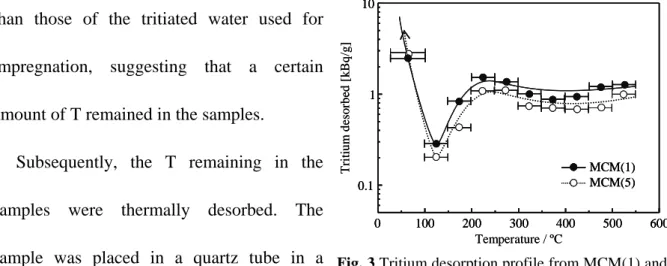
Figure 3 shows the change in the amount of T desorbed depending on temperature. The amount of T desorbed was normalized to the weight of the adsorbent as unity. The T desorption profiles of MCM(1) and MCM(5) were very similar to each other, as seen in Figure 3. Both in MCM(1) and MCM(5), T desorption decreased when temperature rose from 25 to 150 °C, and showed a minimum of about 0.2–0.3 kBq/g at 100–150 °C. Then, the desorption amount increased again above 150 °C. An almost constant amount of T of 0.8–1.1 kBq/g was observed at temperatures from 200 to 550 °C. Such desorption profile can be explained by the state of adsorbed HTO molecule [7]. Namely, a large number of physisorbed HTO molecules desorbed below 100°C. Thereafter, desorption of HTO via condensation of surface silanol groups dominated above 100°C [7].

0 100 200 300 400 500 600

0.1 1 10

T ri tium d esor b ed [ k B q /g ]

Temperature / ºC

MCM(1) MCM(5)

0 100 200 300 400 500 600

0 100 200 300 400 500 600

0.1 1 10

0.1 1 10

T ri tium d esor b ed [ k B q /g ]

Temperature / ºC

MCM(1) MCM(5) MCM(1) MCM(5)

Fig. 3 Tritium desorption profile from MCM(1) and

MCM(5) at 25 – 550 ºC. Error bars represents the

period of T collected.

(7)

The cumulative amount of T desorbed from 25 to 550 °C was estimated to be 9.57 and 9.27 kBq/g for MCM(1) and MCM(5), respectively. The sum of the T desorbed at 25 °C and under thermal conditions corresponded to 434.2 and 391.5 kBq/g for MCM(1) and MCM(5), respectively, showing more than 95 % of mass balance (Table 1). Besides, after thermal desorption, a weight loss of 1.10 wt% for MCM(1) and 1.18 wt% for MCM(5) were observed.

On the basis of the amount of T desorbed and the weight loss, the concentration of tritiated water was calculated to be 290.0 and 282.4 kBq/mL, respectively. It is obvious that the concentration of tritiated water increased as compared with that used for impregnation. The concentration ratio, defined as the ratio of the concentration of T desorbed under thermal conditions to that derived from spontaneous desorption, was 1.34 and 1.29, respectively.

These indicate good reproducibility and reusability of MCM41 in the enrichment of tritiated water. Although the volume of tritiated water obtained under thermal conditions was small, the optimization of desorption and especially adsorption conditions might improve the effective enrichment of tritiated water.

In conclusion, the structural stability and T desorption behavior of MCM-41 was investigated. The mesostructure of MCM-41 was found to be maintained up to 5 cycles of sequential impregnation and spontaneous and thermal desorption. The T desorption behavior of reused MCM-41 was very similar to that of as-synthesized one, showing a good reusability and reproducibility. The results suggest that MCM-41 is one of the attractive adsorbents for the enrichment of tritiated water.

References

(8)

[1] T. Sugiyama, Y. Asakura, T. Uda, T. Shiozaki, Y. Enokida, I. Yamamoto, Fus. Engineer.

Des. 81 (2006) 833.

[2] A. Taguchi, Annual Report of Hydrogen Isotope Research Center, University of Toyama, 2930 (2010) 5. (in Japanese)

[3] C. T. Kresge, M. E. Leonowicz, W. J. Roth, J. C. Vartuli, J. S. Beck, Nature 359 (1992) 710.

[4] J. S. Beck, J. C. Vartuli, W. J. Roth, M. E. Leonowicz, C. T. Kresge, K. D. Schmitt, C. T.

W. Chu, D. H. Olson, E. W. Sheppard, S. B. McCullen, J. B. Higgins, J. L. Schlenker, J.

Am. Chem. Soc. 114 (1992) 10834.

[5] D. Zhao, J. Feng, Q. Huo, N. Melosh, G. H. Fredrickson, B. F. Chmelka, G. D. Stucky, Science 279 (1998) 548.

[6] A. Taguchi, F. Schüth, Micropor. Mesopor. Mater. 77 (2005) 1.

[7] A. Taguchi, Y. Torikai, M. Matsuyama, submitted.

[8] T. Sawada, T. Yano, N. Isshiki, T. Isshiki, M. Iwamoto, Bull. Chem. Soc. Jpn. 81 (2008) 407.

[9] S. Lowell, Joan E. Shields, M. A. Thomas, M. Thommes “Characterization of porous solids and powders: surface area, pore size and density”, Kluwer, London (2004).

[10] I. Eswaramoorthi, A. K. Dalai, Int. J. Hydrogen Energy 34 (2009) 2580.

[11] J. M. Kim, S. Jun, R. Ryoo, J. Phys. Chem. B 103 (1999) 6200.

[12] N. Igarashi, K. A. Koyano, Y. Tanaka, S. Nakata, K. Hashimoto, T. Tatsumi, Micropor.

Mesopor. Mater. 59 (2003) 43.

(9)

[13] C. Zhang, Q. Liu, Z. Xu, K. Wan, Bull. Chem. Soc. Jpn. 78 (2005) 1879.

[14] S. Naoe, Y. Torikai, K. Akaishi, R.-D. Penzhorn, K. Watanabe, M. Matsuyama, Annual

Report of Hydrogen Isotope Research Center, University of Toyama, 28 (2008) 23. (in

Japanese)

Table 1 Summary of T impregnation and desorption for MCM(1) and MCM(5)
Figure 3 shows the change in the amount of T desorbed depending on temperature. The  amount of T desorbed was normalized to the weight of the adsorbent as unity

参照

関連したドキュメント

In this paper we give an update survey of the most important results concerning the Jacobian conjecture: several equivalent descriptions are given and various related conjectures

For instance, what are appropriate techniques that fit choice models, especially those applied in an RM network environment; can new robust approaches reduce the number of

この課題のパート 2 では、 Packet Tracer のシミュレーション モードを使用して、ローカル

The reported areas include: top-efficiency multigrid methods in fluid dynamics; atmospheric data assimilation; PDE solvers on unbounded domains; wave/ray methods for highly

Based on sequential numerical results [28], Klawonn and Pavarino showed that the number of GMRES [39] iterations for the two-level additive Schwarz methods for symmetric

– There are growing numbers of repositories for research data and it’s possible an author’s or editor’s preferred repository is not listed by Springer Nature, FAIRsharing

イヌワシは晩秋に繁殖行動を開始します。オスとメスが一緒に飛んだり、オス が波状飛行を繰り返します。その後、12月から

 Since the amount of tritium released is less than 22 TBq/year, and the lower the concentration of tritium is, the more other radioactive materials discharged, the