Cross‑cultural business English : an analysis of communication breakdowns among Japanese business people
著者(英) Naoki Kameda
journal or
publication title
Doshisha University world wide business review
volume 2
number 2
page range 54‑62
year 2001‑03‑31
権利(英) Research Center for World Wide Business, Doshisha University
URL http://doi.org/10.14988/re.2017.0000015840
54
Cross-cultural Business English :
AnAnalysis of Communication Breakdowns amongJapanese Business People
Naoki Kameda
, Professor .
I Faculty of Commerce I
^ Doshisha University ' Introduction
Several years ago, I had an unexpected linguistic encounter at a restaurant in London. At the London Hilton's steak house one summerevening I ordered my favorite "medium rare" when a waiter asked me, "Howwould you like to have your steak cooked, sir?" The delicious looking sirloin came.I sank a knife into it and found it was not "mediumrare" but well done. I called for the chef.
He cameand said with a smile on his face, "Well, sir, this is the way we cook medium rare here."
He had no ears for my complaint that it should not be called or rated as medium rare either by the Paris standard of juicy filet mignon or the Tokyo standard of super-top Kobe beef. As many people mayhave had the same experience, at a restaurant we have to leave the matter to a chef even though wedon't know his sense at all. A chance customer is not allowed to say, "Cook it for two and a half minutes and turn it over and broil it for another two minutes."
It is thus hard to transmit our thoughts and ideas correctly as we have intended to other people in words even though we could possibly get our ideas across in a foreign language. I would like to discuss in this paper some problems the Japanese business people may come across when trying to communicate with peoples of other countries in the global business arena. I will touch upon the ques- tions of the Japanese language habits and English as an important international business language.
First, I will analyze some features of the unique Japanese language habits and communication style. I will propose the style should be changed when English is used as a business language. Second, I would like to discuss reasons why their communication style has become so unique. Lastly, I will re- fer to the globalization of businesses and the role of World English as an international business lan- guage with a proposal for the global cross-cultural business communication of the 21" century.
%B3 ! Cross-cultural Business English 55
Features of the unique Japanese language habits
I believe that linguistic capability and communication competency are two entirely different things.
I do not think the Japanese people can communicate effectively unless they first realize the difference in the styles of communication between the two languages. They should be flexible and able to change their communication style when speaking English with foreigners. The Japanese cannot raise their global literacy if they merely try to improve their knowledge of the English language. You may have heard or read before something like "'yes' does not always mean yes in Japan, but there are some 16 ways to avoid saying no, and it is not in the Japanese tradition to call a spade a spade." Of manyfeatures of the Japanese language habits often cited, I would like to focus on the following three features.2
First, Japanese often speak in a roundabout mannerthat Westerners, who prefer expressions that are right to the point, tend to feel they are evasive. I will call this communication style "a roundabout pattern."
Second, Japanese start with an explanation and follow it with the point of what they are saying.
This relates to the syntax of the Japanese language, in which the verb comes at the end of a sentence and the subordinate clauses precede the main clause. I have named this pattern "explanation first pat-
tern."
And third, Japanese dislike specifying things down to the last detail or do not feel it necessary to go into great detail when speaking with one another. One always has to figure out the parts that have been left unsaid. This style can be called "non sequitur pattern." Japanese speakers often avoid elabo- rating and connecting two statements with factual information when they feel that the knowledge can be implicitly understood. This tendency often leads to the appearance of a non sequitur.
Most Japanese, unless speaking to a very close friend, would reply to a query, "Aren't you tired?" with something like "lie, betsuni" (Not especially). At most they might admit, "Ikuraka"
(A little). It seldom happens one comes out with a forthright "Yes, I am." And to avoid worrying the host, they would answer to a question, "You must be hungry" with something like "lie, itsumo bangohan waosoi-n desu." (No, I always eat a late supper) even if they were actually quite hungry.
This Japanese tendency to evade from forthright expressions can be seen through the answer to the question of "Coffee or Tea?" which represents the Japanese indecisiveness. After the meal when you are visiting your friend, he or she asks you, "Coffee or tea?" Occasionally or quite often times some Japanese say, "Either is fine," in directly translated English. If he or she were an American,for instance, will first look suspicious, then bewildered, and may even repeat the question in a different
56 7-;VK 74F tfv*X Ufa- ^2^»2-t
Table 1 Features of the Japanese Use of English and their Communication Patterns Features of English
Difficult words and phrases are used 2.50
Sentence structure is complex 2.83
Worn-outbusiness jargon is used 2.77
A sentence is often too long 3.06
Passive voice is often used 3.34
Features of Communication
Facts and opinions are not clearly divided 3.27
The purpose of a statement is not clear 3.25
Reasonor explanation (cause) comes first and result (effect) comes last 3.45
Vagueand indirect expressions are used 3.42
Toneis often assertive 2.82
Source : Kameda 2 form : "Which do you prefer?"
What actually does the Japanese guest mean by this "Either is fine" answer? Why does he or she choose this answer? Three major cases may be conceivable. First, he or she actually likes both of them and find it difficult to choose one of the two. Second, it comes out of the guest's efforts to spare his or her friend trouble wishing either one giving him or her least trouble. Third, when he or she actually doesn't want any drinks, but is reluctant to respond with a direct and emphatic "no."
Overall, as you can see from these possible causes, the Japanese people are apt to evade from forth- right expressions because they do not want to hurt the feeling of their counterpart. This can be termed as a kind of "relationship sensitive" communication style.
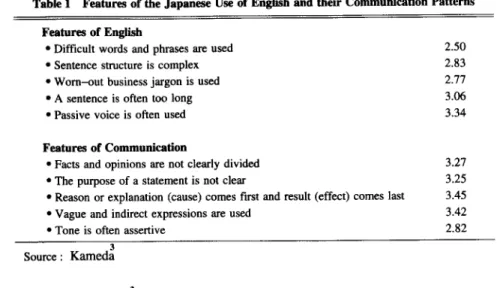
Another feature, peculiar to Japanese language usage, is the "explanation first pattern," which is clearly seen in the results of my research presented in Table 1. This table shows a part of the results of research I did in Singapore in 1997 on the communication competency of Japanese managers. Re-
spondents (Singaporean managers doing business with Japanese) were asked to mark 5-point strongly disagree( l )-strongly agree(5) scales.
While Singaporeans' attitudes regarding the Japanese use of English look rather favorable over- all, the managers' comments on the features of Japanese communication were rather harsh, except for the last question about assertive tone. I think the third item in the features of communication, reason or explanation (cause) comes first and result (effect) comes last is crucial when we discuss cross- cultural business communication. This is the "explanation first pattern" I have been discussing here.
The last pattern is one known as non sequitur pattern. Here are typical examples of Japanese 4
business English sentences that many Japanese business people are apt to write.
Because of the law in Korea against exporting white granite, I will go to Australia.
%J3 ! Cross-cultural Business English 57 Our office has moved to Nara. I'm going to buy a Honda.
These statements lack "cause and effect" relationship. You may wonder why the two seemingly unrelated sentences in each statement are connected. No clear-cut explanation or reason why this guy will go to Australia and another guy is going to buy a Honda car or motorcycle is given here. They must be direct translations of the Japanese expressions. In English you must incorporate a kind of mi- nor premise like :
Because of the law in Korea against exporting white granite, I will have to check other suppliers.
I have heard that Australia has an abundant source and will go there.
Our office has moved to Nara. It's too far from the station to walk, so I'll have to buy a car. I'm thinking of getting a Honda.
Japanese do not try to specify things down to the last detail. They are inclined to skip over the minor premise in a syllogism with a belief that their counterpart in the dialogue must be familiar with that part. They merely sketch the outlines and expect the listener to be able to fill in the gaps and to figure out the parts that have been left unsaid. If you are not good at figuring out those unsaid parts, you will be graded as a person slow to understand. Because they prefer not to state things clearly, the Japanese people in general are said to be unskilled at using words to report facts accurately or to ex- press their opinions logically. Here are some reasons for these peculiar communication styles or lan- guage habits :
WhenJapanese converse, each goes to great pains to respect the other's position. Care is taken to avoid hurting the other's feelings and to go along with the other rather than make a fuss over small details which speakers assume are understood. One can get a sense of how much can go unsaid in Japanese when looking at the great number of proverbs which with a few words draw up detailed feelings and ideas. A foreigner would, of course, have no idea what these euphemistic expressions re- fer to when they are directly translated. Ironically, despite the Japanese urge to not hurt another's feelings in conversation, their shared knowledge often perplexes foreign people.
The Japanese people have an old saying "The richer rice ripens, the lower its head hangs," which is equivalent to "The boughs that bear most hang lowest." The Japanese people do not speak about their own abilities by themselves. Those who do are avoided by others, who may criticize such a per- son as "a manfull of conceit." Those who have achieved success usually talk of their success with muchhumility. Modest persons and modest expressions are respected in Japan.
The Japanese do not place much value and trust in verbal communication. A famous haiku by
58 7-;i/K-7^fK-tfi>*X Ufa- %2%%2^
Basho reads : Mono-ieba Kuchibiru samushi Aki-no-kaze. If literally translated, it goes like : When we utter words / Our lips feel chilly / Autumn winds. This haiku describes the helpless feeling that the Japanese often encounter in trying to communicate verbally. Rather than placing trust in verbal communication, they often want others to infer what they want to say from what they did not say and from their mannerisms. The Japanese culture is rich in proverbs that decry words and talk, such as
"Talk is the root of trouble," "Keep your mouth closed and your eyes open," and "In your speech 5
honey ; in your heart, a sword."
Reasons why their language habits have become so unique
Why is the Japanese language or the people's communication like that? There must be deep- rooted historical, geographical, and religious factors that gave birth to such unique communication styles that we have so far observed. Let us first briefly see what this nation and its people are.
The Japanese population estimated to be 125.6 million have been paddy-field rice farmers for morethan 2,000 years. They have been living in a limited land area which is :
Populated by ethnic Japanese accounting for 99.4%, Koreans 0.5%, and Chinese 0.1%, and About 380,000 square kilometers or 146,000 squaremiles, only 1/25 of the U.S. or approxi- mately the size of the State of Montana, with
About 67% of the land area is mountainous ; agricultural land accounts for less than 20%, and only 3% is suitable for residential use. Another 10% is devoted to industrial production and infrastructure.6
This makes for real togetherness. People, a virtually single tribe, had to work together as a group for the group's goal such as harvesting of rice, lumbering, thatched-roofing of the group member's farm house, and so on. In order to achieve the same goal in collaboration with others, the suppression of the individual was needed for the sake of the group. Dissent always runs the risk of being misrep- resented as dissension in Japan. Each memberof the group tries to avoid awkward situations with his or her counterpart, which may have been caused by a difference of opinions. A single ethnic group is much like one big family. As such, the Japanese do not feel it necessary to go into great detail when speaking with one another ; they merely sketch the outline and expect the listener to be able to fill in
7 the gaps.
Next is a brief look at Japan's modern history, which must be considered for their effect on the
H.B3 : Cross-cultural Business English 59
unique Japanese communication styles :
The Tokugawa Shogunate, founded in 1600, viewed Christianity as subversive and foreign trade as dangerous to the stability of its feudal government.
All Japanese were prohibited on threat of death from going abroad in 1633.
The government imposed seclusion of Japan from all foreign contact for 215 years between
1638 and 1853.
It also enforced a caste system that put the warriors on top and the farmers, artisans, and tradesmen under them in that order.
The Meiji Restoration of 1868 ended the Tokugawa Shogunate and started Japan's new era with a slogan, "Civilization and Enlightenment."
The long period of continued isolation imposed by the Tokugawa government gave the Japanese a strong sense of self-identity. The vast majority of them never spoke to anyone but other Japanese.
While the nation may have started out as a group of different peoples, it was homogenized into virtu- ally a single tribe at a very early date. As a result, until a little over a century ago the Japanese were living in a tribal society effectively cut off from outside contact. This fact exerted a decisive influence on their communication style.
It is natural that a homogeneous people crowded onto four smallish islands should value the abil- ity to avoid confrontation the knack of getting along with everybody. Moreover, because of the caste system once prevailing in Japan, Japanese society emphasizes vertical interpersonal relationships based on differing ranks and status connected to sex, age, rank, and occupation. Typical Japanese in- teractions tend to move along a scale of respectfulness or rudeness according to the status each person
holds.
This sort of environment naturally fostered such communication styles as deferring to other's viewpoints, avoiding giving offense, and softening the impact of one's speech. Situational ethics is an important concept in understanding the ethical principles of the Japanese.
Globalization and world English
First, I would like to try to give a definition of "English as International Business Language."
Some observers regard international business English as a neutral, pragmatic means of communication among non-native users of the language. A British linguist has labeled it IBL (International business language) and said, "in a European context, IBL is the sort of English a Norwegian would use when
60 7-A'K 7-fK H'v^-X Utfi- H2^^2-t
trying to communicate with an Italian in Belgium. In other words, it is a lingua franca used between those for whom English is not their native language, but the only commonlanguage in which any sort of communication is possible. Its grammar and syntax vary, being modeled on those of the lan-
8 guage of the person speaking in each case.
"Lingua franca" is a language used as a means of communication among persons who do not speak each other's native language. Originally, it was a hybrid language for the Mediterranean coast trade of Italian, Spanish, French, Greek, Arabic, and Turkish elements, spoken in certain Mediterra- nean ports in the fourteenth and fifteenth centuries.
No explanation is necessary to show that English is widely used in the fields of politics, eco- nomics, trade, and so on in the world today. As a matter of fact, many linguists are beginning to re- ject the notion of a blanket unaccountable noun "English" with its suggestion of a relatively homoge- neous language and suggest instead the term "Englishes." Though differences in grammar, syntax, and pronunciation may result, the language still remains comprehensive to speakers of the 'standard'
9
variety. One recent research released an interesting result : Of all the companies surveyed, 96% of the Japanese enterprises answered, "English is the language of international trade," and 91% of the companies answered, "English will be used in international trade regardless of the native language of
10
the trading partners."
English has already become a ubiquitous languag spoken by more people as a second tongue than a first. A British scholar once predicted a time when "English will be taught mostly by non- native speakers of the language to non-native speakers in order to communicate mainly with non-
ll
native speakers." The report "Language and electronics : The coming global tongue" in the Econo- mist (1996) continues, "This is an extraordinary state of affairs. Carl Mills, professor of English at the University of Cincinnati, says nervously : 'It will be the first time in the history of the world that the language is not ours any more. If a language is no longer the property of its native speakers, it will change, and it's not clear what the consequences will be.'" However, it is probably true that there are the same number of Englishes as there are countries in the world.
Lany Smith, one of the founders of the International Association for World Englishes (AWE), has been actively advocating the need of acquiring world Englishes. He proposes that the Japanese people should speak Japanese like English, or the native speakers of English need to practice to un-
12
derstand their foreign counterparts and their non-native Englishes, and so on.
According to Smith, many native speakers of English firmly believe that they never make mis- takes in their communication because they are natives. However, troubles often happen between Americans and the British over their language use though both of them speak English. Why? It is be- cause they have different communication customs. Communication breakdowns based on different
H.EH : Cross-cultural Business English 61
customs should be classified into two patterns : one is caused by lexical differences and the other is brought on by differences in communication style. For example, Americans are often offended by the British style of criticism which they perceive as overly harsh. Likewise British people often see Americans as overly sensitive and irritating for their constant softening of their true feelings. We often hear this kind of comments or criticisms from the two countries across the Atlantic Ocean on a movie in which the leading characters play representing both countries' own interests. Anyway, Smith believes that native speakers and non-native speakers of English both should learn World English in the same setting in such a way that people with various cultural backgrounds can use English as a meansof communication.
By communication breakdowns caused by lexical differences I mean idiomatic expressions diffi- cult to the non-native speakers of a language, which should be distinguished from breakdowns caused by communication style. One of the difficulties learning English as a foreign language is its idioms.
The English language is particularly replete with idioms. Native speakers are said to know that the id- iom "the old man kicked the bucket" means the old man died. But, for non-native speakers, the meaning conveyed would be exactly that the old man kicked the bucket quite different from the in- tended meaning. Not understanding idioms can be fatal. In 1993, an exchange student in the U.S.
from Japan looking for a Halloween party went to the wrong address and was shot for apparently not
13
understanding the word "freeze."
There are a number of significant differences between British and U.S. English that can lead to confusion and misunderstandings. In some cases the same word can have two very different meanings on either side of the Atlantic. The American businessperson in London will be in for quite a jolt when his British counterpart, in a genuine attempt to pay a compliment, refers to the American's wife as "homely," for in the U.S. the word means "plain" or "ugly" but in the UK it means "warm"and
14
"friendly."
Conclusion
Clearly the logic of English and the Western styles of communication are quite different. How- ever, no one should think that Western communication style or English logic alone is superior to that
of Japanese. The value of Japan's communication style also has some merit. In order to become a truly qualified communicator or cultural integrator, Japanese managers should be aware that English
and communicationare two different entities. In this day of internationalization and in an information -oriented society, communication competency is truly required for Japanese managers overseas. Com- munication competency is the ability to express oneself and effectively understand others, and it is the
62 7-;l/K 74F tfi>*;* l/tfi- $2^^2-t
basis of persuasion, negotiation, and integration all of which Japanese global managers must accom- plish wherever they are.
In the practice of negotiations across nations and cultures it is natural that different communica- tion patterns backed by each culture come to the forefront. It is important to understand that there are manydifferent communication styles in the world, which have been fostered by each nation's own values and experience. Each of them is as important as your own, and should, therefore, be respected.
Being different does not meanbeing better or worse.
No one should think that Western communication style or English logic is superior to that of Ja- pan. It is true that the Western style of communication is effective. However, Japan's communication style also has some merits. I hope that this communication style based on humanity or warmconsid- eration for others will find its way into the global cross-cultural communication of tomorrow.
Notes
1 Imai, M. (1975), Never Take Yes for an Answer, The Simul Press, Tokyo.
2 These examples are extracted from Kinoshita (1996), Nihonjinn no gengo kankyo wo kangaeru [To Think of the language environment of the Japanese], Shobunsha Publishing Co., Tokyo, pp. 44-69.
3 Kameda, N. (2000), Communication competency of Japanese managers in Singapore, Corporate Communi- cations : An International Journal, Vol. 5 No. 4, p. 208.
4 Hird, B. (1992), A Western Look at Japanese Business Writing Problems, Yohan Publishing Co., Tokyo, pp. 49-50.
5 March, R. M. (1996), Reading the Japanese Mind: The Realities behind Their Thoughts and Actions, Ko- dansha International, Tokyo, p. 37 & pp. 49-50.
6 Nishiyama, K. (2000), Doing business with Japan : successful strategies for intercultural communication, University of Hawai'i Press, HW, p. 4.
7 Kameda, N. (1996), Business communication toward transnationalism : the significance of cross-cultural business English and its role, Kindai Bungeisha Co., Tokyo, p. 106.
8 Fenner, A. (1989), Lingua Anglica : the emergence of International Business English, Language Interna- tional, Vol. 2 No. 1, p. 14.
9 McCallen, B. (1989), A World Commodity, The International Market for Training in English As a Foreign Language, Special Report No. 1166, The Economist Intelligence Unit, The Economist Intelligence Unit Limited, London, p. 24.
10 C. B. Hilton (1992), Japanese International Business Communication : The Place of English, The Journal of Business Communication, Vol. 29 No. 3, The Association for Business Communication, p. 259.
The Economist (1996), December 21, p. 76.
Smith, L. (1999), Let's speak world English as Japanese, Cross And Talk, December, pp. 18-19.
Jandt, F. E. (1995), Intercultural Communication : Introduction, Sage Publications, CA, p. 1 1 1.
Ferrano, G. P. (1994), The Cultural Dimensions of International Business, Prentice Hall, NJ, p. 44.