橋梁マネジメントにおける有限要素曲面回帰
Finite
Element
Surface
Fitting
Algorithms for
Bridge Management
陳小君 木村拓馬
Xiaojun Chen Ibkuma Kimura
弘前大学理工学部数理科学科
Department of Mathematical Sciences, Hirosaki University
1.
Introduction
In the study of bridge deterioration, it is important not only to consider structural
evaluations and traffic load but also environmental factors such
as
climate and frequencyof earthquakes. However, such studies requireextensivedata sets andmethods forhandling
them. In the United States, the National Bridge InventoryDatabase (NBI) contains data
on over
600,000 bridges fora
span of33
years. In the past few years, there has beena
growinginterest inthe study ofdataminingmethodsfor efficiently using NBI database with
Geographic Information System (GIS) database toanalyzeand predict bridge deterioration
[1]. The safety ofbridges in Japan is also crucial for the national trafic network. Japan
has
more
than 1,000 islands which forma
long chain-like islandarc
surrounded by the PacificOcean
and the Sea ofJapan. InJapan, there existextensive database thatcontains detailed historical dataon
over
672,000 bridges. Moreover, environmental factors havegreat impacttobridges. To utilize theextensivebridge databasecombined with very large
geographic data sets,
we
have to developefficient surface fitting methods.Geographicdatasets
are
oftenmade atirregularly spaced pointsand havemeasurementerrors.
Toanalyzethe irregularly spaced noisy data,manyinterpolationmethodsandleast-squares smooth fitting methods have been developed. Our aim is to efficiently
use
verylarge datasets. In this paper,
we
studyfinite element discretization witha
preconditionedNewton method to find
an
approximation of a smooth function which minimizesa
sum
of data residuals and the second derivative in $H^{2}(\Omega)$ under some constraints on data.
The discretizationresults
a
largescale constrained quadratic program whichinvolves largesparse matrices.
We
show the quadraticprogram
hasa
uniquesolution
and proposea
preconditioned Newton method to findthe solution.
Aomori Prefecture is located
on
the northernmost tip of Hunshu Island, Japan. Itis bordered by the Sea of Japan(west), the Pacific Ocean(east), and the Tsugaru
Chan-nel(north). There
are 1646
bridges in Aomori Region, in which 734 bridgesare
managedby Aomori Prefecture. See Figure 1. Environmental factors have significant impact to
these bridges. We
use
the proposed method to form surfacesover
Aomori Region by geovalue, earthquake magnitude, etc. Using these expanded data sets, wecan investigate the relation between environmental factors and bridge deterioration by data mining methods [1].
2.
Finite elementsurface
flttingLet St $\subset \mathbb{R}^{2}$be
a
convex
bounded domain. Thegivendataare
measurementpoints$\mathrm{x}_{i}=$
$(x_{1,1}, x_{1,2})\in\Omega$ and corresponding real values $y_{i},$ $i=1,2,$$\ldots n$
.
Ina
cartesian coordinatesystem, the $x:,1$ and $x_{i,2}$ coordinates reflect the longitude and latitude, while the real
value$y_{i}$ may reflect rainfall value
or
earthquake magnitude at point $\mathrm{x}_{i}$.
Weassume
that$\mathrm{x}_{\dot{*}},$$i=1,2,$
$\ldots,$$n$arenot collinear (i.e., they do not all lieon
a
linein$\Omega$). Let $S=\{\sim,i=$
$1,2,$$\ldots,$$n\}$ be the set of all measurement points, and $S_{0}\subset S$ be
a
subset of$S$.
We considerthe following minimization problem,
$\min$ $\frac{1}{n}\sum_{1=1}^{n}(f(\sim)-y_{i})^{2}+\alpha|f|_{H^{2}(\Omega)}^{2}$
(1)
$\mathrm{s}.\mathrm{t}$
.
$f(*)\geq\tilde{y}:$, $\sim\in S_{0}$over
all functions $f$ in the Sobolev space $H^{2}(\Omega)$.
Here $\tilde{y}$:
are
input data related to$y_{i}$ and
a is
a
fixed positive parameter. The minimizer of (1) not only dependson
the given data$\ ,y_{*}$ and $\tilde{y}_{1}$, but also
on
the parametera. An appropriate choice of$\alpha$dependson
the sizeof the data.
In the
case
where $S_{0}$ is empty, the minimizer of (1) is calleda
thin plate spline. Ithas been shown byDuchon[6] that there exists
a
unique thin platespline in $H^{2}(\Omega)$,
when$\Omega=\mathbb{R}^{2}$
.
Moreover,numerical methods for finding approximate thin plate splines using
simplefinite element spaces in$H^{2}(\Omega)$have beenstudied. However, thereare
some
technicalproblems to
use
standard thin plate splines for applicationsthat have large data sets. Todealwith largedata sets, Christen, Roberts,Hegland andAltas $[5, 7]$proposed
a
methodtofind
a
finite
element thin plate splinein$H^{1}(\Omega)$.
Intheirmethod,onlyfirst order derivativesoccur,
so
that simplefinite element spaces in$H^{1}(\Omega)$can
be used to discretize theproblem.Inmany applications,
some
constraintson
dataare
required. Forinstance, atmeasure-ment points, snowfall values
can
not be negativeorless thancertain values. Furthermore,in
some
case,we
do not know the exact values atsome
measurement points. Only upperor
lowerbounds of these valuesare
available. Hence it isnecessaryto study thecase
where$S_{0}$ is nonempty. In this paper, we generalize the finite element approximation technique
for the thin plate spline in [7] and defineadiscretization problem of(1). Weintroduce
new
vector variable$\mathrm{u}=(u_{1},u_{2})$ which represents the gradient of the function $f$in (1), that is,
Moreover, we generalize the normalization condition
$\sum_{\dot{*}=1}^{n}(f(\sim)-y_{i})=0$
for thecase $S_{0}=\emptyset$ to
$\sum_{\mathrm{X}:\not\in s_{0}}(f(\mathrm{x}_{i})-y_{*}.)=0,$
$f(x_{i})-\tilde{y}_{i}\geq 0,$ $\mathrm{x}_{i}\in S_{0}$
.
(3)Suppose that $S_{0}=\{\mathrm{x}_{n-t+1}, \ldots,\mathrm{x}_{n}\}$
,
where $r\geq 0$ ( $r=0$means
$So=\emptyset$).Now
we
consideran
associated function $\mathrm{u}\in H^{2}(\Omega)$ satisfies$f(\mathrm{x})=u(\mathrm{x})+\mu$ and $\sum_{:=1}^{n-f}u(\ )=0$
where $\mu$ is
a
constant. From (3)we
have $\mu=\frac{1}{\hslash-f}\sum_{i=1}^{n-\mathrm{r}}y_{i}$.
This leads to the followingminimization problem:
$\min$ $\frac{1}{n}.\sum_{*=1}^{n}(u(\mathrm{x}_{1})+\mu-y:)^{2}+\alpha(|u_{1}|_{H^{1}(\Omega)}^{2}+|u_{2}|_{H^{1}(\Omega)}^{2})$
$\mathrm{s}.\mathrm{t}$
.
$($Vu,$\nabla v)_{L^{2}(\Omega)^{2}}=(\mathrm{u},\nabla v)_{L^{2}(\Omega)^{2}}$, $\forall v\in H^{1}(\Omega)$$\sum_{i=1}^{n-\mathrm{r}}u(\sim)=0$ (4)
$u(\mathrm{x}\iota)+\mu\geq\tilde{y}_{\dot{*}}$
,
$i=1,2,$ $\ldots,r$over
allfunctions$u,$$u_{1},$$u_{2}\in H^{1}(\Omega)$.
Inthis problem, $u_{1}$ and$u_{2}$are
approximations of$\frac{\partial u}{\partial x_{1}}$and $\frac{\partial u}{\partial x_{2}’}$ respectively. The purpose in introducing auxiliary functions
$\mathrm{u}_{1}$ and $u_{2}$ is for
the
use
of simple finite element spaces in $H^{1}(\Omega)$.
In particular,we use
simple continuouspiecewise polynomial spaces $\Omega^{h}\subset H^{1}(\Omega)$ associated with
a
finite element meshover
thedomain$\Omega$
.
Let $\mathrm{b}(x)=(b_{1}(x), \ldots,b_{m}(\mathrm{x}))^{T}$ denote
a
vector of basis functions for $\Omega^{h}$.
Then func-tions $\mathrm{u},$$u_{1},$ $u_{2}$are
given by$\mathrm{u}(\mathrm{x})=\mathrm{b}(\mathrm{x})^{T}c$, $u_{1}(\mathrm{x})=\mathrm{b}(\mathrm{x})^{T}g_{1}$, $u_{2}(\mathrm{x})=\mathrm{b}(\mathrm{x})^{T}g_{2}$,
where the vectors $c,g_{1},g_{2}\in \mathbb{R}^{m}$ represent the linear combination coefficients in the basis
$\mathrm{b}$
.
Usingthe following matrix $N=(b:(x_{j}))\in \mathbb{R}^{n\mathrm{x}m}$,we
can
define the values of$u,$$u_{1},$$u_{2}$
at points$x_{l},i=1,2,$$\ldots,n$
,
by$u(\mathrm{r})=(Nc):$, $u_{1}(n)=(Ng_{1})_{i}$, $u_{2}(\mathrm{r})=(Ng_{2}):$
.
Let matrices $A,$$B_{1},$$B_{2}\in \mathbb{R}^{m\mathrm{x}m}$be given by
Set $P=(0_{r\mathrm{x}(n-r)}, I_{r\mathrm{x}r})\in \mathbb{R}^{r\mathrm{x}n}$
.
Let $e_{n}\in R^{n}$ and $e_{f}\in R^{r}$ be the vectors whose $\mathrm{e}1\triangleright$ments are all ones. For the corresponding data $y_{i}$, we set $\mathrm{y}=(y_{1}\cdots y_{n})^{T}\in \mathbb{R}^{n}$, $\tilde{\mathrm{y}}=$
$(\tilde{y}_{1}\cdots\tilde{y}_{\mathrm{r}})^{T}\in \mathbb{R}^{r}$
.
Now, we can write the finite element surface fitting problemas
acon-strained optimization problem in $\mathbb{R}^{3m}$,
$\min$ $\frac{1}{n}||Nc+\mu e_{n}-\mathrm{y}||_{2}^{2}+\alpha(g_{1}^{T}Ag_{1}+g_{2}^{T}Ag_{2})$
$\mathrm{s}.\mathrm{t}$
.
$Ac=B_{1}g_{1}+B_{2}g_{2}$ (5)$(e_{n}^{T}-e_{f}^{T}P)Nc=0$
$PNc+\mu e_{r}\geq\tilde{\mathrm{y}}$
It is worth noting that the number of variables $(c,g_{1},g_{2})\in \mathbb{R}^{3m}$ depends
on
thedis-cretization of a finite element mesh, but not
on
the size of data. Moreover, matrices$A,$$B_{1},$$B_{2}\in \mathbb{R}^{m\mathrm{x}m}$and $N\in \mathbb{R}^{n\mathrm{x}m}$
are
sparse.3. Preconditioned Newton
method
In this section,
we
show that problem (5) hasa
solution and presenta
preconditionedNewton method for solving (5).
Let
$W=$
.
For any given$g_{1},g_{2}\in \mathbb{R}^{m},$ $c$ can be obtainedby the equality constraints inproblem (5) as
$c=W^{+}$
,where $W^{+}$ is the generalized inverse of $W[2]$ which satisfies $W^{+}W=I\in \mathbb{R}^{m\mathrm{x}m}$
.
Let$W_{1}^{+}\in \mathbb{R}^{m\mathrm{x}m}$ be the submatrix of$W^{+}$ whose entries lie in the first $m$ columns. Then
we
have $c=W_{1}^{+}(B_{1g_{1}}+B_{2g_{2}})$
.
Let us denote$g=$
,
$G=NW_{1}^{+}(B_{1}, B_{2}),$$H=$
.
Then problem (5) reducesto the following optimization problem
$\min$ $\frac{1}{n}||Gg+\mu e_{n}-\mathrm{y}||_{2}^{2}+\alpha g^{T}Hg$
(6)
$\mathrm{s}.\mathrm{t}$
.
$PGg+\mu e_{f}\geq\tilde{\mathrm{y}}$
.
The objectivefunction in (6)
can
be rewrittenas
Let $Z=W_{1}^{+}N^{T}NW_{1}^{+}$
.
The matrix$Q:=G^{T}G+n\alpha H=$
is symmetric positive definite. Therefore, the objectivefunction in (6) is strongly convex,
and
problem (6) hasa
unique solution.By
convex
optimization theory, problem (6) is equivalent to the following system ofnonsmoothequations
$F(z)==0$
(7)where$z=(g, \lambda)$ and A $\in R^{f}$ is the Lagrangemultiplier.
To solve (7),
we use
the generalized Newton method,$z^{k+1}=z^{k}-V_{k}^{-1}F(z^{k})$ (8)
where $V_{k}$ is
an
element in the generalized Jacobian of $F$ at $z^{k}[4]$.
Moreover, at eachiteration of (8),
we use a
preconditioned Uzawa method [3] to solve the system of linearequations
$V_{k}d=-F(z^{k})$
.
(9)We
can
show that this methodsuperlinearlyconverges
toa
solution $z^{*}$ of(7), that is, $\lim_{\mathrm{k}arrow\infty}\frac{||z^{k+1}-z^{*}||}{||z^{k}-z^{*}||}=0$.
(10)Moreover, it
can
be shown that there isa
constant $\kappa$ suchthat for any $z\in R^{2m+\gamma}$,
$||z-z^{*}||\leq\kappa||F(z)||$
.
(11)This
error
boundcan
be used to examine how measurement errors in the data affectpredicated values.
4.
Numerical experiment
In the United States, data mining methods have beenused to efficiently
access
bridgeinventory database and geographic information for the study of bridge deterioration [1].
The
KITACON
company inspects bridges inAomori
Region regularly and has structural evaluations andtraffic
records for all bridges managed byAomori
Prefecture. In order touse efficient data mining methods for bridge management,
we
need environmental data,used the finite element surface fitting method proposed in previous sections and climate
data from Japan Meteorological Agency to predicate some environmental data
on
everybridge in Aomori Region.
Aomori Region is surrounded by water
on
all three sides, the Pacific Ocean to theeast, the Tsugaru Channel to the north and the seaof Japan to the west. Climate factors
have great impact to bridges in Aomori Region. We report
some
numerical resultson
temperature, snowdepth, rainfall in Figures 2-4.
To verify the accuracy of the predicated environmental data
on
every bridge,we use
these predicated data and the finite element surfacefittingmethodtodefine testing values
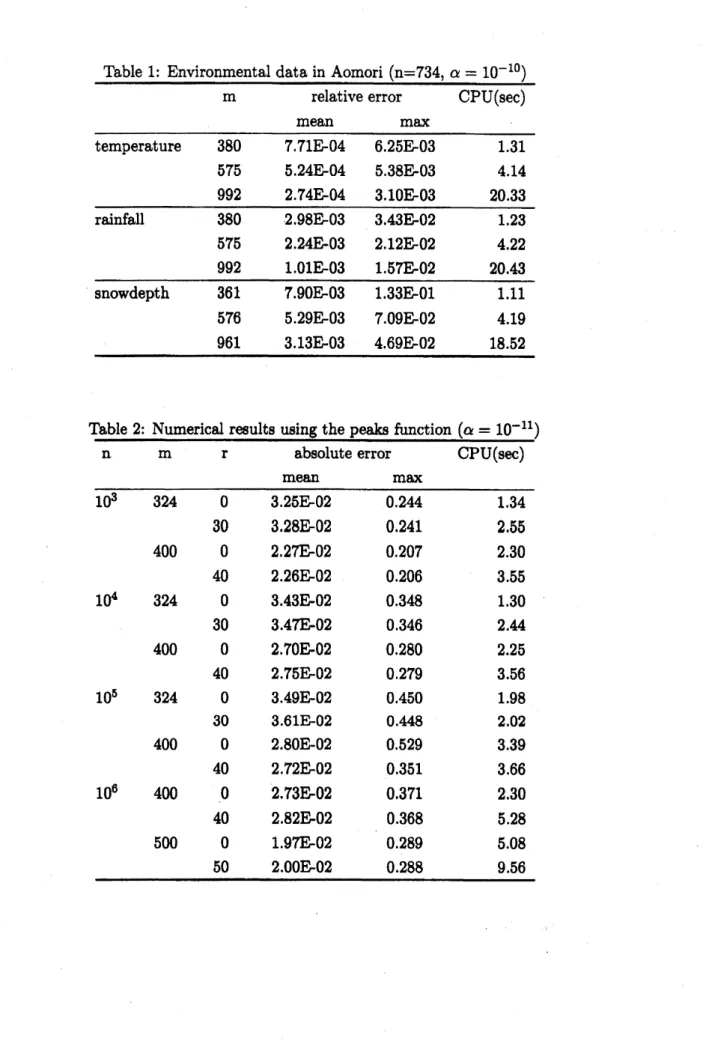
at the measurement points of Japan Meteorological Agency. Table 1 shows the relative
error
of the testing values to the true values at the measurement points.Finally,
we use
the”peaks”function
from Matlab to show thatour
finite elementsurface fitting methodcan
handle very large data sets. The peaks function is formedas a
linearcombination of several scaled and translated Gaussian distributions. Table 2 reports the
error
$= \frac{1}{n}\sum_{1=1}^{n}.|f(\mathrm{r})-y:|$fora
data set of$n$pointswitha
finite element grid of$m$ by $m$.
Preliminary numericalresults indicate thatthe finiteelementsurface fitting method is
promising for handling very large data sets. The generalized Newton method is efficient
for solving (7). Computation time for solving (7)
are
shown in thble 1 and Table 2.Computationswere performed by usingMatlab 7.0 on aIBM PC with IGB memory and
Pentium$4(3\mathrm{G}\mathrm{H}\mathrm{z})$
.
References
[1] S. B. Chase and E.P.Small, An in-depth analysis ofthe national bridge inventory database
utilizing data mining, GIS and advanced statistical methods, Transportation Research
Circu-lar 498(C6), Presentations of the 8th International Bridge Management Conference, Denver,
Colorado, 1999, 1-17.
[2] X. Chen, M.Z. Nashed and L. Qi, Convergence of Newton’s method for singularsmooth and
nonsmoothequations using outer inverses, SIAMJ. Optim., 7(1997) 445-462.
[3] X. Chen, Globalandsuperlinearconvergence ofinexactUzawa methods for saddlepoint
Prok
lems with nondifrerentiablemappings,SIAM J. Numer. Anal. 35(1998) 1130-1148.
[4] F. H. Clarke, Optimization andNonsmooth Analysis, Wiley, NewYork, 1983.
[5] P. Christen,M.Hegland,S.RobertsandI.Altas, A scalableparallelFEM surfacefittingalgorithm
for data mining, Technical Report TR-CS-OI-OI, TheAustralian National University2001.
[6] J.Duchon,Splinesminimizingrotation-invariant semi-normsinSobolev$\mathrm{s}\mathrm{p}\mathrm{a}\varpi$, inConstructive
TheoryofFunctions ofSeveralVariables,Lecture Notes in Math. 571, 1977,85-100.
[7] S. Roberts, M.Helgland andI.Altas, Approximation ofathinplate splinesmootherusing
$\frac{\mathrm{T}\mathrm{a}\mathrm{b}\mathrm{l}\mathrm{e}1:\mathrm{E}\mathrm{n}\mathrm{v}\mathrm{i}\mathrm{r}\mathrm{o}\mathrm{n}\mathrm{m}\mathrm{e}\mathrm{n}\mathrm{t}\mathrm{a}\mathrm{l}\mathrm{d}\mathrm{a}\mathrm{t}\mathrm{a}\mathrm{i}\mathrm{n}\mathrm{A}\mathrm{o}\mathrm{m}\mathrm{o}\mathrm{r}\mathrm{i}(\mathrm{n}=734,\alpha=10^{-10})}{\mathrm{m}\mathrm{r}\mathrm{e}\mathrm{l}\mathrm{a}\mathrm{t}\mathrm{i}\mathrm{v}\mathrm{e}\mathrm{e}\mathrm{r}\mathrm{r}\mathrm{o}\mathrm{r}\mathrm{C}\mathrm{P}\mathrm{U}(\sec)}$
mean
$\max$temperature
380
7.71E-046.
$25\mathrm{B}03$1.31
575 5.24E-04 5.38E-03 4.14
992
2.74E-04 3.10E-03 20.33rainfall
380
2.98E-03 3.43E-02 1.23575
2.24E-03 2.12E-02 4.22992
1.01E-03 1.57E-0220.43
snowdepth $36l$ 7.90E-03 1.33E-0l 1.11
576
5.29E-03 7.09E-024.19
961
3.13E-034.
$69\mathrm{B}02$18.52
Table 2: Numericalresults using the peaks function $(\alpha=10^{-11})$
$\mathrm{n}$ $\mathrm{m}$ $\mathrm{r}$ absolute
error
CPU(sec)mean $\max$ $10^{3}$ 324 $0$ 3.25E-02
0.244
1.3430
3.
$28\mathrm{B}02$0.241
2.66
400
$0$ 2.27E-020.207
2.30
40
2.26E-020.206
3.55
$10^{4}$ 324 $0$ 3.43E-020.348
1.3030
3.47E-020.346
2.44400
$0$ 2.70E-020.280
2.25 40 2.$75\mathrm{B}02$0.279
3.56
$10^{5}$ 324 $0$ 3.49E-02 0.450 1.98 30 3.61E-02 0.448 2.02 400 $0$ 2.80E-020.529
3.39 40 2.72E-020.351
3.66
$10^{6}$400
$0$2.
$73\mathrm{B}02$0.371
2.30
40
2.82E-020.368
5.28
500
$0$ 1.97E-02 0.289 5.0850
$2.00\mathrm{E}\cdot 02$0.288
9.56Figure 1: Distribution ofbridges in
Aomori
Figure 3: Values ofhighest snowdepth in