Japan Advanced Institute of Science and Technology
Title 有機金属構造体を用いた複合膜の調製と水処理への応
用
Author(s) Trinh, Dai Xuan Citation
Issue Date 2017‑09
Type Thesis or Dissertation Text version ETD
URL http://hdl.handle.net/10119/14836 Rights
Description Supervisor:谷池 俊明, マテリアルサイエンス研究科
, 博士
Metal-organic framework-based composite membrane and its application to water filtration
Taniike laboratory 1440206 Trinh Xuan Dai
The shortage of fresh water is pointed out as one of the biggest global problems. In order to address this problem, membrane-based water treatment technology is recognized as a leading technology because of its advantages such as superior water quality, the un-necessity of chemicals, small footprint, and so on. In this technology, membranes are hearts, which dominantly determine the cost and efficiency of the whole process. However, after the invention of cross-linked polyamide thin film composite membranes, the development of membranes seems to be saturated because of their inherent limitations such as membrane fouling, and a tradeoff between permeability and selectivity. Recently, materials bearing well-defined nanochannels such as carbon nanotubes, stacked graphene oxides, and aquaporins have attracted significant attention as next-generation membrane materials. The nanochannels of molecular dimensions offer exceptionally high water flux, which is not accounted by the classical Hagen-Poiseuille equation. In this light, metal-organic frameworks (MOFs) possess nanochanneled and highly porous structures with a diverse of tunable pore sizes and environment, and thus sound appealing to overcome the tradeoff of conventional membranes. There have been several pioneering works that employed MOFs for filtration membranes. These researches reported that the excellent permeability and selectivity of MOF-based membranes were achieved by crystallization of an MOF layer on top of support membranes, while these membranes were either inflexible (because of the crystalline nature) or unstable in water.
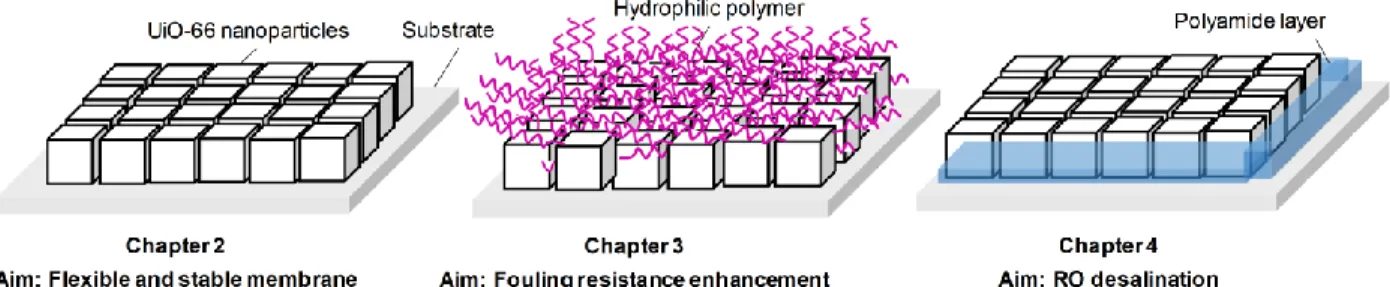
In order to overcome both the limitations of conventional membranes and the challenges of recent MOF-based membranes, in this dissertation, I have designed a new type of MOF-based composite membranes, in which a discontinuous selective layer was created by the deposition of water-stable MOF nanoparticles (UiO-66) on a flexible support membrane. Ultrahigh permeability of selective nanochannels in the MOF against slow permeation through interparticle voids among nanoparticles was behind this design. The membrane design in this dissertation has been implemented in three steps as depicted in Fig. 1. In Chapter 2, UiO-66 nanoparticles were deposited on a support membrane to develop the first flexible and stable MOF-based composite membranes for ultra/nano filtration. In Chapter 3, the fouling resistance of a composite membrane was enhanced by grafting a hydrophilic polymer from UiO-66 nanoparticles. In Chapter 4, interparticle voids among UiO-66 nanoparticles were filled by cross-linked polyamide and the membrane was applied to reverse osmosis (RO) desalination.
Fig. 1. MOF-based composite membranes designed in the dissertation
In Chapter 2, a novel composite membrane was fabricated by depositing UiO-66 nanoparticles into the porosity of a regenerated cellulose support membrane. The resulting membrane was applied to ultra/nano filtration for the rejection of methylene blue and polyethylene glycol from aqueous solutions. The membrane exhibited a perfect rejection while keeping an exceptionally high permeability (Fig. 2a), two to three orders of magnitudes higher than those of commercial ultra/nano filtration membranes. The origin of the permeability and rejection was attributed to the fluxes passing through intraparticle channels of UiO-66 with a size cut-off between 1.22 and 2.28 nm (Fig. 2b). The unique membrane structure and the stability of UiO-66 in water enabled consistent performance against bending and reuse.
Fig. 2. Filtration performance of a membrane filled by UiO-66 nanoparticles: (a) methylene blue filtration and (b) polyethylene glycol filtration
In Chapter 3, a strategy to enhance the fouling resistance of the membrane was proposed, in which hydrophilic poly(ethylene glycol) methacrylate (PEGMA) was grafted from UiO-66 nanoparticles via atom transfer radical polymerization without destructing the structure of UiO-66.
Then, the PEGMA-g-UiO-66 nanoparticles were deposited on a cellulose nitrate support membrane.
The oil removal test from oil/water nanoemulsion revealed that the polymer modification improved the founling resistant of the MOF-based membranes. Moreover, the grafted PEGMA also benefitted in the improvement of the permeability and selectivity of the membranes.
In this way, Chapters 2 and 3 clarified the feasibility and promising performance of the new type of MOF-based membranes, which was based on the creation of a discontinuous selective layer by MOF nanoparticles. However, when the membranes are subjected to the removal of smaller solutes (i.e. salts), the applied pressurization causes the leakage from the interparticle voids among UiO-66 nanoparticles. This challenge was finally addressed in Chapter 4, in which interfacial polymerization of cross-linked polyamide (PA) was utilized to fill the voids among the nanoparticles deposited on a polyethersulfone (PES) support membrane, thus forming a PA/UiO- 66/PES membrane. The membranes were applied to salt rejection based on an RO process. The PA/UiO-66/PES membrane exhibited very good salt rejection, while the permeability was 200%
higher than that of the PA/PES membrane with the same preparation condition (Fig. 3). This increment was explained by a contribution of ultrafast intraparticle channels of UiO-66 nanoparticles embedded in the PA layer.
Fig. 3. Filtration performance of PA/PES and PA/UiO-66/PES membranes
Chapter 5 describes the summary and general conclusions of the dissertation. The purpose of the thesis was accomplished by successful fabrication of new composite membranes based on the creation of a discontinuous selective layer by depositing water-stable MOF nanoparticles on a support membrane. I showed that such the membranes can exploit superior permeability and selectivity while keeping the flexibility and stability. Additional strategies were also proposed in order to improve the fouling resistance of the membranes and to enable their application in the RO desalination. The former was based on the modification of MOF nanoparticles by hydrophilic polymer, and the latter based on filling the interparticle voids among MOF nanoparticles by cross- linked polyamide through interfacial polymerization. Thus, this dissertation has successfully uncovered the promising design and aspects of MOF-based next-generation membranes for a wide range of applications.
KEYWORDS: UiO-66; Metal-organic framework; nanofiltration; desalination; rejection mechanism
Table and contents
Chapter 1 General introduction………...…………8 Chapter 2 Fabrication of new composite membrane filled with UiO-66 nanoparticles and its application to nanofiltration………46 Chapter 3 Synthesis of poly(ethylene glycol) methacrylate-grafted UiO-66 nanoparticles and application for new composite membranes………....73 Chapter 4 Development of reverse osmosis membranes based on UiO-66 nanoparticles deposited on polymeric support………...………...92 Chapter 5 General conclusion……… ………...………...112
Achievements
1. Dai Xuan Trinh, Thuy Phuong Nhat Tran, Toshiaki Taniike, “Fabrication of new composite membrane filled with UiO-66 nanoparticles and its application to nanofiltration”, Separation and purification Technology, 2017, 177, 249-256.
2. Linh Hoang Le, Dai Xuan Trinh, Trung Ba Le, Thuy Phuong Nhat Tran, Toshiaki Taniike,
“Fabrication of functionalized graphene membrane for evaluation of permeation performance”, Carbon, 2017, 114, 519-525.
3. Thuy Phuong Nhat Tran, Ashutosh Thakur, Dai Xuan Trinh, Anh Thi Ngoc Dao, Toshiaki Taniike, “Design of Pd@Graphene Oxide Framework Nanocatalyst and its Application in Suzuki- Miyaura Cross-Coupling Reaction” (under review).
4. Dai Xuan Trinh, Yuuki Sekiya, Thuy Phuong Nhat Tran, Thang Quoc Vu, Takashi Morinaga, Takaya Sato, Toshiaki Taniike, “Development of reverse osmosis membranes based on UiO-66 nanoparticles deposited on polymeric support” (In preparation).