REGULAR ARTICLE
PTCy ameliorates GVHD by restoring regulatory and effector T-cell homeostasis in recipients with PD-1 blockade
Shuntaro Ikegawa, Yusuke Meguri, Takumi Kondo, Hiroyuki Sugiura, Yasuhisa Sando, Makoto Nakamura, Miki Iwamoto, Yoshinobu Maeda, and Ken-ichi Matsuoka
Department of Hematology and Oncology, Okayama University Graduate School of Medicine, Dentistry and Pharmaceutical Sciences, Okayama, Japan
Key Points
•PD-1 blockade exacer- bated GVHD by alter- ing the homeostasis of Tregs and effector T cells after HSCT.
•PTCy ameliorated GVHD after PD-1 blockade by restoring the homeostatic bal- ance of T-cell subsets.
Graft-versus-host disease (GVHD) after allogeneic hematopoietic stem cell transplantation (allo-HSCT) is a significant cause of morbidity and mortality. Regulatory T cells (Tregs) are critical mediators of immune tolerance after allo-HSCT. Clinical studies have indicated that programmed cell death 1 (PD-1) blockade before allo-HSCT involves a risk of severe GVHD. However, the mechanisms underlying GVHD induction resulting from PD-1 blockade remain unclear. We investigated the impact of PD-1 expression of donor T cells on T-cell reconstitution and GVHD using murine models. Wefirst demonstrated that inhibition of PD-1 signaling induced aggressive expansion of CD41conventional T cells;
however, Tregs could not maintain expansion because of high susceptibility to apoptosis, resulting in discordant immune recovery and subsequent development of severe GVHD.
We then evaluated the impact of posttransplantation cyclophosphamide (PTCy) on abnormal T-cell reconstitution after PD-1 blockade. PTCy efficiently ameliorated GVHD after transplantation from a PD-12/2donor and extended overall survival by safely regulating the proliferation and apoptosis of T-cell subsets. Notably, in thefirst 2 weeks after administration of PTCy, Tregs regained their ability to continuously proliferate, resulting in well-balanced reconstitution of donor T-cell subsets. In conclusion, the influence of PD-1 blockade differed within T-cell subsets and caused unbalanced
reconstitution of T-cell subsets, resulting in severe GVHD. PTCy successfully restored T-cell homeostasis and ameliorated GVHD induced by PD-12/2donor T cells. Thesefindings may help explain the pathophysiology behind the observation that PTCy may mitigate the incidence and impact of GVHD associated with prior exposure to PD-1 blockade.
Introduction
Programmed cell death 1 (PD-1) is a coinhibitory receptor expressed on hematopoietic and nonhematopoietic cells. PD-1 attenuates T-cell activation by engaging its ligands, PD-L1 and PD-L2.1,2 PD-L1 overexpression in tumor cells inhibits the antitumor activity of effector T cells, whereas PD-1 blockade induces preferential stimulation of antitumor effector T cells and mediates antitumor activity.3 Clinical studies have demonstrated that PD-1 blockade is effective against various cancers, including hematological malignancies.4-6
Patients with hematological malignancies who respond to PD-1 blockade are candidates for allogeneic hematopoietic stem cell transplantation (allo-HSCT), because most patients experience disease recurrence after transient disease control by PD-1 blockade.7,8In allo-HSCT, PD-1 blockade of donor
Submitted 10 March 2019; accepted 6 November 2019. DOI 10.1182/
bloodadvances.2019000134.
Presented orally in abstract form at the 60th annual meeting of the American Society of Hematology, San Diego, CA, 2 December 2018.
For original data, please contact the corresponding author at [email protected] u.ac.jp.
The full-text version of this article contains a data supplement.
© 2019 by The American Society of Hematology
Downloaded from https://ashpublications.org/bloodadvances/article-pdf/3/23/4081/1547234/advancesadv2019000134.pdf by OKAYAMA UNIVERSITY user on 15 May 2020
T cells was found to be associated with lethal graft-versus-host disease (GVHD) in experimental murine models,9,10 and retro- spective clinical data have indicated that PD-1 blockade before allo-HSCT can increase the risk for severe acute GVHD.11-13 Posttransplantation cyclophosphamide (PTCy) is a novel GVHD prophylactic strategy for acute GVHD after allo-HSCT from HLA- haploidentical donors.14-17 Retrospective studies have demon- strated that HLA-haploidentical transplantation with PTCy results in similar survival, disease recurrence, and transplantation-related mortality and lower chronic GVHD compared with HLA-identical transplantation with conventional GVHD prophylaxis.16-18 For patients with Hodgkin lymphoma, HLA-haploidentical transplan- tation with PTCy reduced the incidence of relapse to a greater extent than in HLA-identical transplantation.19,20Furthermore, as in HLA-haploidentical transplantation, PTCy has been reported as an effective single GVHD prophylactic agent for HLA-identical transplantations.21-23The mechanism underlying the effect of PTCy on GVHD involves selective depletion of alloreactive proliferative effector T cells14,24-26and enhancement of the recovery of donor regulatory T cells (Tregs) that are resistant to PTCy because of aldehyde dehydrogenase expression.27Theoretically, PTCy is an attractive GVHD prophylaxis for patients undergoing PD-1 blockade before allo-HSCT, because PD-1 blockade may induce aggressive proliferation by effector T cells, enhancing the susceptibility of these cells to cytotoxic agents, such as Cy. In fact, recent clinical studies indicated that PTCy may be an effective GVHD prophylaxis for patients receiving PD-1 blockade therapy.28,29 A retrospective clinical study showed that checkpoint inhibitor treatment before allo-HSCT followed by PTCy was not associated with an increase in acute GVHD. Remarkably, no patients developed grade 3 to 4 acute GVHD with PTCy prophylaxis, suggesting that this pro- cedure may be an appropriate approach for preventing lethal alloreactions after pretransplantation PD-1 blockade.27,28 How- ever, the mechanisms of PTCy against GVHD after PD-1 blockade are largely unknown.
Tregs are a functionally distinct subset of mature T cells with broad immune suppressive activity.30-32The number of Tregs is a crucial determinant of the regulatory burden on the immune system.33 Moreover, an appropriate balance between Tregs and effector T cells is critical for peripheral tolerance.34,35 Tregs constitutively express high levels of high-affinity interleukin-2 (IL-2) receptors;
therefore, IL-2 plays an important role in Treg homeostasis.34,36,37 We previously reported that altered Treg homeostasis in prolonged lymphopenia may result in the development of chronic GVHD, and this effect can be reversed by administering low-dose IL-2.38,39 Importantly, analyses of clinical samples showed that Tregs selectively elevated PD-1 expression during IL-2 administration.40Our previous murine study suggested that PD-1 acts as a critical homeostatic regulator of Tregs by modulating proliferation and apoptosis during IL-2 therapy.41PD-1–deficient Tregs underwent rapid expansion soon after IL-2 induction, but thereafter, Tregs became proapop- totic. As a result, the Treg population returned to baseline levels despite continuous IL-2 administration. The fragility of PD-1–deficient Tregs has also been reported in an autoimmune pancreatitis model,42indicating that PD-1 plays an essential role in Treg homeostasis.
In contrast to the chronic phase after allo-HSCT, data are lacking regarding the impact of PD-1 expression in donor T cells on the early- phase reconstitution of T-cell subsets, including Treg homeostasis.
To clarify the mechanisms underlying severe acute GVHD caused by PD-1 blockade and its resolution, we assessed the effect of PD-1 expression of donor T cells on the reconstitution of T-cell subsets after allo-HSCT, as well as the effect of PTCy after PD-1 blockade, using murine HSCT models.
Methods
Mice
Female C57BL/6 (CD45.2, H2Kb/b, B6), B6D2F1 (CD45.2, H2Kb/d, BDF1), and BALB/c (CD45.2, H2Kd/d) mice were purchased from SLR Japan (Tokyo, Japan). Female CD45.1 B6 (CD45.1, H2Kb/b, Ly 5.1 B6) mice as well as PD-1–deficient mice with a B6 background (CD45.2, H2Kb/b, PD-12/2) were purchased from the RIKEN BioResource Center (Tsukuba, Japan). All mice were maintained under specific pathogen-free conditions and used at ages of 8 to 12 weeks. All animal experiments were performed according to the regulations of the Animal Care and Use Committee, Okayama University Advanced Science Research Center.
Transplantation procedure
On day 0, female BDF1 mice were conditioned by lethal irradiation with 2 doses of 4 to 6 Gy each 6 hours apart. Recipient mice were injected with splenocytes (SPs) and T cell–depleted bone marrow (TCD-BM) from donor mice on day 0. T-cell depletion from donor BM cells was conducted using anti-CD90 MicroBeads and an AutoMACS system (Miltenyi Biotec, Bergisch Gladbach, Germany) according to the manufacturer’s instructions. Depletion of CD251 cells was performed using PE-conjugated anti-CD25 monoclonal antibodies (mAbs) and MicroBeads (Miltenyi Biotec). Whole SPs harvested from donor mice were labeled with CD25-PE and anti-PE MicroBeads, and CD252cells were negatively purified by magnetic separation using the AutoMACS system. The purity of the CD252 CD41T-cell fractions was.95%.
Assessment of GVHD
Survival after HSCT was monitored daily, and the degree of clinical GVHD was assessed from days 3 to 7, and later weekly, using a scoring system including 5 clinical parameters: weight loss, posture, activity, fur texture, and skin integrity (maximum index, 10), as described previously.43
Flow cytometry for murine experiments
Single-cell suspensions were first incubated with the following directly conjugated mAbs (obtained from eBioscience, San Diego, CA, unless otherwise stated) for 20 minutes at 4°C: eFluor450- or Brilliant Violet 510–conjugated anti-CD4 (eFluor450, GK 1.5; Brilliant Violet 510, GK 1.5; Biolegend, San Diego, CA); eFluor450-, PerCP-, or APC-eFluor450–conjugated CD8 (53-6.7); fluorescein isothiocyanate–
conjugated anti-CD62L (MEL14); FITC-conjugated H2Kd (SF1- 1.1); PE-conjugated anti–PD-1 (RMP1-30), annexin V, and Ki-67 (SolA15); PE-Cy7–conjugated anti-CD25 (PC61.5); and APC- eFluor780–conjugated anti-CD44 (IM7) and CD45.2 (104). Cells were processed for intracellular staining using a Foxp3 staining buffer set (eBioscience). The cells were incubated with APC- conjugated anti-Foxp3 (FJK-16S) for 30 minutes at 4°C. Samples were analyzed using a MAQSQuant flow cytometer (Miltenyi Biotec), and data were analyzed using FlowJo software (TreeStar, Ashland, OR).
Downloaded from https://ashpublications.org/bloodadvances/article-pdf/3/23/4081/1547234/advancesadv2019000134.pdf by OKAYAMA UNIVERSITY user on 15 May 2020
Enzyme-linked immunosorbent assay
Serum was collected from the mice for days 3 after HSCT, and serum samples were assayed for interferon-gvia sandwich enzyme- linked immunosorbent assay using commercially available kits (R&D Systems, Minneapolis, MN).
In vivo proliferation assay
SPs were harvested from donor mice and labeled with CellTrace Violet (Thermo Fisher Scientific, Waltham, MA) according to the manufacturer’s protocol. SPs were transfused into recipient mice and harvested at 3 days posttransfusion. T-cell proliferation in the spleens was analyzed using a MAQSQuant flow cytometer.
Histopathology
Skin, liver, and colon specimens from the recipients were fixed in 10% formalin, embedded in paraffin wax, sectioned, mounted on slides, and stained with hematoxylin and eosin. Images were captured using a KEYENCE BZ-8100 fluorescence microscope (Keyence, Osaka, Japan).
Scoring of the skin sections was performed based on previously reported criteria.44 Liver and colon slides were scored using a semiquantitative scoring system (0.5-4.0 grade) as previously described.45
Administration of PD-1 mAb
PD-1 mAb (clone 4H2) was received from Ono Pharmaceutical (Osaka, Japan). Mouse immunoglobulin G1 (IgG1) isotype control was used as a control. PD-1 mAb and mouse IgG (600mg) were administered intraperitoneally during the peritransplantation period (twice weekly from day 25 through day 120) or during the pretransplantation period (on days25 and21).
PTCy
Cy (50 mg/kg; Sigma-Aldrich, St. Louis, MO) was administered intraperitoneally on day 3 after HSCT.
Statistical analysis
The results are presented as the mean 6 standard error of the mean. The Mann-WhitneyUtest and Studentttest were used to assess statistical significance between the 2 groups, and 1-way analysis of variance was used to compare.2 groups. The Kaplan- Meier product limit method was used to determine survival probability, and the log-rank test was applied to compare survival curves. Statistical significance was set toP,.05, and all tests were 2 tailed. GraphPad Prism 7 software (GraphPad, La Jolla, CA) was used for analysis.
Results
PD-12/2graft resulted in lethal GVHD and significantly inferior survival than PD-11/1graft First, we developed an HSCT model to compare survival and GVHD scores of recipients of transplants from PD-11/1donors with those from PD-12/2 donors after HSCT. Lethally irradiated BDF1 mice received transplants of 103106SPs from PD-11/1or PD-12/2B6 mice and 5 3 106 TCD-BM cells from PD-11/1 B6 mice. As a control, syngeneic transplantation (BDF1→BDF1) was performed (Figure 1A). Compared with the syngeneic group, the allogeneic PD-11/1 group showed significantly inferior survival after HSCT.
Furthermore, the allogeneic PD-12/2graft group showed a mark- edly lower rate of survival than the allogeneic PD-11/1 group (Figure 1B). The GVHD score was also significantly higher in the PD-12/2group than in the PD-11/1 group on day 7 after HSCT (Figure 1C). On day 3 after HSCT, the serum levels of interferon-g were significantly elevated and the serum level of tumor necrosis factor-awas relatively higher in the PD-12/2group than in the PD- 11/1group (Figure 1D; supplemental Figure 1).
Next, to evaluate the effect of PD-1 mAb on posttransplantation outcomes, we treated recipient mice with PD-1 mAb or isotype mouse control IgG twice weekly during the peritransplantation and pretransplantation periods (Figure 1E). First, we determined the dose of PD-1 mAb needed to affect posttransplantation GVHD in the current BMT model. We treated recipient mice with control vehicle or 200, 600, or 1,800 mg of PD-1 mAb intraperitoneally on days 25 and 21 before transplantation and compared the GVHD scores among the 4 groups. Mice administered 600 and 1,800mg of PD-1 mAb showed significantly higher GVHD scores than those in the control group, and no difference was observed between the 600- and 1,800-mg PD-1 mAb groups (supplemental Figure 2A). Therefore, we defined 600 mg per mouse as an appropriate PD-1 mAb dose to effect a sufficient alloimmune reaction. Next, to determine the optimal duration of the last administration of PD-1 mAb and BMT, we treated recipient mice at different timings before transplantation (3 weeks, 1 week, and immediately before transplantation). Recipients administered PD- 1 mAb immediately before transplantation showed high GVHD scores, whereas those treated with PD-1 mAb until 3 weeks and 1 week before transplantation showed similar GVHD scores compared with the control group (supplemental Figure 2B). There- fore, we treated the recipients with 600mg of PD-1 mAb per mouse immediately before (days 25 and 21) transplantation in the pretransplantation PD-1 mAb experiments. PD-1 expression of the donor T cells was decreased after PD-1 mAb infusion (Figure 1F).
On day 28 after HSCT, a significant difference was observed in clinical GVHD scores between the PD-1 mAb and control groups (Figure 1G). PD-1 mAb treatment only before transplantation also resulted in GVHD scores comparable to those in peritransplanta- tion mAb treatment (Figure 1H).
These results indicate that the PD-12/2graft and anti–PD-1 mAbs exacerbated GVHD. Thus, this HSCT model was appropriate for assessing the mechanisms underlying GVHD induced by PD-1 blockade.
PD-12/2graft developed severe tissue damage in GVHD target organs
Next, we evaluated tissue damage in GVHD target organs.
Sublethally irradiated BDF1 mice received transplants of 53106 SPs from either PD-11/1or PD-12/2B6 mice together with 53 106TCD-BM cells from Ly 5.1 B6 mice. The recipient mice were anesthetized and euthanized on day 14, and the GVHD target organs, including the skin, liver, colon, and thymus, were harvested (Figure 2A). Histological examination revealed greater lympho- cyte infiltration in GVHD target organs of the PD-12/2 group.
Pathological scores were significantly higher in recipient mice in the PD-12/2 group than in the PD-11/1 group (Figure 2B-C).
Additionally, the thymuses of recipient mice in the PD-12/2group displayed severe morphological changes, including decreased thymus size and a lack of demarcation between the cortex and
Downloaded from https://ashpublications.org/bloodadvances/article-pdf/3/23/4081/1547234/advancesadv2019000134.pdf by OKAYAMA UNIVERSITY user on 15 May 2020
medulla, which is typical of thymic GVHD46(Figure 2D). CD41 CD81 DP cells were markedly depleted in the PD-12/2 group, and a significant difference was observed between the PD-11/1 and PD-12/2 groups (Figure 2D). Chimerism analysis via flow
cytometry revealed that graft-derived CD41conventional T cells (Tcons) and CD8 T cells were more evident in the thymuses of recipient mice in the PD-12/2 group (Figure 2E). Depletion of DP cells and histological abnormalities were not observed in the
H G
0
-10 0 10 20 30
2 4 6
GVHD score
Days after BMT 8
*****
*
p0.05 on day14
* PD-1 mAb treatment
Syngeneic Mouse lgG PD-1 mAb 0
-10 0 10 20 30
2 4 6
GVHD score
Days after BMT 8
Syngeneic Mouse lgG PD-1 mAb
*******
* *
PD-1 mAb treatment
D C
IFN-J (pg/ml)
***
****
0 500 1000 1500
Syn. PD-1+/+ PD-1-/-
Allo PD-1+/+ Allo PD-1-/- Syngeneic
GVHD score
Days after BMT
*
0
0 10 20 30
2 4 6 8
B A
0
0 20 40
Days after BMT
60 80 100 50
100
Overall survival (%) ****
****
Allo PD-1+/+ Allo PD-1-/- Syngeneic
day 0 TBI BMT
B6D2F1 (H2Kb/d) C57BL/6J (H2Kb/b)
SP 10 x 106 PD-1+/+ or PD-1-/- TCD-BM 5 x 10⁶ PD-1+/+
BMT
TBI
F E
PD-1 CD8 T
Isotype Mouse lgG PD-1 mAb
Events
B6D2F1 (H2Kb/d) C57BL/6J (H2Kb/b)
SP 10 x 106 PD-1+/+
TCD-BM 5 x 10⁶ PD-1+/+
BMT
TBI
"Peri-transplant" 2/week from day-5 to +20
"Pre-transplant" day-5 and -1 day 0
Figure 1.PD-12/2graft and PD-1 blockade of donor T cells exacerbated GVHD, and PD-12/2 graft demonstrated inferior overall survival after HSCT.(A) Lethally irradiated BDF1 recipients re- ceived transplants of 103106PD-11/1B6 or PD- 12/2B6 SPs with 53106B6 TCD-BM cells (allogeneic group). The syngeneic group was adminis- tered the same amounts of SPs and TCD-BM cells from BDF1 mice (n515 per group). All animals were monitored daily for survival, and GVHD scores were estimated from days 3 to 7 and once a week from day 14. (B) Kaplan-Meier survival curve of recipient mice (syngeneic vs PD-11/1,P,.0001; syngeneic vs PD-11/1,P,.0001; PD-11/1vs PD-12/2, P,.0001). Data from 3 same experiments were combined. (C) Mean GVHD scores of recipient mice (PD-11/1vs PD-12/2on day 7,P,.05). Data are representative of 3 independent experiments. (D) Se- rum levels of interferon-g(IFN-g) on day 3 after HSCT (syngeneic vs PD-12/2,P,.001; PD-11/1vs PD-12/2,P,.0001). (E) Lethally irradiated BDF1 recipients received transplants of 103106PD-11/1 B6 SPs and 53106B6 TCD-BM cells (allogeneic group). The syngeneic group was administered the same amounts of SPs and TCD-BM cells from BDF1 mice (n55 per group). Recipient mice were injected with 600mg of PD-1 mAb per mouse or isotype mouse IgG intraperitoneally twice weekly from day 15 to120 after HSCT. All animals were monitored daily for survival, and GVHD scores were estimated from days 3 to 7 and once a week from day 14. (F) Representative flow cytometric histograms detecting PD-1 expression of donor CD8 T cells on day 7 after transplantation. (G) Mean GVHD scores of recipient mice treated during peritransplantation period (mouse IgG vs PD-1 mAb on day 5,P,.05; day 6, P,.001; day 7,P,.0001; and day 28,P,.05).
(H) Mean GVHD scores of recipient mice treated be- fore transplantation (mouse IgG vs PD-1 mAb on day 5,P,.05; day 6,P,.01; day 7,P,.001; and day 14,P,.05). Clinical scores are shown as the mean 6standard error of the mean. *P,.05, **P,.01,
***P,.001, and ****P,.0001. BMT, BM trans- plantation; TBI, total-body irradiation.
Downloaded from https://ashpublications.org/bloodadvances/article-pdf/3/23/4081/1547234/advancesadv2019000134.pdf by OKAYAMA UNIVERSITY user on 15 May 2020
C
10
Pathology scores
8 6 4 2 0
PD-1+/+ PD-1-/-
*
Skin
10 8 6 4 2 0
PD-1+/+ PD-1-/-
*
Liver
10 8 6 4 2 0
PD-1+/+ PD-1-/-
*
Colon
1.0 **
0.8 0.6 0.4 0.2 0.0
PD-1+/+ PD-1-/- DP cells
Cells x106
D
PD-1+/+
x8 x200
x8 x200 12 28
60 25
13 50
11 0.3
PD-1-/-
CD4
CD8
A
day 0 day 14
BMT TBI
BMT
TBI
B6D2F1 (H2Kb/d)
Harvest of GVHD target organs SP (CD45.2) 5 x 10⁶ PD-1+/+ or PD-1-/-
TCD-BM (CD45.1) 5 x 10⁶ PD-1+/+
C57BL/6J (H2Kb/b)
B
PD-1+/+
PD-1-/-
E
***
Single-positive cells 100
% of CD8SP
50
0
PD-1+/+ PD-1-/-
Stem Host Graft
Stem Host Graft
Single-positive cells 100
50
0
% of CD4Tcon
PD-1+/+ PD-1-/-
***
Skin Liver Colon
Figure 2.PD-12/2graft-induced GVHD in target organs, especially in the thymus.(A) Sublethally irradiated BDF1 recipient mice received transplants of 53106 PD-11/1B6 or PD-12/2B6 SPs and 53106Ly 5.1 B6 TCD-BM cells (n55 per group). Recipient mice were euthanized on day 14 after HSCT, and the skin, liver, colon, and thymus were harvested. (B) Representative images of the skin, liver, and colon from recipient mice with hematoxylin and eosin (H&E) staining are shown (magnification,3200 for skin and liver,3400 for colon). (C) Pathological scores for the skin, liver, and colon on day 14 after HSCT are shown (PD-11/1vs PD-12/2,P,.05). (D) Representative
Downloaded from https://ashpublications.org/bloodadvances/article-pdf/3/23/4081/1547234/advancesadv2019000134.pdf by OKAYAMA UNIVERSITY user on 15 May 2020
syngeneic model (supplemental Figure 3A). On day 28 after HSCT, the number of circulating T cells in the peripheral blood was significantly lower in the PD-12/2group than in the PD-11/1 group (supplemental Figure 3B). These results indicate that the PD-12/2 graft induced tissue damage in GVHD target organs, particularly in the thymus.
Effector T cells from PD-12/2donors showed markedly high-level proliferation soon after HSCT To explore the mechanisms underlying severe acute GVHD induced by the PD-12/2 graft, we assessed the reconstitution of T-cell subsets after HSCT via flow cytometry. Before evaluation in an allogeneic setting, we analyzed the SPs of 10-week-old PD-11/1 and PD-12/2B6 mice in a transplantation-naive setting. The Treg population was significantly higher in PD-12/2B6 mice than in PD- 11/1 B6 mice (supplemental Figure 4A). Expression of Ki-67 in CD8 T cells, CD4 Tcons, and Tregs did not differ between PD-11/1 and PD-12/2 B6 mice (supplemental Figure 4B). Annexin V expression in each T-cell subset was significantly higher in PD- 12/2B6 mice than in PD-11/1B6 mice (supplemental Figure 4B).
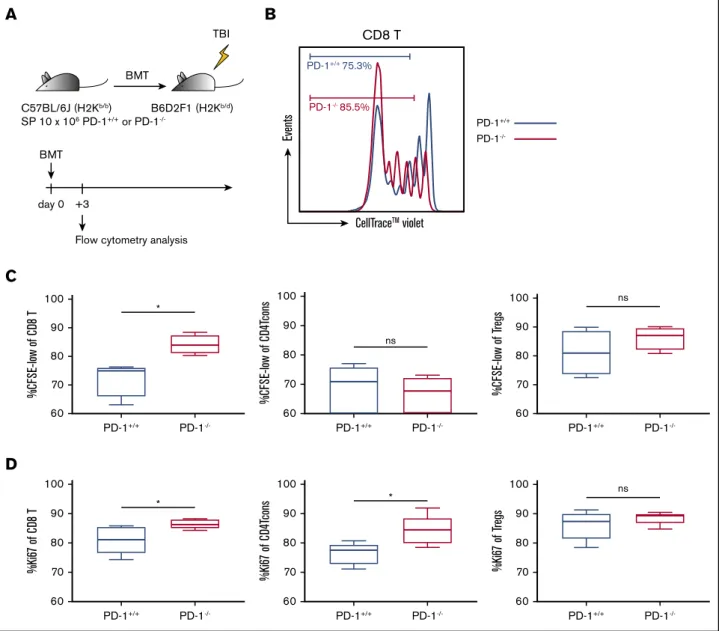
Next, irradiated BDF1 mice administered 103106SPs from either PD-11/1B6 or PD-12/2B6 were euthanized on day 3 for analysis.
Ki-67 expression and in vivo cell division of donor graft–derived T cells were analyzed by flow cytometry (Figure 3A). PD-12/2donor graft–derived CD8 T cells and CD4 Tcons showed significantly higher Ki-67 expression, and PD-12/2 graft–derived CD8 T cells had a significantly higher population of divided cells than those in the PD-11/1group. Tregs showed high Ki-67 expression and a high frequency of cell division in both the PD-11/1and PD-12/2groups (Figure 3B-C). These results suggest that effector T cells from the PD-12/2 graft have high proliferation capacity and that enhanced expansion of effector T cells triggers lethal GVHD.
PD-12/2donor Tregs increased proliferation
transiently but could not maintain expansion because of high susceptibility to apoptosis
To explore homeostasis during the first 2 weeks after HSCT, sublethally irradiated BDF1 mice received transplants of 53106 SPs from either PD-11/1 or PD-12/2B6 SPs, together with 53 106TCD-BM cells from Ly5.1 B6 mice (Figure 4A). Recipient mice were euthanized, and SPs were harvested and analyzed on days 3, 7, and 14 after HSCT. Donor graft–derived T cells were defined as H2kd2/CD45.21gated cells (Figure 4B).
First, we evaluated PD-1 expression in donor T cells after HSCT. In the PD-11/1 group, both Tregs and CD4 Tcons displayed increased PD-1 expression during the days after HSCT. PD-12/2 donor T cells did not express PD-1 (supplemental Figure 5).
PD-12/2 CD4 Tcons rapidly increased, and their numbers were significantly higher than those of PD-11/1CD4 Tcons during the first 2 weeks after HSCT (Figure 4C).
With regard to Tregs, PD-12/2Tregs rapidly proliferated in the first week, and their numbers were significantly higher than those of
PD-11/1Tregs on day 7; however, PD-12/2Treg expansion was not sustained, and the number of Tregs in the PD-12/2group was significantly lower than that in the PD-11/1 group on day 14 (Figure 4C). We next analyzed annexin V expression of donor T cells on day 14. The expression level of annexin V of CD4 Tcons was comparable between the PD-11/1 and PD-12/2 groups (Figure 4D). In contrast, PD-12/2Tregs showed significantly higher annexin V expression than PD-11/1Tregs on day 14 after HSCT (Figure 4D), suggesting that PD-12/2Tregs are more susceptible to apoptosis compared with PD-11/1Tregs.
PTCy ameliorated clinical GVHD after HSCT from allogeneic PD-12/2donors
Effector T cells from PD-12/2 donor grafts were aggressively proliferative on day 3, indicating that these cells could be highly susceptible to the cytotoxic effects of Cy. We therefore tested the prophylactic efficacy of PTCy against severe GVHD with the PD-12/2 donor graft. Lethally irradiated recipient BDF1 mice received transplants of 10 3 106 SPs from either PD-11/1 or PD-12/2B6 mice, together with 53106TCD-BM cells on day 0, and were treated with 50 mg/kg of Cy on day 3 (Figure 5A). PTCy improved the survival outcome and reduced GVHD severity in the PD-12/2group, resulting in comparable survival rates between the PD-11/1and PD-12/2groups because of PTCy prophylaxis (Figure 5B-C). We confirmed GVHD amelioration by PTCy in another acute GVHD mouse model using PD-11/1or PD-12/2B6 donors and BALB/c recipients (supplemental Figure 6A-B). We further evaluated the effect of PTCy against GVHD after PD-1 mAb administration. PTCy also improved GVHD scores after pre- transplantation administration of PD-1 mAb (Figure 5D-E).
PTCy restored the balanced reconstitution of T-cell subsets and prevented tissue damage after HSCT from allogeneic PD-12/2donors
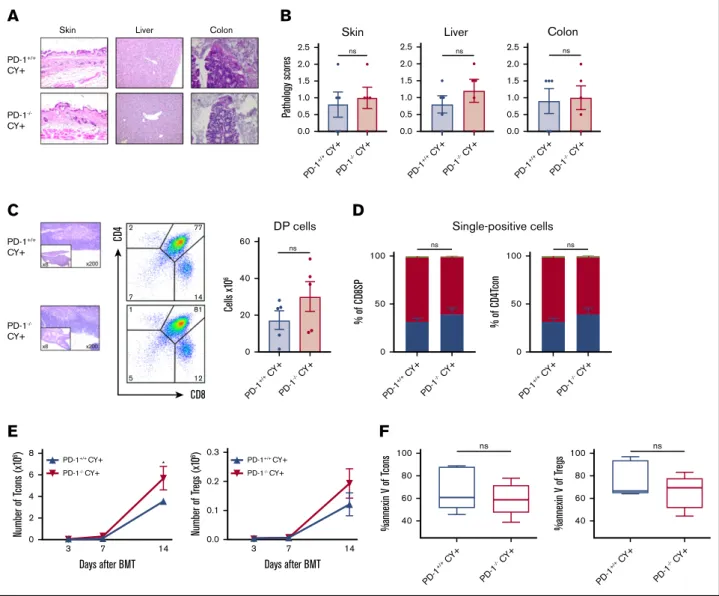
We evaluated the effects of PTCy on tissue damage in GVHD target organs and the reconstitution of T-cell subsets in recipient mice after PD-1 blockade. Sublethally irradiated BDF1 mice received transplants of 5 3 106 SPs from either PD-11/1 or PD-12/2B6 mice, together with 53106TCD-BM cells from Ly5.1 B6 mice, and were administered PTCy on day 3. Histological analysis on day 14 demonstrated that lymphocyte infiltration in GVHD target organs were decreased irrespective of the PD-1 expression status of donor T cells and that the pathological scores were comparable between the 2 groups (Figure 6A-B). In terms of thymus effects, PTCy treatment completely alleviated histological abnormalities and facilitated the recovery of DP cell numbers in the thymuses of recipient mice in the PD-12/2group (Figure 6C).
In addition, CD4 Tcons and CD8 T cells in the thymuses of both the PD-11/1 and PD-12/2 groups were predominantly residual host T cells (Figure 6D), suggesting that thymic damage resulting from donor T-cell infiltration was limited by PTCy. These results indicate that PTCy prevents damage to the GVHD target organs after PD-1 blockade.
Figure 2.(continued)images of thymuses with H&E staining, lymphocyte gate of thymuses, and absolute number of double-positive (DP) cells in thymuses (PD-11/1vs PD-12/2, P,.01). (E) Chimerism analysis of CD8 or CD4 single-positive conventional T cells (PD-11/1vs PD-12/2,P,.001). Green, red, and blue indicate donor stem cell–, host-, and donor graft–derived cells, respectively. (D-E) Data are representative of 2 independent experiments. Data are shown as the mean6standard error of the mean. *P,.05,
**P,.01, ***P,.001.
Downloaded from https://ashpublications.org/bloodadvances/article-pdf/3/23/4081/1547234/advancesadv2019000134.pdf by OKAYAMA UNIVERSITY user on 15 May 2020
Analysis of T-cell reconstitution demonstrated that PTCy sup- pressed the early expansion of Tcons and Tregs on day 7, irrespective of the PD-1 expression status of donor T cells (Figure 6E).
Thereafter, PD-12/2CD4 Tcons gradually increased, and their number on day 14 was significantly higher than that of PD-11/1CD4 Tcons.
Importantly, after PTCy treatment, the numbers of PD-12/2Tregs and concomitant CD4 Tcons were increased and their suscep- tibility to apoptosis was lower on day 14 versus the non-PTCy setting (Figure 4D,F). These results suggest that PTCy restores T-cell homeostasis in recipients with PD-1 blockade.
PTCy preserved the antitumor effect of PD-12/2T cells To assess graft-versus-tumor effect after PTCy, sublethally irradi- ated BDF1 mice received transplants of 53106SPs from PD-11/1
or PD-12/2B6 mice and 53 106TCD-BM cells from B6 mice, together with 0.5 3106mastocytoma cells (P815), followed by PTCy on day 3 (supplemental Figure 7A). Control syngeneic transplantation (BDF1→BDF1) was also performed. After HSCT, overall survival was similar between the PD-11/1plus PTCy and PD-12/2plus PTCy groups, and all recipients died as a result of tumor progression (supplemental Figure 7B-C), indicating that PTCy did not disrupt the antitumor effects of PD-12/2 effector T cells. Next, we evaluated tumor-infiltrating lymphocytes (TILs) in the liver of recipient mice in the PD-11/1 and PD-12/2 donor transplantations after PTCy. The numbers of CD81 TILs, CD41 TILs, and Foxp31 TILs did not significantly differ between the 2 groups. These results suggest that PTCy preserves the antitumor effect of PD-12/2T cells (supplemental Figure 7C-D).
PD-1+/+
*
%Ki67 of CD8 T
60 70 80 90 100
PD-1-/- PD-1+/+
%Ki67 of Tregs
60 70 80 90 100
PD-1-/- ns
PD-1+/+
*
%Ki67 of CD4Tcons
60 70 80 90 100
PD-1-/-
D
PD-1+/+ 75.3%
PD-1-/- 85.5%
CellTraceTM violet
Events PD-1-/-
PD-1+/+
CD8 T
B A
day 0 BMT
BMT
TBI
C57BL/6J (H2Kb/b)
SP 10 x 106 PD-1+/+ or PD-1-/-
B6D2F1 (H2Kb/d)
+3
Flow cytometry analysis
PD-1+/+
*
%CFSE-low of CD8 T
60 70 80 90 100
PD-1-/- PD-1+/+
%CFSE-low of Tregs
60 70 80 90 100
PD-1-/- ns
PD-1+/+
ns
%CFSE-low of CD4Tcons
60 70 80 90 100
PD-1-/-
C
Figure 3.PD-12/2donor graft–derived effector T cells exhibited high proliferative capacity.(A) Lethally irradiated BDF1 recipients received transplants of 103106 PD-11/1B6 or PD-12/2B6 SPs (n55 per group). All animals were euthanized, and spleen cells were harvested on day 3. (B) Representative image of cell division of graft- derived CD8 T cells and the population of graft-derived T cells. (C) Percentage of proliferated graft-derived T cells (divided$2) (CD8 T cells, PD-11/1vs PD-12/2, P,.05).
(D) Ki-67 expression of graft-derived T cells (CD8 T, PD-11/1vs PD-12/2,P,.05; CD4 Tcons, PD-11/1vs PD-12/2,P,.05). Data are expressed as the mean6standard error of the mean. *P,.05. CFSE, carboxyfluorescein diacetate succinimidyl ester; ns, not significant.
Downloaded from https://ashpublications.org/bloodadvances/article-pdf/3/23/4081/1547234/advancesadv2019000134.pdf by OKAYAMA UNIVERSITY user on 15 May 2020
PTCy could not achieve maximum prophylactic effect against PD-12/2donor–induced GVHD without Tregs in donor graft
A previous study demonstrated that the effect of PTCy was due not only to the depletion of alloreactive proliferative effector T cells, but also to the rapid recovery of donor Tregs.47Therefore, we depleted Tregs in the donor graft and assessed the impact of PD-12/2 graft–derived Tregs on PTCy prophylaxis against PD-12/2graft–
induced GVHD. BDF1 mice were lethally irradiated and received transplants of 10 3 106 SPs from B6 mice (PD-11/1, CD251 T cell–replete [PD-11/1CD251]; PD-11/1, CD251T cell–deplete [PD-11/1 CD252]; PD-12/2, CD251 T cell–replete [PD-12/2 CD251]; or PD-12/2,CD251 T cell–deplete [PD-12/2CD252]) and 53106TCD-BM cells from B6 mice. PTCy was administered on day 3 after HSCT (Figure 7A). The PD-12/2 CD252 group showed a significantly lower survival rate and higher GVHD scores
than the PD-12/2CD251group (Figure 7B-C). The overall survival of the PD-11/1CD252group was lower than that of the PD-11/1 CD251group. These results indicate that Tregs play an important role in PTCy efficacy against GVHD, particularly for the PD-12/2 graft.
Discussion
This study provides insight into 3 aspects associated with the impact of PD-1 signaling on immune reconstitution after allo-HSCT.
First, PD-1 inhibition did not uniformly affect graft-derived T cells within the T-cell subsets; this caused unbalanced reconstitution of the T-cell subsets, resulting in severe GVHD in the PD-1 knockout and PD-1 mAb models. Second, PD-12/2donor T cells developed severe GVHD, particularly in the thymus. Few studies have focused on the effect of donor graft PD-1 expression on the thymus after HSCT, where acute GVHD in the thymus may lead to late central
D
100 ns
80 60 40
PD-1-/- PD-1+/+
%annexin V of Tcons
100
*
80 60 40
PD-1+/+ PD-1-/-
%annexin V of Tregs
C
10 PD-1+/+
PD-1-/-
****
**
8 6 4 2 0
3 7
Days after BMT Number of Tcons (x106)
14
Days after BMT
PD-1+/+
PD-1-/-
****
**
0.4 0.3 0.2 0.1 0.0
3 7 14
Number of Tregs (x106)
A
TBI
day 0day 3 day 7 day 14 BMT
BMT
TBI
B6D2F1 (H2Kb/d)
FACS analysis SP (CD45.2) 5 x 10⁶ PD-1+/+ or PD-1-/- TCD-BM (CD 45.1) 5 x 10⁶ PD-1+/+
C57BL/6J (H2Kb/b)
B
Host
Stem Graft
H2KdCD8 Foxp3
CD4
CD45.2 PD-1
CD25
isotype sample
Figure 4.PD-1 inhibition promoted CD4 Tcon ex- pansion and suppressed recovery of Tregs.(A) Sub- lethally irradiated BDF1 recipient mice received transplants of 53106PD-11/1B6 or PD-12/2B6 SPs and 53106Ly 5.1 B6 TCD-BM cells (n55 per group).
Recipient mice were euthanized on days 3, 7, and 14 after HSCT, and spleens were harvested. (B) Representa- tive lymphocyte gates of the spleen for identification of CD4 and CD8 T-cell subsets and chimerism. (C) Num- bers of donor spleen–derived CD4 Tcons and donor spleen–derived Tregs after HSCT (CD4 Tcons, PD-11/1 vs PD-12/2,P,.01 on day 7,P,.0001 on day 14;
Tregs, PD-11/1vs PD-12/2,P,.01 on day 7, P,.0001 on day 14). (D) Annexin V expression of spleen-derived T cells on day 14 after HSCT. Data are shown as the mean6standard error of the mean.
*P,.05, **P,.01, ****P,.0001. FACS, fluorescence- activated cell sorting.
Downloaded from https://ashpublications.org/bloodadvances/article-pdf/3/23/4081/1547234/advancesadv2019000134.pdf by OKAYAMA UNIVERSITY user on 15 May 2020
immune disturbances. Third, PTCy successfully ameliorated GVHD induced by PD-12/2 donor T cells, preserving the graft-versus- tumor effect.
Before analyzing the reconstitution of T-cell subsets posttransplan- tation, we first analyzed the basal levels of the proportion, proliferation, and apoptosis of T-cell subsets in PD-12/2B6 mice as compared with those in PD-11/1B6 mice in the transplantation- naive setting. We found that each T-cell subset from PD-12/2mice exhibited higher expression of annexin V than each respective subset from PD-11/1 mice, indicating that inhibition of PD-1 signaling predisposes T-cell subsets to apoptotic susceptibility (supplemental Figure 4B). Annexin V level of PD-12/2Tregs was much higher than that of PD-12/2Tcons, but the Treg population
was maintained in the noninflammatory transplantation-naive setting (supplemental Figure 4A). In contrast, in the inflammatory and lymphopenic posttransplantation settings, the apoptotic suscepti- bility of PD-12/2Tregs was further elevated, and the cells did not maintain homeostasis, leading to a decrease of this cell population (Figure 4C-D right panels). Notably, the apoptotic susceptibility of PD-12/2 Tcons remained comparable to that of PD-11/1 Tcons, and both PD-12/2and PD-11/1Tcons continued increasing during the first 2 weeks (Figure 4C-D left panels). As demonstrated previously, Treg homeostasis may be fragile in the inflammatory or lymphopenic environment.34,48,49Our results suggest that the posttransplantation inflammatory and lymphopenic environments drive PD-12/2 Treg fragility and collapse of homeostasis, leading to unbalanced immune recovery as a pathogenic basis of severe GVHD.
TBI PTCy
day 0 day 3 BMT
BMT
TBI
B6D2F1 (H2Kb/d) TCD-BM 5 x 10⁶ PD-1+/+
SP 10 x 106 PD-1+/+ or PD-1-/- C57BL/6J (H2Kb/b)
A
100
Overall survival (%)
50
0
0 20 40 60
Days after BMT
80 100 ns
Allo PD-1-/- CY+
Allo PD-1-/-
Allo PD-1+/+ CY+
Allo PD-1+/+
Syngeneic CY+
Syngeneic
B
8 6
4 * *
**
2 0
0 10 20 30
Days after BMT
GVHD score
Allo PD-1-/- CY+
Allo PD-1+/+ CY+
Syngeneic CY+
C
8
**
‡‡‡‡‡‡‡‡
6 §§
4 2 0
0 10 20 30
Days after BMT
GVHD score ‡ †
*
‡‡‡
†††
‡
†††
Syngeneic CY+
Syngeneic vehicle Ctrl vehicle Ctrl CY+
PD-1 mAb vehicle PD-1 mAb CY+
*
†
‡
§
D
8 6 4 2 0
0 10 20 30
Days after BMT
GVHD score ‡‡
***
‡‡‡‡ †††
‡‡
††
‡
†
Syngeneic CY+
Syngeneic vehicle Ctrl vehicle Ctrl CY+
PD-1 mAb vehicle PD-1 mAb CY+
*
†
‡
E
Figure 5.PTCy ameliorated GVHD caused by PD-12/2graft and PD-1 mAb.(A) Lethally irradiated BDF1 recipients received transplants of 103106PD-11/1B6 or PD-12/2B6 SPs and 53106B6 TCD-BM cells (allogeneic group). The syngeneic group was administered the same amounts of SPs and TCD-BM cells from BDF1 mice (n59-15 per group). All recipient mice were intraperitoneally injected with 50 mg/kg of Cy on day 3 after HSCT. All animals were monitored daily for survival, and GVHD scores were monitored from days 3 to 7 and once per week from day 14. (B) Kaplan-Meier curve of survival after HSCT. Solid lines show outcomes of recipient mice treated with PTCy, and the dotted line shows survival without PTCy treatment (PD-11/1Cy1vs PD-12/2Cy1; ns). Data from 3 same experiments were combined. (C) Mean GVHD scores of PD-11/1or PD-12/2donor mice (PD-11/1vs PD-12/2on day 14,P,.05; day 21,P,.05; and day 28,P,.01). Data are representative of 3 independent experiments.
(D) Lethally irradiated BDF1 recipients received transplants of 103106PD-11/1B6 SPs and 53106B6 TCD-BM cells (allogeneic group). The syngeneic group was adminis- tered the same amounts of SPs and TCD-BM cells from BDF1 mice (n56-18 per group). Recipient mice were intraperitoneally injected with control mouse IgG or PD-1 mAb twice weekly between day25 and120 and were administered 50 mg/kg of Cy or vehicle on day 3 after HSCT. Mean GVHD scores of recipient mice treated with mouse IgG or peritransplantation PD-1 mAb6PTCy (mouse IgG vs PD-1 mAb on day 5,P,.05; day 6,P,.0001; day 7,P,.0001; day 21,P,.001; and day 28,P,.05). Data from 2 same experiments were combined. (E) Lethally irradiated BDF1 recipients received transplants of 103106PD-11/1B6 SPs and 53106B6 TCD-BM cells (allogeneic group).
The syngeneic group was administered the same amounts of SPs and TCD-BM cells from BDF1 mice (n56-10 per group). Recipient mice were intraperitoneally injected with control mouse IgG or PD-1 mAb on days25 and21 and were administered 50 mg/kg of Cy or vehicle on day 3 after HSCT. Mean GVHD scores of recipient mice treated with mouse IgG or pretransplantation PD-1 mAb6PTCy (mouse IgG vs PD-1 mAb on day 6,P,.01; day 7,P,.0001; day 21,P,.01; day 28,P,.05) Data from 2 same experiments were combined. Clinical scores are expressed as the mean6standard error of the mean. *P,.05, **P,.01, ***P,.001, ****P,.0001. *,†,‡, and§indicate the comparison between control IgG1vehicle vs control IgG1PTCy, PD-1 mAb1vehicle vs PD-1 mAb1PTCy, control IgG1vehicle vs PD-1 mAb1vehicle, and control1PTCy vs PD-1 mAb1PTCy, respectively.
Downloaded from https://ashpublications.org/bloodadvances/article-pdf/3/23/4081/1547234/advancesadv2019000134.pdf by OKAYAMA UNIVERSITY user on 15 May 2020