P
ercutaneous ablation therapies have been recog- nized as successful approaches in patients with hepatocellular carcinoma (HCC), generally in patients with Child-Pugh class A or B liver function with ≤3 tumors of ≤3 cm in diameter [1,2].Radiofrequency ablation (RFA) is accepted as being as good as resection for Child-Pugh class A or B tumors of ≤3 cm in diameter [2]. In one study, complete abla- tion was achieved in >99% of the RFA-treated patients with tumors ≤3 cm in diameter [3]. As a percutaneous ablation therapy, RFA is regarded as superior to percu- taneous ethanol injection (PEI), as it achieves better
overall survival, overall recurrence and local tumor progression rates, with no difference in the incidence of adverse events [4].
A Japanese nationwide survey of 12,968 patients who underwent surgical resection, RFA, and PEI showed that the 5-year recurrence rates in patients who received these treatments were 63.8%, 71.7%, and 76.9%, respectively [5]. The clinical practice guidelines for HCC in Japan recommend resection as a first-line therapy for solitary HCC, as is recommended in the American Association for the Study of Liver Diseases guidelines [2,6]. However, as HCC usually occurs in cirrhosis patients, the low rate of post-treatment com-
CopyrightⒸ 2020 by Okayama University Medical School.
http ://escholarship.lib.okayama-u.ac.jp/amo/
Original Article
Decreased Serum Antioxidant Marker is Predictive of Early Recurrence in the Same Segment after Radical Ablation for Hepatocellular Carcinoma
Taiko Muro, Shinichiro Nakamura, Akinobu Takaki*, Hideki Onishi, Nozomu Wada, Tetsuya Yasunaka, Daisuke Uchida, Atsushi Oyama,
Takuya Adachi, Hidenori Shiraha, and Hiroyuki Okada
Department of Gastroenterology and Hepatology, Okayama University Graduate School of Medicine, Dentistry and Pharmaceutical Sciences, Okayama 700-8558, Japan
Radiofrequency ablation (RFA) for hepatocellular carcinoma (HCC) is a promising method for controlling tumors, although it does not entirely eliminate recurrence. Oxidative stress is associated with the progression of hepatocarcinogenesis, while also acting as an anticancer response. The objective of the present study was to investigate the factors influencing post-RFA outcomes. We recruited 235 newly diagnosed HCC patients who received RFA for single tumors. The patients with recurrence were sub-grouped into early and segmental recur- rence groups. The characteristics of the sub-grouped patients were evaluated, including by measuring oxidative stress marker reactive oxygen metabolites and antioxidant marker OXY-adsorbent tests. The factors associated with poor survival were a high Child-Pugh score and early recurrence within 2 years in the same segment. The patients who experienced recurrence within 2 years in the same segment showed a larger tumor diameter than did others. According to a multivariate analysis, the OXY values were also significantly low in these patients.
In conclusion, maintaining the antioxidant reservoir function with a high OXY value might be necessary to prevent early recurrence within the RFA-treated segment.
Key words: oxidative stress, hepatocellular carcinoma, recurrence, radiofrequency ablation
Received January 20, 2020 ; accepted March 10, 2020.
*Corresponding author. Phone : +81-86-235-7219; Fax : +81-86-225-5991
E-mail : [email protected] (A. Takaki) Conflict of Interest Disclosures: No potential conflict of interest relevant to this article was reported.
plications with RFA is a strength of this local treatment [7].Recurrence after local treatment can be divided into two patterns based on the time and lesion of recurrence.
Early recurrence has been reported to arise mainly from intrahepatic metastasis and to have poor survival, whereas late recurrence is more likely to be of multi- centric origin [8]. Even early-stage HCC patients have been shown to have a poor survival rate when they experience recurrence within one year after curative RFA [9].
Recurrence in the same segment after RFA is reported to be associated with a periportal location of the ablated tumor, where complete eradication is diffi- cult [10]. Given that resection is performed at the seg- ment or lobe in which the tumor is located, multifocal tumors localized in the sub-segment, segment or lobe can be better controlled with resection than with RFA [11]. Early recurrence in anatomically the same seg- ment is an important pattern of recurrence after RFA on which the tumor located segment remained.
It is necessary to identify the characteristics of recurrence after RFA in order to improve survival after RFA. The tumor microenvironment has been shown to be a local recurrence factor. Oxidative stress is cor- related with hepatocarcinogenesis and can even induce a p53 mutation [12]. Reactive oxygen species (ROS) are a source of oxidative stress that are produced by free fatty acid metabolism in microsomes, peroxisomes and mitochondria [13]. It has been reported that ROS induce the progression of HCC [14], thereby inducing the synthesis and activation of a large number of cyto- kines and growth factors [15]. Chronic inflammation due to viral hepatitis or lipid overload can induce ROS through microsomes, peroxisomes, and the activation or damaging of the mitochondrial energy metabolism pathway [13]. However, such stress has recently been acknowledged to be part of the anticancer response, especially after tumor development [16]. There are sev- eral markers for defining oxidative-stress-related condi- tions in organs or serum. The serum levels of dia- chron-reactive oxygen metabolites (dROM, Diacron, Italy), a reactive oxygen metabolite marker have been shown to reflect circulating ROS [17,18]. The OXY- adsorbent test (OXY, Diacron, Italy) has also been performed in order to evaluate the corresponding anti- oxidative status [19]. In our previous analysis, the dROM level increased with the progression from
chronic hepatitis to HCC in hepatitis C virus (HCV)- related diseases, while the level of OXY decreased in HCC [20]. In patients with non-alcoholic fatty liver disease (NAFLD)-related HCC, the OXY levels were lower than those in NAFLD patients without HCC [21].
The oxidative stress-related condition in HCC is not well defined.
The objective of the present study was to investigate the balance between oxidative stress and the antioxida- tive activity in patients with HCC who underwent radi- cal RFA. We investigated the possible correlations among dROM and OXY values and the clinical param- eters and clinical course after local ablation of HCC.
Methods
Subjects. The study population included 235 patients with newly diagnosed HCC who underwent radical RFA in our hospital. The inclusion criteria were patients with solitary and hyper-vascular tumors with
≤3 tumors of ≤3 cm in diameter who received radical RFA as the first-line treatment with a Child-Pugh class A or B liver function. Neither vascular invasion nor metastasis was noted on dynamic computed tomogra- phy (CT) or magnetic resonance imaging (MRI). The exclusion criteria were patients with multiple tumors, hypo-vascular tumors, tumors of >3 cm in diameter, and recurrent tumors. At three to four days after RFA, dynamic CT or MRI was performed to detect any resid- ual lesions. Additional RFA was performed until com- plete ablation had been achieved. After complete abla- tion was obtained, the patients were followed for recurrence using ultrasound or dynamic CT or dynamic MRI every three months. The last observation date was April 2016, before the direct-acting antiviral agent (DAA) for HCV had been widely used. The median follow-up period was 1716 days.
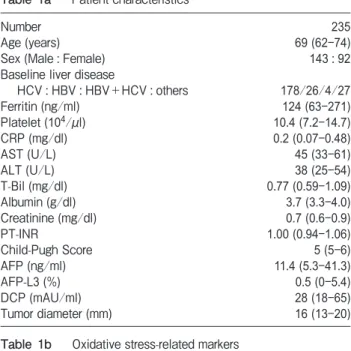
The background characteristics of the patients are summarized in Table 1a. The baseline liver diseases were diagnosed as HCV related chronic liver disease if the patients were positive for HCV antibody (Ab) in the serum, as hepatitis B virus (HBV)-related chronic liver disease if the patients were positive for hepatitis B s antigen (HBs Ag) in the serum, and as HBV+HCV- related chronic liver disease if the patients were positive for both the HCV Ab and HBs Ag in the serum.
The patients were recruited at the Clinic of Gastroenterology and Hepatology, Okayama University
Hospital, from April 2001 to December 2013. The study was approved by the Ethics Committee of Okayama University Graduate School of Medicine, Dentistry and Pharmaceutical Sciences (Approval num- ber 1603-025). Informed consent was obtained from all individual participants included in the study.
Blood sample collection and preparation. Fasting blood samples were collected from all patients before treatment. The serum aliquots were stored at −80°C until subsequent analyses. The obtained samples were used to obtain biochemical data, including the serum levels of dROM and OXY.
Measurement of the serum dROM and OXY levels.
Measurement of the serum dROM levels was performed using a spectrophotometer (Diacron International, Grosseto, Italy), as reported previously [17]. The mea- surement unit was the Carratelli unit (CARR U), where 1 CARR U corresponds to 0.08 mg/dl of hydrogen per- oxide. In order to determine the total serum antioxi-
dant capacity, OXY was performed using a spectropho- tometer (Diacron International) [19]. This test evaluates the capacity of serum to prevent the occurrence of massive oxidative activity in a hypochlorous acid (HClO) solution. The total antioxidant capacity was expressed in terms of the HClO (μmol) consumed by 1mL of sample (μmol HClO/mL).
Statistical analyses. Statistical analyses were con- ducted using the JMP software package (Version 14;
SAS Institute Inc., Cary, NC, USA). Continuous vari- ables were expressed as median values (interquartile range), and the Mann-Whitney U-test or the chi- squared test was used to compare parameters. A Cox proportional hazard model was used for the univariate and multivariate analyses with stratification of the vari- ables that were significantly correlated according to a univariate analysis. Spearman’s rank correlation was used to evaluate the relationship between oxidative- stress-related markers and clinical parameters. A mul- tivariate logistic regression analysis was performed to define the parameters predictive of recurrence within 2 years in the same segment. Statistical significance was set at p<0.05.
Results
Baseline characteristics of the patients. The clin- ical characteristics of the patients are shown in Table 1a.
HCV-related chronic liver disease was the most fre- quent baseline liver disease. The median values of oxidative stress-related markers were dROM 311 CARR U and OXY 314 μmol HClO/mL, which were not markedly different from the healthy volunteer data in our previous report (dROM 306, OXY 311) (Table 1b).
The 5-year survival rate was 68%, and the 5-year recurrence rate was 70% (Fig.1).
Correlation between oxidative stress-related mark- ers and clinical characteristics. To determine the characteristics of oxidative stress-related markers, we investigated the correlation with clinical parameters (Table 2). The dROM was positively correlated with the age and platelet count and negatively correlated with the prothrombin time international ratio. The OXY was positively correlated with the platelet count and albu- min levels and negatively correlated with the total bili- rubin levels and Child-Pugh scores.
Factors associated with poor survival. The pre- RFA factors associated with poor survival were analyzed
Table 1a Patient characteristics
Number 235
Age (years) 69 (62-74)
Sex (Male : Female) 143:92
Baseline liver disease
HCV : HBV : HBV+HCV : others 178/26/4/27
Ferritin (ng/ml) 124 (63-271)
Platelet (104/μl) 10.4 (7.2-14.7)
CRP (mg/dl) 0.2 (0.07-0.48)
AST (U/L) 45 (33-61)
ALT (U/L) 38 (25-54)
T-Bil (mg/dl) 0.77 (0.59-1.09)
Albumin (g/dl) 3.7 (3.3-4.0)
Creatinine (mg/dl) 0.7 (0.6-0.9)
PT-INR 1.00 (0.94-1.06)
Child-Pugh Score 5 (5-6)
AFP (ng/ml) 11.4 (5.3-41.3)
AFP-L3 (%) 0.5 (0-5.4)
DCP (mAU/ml) 28 (18-65)
Tumor diameter (mm) 16 (13-20)
Table 1b Oxidative stress-related markers
dROM (CARR U) 311 (270-356)
OXY (μmol HClO/mL) 314 (281-347)
Values were indicated as median (25-75 percentile) unless other- wise noted.
HCV, hepatitis C virus; HBV, hepatitis B virus; CRP, C-reactive protein; AST, aspartate aminotransferase; ALT, alanine amino- transferase; T-Bil, total bilirubin; PT-INR, prothrombin time inter- national ratio; AFP, alpha fetoprotein; DCP, des-gamma-carboxy prothrombin.
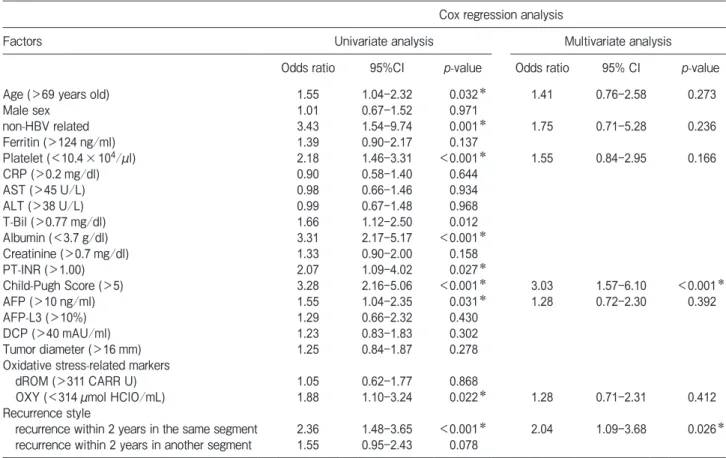
by a Cox proportional hazard model (Table 3). The univariate analysis revealed that a high age, non-HBV- related baseline disease, low platelet count, low albu- min level, high Child-Pugh score, high alpha-fetopro- tein (AFP) level, and low OXY level were associated with poor survival. Given that the recurrence pattern could be divided into time-dependency and location-
dependency, we sub-grouped the early-recurrence patients into those who experienced recurrence within two years in the same segment and those who experi- enced recurrence within 2 years in another segment.
The recurrence pattern associated with poor survival of the patients was recurrence within 2 years in the same segment. The multivariate Cox proportional hazard
Table 2 The correlation between oxidative stress-related markers and clinical parameters
dROM OXY
Spearmanʼs rho p-value Spearmanʼs rho p-value
Age 0.297 <0.001* 0.052 0.522
Ferritin -0.105 0.227 -0.032 0.716
Platelet 0.172 0.032* 0.262 0.001*
CRP 0.105 0.221 0.063 0.461
AST 0.108 0.180 0.001 0.987
ALT -0.016 0.843 0.082 0.312
T-Bil -0.146 0.070 -0.170 0.034*
Albumin -0.017 0.835 0.285 <0.001*
Creatinine -0.069 0.393 0.057 0.483
PT-INR -0.287 0.006* -0.197 0.062
Child-Pugh Score -0.038 0.638 -0.244 0.002*
AFP 0.037 0.644 -0.103 0.203
AFP-L3 0.011 0.903 0.003 0.973
DCP 0.135 0.098 0.007 0.937
Tumor diameter 0.118 0.143 -0.012 0.887
CRP, C-reactive protein; AST, aspartate aminotransferase; ALT, alanine aminotransferase; T-Bil, total bilirubin; PT-INR, prothrombin time international ratio; AFP, alpha fetoprotein; DCP, des-gamma-carboxy prothrombin.
*Statistically significant data.
5y 68%
2 4 6 8 10 12
0 Survival rate
235 197 138 93 50 27 12
1.0 0.8 0.6 0.4 0.2 0.0
Number at risk
Years after RFA (years)
0 2 4 6 8 10 12
Years after RFA (years) 5y 70%
Recurrence rate
235 124 64 28 14 6 3
Number at risk
1.0 0.8 0.6 0.4 0.2 0.0
Fig. 1 The overall survival rate and recurrence rate of the patients. (A) The 5-year survival rate was 68%. (B) The 5-year recurrence rate was 70%.
Table 3 Pre-RFA and post- RFA recurrence style-related factors associated with poor survival
Cox regression analysis
Factors Univariate analysis Multivariate analysis
Odds ratio 95%CI p-value Odds ratio 95% CI p-value
Age (>69 years old) 1.55 1.04-2.32 0.032* 1.41 0.76-2.58 0.273
Male sex 1.01 0.67-1.52 0.971
non-HBV related 3.43 1.54-9.74 0.001* 1.75 0.71-5.28 0.236
Ferritin (>124ng/ml) 1.39 0.90-2.17 0.137
Platelet (<10.4×10⁴/μl) 2.18 1.46-3.31 <0.001* 1.55 0.84-2.95 0.166
CRP (>0.2mg/dl) 0.90 0.58-1.40 0.644
AST (>45U/L) 0.98 0.66-1.46 0.934
ALT (>38U/L) 0.99 0.67-1.48 0.968
T-Bil (>0.77mg/dl) 1.66 1.12-2.50 0.012
Albumin (<3.7g/dl) 3.31 2.17-5.17 <0.001*
Creatinine (>0.7mg/dl) 1.33 0.90-2.00 0.158
PT-INR (>1.00) 2.07 1.09-4.02 0.027*
Child-Pugh Score (>5) 3.28 2.16-5.06 <0.001* 3.03 1.57-6.10 <0.001*
AFP (>10ng/ml) 1.55 1.04-2.35 0.031* 1.28 0.72-2.30 0.392
AFP-L3 (>10%) 1.29 0.66-2.32 0.430
DCP (>40mAU/ml) 1.23 0.83-1.83 0.302
Tumor diameter (>16mm) 1.25 0.84-1.87 0.278
Oxidative stress-related markers
dROM (>311CARR U) 1.05 0.62-1.77 0.868
OXY (<314μmol HClO/mL) 1.88 1.10-3.24 0.022* 1.28 0.71-2.31 0.412
Recurrence style
recurrence within 2 years in the same segment 2.36 1.48-3.65 <0.001* 2.04 1.09-3.68 0.026* recurrence within 2 years in another segment 1.55 0.95-2.43 0.078
HBV, hepatitis B virus; CRP, C-reactive protein; AST, aspartate aminotransferase; ALT, alanine aminotransferase; T-Bil, total biliru- bin; PT-INR, prothrombin time international ratio; AFP, alpha fetoprotein; DCP, des-gamma-carboxy prothrombin.
*Statistically significant data.
5y 78%
5y 64%
5y 37%
Survival time (years)
0 2 4 6 8 10 12
Survival rate
a b c
152 123 94 70 38 23 12
Number at risk
a 39 37 26 15 8 3 1
b 44 39 20 10 5 3 1
c
1.0 0.8 0.6 0.4 0.2 0.0
Fig. 2 The survival rate according to the time and spread. The 5-year survival rate of the patients who showed no recurrence within 2 years after radical RFA was 78% (line “a”). The 5-year survival rate of the patients who experienced recurrence within 2 years in another segment after RFA was 64% (line “b”). The 5-year survival rate of the patients who experienced recurrence within 2 years in the same segment was 37% (line “c”).
model revealed that a high Child-Pugh score and early recurrence in the same segment were definite factors.
The 5-year survival rates according to the recurrence patterns of recurrence within 2 years in the same seg- ment, recurrence within 2 years in another segment, and no recurrence within 2 years were 37%, 64%, and 78% respectively (Fig.2).
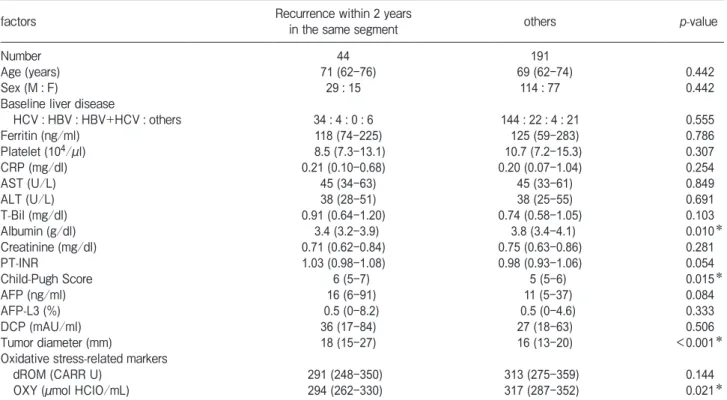
Factors associated with recurrence within two years in the same segment. To define the recurrence pat- tern associated with poor outcomes, we next investi- gated the pre-RFA factors associated with the different recurrence patterns. The patients who experienced
recurrence within 2 years in the same segment showed lower albumin levels, a higher Child-Pugh score, larger tumor diameter, and lower OXY levels than others (Table 4a). A multivariate analysis was performed with these significant factors and the representative tumor marker AFP (Table 4b). A large tumor diameter and low OXY levels were found to be factors associated with recurrence within 2 years in the same segment.
Discussion
In the present study, we investigated the clinical
Table 4a Recurrence within two years in the same segment or not
factors Recurrence within 2 years
in the same segment others p-value
Number 44 191
Age (years) 71 (62-76) 69 (62-74) 0.442
Sex (M : F) 29:15 114:77 0.442
Baseline liver disease
HCV : HBV : HBV+HCV : others 34:4:0:6 144:22:4:21 0.555
Ferritin (ng/ml) 118 (74-225) 125 (59-283) 0.786
Platelet (104/μl) 8.5 (7.3-13.1) 10.7 (7.2-15.3) 0.307
CRP (mg/dl) 0.21 (0.10-0.68) 0.20 (0.07-1.04) 0.254
AST (U/L) 45 (34-63) 45 (33-61) 0.849
ALT (U/L) 38 (28-51) 38 (25-55) 0.691
T-Bil (mg/dl) 0.91 (0.64-1.20) 0.74 (0.58-1.05) 0.103
Albumin (g/dl) 3.4 (3.2-3.9) 3.8 (3.4-4.1) 0.010*
Creatinine (mg/dl) 0.71 (0.62-0.84) 0.75 (0.63-0.86) 0.281
PT-INR 1.03 (0.98-1.08) 0.98 (0.93-1.06) 0.054
Child-Pugh Score 6 (5-7) 5 (5-6) 0.015*
AFP (ng/ml) 16 (6-91) 11 (5-37) 0.084
AFP-L3 (%) 0.5 (0-8.2) 0.5 (0-4.6) 0.333
DCP (mAU/ml) 36 (17-84) 27 (18-63) 0.506
Tumor diameter (mm) 18 (15-27) 16 (13-20) <0.001*
Oxidative stress-related markers
dROM (CARR U) 291 (248-350) 313 (275-359) 0.144
OXY (μmol HClO/mL) 294 (262-330) 317 (287-352) 0.021*
Values were indicated as median (25-75 percentile) unless otherwise noted.
HCV, hepatitis C virus; HBV, hepatitis B virus; CRP, C-reactive protein; AST, aspartate aminotransferase; ALT, alanine aminotransfer- ase; T-Bil, total bilirubin; PT-INR, prothrombin time international ratio; AFP, alpha fetoprotein; DCP, des-gamma-carboxy prothrombin,
*Statistically significant data.
Table 4b Results of a multivariate analysis for recurrence within two years in the same segment or not
odds ratio 95% C.I. p-value
Child-Pugh Score (>5) 2.060 0.876-4.842 0.098
Tumor diameter (>16mm)* 2.822 1.181-6.744 0.020*
AFP (>10ng/ml) 1.160 0.501-2.688 0.729
OXY (<314)* 2.416 1.006-5.801 0.049*
AFP, alpha fetoprotein; DCP, des-gamma-carboxy prothrombin, *Statistically significant data.
impact of oxidative stress-related conditions before rad- ical ablation of HCC. Poor survival was correlated with recurrence within 2 years in the same segment. This poor outcome-related pattern of recurrence was associ- ated with a large tumor and low OXY levels. A highly maintained antioxidative function would be a necessary response after radical RFA.
Post-ablation HCC recurrence is a critical factor associated with poor survival. Several reports have described the phenotype of early-recurring tumors.
One study showed that progressive tumor cell pheno- types with high positivity for the proliferation marker Ki-67 were predominant in post-RFA recurrence tumors in comparison to the initially resected tumors [22]. Oxidative-stress-related markers have also been involved as significant markers. A genome-wide gene- expression profile of cancer tissue and the surrounding noncancerous liver tissue found that increased expres- sion of the cytochrome P450 1A2 (CYP1A2) gene in noncancerous tissue was a predictive marker for non- recurrence [23]. CYP1A2 is a form of the hepatic cyto- chrome P450 oxidative system that is involved in drug and cholesterol metabolism. CYP1A2 knockout mice showed increased oxidative stress in liver microsomes, suggesting that CYP1A2 is an antioxidant molecule [24]. The plasma concentration of another antioxidant enzyme, glutathione peroxidase 3 (GPx3), has been investigated in resected HCC patients, with the result that lower levels were predictive of tumor progression and tumor recurrence [25]. These data likely indicated that the antioxidant reservoir function in the adjacent liver is critical for achieving good survival, as we found that antioxidant OXY levels were high in patients with a better prognosis. OXY has been shown to be correlated with the serum albumin levels in chronic liver diseases patients, suggesting that the antioxidant function depends on the liver reservoir function as shown in our present data [20]. The difference between resected patients and our present cases who underwent radical ablation is the persistence of the tumor-adjacent non- cancerous area, which was free in the resected patients.
The tumor-adjacent area has been shown to have increased levels of antioxidant enzymes in colon cancer as well, suggesting that an antioxidant response may be induced in the cancer-adjacent area [26]. The patients who achieved a better prognosis may have had a greater degree of antioxidant-related activity adjacent to their ablated cancers.
However, antioxidant system activation in cancer cells enables them to escape from oxidative stress resulting in their survival. Under oxidative-stress- inducing experimental conditions, HCC cells could induce anti-oxidant defense system TRIM25-Nrf2 path- way activation, resulting in tumor cell survival [27].
Oxidative stress should be maintained to damage cancer cells. Recently, the use of oxidative-stress-inducing agents has been suggested as a future strategy for man- aging several cancers, as in the use of high-dose ascor- bic acid for treating gastric cancer [28], colon cancer [29], and pancreatic cancer [30]. Antioxidant activity is favorable in the tumor-adjacent normal liver; however, it is unfavorable in cancer cells. One of the limitations of the present investigation was that the oxidative stress condition was investigated using only serum obtained just before RFA. To accurately evaluate the oxidative stress condition, a local oxidative-stress-related status analysis should be conducted with samples of the tumor and of the non-tumor surrounding tissue. However, given that our subjects received RFA as a radical ther- apy, an insufficient number of specimens were obtained. In the future, liver tumor and adjacent tissue biopsy specimen analyses should be conducted. In addition, the time course of the oxidative stress-related markers was not investigated. A prospective study should be conducted as the next step.
In our present study, the oxidative stress marker dROM showed no correlation with post-RFA recur- rence or survival. dROM is considered to be a reliable indicator of circulating ROS [17,18]. Suzuki et al.
reported that higher dROM was predictive of post- resection or post-RFA recurrence [31]. The number of patients included in the study was relatively small at 45 patients, 20% (9 patients) of whom had multiple tumors. In addition, they defined the factors that pre- dicted simple recurrence. These differences from our present analysis might have resulted in the difference in the assessment of the dROM levels.
The segment of the resident HCC is at a high risk of recurrence because of the high likelihood of cancer cells from HCC spreading through the portal vein.
Anatomic resection, which involves the systematic removal of a hepatic segment, has been indicated to be superior to local resection with respect to the risk of recurrence and the survival of HCC [32]. Recurrence in the same segment is a unique issue with local ablation therapy, in contrast to anatomic resection. To manage
this issue in cases of RFA treatment, our present results suggest that oxidative stress should be maintained rather than eliminated.
OXY was positively correlated with the platelet count and albumin levels and negatively correlated with the total bilirubin level and Child-Pugh score.
Similarly, in our previous analysis of patients with NAFLD, OXY showed a positive correlation with the platelet count and albumin levels [21]. OXY might reflect the liver reservoir function that would be neces- sary for antioxidant power.
Recently, many commercially available dietary anti- oxidants have been marketed as having an “anticancer”
effect. However, we must be aware that the physiologi- cal induction of ROS is a natural response to defend cells from a toxic microbiome and is required for plasma membrane repair, and especially in HCC patients, it is an anticancer response that should be moderately maintained. Given that antioxidant power was correlated with liver function reservoir markers, maintaining liver function is necessary to avoid poor-survival-related recurrence after RFA.
In conclusion, the post-radical RFA survival was correlated with the Child-Pugh score and with recur- rence within 2 years in the same segment. This recur- rence pattern was associated with a large tumor diame- ter and low levels of the antioxidant reservoir marker OXY. Maintaining the antioxidant reservoir function with high OXY values is favorable for long-term sur- vival and to prevent recurrence within two years in the RFA-treated segment.
Acknowledgments. We would like to thank Asuka Maeda and Chizuru Mori for their technical assistance and Toshie Ishii for helping with the data collection at our institute.
References
1. Omata M, Cheng AL, Kokudo N, Kudo M, Lee JM, Jia J, Tateishi R, Han KH, Chawla YK, Shiina S, Jafri W, Payawal DA, Ohki T, Ogasawara S, Chen PJ, Lesmana CRA, Lesmana LA, Gani RA, Obi S, Dokmeci AK and Sarin SK: Asia-Pacific clinical practice guidelines on the management of hepatocellular carci- noma: a 2017 update. Hepatol Int (2017) 11: 317-370.
2. Kokudo N, Takemura N, Hasegawa K, Takayama T, Kubo S, Shimada M, Nagano H, Hatano E, Izumi N, Kaneko S, Kudo M, Iijima H, Genda T, Tateishi R, Torimura T, Igaki H, Kobayashi S, Sakurai H, Murakami T, Watadani T and Matsuyama Y: Clinical practice guidelines for hepatocellular carcinoma: The Japan Society of Hepatology 2017 (4th JSH-HCC guidelines) 2019 update.
Hepatol Res (2019) 49:1109-1113.
3. Shiina S, Tateishi R, Arano T, Uchino K, Enooku K, Nakagawa H, Asaoka Y, Sato T, Masuzaki R, Kondo Y, Goto T, Yoshida H, Omata M and Koike K: Radiofrequency ablation for hepatocellular carcinoma: 10-year outcome and prognostic factors. Am J Gastroenterol (2012) 107:569-577; quiz 578.
4. Shiina S, Teratani T, Obi S, Sato S, Tateishi R, Fujishima T, Ishikawa T, Koike Y, Yoshida H, Kawabe T and Omata M: A ran- domized controlled trial of radiofrequency ablation with ethanol injection for small hepatocellular carcinoma. Gastroenterology (2005) 129:122-130.
5. Hasegawa K, Kokudo N, Makuuchi M, Izumi N, Ichida T, Kudo M, Ku Y, Sakamoto M, Nakashima O, Matsui O and Matsuyama Y:
Comparison of resection and ablation for hepatocellular carcinoma:
a cohort study based on a Japanese nationwide survey. J Hepatol (2013) 58: 724-729.
6. Heimbach JK, Kulik LM, Finn RS, Sirlin CB, Abecassis MM, Roberts LR, Zhu AX, Murad MH and Marrero JA: AASLD guide- lines for the treatment of hepatocellular carcinoma. Hepatology (2018) 67: 358-380.
7. Chen MS, Li JQ, Zheng Y, Guo RP, Liang HH, Zhang YQ, Lin XJ and Lau WY: A prospective randomized trial comparing percu- taneous local ablative therapy and partial hepatectomy for small hepatocellular carcinoma. Ann Surg (2006) 243:321-328.
8. Poon RT, Fan ST, Ng IO, Lo CM, Liu CL and Wong J: Different risk factors and prognosis for early and late intrahepatic recurrence after resection of hepatocellular carcinoma. Cancer (2000) 89:
500-507.
9. Tsuchiya K, Asahina Y, Tamaki N, Yasui Y, Hosokawa T, Ueda K, Nakanishi H, Itakura J, Kurosaki M, Enomoto N and Izumi N: Risk factors for exceeding the Milan criteria after successful radiofre- quency ablation in patients with early-stage hepatocellular carci- noma. Liver Transpl (2014) 20: 291-297.
10. Kang TW, Lim HK, Lee MW, Kim YS, Rhim H, Lee WJ, Gwak GY, Paik YH, Lim HY and Kim MJ: Aggressive Intrasegmental Recurrence of Hepatocellular Carcinoma after Radiofrequency Ablation: Risk Factors and Clinical Significance. Radiology (2015) 276: 274-285.
11. Jiang L, Yan L, Wen T, Li B, Zeng Y, Yang J, Wang W, Xu M and Wu H: Comparison of Outcomes of Hepatic Resection and Radiofrequency Ablation for Hepatocellular Carcinoma Patients with Multifocal Tumors Meeting the Barcelona-Clinic Liver Cancer Stage A Classification. J Am Coll Surg (2015) 221: 951-961.
12. Hussain SP, Raja K, Amstad PA, Sawyer M, Trudel LJ, Wogan GN, Hofseth LJ, Shields PG, Billiar TR, Trautwein C, Hohler T, Galle PR, Phillips DH, Markin R, Marrogi AJ and Harris CC:
Increased p53 mutation load in nontumorous human liver of wilson disease and hemochromatosis: oxyradical overload diseases. Proc Natl Acad Sci U S A (2000) 97:12770-12775.
13. Pessayre D: Role of mitochondria in non-alcoholic fatty liver dis- ease. J Gastroenterol Hepatol (2007) 22 Suppl 1: S20-27.
14. Lim SO, Gu JM, Kim MS, Kim HS, Park YN, Park CK, Cho JW, Park YM and Jung G: Epigenetic changes induced by reactive oxygen species in hepatocellular carcinoma: methylation of the E-cadherin promoter. Gastroenterology (2008) 135: 2128-2140, e1-8.
15. Severi T, van Malenstein H, Verslype C and van Pelt JF: Tumor initiation and progression in hepatocellular carcinoma: risk factors, classification, and therapeutic targets. Acta Pharmacol Sin (2010) 31: 1409-1420.
16. Takaki A, Kawano S, Uchida D, Takahara M, Hiraoka S and
Okada H: Paradoxical Roles of Oxidative Stress Response in the Digestive System before and after Carcinogenesis. Cancers (Basel) (2019) 11.
17. Tamaki N, Tomofuji T, Ekuni D, Yamanaka R, Yamamoto T and Morita M: Short-term effects of non-surgical periodontal treatment on plasma level of reactive oxygen metabolites in patients with chronic periodontitis. J Periodontol (2009) 80:901-906.
18. DʼAiuto F, Nibali L, Parkar M, Patel K, Suvan J and Donos N:
Oxidative stress, systemic inflammation, and severe periodontitis.
J Dent Res (2010) 89: 1241-1246.
19. Tamaki N, Tomofuji T, Ekuni D, Yamanaka R and Morita M:
Periodontal treatment decreases plasma oxidized LDL level and oxidative stress. Clin Oral Investig (2011) 15:953-958.
20. Nishimura M, Takaki A, Tamaki N, Maruyama T, Onishi H, Kobayashi S, Nouso K, Yasunaka T, Koike K, Hagihara H, Kuwaki K, Nakamura S, Ikeda F, Iwasaki Y, Tomofuji T, Morita M and Yamamoto K: Serum oxidative-anti-oxidative stress balance is dysregulated in patients with hepatitis C virus-related hepatocel- lular carcinoma. Hepatol Res (2013) 43: 1078-1092.
21. Shimomura Y, Takaki A, Wada N, Yasunaka T, Ikeda F, Maruyama T, Tamaki N, Uchida D, Onishi H, Kuwaki K, Nakamura S, Nouso K, Miyake Y, Koike K, Tomofuji T, Morita M, Yamamoto K and Okada H: The Serum Oxidative/Anti-oxidative Stress Balance Becomes Dysregulated in Patients with Non- alcoholic Steatohepatitis Associated with Hepatocellular Carcinoma. Intern Med (2017) 56: 243-251.
22. Yamamoto N, Okano K, Kushida Y, Deguchi A, Yachida S and Suzuki Y: Clinicopathology of recurrent hepatocellular carcinomas after radiofrequency ablation treated with salvage surgery. Hepatol Res (2014) 44:1062-1071.
23. Tanaka S, Mogushi K, Yasen M, Ban D, Noguchi N, Irie T, Kudo A, Nakamura N, Tanaka H, Yamamoto M, Kokudo N, Takayama T, Kawasaki S, Sakamoto M and Arii S: Oxidative stress pathways in noncancerous human liver tissue to predict hepatocellular carci- noma recurrence: a prospective, multicenter study. Hepatology (2011) 54: 1273-1281.
24. Shertzer HG, Clay CD, Genter MB, Schneider SN, Nebert DW and Dalton TP: Cyp1a2 protects against reactive oxygen produc- tion in mouse liver microsomes. Free Radic Biol Med (2004) 36:
605-617.
25. Qi X, Ng KT, Lian QZ, Liu XB, Li CX, Geng W, Ling CC, Ma YY, Yeung WH, Tu WW, Fan ST, Lo CM and Man K: Clinical significance and therapeutic value of glutathione peroxidase 3 (GPx3) in hepatocellular carcinoma. Oncotarget (2014) 5: 11103- 11120.
26. Hernandez-Lopez R, Torrens-Mas M, Pons DG, Company MM, Falco E, Fernandez T, Ibarra de la Rosa JM, Sastre-Serra J, Oliver J and Roca P: Non-tumor adjacent tissue of advanced stage from CRC shows activated antioxidant response. Free Radic Biol Med (2018) 126: 249-258.
27. Liu Y, Tao S, Liao L, Li Y, Li H, Li Z, Lin L, Wan X, Yang X and Chen L: TRIM25 promotes the cell survival and growth of hepatocellular carcinoma through targeting Keap1-Nrf2 pathway.
Nat Commun (2020) 11: 348.
28. Ha YM, Park MK, Kim HJ, Seo HG, Lee JH and Chang KC: High concentrations of ascorbic acid induces apoptosis of human gas- tric cancer cell by p38-MAP kinase-dependent up-regulation of transferrin receptor. Cancer Lett (2009) 277: 48-54.
29. Yun J, Mullarky E, Lu C, Bosch KN, Kavalier A, Rivera K, Roper J, Chio, II, Giannopoulou EG, Rago C, Muley A, Asara JM, Paik J, Elemento O, Chen Z, Pappin DJ, Dow LE, Papadopoulos N, Gross SS and Cantley LC: Vitamin C selectively kills KRAS and BRAF mutant colorectal cancer cells by targeting GAPDH. Science (2015) 350:1391-1396.
30. Espey MG, Chen P, Chalmers B, Drisko J, Sun AY, Levine M and Chen Q: Pharmacologic ascorbate synergizes with gemcit- abine in preclinical models of pancreatic cancer. Free Radic Biol Med (2011) 50:1610-1619.
31. Suzuki Y, Imai K, Takai K, Hanai T, Hayashi H, Naiki T, Nishigaki Y, Tomita E, Shimizu M and Moriwaki H: Hepatocellular carcinoma patients with increased oxidative stress levels are prone to recurrence after curative treatment: a prospective case series study using the d-ROM test. J Cancer Res Clin Oncol (2013) 139:
845-852.
32. Hasegawa K, Kokudo N, Imamura H, Matsuyama Y, Aoki T, Minagawa M, Sano K, Sugawara Y, Takayama T and Makuuchi M:
Prognostic impact of anatomic resection for hepatocellular carci- noma. Ann Surg (2005) 242: 252-259.