Quantitative research on TPACK status and development strategies of secondary school teachers under the background of "Internet + education"
YIN Yali (Beijing Normal University, Graduate Student)
keywords:high school teachers, technological Pedagogical Content Knowledge (TPACK), teacher education, Empirical study
0. Introduction
With the development of science and technology, information technology has quickly penetrated into the field of education, and teachers' educational technology skills have become more and more essential qualities for teachers. In 2010, the State council of China issued the "Outline of the National Medium and Long-term Education Reform and Development Plan (2010-2020)", which clearly pointed out the revolutionary impact of information technology on education development.
Since May 30, 2014, "Standards for Training Courses on Information Technology Application Ability for Primary and Secondary School Teachers (Trial) (2014)" formulated by the Ministry of Education has been implemented. It stipulates that: according to the Standard of Primary and Secondary School Teachers' Information Technology Application Ability to conduct the basic requirements and developmental requirements, set up three series of courses which are the "Applying Information Technology to Optimize Classroom Teaching", "Applying Information Technology to Transform Learning" and "Applying Information Technology to Support Teachers' Professional Development".
Three series of courses help teachers improve their information technology literacy. And these courses are help for apply information technology and promote professional development.
It can be seen that the Ministry of Education attaches great importance to the cultivation of
teachers' information literacy. So it is necessary to study the actual information literacy ability of middle school teachers. Finding problems and solving them are also important. Based on this, researching teachers' information technology knowledge and ability is extremely critical for teachers’ promotion.
"Technological Pedagogical Content Knowledge" (TPACK for short) was proposed by American scholar Mishra and Kohler in 2005. Its principle is to incorporate technical elements into professional
knowledge and teaching methods. The TPACK framework provides support for testing the technical knowledge of teachers' information literacy, and there are relatively mature scales. So using TPACK theory as the theoretical basis has a positive significance for the exploration of teachers' technical knowledge and abilities.
1. The Theoretical Model
Shulman first introduced the concept of "PCK" in 1986. PCK stands for Pedagogical Content
Knowledge. After that, TPACK was developed on the basis of PCK. The concept of TPACK originally originated from Pierson's (2001) research on how teachers integrated technology with teaching, and then gradually formed in Lundeberg et al.'s(2003) research on information technology knowledge and beliefs of pre-service teachers. "Koehler and Mishra further developed on this basis, and proposed the TPACK framework.
This framework contains three basic elements and four composite elements. It’s a theory that combines information technology and teaching. Three basic elements include Technology Knowledge (TK), Content Knowledge (CK), Pedagogical Knowledge (PK); Four composite elements include Pedagogical Content Knowledge (PCK), Technological Pedagogical Knowledge (TPK), Technological Content Knowledge (TCK) and Technological Pedagogical Content Knowledge (TPCK). In order to make TPCK easier to pronounce, vowel A is added to it to become TPACK.
In 2009, American scholar Suzy Cox conducted a detailed conceptual analysis of the TPACK framework and obtained a refined TPACK framework. Cox conducted a more specific analysis and definition. He understood Pedagogical Knowledge (PK) as general teaching activity knowledge (Ag), Content Knowledge (CK) as knowledge of teaching representation of specific topics in a given subject, and Technology Knowledge (TK) as how to use emerging technical knowledge. Cox and Graham proposed some amendments to the previous TPACK framework, thinking that TPACK is a temporary framework and has the possibility of sliding into PCK. Cox and Graham define TPACK as "the use of emerging technologies to coordinate activities in a particular subject with the representation of a particular subject to promote student learning."(Cox,2008)
American scholar Margaret Niess proposed the four core elements of TPACK based on the PCK defined by Grossman. The four core elements include the dominant notions of mutual integration of technology and subject teaching, the teaching strategies and representational knowledge of technology and subject teaching, the knowledge of students understanding and learning subject matter, as well as the curriculum and curriculum material integration of technology and subject teaching ( Niess M.L.2005).
Based on the above theories, the theoretical model of TPACK can be expressed as Figure 1.
Fig.1. TPACK framework (image from http://tpack.org)
2. The Survey Design 2.1 Research methods
This research mainly adopted questionnaire survey to collect data. Through the questionnaire survey, a large amount of first-hand information can be obtained, which is convenient to explain the current situation, find problems, analyze the reasons, and then propose solutions to the problems. This study also used literature analysis. Literature analysis method is an effective research method for
carrying out research work, grasping the previous research results, understanding the research status, and finding the crux of the problem. No research can exist independently of the theoretical basis, so the literature analysis method is an essential foundation for research. The TPACK framework and theory adopted in this study are based on the literature analysis method, and strive to discover new research ideas from a more comprehensive and objective perspective.
2.2 Questionnaire design
At present, there is no mature TPACK scale for middle school teachers. In order to ensure that the questionnaire is scientific and reasonable, this study combined the current internationally authoritative Schmidt scale and the American K-12 online teacher scale. This study’s questionnaire went through several steps of translation, integration, deletion, localization, and then developed into a questionnaire on TPACK for middle school teachers.
This study refers to the current authoritative TPACK measurement questionnaire, which was jointly developed by Denise Schmidt,Koehler and Mishra of Iowa state university, and which translates as the
"pre-service teachers’ pedagogical and technical knowledge questionnaire" (referred to as the Schmidt questionnaire)( Schmidt Denise A.2009). The scale consists of four parts. Since the research object of this study is middle school teachers rather than pre-service teachers, the significant part of this study is mainly about the seven dimensions of TPACK.
The K-12 online teacher scale was designed by Leanna Archambault of the University of Arizona in collaboration with Kent Crippen of the University of Nevada (2009). And the K-12 scale was used to investigate the TPACK level of American online teachers. This questionnaire is composed of a total of 24 questions in seven dimensions, and the ratio of the questions in the seven dimensions is 3: 3: 3: 4: 3:
4: 4. What this questionnaire deserves to be used is that it emphasizes on serving teachers. Its disadvantage is that it focuses too much on teachers' educational technology.
This study combined the two questionnaires, deleted the part that emphasizes the teacher students too much in the Schmidt questionnaire, removed the part that emphasizes online and technology in the K-12 online teacher scale, and integrated to form a new questionnaire. The new questionnaire consisted of two parts. The first part was the basic information, which helped to answer the basic situation of the teachers. The second part was the investigation of the seven dimensions of TPACK. A total of 25 questions were designed, and the proportion of the seven dimensions was 4: 3: 4: 4: 3: 3: 4, the number
of questions in each dimension was more balanced, which was similar to the question setting allocation ratio in the K-12 online teacher scale This questionnaire referred to the Schmidt questionnaire and used the Likert five-level scale method, which was divided into five levels of "strongly disagree, disagree, neither agree nor disagree, agree, strongly agree", ranging from 1 to 5 according to different degrees scoring.
2.3 Questionnaire prediction and revision
The trial of the questionnaire mainly adopts two methods: one is the subjective evaluation method, that is, the first draft of the questionnaire is sent to experts, researchers or typical respondents in the research field, and they are asked to analyze and modify it based on their experience and comments; One is the objective test method, which is to issue a preliminary draft of the questionnaire to a randomly selected sample for trial use(Liu Shujie,2016).This study used these two methods to revise the questionnaire.
2.3.1 Preliminary revision--Subjective evaluation
After the first draft of the new questionnaire was completed, the professional teacher was first asked for advice in order to ensure the validity of the experts. And the expression of "consent" in the original questionnaire was changed to an expression suitable for Chinese localization-"conformity". The researcher also consulted two senior school teachers on the phone. After some discussion and research, the research fully took their opinions into consideration, made some abstract issues concrete, simplified professional issues, and further revised the questionnaire.
2.3.2 Pre-survey--Objective test
The questionnaire must be tested before it can be further revised. This research pre-survey selected 72 middle school teachers, and the questionnaire recovery rate was 100%. The reliability and validity of the questionnaire are important indicators for testing the questionnaire. So it’s necessary to test the reliability and validity. The tool used for the analysis was SPSS 20.0.
(a)Item Analysis
The measurement ability of the questionnaire is related to the quality of the questionnaire and the quality of the research. Each question in the questionnaire is called an item, and the test of the strategic ability of each question in the questionnaire is called Item Analysis (Lu Jiamei, 2009).
In this research, the total score of each dimension was calculated, and the independent sample T test was divided into high and low groups. Truman L. Kelley, who originally came from Harvard University, divided the questionnaire questions into high and low classification in The selection of upper and lower groups for The validation of test items (1939). After several classification measurements, he found that the difference was most obvious when the data were divided into 27th and 73th percentile. In 1975, Ralph B. Agostino from Boston University further verified this conclusion in the article: The 27 Percent Rule Revisited (1975). Therefore, in this study, the total scores of subjects were divided into
high and low scores according to 27th and 73th quantiles, and they were analyzed from 7 dimensions.
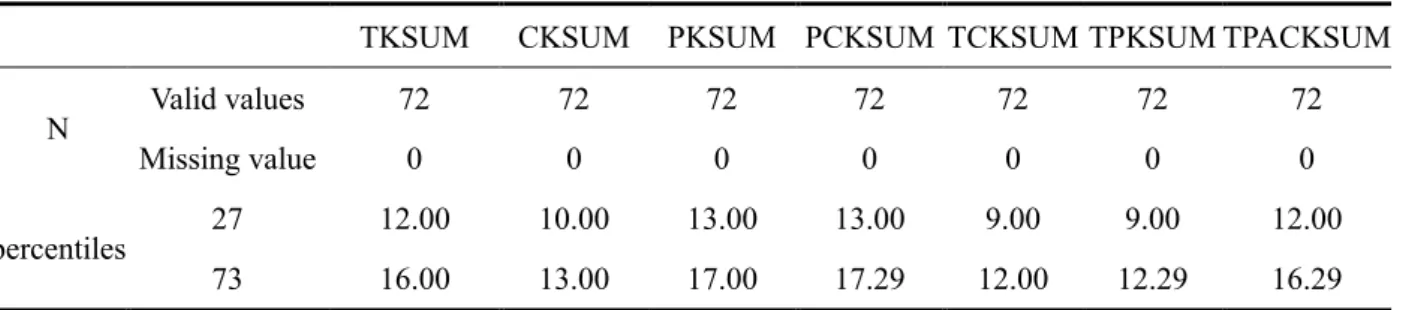
The specific statistics are shown in Table 1.
Table 1. High and low group statistics
TKSUM CKSUM PKSUM PCKSUM TCKSUM TPKSUM TPACKSUM
N Valid values 72 72 72 72 72 72 72
Missing value 0 0 0 0 0 0 0
percentiles 27 12.00 10.00 13.00 13.00 9.00 9.00 12.00 73 16.00 13.00 17.00 17.29 12.00 12.29 16.29 According to the display results of the high and low groupings, an independent sample T test was performed on 7 dimensions to identify whether the high and low groups had significant differences, and to analyze whether the topics had good discrimination and discrimination capabilities. The analysis found that the absolute value of the t value of the questions in each group of TK, CK, PK, PCK, TCK, TPK, and TPACK were all greater than 1.96, indicating that the high and low score groups have extremely significant differences, and the questions are very discriminating. So the questions were retained.
(b)Validity analysis
Reliability analysis is also called internal consistency analysis. It can understand the degree of representativeness of the dimension. Since Cronbach (1951) discussed the α coefficient derived by Guttman (1945), the α coefficient has almost become a substitute for the reliability of the questionnaire (Lu Jiamei, 2009). Cronbach's Alpha is an effective method for detecting the internal consistency of the questions. Therefore, this study calculated the Cronbach's coefficients of 7 dimensions and the total table.
The reliability coefficient is the quantitative value to measure the reliability of the questionnaire.
The larger the reliability coefficient is, the higher the reliability of the questionnaire is (Liu Shujie, 2016).After testing, the Cronbach's Alpha of the seven dimensions obtained by this questionnaire were 0.9, 0.879, 0.881, 0.930, 0.817, 0.873, and 0.887, all of which were greater than 0.8, indicating that the reliability of the questionnaire is better. The TK and PCK reliability coefficients were greater or equal to 0.9, indicating that the questionnaire reliability is very good. The Cronbach's Alpha of the total scale was 0.972, indicating that the reliability of the entire questionnaire is extremely high.
(c)Validity analysis
Validity refers to the effectiveness of the measuring tool, that is, to what extent a measuring tool can measure the purpose and intention to be measured (Liu Shujie,2016). According to Hair (2009), the sample size for factor analysis should be no less than 50, 100 and above. Therefore, factor analysis didn’t be performed here. After all samples were collected, factor analysis would be performed uniformly to test the convergence validity and differential validity of the scale.
2.4 Formal test: the issuance and recycling of the questionnaire 2.4.1Issuing and collecting questionnaires
This research used the “Questionnaire Star” platform to entrust the three provinces and
municipalities of Jilin, Henan, and Beijing to focus on the basic principles of convenient sampling, then expanded to 14 provinces across the country through snowball sampling, and surveyed middle school teachers. The questionnaire was issued on March 30, 2017. A total of 404 questionnaires were collected, and the questionnaire recovery rate was 100%.
The advantage of the electronic questionnaire was that each question is required, so there were no missing answers, wrong lines, default values, etc. However, some seemingly complete questionnaires may also be problematic and require further identification and screening. The electronic questionnaire can show the answer time and IP address, which helped to check the validity of the returned
questionnaire. There were 33 questions in this questionnaire. From the answer time of 404 samples, the maximum value of 48058 seconds and the minimum value of 32 seconds were removed. The average response time of the other 402 samples was 192.78 seconds. With reference to the test time and the average response time of the sample, the total time of reading and thinking was about three minutes.
Therefore, this study made full use of the advantages of electronic questionnaires and screens out questionnaires with a response time of less than 100 seconds, and excluded questionnaires with a single option, questionnaires with logical errors and contradictory options, and questionnaires with a response time less than 50 seconds. To ensure that the research is rigorous, scientific and effective, this study also conducted a comparative analysis of the answer sheets of the same IP address, and deleted the
questionnaires of multiple answers of the same IP type.
After identification and review, 38 invalid questionnaires were deleted and 366 valid questionnaires were obtained. The effective recovery rate of the questionnaire was 90.59%. Participants' specific gender and teaching age distribution are shown in Table 2.
Table 2. Sample statistics (Cross-tabulation of gender and teaching age)
0-5 years 6-10 years 11-15 years 16 years and more Total
Male 17 7 23 32 79
Female 58 40 57 132 283
Total 75 47 80 164 366
2.4.2 Factor analysis
In this study, KMO and Bartlett spherical test were performed on all the collected data, and the calculated KMO value was 0.968, greater than 0.9. So it was very suitable for factor analysis. Because this questionnaire was based on a known questionnaire with 7 factors, a confirmatory factor analysis was used to set the number of factors to 7 to get the total variance explained. The cumulative explanatory power of these factors was 81.456%, indicating that the seven factors can represent the information of
the original variable 81.456%.
Tomaz Kolar,Vesna Zabkar (2010) believe that the factor load is greater than 0.6, the question is meaningful. The factors in this study were calculated and found no value less than 0.6. From the perspective of the common factor variance, the larger the value of the common factor variance was, the more suitable for factor analysis. The calculation found that the common factor variances of all topics were greater than 0.2, indicating that the topics and dimensions have commonality and consistency. The analysis found that PK1 belonged to two components, so PK1 was deleted and other items were keep other topics.
2.4.3Reliability analysis
During the pre-survey of the questionnaire, this study simply used Cronbach's Alpha to do the reliability analysis. In this section, the further reliability analysis would be conducted. The SPSS reliability analysis, the output correlation matrix between items, the reliability statistics, and the item total statistics were used to calculate the seven dimensions. And the reliability of the subject was
analyzed from the internal consistency test, the subject correlation, and the revised item correlation. Hair et al.(2009) believed that Cronbach's Alpha is greater than 0.7, the correlation of the questions is greater than 0.3, and the total correlation of the correction items is greater than 0.5, so the questions have good reliability. After calculation, the Cronbach's Alpha of seven dimensions were all greater than 0.7, the correlations between the questions were greater than 0.3, and the correlations between the correction items were greater than 0.5, so the questions in seven dimensions had high reliability. For the
convenience of statistics, the mean of seven dimensions could be taken to represent each dimension.
2.4.4Validity analysis
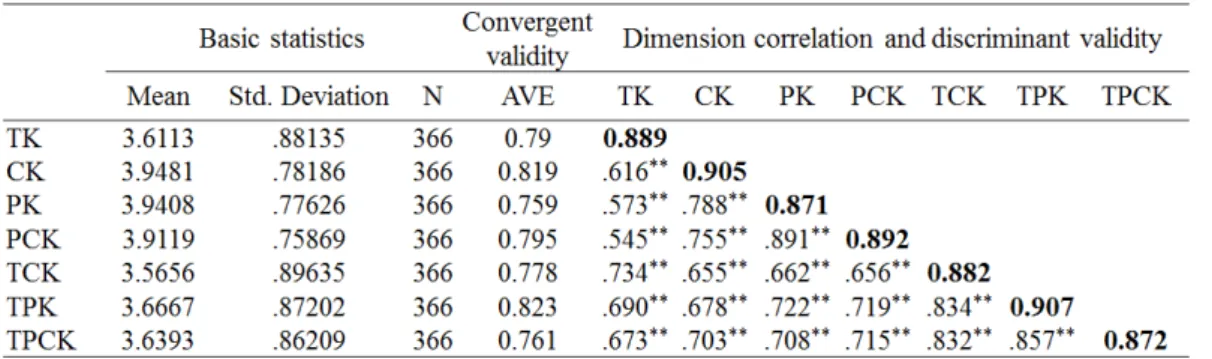
Validity refers to the validity of the test. Convergence validity means that items or tests that measure the same potential traits will fall on the same factor facet, and there is a high correlation between the measured values (Wu Minglong, 2009). Differential validity means that the potential traits represented by facets and the potential traits represented by other facets have a low correlation or significant differences (Liu Lingyu, 2015). The study calculated the convergence validity and discriminant validity, and integrated the data results into the following table.
Table 3. Convergence Validity and Differential Validity Analysis Table for Each Dimension
A total of 366 samples were studied, and the convergence validity AVE was greater than 0.5, indicating a good convergence validity. The higher the AVE value was, the higher the average of the correlations between the dimensions was. Because AVE was a squared value, it was rooted and compared with other correlations to ensure that intra-group correlations are higher than inter-group correlations. For example, the square root value of TK convergence validity was 0.889, which was higher than several other correlation values: 0.616, 0.573, 0.545, 0.734, 0.69, 0.673, indicating that TK has different validity from the other five dimensions. Similarly, the squared value of the convergence validity of CK was 0.905, which was also higher than the correlation between CK and the other six dimensions, indicating that CK also has good differential validity. Several other AVE square values, such as PCK, TCK, TPK, and TPCK, were higher than others. However, it was worth noting that the squared value of the convergence efficiency of PK was 0.871, which was slightly smaller than the correlation of PCK 0.891. Because PK and PCK had cross components, and the correlation values were small, they could be ignored here. Therefore the scale has good convergence validity and differential validity.
3. Data Analysis and Inference 3.1 Basic statistics
The survey objects came from different provinces, of which Jilin Province and Henan Province accounted for the largest proportion, accounting for 59% and 19%, respectively. Its specific distribution is shown in Figure 2.
Fig.2. Sample geostatistical chart Fig.3. Line chart for each dimension’s mean Among the seven dimensions of TPACK, the average scores are 3.61, 3.95, 3.91, 3.91, 3.56, 3.67 and 3.64, as shown in figure 3. It can be seen from the figure that the scores of the three dimensions are all higher than 3.9. The three dimensions are Content Knowledge, Pedagogical Knowledge and
Pedagogical Content Knowledge. When it comes to technology, such as TK, TCK, TPK and TPCK, the score is lower, for example, TK is 3 .61 points, TCK is 3.56 points, TPK is 3.67 points, and TPCK is 3.64 points. This also fully shows that the understanding and application of technology by middle school teachers need to be improved. And technical means should become skills that are equal to other aspects, and teachers should fully improve their skills in using technology and their mastery of technical
knowledge.
3.2 Differential analysis of TPACK
3.2.1 Analysis of gender differences in TPACK
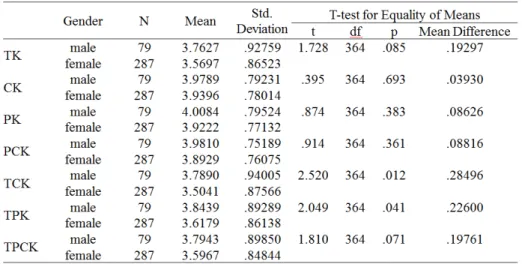
From the perspective of gender, we did the Independent-Sample T test in gender firstly. There were 79 male teachers and 287 female teachers. The test results show that the absolute values of t values in the TCK and TPK dimensions are 2.52 and 2.049, which are greater than 1.96, indicating that there are significant differences between men and women in these two dimensions.
In terms of TPACK, the average value of male teachers is 3.79 and the average value of female teachers is 3.50. In terms of CK, there is no significant difference between male and female teachers.
Male teachers have an average score of 3.98, and female teachers have an average score of 3.94. So there is not much difference in Content Knowledge. And when technology is added to it, male teachers are significantly higher than female teachers. It shows that male teachers are better at using technical means. In terms of TPK, there is also a significant difference between male and female teachers.
Similarly, in terms of PK, the average value of male teachers is 4.01, which is slightly higher than the average value of female teachers’ 3.92. However, after adding technical components, the average value of male teachers is 3.84 and the average value of female is 3.62. And the difference between them is significant, which shows that male teachers are superior to female teachers in terms of technology use and technology teaching. On the whole, the average value of male teachers in all dimensions is higher than that of female teachers, indicating that male teachers are slightly better than female teachers in the entire TPACK perspective.
Table 4. Difference analysis between male and female teachers
3.2.2 Analysis of the differences in Teacher Training
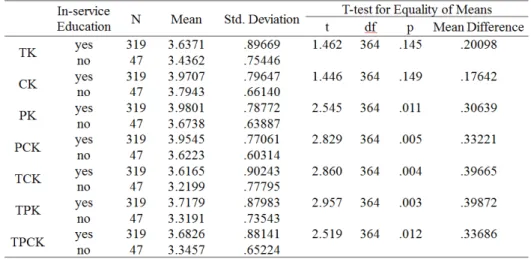
The study conducted another independent dichotomous test on another dichotomous variable, whether it has received on-the-job training. The test results are shown in Table 5. From the chart, except for TK and CK, the absolute values of t are all greater than 1.96, that is, there are significant differences in five aspects of PK, PCK, TCK, TPK and TPCK. From the perspective of PK, teachers who have received on-the-job training score 3.98 and teachers who have not received on-the-job training score
3.67. It can be seen that on-the-job training plays a vital role in teaching method knowledge. In terms of PCK, teachers who received on-the-job training scored 3.95, and teachers who did not receive
on-the-job training scored 3.62. In terms of TCK, teachers who received on-the-job training scored 3.62, and teachers who did not receive on-the-job training scored 3.22. In terms of TPK, teachers who
received on-the-job training averaged 3.72 points, and teachers who did not receive on-the-job training received 3.32 points. In terms of TPACK, teachers who received on-the-job training averaged 3.68 points, and teachers who did not receive on-the-job training received 3.35 points. This shows that from the perspective of TPACK, on-the-job training is essential for teachers. TK and CK do not show significant differences. It is speculated that the other dimensions are focused on technical skills and practical experience, but TK and CK focus on theoretical knowledge. As we know practical knowledge and skills are easier to obtain through training.
In general, in all dimensions, teachers who have received on-the-job training score higher than teachers who have not received on-the-job training, indicating that the effectiveness of on-the-job training in education in China is obvious. Moreover, it can be seen from the ratio of the number that only 47 of the 346 have not received on-the-job training, indicating that the popularity of on-the-job training is high.
Table 5. Difference analysis of on-the-job training teachers
3.3 One-way ANOVA
Then, this study performed a one-way analysis of variance on more than three groups of variables, specifically from the five dimensions of age, teaching age, educational background, teaching grade, and teaching subjects.
3.3.1Teaching age analysis
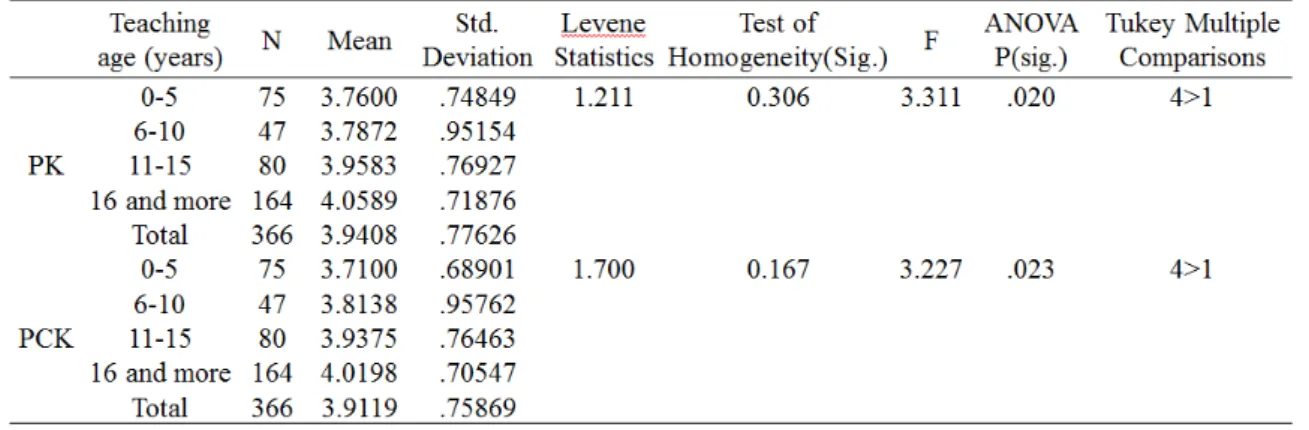
From the perspective of teaching age, the homogeneity test of variance is performed first. The test results show that the significance of all dimensions is 0.141, 0.695, 0.306, 0.167, 0.308, 0.557, and 0.574, which are all greater than 0.05, indicating that the variance between different groups is uniform.
Then one-way ANOVA of variance was performed and two dimensions with P values less than 0.05
were found: PK had a P value of 0.02 and PCK had a P value of 0.023. Therefore, the two dimensions of PK and PCK were analyzed below. The integration results are shown in Table 6.
It can be seen from Table 6 that the average value of PK increases with the increase of teaching age, as does PCK. It fully demonstrates that in terms of Pedagogical Knowledge and Pedagogical Content Knowledge, the longer the teaching age, the more teaching experience it has. In Tukey's post hoc comparison of teaching age, 1 represents 0-5 years, 2 represents 6-10 years, 3 represents 11-15 years, and 4 represents 16 years even above. So 4>, 1 means that the mean of teachers who have been teaching for 16 years or more is greater than the mean of teachers who have been teaching for 0-5 years.
Table 6. One-way ANOVA and post hoc multiple comparison table of PK and PCK
3.3.2 Grade analysis
From the grade point of view, the significance of all dimensions in the homogeneity of variance test is greater than 0.05, indicating that the variance between different groups is uniform. The significance level of homogeneity of variance in the TK dimension is 0.095. Then this study did a one-way analysis of variance with a P value of 0.024. It finds that there are significant differences between the grades of the TK dimension. The statistics of the TK dimension are combined to Table 7. In the Tukey post hoc comparison, 1 to 7 represent from the first grade of junior high school to the third grade of senior high school.
According to Table 7, the average of teachers in the first grade of junior high school is the highest, with 3.8141 points, and the average of the first grade of junior high school is the lowest, only 3.1705 points. There is a significant difference between the first grade of junior high school to the third grade of senior high school. The teachers in the third grade of senior high school may be under the pressure of students’ progress to higher education. And teachers are also faced with huge curriculum tasks, so they do not have much energy to study or use technical means. And the main courses in the third grade of senior high school are more focused on review lessons than new ones, so technical means may not be the most effective teaching method.
Table 7. One-way ANOVA and post hoc multiple comparison table of TK
As for the other aspects, such as age, educational background, and discipline, when one-way ANOVA was performed, no significant differences were found, so no further analysis was performed.
4. The research conclusion
After data analysis, the following conclusions are drawn:(1) The translated TPACK scale has good reliability and validity;(2)The overall TPACK level of middle school teachers is higher; (3) The score of all dimensions involving technology is low, but the score of non-technical aspects such as subject knowledge and pedagogical knowledge is high, indicating that teachers' contact and use of technology need to be improved; (4)The scores of male teachers are higher than that of female teachers, and there are significant differences in TCK and TPK dimensions; (5) teachers who have received on-the-job training have higher average scores than untrained. And there are significant differences in the five dimensions of PK, PCK, TCK, TPK and TPCK; (6)The older the teachers, the better the mastery of Pedagogical Knowledge(PK)and Pedagogical Content Knowledge(PCK);(7) The first grade teachers use technical knowledge(TK)better than third-year teachers.
5. Strategies for improving teaching skills of middle school teachers
This study found that teachers who received on-the-job training scored high. Therefore, education and training should be comprehensive, multi-level, and wide-ranging. All-round training means that education and training should be universal. And teacher training must be guaranteed in both rural and urban areas. Multi-level means that education and training should be suitable for the level of regional education development, the actual ability of teachers, the students’ development needs, and the
effectiveness of training. In order to promote teachers' all-round development, teachers' abilities should be trained in a wide range of fields, including not only the training of teachers' information literacy, but also the strengthening of teachers' psychological construction and physical constitution. Adopting a variety of teacher training models can increase teachers' motivation and self-confidence in lifelong learning. With the combination of multiple training models, we must attach importance to integrating networked training into teacher training. Network training has two meanings. On the one hand, the content of training is the application or knowledge of network information technology, and on the other
hand, it means that teachers receive training through the network.
Developing the ability of teachers at the technical level is related to the effectiveness of technical teaching. Attention should be paid to the technical education of normal students and the technical
training of teachers. Only by mastering excellent skills can various technical methods be flexibly applied in teaching. With the development of the times and the renewal of technological level, mastering and using technology proficiently is a basic skill necessary for teachers in modern society, and it is also the trend of future education development.
References
Archambault, L., & Crippen, K. (2009). Examining TPACK among K-12 online distance educators in the United States Contemporary Issues in Technology and Teacher Education,9(1), 71-88.
COX.A Conceptual Analysis of Technological Content Knowledge [D].Brigham Young University,
2008.
Chai Chingsing, Deng Feng. Research on Technological Pedagogical Content Knowledge (TPACK):
Progress and Trend [J].Modern Distance Education Research, 2015,(03):9-18.
China Union Papers Network, date: 2016-01-13 09:59:23, this article quotes "School".
Denise A. Schmidt,
General Office of the Ministry of Education .Standards for Training Courses on Information Technology Application Ability for Primary and Secondary School Teachers (Trial) [Z]. Teacher's Office [2014]
Document 3, 2014-5-28.
Hair et al. 2009. Exploratory Factor Analysis: 89-149.
Lu Jiamei. Educational Science Research Methods[M]. Shanghai: Shanghai Educational Publishing house, 2009:141,144
Liu Lingyu. A Study of Learner Factors Affecting Trilingual Writing Achievement: Taking German as an Example [M]. Suzhou: Suzhou University Press, 2015. 92.
Liu Shujie. Educational Research Methods [M]. Beijing: Peking University Press,2016:76,79,82.
Ministry of Education. Outline of National Medium and Long-term Education Reform and Development Plan (2010-2020) [DB/OL].http://www.moe.edu.cn,2013-10-01.
Niess M.L. Preparing teachers to teach science and mathematics with technology: Developing a Technological Pedagogical Content Knowledge [J].Teaching and Te
Schmidt, Denise A ; Baran, Evrim ; Thompson, Ann D ; Mishra, Punya ; Koehler, Matthew J ; Shin, Tae S. Technological Pedagogical Content Knowledge (TPACK):The Development and Validation of an Assessment Instrument for Preservice Teachers [J].Journal of Research on Technology in Education, 01 December 2009, Vol.42(2), pp.123-149
Tomaz Kolar, Vesna Zabkar: A consumer-based model of authenticity 2010 [J]. Tourism Management 31 (2010) 652–664.
Wu Minglong. Structural Equation Model-Operation and Application of AMOS[M]. Chongqing:
Chongqing University Press,2009.
Abstract
With the development of science and technology, "Internet + Education" becomes the trend of the times. And teachers have obtained an efficient and convenient teaching model, but they also face the challenge of mastering the corresponding technical means. By investigating the current TPACK level of middle school teachers, this study provides development strategies for improving teachers' information literacy from the perspective of teacher education. Based on the theory of Koehler and Mishra's TPACK
framework, combined with the Schmidt questionnaire and the K-12 scale, 404 middle school teachers were surveyed by quantitative method. Findings indicate that the overall TPACK level of middle school teachers is higher, but the scores involving technical dimensions are lower; the scores of male teachers are higher than that of female teachers; teachers who have received on-the-job training have higher average scores than untrained teachers; the older the teachers, the better the mastery of Pedagogical Knowledge(PK)and Pedagogical Content Knowledge(PCK); the first grade teachers use technical knowledge(TK)better than third-year teachers. Therefore, teacher education should be comprehensive, multi-level, wide-ranging, adopt a variety of teacher training models, and develop teachers' technical skills.