Tithikarmagu
ṇ
a in Gārgīyajyotiṣa:
Tithi Worship According to a Number of Early Sources
Bill. M. M
AK1. Introduction
Within the jyotiṣa tradition of India, Garga has long been considered one of the most im-portant, if not the earliest authorities on a variety of subjects in the astral science.1) The
old-est materials attributed to Garga were dated to around the first century CE and possibly older. References to Garga are found in Mīnarāja s Vṛddhayavanajātaka (fourth century CE?) and Varāhamihira s works (sixth century CE).2) According to Pingree s survey, there
are no less than thirty-four distinct works of the jyotiṣa genre bearing a title associated with Garga.3) The exact relations between these works, with topics ranging from planetary
omens and bird divination to horoscopy and astronomy, await further investigation.4)
Among the most extensive works of Garga in terms of both scope and size is the Gārgīyajyotiṣa, which Pingree called the first Gargasaṃhitā (G1).5) The particular
redac-tion of the Gargasaṃhitā we examine here is described as a dialogue on astral omens be-tween Krauṣṭuki (mss. Kroṣṭuki) and Garga. The two manuscripts we have consulted for this paper, considered by Pingree and Mitchiner the most legible, are as follows:6)
Bh BORI, Pune 542 of 1895/1902. 226 ff. CESS A2, 117.
G Cambridge Trinity College, Cambridge R.15.96. 109 ff. CESS A2, 117.
2. Astral Omens and Tithi Worship in the
Gārgīyajyoti
ṣ
a
Astral omens constitute one of the main, if not the most important topics in most of the ex-tant works attributed to Garga.7) Among the most archaic materials in the Gārgīyajyotiṣa,
besides those dealing with the nakṣatras, are those found in the chapter titled Tithikarmaguṇāḥ in forty-four verses, which forms a part of the first aṅga, titled Karmaguṇāḥ. As the introductory passage explains (vv. 2–4), the chapter describes the
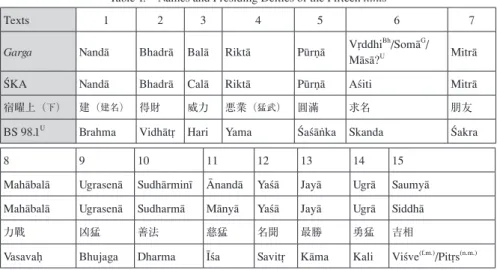
fifteen tithis conceived as a cycle of time, in either white or dark pakṣa, with each tithi as-sociated with a deity and the corresponding auspicious and inauspicious acts for a Brahmin in service to a king (vv. 11–44). The materials described therein appear to be the source of a number of later works.8) Particularly noteworthy are the names of the fifteen tithis,
attest-ed in the Buddhist sources (Table 1), but seem to have become obsolete by the time of Varāhamihira, who identified the presiding deities for each tithi, but provided only the names of the first five tithis, repeatedly applied to the remaining ten.9) The rationale behind
this underlying tripartite structure which in fact appears to determine the general character of a particular tithi, and the connection between the cyclical tithi omens, worship, rituals and the rest of the Gārgīyajyotiṣa remain topics to be investigated. According to Pingree, the Indian tithi seems likely a concept borrowed from Mesopotamia though he admits that its origin remains obscure.10) Within the Indian context, the tithi was likely conceived
originally as a means to keep track of the phases of the Moon, with the assumption that a lunar month from one Full Moon to the next is always made up of thirty tithis.11) A tithi was
thus defined as one thirtieth of a synodic month (c. 29.5 days), resulting in an average tithi being slightly less than a day. In our text, the tithis are enumerated from after the Full Moon and a tithi is defined as a day less two lavas (dvilavonam, v. 6),12) resulting inevitably
in the tithis beginning from different parts of the day. Inconvenient as it is, the tithi is
none-Table 1. Names and Presiding Deities of the Fifteen tithis
Texts 1 2 3 4 5 6 7
Garga Nandā Bhadrā Balā Riktā Pūrṇā Vṛddhi
Bh/SomāG/
Māsā?U Mitrā
ŚKA Nandā Bhadrā Calā Riktā Pūrṇā Aśiti Mitrā
宿曜上(下) 建(建名) 得財 威力 悪業(猛武) 圓滿 求名 朋友
BS 98.1U Brahma Vidhātṛ Hari Yama Śaśāṅka Skanda Śakra
8 9 10 11 12 13 14 15
Mahābalā Ugrasenā Sudhārminī Ānandā Yaśā Jayā Ugrā Saumyā
Mahābalā Ugrasenā Sudharmā Mānyā Yaśā Jayā Ugrā Siddhā
力戰 凶猛 善法 慈猛 名聞 最勝 勇猛 吉相
theless an important concept not only in Indian calendrics, astrology and rituals, but also later in Indian astronomical computation as a fundamental unit (as in the Vedāṅgajyotiṣa), and was eventually established as one of the five components of the traditional pañcāṅga.13)
From an astronomical standpoint, such mean tithi is a useful device as it is based on the mean synodic month, disregarding its actual varying length due to the Moon s anomalistic movement.14) Most likely for the same reason, the same principle was adopted in the
Baby-lonian lunar tables, although the unit was never spelt out explicitly and was referred to sim-ply as day in Babylonian texts.15) Beside the lack of a specific designation, the concept of
tithi itself has no counterpart in Babylonian sources in terms of astrological or ritual appli-cations, and was never used for astronomical computation in any fundamental way. In the case of Hellenistic astral science, there has so far been no evidence of any concept compa-rable to the tithi at all.16)
The fifteen
tithis [G8v6, Bh10v5, U=BS 98.1–3, pp. 1037 ff.]
17)nandā pratipadā proktā praśastā
dhruvakarmasu/ jñānasya ca samārambhe pravāse ca vigarhitā//11//
dānaṃ dadyāt tapaḥ kuryāt puṣṭisaubhāgyam eva ca/ janma cātrottamaṃ vidyāt
svayaṃbhūś cātra devatām//12//
bhadrety uktā dvitīyā ca śilpavyāyāmināṃ
hitā/ ārambhe bheṣajānāṃ ca pravāse ca pravāsināṃ//13//
vivāhavyavahārārthe vāstukṣetragṛhādiṣu/ puṣṭikarmasu ca śreṣṭhā devatā ca bṛhaspatiḥ//14//
balety uktā tṛtīyā ca balaṃ syāt tatra kārayet/ gośvakuñjarabhṛtyānāṃ damyānāṃ
damanāni ca//15//
kuryāc ca sarvakarmāṇi bījāny api ca vāpayet/ balakarmārambhed vāpi viṣṇuṃ
vidyāc ca daivatām//16//
riktā coktā caturthī tu kṣudrakarma prayojayet/ gograhaṃ dāruṇaṃ karma kūṭasākṣyaṃ samārabhet//17//
kuryāt sāṃvatsarāṇy atra abhighātāśrayāṇi ca/ grāmasenāvadhaṃ kuryāt yamaṃ vidyāc ca daivatam//18//
pūrṇāṃ tu pañcamīm āhuḥ praśastāṃ
dhruvakarmasu/ navānnāgrayaṇānāṃ ca śayanāsanaveśmanām//19//
janmakṣetravibhūṣārthā
vyavahārauṣadhikriyāḥ/ praśastaṃ pauṣṭikaṃ
karma somaṃ vidyāc ca daivatam//20// ṣaṣṭḥī somātithir nāma praśastā dhruvakarmasu/ kṣetrārambhaṃ gṛhaṃ
kuryād devatāyatanāni ca//21//
kārayet saṃśrayed vāpi gopurādyālayāni ca/ adhvānaṃ ca na kartavyaṃ kumāraś cātra daivatam//22//
saptamī mitrā nāmā tu mitrakāryādhruvāṇi ca/ kuryād rājño dhvajaṃ chatram āsanaṃ
śayanāni ca//23//
ratnāni maṇimuktāni vastrāny ābharaṇāni ca/ dhārayed bhūṣaṇārthāya devāḥ saptarṣayaḥ
smṛtāḥ//24//
mahābalāṣṭamī proktā kuryād balanidaṃśanaṃ/ adhikārān prayuñjīta yantrakāṃś ca dhanūṃṣi ca//25//
kuryāc ca nagare guptiṃ suruṅgān parikhān tathā/ hastyaśvāṃś ca prayuñjīta vasavaś cātra devatā//26//
ugrasenā tu navamī rodhane vadhabandhane/ amitradamanārthe ca hitā śatru-
vadhārthinām//27//
adhvānaṃ ca na gaccheta proṣyaṃ na praviśed gṛhaṃ/ saharodhaviṣādīni rudrāṇī cātra devatā//28//
sudharmāṃ daśamīṃ prāhur dhruvaṃ kuryād yaśaṣkaraṃ/ kūpān khanen nadīś caiva kūpaṃ puṣkaraṇīyutam//29//
ārāmān nagarīś caiva kṣetrāṇi ca gṛhāṇi ca/ puṇyaśālāṃ sabhāṃ kuryād dharmaṃ
vindyāc ca daivatam//30//
sunandaikādaśīm āha dhruvaṃ vindyān mahānasam/ niveśanagaragrāmayajña- viprasabhās tathā//31//
strīṣu cāgraṃ pravarteta dāsakarmakareṣu ca/ gūḍhārthaṃ na prayuñjīta kāmaśatruś ca devatā//32//
dvādaśīṃ tu yamām āha dhruvaṃ vindyād yaśaskaram/ maṅgalāny atra kurvīta mantropanayanāni ca//33//
koṣṭhāgārāṇi yuñjīta nidhānaṃ ca nidhāpayet/
ṛṇaṃ cātra na gṛhnīyād ādityaś cātra daivatā//34//
jayāṃ trayodaśīm āhuḥ kartavyaṃ
vāstuveśanaṃ/ vastramālyam alaṅkāraṃ
citrāny ābharaṇāni ca//35//
saubhāgyakaraṇaṃ strīṇāṃ kanyāvaraṇam eva ca/ maṇḍalaṃ copavasanaṃ kāmaṃ
vidyāc ca daivatām//36//
ugrāṃ caturdaśīṃ vidyād dāruṇāny atra kārayet/ bandhanaṃ svaripūnāṃ ca pravāsaṃ
cātra varjayet//37//
pūrvābhighātanaṃ caiva dāruṇaṃ
viṣaghātinaṃ/ grāmasenāvadhaṃ kuryād vidyād rudro 'tra devatā//38//
amāvāsyā tu siddhārthā pitṛyajño 'tra śasyate/ daivakāryāgnikāryāṇi gokulāni
niveśayet//39//
purohitaṃ ca vasyeta kuryād yajñakriyās tathā/ balīṃś cāropahārāṃś ca pitaraś cātra devatā//40//
kalyāṇī paurṇamāsī ca devakarmādhi- kārakaṃ/ viprakāryāgnikārye ca gavāṃ
ghoṣān niveśayet//41//
rājñāṃ purohitān kuryād yajñāni vividhāni ca/ śubhaṃ karma ca kartavyaṃ somaṃ
vidyāc ca devatām//42//
etās tu tithayaḥ sarvāḥ parivarttate cakravat/ śuklapakṣe ca kṛṣṇe ca śuklacandrama- sāvṛtāḥ//43//
apramattaḥ satāṃ yukto brāhmaṇaḥ
susamāhitaḥ/ tithayo nirdiśet samyag gārgasya vacanaṃ yathā//44//
Translation
(11) The first [tithi] is said to be Nandā. It is auspicious for firm acts, for the commencement
of learning; traveling on a journey is however forbidden. (12) One should give gifts, perform asceticism. Birth on this [tithi] is the best, characterized by prosperity and fortune. Its deity is Svayambhū. (13) The second [tithi] is said to be Bhadrā. It is good for craft and athletic contest, for starting medical treatment, and for the travelers traveling on a journey. (14) ...for betrothal, marriage, properties, fields and houses. It is excellent to perform nourishing acts. Bṛhaspati is the deity. (15) The third [tithi] is said to be Balā. One may have an army on this [tithi]. One should perform the taming of tamable cows, horses, elephant and servants. (16) One should perform all kinds of rites and sow seeds. Or, one should engage in the act of strength. One should know Viṣṇu as the deity. (17) The fourth [tithi] is called Riktā. One should perform menials act, capture oxen, do cruel things and make false witnesses. (18) On this [tithi], one may engage in the annual raid of shelters. One should destroy village armies. One should know Yama as the deity. (19) The fifth tithi is called Pūrṇā. One should perform firm acts, of the ceremony of consuming new grain, oblation of the first fruits, and of beds, seats and houses. (20) [One should engage in] activities related to birth, fields, ornaments, wealth, commerce and medicine. Works of nourishing nature are auspicious. One should know Soma as the deity. (21) The sixth tithi is called Somā (Vṛddhi?/Māsā?). It is auspicious for firm acts. One should engage in agricultural works, build houses and temples for deities.
(22) One should build or take refuge in buildings such as the city-gates. Journey should be
avoided. The deity for this [tithi] is Kumāra (Skanda). (23) The seventh tithi is called Mitrā. One should engage in gentle activities performed for friends, make king s banner, parasol, throne and beds. (24) One should put on jewels, gems, pearls, clothes and ornaments for the purpose of embellishment. The deities are known as the seven ṛṣis. (25) The eighth [tithi] is called Mahābalā. One should make army armors, appoint officials, and [produce] military machines and bows. (26) He should make fortification, as well as underground passages and ditches in the city. He should employ elephants and horses. The Vasus are the gods on this [tithi]. (27) The ninth [tithi] is Ugrasenā. It is good for creating obstacles, killing and captur-ing, as well as for the subjugation of enemies and for the slaying of enemies. (28) One should not go on the road, to the foreign land or enter a house with corrosive poisons and so on. Rudrāṇī is the deity on this [tithi]. (29) The tenth [tithi] is said to be Sudharmā. One
should perform [deeds which are] firm and glorifying. One should dig wells and channels, and [make] a well fastened with a bucket. (30) One should make gardens, cities, fields, hous-es, almshoushous-es, assembly halls. One should know Dharma as the deity. (31) The eleventh [tithi] is said to be Sunandā. One should make firm [acts], kitchen, houses, towns, villages, sacrifices and assembly halls for Brahmins. (32) One should choose the best among women and servants. One should not hide money. Śiva (enemy of Kāma) is the deity. (33) The twelfth [tithi] is called Yamā. One should perform [deeds which are] firm and glorifying. One should undergo auspicious acts and applications of mantras. (34) One should prepare storehouses and bury treasures. One should not take a loan. The Sun is the deity on this [tithi]. (35) The thirteenth [tithi] is called Jayā. One should make houses, buildings, clothes, garlands, decoration and colorful ornaments. (36) [One should] please women and even choose a bride. [One should make] a maṇḍala and perform fasting (upavasanam). One should know Kāma as the deity [on this tithi] (37) One should know the fourteenth [tithi] as Ugrā. On this [tithi] one should perform cruel deeds and capture one's enemies. On this [tithi] one should avoid travel. (38) One should engage in preemptive attack, horrific killing by poisons and destruction of regional factions (lit. village army). One should know Rudra as the deity on this [tithi]. (39) The New Moon is Siddhārthā. The worship of ancestors is praised on this [tithi]. One should enter sanctuaries (gokulāni) where there are holy rites and fire rites. (40) One should appoint a Purohita and perform sacrificial rites, make offerings and occasional oblations. The ancestors are the deity on this [tithi]. (41) The Full Moon is Kalyāṇī. [One should engage in] duties for the gods, acts for the Brahmans and kindle the sacrificial fire. One should devote to the sounds of the cattle. (42) One should appoint Puro-hitas and perform various rites for the kings. Auspicious acts should be performed. One should know Soma as the deity. (43) Here are all the tithis covering the Full Moon (i.e., from one Full Moon to the next). It revolves like a wheel in both the bright fortnight and the dark fortnight. (44) A Brahman, proper, very attentive among the good people, should teach the tithis completely, [based on] such as Garga s teaching.
Notes
1) Weber 1852: 225; Pingree 1963: 232–33, 1981: 69–71, 1987: 295; Mitchiner 2002: 92–94. 2) Pin-gree 1981: 71–72. 3) CESS A2, 115–117; A3, 29–30; A4, 78–80; A5, 78–84. 4) Geslani, Mak et al. 2017. 5) Pingree 1987: 293; Mitchiner 2002: 113–126. 6) Mitchiner 2002: 24–28; Pingree 1987: 293–294. In addition, a helpful but not always reliable transcription of G by Pingree is kept at the
American Philosophical Society. 7) For the sources and transmission of the work, see Geslani, Mak et al. 2017: 163–165. 8) BS 98, ŚKA 202–3, Taishō (1299) 21.393 ff.; Yano 1986: 109–110. 9) BS 98.2 cd: nandā bhadrā vijayā riktā pūrṇā ca tās trividhāḥ// 10) Pingree 1963: 231. 11) Plofker and Knudsen 2011: 62. 12) tataḥ prakṣīyamāṇasya tithir evaṃ ca saṃjñitā/ dvilavonam ahorātram etasya paramā gatiḥ//6// While later traditions often define a tithi as a day less 1/64, the con-version here is unknown. The unit lava is defined generally by Buddhists as 1/900 of a day, and less by Brahmanical authors (Hayashi 2017). 13) Plofker and Knudsen 2011: 61. 14) Neugebauer 1957: 186–187, fn. 2. 15) Neugebauer 1957: 128; 1975: 349, 358, 360. 16) Neugebauer 1957: 186.
17) Apparatus not provided here due to space constraint.
Abbreviations
BS The Bṛhatsaṃhitā with the Commentary of Bhaṭṭotpala. Ed. Sudhakāra Dvivedin. 2 vols. Varana-si: Varanaseya S. V., 1968.
CESS Census of the Exact Sciences in Sanskrit. Ed. David Pingree. 5 vols. Philadelphia: American Phil-osophical Society, 1970–1994.
ŚKA The Śārdūlakarṇāvadāna. Ed. Sujitkumar Mukhopadhyaya. Santiniketan: Visvabharati, 1954.
Bibliography
Geslani, Marko, Bill M. Mak, Michio Yano, and Kenneth Zysk. 2017. Garga and early astral science in India. History of Science in South Asia 5 (1): 151–191.
Hayashi, Takao. 2017. The Units of Time in Ancient and Medieval India. History of Science in South Asia 5 (1): 1–116.
Kern, H. 1865. The Bṛhat Sañhitá of Varáha-Mihira. Calcutta: Baptist Mission Press.
Mak, Bill M. 2015. The Transmission of Buddhist Astral Science from India to East Asia: The Central Asian Connection. Historia Scientiarum 24 (2): 59–75.
Mitchiner, John E. 2002. The Yuga Purāṇa. 2nd rev. ed. Calcutta: Asiatic Society.
Neugebauer, Otto. 1957. The Exact Sciences in Antiquity. 2nd ed. Providence: Brown University Press. Reprint, New York: Dover, 1969.
̶. 1975. A History of Ancient Mathematical Astronomy. Berlin/New York: Springer. Pingree, David. 1963. Astronomy and Astrology in India and Iran. Isis 54 (2): 229–246.
̶. 1973. The Mesopotamian Origin of Early Indian Mathematical Astronomy. Journal for the History of Astronomy 4: 1–12.
̶. 1981. Jyotiḥśāstra: Astral and Mathematical Literature. Wiesbaden: Harrassowitz.
̶. 1987. Venus Omens in India and Babylon. In Language, Literature, and History: Philological and Historical Studies Presented to Erica Reiner, ed. Francesca Rochberg-Halton, 293–315. Ameri-can Oriental Series 67. New Haven: AmeriAmeri-can Oriental Society.
Plofker, Kim and Toke L. Knudsen. 2011. Calendars in India. In Calendars and Years II: Astronomy and Time in the Ancient and Medieval World, ed. John M. Steele, 53–68. Oxford, UK: Oxbow Books.
Weber, Albrecht. 1852. Indische Literaturgeschichte. Berlin: F. Dümmler.
Yano Michio 矢野道雄. 1986. Mikkyō senseijutsu 密教占星術. Tokyo: Tokyo bijutsu. (This research was supported in part by JSPS KAKENHI Grant Number 15K01118.)
Key words Garga, jyotiṣa, tithi