Introduction
Since 1988, research cruises of TRV Toyoshio- maru of the Hiroshima University investigating benthic and planktonic faunae in the Ryukyu Is- lands, southwestern Japan, have been intensively carried out by the second author. Parts of its re- sults have already published as a monograph (Hasegawa et al., 2005). During the recent cruis- es of 2007 and 2008, both sexes of an unusual pinnotherid crab were found from the mantle cavity of the deep-sea large bivalve mollusk, Acesta philippinensis (Bartsch, 1913). These are identified as an undescribed species of the mono- typic genus Abyssotheres Manning and Galil, 2000 and herein described and illustrated as a new species. The only, previously known species, A. abyssicola (Alcock and Anderson, 1899), was found from the mantle cavity of the deep-sea bi- valve, Acesta indica (Smith, 1899), collected at a depth of 787 m off Travancore, India. The male of the genus is for the first time described herein.
Through the morphological study of the new
species, the diagnosis of the genus is emended.
Then the taxonomic position of the genus is dis- cussed.
Material and Methods
The material was collected with a sledge net towed along the muddy bottoms north off Nagan- nu Island, Kerama Group, the Ryukyu Islands.
The crab specimens removed from the host shells were fixed with 80% ethanol and then preserved in 70% ethanol. A pleopod and eggs of a paratypic ovigerous female were separately pre- served in 99% ethanol for future DNA analysis.
Unfortunately, the host shells are not extant. In the laboratory, crab body parts and appendages were examined under a stereomicroscope (Leica MZ8). For detailed observation of the surface structure, body parts and appendages were stained by a methylene blue solution. Drawings were made with the aid of a camera lucida. Mea- surements, given in millimeters (mm), are of the greatest carapace length and breadth, respective-
A New Species of the Genus Abyssotheres (Crustacea, Decapoda, Brachyura, Pinnotheridae) from the Ryukyu Islands,
Southwestern Japan, with Taxonomic Notes on the Genus
Hironori Komatsu
1and Susumu Ohtsuka
21Department of Zoology, National Museum of Nature and Science, 3–23–1 Hyakunincho, Shinjuku-ku, Tokyo, 169–0073 Japan
E-mail: [email protected]
2Takehara Marine Science Station, Setouchi Field Science Center, Graduate School of Biosphere Science, Hiroshima University, 5–8–1 Minato-machi, Takehara, Hiroshima, 725–0024 Japan
E-mail: [email protected]
Abstract A new species of the genus Abyssotheres is described and illustrated based on two ovigerous females and a single male taken in the mantle cavity of the bivalve mollusk, Acesta philippinensis(Bartsch, 1913) from the depths of 722–738 m off the Ryukyu Islands, southwestern Japan. Abyssotheres acesticolasp. nov. can be distinguished from the unique member of the genus, A. abyssicola(Alcock and Anderson, 1899), in the absence of a projection on the dactylus of the walking legs and the relative length of the dactylus of the cheliped and the walking legs. The diag- nosis of the genus is revised and its taxonomic position is discussed.
Key words : Crustacea, Brachyura, Pinnotheridae, Abyssotheres, new species, Japan.
ly. Pereiopods are measured along the outer mar- gin from ischium to dactylus. The specimens ex- amined are deposited in the National Museum of Nature and Science, Tokyo (NSMT). Abbrevia- tions used are: cb, carapace breadth; cl, carapace length; G1, first male gonopod; G2, second male gonopod; stn, station; WL, walking leg(s); WT, water temperature.
Taxonomy
Family Pinnotheridae de Haan, 1833 Subfamily Pinnotherinae de Haan, 1833
sensu Campos, 2009
Abyssotheres Manning and Galil, 2000
Diagnosis (emend.). Carapace length and width subequal, front prominent, transverse, pro- jecting anteriorly beyond eyes. Eyes visible in dorsal view. Third maxilliped with ischium and merus indistinguishably fused, arched, inner mar- gin projecting at about distal third. Palp 3-seg- mented, relative length carpus propodus dactylus; dactylus styliform, articulated at end of propodus. WL slender, symmetrical; dactyli hooked at tips. All abdominal segments free in both sexes.
Remarks. The following diagnostic features proposed by Manning and Galil (2000) are not suitable for the new species, and therefore should be considered as the specific features of A.
abyssicola: (1) size is medium (8 mm in female);
(2) the dactylus of the chela is slightly less than half of the propodus; (3) the dactyli of the WL 1–2 is longer than that of the WL 3–4. Hence these should be eliminated from the generic diag- nosis.
Since male of the genus has been first discov- ered in the present study, features of the sex are preliminarily diagnosed: (1) size is small (cl 3 mm); (2) the WL 2–3 bear swimming setae; (3) all abdominal segments are free. And the follow- ing feature may be unique for the genus, but we do not know whether A. abyssicola shares it or not: the basal protuberance of the antenna is par-
tially covered by the medially projecting buccal frame ( labrum).
Manning and Galil (2000) described the third maxilliped of A. abyssicola as bearing 2-seg- mented palp through the examination of the holo- type, however, that of A. acesticola contradictori- ly bears 3-segmented palp. The original descrip- tion of Pinnotheres abyssicola by Alcock and Anderson (1899) mentioned that “the dactylus of the external maxillipeds ( third maxillipeds) is styliform and is inserted at the end of the preced- ing joint (segment)” and furthermore the subse- quent description by Alcock (1900) mentioned that “the palp of the external maxillipeds is minute and is much concealed by hairs that fringe the prominent internal angle of the merus:
the dactylus is borne at the tip of the propodite ( propodus).” These descriptions well agree with that of A. acesticola. In conclusion, the palp of the third maxilliped of A. abyssicola is actual- ly 3-segmented, and the dactylus was possibly hidden beneath the setae or had already been de- tached when Manning and Galil (2000) exam- ined. Thus, the diagnosis of the genus Abyssotheres should be revised as follows: (1) the palp of the third maxilliped is 3-segmented;
(2) the dactylus of the third maxilliped is styli- form and is articulated at the end of the propo- dus.
Affinity. In the family Pinnotheridae, the taxo- nomic position of Abyssotheres had been uncer- tain (Campos, 2009). But the present morpholog- ical study shows that Abyssotheres shares the di- agnosis of the subfamily Pinnotherinae sensu Campos, 2009, except that the carapace is not soft. Regarding other diagnostic features, partic- ularly the protuberance in the basal antennal arti- cle, however, Abyssotheres should be placed in the subfamily Pinnotherinae.
In the subfamily Pinnotherinae, the simply 3-
segmented palp of the third maxilliped with the
dactylus articulated at the end of the propodus
like Abyssotheres is unusual and is hitherto ob-
served only in the members of Otrhotheres
Sakai, 1969, Limotheres Holthuis, 1975,
Austinotheres Campos, 2002, and the Bürger’s
(1895) three species of the genus Pinnotheres, viz., Pinnotheres glaber Bürger, 1895, P. laevis Bürger, 1895, and P. longipes Bürger, 1895. Or- thotheres was originally monotypic, O. turboe Sakai, 1969, and then Schmit et al. (1973) added 5 more species to the genus. Subsequently, Cam- pos (1989) revised Orthotheres with removing the three species added by Schmit et al. (1973), viz., P. rathbunae Schmit, 1973, P. laevis, and P.
longipes, due to the difference in the shape of the carapace, the palp of the third maxilliped, and the dactyli of the WL. Campos (1989) additionally placed two other species in Orthotheres. Geiger and Martin (1999) described a new species, O.
haliotidis, with modification on the diagnosis of the genus. On the other hand, Ahyong and Ng (2007) placed P. glaber, P. laevis, and P. longipes in Orthotheres as a new combination due to “the subdistal insertion of the dactylus on the propo- dus of the third maxilliped” only. But these three species are not suitable for the diagnosis given by Geiger and Martin (1999) in: (1) the carapace is broader than long; (2) the carpus of the third maxilliped is longer than the propodus; (3) the WL dactyli are uniformly short. In this paper, we tentatively remove these three species from Or- thotheres and follow the diagnosis given by Geiger and Martin (1999).
The genus Abyssotheres is similar to the genus Orthotheres in the complete fusion between is- chium and merus and the terminally articulated dactylus to the propodus of the third maxilliped, but can be distinguished from Orthotheres by:
(1) the carapace is subequal in length and breadth (vs. broader than long in Orthotheres); (2) the eyes are visible in dorsal view (vs. hardly visible in Orthotheres); (3) the relatively long (about 4 times as long as broad) dactyli of the WL (vs.
short (less than 3 times as long as broad) in Otrhotheres) (Sakai, 1969; Geiger and Martin, 1999).
The genus Abyssotheres is also similar to Limotheres in the shape of the third maxilliped, the moderately long and hooked dactyli of the WL, and the same host bivalve family, Limidae, but can be distinguished from Limotheres by: (1) the carapace is rounded (vs. pentagonal in Limotheres); (2) the frontal region is prominent and transverse (vs. distinctly triangular in Limotheres); (3) the upper surface of the cara- pace is smooth (vs. with distinct median, longitu- dinal ridges in Limotheres) (Holthuis, 1975).
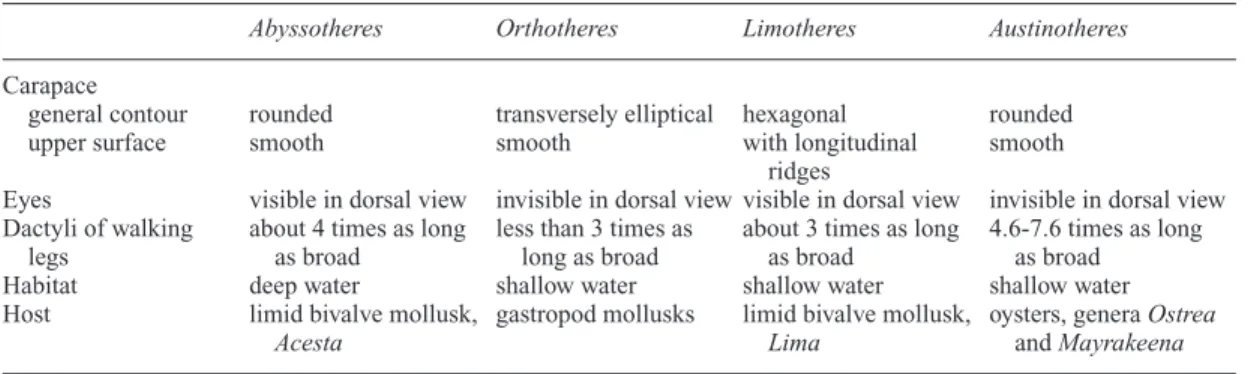
The genus Abyssotheres is also similar to Austinotheres in the subcircular carapace and the shape of the third maxilliped, but can be distin- guished from Austinotheres by: (1) the carapace is firm (vs. thin and easily wrinkled in Austinotheres); (2) the WL 2 is symmetrical in length (vs. asymmetrical in Austinotheres) (Cam- pos, 2002). Comparison of the genera is provided in Table 1.
The Bürger’s (1895) three species of Pin- notheres, viz., P. glaber, P. laevis, and P.
longipes, are similar to Abyssotheres in the rounded carapace and the shape of the third max- illiped, but they are different from Abyssotheres
Table 1. Comparison of the morphological characters and the ecologiccal features between Abyssotheresand its allied genera.
Abyssotheres Orthotheres Limotheres Austinotheres
Carapace
general contour rounded transversely elliptical hexagonal rounded
upper surface smooth smooth with longitudinal smooth
ridges
Eyes visible in dorsal view invisible in dorsal view visible in dorsal view invisible in dorsal view Dactyli of walking about 4 times as long less than 3 times as about 3 times as long 4.6-7.6 times as long
legs as broad long as broad as broad as broad
Habitat deep water shallow water shallow water shallow water
Host limid bivalve mollusk, gastropod mollusks limid bivalve mollusk, oysters, genera Ostrea
Acesta Lima and Mayrakeena
in: (1) the eyes are not visible in dorsal view (vs.
visible in Abyssotheres); (2) the propodus of the third maxilliped is longer than carpus (vs. shorter in Abyssotheres); and the dactyli of the WL1, 3, 4 are short (about twice as long as broad) (vs.
long (about 4 times as long as broad) in Abyssotheres) (Bürger, 1895; Ahyong and Ng, 2007). Thus, we remain these three species to the genus Pinnotheres.
Abyssotheres acesticola sp. nov.
[New Japanese name: Shinkai-pinno]
(Figs. 1–4)
Material examined. Holotype, ovig. female (cl 11.2 cb 11.1 mm), NSMT-Cr 19860, north of Nagannu I., Kerama Group, Ryukyu Is.,
Japan, 26°23.15 N, 127°30.09 E–26°23.56 N, 127°30.39 E, TRV Toyoshio-maru, stn TY-07-9, sledge net, 738–722 m deep, bottom of soft grey mud, coll. H. Komatsu, 26 May 2007. Paratype, male (cl 3.0 cb 2.6 mm), NSMT-Cr 19861, same data as holotype. Paratype, ovig. female (cl 10.1 cb 10.8 mm), NSMT-Cr 19862, north of Nagannu I., Kerama Group, Ryukyu Is., Japan, 26°21.93 N, 127°29.54 E–26°21.49 N, 127°29.34 E, TRV Toyoshio-maru, stn TY-08-7, sledge net, 736–738 m deep, WT 6.4°C, coll. H.
Komatsu, 24 May 2008.
Description. Female: Size large (cl 10 mm).
Carapace (Fig. 1A) rounded, firm but not hard, nearly as long as broad, convex dorsally, naked on dorsal surface, covered with short setae on an- terolateral surface, regions ill-defined. Front prominent, projecting beyond eyes, slightly de-
Fig. 1. A–C, Abyssotheres acesticolasp. nov. A–B, holotype, ovigerous female (NSMT-Cr 19860; cl 11.2cb 11.1 mm), dorsal and ventral views, respectively; C, paratype, male (NSMT-Cr 19861; cl 3.0cb 2.6 mm), dorsal view. D, Acesta philippinensis(shell height ca 170 mm; id by K. Hasegawa), host of paratype, ovig. fe- male (NSMT-Cr 19862). Scales: 3 mm (A–C), 50 mm (D).
pressed medially; margin scarcely concave medi- ally, fringed with short setae. Cardiac region con- vex.
Eye stalk (Fig. 2A) short, immovable, visible in dorsal view; cornea pigmented; orbital hiatus partially filled with distal half of second segment of antenna.
Antennule (Fig. 2A) slightly obliquely folded in antennular fossa; basal segment occupying ventral 0.6 of fossa. Antenna (Fig. 2A) basal seg- ment longitudinally rectangular, with disto-later- al extension; basal protuberance present, partially covered by the medially projecting buccal frame ( labrum); second segment longitudinally rec- tangular.
Mandible (Fig. 3A) not well calcified; molar process triangular; incisor process (lacking on
distal corner in figure) with some fine teeth; palp 3-segmented, straight. Maxillule (Fig. 3B) with coxal endite tongue-shaped; basal endite triangu- lar; endopod 2-segmented, with some setae on tip of distal segment. Maxilla (Fig. 3C) with coxal endite divided into 2 lobes; basal endite faintly divided into 2 lobes; endopod thin, tongue- shaped; scaphognathite (exopod) longitudinally ovoid. First maxilliped (Fig. 3D) with coxal en- dite subcircular; basal endite tongue-shaped; en- dopod longitudinally rectangular; exopod with flagellum. Second maxilliped (Fig. 3E) with dactylus articulated at proximal part of propodus;
exopod with flagellum. Third maxilliped (Fig.
3F) with ischium and merus indistinguishably fused, arched; mesial margin straight (lacking on proximal angle in figure); palp 3-segmented, rela-
Fig. 2. Abyssotheres acesticolasp. nov., holotype, ovigerous female (NSMT-Cr 19860; cl 11.2cb 11.1 mm). A, carapace, frontal view; B–C, left chela, outer and inner views, respectively; D–G, left first to fourth walking legs, posterior view. Scales: 1 mm.
Fig. 3. Abyssotheres acesticolasp. nov., holotype, ovigerous female (NSMT-Cr 19860; cl 11.2cb 11.1 mm). A, mandible (lacking on mesio-distal corner of incisor process); B, maxillule; C, maxilla; D, first maxilliped; E, second maxilliped; F, third maxilliped (lacking on mesio-proximal angle of merus). Scale 1 mm.
tive length carpus propodus dactylus; dactylus styliform, articulated at distal end of propodus;
exopod present, with flagellum.
Cheliped (Figs. 1A–B, 2B–C) 1.1 times as long as carapace; merus and carpus subcylindri- cal; palm weakly convex; fingers subconical, without gap between cutting edges when closed,
crossing at tip; cutting edge of movable finger with triangular, subproximal tooth, with thin blade except on proximal tooth and tip; immov- able finger with dense short setae on ventral 0.3 of inner surface, with triangular tooth on proxi- mal end of cutting edge.
Walking legs (Fig. 2D–G) similar in shape,
Fig. 4. Abyssotheres acesticolasp. nov., paratype, male (NSMT-Cr 19861; cl 3.0cb 2.6 mm). A, carapace, dorsal view; B, third maxilliped, ventral view; C, right chela, outer view; D–G, right walking legs, posterior view;
H, abdomen, ventral view; I, right first gonopod, ventral view; J, right second gonopod, ventral view. Scales: 1 mm (A, D–G), 0.5 mm (B–C, H–J).
relative length WL2 WL3 WL1 WL4; meri subcylindrical, with very short setae on outer margins; carpi and propodi subcylindrical;
dactyli long, about 4 times longer than broad, weakly compressed, hooked on tips, with short setae on inner margins, relative length WL2 WL3 WL4 WL1.
Thoracic sternites with medially interrupted, transverse sutures, without longitudinal median suture. Genital pores opening at sixth sternite, di- rected medially.
Abdomen (Fig. 1B) transversely ovate, strong- ly convex ventrally, entirely fringed with short setae; all segments free, transversely rectangular, weakly convex along midline; fifth segment broadest, 1.2 time as broad as carapace; distal margin of telson divided into two lobes by shal- low medial notch in holotype, almost straight in paratype.
Male: Size small (cl 3 mm). Carapace (Figs.
1C, 4A) longitudinally ovoid in outline, convex dorsally, entirely covered with very short setae;
front projecting, fringed with short plumose setae, shallowly concave medially. Eye stalk very short, immovable, visible in dorsal view; cornea pigmented. Antennule and antenna as in female.
Third maxilliped (Fig. 4B) ischium and merus arched; palpal segments articulated end to end;
exopod present (missing in figure), with flagel- lum. Cheliped (Figs. 1C, 4C) moderate, 1.2 times as long as carapace; chela covered with very short setae; each finger with triangular tooth on proximal end. Walking legs (Fig. 4D–G) similar in shape except setation, slender, compressed;
WL2–3 with swimming setae on carpi and propodi; dactyli hooked on tips. Thoracic stern- ites scattered with small pores; transverse sutures medially interrupted; median suture extending from fifth to eighth sternite; fifth sternite with small button on each side of abdominal groove;
genital pores opening on eighth sternite. Ab- domen (Fig. 4H) subtriangular, entirely fringed with short setae; all segments free; sixth segment with socket on each side of inner surface; telson semicircular. G1 (Fig. 4I) compressed, curving laterally, tapering distally, with long setae on lat-
eral margin and short setae on medial margin, acute tip directed medially. G2 (Fig. 4J) short, 0.3 times as long as G1.
Color. Whole body translucent, amber; cornea red; eggs and oocytes orange-red.
Etymology. The specific name derives in refer- ence to the association with a large bivalve mol- lusk, Acesta.
Host. A large bivalve mollusk in the family Limidae, Acesta philippinensis (Bartsch, 1913) (identified by Dr. K. Hasegawa, NSMT). We have hitherto collected two specimens of A. philip- pinensis and found Abyssotheres acesticola liv- ing in the mantle cavity of both. The paratypic male was found from the same host individual to- gether with the holotypic female, which is an evi- dence that these belong to the same species in spite of remarkable sexual dimorphic features.
Remarks. Abyssotheres acesticola sp. nov. can be distinguished from the unique congener, A.
abyssicola (Alcock and Anderson, 1899) (type locality: off Travancore, India, 787 m), by: (1) the dactylus of the cheliped is longer than half of the propodus (vs. slightly less than half of propodus in A. abyssicola); (2) the dactylus of the WL is without any projection (vs. with a obtuse subdis- tal projection on the dorsal surface in A. abyssi- cola); (3) the relative length of the WL dactyli is WL2 WL3 WL4 WL1 (WL 1–2 WL 3–4 in A. abyssicola).
Acknowledgements
We wish to express our cordial thanks to Dr.
Ernesto Campos for reviewing the manuscript
and offering valuable comments for improve-
ments. Our thanks are also due to all the staff of
TRV Toyoshio-maru and all the member who
joined the cruises for their support on board. We
obliged to Dr. K. Hasegawa of NSMT for identi-
fication of the host bivalve mollusks. This study
was partially supported by a grant-in-aid from
the Japan Society for the Promotion of Science
awarded to SO (No. 20380110).
References
Ahyong, S. T. and P. K. L. Ng, 2007. The pinnotherid type material of Semper (1880), Nauck (1880) and Bürger (1895) (Crustacea: Decapoda: Brachyura). Raffles Bul- letin of Zoology, Supplement, (16): 191–226.
Alcock, A., 1900. Materials for a carcinological fauna of India. No. 6. The Brachyura Catometopa, or Grap- soidea. Journal of Asiatic Society of Bengal, 69:
279–456.
Alcock, A. and A. R. S. Anderson, 1899. Natural history notes from H.M. Royal Indian Marine Survey Ship ‘In- vestigator,’ Commander T.H. Heming, R.N., command- ing. Series III, No. 2. An account of the deep-sea Crus- tacea dredged during the surveying-season of 1897–98.
Annals and Magazine of Natural History, Series 7, 3:
1–27.
Bürger, O., 1895. Ein Beitrag zur kenntniss der Pinnother- inen. Zoologische Jahrbücher, Abtheilung für System- atik, Geographie und Biologie der Thiere, 8: 361–390, pls. 9–10.
Campos, E., 1989. Comments on taxonomy of the genus Orthotheres Sakai, 1969. Bulletin of Marine Science, 44: 1123–1128.
Campos, E., 2002. Two new genera of pinnotherid crabs from the tropical eastern Pacific (Decapoda: Brachyura:
Pinnotheridae). Journal of Crustacean Biology, 22:
328–336.
Campos, E., 2009 (in press). A new species and two new
genera of pinnotherid crabs from the northeastern Pa- cific Ocean, with a reappraisal of the subfamily Pin- notherinae de Haan, 1833 (Crustacea: Brachyura: Pin- notheridae). Zootaxa.
Geiger, D. L. and J. W. Martin, 1999. The pea crab Or- thotheres haliotidisnew species (Decapoda: Brachyura:
Pinnotheridae) in the Australian abalone Haliotis asini- naLinnaeus, 1758 and Haliotis squamataReeve, 1846 (Gastropoda: Vetigastropoda: Haliotidae). Bulletin of Marine Science, 64: 269–280.
Hasegawa, K., G. Shinohara and M. Takeda (eds.), 2005.
Deep-Sea Fauna and Pollutants in Nansei Islands. Na- tional Science Museum Monographs, (29): 1–476.
Holthuis, L. B., 1975. Limotheres, a new genus of pin- notherid crab, commensal of the bivalve Lima, from the Caribbean Sea. Zoologische Mededelingen, 48:
291–295.
Manning, R. B. and B. S. Galil, 2000. A new genus of pinnotherid crab from the Indian Ocean (Crustacea:
Decapoda: Brachyura). Proceedings of the Biological Society of Washington, 113: 66–69.
Sakai, T., 1969. Two new genera and twenty-two new species of crabs from Japan. Proceedings of the Biolog- ical Society of Washington, 82: 243–280.
Schmitt, W. L., J. C. McCain and E. S. Davidson, 1973.
Decapoda I: Brachyura I: Fam. Pinnotheridae. Crus- taceorum Catalogus, 3: 1–160.