Belief-Mediation Model:
Role of self-confidence beliefs in a latent factor model of Japanese intermediate English as a foreign language learners
Introduction
In the interaction between socio-cultural and educational contexts, various self-related experiences might have an impact on one’s ideas and actions. This assumption can be applied to adult second language (L2) and foreign language (FL) learning, which is beyond child first language acquisition. This is because children as toddlers are able to internalize their mother tongue largely unconsciously using the mental organization of their language faculty. On the other hand, adults consciously study linguistic features such as vocabulary, pronunciation, and grammar, while also considering non- linguistic matters such as their goals and motives, worries and anxiety, ideas on how to study, and strategies for learning the target language effectively, as demonstrated by Bley-Vroman (1989) in the fundamental differences hypothesis. The following multivariate regression formula describes the abstract presupposition:
̂y (outcomes) = β1× x1 (variable) + β2× x2 (variable) + βn× xn (variable)
+ βn + 1× xn + 1 (variable) +E (error)
Here, ̂y, pronounced as “y hat,” denotes a certain value of the estimate of learning outcomes obtained by summing all variables related to L2 and FL learning, including some errors indicated as E; β is the impact of each variable x, but its exact value is unknown. Scientific research should aim at discovering the true value of the impact β when the other variables are kept constant in an ideal environment. On the other hand, in educational research, the goal is not just to uncover the true value of the impact, but to present a hypothesis on the impact and the estimation of learning outcomes, or to predict what happens when teachers apply educational intervention on a certain variable, which might have a stronger and
significant impact on the pursuit of the task (i.e., L2 and FL learning) and on the learning outcomes. For example, as several studies have shown, if a variable (x1) has a stronger impact β than another variable (x2), teachers and researchers in this field should invest their efforts in determining that particular variable (x1) to obtain students’learning outcomes as “y hat.” In educational practice, it is apparently impossible for teachers to access the mental organization of students that enables them to acquire their native language. However, it is possible for teachers to manipulate their affective variables of motivation and anxiety, cognitive variables of beliefs and strategy, and other past language experience, which in turn would help students succeed in L2 and FL learning.
Specifically, in FL settings, English as a foreign language (EFL) learners lack exposure to authentic English usage and materials, and thus, they assume this exposure is necessary for them to sustain their motivation to study English, unlike learners in the L2 context. Therefore, this facet of EFL learning needs further research.
Preceding Representative Models
Most of the previous research on affective variables in language learning (e.g., Chen, Warden, & Chang, 2005;
Dörnyei, 1990; Gardner, 1985; Kondo & Yang, 2003; Liu
& Jackson, 2008) has dealt with the role of motivation as well as the debilitative role of anxiety, but has denied a direct relationship between the affective variables and proficiency. Conversely, several studies on cognitive variables of learning strategies (Gardner, Tremblay,
& Masgoret, 1997; Kubo, 1999) have indicated that strategy use has both a positive and negative impact on proficiency depending on the socio-cultural and educational contexts in which the target language is taught or learnt.
For an L2 environment, Gardner et al. (1997) proposed
Akira Nakayama
English Education Center, Institute for Education and Student Support, Ehime University
a latent factor model called the Socio-Educational Model. The model was examined using structural equation modeling (SEM); the results indicate an integrative motivation toward the target language and a significant positive impact (β=.48) on L2 achievements.
Unexpectedly, it also indicated that the strategy factor had a significant negative impact ( β =-.25) on L2 achievement.
Alternatively, for an EFL learning environment, Kubo (1999) proposed the Orientation-Appraisal Model. This model was also examined using SEM, and the results indicate that motivation had a significant positive impact on the strategy factor, and in turn, strategy had a significant impact on EFL achievement.
The Need for a New Model
The significance of the Socio-Educational Model developed by Gardner and his colleague was in its methodology–the introduction of SEM. The model attempted to account for a wide number of variables and their interactions simultaneously and demonstrated the close relationship between motivation and L2 achievement.
On the other hand, the Orientation-Appraisal Model developed by Kubo (1999) viewed L2 learning from a Japanese EFL perspective and showed how this strategy perspective could play a greater role in EFL classrooms in Japan than those in North America.
However, neither of the two models identify any intervening variables among motivation, anxiety, and strategy, that is, the role of learner beliefs in influencing learning behavior. Yang (1999), in studying learner beliefs, examined the relationship between college EFL learners’
beliefs about language learning and the strategies they used, reporting that students’ beliefs were related to the learning strategies they adopted. From this, he concluded that learner beliefs might be one of the factors that influence learning behaviors. Furthering this viewpoint, the current study claims that there is a need for a new model that includes the variable of learner beliefs and examines the role of, and interactions among, all variables.
Theoretical Background
Most motivational studies refer to the Self- Determination Theory (Deci & Ryan, 1985) to account for the interactions among affective variables and focus on explaining the transition and variation of people’s
affective state (not trait), that is, going from the state of
“amotivation” to “motivation.” However, as a theoretical background for connecting the affective and cognitive factors of the four variables (i.e., motivation, anxiety, beliefs, and strategy), the current study refers to Goal Theory (Dweck, 1986), which is one of the motivational theories widely accepted in the field of educational psychology. The fundamental difference between Goal theory and Self-Determination Theory is that the former sees motivation as a fixed variable, while the latter sees it as a state variable. In Goal Theory, goal orientations are thought to be a relatively stable human trait that emerges from more primal beliefs. This is also known as the “theory of intelligence.” This theory encapsulates the ideas of “incremental theory” and “entity theory.”
According to Dweck (1986), the former refers to the idea that “intelligence is malleable” (p.1041) and the latter that “intelligence is fixed” (p.1041), and that individual students’theory of intelligence appears to orient them toward different goals (orientations). By adopting Goal Theory, the dilemma of “which came first, the chicken or the egg?” can be shuffled off because it assumes that the student’s theory of intelligence has been internalized in his or her infancy, somewhat like a personality trait (Dweck, 1999; Pintrich, 2000; Smiley & Dweck, 1994), making it relatively stable over the course of the student’s lifetime.
The premise is that goal orientations come first, or at least before the other variables of learning beliefs, anxieties, and strategies, which, on the other hand, easily change because they are unstable (i.e., state variables).
In Goal Theory, individual behaviors are considered rational and economic to achieve certain goals. Goals (e.g., motivation) set by an individual influence the individual’s cognition (e.g., beliefs), choice of strategy, methodology, and the process for achieving those goals. Based on the kind of goals of an individual student, Goal Theory can be used to predict that student’s learning behavior and learning outcome (Dweck, 1986). According to Dweck (1986), there are two types of goal orientations: Learning Goal (LG) and Performance Goal (PG). The former refers to the orientation to increase competence and understand something new, whereas the latter refers to the orientation for being positively judged for one’s competence and avoid being negatively judged for the lack of it.
Although this assumption is apparently in conflict with the idea that anxiety and beliefs are more primal and that self-concept and self-assessment determine the level
of motivation and goal orientation (Dörnyei, 2001), the conflict is only because of a difference in the theoretical viewpoint. Moreover, this is also considered a genetically determined trait, which implies that these are relatively stable variables that teachers or parents cannot easily change. Most likely, Dörnyei considers “beliefs” as the primal beliefs assumed by the Goal Theory. However, it is likely that some beliefs (including more general beliefs or folktales) are influenced by motivations or orientations.
Target Issues and Purpose of This Study
In the current study, the primary assumption is that the type of motivation (i.e., goal orientations) students have influences their anxiety and beliefs, and these in turn influence the type of learning strategies they select. Within the theoretical model of this assumption, this study aims to examine the roles and interactions of selected variables of Japanese university students’ past language studies and their overseas experiences, which could have a bearing on their English learning, and to discuss the implications for practice and further research.
The impact of learners’use of strategies on their achievement depends on the environment in which they live. Nakayama (2006) reported that the goodness of fit index (GFI) of the hypothesis model improved when intermediate variables such as learning belief and strategy were included in the model, according to which student motivation has no impact on proficiency.
However, some variables of past experience have not been included in the former models, and the influence of those variables remain unexamined. By including these variables in the present study, it might be possible to propose a far more persuasive latent model, that is, a revised version of the Belief-Mediation Model (Nakayama, 2006).
Hypothesis for Confirmatory Analysis
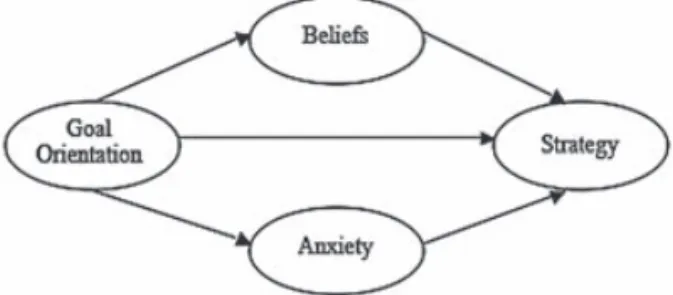
In the current study, the primary assumption is that the types of goal orientation students have influence their anxiety and beliefs, which in turn influence the type of strategies they select. A schematic depicting the assumptions of the current study is as shown in Figure 1.
In Figure 1, the four circles represent the four latent factors of the Belief Mediation Model: Goal Orientation, Beliefs, Anxiety, and Strategy. These should be interpreted from left to right. The one-way arrows indicate both the direction of the causation and the impact of one variable on another.
Advanced Statistical Analysis
Previous three research studies conducted by the author and his colleagues (Nakayama, 2007; Nakayama &
Heffernan, 2013; Nakayama, Heffernan, Matsumoto, and Hiromori, 2012) only used categorical regression analysis under the assumption that the categorical data were thought to have the significant impacts on the dependent variables as well we continuous variables, then the whole data were analyzed simultaneously. However, the results of the studies indicated that the impact of the categorical variables on the participants’use of strategies were scarce.
In the current study, therefore, the categorical data were excluded, and the assumption is updated as that the interactions of independent variables and the indirect effects of them has some impact on the dependent variables. Thus, for re-analyzing the previous data without the categorical data by using advanced statistical approach, structural equation modeling, new findings and knowledge on the complexed relationship among the independent variables will be extracted.
Method
Participants
Data used were from the previous research studies conducted by the author and his colleagues (Nakayama, 2007; Nakayama & Heffernan, 2013; Nakayama et al, 2012). There were 375 participants in the study, who were all non-English majors at a Japanese national university in the Kanto area. All participants were enrolled in the English foundation course class (credit- bearing), which was compulsory for all freshmen. Ranging from 18 to 32 years (96.5% were under 21), the majority of the participants (92.3%) had never visited a foreign country, and 25.8% of them had studied English from the elementary school stage.
Figure 1. The Belief-Mediation Model
Instruments
The participants were asked to complete and sign a consent form, and then asked to answer a questionnaire that included the questions and scales mentioned below.
There were a total of 56 items (except for qualitative and open-ended questions), all of which were to be marked on a 7-point Likert scale ranging from strongly disagree to strongly agree, except the ones related to gender, age majors, and English-learning background.
Revised Version of the Goal Orientation Scale. To assess Goal Orientation, a revised version of the Mokuhyo Tassei Keikou Shakudo, which is translated as “Goal Orientation Scale,” was used. The original version developed by Hayamizu, Ito, and Yoshizaki (1989) was designed for younger Japanese students’ Goal Orientations in accordance with the basic tenets of Goal Theory. For this study, the original version was modified to suit older students, particularly for Japanese university students.
The revised version consisted of 11 randomized items, each of which stated a possible reason for achievement or learning. Based on the framework of Dweck (1986), three of the items were related to a Learning Goal Orientation, and six other items were related to a Performance Goal Orientation.
Revised Version of the Strategy Inventory for Language Learning (SILL). To assess participants’ use of direct strategies for studying vocabulary in a reading and grammar class, their metacognitive strategy, and social strategy, a revised version of SILL, initially developed by Oxford (1990), was used by modifying it to suit the EFL context of the study (Nakayama, 2005). It consisted of 21 items, each involving a statement describing the strategy used. SILL has six categories of language learning strategies. The categories are memory strategies, cognitive strategies, compensation strategies, metacognitive strategies, affective strategies, and social strategies. Although Oxford (1990) introduced SILL as a generalized inventory, Robson and Midorikawa (2001) reported two problems with the factor construction of SILL. One is that despite the high degree of reliability of SILL overall, it has six independent subsections in its factor construction. Second, the results of factor analysis do not confirm Oxford’s six-strategy categories even when attempting to force the analysis into a six-factor solution. To overcome these problems, the author had to develop a strategy inventory for Japanese EFL learners by revising SILL.
Revised Version of Beliefs about Language Learning
Inventory (BALLI). To assess participants’Beliefs about English learning, an EFL version (Nakayama, 2005) of the BALLI was used. It consisted of nine items on beliefs about language learning in Japan. The original BALLI was developed by Horwitz (1987) for North American learners of foreign languages. To assess General Learning Beliefs, Ueki’s (2002) scale was used without modification.
It consisted of nine items on General Learning Beliefs.
Anxiety Scales. To assess participants’ anxiety in English learning and use, the Language Learning Anxieties Scale developed by Mori (2003) was employed. It consisted of six items on anxiety in English language learning and use in Japan.
English learning Background. An English learning background questionnaire obtained data on whether the participants had studied abroad and their overall proficiency in English.
Procedure
The questionnaires were administered to several classes of English as a foundation course (general education subjects) toward the end of the 2nd semester of the 2005-2006 academic year. The students signed a consent form and completed the survey in 30 minutes at the end of one lesson. Of the 400 collected questionnaires, since the others were incomplete, only 375 could be used.
Data Analysis
To test the hypothesis of the current study, the following two analyses were conducted. First, item analysis was performed to find the value of Cronbach’s α for the reliability of the scales, the mean (M), and the standard deviation (SD), which reveal a respondent’s general tendency. Second, to test the hypothesized model (the Belief-Mediation Model), structural equation modeling was carried out. Structural equation modeling (SEM), including other latent factor modeling techniques, is becoming increasingly popular to differentiate dependent variables from independent variables in the fields of both second and foreign language education research, especially in studies on learner motivation and strategy (e.g., Chen et al., 2005; Gardner et al., 1997; Kubo, 1999).
This is because it enables one to treat the unobservable variables (e.g., motivation, beliefs, strategy, and anxiety) as latent factors. Structural equation modeling techniques also allow researchers to evaluate the plausibility of a hypothesized model of any related variable of language learning in a statistical format, by testing the model using
a simultaneous analysis of the entire system of variables to determine the extent to which it is consistent with the variable data extracted from self-report questionnaires (Byrne, 2001).
Results
Item Analysis
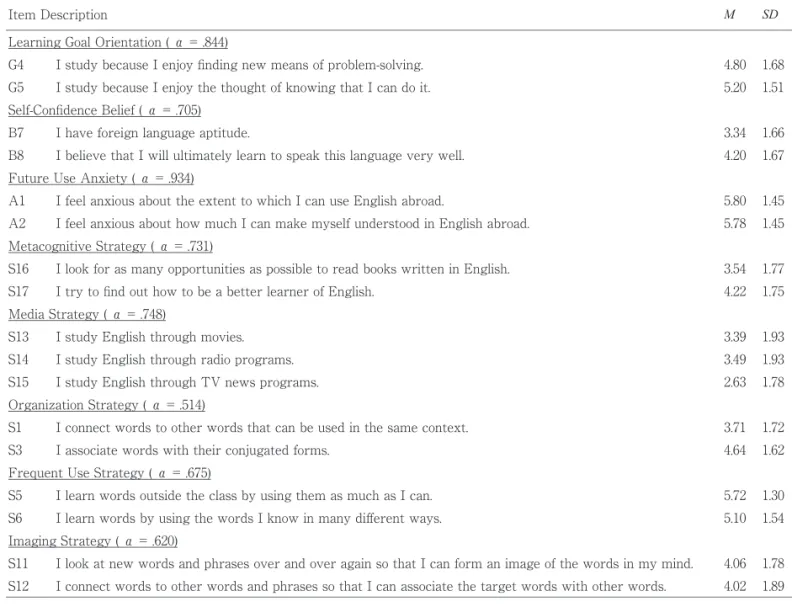
Table 1 presents the descriptive statistics of the items that were used in further statistical analyses and includes the item’s description as well. It can be inferred from Table 1 that the participants overall tended to feel anxiety at the prospect of using English abroad in the future (Mean average of A1 = 5.80 and that of A2 = 5.78); besides, they tended not to use the Media Strategy (Mean average of those strategy variables < 4.00). Even though the anxiety items (A1 and A2) showed the ceiling effect (>7.0), these two items were included in the further analysis because it was one of the purpose of this study to investigate whether the level of students’ anxiety can be explained within the model or not. In addition, though
one of the Frequent Use Strategy (FUS) items “S5” also showed the ceiling effect, since it is about the frequency of their use of the target strategy as a dependent variable and it is a significant variable, it was included for the final analysis.
Structural Equation Modeling
Figure 2 displays the result of the final structural equation modeling, and the overall goodness-of-fit indexes (GFI = .973; CFI = .993; CMIN/df = 1.122; RMSEA = .018) indicate that the hypothesized model fits with the data in an inferential statistical format. This implies that, to some extent, it is possible to predict the dependent variables in the model by the independent variables.
The final structural equation modeling is comprised of configurations of four types of symbols: circles, squares, one-way arrows (referred to as causations), and two-way arrows with dotted lines (referred to as correlations).
The seven circles represent the seven latent factors, and each of the fourteen observable variables is associated with one latent factor. Statistically, latent factors are
Table 1
Descriptive Statistics (N=375)
Item Description M SD
Learning Goal Orientation ( α = .844)
G4 I study because I enjoy finding new means of problem-solving. 4.80 1.68
G5 I study because I enjoy the thought of knowing that I can do it. 5.20 1.51
Self-Confidence Belief ( α = .705)
B7 I have foreign language aptitude. 3.34 1.66
B8 I believe that I will ultimately learn to speak this language very well. 4.20 1.67
Future Use Anxiety ( α = .934)
A1 I feel anxious about the extent to which I can use English abroad. 5.80 1.45
A2 I feel anxious about how much I can make myself understood in English abroad. 5.78 1.45 Metacognitive Strategy ( α = .731)
S16 I look for as many opportunities as possible to read books written in English. 3.54 1.77
S17 I try to find out how to be a better learner of English. 4.22 1.75
Media Strategy ( α = .748)
S13 I study English through movies. 3.39 1.93
S14 I study English through radio programs. 3.49 1.93
S15 I study English through TV news programs. 2.63 1.78
Organization Strategy ( α = .514)
S1 I connect words to other words that can be used in the same context. 3.71 1.72
S3 I associate words with their conjugated forms. 4.64 1.62
Frequent Use Strategy ( α = .675)
S5 I learn words outside the class by using them as much as I can. 5.72 1.30
S6 I learn words by using the words I know in many different ways. 5.10 1.54
Imaging Strategy ( α = .620)
S11 I look at new words and phrases over and over again so that I can form an image of the words in my mind. 4.06 1.78 S12 I connect words to other words and phrases so that I can associate the target words with other words. 4.02 1.89
implied by the covariance among two or more observable variables. The latent factor “Goal Orientation (GO),” for example, has two observable variables, and the variations of the variance of these two variables are accounted for by the latent factor “GO.” The indicators accompanying the one-way arrows show the regression coefficients (where the latent factor is considered to be the cause of those observable variables).
In turn, one-way arrows between latent factors represent the impact of one latent factor on another. The latent factor “GO,” for instance, has two one-way arrows associated with the two latent factors of “Metacognitive Strategy (McS)”and“Self-confidence Beliefs (ScB).” Here,
“GO” has a positive impact on “ScB (β = .33)” and “McS (β = .39)”. The value of the β indicates the standardized regression coefficients, which means that it is possible to compare the impacts on them.
The values of r-squared (R2), accompanied with the latent factors, is the coefficient of determination that indicates how much the variance of the latent factors can be explained by the other one or ones. The following examples demonstrate this: 13% of the total variance of the latent factor “ScB (R2 = .13)” can be accounted for by the latent factor “GO”; 43% of the total variance of the latent factor “McS (R2 = .43)” is explained by the latent factors “GO” and “ScB”; and 61% of the total variance of the latent factor “Direct Strategy (DS) (R2 = .61)” can be accounted for by the latent factor “McS.”
On the causation among the observable variables in the model, the observable variable “Proficiency
(ProF)” receives three one-way arrows from “Overseas Experience (OvE),” “B7, one of the ScB items (I have foreign language aptitude),” and “S16, one of the McS items (I look for as many opportunities as possible to read books written in English.).” This indicates that these variables have an effect on a student’s proficiency, but they only explain 9% of the total variance of the observable variable
“Proficiency (ProF).”
Relating to the correlation among observable variables,
“S16 (I look for as many opportunities as possible to read books written in English.)” has a negative correlation with
“S5, one of the FUS items: I learn words outside the class by using them as much as I can.).” Item S16 refers to the development of receptive skills in the target language, and item S5 refers to enriching vocabulary, which connects to the productive skills. We can assume that for learners both strategies are time-consuming endeavors;
thus, focusing on one may mean that the learner does not have sufficient time for the other.
On the other hand, “S17, one of the McS items (I try to find out how to be a better learner of English.)” has a weak correlation with “S11, one of the Imaging Strategy items (I look at words and phrases over and over again so that I can form an image of the words in my mind.)”. Contrary to the relationship between S16 and S5, this weak correlation is free from the issue of time that was highlighted above.
Item S17 refers to the indirect strategy; one possible way to carry out the indirect strategy (S17) is by using the direct strategy (S11) - or at least, those who try to memorize words and phrases in English believe that this Figure 2. Final structural equation model: The influence of motivational, belief, and strategy variables on change in
English proficiency level (N=375).
is what a good learner of English should do.
Discussion
These results offer some unique observations and have strong implications in the field of EFL in Japan.
With regards to the hypothesis of the current study, the results support the validity of the Belief-Mediation Model, except for the role of anxiety, as represented in the SEM done for this study; that is, the Belief-Mediation Model fit the data and the causations drawn in the model were also supported by the data. It is noteworthy that Self- confidence Belief mediates the effects of Goal Orientation on Strategy variables of Metacognitive Strategy, and in turn, Metacognitive Strategy mediates the effects of Goal Orientation and Self-confident Belief on Direct Strategy.
This means that educational intervention in Self- confidence Belief would have an effect on the investment of Metacognitive Strategy. Students’preferences for using certain strategies imply that they stick to their beliefs when it comes to language learning (Nakayama, 2005). Therefore, the results confirm the associations between learner belief and strategy in the EFL context.
The findings, however, denied the role of anxiety in the model, which seems particularly informative when we consider the preceding results of the categorical regression analysis that was reported in the previous two studies conducted by the author and his colleague (Nakayama, 2007; Nakayama & Heffernan, 2013;
Nakayama et al, 2012). No significant correlations and causations between anxiety and the other latent variables were found in the SEM, but as a dependent variable in the categorical regression analysis previously reported by Nakayama et al (2012), the degree of anxiety would vary in proportion to the period of time the students stayed abroad. Moreover, Self-confidence beliefs were positively affected by their overseas experiences while students’
future use anxiety was negatively affected, which means
“reduced”, by their overseas experiences. These findings indicate that the more overseas experience a student has, the more self-confidence they gain, and they feel less anxious about using English in the future (Nakayama et al, 2012). EFL learners, like Japanese university students at the intermediate level, generally feel anxious about the prospect of using English abroad. However, not all students are pessimistic about being successful learners of English. The students of the Learning Goal orientation and those who have experienced studying abroad are
more likely to have confidence in learning English in an EFL context, and therefore, are more likely to try to learn English in more varied ways, while using different strategies.
These findings lead to another implication in the link between direct strategy and proficiency. No significant positive correlation and causation between any of direct strategies and proficiency was found in the final SEM.
This does not always mean that strategy would not have an effect on proficiency. One interpretation for this result is the absence of the strategy items that the participants use. Along similar lines, the negative causation between strategies and proficiency that Gardner et al. (1997) reported occurs simply because of the limitations associated with asking the participants to report their strategies.
Limitations and Further Research
This study has a few limitations. First, Gardner (1985) pointed out the limitations of research using the structural equation modeling technique, which is directly applicable to this study, as follows: “Just as a factor analytic solution is only one of an infinite number of possible solutions which can also reproduce the correlation matrix, so too is any particular causal model only on of many” (Gardner, 1985, p.155). In addition, inferences drawn from the results of this study are limited by the nature of the particular sample used, which consisted solely of students at one university in the Kanto area of Japan. Therefore, the Belief-Mediation Model only applies within the Japanese EFL context, and the participants of the study were aged 19 years (age range: 18-20). Therefore, further research related to this model should test other contexts, as well as EFL learners of varying levels of proficiency and backgrounds.
References
Bley-Vroman, R. (1989). What is the logical problem of foreign language learning? In Gass, S., & Schachter, J. (Eds.) Linguistic perspectives on second language acquisition, 41–68.
Cambridge: Cambridge University Press.
Byrne, B. M. (2001). Structural equation modeling with AMOS:
Basic concepts, applications, and programming. Mahwah, NJ:
Lawrence Erlbaum Associates.
Chen, J., Warden, C., & Chang, H. (2005). Motivators that do not motivate: The case of Chinese EFL learners and the influence of culture on Motivation. TESOL Quarterly, 39(4),
609–633.
Deci, E. L., & Ryan, R. M. (1985). Intrinsic motivation and self- determination in human behavior. New York: Plenum Press.
Dörnyei, Z. (1990). Conceptualizing motivation in foreign language learning. Language Learning, 40, 45–78.
Dörnyei, Z. (2001). New themes and approaches in second language motivation research. Annual Review of Applied Linguistics, 21, 43–59.
Dweck, C. S. (1986). Motivational processes affecting learning.
American Psychologist, 41, 1040–1048.
Dweck, C. S. (1999). Self-theories: The role in motivation, personality, and development. New York: Psychology Press, Taylor and Francis.
Gardner, R. C., Tremblay, P. F., & Masgoret, A. (1997).
Towards a full model of Second Language Learning: An empirical investigation. The Modern Language Journal, 81(3), 344–362.
Gardner, R. C. (1985). Social psychology and second language learning: the role of attitudes and motivation. London: Edward Arnold.
Hayamizu, T., Ito, A., & Yoshizaki, K. (1989). Chuugakusei no tassei mokuhyou keikou [Junior high school students’
tendencies of achievement goals]. Bulletin of Division of Education of Nagoya University, 36, 55–72.
Horwitz, E. K. (1987). Surveying student beliefs about language learning. In Wenden, A. L., Rubin, J. (eds.), Learner Strategies in Language Learning. Prentice-Hall, Englewood Cliffs, NJ, 119–129.
Kondo, S., Yang, Y. L. (2003). The English Language classroom anxiety scale: Test construction, reliability, and validity. JALT Journal, 25(2), 187–196.
Kubo, N. (1999). Orientation-appraisal model for Japanese university students’ learning of English: Relation among learning motives, cognitive appraisal, learning behavior, and performance. Japanese Journal of Educational Psychology, 47, 511–520.
Labov, W. (1991). The interaction of sex and social class in the course of linguistic change. Language Variation and Linguistic Change, 2, 205–251.
Liu, M., & Jackson, J. (2008). An exploration of Chinese EFL learners’unwillingness to communicate and foreign language anxiety. The Modern Language Journal, 92(1), 71–86.
Mori, M. (2003). Anxieties related to foreign language learning.
Unpublished master’s thesis, International Christian University, Tokyo.
Nakayama, A. (2005). Testing a hypothesized model of English language learning: Japanese university students' goal orientation, beliefs, and learning strategies. Japanese Journal of Educational Psychology, 53(3), 320–330.
Nakayama, A. (2006). Affective and cognitive factors among
Japanese university EFL students: goals, anxieties, beliefs, and strategies. A dissertation presented to the division of Education, the graduate school of International Christian University, for the degree of doctor of philosophy.
Nakayama, A. (2007, July). The Influence of Past Language Studies Experience on Current English Learning. Poster presented at ALAA Congress 2007 in Wollongong, from July 1–3, Australia.
Nakayama, A., & Heffernan, N. (2013). The influence of goal orientations and language experiences on the behaviors of Japanese university students learning English as a foreign language. Journal of Faculty and Staff Development in Higher Education, (11), 11–18
Nakayama, A., Heffernan, N., Matsumoto, H., & Hiromori, T. (2012). The influence of goal orientation, past language studies, overseas experiences, and gender differences on Japanese EFL learners’beliefs, anxiety, and behaviors.
Apples-Journal of Applied Language Studies, Vol 6, 2, 19-39.
Oxford, R, L. (1990). Language Learning Strategies: What every teacher should know. New York: Newbury House.
Pintrich, P. R. (2000). An achievement goal theory perspective on issues in motivation terminology, theory, and research.
Contemporary Educational Psychology, 25, 92–104.
Robson, G., & Midorikawa, H. (2001). How reliable and valid is the Japanese version of the Strategy Inventory for Language Learning. JALT Journal, 21(2), 202–226.
Smiley, P. A., & Dweck, C. S. (1994). Individual differences in achievement goals among young children. Child Development, 65, 1,723–1,743.
Ueki, R. (2002). Structure of high-school students’ beliefs about learning. Japanese Journal of Educational Psychology, 50, 301–
310.
Yang, N. D. (1999). The relationship between EFL learners’
beliefs and learning strategies use. System 27, 515–535.
Additional Notes
The raw data analyzed in the current study is identical to that used in the paper titled “The influence of goal orientations and language experiences on the behaviors of Japanese university students learning English as a foreign language,” published by Nakayama and Heffernan (2013, Journal of Faculty and Staff Development in Higher Education, 11, 11–18). Structural Equation Modeling, an advanced statistical analysis, was not used in the aforementioned study; however, it has been used in the current study.
In addition, this work was supported by MEXT Japan, KAKENHI (No. 17720139) and (No. 16K01139).