原 著
京都大学における生体肝移植と輸血管理・
輸血療法に関する研究(第 1 報)
丹羽 紀実
1)2)湯浅 健
1)木村 晋也
1)辻 博昭
1)万木紀美子
1)竹川 良子
1)菱田 理恵
1)江川 裕人
4)田中 紘一
4)浅野 弘明
5)河村 朋子
6)横山 繁樹
6)前川 平
1)3)1)京都大学医学部附属病院輸血細胞治療部,2)検査部,3)分子細胞治療センター,
4)移植外科,5)京都府立医科大学医学部看護学科,6)京都府赤十字血液センター
(平成 15 年 10 月 6 日受付)
(平成 16 年 3 月 12 日受理)
TRANSFUSION REQUIREMENTS DURING LIVING DONOR LIVER TRANSPLANTATION―ANALYSIS OF 772 CASES AT A SINGLE CENTER Norimi Niwa1)2), Takeshi Yuasa1), Shinya Kimura1), Hiroaki Tsuji1), Kimiko Yurugi1), Ryoko Takegawa1), Rie Hishida1), Hiroto Egawa4), Koichi Tanaka4), Hiroaki Asano5),
Tomoko Kawamura6), Shigeki Yokoyama6)and Taira Maekawa1)3)
1)Department of Transfusion Medicine and Cell Therapy,2)Laboratory Medicine,
3)Center for Cell and Molecular Therapy, and4)Transplantation and Immunology, Kyoto University Hospital,5)Kyoto Prefectural University of Medicine,
School of Nursing, and6)Kyoto Blood Center
Living-donor liver transplantation(LDLT)has developed rapidly and is now an important thera- peutic procedure for patients with end-stage and irreversible liver diseases. However, LDLT is often associated with massive intraoperative hemorrhage and substantial requirements for blood transfu- sion. Because of the shortage of organs from brain death donors, the use of LDLT is set to increase throughout the world. We analyzed 772 evaluable LDLT cases from June 1990 to March 2002 at Kyoto University Hospital. Here, we report the prepared quantities of mannitol-adenine-phosphate- added red cell concentrate(MAP), fresh frozen plasma(FFP), and platelet concentrate(PC)for each transplantation and compare retrospectively these preparations and actual requirements as analyzed after surgery. Moreover, we assess the ability of preoperative variables to predict intraop- erative blood transfusion requirements in LDLT. We routinely prepare 10 to 20 units of MAP(child:
1 unit!kg, maximum 10 units), 10 units FFP(child:5 units), and 10 units PC(child:5 units). This study revealed that these quantities are sufficient for regular LDLT. Significant associations between blood transfused and the following variables;age, diagnosis, preoperative condition, and operation times were demonstrated by the Mann-Whitney s U test. Although no correlation was found be- tween the blood requirements and preoperative laboratory findings overall, more detailed analysis among subgroups is required.
はじめに
肝移植は高度先進医療として確立され,わが国 では現在までに約 2,000 例が実施されている.脳 死ドナーはきわめて少なく,99% 以上が生体部分 肝移植(以下,生体肝移植)である1).京都大学医 学部附属病院(以下,京大病院)は 1990 年に小児 を対象として第 1 例目を実施し,1994 年にはじめ て成人症例の生体肝移植を行った2).以降,移植件 数は急速に増加し,2000 年には年間 100 例を越す 生体肝移植が行われている3).全肝移植が行われ る脳死グラフトによる肝移植と異なり,生体肝移 植は部分肝移植であるためレシピエントの下大静 脈を温存する必要があり,レシピエントの肝臓に 対してより綿密な!離と摘除をおこなう必要があ る.とくに,胆管,肝動脈,門脈を病的肝臓の内 部にまで入り込んで!離しなければならない.レ シピエントの病んだ肝臓は硬くてもろい.した がって,出血の危険性は脳死患者からの献肝移植 と比較してはるかに高く,輸血による補助療法が きわめて重要な役割を担っている.生体肝移植は 慢性的な脳死グラフトの不足により,今後わが国 のみならず世界的にも増加すると考えられ,輸血 部として生体肝移植に対してどのように対処すれ ば良いかを知る目的で,生体肝移植時の輸血療法 について後方視的に検討したので報告する.
対象と方法
対象は京大病院で 1990 年 6 月から 2002 年 3 月 までに行われた生体肝移植(ドミノ肝移植,再移 植を含む)772 例である.患者体重あたりの輸血量 を求め,現在の輸血準備量と比較検討した.2002 年 4 月に生体肝移植に対する MSBOS(Maximum Surgical Blood Order Schedule)の見直しを行っ た.現在の京大病院での生体肝移植に対する輸血 準備量は以下のごとくである.
・濃 厚 赤 血 球(mannitol-adenine-phosphate added red cell concentrates;MAP): 小児(18 歳未満);1 単位!kg で最大 10 単位,
成人(18 歳以上);10〜20 単位
・新鮮凍結血漿(fresh frozen plasma;FFP):
小児;5 単位,成人;10 単位(いずれも輸血 部で確保,保存)
・血小板製剤(platelet-concentrates;PC): 小児;5 単位(分割製剤を輸血部で作製)また は 10 単位(血液センターで確保)
成人;10 単位(血液センターで確保)
さらに対象項目と手術中輸血量の関連性を後方 視 的 に 検 討 し,相 関 分 析 と Mann-Whitney s U test によって解析し統計学有意差をp<0.05 とし た.今回解析をおこなった項目は,年齢,性別,
体重,原疾患,術前状態,ドナーとの続柄,初回 あ る い は 再 移 植 症 例,お よ び 血 液 生 化 学 検 査
(WBC,Hb,Plt,PT,AST,ALT,LDH,γ-GTP,
TP,Alb,T-Bil,D-Bil,Cre,BUN,Glu,CRP)
である.
結 果
生体肝移植患者の年齢は 0 歳から 69 歳まで平 均 17.2 歳,小児 511 例および成人 261 例,性別は 男性 365 人,女性 407 人,体重は 3.1kg か ら 108 kg(平均 30.6kg)であった.肝移植手術前の状態 としては,外来通院中 235 人,入院中(一般病棟)
301 人,入院中(ICU)118 人で,不明 118 人,ド ナーとレシピエント間の血液型組合せでは iden- tical(血液型一致)533 人,incompatible(血液型 不適合)92 人,compatible(血液型適合)147 人で あった.ドナーは,父親 253 人,母親が 316 人で 合 計 569 人,配 偶 者 64 人,兄 弟 66 人,子 供 54 人,ドミノ移植 7 人,その他 12 人で,初回移植症 例 738 例,再移植症例 34 例であった.原疾患の内 訳を Table 1 に示す.
まず,年次別の症例数と輸血量の変化を示す
(Fig. 1).京大病院では 1990 年 6 月に小児の第 1 例目を行い,1994 年から成人間の移植も行うよう になった.年度別の輸血量では小児では 1993 年か ら 1994 年ごろ,成人例では 1996 年から 1997 年ご ろに learning curve と適応症例の拡大によって一 過性の増加がみられるが,ともに速やかに改善さ Living donor liver transplantation, MSBOS, Transfusion, Blood requirements, Preopera- tive laboratory findings
Key words:
Table 1 Diagnosis and number of cases of patients receiving LDLT(living-donor liver transplantation)
No. of cases Disease (%)
465(60.1)
Cholestatic disease
384(49.6)
Biliary atresia(BA)
35(4.5)
Primary sclerosing cholangitis(PSC)
20(2.6)
Primary biliary cirrhosis(PBC)
17(2.2)
Alagille syndrome
5(0.7)
Byler s disease
4(0.5)
others
113(14.6)
Liver cirrhosis(LC)
39(5.0)
Hepatitis B Virus(HBV)
35(4.5)
Hepatitis C Virus(HCV)
5(0.7)
Autoimmune
3(0.4)
Alcoholic
31(4.0)
others
64(8.3)
Fulminant hepatic failure
17(2.2)
Hepatitis B Virus(HBV)
1(0.1)
Drug-induced
46(5.9)
others
62(8.0)
Neoplastic disease
54(7.0)
Hepatocellular carcinoma
7(0.9)
Hepatoblastoma
1(0.1)
Metastatic liver tumor
58(7.5)
Metabolic disease
27(3.5)
Wilson s disease
6(0.8)
Citrulinemia
6(0.8)
Ornithine transcarbamylase deficiency
5(0.6)
Tyrosinemia
4(0.5)
Glycogen storage disease
1(0.1)
Familial amyloid polyneuropathy
9(1.2)
others
10(1.3)
Vascular disease
8(1.0)
Budd-Chiari syndrome
2(0.3)
others
れ,1998 年以降は MAP では小児で 0.5 単位!kg 以下,成人で 0.4 単位!kg 以下,FFP と PC では小 児,成人共に 0.2 単位!kg 前後のほぼ定常状態と なり,その後も緩やかに減少している.また,MAP や PC に 比 較 し て FFP は 年 次 別 に 変 動 が 少 な かった.全体として小児の輸血平均量は MAP 8.4 単 位(0.65 単 位!kg),FFP 2.5 単 位(0.19 単 位!
kg),PC 6.3 単位(0.51 単位!kg)であった.成人 で は 輸 血 平 均 量 は MAP 20.9 単 位(0.38 単 位! kg),FFP 10.2 単位(0.19 単位!kg),PC 15.6 単位
(0.28 単位!kg)であった.またそれぞれの中央値 は小児において MAP 5.0 単位(0.42 単位!kg), FFP 0 単位(0 単位!kg),PC 0 単位(0 単位!kg)
であっ た.成 人 で は MAP 10.0 単 位(0.19 単 位! kg),FFP 4.0 単位(0.07 単位!kg),PC 15.0 単位
(0.24 単位!kg)であった.小児と成人別に MAP,
FFP,PC それぞれの輸血量の分布をパーセンタ イル・プロットで示す(Fig. 2).1990 年よりの全 772 症例のデーターを後方視的に見ると,小児で は MAP : 82.7% , FFP : 87.6% , PC : 64.3%
(Fig. 2A,C,E)の 患 者 が,成 人 で は MAP:
70.2%,FFP:72.1%,PC:47.3%(Fig. 2B,D,
F)の患者が,現在の京大病院での血液準備量で対 処可能であったと推定される.Fig. 2E および 2F を見ると,小児で約 60%,成人で約 40% もの手術 が PC の輸血を必要としなかったことが分かる.
PC は有効期限も短く,他患者への転用も難しい こともあり,一旦大学へ搬送された PC は血液セ ンターへの返却も不可能である.したがって,京 大病院では,血液センターの理解と協力を得て,
生体肝移植の PC に関してのみセンター内で確保 し,必要になった時点で大学病院へ搬送し,30 分以内に供給できるシステムを採っている.生体 肝移植の血液準備量の見直しが臨床サイドで充分 に理解され,遵守されるようになった 2002 年 8 月から 2003 年 7 月までの状況を調べると,小児
(n=41)で MAP:92.6%,FFP 92.7%,PC 92.6%,
成人(n=43)で MAP:79.1%,FFP 86.0%,PC 83.7% の症例が準備血液量内で対処可能であっ た.FFP をみると,小児で 60% 以上,成人で約 35% の症例が FFP の輸血を 必 要 と し て い な い
(Fig. 2C,2D).したがって,FFP は輸血部で保管 し,必要時に 5 分以内に手術室へ払い出す体制を とるようにした.
次に対象項目別に輸血量を比較した.成人に比 べて小児では MAP,PC について有意に必要量 が多かった(p<0.001,Fig. 3).性別,体重および ドナーとの続柄では輸血必要量との相関は認めな
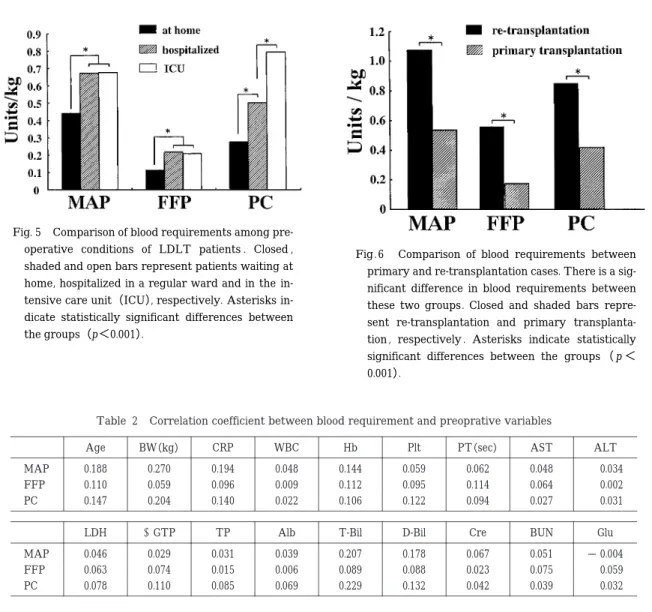
かった.原疾患では先天性胆道閉鎖症(Biliary atresia:BA)(MAP,PC:p<0.001)および Budd- Chiari 症候群(MAP:p<0.001)は他疾患に比較 して有意に多くの輸血量を必要とした(Fig. 4).ま た,術前に入院状態にある患者は在宅患者に比べ て多くの輸血量を(MAP,FFP,PC:p<0.001), 集中治療室(intensive care unit:ICU)入院患者 は一般病棟入院患者に比べて多くの PC 輸血を必 要とした(PC:p<0.001,Fig. 5).さらに,再移 植症例では初回移植症例と比較して有意に多量の 輸血量を必要とした(MAP:p<0.001,PC:p<
0.001,Fig. 6).しかし,全症例を対象に,移植前 の血液生化学データーと MAP,FFP,そして PC の輸血必要量との関係を相関分析によって解析し たところ有意差はみられなかった(Table 2).
考 察
生体肝移植は,脳死グラフトが圧倒的に不足す るわが国ではとくにさかんに施行され,現在では
手技的にも確立し保険適応も認められている.現 在,生体肝移植の術式と術後管理を学ぶべく,国 内および世界各地から京大病院へ見学者や研修生 が多数訪れている.生体肝移植はわが国のみなら ず中国や台湾などアジア諸国,欧米を含め世界的 にも今後一層増加すると考えられる.実際,米国 でも小児に対する脳死肝グラフトの不足から生体 肝移植が急激な勢いで増加しつつある.京大病院 では 1990 年に第 1 例目が施行され,2003 年 6 月 現在で 960 症例を数え,単一施設としては世界最 多である.このような状況を鑑みれば,生体肝移 植における輸血療法についてできるだけ多くの情 報を整理して解析し,その指針を早急に示すとと もに,貴重な医療資源である献血を大量に使用す る生体肝移植の輸血療法の妥当性を社会に対して 説明しなければならない.その責務はわが国にお いて最大の症例数を経験してきた京大病院にある と考え,生体肝移植における輸血療法のデーター Fig. 1 Annual changes in the number of LDLT patients and blood requirements at
Kyoto University Hospital(from 1990 to 2002). Open, shaded and closed bars indi- cate the numbers of LDLT cases per year, and of patients under and over 18 years old, respectively. Blood transfusion volumes are indicated as units!kg. Open circle, closed square, and closed triangle represent MAP, PC and FFP, respectively.
を解析した.
脳死肝移植患者における術前因子と輸血量との 相関性を求めた研究は散見される.Steib4)や Find- lay5)らは輸血量の移植前の予想は困難で,臨床で 用いるには正確性に乏しく,患者の術前因子より も手術手技などの手術中因子に大きく左右される と報告している.しかし,われわれは生体肝移植 における輸血量を予知できないか,あるとすれば その指標は何かという観点から検討した.その結 果,われわれの現在の生体肝移植に対する輸血準 備量は後方視的に算出した輸血量と比較しても妥 当なものであり,最近の症例で検討してみても約
80%〜90% の症例で準備量以内にて対処可能で あることが示された.
しかし,今回の解析結果では,小児生体肝移植 の代表的な疾患である BA や,患者の術前状態や 再手術症例などにおいて輸血量の有意差を認めた ものの,全症例を対象とした場合,輸血量と血液 生化学データーとの相関は認められなかった.ま た,小児症例は成人症例に比べて輸血量が多い結 果が得られたが,血液製剤の標準的な内容量が小 児を対象に作製されていない点を考慮する必要が あろう.Fig. 2 を見てみると,たとえば MAP の輸 血量が,小児で 1 単位!kg 以上,成人では 20 単位 Fig. 2 Percentile plots for the volume of blood transfused for LDLT. Plots for pa-
tients under 18 are shown in A(MAP),C(FFP)and E(PC), and over 18 in B
(MAP), D(FFP)and F(PC). The horizontal lines indicate the present volume of blood preparations for LDLT at Kyoto University Hospital.
以上の通常準備量を超えた症例が,1990 年からの 全 772 症 例 で 見 れ ば 各 々 17.3% お よ び 29.8%,
2002 年 8 月から 2003 年 7 月までの 1 年間の集計 では各々 7.4% および 20.9% 認められている.こ のことから,とくに臨床の現場で問題となる,輸 血必要量が大量になると推定される症例を術前に 把握できる血液生化学的指標を検討する必要があ ると考えられる.多量の輸血を必要とした症例で は肝移植そのものの予後も悪いと言う報告6)もあ るが,今後これらの多量輸血例に関しての危険因 子を移植手術前に把握することは非常に重要と思 われ,さらなる検討が必要と考えられた.一方,
MAP や PC に比 較 し て FFP は 年 次 変 動 が 少 な かった.これは肝移植後ただちに凝固系の回復が みられ,過凝固による血栓症の合併を防ぐ意味で,
当院では FFP の使用を可及的少量にしてきたた めと考えられる7)8).FFP は標準的リスクの生体 Fig. 3 Comparison of blood requirements between
child and adult LDLT patients. Closed and shaded bars represent patients aged under and over 18 years old, respectively. Asterisks indicate statisti- cally significant differences between the groups
(p<0.001).
Fig. 4 Comparison of blood requirements by LDLT indication. BA:biliary atresia, LC:liver cirrhosis, PBC:primary biliary cirrohsis, PSC:primary sclerotic cho- langitis. Closed, shaded and open bars represent MAP, PC and FFP, respectively.
Asterisks indicate statistically significant differences between the groups (p< 0.001).
Table 2 Correlation coefficient between blood requirement and preoprative variables
ALT AST
PT(sec)
Plt Hb
WBC CRP
BW(kg)
Age
0.034 0.048
0.062 0.059
0.144 0.048
0.194 0.270
0.188 MAP
0.002 0.064
0.114 0.095
0.112 0.009
0.096 0.059
0.110 FFP
0.031 0.027
0.094 0.122
0.106 0.022
0.140 0.204
0.147 PC
Glu BUN
Cre D-Bil
T-Bil Alb
γGTP TP LDH
− 0.004 0.051
0.067 0.178
0.207 0.039
0.031 0.029
0.046 MAP
0.059 0.075
0.023 0.088
0.089 0.006
0.015 0.074
0.063 FFP
0.032 0.039
0.042 0.132
0.229 0.069
0.085 0.110
0.078 PC
肝移植の場合,10 単位の準備量でほぼ十分である と考えられる.
生体肝移植は出血量が多く,手術にあたって多 量の輸血準備が必要であり,いきおい血液セン ターに多大の負担をかけることになる9).われわ れは 2002 年 4 月に輸血の準備量をあらためた結 果,血液センターに一度に 20 単位以上の MAP を発注する回数は激減した(Fig. 7).貴重な医療資 源である献血を有効に利用するためにも,医学の 進歩とともに,その都度 MSBOS を見直す必要が あると考えられた.加えて,輸血管理 24 時間体制 の早急な構築10),また FFP を手術室に運び込ま
ず,輸血部保存とし必要量のみ手術中に解凍・使 用することが必要であろう.また,血液センター の協力を得て,有効使用期限の短い血小板製剤は 血液センターに発注のみ行い,必要時に手術中に 配送できるようにした.
このように輸血を管理する側から臨床の現場に 積極的に働きかけ,実際のデーターを解析して臨 床サイドに示すことで移植外科医,麻酔医の理解 と協力を容易に得ることができた.現在,MAP の 輸 血 は Ht で 20%〜25%,PC の 輸 血 は 5 万! µL を指標に,また FFP は術中に AT-III を測定し ながら 70% を目安に使用している.生体肝移植手 Fig. 5 Comparison of blood requirements among pre-
operative conditions of LDLT patients . Closed , shaded and open bars represent patients waiting at home, hospitalized in a regular ward and in the in- tensive care unit(ICU), respectively. Asterisks in- dicate statistically significant differences between the groups(p<0.001).
Fig . 6 Comparison of blood requirements between primary and re-transplantation cases. There is a sig- nificant difference in blood requirements between these two groups. Closed and shaded bars repre- sent re-transplantation and primary transplanta- tion , respectively . Asterisks indicate statistically significant differences between the groups (p< 0.001).
術時の輸血管理においては,血液センターと輸血 部間で密に情報交換を行い,緊急時には即座に対 応できる供給体制を確保しておくことが肝要であ る.加えて,輸血部技官・教官は臨床の現場に出 向いて回診やカンファレンスなどに参加して,外 科系主治医との間につねに良好なコミュニケー ションを維持し,生体肝移植という治療法の特殊 性と輸血療法・輸血管理の重要性を互いに理解す れば,貴重な献血の有効利用が推進でき,また臨 床に役立つあたらしい輸血検査法の開発にも繋が ると期待される.
結 語
京大病院における生体肝移植に対する輸血管理 と輸血療法を述べた.原疾患により必要とする血 液量は異なること,再移植症例では輸血量が多く なること,待機的手術と緊急手術では輸血量が異 なることなどを明らかにしたが,症例全体を通し た統計解析結果では,個々の症例の輸血量と血液 生化学検査成績とのあいだに相関を認めなかっ た.しかし,生体肝移植に対する輸血管理を行う 上でとくに問題となるのは,多量の輸血を必要と
する症例を術前にいかに把握するかということで ある.今後,多量の輸血を必要とした症例に関し て,血液生化学検査から見た危険因子を統計学的 に詳しく解析し,さらなる検討を行いたい.
(*本論文の要旨は,第 51 回日本輸血学会総会(小倉,平成
15 年 5 月 29 日)の一般講演,および第 27 回日本血液事業 学会総会(京都,平成 15 年 9 月 19 日)の公開講座にて発 表した.)
文 献
1)日本肝移植研究会:肝移植症例登録報告.日本移 植学会誌,37:245―250, 2002.
2)上本伸二, 他:小児生体部分肝移植. 臨床外科,
55:55―59, 2000.
3)笠原群生,他:わが国における肝移植の現状と展 望.消化器外科,25:277―282, 2002.
4)Steib, A., Freys, G., Lehmann, C., Meyer, C. and Mahoudeau, G.:Intraoperative blood losses and transfusion requirements during adult liver transplantation remain difficult to predict. Can.J.
Anaesth., 48:1075―1079, 2001.
5)Findlay, J.Y., Rettke, S. R . : Poor prediction of blood transfusion requirements in adult liver transplantations from preoperative variables . J . Clin. Anesth., 12:319―323, 2000.
6)Mor, E., Jennings, L., Gonwa, T.A., Holman, M.J., Gibbs, J., Solomon, H., Goldstein, R.M., Husberg, B.
S., Watemberg, I.A. and Klintmalm, G.B.:The im- pact of operative bleeding on outcome in trans- plantation of the liver . Surg . Gynecol . Obstet . , 176:219―227, 1993.
7)Dupont, J., Messiant, F., Declerck, N., Tavernier, B . , Jude , B . , Durinck , L . , Pruvot , F . R . and Scherpereel , P . : Liver transplantation without the use of fresh frozen plasma. Anesth. Analg., 83:681―686, 1996.
8)Stahl, R.L., Duncan, A., Hooks, M.A., Henderson, J.
M., Millikan, W.J. and Warren, W.D.:A hyperco- agulable state follows orthotopic liver transplan- tation. Hepatology, 12:553―558, 1990.
9)河村朋子,他:生体肝移植における輸血.血液セ ンターの立場から.血液事業,23:69―74, 2000.
10)万木紀美子,他:京都大学病院における輸血検査 24 時間体制の構築過程から学んだこと.日本輸血 学会雑誌,49:673―677, 2003.
Fig. 7 Changes in number of blood orders over 20 units per one patient per day to Kyoto Blood Cen- ter.