【原 著】
Original
低温保存から 10℃ または 28℃ に曝露された赤血球製剤の品質
内藤 祐1) 秋野 光明2)3) 柴 雅之4) 藤原 満博1) 有澤 史倫1)
遠藤 正浩1)3) 本間 稚広1) 山本 哲5) 池田 久實5) 紀野 修一1)
牟禮 一秀1) 髙本 滋1)
日本において,赤血球製剤(RBC)は,2〜6℃ で保存しなければならない.しかし,RBC は,製品出荷や輸血検 査等で一時的に保存温度の範囲外に曝露される場合がある.本検討では,保存温度の範囲外に曝露された照射赤血球 液-LR「日赤」(Ir-RBC-LR)の品質を調べた.
Ir-RBC-LR が,保存 9 日目あるいは 16 日目に 10℃ で 24 時間曝露され,再び 4℃ 保存された場合,溶血率は 10℃
曝露による影響をみとめず,保存 28 日目まで 0.3% 以下であった.ATP 濃度は,保存 28 日目で 3.5
μ
mol/gHb 以上 を維持した.Ir-RBC-LR が,保存 10 日目に 28℃ で 3 時間曝露あるいは保存 10 および 14 日目に 1 時間曝露され,再 び 4℃ 保存された場合,溶血率は保存 28 日目まで 0.2% 以下であった.ATP 濃度は,4℃ 保存群および 28℃ 保存群 何れも,保存 28 日目で 3.0μmol/gHb 以上を維持した.以上の結果から,Ir-RBC-LR は,10℃ 曝露が 24 時間,28℃ 曝露が 3 時間あるいは 1 時間 2 回までであれば,赤血 球の品質に与える影響は少ないと考えられた.
キーワード:赤血球濃厚液,保存温度,赤血球品質,30 分ルール
はじめに
赤血球製剤(RBC)の保存温度は,品質維持や細菌 増殖抑制のため,各国 1 または 2〜6℃ と規定されてい る(Table 1)1)〜5).例外として,イギリスは,保管機器 の故障等によって RBC が保存温度から逸脱した時,そ の温度が 1〜10℃ で 5 時間以内,1 回のみであれば,製 品の出荷をみとめている. また,RBC の輸送温度は,
欧州と米国では上限を 10℃ と規定している.
米国2),カナダ3)およびオーストラリア6)では,医療機 関内で,輸血のために出荷された RBC が 30 分以上冷 蔵されていなかった場合,その製剤は在庫に戻しては ならないとしている.これは, 30 分ルール として知 られ,Pick らは,室温で赤血球の viability を維持する には,30 分を超えてはならないと結論した7).しかし,
この検討では,全血液が用いられており,現在の RBC と同一ではない.さらに,RBC の品質や細菌増殖に関 する結果も示されていない. 近年, 30 分ルール は,
現代の輸血療法には合致しないとして,その妥当性に
ついて検証されている8)〜17).
一方,本邦では,欧米と同様,RBC を管理外の温度 に置く限界は 30 分とされているが18),RBC が保存温度 の管理外に曝露された時,赤血球の品質に与える影響 を検証した報告は少ない.そこで,RBC が保存温度の 管理外に曝露された時の赤血球品質への影響を 2 条件 の温度で検討した.1 つは,保管機器の故障や海外で実 用されている輸送温度を想定し,Ir-RBC-LR の有効期間 内前期(保存 9 日目)と後期(保存 16 日目)に 10℃
で曝露した.もう 1 つは,医療機関において輸血検査 等で保冷庫から出庫された場合を想定し,同様に有効 期間中期(保存 10 および 14 日目)に室温(28℃)に 曝露した.
材料および方法
検討
1.Ir-RBC-LR
相当模擬血液の内部温度測定 1 または 2 単位の Ir-RBC-LR に相当する模擬血液は,ACD-A 液(カーミパック ACD-A 液,Kawasumi Labo-
1)日本赤十字社北海道ブロック血液センター 2)日本赤十字社関東甲信越ブロック血液センター 3)日本赤十字社血液事業本部
4)日本赤十字社血液事業本部中央血液研究所 5)北海道赤十字血液センター
〔受付日:2017 年 6 月 5 日,受理日:2017 年 8 月 5 日〕
Fig. 1 Temperature measurements
The core temperature was measured by inserting the probe of the data logger into the approximate center of the bag.
Data logger
Probe
Table 1 Regulation temperatures during storage and transportation of red blood cell products in countries including Japan
Storage Transportation
Japana) 2 to 6℃ 2 to 6℃*1)
USAb) 1 to 6℃ ≤10℃*2)
Canadac) 1 to 6℃ ≤10℃,24 hr
Europed) 2 to 6℃*3) ≤10℃,24 hr
UKe): ≤10℃,12 hr
a) Minimum Requirements for Biological Products
b) American Association of Blood Banks. Standards for blood banks and transfusion services 29th edition
c) Canadian Blood Services. Clinical guide to transfusion, Chapter 2: Blood Components.
d) Guide to the preparation, use and quality assurance of blood components. 18th edition
e) Guidelines for the blood transfusion services in the United Kingdom. 8th ed. London
*1) Components are transported in validated shipping containers at 2 to 6℃.
*2) The transportation is not time-bound.
*3) In the UK, exceptionally, it is allowed that the core temperature may extend from 1 to 10℃, providing that this deviation has happened on one occasion only, and that the duration is no longer than five hours.
ratories, Inc.)を血液分離バッグ(200m
l
:KBP-200C,400m
l
:KBP-400C,Kawasumi Laboratories, Inc.)に約 130ml
(ACD-A-1)または約 280ml
(ACD-A-2)添加 して作製した.模擬血液バッグには,温度データロガー(おんどとり TR-81,T&D Corporation)のセンサ(TR- 8120,T&D Corporation)を取り付けた(Fig. 1).ACD- A-1 および ACD-A-2 は,2〜6℃ で冷蔵後,10℃ または 28℃ に設定されたインキュベーター(CN-25C,Mitsub- ishi Electric Engineering Co., Ltd.)に静置した.模擬血 液の内部温度は,5 分間隔で 5 時間測定した.温度測定 は各 6 回行った.
検討
2.Ir-RBC-LR
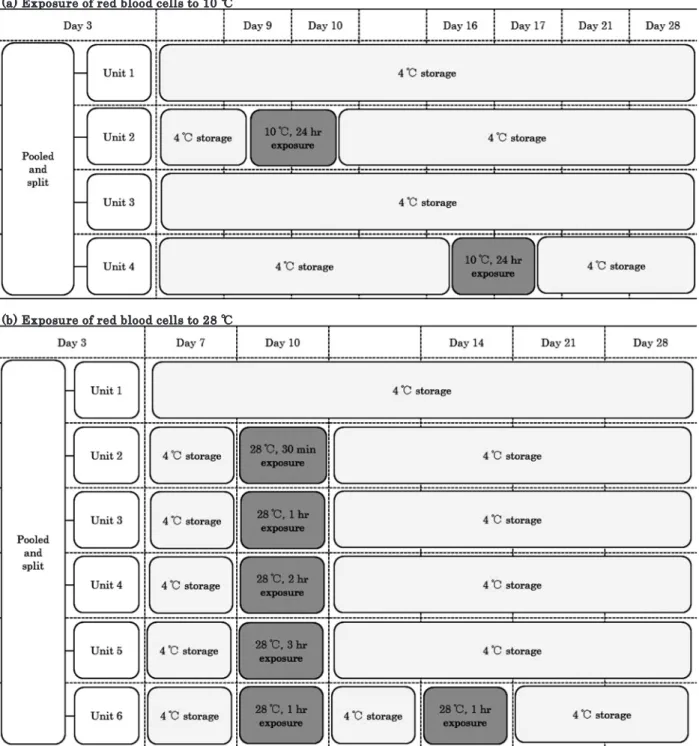
の品質変化 1.Ir-RBC-LR の 10℃ 曝露試験には採血後 3 日目の ABO 同型 Ir-RBC-LR2(採 血後 2 日目に放射線照射)を 2 バッグ用意し,血液分
離バッグ(KBP-1000C,Kawasumi Laboratories, Inc.)
にプールおよび混和した. プールした Ir-RBC-LR は,
血液分離バッグ(KBP-200C,Kawasumi Laboratories, Inc.)に 4 分割し,1 単位相当(約 130m
l
)となるよう に調整した(Fig. 2(a)).4℃ 保存の Ir-RBC-LR を 10℃に曝露し,再度 4℃ に戻して保存した影響をみるため,
4 バッグのうち 2 バッグは,それぞれ保存 9 日目(unit 2)または保存 16 日目(unit 4)に 10℃ で 24 時間曝露 し,再度 4℃ で保存した.残りの 2 バッグ(unit 1 およ び 3)は,それぞれ unit 2 および 4 の対照とし,継続し て 4℃ で保存した.Unit 1 および 2 の検体は,保存 3,
9,10,16,21 および 28 日目に採取した.Unit 3 およ び 4 の検体は,保存 3,9,16,17,21 および 28 日目 に採取した.10℃ 曝露の検討は同プロトコールで 6 回実施した.
2.Ir-RBC-LR の 28℃ 曝露
試験には採血後 3 日目の ABO 同型 Ir-RBC-LR2(採 血後 1 または 2 日目に放射線照射)を 3 バッグ用意し,
血液分離バッグ(KBP-1000C,Kawasumi Laboratories, Inc.)にプールおよび混和した.プールした Ir-RBC-LR は,血液分離バッグ(KBP-200C,Kawasumi Laborato- ries, Inc.)に 6 分割し,1 単位相当(約 130m
l
)となる ように調整した(Fig. 2(b)).4℃ 保存の Ir-RBC-LR を 28℃ に曝露し,再度 4℃ に戻して保存した影響をみ るために,6 バッグのうち 4 バッグは保存 10 日目に 28℃で そ れ ぞ れ 30 分(unit 2),1 時 間(unit 3),2 時 間
(unit 4)および 3 時間(unit 5)曝露し,再度 4℃ に保 存した.1 バッグは保存 10 日目および 14 日目に 28℃
でそれぞれ 1 時間曝露した(unit 6).1 バッグは対照と し,継続して 4℃ で保存した(unit 1).検体は,保存 3,7,10,14,21 および 28 日目に採取した.28℃ 曝 露の検討は同プロトコールで 6 回実施した.
Fig. 2 Experimental design
(a) Two units of red blood cell components from 400 ml of whole blood donation were pooled and split into 4 units (130 ml/unit) 3 days after the donation and stored at 4℃. Units #1 and #3 were negative controls for #2 and #4, respectively. Units #2 and
#4 were exposed to 10℃ for 24 hours on days 9 and 16, respectively. Samples were taken on days 3, 9, 10, 16, 21 and 28 from units #1 and #2. From units #3 and #4, samples were taken on days 3, 9, 16, 17, 21 and 28 for analyses of red blood cell quality.
(b) Three units of red blood cell components from 400 ml of whole blood donation were pooled and split into 6 units (130 ml/
unit) 3 days after the donation and stored at 4℃. Unit #1 was a negative control. Units #2, #3, #4 and #5 were exposed to 28℃
for 30 min, 1 hour, 2 hours and 3 hours on day 10, respectively. Unit #6 was exposed to 28℃ for 1 hour on days 10 and 14.
Samples were taken on days 3, 7, 10, 14, 21 and 28 for analyses of red blood cell quality.
(a) Exposure of red blood cells to 10 䉝
(b) Exposure of red blood cells to 28 䉝
3.各種パラメーターの測定
pH は,ガラス電極法または全自動血液ガス・電解質 分析装置(cobas b 221,Roche Diagnostics K. K.)によっ て測定した.アデノシン-5ʼ-三リン酸(ATP)濃度は,
除蛋白処理後の抽出物を検体として,生物発光法で測 定した.2,3-ジホスホグリセリン(2,3-DPG)濃度は,2,3- DPG テスト「RD」(Roche Diagnostics K. K.)を用いて 酵素法で測定した.
Fig. 3 Morphology of red blood cells
Individual cells in (a)‒(d) show the various stages of morphological change that red blood cells undergo during storage, named discocyte, echinocyte I, echinocyte II and spherocyte, respectively. The morphology score of a total of one hundred red blood cells was calculated by multiplying the number of discocytes by 3, echinocyte Is by 2, echinocyte IIs by 1 and spherocytes by 0 and then adding them together.
a
a b b c c d d
Fig. 4 Temperature profiles
ACD-A-1 and -2 corresponding to Ir-RBC-LR-1 and -2, respectively, were been exposed to 10℃ (a) or 28℃ (b) for 300 min.
Data are represented as mean, n=6.
Ir-RBC-LR の一部は,遠心(3,000 rpm,10 分,4℃)
し,上清採取後,再度,同条件で遠心し,採取した上 清を検体とした.上清中のヘモグロビン(Hb)濃度は Leuco crystal violet 法で測定し,溶血率を算出した19). 赤血球形態は,赤血球をグルタールアルデヒドで固定 後,走査型電子顕微鏡(JCM-5700,JEOL Ltd.)または 微分干渉顕微鏡(BX53DIC,Olympus Corporation)に よって観察した.Morphology score は,discocyte を 3,
echinocyteI を 2,echinocyte II を 1 および spherocyte を 0 とし,100 個当たりの合計値で表した(Fig. 3)20).
4.統計
Ir-RBC-LR の 10℃ 曝露検討は,4℃ 保存群と paired t-test を用いて比較し,危険率(P)5% 未満を有意とし た.Ir-RBC-LR の 28℃ 曝露検討は,4℃ 保存と他条件 の比較について,Repeated Measures ANOVA で検定 後,Dunnettʼs test を用い,危険率(P)5% 未満を有意 とした.統計処理には GraphPad Prism(Version 6.0,
GraphPad Software, Inc., USA)を用いた.
結 果
1.模擬血液の内部温度
Ir-RBC-LR が 10℃ または 28℃ に曝露された時の内部 温度変化について,模擬血液を用いて調べた.模擬血 液が 10℃ に曝露された時(Fig. 4(a)),ACD-A-1 は 30 分で 7.7±1.2℃,60 分で 8.7±0.9℃ となった.ACD- A-2 は 30 分で 7.3±1.2℃,60 分で 8.2±1.1℃ となった.
同様に,模擬血液が 28℃ に曝露された時(Fig. 4(b)),
1 単位は 30 分で 15.2±0.2℃,60 分で 21.1±0.2℃ となっ た.2 単位は 30 分で 12.0±0.1℃,60 分で 17.5±0.1℃ と なった.
2.Ir-RBC-LR
の10℃ 曝露
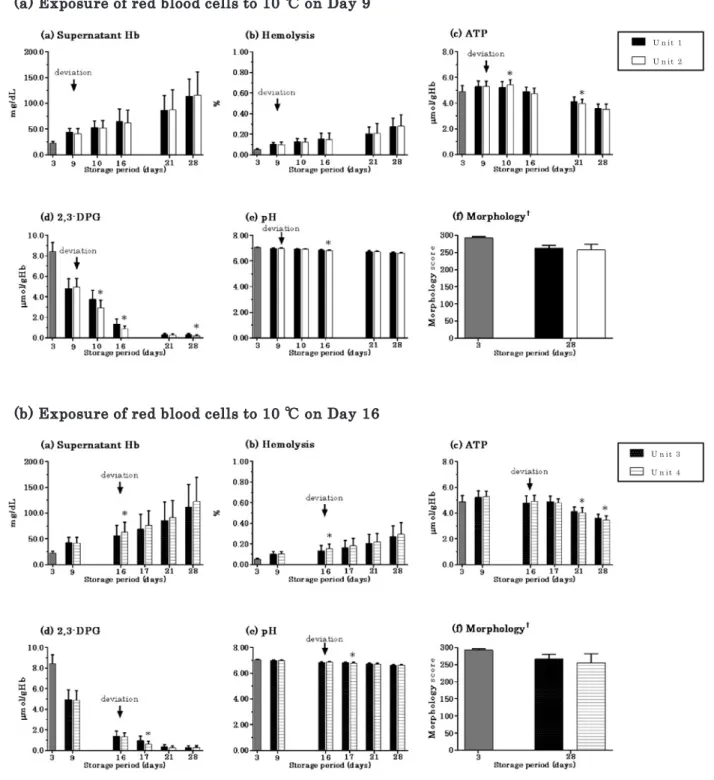
Ir-RBC-LR を 10℃ に曝露し,再び 4℃ に戻して保存 した時の品質変化を調べた.保存 9 日目に 10℃ で 24 時間曝露した時(Fig. 5(a)),上清 Hb 濃度および溶血 率は,保存 10 日目において,unit 1(対照)と 2 の間 に有意差をみとめなかった.unit 2 の ATP 濃度は,保 存 21 日目において保存 3 日目の値(4.8±0.5μmol/gHb)
の 80% 以上を維持した.2,3-DPG 濃度は,unit 2 が保存 10 日目以降,unit 1 に比較し低値であったが,保存 21
Fig. 5 Levels of in vitro parameters of Ir-RBC-LR after exposure to 10℃ for 24 hr: supernatant Hb (a), hemolysis (b), ATP (c), 2, 3-DPG (d), pH (e), and morphology (f).
Data are represented as mean±standard deviation, n=6. †: n=4.
*Comparison of in vitro parameter levels between control and treated units with paired t-test at each point. Significance was set at p<0.05.
(a) Exposure of red blood cells to 10
䉝on Day 9
(b) Exposure of red blood cells to 10
䉝on Day 16
U n i t 1 U n i t 2
U n i t 3 U n i t 4
日目および 28 日目では共に 1.0μmol/gHb 以下となった.
pH は,10℃ 曝露後,保存 10,21 および 28 日目におい て,unit 1 と unit 2 の間に有意差をみとめなかった.Mor- phology score は,unit 2 が保存 28 日目において 258
±17 であり,unit 1 と有意差をみとめなかった.
一方,保存 16 日目に 10℃ で 24 時間曝露した時(Fig.
5(b)),2,3-DPG 濃度は,unit 4 が保存 17 日目以降,
unit 3(対照)に比較し低値であったが,共に 1.0
μ
mol/gHb 以下であった.上清 Hb 濃度,溶血率,ATP 濃度,
pH および Morphology score は,10℃ 曝露後,顕著な 変化がみられなかった.
Fig. 6 Levels of in vitro parameters of Ir-RBC-LR after exposure to 28℃ for specified periods: supernatant Hb (a), hemolysis (b), ATP (c), 2,3-DPG (d), pH (e), and morphology (f).
Data are represented as mean±standard deviation, n=6. †: n=5. ‡: n=4.
*Comparison of in vitro parameter levels between control and treated units with Dunnettʼs test at each point. Significance was set at p<0.05.
3.Ir-RBC-LR
の28℃ 曝露
Ir-RBC-LR を 28℃ に曝露し,再び 4℃ に戻して保存 した時の品質変化を調べた(Fig. 6).上清 Hb 濃度は,
保存 10 日目および 14 日目において,unit 1(対照)が それぞれ 22.8±4.3,25.8±3.3mg/d
l
であり,各 28℃ 曝 露群との間に有意差をみとめなかった.溶血率は,保 存 28 日目までいずれの群も 0.2% 以下であった.ATP 濃度は, 28℃ 曝露後, 著しい変化をみとめなかった.また,unit 1 は,保存 21 日目および 28 日目において,
それぞれ 4.3±0.3,3.5±0.2
μ
mol/gHb となり,各 28℃曝露群との間に有意差をみとめなかった.2,3-DPG 濃度 は,保存 10 日目において,unit 2,3,4 および 5 が,
それぞれ 3.4±1.2,3.2±1.2,2.7±1.1 および 2.1±0.9μmol/
gHb となり,28℃ に曝露された時間が長い程低値となっ た.pH は,28℃ 曝露による著しい変化をみとめなかっ た.Morphology score は,unit 1 が保存 28 日目におい て 243±4 であり,各 28℃ 曝露群との間に有意差をみ とめなかった.
考 察
本検討では,Ir-RBC-LR が保存温度の範囲外に一定時 間曝露された時,その温度と経過時間が赤血球品質に 与える影響を検討した.
Ir-RBC-LR が保存 9 日目または 16 日目に,10℃ で 24 時間曝露後,4℃ に再保存された場合,赤血球の溶血,
ATP 濃度および赤血球形態には大きな影響を与えない と考えられた(Fig. 5).RBC の 13℃,24 時間曝露を 5 回繰り返す際の品質について検討した報告16)は,我々 の検討に比べて,曝露した温度は高く,回数も多いが,
RBC の品質低下はなかった.
海外のガイドライン2)3)6)では,RBC において, 30 分ルール が提唱されている.本邦では,RBC を手術 室等で 30 分以上手元に置く場合,2〜6℃ で保存するこ ととされる18). 30 分ルール は,Pick ら7)の報告が嚆 矢とされるが,この研究では全血液が用いられており,
赤血球の品質や細菌増殖に関する検討はされていない.
本検討では,RBC が保冷庫から取り出され,室温に曝 露された時を想定して,血液バッグ内部温度および赤 血球品質を調べた.なお,室温は,夏季エアコン冷房 政府推奨設定温度21)である 28℃ とした.
Ir-RBC-LR の代用とした ACD-A-2(約 280m
l
)およ び ACD-A-1(約 130ml
)を 28℃ に曝露した時,血液バッ グ内部温度は,30 分でそれぞれ 12.0±0.1℃ および 15.2±0.2℃ となった(Fig. 4).RBC(約 300m
l
)を室温に 曝露した時,30 分後の温度は 11.6℃〜11.8℃ であった との報告もある14)15).Ir-RBC-LR は全血液から血漿の大部分を取り除き,赤血球保存液が添加され,また,内 部温度変化は Ir-RBC-LR の容量によっても異なるため,
Pick らが全血液を用いて検討し,提唱した 30 分ルール は,現代に合致しないと思われる.
Ir-RBC-LR が保存 10 日目あるいは保存 10 日目と 14 日目に 28℃ で曝露した時の赤血球品質については,Ir- RBC-LR を 28℃ で 3 時間曝露した場合,あるいは 28℃
で 1 時間曝露を 2 回繰り返した場合でも,赤血球の溶 血率は保存 28 日目まで欧州基準(0.8% 以下)22)を満た しており,ATP 濃度は保存 28 日目まで容認レベル(2.3
μmol/gHb)
23)以上を維持した.Morphology score は 4℃保存群と各 28℃ 曝露群との間に有意差はなかった.2,3- DPG 濃度は,28℃ 曝露の時間が長くなるほど低値となっ たが,2,3-DPG レベルは輸血後に回復するとされる24). 以上のことから,Ir-RBC-LR が 28℃ で 3 時間曝露ある いは 28℃ で 1 時間曝露を 2 回繰り返すのであれば,品 質への影響は少ないと考えられた(Fig. 6).Thomas ら12)も,RBC を 30℃ で 60 分間,3 回(保存 15,17 お よび 21 日目)曝露したが,溶血率は 4℃ 保存に比べて 有意な上昇がみられず,保存 28 日目の ATP 濃度は容 認レベル以上であったと報告している.
本検討では放射線照射の RBC を用いたが,日本赤十 字社は放射線未照射の RBC も供給している.未照射 RBC の低温保存における品質変化は,上清カリウム濃度を 除き,照射 RBC と同等である25)ことから,本検討結果 は未照射 RBC にも適用可能と思われた.
RBC の温度上昇に起因する細菌増殖も重要な問題で ある.赤血球製剤は細菌に汚染された場合,菌種や菌 濃度にも因るが,著しい溶血や血液バッグ全体が黒色 化する等の外観変化が観察される26).今回,少なくとも 検討に使用した Ir-RBC-LR は,いずれも保存 28 日目ま で,色調や外観に異常はみられなかった.Ramirez-Arcos ら13)は,RBC に好冷性細菌を接種し,室温で 30 分間 6 回,または 60 分間 3 回曝露した.その結果,細菌増殖 やエンドトキシン産生は,4℃ 保存と差がなかったこと を示し, 30 分ルール から 60 分への延長が妥当であ るとした.Dumani ら11)は,米国食品医薬品局が,2007 年から 2011 年の間に,細菌汚染された RBC を原因と する死亡事例はないと報告している27)ことから, 30 分ルール は 60 分に延長しても細菌汚染事故は増加し ないだろうと述べている. また,RBC の細菌汚染は,
献血者スクリーニング,採血時皮膚消毒,初流血除去 および白血球除去等の適用によっても減少すると述べ ている.本邦においても,初流血除去,保存前白血球 除去導入後,RBC で細菌感染が特定された例はないこ とから28),RBC を室温で 60 分曝露しても,細菌汚染事 故の発生リスクは低いと考えられる.2016 年 6 月,英 国は,RBC が 6 時間冷蔵されていること,3 回以上保
管温度外に曝露されていないことを条件に,30 分ルー ル を 60 分に変更した29).また,カナダでは,60 分へ 延長することを検証するため,数種の菌種を用いた研 究が行われている15).
以上,保存温度管理外に曝露された RBC について,
10℃,24 時間以内であれば,赤血球品質には影響が少 なく,安全に使用可能であると言える.また,この条 件は欧州22)の RBC 輸送条件と同様であることから,本 邦における RBC の輸送にも適用可能と考えられた.28℃
で 3 時間あるいは 28℃ で 1 時間が 2 回以内の曝露の時,
赤血球品質に及ぼす影響は少なく,近年報告されてい る 30 分ルール 延長に関する検討も考慮すると,少 なくとも 28℃ で 60 分以内での室温曝露であれば,安 全に使用可能と考えられた.本検討結果は赤血球輸血 の安全性確保のみならず,不適切な保管による廃棄が 減少することが期待でき,献血血液の有効利用にも寄 与すると考える.
著者の COI 開示:本論文発表内容に関連して特に申告なし 本論文の内容の一部は,第 65 回日本輸血・細胞治療学会総会
(2017,千葉)において発表した.
文 献
1)生物学的製剤基準:厚生労働省告示第 192 号,2015.
2)American Association of Blood Banks: Standards for blood banks and transfusion services 29 th edition, American Association of Blood Banks, Bethesda (MD), 2014.
3)Kraegel J, ed: CSA (Canadian Standards Association) Z 902-10 blood and blood components. Standard 10.10.5, Canadian Standards Association, Mississauga ( ON ) , 2010.
4)Chapter 4: Principles of blood component processing.
Guide to the preparation, use and quality assurance of blood components, 18th edition, Council of Europe Pub- lishing, Strasbourg, 2015, 85―114.
5)Guidelines for the blood transfusion services in the United Kingdom, 8th edition, The Stationary Office, Lon- don, 2013.
6)The ANZSBT Clinical Practice Improvement Commit- tee (CPIC), the Australian Specialist Practitioners of Transfusion (AUS SPOT), Royal College of Nursing Aus- tralia (RCNA): Australian and New Zealand Guidelines for the Administration of Blood Products, 2nd edn, 2011, Guideline 5.5.1 (“30-minute rule for red cells”).
7)Pick P, Fabijanic J: Temperature changes in donor blood under different storage conditions. Transfusion, 11 : 213―215, 1971.
8)Brunskill S, Thomas S, Whitmore E, et al: What is the maximum time that a unit of red blood cells can be safely left out of controlled temperature storage? Trans- fus Med Rev, 26: 209―223, 2012.
9)Thomas S, Hancock V, Cardigan R: Repeated short-term warming of red blood cell concentrates has minimal ef- fect on their quality. Vox Sang, 103: 113―121, 2012.
10)Reiter U, Reiter G, Wagner T, et al: Four-dimensional temperature distributions in red blood cells withdrawn from storage and exposed to ambient temperature: a magnetic resonance thermometry study. Transfusion, 53: 167―173, 2013.
11)Dumani D, Goldfinger D, Ziman A: Is the 30-minute rule still applicable in the 21 st century ? Transfusion, 53 : 1150―1152, 2013.
12)Thomas S, Hancock V, Cardigan R: The 30 minute rule for red blood cells: in vitro quality assessment after re- peated exposure to 30 degrees C. Transfusion, 53: 1169―
1177, 2013.
13)Ramirez-Arcos S, Perkins H, Kou Y, et al: Bacterial growth in red blood cell units exposed to uncontrolled temperatures: challenging the 30-minute rule. Vox Sang, 105: 100―107, 2013.
14)Ramirez-Arcos S, Mastronardi C, Perkins H, et al: Evalu- ating the 4-hour and 30-minute rules: effects of room temperature exposure on red blood cell quality and bac- terial growth. Transfusion, 53: 851―859, 2013.
15)de Grandmont MJ, Ducas E, Girard M, et al: Quality and safety of red blood cells stored in two additive solutions subjected to multiple room temperature. Vox Sang, 107:
239―246, 2014.
16)Wagner T, Pabst MA, Leitinger G, et al: Impact of con- stant storage temperatures and multiple warming cy- cles on the quality of stored red blood cells. Vox Sang, 106: 45―54, 2014.
17)Gulliksson H, Nordahl-Kallman AS: Effect of transient warming of red blood cells for up to 24 h: in vitro charac- teristics in CPD/saline-adenine-glucose-mannitol envi- ronment. Vox Sang, 106: 61―67, 2014.
18)輸血療法の実施に関する指針:厚生労働省医薬食品局血 液対策課,2014.
19)Sowemimo-Coker SO: Red blood cell hemolysis during processing. Transfus Med Rev, 16: 46―60, 2002.
20)柴 雅之,村 徹,増山哲也,他:MAP 加濃厚赤血
球の製造と長期保存試験.日本輸血学会雑誌,37:404―
410, 1991.
21)政府広報オンライン:室温 28℃ で快適に!クールビズ の 提 案.http://www.gov-online.go.jp/useful/article/2 01106/3.html(2017 年 3 月現在).
22)Chapter 5: Component monographs. Guide to the prepa- ration, use and quality assurance of blood components, 18th edition, Council of Europe Publishing, Strasbourg, 2015, 217―342.
23)Heaton WA: Evaluation of posttransfusion recovery and survival of transfused red cells. Transfus Med Rev, 6:
153―169, 1992.
24)Heaton A, Keegan T, Holme S: In vivo regeneration of red cell 2,3-diphosphoglycerate following transfusion of DPG-depleted AS-1,AS-3 and CPDA-1 red cells. Br J Haematol, 71: 131―136, 1989.
25)日本赤十字社医薬品情報:製品情報.http://www.jrc.
or.jp/mr/product/list/(2017 年 7 月現在).
26)名雲英人,佐竹正博:輸血用血液製剤の細菌汚染の現状 と対策.日本輸血細胞治療学会誌,60:3―11, 2014.
27)US Food and Drug Administration. Center for Biologics Evaluation and Research. Fatalities reported to FDA following blood collection and transfusion: Annual sum- mary for fiscal year 2011. 2011. [cited 2013 Feb 11]. htt p://www.fda.gov/BiologicsBloodVaccines/SafetyAvail ability/ReportaProblem/TransfusionDonationFatalitie s/ucm302847.htm
28)日本赤十字社医薬品情報:輸血の副作用.http://ww w.jrc.or.jp/mr/reaction/infection/bacterium/( 2017 年 3 月現在).
29)Joint UK Blood Transfusion and Tissue Transplanta- tion Services Professional Advisory Committee (JPAC):
Deviations from 4 ℃ temperature storage for red cells:
effect on viability and bacterial growth. http://www.tr ansfusionguidelines.org/document-library/general-doc uments (Accessed March 1, 2017).
QUALITY OF RED BLOOD CELLS SUBJECTED TO 10°C OR 28°C EXPOSURES
Yu Naito
1), Mitsuaki Akino
2)3), Masayuki Shiba
4), Mitsuhiro Fujihara
1), Fuminori Arisawa
1), Masahiro Endo
1)3), Chihiro Homma
1), Tetsu Yamamoto
5), Hisami Ikeda
5), Shuichi Kino
1), Kazuhide Mure
1)and Shigeru Takamoto
1)1)
Japanese Red Cross Hokkaido Block Blood Center
2)
Japanese Red Cross Kanto-Koshinetsu Block Blood Center
3)
Japanese Red Cross Blood Service Headquarters
4)
Japanese Red Cross Blood Service Headquarters Central Blood Institute
5)
Hokkaido Red Cross Blood Center
Abstract:
In Japan, red blood cell (RBC) products are routinely stored at 2-6˚C. However, RBC products may be temporar- ily exposed to temperatures outside of these storage temperatures when they are issued or tested for transfusion. In this study, we investigated the effect of exposure to temperatures outside of the storage temperatures on the quality of irradiated red blood cells-leukocytes reduced, Nisseki (Ir-RBC-LR).
When Ir-RBC-LR were exposed to 10˚C for 24 hours on day 9 or 16 and returned to 4˚C storage, hemolysis re- mained under 0.3% up to day 28. ATP levels of the test units were maintained above 3.5
μmol/gHb up to day 28.
Hemolysis of test units that were exposed to 28˚C for 3 hours on day 10 or 1 hour on days 10 and 14 was lower than 0.2% up to day 28. ATP levels of both control and test units on day 28 were higher than 3.0
μ
mol/gHb.These results suggest that there is no impact on the
in vitro
RBC quality after exposure to 10˚C for 24 hours or 28˚C for 3 hours.Keywords:
Red blood cell concentrate, Storage temperature, Red blood cell quality, 30-minute rule
!2017 The Japan Society of Transfusion Medicine and Cell Therapy Journal Web Site: http:!!yuketsu.jstmct.or.jp!