Quest for Financial Stability in East Asia: Establishment of an
Independent Surveillance Unit “AMRO” and Its Future Challenges
*1Akkharaphol Chabchitrchaidol
*2Satoshi Nakagawa
*3Special Advisor to the President for Global Strategy, Japan Credit Rating Agency, Ltd.
Chairman, The Association of Credit Rating Agencies in Asia
Yoichi Nemoto
*4Professor, Hitotsubashi University
Abstract
Regional Financial Arrangements in East Asia made large institutional advances in the aftermath of the Global Financial Crisis. The network of bilateral swap agreements (BSA) under the Chiang Mai Initiative (CMI) was multilateralized (CMIM) in 2010. An indepen- dent surveillance unit called the ASEAN+3 Macroeconomic Research Office (AMRO) was established in 2011. Focusing on AMRO, this paper aims to (1) indicate salient features of the surveillance activities conducted by AMRO when initially established as a private com- pany (“AMRO (Company)”) in 2011, (2) lay out the background and major changes upon the transformation of AMRO (Company) into an international organization (“AMRO (IO)”) in 2016, and (3) identify remaining challenges for AMRO (IO) in achieving monetary and financial stability in East Asia.
AMRO (Company)’s surveillance was characterized in that (1) it was undertaken in line with the needs of the ASEAN+3 authorities and (2) greater attention was paid on (a) short- term movements of private capital flows and (b) economic inter-linkages among ASEAN+3 countries where shocks may be transmitted. Upon the transformation into an international organization, AMRO (IO) was given new mandates to (1) support the CMIM’s operation and (2) publish its surveillance reports as per its pre-determined publication guideline. Re- maining challenges are suggested, among others, on (1) developing AMRO’s policy recom- mendation capacity, (2) enhancing AMRO’s roles in the CMIM activation process, (3) lead- ing the discussion on the CMIM’s coordination with bilateral and global support facilities, and (4) constant improvement of statistics.
Keywords: AMRO, ASEAN+3, ASEAN+3 Macroeconomic Research Office, Chiang Mai Initiative Multilateralization, CMIM, Economic Review and Policy Dia- logue, Establishment of International Organization, Global Financial Crisis, Global Financial Safety Net, International Monetary Fund, Regional Finan- cial Arrangement
JEL Classification: F33, F53, F55, K33
I. Enhancement of the Regional Financial Arrangements in East Asia in the aftermath of the Global Financial Crisis
I-1. The ASEAN+3 Financial Arrangements prior to the Global Financial Crisis The Asian Financial Crisis (AFC) in 1997-98 produced an unintended outcome, i.e., the start of regional financial arrangements among ASEAN countries, China, Japan and Korea.1
The AFC highlighted the danger of sudden changes in the direction of cross-border private capital flows and foreign exchange rates which caused foreign currency liquidity and finan- cial crises. After the AFC, the monetary and financial authorities in East Asia consolidated their economic policy and financial supervisory framework in their own jurisdictions. In ad- dition, they started to cooperate with their regional counterparts.
First, at the ASEAN+3 Finance Ministers’ Meeting (AFMM+3)
2in Chiang Mai, Thai- land in May 2000, they agreed to establish a regional financing arrangement to supplement the existing international facilities. It was called the “Chiang Mai Initiative (CMI).” The CMI consisted of (a) an expanded ASEAN Swap Arrangement
3and (b) a network of bilater- al swap agreement (BSA) facilities among ASEAN countries, China, Japan and Korea. Sec- ond, at the AFMM+3 in Shanghai, China, in May 2002, it was announced that the finance and central bank deputies would meet informally to discuss economic and policy issues, a framework now called “Economic Review and Policy Dialogue (ERPD).”
4Under these settings, the ASEAN+3 financial arrangements advanced steadily. By May 2004, the total number of BSAs under the CMI counted sixteen with the aggregate size of
*1 This paper is based upon Chabchitrchaidol, Nakagawa & Nemoto (2018) which was published in Japanese in the March 2018 issue of the Financial Review, Vol. 133, and updated pro re nata. The authors would like to thank Professor Masahiro Kawai and the participants in the thesis committee meeting for their valuable comments to this paper. Nemoto would like to thank the participants in the seminars held at Kyoto University, Thammasat University, Fudan University and Columbia Uni- versity for their inspiring comments and questions. Nonetheless, any errors and mistakes are entirely the fault of the authors.
The authors were previous staff of AMRO. However, the views expressed here are solely those of the authors in their private capacity and do not in any way represent the official views of ASEAN+3 Macroeconomic Research Office (AMRO) nor the ASEAN+3 authorities. The information contained in this article is based on public knowledge, publicly available information, the authors’ personal observation or the knowledge the authors had already possessed before working for AMRO. No confiden- tial information they received during their tenure at AMRO is disclosed in this paper.
*2 Former Senior Economist at AMRO, [email protected]
*3 Former Senior Coordination Officer at AMRO, [email protected]
*4 Former Director of AMRO, [email protected]
1 See Nemoto (2003) for details on the burgeoning of the ASEAN+3 financial arrangements.
For the development of policymakers’ discussions at Japan’s Ministry of Finance during the period between the support meeting for Thailand (“Friends of Thailand” meeting) in August 1997 and the agreement of the CMI in May 2000, see Minis- try of Finance (2017), pp. 321-328.
For the specific attempt to establish the Asian Monetary Fund (AMF), see Sakakibara (2000).
2 The ASEAN+3 Finance Ministers’ Meeting (AFMM+3) has been held regularly since 1999. The participants were expanded to include central bank governors in 2012 when the meeting was renamed as the “ASEAN+3 Finance Ministers and Central Bank Governors’ Meeting (AFMGM+3).”
All the Joint Statements of the AFMM+3 and the AFMGM+3 are available at AMRO’s website: http://www.amro-asia.org/
news-events/joint-statements/. The source of those Joint Statements in the following footnotes are the same.
3 On 17 November 2000, the ASEAN Swap Arrangement was expanded to cover all ASEAN member countries, and enlarged to US$ 1 billion.
4 Kuroda (2005) indicates that the CMI became a symbol of the regional financial cooperation in East Asia as the framework of financial safety-net was accompanied by the surveillance, pp. 182-184.
the network at US$ 36.5 billion.
5In May 2005, the ASEAN+3 Finance Ministers agreed to go further by: (i) integrating and enhancing the ASEAN+3 economic surveillance (namely
“ERPD”) into the CMI framework to enable early detection of irregularities and swift reme- dial policy actions with a view to developing effective regional surveillance capabilities; (ii) clearly defining the swap activation process and adopting a collective decision-making mechanism of the BSA network as a first step of its multilateralization
6; (iii) significantly in- creasing the swap size
7; and (iv) raising the swap amount that can be drawn without a link- age to an IMF
8program from 10% to 20%.
9The discussions on the CMI’s multilateralization (called “CMIM”) started in 2005. In May 2005, the ASEAN+3 Finance Ministers announced to “study various possible routes towards multilateralizing the CMI.” In the following year, the Ministers instructed their Deputies to set up a new task force to study the CMI’s multilateralization.
10However, the discussions lingered. The CMIM materialized only after the Asian countries went through the shock of the Global Financial Crisis (GFC) in 2008-09.
11I-2. Lessons from the Global Financial Crisis
The GFC reminded the ASEAN+3 financial authorities of the threat posed by sudden changes in the direction of cross-border private capital flows. Even after the GFC, such risk did not subside as the monetary authorities of the advanced economies started to employ an unconventional monetary easing policy led by the US Federal Reserve in 2008. Under such circumstances, internally, they recalibrated their exchange rate policy and introduced vari- ous macro-prudential policies. Also, externally, they sought to enhance regional financial ar- rangements such as the CMI as an added protective layer of support to help reinforce the re- gion’s financial resilience against shocks emanating from the rest of the world.
During the GFC, countries in East Asia were silent on the use of the CMI and the IMF facilities. Both of them were not seriously sought for activation. Instead, they seemed more interested in ad hoc financial arrangements with the US Federal Reserve, namely the “Dollar Liquidity Swap Lines,” which were set up with Japan, Korea, and Singapore.
12The Dollar Liquidity Swap Lines may have looked more appealing as, under this facility, US dollar li-
5 The aggregate size was shown in the Joint Statement of the AFMM+3 in May 2004.
6 The ASEAN+3 Research Group, another joint initiative under the ASEAN+3 financial cooperation, conducted a study on the future directions of the CMI in 2004-05 entitled “Exploring Ways to Enhance the Functions of the Chiang Mai Initiative in the Medium Term.” It recommends the CMI’s multilateralization. See ASEAN+3 Research Group (2005) for details, available at http://www.amro-asia.org/publications/asean-3-research-group/.
7 By May 2006, the total swap size increased to US$ 75 billion.
8 Short for the “International Monetary Fund.”
9 For details, see the Joint Statement of the AFMM+3 in May 2005.
For an interpretation of the ASEAN+3 financial authorities’ intention behind this Joint Statement, see Kenen & Meade (2008), pp. 153-156.
10 See the Joint Statement of the AFMM+3 in May 2006.
11 For ASEAN+3 discussion before the GFC, see Shinohara (2018), pp. 226-241.
12 For details, see the Federal Reserve’s explanation of the Dollar Liquidity Swap Lines, available at https://www.federalre serve.gov/monetarypolicy/bst_liquidityswaps.htm.
quidity could be unconditionally provided by the US Federal Reserve, unlike the CMI and IMF facilities that set certain conditions for drawing.
13This notable inactivity may have led to questioning and reviewing of the CMI in its af- termath. It may have appeared that the complicated nature of the CMI with its 16 separate agreements, along with the lack of a surveillance unit underpinning that lending, may have raised doubts as to whether requests for activation could be honored in a timely manner.
Moreover, activation of the CMI is, in principle, conditioned upon having an IMF program.
There might have been concerns that, should a request for activation be made and that re- quest be denied or even just delayed due to operational glitches or lack of consolidated con- ditions overarching BSAs, it could even undermine confidence.
During the crisis, the authorities had the chance to reflect upon these weaknesses of the CMI, leading to their Finance Ministers’ agreement in February 2009 on the necessity of the CMI’s multilateralization as well as establishment of an independent surveillance unit.
14I-3. CMI’s Multilateralization (CMIM)
The menace of the GFC prompted a breakthrough of the technical obstacles faced by the ASEAN+3 financial authorities on the discussion to multilateralize the CMI. In February 2009, the ASEAN+3 Finance Ministers at its ad hoc meeting in Phuket, Thailand, agreed on key elements of the CMIM.
15The agreement included (a) the improvement of the CMI’s ac- tivation procedure through consolidating multiple contracts into a single agreement (i.e., the CMIM Agreement) and (b) the increase in the total size to US$ 120 billion, aiming that the CMIM would provide credible financial support to the CMIM participants facing “bal- ance-of-payments and short-term liquidity difficulties.”
16The CMIM’s core objectives were reaffirmed from the CMI that it is “(i) to address balance-of-payments and short-term liquid- ity difficulties in the region and (ii) to supplement the existing international financial ar- rangements.” Each CMIM participant would be entitled to swap their local currency for US dollars with the other CMIM members up to the amount set according to a pre-specified multiplier, which would depend on each economy’s contribution.
Following the February 2009 announcement, the CMIM, a contract amongst the ASE-
13 See Ito (2017) for emerging markets’ preference for the central bank swap extended by the Federal Reserve compared with the IMF program and IMF-linked CMI, pp. 237-238. See Kinkyo (2013) for the difficulty of Korea to seek CMI activation.
See Aizenman, Cheung & Ito (2015) for negative contribution to international reserve accumulation by signing on a bilateral currency swap agreement with a major central bank, suggesting that currency swap agreements can supplement international reserve accumulation.
14 Katada (2017) indicates that the centripetal forces that united East Asia post-AFC under the defensive regionalism against global financial forces dissipated in the face of the GFC and Asian governments began to rely on multiple sources and institu- tions for financial stability.
15 The ASEAN+3 Finance Ministers met at an extraordinary time in February 2009 in the aftermath of the GFC. They issued the Joint Media Statement “Action Plan to Restore Economic and Financial Stability of the Asian Region,” in which they an- nounced that they had agreed on key elements of the CMIM. This Joint Media Statement is available at AMRO’s website:
http://www.amro-asia.org/news-events/joint-statements/.
16 See the Joint Press Release on “The Establishment of the Chiang Mai Initiative Multilateralization, December 28, 2009,”
available at http://www.mof.go.jp/english/international_policy/financial_cooperation_in_asia/cmi/091228press_release.pdf.
AN+3 financial authorities, was signed on December 28, 2009 and came into effect on March 24, 2010. The evolution of the CMI into the CMIM may have indicated the members’
commitment to continuously improve the regional arrangement.
17I-4. Establishment of AMRO, the Regional Surveillance Unit in East Asia
The idea to establish a regional surveillance unit has unfolded since 2005, together with the CMIM.
18That said, just like the CMIM, technical-level discussions encountered numer- ous difficulties, such as selection of its office location.
With the GFC’s experience, the ASEAN+3 financial authorities may have realized and reaffirmed that, for the CMIM to be effective, it would need to be anchored by a surveillance mechanism to monitor the economies as well as to safeguard disbursed funds.
19The ASE- AN+3 Finance Ministers decided to establish an independent regional surveillance unit that would ensure timely monitoring and analysis of the parties in the CMIM. This surveillance mechanism would in turn aid in the early detection of risks, swift implementation of remedi- al actions, and effective decision-making of the CMIM, which is expected to help promote stability in the region.
In that context, AMRO, short for the ASEAN+3 Macroeconomic Research Office, was established in April 2011. It was initially founded as a company in Singapore, rather than an international organization, given expectations that setting up an international organization would usually require a long preparation period. For example, in case of the IMF and the Asian Development Bank (ADB), it took each of them four years and three years, respec- tively, to start operations since the discussion began for establishment (See Table 1). The ASEAN Secretariat was set up in 1976
20and transformed into an international organization in 2008. AMRO was desired to start operations promptly in light of the underlying econom- ic and financial condition surrounding the region.
Table1. Comparison of Process to Establish International Organizations
(Source) IMF (1996), McCawley (2017), Watanabe (1973), Joint Statements of AFMM+3 and AFMGM+3
17 In addition, it is noteworthy that the CMIM agreement was signed by Brunei Darussalam, Cambodia, Myanmar, Lao PDR and Vietnam as well, which did not have any BSAs under the CMI before.
18 See the Joint Statement of the AFMM+3 in May 2005 and ASEAN+3 Research Group (2005) on “Exploring Ways to En- hance the Functions of the Chiang Mai Initiative in the Medium Term” available at http://www.amro-asia.org/publications/ase- an-3-research-group/.
19 The authors are of the view that, as of 2011, only a few authorities recognized this function of “safeguarding” as a role of the surveillance unit.
20 See ASEAN’s website at http://asean.org/asean/asean-secretariat/. According to this website, the ASEAN secretariat was first housed at the Department of Foreign Affairs of Indonesia in Jakarta and the current ASEAN Secretariat at 70A Jalan Sisin- gamangaraja, Jakarta was established and officiated in 1981.
II. Establishment of AMRO
II-1. Establishment of AMRO (Company) (between May 2011 and May 2012)
21The ASEAN+3 countries agreed to set up an independent macroeconomic surveillance unit in 2009. The external environment at the time was as follows: (1) the IMF’s 14
thGener- al Quota Review was kept on hold due to the delay in the US Congress’s approval (which became effective only in January 2016) and (2) European countries, in the midst of the sov- ereign debt crisis, established regional organizations such as the European Financial Stabili- ty Facility (EFSF) and the European Stability Mechanism (ESM). It may be too early to judge whether these initiatives in Europe and Asia were (a) of a temporary emergency na- ture amid the market instability after the GFC with the delay of the IMF’s quota increase or (b) a sign of the paradigm shift towards a more collaborative approach between the global safety-net (i.e., the IMF) and regional safety-nets. Such judgment may depend on stakehold- ers’ moves in future.
22A less likely factor could have stemmed from the desire for a combi- nation of (a) “volume” in bilateral safety-nets and self-defense with accumulated interna- tional reserves and (b) increased “credibility” by pairing up with a global institution.
Following two years of deliberations by the ASEAN+3 authorities, AMRO was estab- lished as a company (“AMRO (Company)”) in Singapore in April 2011. Its first Director, Wei Benhua, a senior official who previously worked at the State Administration of Foreign Exchange of the People’s Republic of China, was appointed.
23While it took time to secure the budget and set up the office for various reasons, AMRO (Company) began to recruit economists and administrative staff. Moreover, the founders laid ground to start surveillance work, such as selection of relevant information sources and databases. Staff were basically employed independently.
In August 2011, a six-person Advisory Panel was selected and convened, with three per- sons nominated jointly by the ASEAN countries and three from each of the Plus-3 countries (i.e., China, Japan and Korea). The Advisory Panel met with the AMRO Director and senior staff on a quarterly basis. They provided technical guidance on AMRO’s surveillance.
In May 2012, Yoichi Nemoto, a senior official from the Ministry of Finance of Japan, succeeded as the second Director of AMRO (Company).
2421 See also Annex of this paper, “Chronology of AMRO’s development.”
22 See Henning (2002) and Kenen & Meade (2008) for their prospects prior to the GFC of the regional financial cooperation in East Asia. Grimes (2008) points out that financial regionalism can best be understood in the context of great power rivalry among Japan, China, and the United States. See IMF (2013) for the IMF’s view on the role of regional safety nets. See IMF (2016) for the growth of bilateral and regional frameworks after the GFC and their latest snapshot.
23 See AMRO’s press release at http://www.amro-asia.org/appointment-of-the-first-amro-director/.
24 See AMRO’s press release at http://www.amro-asia.org/appointment-of-the-second-amro-director/.
Requested by the ASEAN+3 authorities, Nemoto joined Wei from the onset to help set up the office and surveillance activi- ties so as to ensure consistency through his term that was scheduled to commence in one-year period.
II-2. Salient Features of Surveillance at AMRO (Company) (between May 2011 and February 2016)
Since December 2011, AMRO (Company) has submitted a set of surveillance reports on a quarterly basis. The first set comprised (a) the ASEAN+3 Regional Economic Monitoring (AREM) report that presented an analysis of regional trends and concerns and (b) individual surveillance reports on all the fourteen economies of ASEAN+3 (including Hong Kong, China).
25During the period when AMRO was a private company, AMRO (Company) was practically not allowed to publish its reports.
26AMRO (Company)’s surveillance was made to contribute to the discussions among the ASEAN+3 authorities on the macroeconomic and financial surveillance and the CMIM. Pri- mary focus was given to monitoring the risks related to short-term liquidity and bal- ance-of-payments.
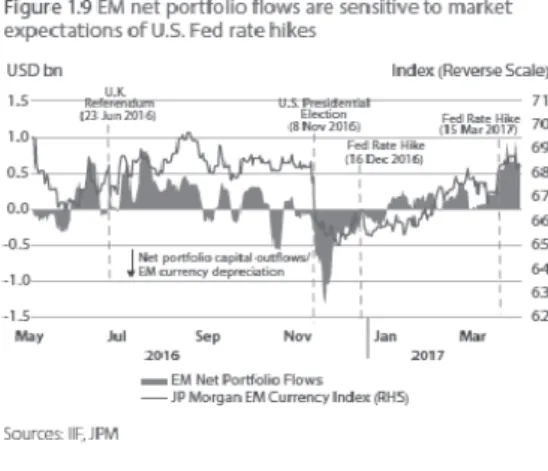
27East Asian countries, despite fairly sound macroeconomic conditions, repeatedly experi- enced reversals of private capital flows triggered by external events, such as rating down- grade of US government bonds in August 2011, then Federal Reserve Chairman Ben Ber- nanke’s testimony in May 2013, or the People’s Bank of China’s devaluation announcement in August 2015. It became apparent that the movement of private portfolio investment flows and private cross-border bank lending may not be captured by the official quarterly bal- ance-of-payments statistics in a timely fashion. AMRO’s economists looked at various short-term indicators which could be used to gauge upcoming risks, including financial mar- ket variables, commodity prices, as well as other high frequency data. Figure 1 illustrates the analysis of capital flows in their regional report (“ASEAN+3 Regional Economic Report (AREO)”) published in May 2017.
The coverage of AMRO’s surveillance needed to be wide enough to detect risks arising from the real sector as well. Given the openness and interconnectedness of the trade and in- vestment as well as the financial linkages of the ASEAN+3 economies, risks in the real sec- tor, especially spillovers from larger economies, would need to be monitored as well. This required country-specific understanding of member economies to identify potential hot spots. This also required an understanding of region-specific issues, which could have con- tagious effects or affect many countries at a time.
25 Initially, the AREM report was produced quarterly to assess and monitor developments in the whole ASEAN+3 region. Af- ter AMRO was transformed into an international organization, the AREM report was renamed as “ASEAN+3 Regional Eco- nomic Outlook (AREO).” The AREO Report has been published since May 2017. The individual surveillance reports have been also made public since 2017 following AMRO’s transformation into an international organization.
26 Publication of reports was later done following establishment of a publication policy of AMRO as an international organiza- tion. The governing rules for the publication were much stricter when AMRO was a company.
27 See Eichengreen & Woods (2016) for challenges of the IMF with regard to integrating macroeconomic and financial analy- sis or to overcoming informational silos within the institution.
II-3. AMRO’s Support for the CMIM
When the ASEAN+3 Finance Ministers agreed on the key elements of AMRO in May 2010, a year before AMRO (Company) was established, they stated, “AMRO will be locat- ed in Singapore to monitor and analyze regional economies, which contributes to the early detection of risks, swift implementation of remedial actions, and effective decision-making of the CMIM.”
28It is understood that supporting the CMIM was not the primary purpose of AMRO that time.
However, after AMRO (Company) was established, the ASEAN+3 authorities gradually began to utilize AMRO (Company) to support their implementation of the CMIM. AMRO (Company) also accommodated such request albeit with its limited human resources. There were two specific areas AMRO (Company) was tasked to support, namely (a) formulating the ERPD Matrix
29and (b) preparing for the CMIM’s operational readiness including en- hancing the CMIM’s operational guidelines.
When AMRO (Company) was transformed into an international organization in 2016, this CMIM support function was explicitly included in its treaty (“AMRO Agreement”). It is prescribed that “The purpose of AMRO is to contribute to securing the economic and fi- nancial stability of the region through conducting regional economic surveillance and sup- porting the implementation of the regional financial arrangement.”
30Figure 1. Examples of AMRO’s Analysis Focusing on Capital Flow Movement
(Source) AMRO (2017)
28 See the Joint Statement of the AFMM+3 in May 2010.
29 The ERPD Matrix is a set of indicators to assess ASEAN+3 members’ qualification for the CMIM’s crisis prevention facility.
30 See AMRO’s website for the text of the AMRO Agreement, available at http://www.amro-asia.org/amro-agreement/.
III. Transformation of AMRO (Company) into an International Organization III-1. Limitation of Surveillance by a Private Company
AMRO was initially established as a company in Singapore, subject to the laws of Sin- gapore. This brought AMRO (Company) with two major constraints in the building of sur- veillance capacity: (a) human resources and (b) data access. This subsection mainly discuss- es the constraints stemming from the laws of Singapore while certain issues such as the staff’s immunity from arrest or the protection of AMRO’s documents were common in all member jurisdictions.
First, as a private company in Singapore, AMRO (Company) was constrained by Singa- pore’s immigration policy, which was being tightened during that time against foreign work- ers. Second, AMRO (Company) was under the sovereign rule of the Republic of Singapore.
This could have made the authorities of the other ASEAN+3 member countries be reluctant to provide AMRO (Company) with any confidential information or policy plans. Third, AMRO (Company) and its staff were subject to Singapore’s laws on freedom of speech.
That said, the status of a company in Singapore had certain merit as well, such as the use of Singapore’s labor laws. For example, when AMRO was reconstituted as an international organization (“AMRO (IO)”), AMRO (IO) had to independently determine how to address labor disputes and include them in the employment contract with each staff.
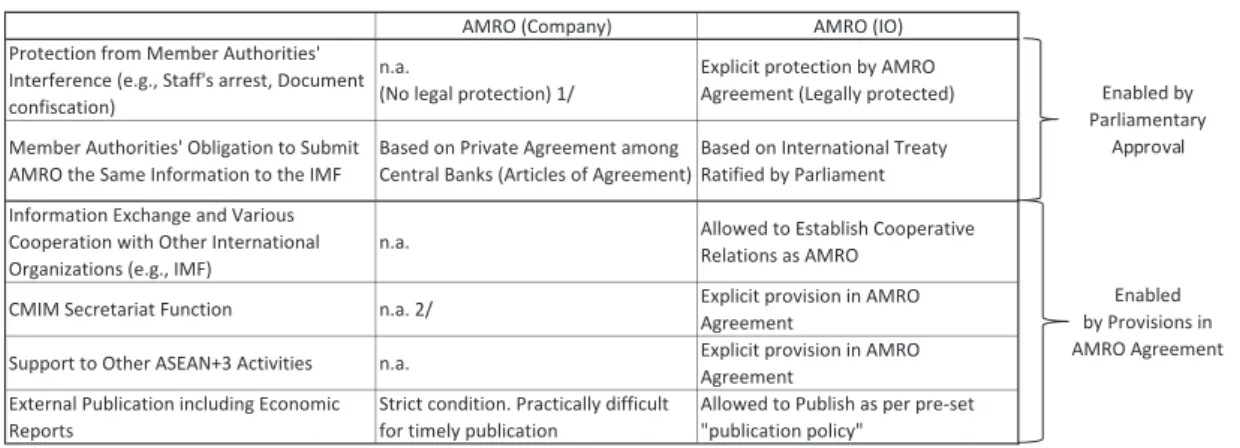
In addition, AMRO (Company)’s purposes were narrowly defined, which were to moni- tor and assess macroeconomic and financial surveillance and to monitor the compliance of lending covenants of the CMIM. AMRO (Company) was not given a clear legal mandate to (a) support the ASEAN+3 authorities in the implementation of the regional financial ar- rangement (i.e., CMIM) and (b) publish its reports as it deems desirable for carrying out its purpose and functions in accordance with its publication policy. There were views that these would need to be rectified when AMRO (Company) was transformed into an international organization. See Table 2 for the comparison between AMRO (Company) and AMRO (IO) in terms of their key functions.
III-2. Transformation into an International Organization III-2-1. Overview
In May 2012, the ASEAN+3 authorities embarked on the preparation to transform AMRO (Company) into an international organization. In less than four years, it was recon- stituted as an international organization on February 9, 2016.
When a new international organization (IO) is established, it normally follows a proce-
dure which includes: (i) preparation of the treaty, (ii) signing and ratification of the treaty,
(iii) establishment of IO, and (iv) operationalization of IO. However, in AMRO’s case, it
was first operationalized as a private company, so preparation steps took the order of (iv), (i),
(ii), and (iii) (See Table 1 in I-4 and Table 3 in the next page).
III-2-2. Beginning of the Preparatory Work
After the ASEAN+3 Finance Ministers and Central Bank Governors Meeting (AFMGM+3) in Manila in May 2012, concrete preparations began to draft an international treaty to transform AMRO (Company) into an international organization. In this meeting, AMRO (Company) was urged to prepare a work plan, including a concrete timeline, and to come up with the first draft of the treaty.
31It was assumed that (a) to cope with the con- straints as described in III-1 above, AMRO should be given the same legal status as the IMF and the ADB, (b) an agreement to establish an international organization should include contents such as no arrest by the member authorities, and, therefore, (c) an agreement should be basically approved by the members’ parliaments.
Table 2. Comparison of AMRO (Company) and AMRO (IO) on Key Functions
(Note 1) A Memorandum of Understanding (MOU) was signed between AMRO (Company) and Singapore in May 2013, two years after AMRO (Company)’s establishment. This gave AMRO headquarters certain protection from the authorities of the host country.
(Note 2) With the explicit instruction by the ASEAN+3 authorities, AMRO prepared a set of indicators to assess ASEAN+3 members’ qualification for the CMIM’s crisis prevention facility (called the “ERPD Matrix”).
(Source) Authors based on the AMRO Agreement
Table 3. Process of AMRO’s Transformation to an International Organization
(Source) Authors based on Joint Statements of AFMM+3 and AFMGM+3
31 See the Joint Statement of the AFMGM+3 in May 2012.
III-2-3. Preparation of the International Treaty
In May 2013, the ASEAN+3 Finance Ministers and Central Bank Governors declared that they “have reached consensus on the draft of the AMRO Agreement
32and will proceed with the necessary domestic processes as early as possible for its prompt signature and entry into force.”
33Subsequent to minor adjustments, the ASEAN+3 authorities at their technical level finalized the text of the AMRO Agreement in November 2013, slightly more than one year after they started drafting in September 2012.
It is also noted that, in May 2013, the Ministers and the Governors stated that they “wel- comed the finalization of the text of the Headquarters Agreement (HQA) between Singapore and AMRO concurrently with the AMRO Agreement, which would be concluded once AMRO is reconstituted as an international organization.”
34III-2-4. Signing of the AMRO Agreement
After reaching consensus on the draft AMRO Agreement, the steps to follow were: (a) to sign the AMRO Agreement by all ASEAN+3 members so as to firmly fix the language of the agreement and (b) to ratify the AMRO Agreement by the members.
35The signing ceremony took place on October 10, 2014.
36III-2-5. Ratification of the AMRO Agreement and Establishment of AMRO as an International Organization
The AMRO Agreement became effective on February 9, 2016, following the ratification by the sufficient members required for entry into force as per Article 26 of the AMRO Agreement. The opening ceremony was held on February 19, 2016.
37Yoichi Nemoto, AMRO (Company)’s then Director became the Director of AMRO (IO). In May 2016, Chang Junhong, a senior official of China’s Ministry of Finance, succeeded the position.
32 The AMRO Agreement is an abbreviation of the “Agreement Establishing ASEAN+3 Macroeconomic Research Office.”
33 See the Joint Statement of the AFMGM+3 in May 2013.
34 While AMRO (Company)’s Articles of Agreement had taken effect in January 2011, the agreement between the host country and AMRO (Company) was not signed until May 2013. In fact, in May 2012, the ASEAN+3 Finance Ministers and the Central Bank Governors expressed that:
“We welcomed Singapore’s commitment to provide the necessary host country support which AMRO deems critical to pursue its mission as an independent surveillance unit, for example to provide budget and liquidity support, protect the member countries’ data and information, and facilitate employment pass process. We also instructed the Deputies to accelerate the preparation to institutionalize AMRO as an international organization.”
It is understood that, by fixing the HQA together with the AMRO Agreement, the authorities aimed to allow AMRO (IO) to start operation in a stable setting from the beginning.
35 According to the Article 26, the AMRO Agreement would “enter into force on the sixtieth (60th) day following the deposit of instruments of ratification, acceptance or approval by the People’s Republic of China, Japan, the Republic of Korea, and at least five (5) ASEAN Member States including the Republic of Singapore.”
36 See AMRO Director’s statement in October 2014, available at http://www.amro-asia.org/amro-directors-statement-on-the- completion-of-the-signing-of-the-agreement-establishing-amro/ and the Joint Statement of the AFMGM+3 in May 2015.
37 See AMRO’s press release, available at http://www.amro-asia.org/amro-is-officially-established-as-an-international-organi- zation-in-february-2016/.
IV. Challenges for AMRO (IO) IV-1. Remaining Challenges
In February 2016, AMRO was reconstituted as an international organization. With this, formation of the legal framework completed. Nevertheless, AMRO (IO) is still faced with significant challenges in regard to how to run. This section aims to raise four major chal- lenges with particular emphasis on AMRO.
38IV-2. AMRO’s Surveillance and Policy Recommendation Function
The AMRO Agreement defines policy recommendation as one of AMRO (IO)’s func- tions.
39In the pursuit of risk and vulnerability assessment and policy recommendations, AMRO (IO) faces three main challenges.
The first is to develop expertise on crises and market turbulence. Knowledge needs to be accumulated on economic and financial crises and market turbulences including policy re- sponses, both in cases of success and failure. Internal simulation exercises also need to be conducted constantly.
Second, in assessing risks and vulnerabilities and making policy recommendations, a subtle balance needs to be struck among the member authorities who have various, and oc- casionally conflicting interests.
40AMRO is expected to play a critical role in the judgment of CMIM activations, including whether it requires involvement of an IMF program. It could be important to stay objective so as to maintain the relevance of not only AMRO but also the CMIM to the ASEAN+3 members.
41Third, AMRO needs to be tactful in sending out its message to external parties, especial- ly to market participants. How to express its assessment in its surveillance reports is a new challenge for AMRO (IO) as AMRO (Company) was practically not allowed to publish its reports as mentioned in II-2. Perhaps, at the time, timeliness and candidness were the priori-
38 See Kawai (2015) for the overall challenges for the regional financial cooperation in East Asia.
39 Se e Article 3 of the AMRO Agreement for AMRO’s functions:
“a) to monitor, assess and report to members on their macroeconomic status and financial soundness;
b) to identify for members macroeconomic and financial risks and vulnerabilities in the region and assist them, if requested, in the timely formulation of policy recommendations to mitigate such risks;
c) to support members in the implementation of the regional financial arrangement; and
d) to conduct such other activities necessary for achieving the purpose of AMRO as may be determined by the Executive Committee.”
40 Kenen & Meade (2008) points out that the whole notion of supranationality is alien to Asian thought and history, p. 178. See Nemoto (2016) for a proposal to the ASEAN+3 authorities to make wise use of AMRO (IO) as a credible third party for steady progress of its common agenda.
41 For a question whether the IMF’s advice is well-tailored to their circumstances or simply reflects the self-interest of the in- stitution’s dominant shareholders, see Eichengreen & Woods (2016), pp. 47-48.
The governance of the CMIM and AMRO has not become an issue so far, given that consensus has been sought in their de- cision makings and no demand for augmenting the size of individual members’ contribution has been surfaced. Nevertheless, the ASEAN+3 authorities may need to continue paying due attention to this as it may easily lead to a loss in their confidence.
Sussangkarn (2011), Kawai (2015) and Shinohara (2018) review how the voting rights of China, Japan and Korea came up with 32%, 32% and 16% (Sussangkarn, 2011, pp. 211-212; Kawai, 2015, pp.14-15, Shinohara, 2018, pp. 213-217).
ty for AMRO (Company), while recognizing the drawbacks of not disclosing its assess- ments. In 2017, AMRO started to publish its (a) “Annual Report 2016,” (b) Regional Sur- veillance Report called “ASEAN+3 Regional Economic Outlook (AREO) 2017,” and (c) Country Surveillance Reports (such as on the Philippines, Thailand and Hong Kong, Chi- na).
42As the publication includes country surveillance reports, the content of its analysis and its timing may need to be carefully calibrated in a manner not to unnecessarily infringe on market turbulence while maintaining its candidness.
IV-3. AMRO’s Roles in CMIM Activation
Support for the CMIM is defined as AMRO (IO)’s function in the Article 3 of the AMRO Agreement.
43The official statement on AMRO’s support function for the CMIM
44explains that AMRO is providing support to ASEAN+3 members in “making sure that the CMIM is operationally ready” through such measures as “test runs” and “peacetime checklist.” In fact, the ASEAN+3 Finance Ministers and Central Bank Governors have repeatedly noted the contribution of AMRO for the CMIM such as ERPD Matrix and Operational Readiness.
AMRO’s such support may be important in smooth implementation of the CMIM.
45“Crisis-time surveillance,” vis-à-vis peace-time surveillance, may be another area to re- inforce. Strengthening the relations with the organizations with rich experiences of crises, such as the IMF and the ESM, could be useful. The IMF and AMRO signed an MOU in Oc- tober 2017 for exchanges of views and capacity building.
46Moreover, there could be some more areas for further consideration in the medi- um-to-long term, particularly for the CMIM (and not just AMRO), such as how to make CMIM activation smoother. For example, it could be rational to conceive a more solid mechanism to swiftly make the funds disbursable. Reserve pooling could be one option.
AMRO may start exploring what roles it could play under such frameworks.
47IV-4. Coordination among Global, Regional and Bilateral Facilities
Coordination among global, regional and bilateral facilities for short-term bal- ance-of-payments support is an unresolved challenge for the CMIM (and AMRO). Subse-
42 All the published reports are available at http://www.amro-asia.org/publications/.
43 For the source, see the footnote on the last sentence of Section II above.
44 The document to explain AMRO’s support function for the CMIM is available at http://www.amro-asia.org/amros-support- function-for-cmim/.
45 From 2016, the positions of two Deputy Directors and one Chief Economist were created at AMRO. One Deputy Director is in charge of CMIM support and formulation of medium-term strategy. For the ASEAN+3 authorities’ decision on the positions, see the Joint Statement of AFMGM+3 in May 2015. For Deputy Directors and Chief Economist, see AMRO’s website at http://
www.amro-asia.org/about-amro/#management.
46 See the press releases by AMRO at http://www.amro-asia.org/amro-imf-enhance-cooperation-to-support-regional-and-glob- al-financial-stability/ and by the IMF at https://www.imf.org/en/News/Articles/2017/10/11/pr17395-imf-and-the-amro-agree- to-enhance-cooperation.
47 See Kinkyo (2013) for a potential conflict of interests in the reserve pooling, pp. 305-306.
quent to the AFC, such framework has expanded by adding bilateral and regional facilities on top of the global facility, i.e., the IMF. These bilateral and regional facilities may have been regarded as supplementary or complementary to the global facility. Nevertheless, a few fundamental issues remain outstanding on the coordination among the frameworks, namely (a) before activation (e.g., analysis, policy recommendation, support amount); (b) during ac- tivation (e.g., disbursements); and (c) after activation (e.g., seniority of claims).
Furthermore, the CMIM Agreement and the AMRO Agreement are two separate con- tracts. Who can represent the CMIM may remain as another issue.
48IV-5. Improvement of Statistics
The ASEAN+3 Finance Ministers and Central Bank Governors are encouraging AMRO to provide technical assistance to enhance the capacity on surveillance activities. As the economy and financial sector develops and advances, the range of required statistics may expand. The need to enhance the coverage, frequency, quality and cross-country compara- bility of the statistics may continue to be a long-term agenda.
Reference
Aizenman, J., Y. Cheung and H. Ito (2015), “International reserves before and after the global crisis: Is there no end to hoarding?”, Journal of International Money and Fi- nance, Elsevier, No. 52, pp. 102-126
ASEAN+3 Macroeconomic Research Office (2017), “ASEAN+3 Regional Economic Out- look 2017”, <http://www.amro-asia.org/wp-content/uploads/2017/05/AREO2017_Full- Text.pdf>
ASEAN+3 Research Group (2005), “Exploring Ways to Enhance the Functions of the Chi- ang Mai Initiative in the Medium Term”, <http://asean.org/?static_post=asean3-re- search-group-studies-2004-2005>
Chabchitrchaidol, A., S. Nakagawa and Y. Nemoto (2018), “Quest for Financial Stability in East Asia: Establishment of an Independent Surveillance Unit ‘AMRO’ and Its Future Challenges”, Financial Review, Vol. 133, pp. 170-201 (in Japanese)
Eichengreen, B. and N. Woods (2016), “The IMF’s Unmet Challenges”, Journal of Econom- ic Perspectives, Vol. 30, No. 1, pp. 29-52
Grimes, W.W. (2008), Currency and Contest in East Asia: The Great Power Politics of Fi- nancial Regionalism, Cornell University Press
Henning, C. R. (2002), East Asian Financial Cooperation, Peterson Institute Press
Historical Science Society of Japan (ed.) (2017), Chronology of the World History 3
rdedi- tion, Iwanami Shoten (in Japanese)
48 The AMRO Agreement defines that AMRO is “to support members in the implementation of the regional financial arrange- ment.” The members of the CMIM are the ASEAN+3 authorities. AMRO may not automatically represent the regional finan- cial arrangement in East Asia.
International Monetary Fund (1996), The International Monetary Fund 1945-1965: Twenty Years of International Monetary Cooperation Volume I: Chronicle, International Mon- etary Fund
International Monetary Fund (2013), “Stocktaking the Fund’s Engagement with Regional Financing Arrangements”, <https://www.imf.org/external/np/pp/eng/2013/041113b.
pdf>
International Monetary Fund (2016), “Adequacy of the Global Financial Safety Net”,
<http://www.imf.org/~/media/Files/News/Seminars/adequacy-of-the-global-finan- cial-safety-net.ashx?la=en>
Ito, T. (2017), “A new financial order in Asia: Will a RMB bloc emerge?”, Journal of Inter- national Money and Finance, No. 74, pp. 232-257
Katada, S.N. (2017), “In pursuit of stability: evolution of Asia’s regional financial architec- ture”, The Pacific Review, Vol. 30, No. 6, pp. 910-922
Kawai, M. (2015), “From the Chiang Mai Initiative to an Asian Monetary Fund”, ADBI Working Paper No. 527, <http://www.adbi.org/working-paper/2015/05/20/6612.chiang.
mai.asian. monetary.fund/>
Kenen, P. B. and E. E. Meade (2008), Regional Monetary Integration, Cambridge Universi- ty Press
Kinkyo, T. (2013), “Coordinating Regional Financial Arrangements with the IMF: Chal- lenges to Asia and Lessons from the EU”, in E. Kirchner, T. Christiansen, K. Jørgensen and P.B. Murray (eds.), The Palgrave Handbook of EU-Asia Relations, Palgrave Mac- millan
Kuroda, H. (2005), Rise and Fall of Currencies: The Fate of the Yen, Dollar, Euro and Ren- minbi, Chuokoron Shinsha (in Japanese)
McCawley, P. (2017), Banking on the Future of Asia and the Pacific: 50 Years of the Asian Development Bank, Asian Development Bank
Ministry of Finance (2017), History of Public Finance in the Heisei Period – FY1989- FY2000, Vol. 7 (International Finance, External Affairs, Customs Administration), Hakuhousha (in Japanese)
Nemoto, Y. (2003), An Unexpected Outcome of the Asian Financial Crisis, Princeton Insti- tutes for International and Regional Studies, Program on U.S.-Japan Relations, Mono- graph Series, Number 7, Princeton University
Nemoto, Y. (2016), “Farewell remarks by AMRO Director, Dr Yoichi Nemoto, on 3 May 2016, at the AFMGM+3 in Frankfurt, Germany”, <http://www.amro-asia.org/farewell- remarks-by-dr-yoichi-nemoto-amro-director-at-the-asean3-finance-ministers-and-cen- tral-bank-governors-meeting/>
Sakakibara, E. (2000), The Day Japan and the World Trembled: Formation of Cyber Capi- talism, Chuokoron Shinsha (in Japanese)
Shinohara, N. (2018), The Global Financial Crisis: Former Finance Deputy’s Memoir, Mainichi Shimbun Publishing (in Japanese)
Sussangkarn, C. (2011), “Chiang Mai Initiative Multilateralization: Origin, Development,
and Outlook”, Asian Economic Policy Review, No. 6, pp. 203-220
Watanabe, T. (1973), Diary of the ADB President, Nihon Keizai Shimbun (in Japanese)
Annex - Chronology of AMRO’s Development CY2009 (Co-Chairs: Thailand and Korea)
February ASEAN+3 Finance Ministers’ Meeting (Phuket, Thailand)
☆“Action plan to restore economic and financial stability of the Asian region” released.
In order to ensure regional market stability and to foster confidence in the markets, we stress the importance of operationalising the Multilateralisation of the Chiang Mai Ini- tiative (CMI), and agree on the following key elements.
The total size of Multilateralised Chiang Mai Initiative (CMIM) will be increased from the initially agreed level of US$ 80 billion to US$ 120 billion, the proportion of the amount of contribution between ASEAN and the Plus Three countries will be main- tained at 20:80 respectively.
The regional surveillance mechanism should be further strengthened into a robust and credible system which will facilitate prompt activation of the CMIM. An independent regional surveillance unit will be established to promote objective economic monitor- ing.After the above surveillance mechanism becomes fully effective in its function, the IMF de-linked portion may be increased above the current limit of 20 percent.
CY2010 (Co-Chairs: Vietnam and China)
March ☆The Chiang Mai Initiative Multilateralization (CMIM) Agreement enters into effect.
CY2011 (Co-Chairs: Indonesia and Japan)
April ASEAN+3 (China, Japan and Korea) Finance and Central Bank Depu- ties’ Meetings (Bali, Indonesia)
Appointment of Mr Wei Benhua as Director made public.
April AMRO (Company) established in Singapore.
May ASEAN+3 Finance Minister’s Meeting (Hanoi, Vietnam)
We welcomed the establishment of AMRO, which, as the surveillance unit of CMIM, plays an important role to monitor and analyze regional economies, and to contribute to early detection of risks, swift implementation of remedial actions, and effective deci- sion-making of CMIM. We expect AMRO to be fully operational soon, and are com- mitted to promote the smooth and efficient operation of AMRO. We instructed the Deputies to review AMRO’s organizational capacity at the next Deputies’ meeting so that AMRO could fully meet its objectives. We also instructed the Deputies to launch a study to strengthen the legal status of AMRO to constitute an international organization with an international legal personality.
AMRO (Company) requested to submit its budget after establishment (N.B. No funds would be released until the budget is approved).
Director Wei and Counselor Nemoto arrive in Singapore.
Employment contract of Director Wei signed by the Board of Directors.
June Employment Pass for Director Wei issued (81 days from the Bali meet- ing).
ASEAN+3 Taskforce Meeting
AMRO (Company) submits its manpower-related budget and office-re- lated budget for 2011.
August First transfer of manpower-related funds (USD) arrives at AMRO (Company)’s bank account.
Draft liquidity support by MAS to AMRO (Company) for both the manpower-related budget (USD) and office-related budget (SGD) ap- proved by the Executive Committee.
First AMRO Advisory Panel meeting
Liquidity support contract between MAS and AMRO (Company) for the manpower-related budget (USD) signed.
September Singapore sends AMRO (Company) the first proposal of Memorandum of Understanding between Singapore and AMRO (Company).
First transfer of office-related funds (SGD) arrives at AMRO’s bank ac- count.
First economist arrives in Singapore.
October First country visit (Vietnam)
December ASEAN+3 Finance and Central Bank Deputies’ Meeting (Sendai, Ja- pan) Country surveillance reports presented.
AMRO’s homepage launched.
☆In-office study session of the CMIM takes place.
CY2012 (Co-Chairs: Cambodia and Korea)
January Opening Ceremony of AMRO (Company)
March ASEAN+3 Finance and Central Bank Deputies’ Meeting (Phnom Penh, Cambodia)
May ASEAN+3 Finance Ministers’ and Central Bank Governors’ Meeting (Manila, Philippines)
☆Introduction of the crisis prevention facility (CMIM Precautionary Line) agreed.
☆Design of the CMIM Precautionary Line criteria (ERPD Matrix) tasked to AMRO (Company).
Acceleration in the preparations to institutionalize AMRO as an inter- national organization announced.
In order for AMRO to play a pivotal role under the strengthened CMIM, we requested the Deputies to find out how AMRO’s organizational capacity can be strengthened by
the upcoming November Deputies’ meeting. We encouraged AMRO to further enhance collaboration with relevant international financial institutions, including the ADB, the IMF, and the World Bank. We also instructed the Deputies to accelerate the preparation to institutionalize AMRO as an international organization. In this regard, we endorsed the Deputies’ decisions to urge AMRO to prepare a work plan, including a concrete timeline, and Singapore to work with AMRO to come up with the first draft of the trea- ty. We also affirmed the importance of concluding the Host Country Memorandum of Understanding (MOU) between AMRO and Singapore to clearly define the responsibil- ity of the Host Country. We welcomed Singapore’s commitment to provide the neces- sary host country support which AMRO deems critical to pursue its mission as an inde- pendent surveillance unit, for example to provide budget and liquidity support, protect the member countries’ data and information, and facilitate employment pass process.
May Dr Yoichi NEMOTO appointed as Director
July First meeting between AMRO (Company) Director and IMF Managing Director
First meeting between AMRO (Company) Director and Asian Develop- ment Bank President
August First meeting between AMRO (Company) Director and CEO of the Eu- ropean Financial Stability Facility (EFSF)
September AMRO (Company) and Singapore submit joint draft treaty proposal.
ASEAN+3Taskforce discussions on draft treaty begin.
November ASEAN+3 Finance and Central Bank Deputies’ Meeting (Seoul, Ko- rea) Outlines of Treaty and Headquarters Agreement of AMRO (Interna- tional Organization) agreed on.
Discussions on the creation of Deputy Director and/or Chief Economist positions begin.
CY2013 (Co-Chairs: Brunei and China)
April ASEAN+3 Finance and Central Bank Deputies’ Meeting (Bandar Seri Begawan, Brunei)
AMRO (Company)’s first presentation at the ASEAN Finance Minis- ters’ Meeting (Bandar Seri Begawan, Brunei)
☆G20-IMF Seminar: Regional Financing Arrangements—Their Role in the International Financial Architecture and Cooperation with the IMF (IMF Headquarters, US)
May MOU between AMRO (Company) and Singapore signed.
ASEAN+3 Finance Ministers’ and Central Bank Governors’ Meeting (New Delhi, India)
Ministers and Governors agree to transform AMRO (Company) into an
international organization.
Consensus on the draft treaty (“AMRO Agreement”) reached.
To further consolidate our endeavor, we agreed to transform AMRO to an international organization. This marks an important milestone in our joint efforts to enhance the ef- fectiveness of our ASEAN+3 financial cooperation. We have reached consensus on the draft of “AMRO Agreement” and will proceed with the necessary domestic processes as early as possible for its prompt signature and entry into force. This would enable AMRO to conduct objective surveillance as a credible, independent international orga- nization, contributing further to the regional financial stability along with the strength- ened CMIM.
May ☆Informal IMF board meeting on “Regional Financing Arrange- ments—Their Role in the International Financial Architecture and Co- operation with the IMF”
June AMRO receives the first trainee from CLM countries.
IMF’s Article IV mission teams begin to call on AMRO (at the AMRO office) for exchange of views.
August ☆First AMRO Management Retreat held in Singapore.
October ☆AMRO (Company) participates at the IMF/World Bank Annual Meeting (Washington, DC., US) as observer for the first time.
November ☆AMRO (Company) prepares and facilitates the first test run of CMIM.
ASEAN+3 Finance and Central Bank Deputies’ Meeting (Shanghai, China)
Draft treaty technically agreed on.
AMRO (Company) proposes a review of its human resource framework to make it compatible and competitive with peer IFI practices.
December Thailand’s Lower House dissolved. Without the approval of both Hous- es, the Thai Finance Minister cannot sign the treaty to finalize the content.
CY2014 (Co-Chairs: Myanmar and Japan)
February ☆AMRO (Company) Director and staff visit the European Stability Mechanism.
April ASEAN+3 Finance and Central Bank Deputies’ Meeting (Nay Pyi Taw, Myanmar)
ASEAN Finance Ministers Meeting (Nay Pyi Taw, Myanmar)
May ASEAN+3 Finance Ministers’ and Central Bank Governors’ Meeting (Astana, Kazakhstan)
Recognizing the importance of transforming AMRO into an international organization to enable it to conduct surveillance activities effectively as an independent surveillance unit in the region, we reaffirm our commitment to complete our domestic processes as soon as possible for the prompt signature and entry into force of the AMRO Agreement.
We also welcomed the report by AMRO on the progress in the develop of secondary rules and other necessary transitional arrangements in preparation for the conversion of AMRO into an international organization. We supported the review of AMRO’s human resources framework referencing the human resource frameworks of peer international financial institutions (IFIs) in order that AMRO’s could be made compatible with and competitive against peer IFI practices.
Martial Law declared by Thai Army.
Constitution suspended in Thailand.
June ☆IMF’s Executive Board discusses precautionary and liquidity line re- view (possible deviation of criteria between PLL and CMIM-PL).
July ☆Revised CMIM becomes effective.
CMIM Precautionary Line introduced.
Interim constitution promulgated in Thailand.
August AMRO’s annual consultation visit to Thailand
September Thailand’s National Legislative Assembly gives the Finance Minister the authority to sign the AMRO treaty.
October
Oct 10th Signing Ceremony of the AMRO treaty (World Bank Building, Wash- ington, DC., US)
Domestic approval process of the AMRO treaty starts.
December ASEAN+3 Finance and Central Bank Deputies’ Meeting (Tokyo, Ja- pan) AMRO’s pension scheme approved.
CY2015 (Co-Chairs: Malaysia and Korea)
February AMRO (Company)’s first thematic report (“Understanding Banking Supervisory Priorities and Capacities in ASEAN+3 Economies”) made public.
(This was the only thematic report made public by AMRO (Company) due to the condition that explicit authorization by the Executive Com- mittee would be required.)
First ratification of the AMRO treaty by Singapore
March ASEAN Finance Ministers’ Meeting (Kuala Lumpur, Malaysia)
April ASEAN+3 Finance and Central Bank Deputies’ Meeting (Seoul, Ko-
rea) Ratification of the AMRO treaty by Malaysia
May ASEAN+3 Finance and Central Bank Deputies’ Meeting (Baku, Azer- baijan)
Establishing AMRO as an international organization remain crucially important. We welcome the signing of the Agreement Establishing ASEAN+3 Macroeconomic Re- search Office (AMRO Agreement) in October last year. We reaffirmed our commitment to expedite our respective domestic procedure for the entry into force of the AMRO Agreement this year.
We welcomed the Deputies’ decision to strengthen AMRO’s capacity by formulating a strong strategic vision and having two Deputy Directors and one Chief Economist. We are confident that these three new senior management positions will be beneficial in building AMRO’s capacity and the fulfilling of its mandate as an independent surveil- lance unit. We encouraged the further development of a medium-term strategic vision for AMRO.
June Ratification of the AMRO treaty by Japan October Ratification of the AMRO treaty by China
December ASEAN+3 Finance and Central Bank Deputies’ Meeting (Kuala Lum- pur, Malaysia)
Ratification of the AMRO treaty by Korea. The AMRO treaty would enter into force on February 9th, 2016 (60 days after conditions of Arti- cle 26 are fulfilled).
CY2016 (Co-Chairs: Laos and China) February
Feb 9th AMRO begins operations as an International Organization (60 days af- ter Korea’s ratification).
Headquarters Agreement (HQA) between AMRO (IO) and Singapore signed.
Opening Ceremony to commemorate AMRO’s new status as an Inter- national Organization
April ASEAN+3 Finance and Central Bank Deputies’ Meeting (Vientiane, Laos)
AMRO (International Organization) takes on the role of secretariat for the CMIM preparation for the first time.
ASEAN Finance Ministers Meeting (Vientiane, Laos)
AMRO’s second thematic report (“Non-Financial Corporate Bond Fi- nancing in Foreign Currency: Trends and Risks in ASEAN+3 Emerg- ing Economies”) made public.
(This was the thematic report made public by AMRO International Or-
ganization, in accordance with AMRO Company’s old publication poli-
cy.)
May ASEAN+3 Finance and Central Bank Deputies’ Meeting (Frankfurt, Germany)
We welcomed the establishment of AMRO as an international organization, effective 9 February 2016. With this milestone, AMRO can function more effectively as the re- gion’s independent surveillance unit and contribute towards ensuring the macroeco- nomic and financial stability of the ASEAN+3 region.
We encouraged AMRO to finalize its medium-term strategic vision in a timely manner.
We share the vision to build AMRO into an independent, strong, credible, reliable and professional international organization.
May 27th Dr Chang Junhong appointed as Director.
December ASEAN+3 Finance and Central Bank Deputies’ Meeting (Guiyang, China)
AMRO Former Staff Association starts.
CY2017 (Co-Chair: Philippines and Japan)
April ASEAN+3 Finance and Central Bank Deputies’ Meeting (Cebu, Philip- pines)
ASEAN Finance Ministers Meeting (Cebu, Philippines) AMRO’s annual report made public.
(First publication of reports under the publication guidelines of AMRO International Organization)
May ASEAN+3 Finance and Central Bank Deputies’ Meeting (Yokohama, Japan)
We noted AMRO’s significant efforts in enhancing its surveillance capacity which re- sulted in the publication of the very first edition of its flagship report, the “ASEAN+3 Regional Economic Outlook”. We look forward to more focused and comprehensive surveillance activities and welcomed AMRO’s “Guidance Note for AMRO Country Surveillance Consultation” to serve as guidelines for its country consultations and re- gional assessments. We commended the Deputies’ endorsement of AMRO’s Publica- tion Policy which will promote its accountability and visibility beyond the regional platform and solidify its presence as an international organization.
We appreciate AMRO’s efforts to support the CMIM activities of ASEAN+3. We ex- pect to enhance AMRO’s role to support members in the implementation of the CMIM.
With AMRO’s enhanced surveillance capacity, we look forward to its further contribu- tion to ensuring the macroeconomic and financial stability of the region. We expect AMRO’s active participation in the CMIM Periodic Review in coordination with the WGs to enhance the operational readiness of the CMIM.
Recognizing that building multi-layered macroeconomic and financial stability mecha- nism worldwide is key to stability, we encouraged AMRO to explore closer coopera- tion with global and other regional financial institutions, which would also help en- hance AMRO’s organizational capacity through information sharing, joint activities and staff exchanges.
AMRO’s inaugural flagship report (“ASEAN+3 Regional Economic Outlook”) made public.
AMRO’s country surveillance reports’ publication starts.
July IMF Executive Board approves the establishment of a new non-financ- ing Policy Coordination Instrument (PCI).
December ASEAN+3 Finance and Central Bank Deputies’ Meeting (Asahikawa, Japan)
(Note) ☆ indicates CMIM-related developments.
(Source) Historical Science Society of Japan (ed.) (2017), Joint Statements of ASEAN+3 Finance Ministers’ and Central Bank Governors’ Meetings, AMRO website and others.