Vol. 13. (1976)
ijJf~~3t1
004 The Reduction on Guaiazulene by the Bouveault-Blanc's Method
Yasushi OHT ANI*, Naomichi ITOH, Isao OGURA and Masao Y AMAGUCHI**
(Received Sept. 22, 1976)
From the fragmentation patterns of hydrogenated guaiazulene by the Bouveault- Blanc's method, it has been presumed that the products were reduced from seven membered ring differed from the reduction in liquid-ammonia and had the following structures; 5.6 (or 6,7)-di-, 4,5,6, 7 (or 5,6, 7, 8)-tetra- and 4,5,6,7,8,9 (or 4,5,6,7,8,10)- hexahydroguaiazu lene.
A number of polarographic studies on azulene have been reported by Chopard-dit Jean and Heilbronnerl) to reveal that azulene exhibited generally three reduction waves at about -1. 7, -2.4 and -2.7 volt and the formation of anion at the first halfwave potential was reversible and further alkyl substitutions on nucleus resulted in a difficulty of the reduction, by Zuman2) to supplement that azulene cation was reduced at a higher voltage than the first potential and also by Given3) that a product of three electrons reduction was doubly protona- ted at 4 and 5 position to from a cyclopentadienyl anion, which was fairly stable because of its six 7C electron system.
On the other hand, Hafner4 ) reported a formation of 1, 6-dihydroazulene by reduction of azulene with sodium-liquid ammonia and Fenton and Hurwitz5) commented on a synthesis of 5,6-dihydroazulene by condensation of cyclopentadiene with gultardialdehyde, though Bertelli and Crabtree6 ) proposed a structure of 1,6-dihydroazulene for this adduct from its nmr spectra. By Ruzicka and Rudolph7) a reduction product of chamazulene using sodium- amylalcohol was postulated to be decahydrochamazulene only on the basis of its elementary analysis. In Bouveault-Blanc's reduction with alcohol of rather less reactivity and sodium approvinglyS), an isolated double bond was not reduced9 ) but a conjugated double bond was hydrogenated at 1 and 4 positions with sodium~-ethanol differed in each other whether at its boiling point or in liquid-ammonia. 10)
The authors carried out the reduction of guaiazulene with sodium-ethanol and the reaction product was analysis by gas chromatography. nmr and mass spectra.
Results and Discussion
Gas chromatography: Previously. the authorsll ) experienced that the retention time of a product obtained from guaiazulene by catalytic hydrogenation using Pt-C catalyst became
* Konankako Co. Ltd.
**
Wakayama Medical College- 25-
shorter as hydrogenation proceeded. In this ::.1) c - - - , case, five peaks beside that of guaiazulene
itself were observed at retention time of 5.0, 5.5, 6.5, 8.5 and 10.3 min. regardless of quantity of sodium used. However, it was found that the peak of dihydroguaiaz~lene
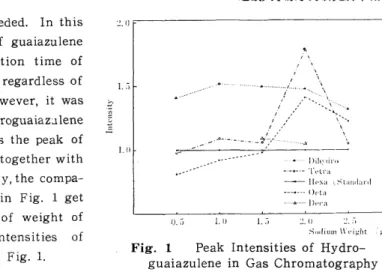
decreased, in contrast with this the peak of tetrahydrocompound increased together with the time elapsed. Accordingly, the compa- rison of those corrected yield in Fig. 1 get into trouble, but the relation of weight of used sodium and relative intensities of those peaks were illustrated in Fig. 1.
I.:i
I.Il
O. J 1.1) 1.,')
1 \
I ' -
\ ... \ \
~ ~ ~ ... ~ '" .
'.
\ ~"".
l)ih,'"dro
- ' - 0 - ' -'l\.tra
~-II""I \~!""d,, .. d ---.--- (J,.!"
6··· .. · ])1'(';)
~. () ~.;)
Sodium \rt'ight :-: \
Fig. 1 Peak Intensities of Hydro- guaiazulene in Gas Chromatography Assignment of peaks was also supported by mass spectrometry as described later, and three fraction corresponding to hexa-(1), tetra-(2) and dihydroguaiazulene (3) were isolalated by using preparative gas chromatography under manual operation, though any of them was extremly contaminated by other components. Other two highly hydrogenated components could not be isolated because of their peaks having the close retention time.
Mass Spectra: As shown in Fig. 2, three major components corresponding to hexa-, tetra- or dihydroguaiazulene of each fraction 1, 2, 3 or the mixture of octa- and decahydro- guaiazulene from the catalytic hydroge-
:nation was releaved to have parent peak of mle 204, 202, 200 or 206 and 208, by comparing spectra of guaizulene and others. And as observed commonly in their fragmentation patterns, the first fragment peak, smaller by mle 43 (CH3-
CH-CH3) than parents', was generally most intense and was followed by serial peaks which were constituted of six, four and three peaks with interval of mle 14 (-CH2-), respectively. On the base of these facts, major component in fraction 1 ; hexahydroguaiazulene, 2; tetrahydro- guaiazulene 3 ; dihydroguaiazulene and partial ion structure of minor com- ponents in fraction 1 were designated as shown in Fig. 3.
NMR Spectra: As mentioned above, Bertelli and Crabtree studied on hydro- genated chamazulene to determine their structures, especially sites of saturation by nmr. However, such a technique did not provide any distinct information with the product because of its poor
183
GA El8
IGil
1~8 III Ij:J
C.\ II
1~)7
In
i{) ~()O
lEi 1~~) I~()
71
II
:II III.>III II!I
1;.\111 S:ll X~)I 89
II \ '11
~I I
~[
(;.\111;
liJ:i II ~ )
1: ~:)
Fig. 2 Mass Spectra of Guaiazulene and Hydroguaiazulene
- 26-
Vol. 13. (1976)
Fig. 3 Presumed Fragmentation of Guaiazulenene and
Hydroguaiazulene (Relative Intensities in Hexahydrocompound are indicated by a Parenthesized figure)
purity, expect with the fraction 1 as shown in Fig 4, two ethylenic protons on five membered ring were designated for signal of 4.15 and 4.16 in or, and other protons of saturated portion were observed in higher or values just as
expected. 12)
The following presumption has been designed to hold from the above observation;
by Bouveault-Blanc's reduction guaiazulene was converted into di-, tetra- and hexa-, and presumably also into octa- and deca- hydroguaiazulenes, successively. Among them, as 1,6-dihydro structure for dihydro derivative was excluded owing to its charac- teristic fragmentation pattern and as cyclo- pentadienyl structure for hexahydro deriva- tive was introduced owing to its informative
lOT
Fig. 4 NMR Spectra of
Hexahydroguaiazulene fraction nmr pattern, their major products were elucidated their structures rather confirmatively to be 5, 6- or 6, 7-di- and 4, 5, 6, 7, 8, 9 (or lO)-hexahydroguaiazulene, respectively. And by analogous speculation, tetrahydro derivative was assumed to be 4, 5, 6, 7- or 5, 6, 7, 8-tetra- hydroguaiazulene.
Experimentary
Two grams of sodium was gradually added to a soluton of two grams of guaiazulene (mp 130-1310) in 100 ml ethanol. After sodium disappeared ethanol was distilled off. Products were extracted with ether and were washed several times with water. The solution was
- 27-
dried and ether was removed, then its acetone solution was subjected gas chromatography.
(Silicon DC-550, 80-100 mesh, temp. 1600, He 1.
o
Kg/cm2)Reference
1) L. H. Chopard-dit-Jean and E. Heilbronner, Helv. Chim. Acta, 36, 144 (1953) 2) P. Zuman, Z, Physik. Chern., 1968, 243
3) P. H. Given and M. E. Peover, Coll. Czech. Chem. Comm. 25, 3159 (1960) 4) K. Hafner, Angew. Chem., 3, 165 (1964)
5) D. M. Fenton and M. J. Hurwitz, ]. Org. Chem., 28, 1646 (1963) 6) D. J. Berte11i and J. H. Crabtree, Tetrahedron, 24, 2079 (1968) 7) L. Ruzicka and E. A. Rudolph, Helv. Chim. Acta, 9, 118 (19?6) 8) V. L. Hansley, Ind. Eng. Chem., 39, 55 (1947)
9) Y. Yukawa and S. Hanabusa, Bull. Chem. Soc. Japan (Japanease) 76, 572 (1955) 10) W. Hukel and H. Schlee, Ber. 88, 346 (1955)
11) Y. Otani, Yakugaku Zasshhi, 88, 795 (1968)
12) K. B. Wiberg and B. J. Nist, ]. Am. Chem. Soc., 83, 1226 (1961)
- 28 ~