Quality Signaling, Advertising and Firm Numbers
Hsiao-Chien Tsui
*and Yi-Shiun Lin
**Abstract
This paper investigates whether low-quality firms can pretend through advertising to be high-quality firms, which is a signal of product quality, when the number of firms increases. We assume that consumers remain loyal to high-quality firms after purchasing high-quality products and will therefore not patronize low-quality firms, which pretend through advertising to be high-quality firms. Our results indicate that the possibility of low-quality firms entering the high-quality market declines when the number of high-quality firms increases. Furthermore, the result of this paper suggests that if the number of low-quality firms is larger than that of high-quality firms, it may not be profitable for low-quality firms to advertise.
In the time of the Warring States in China, there was a monarch called Qi Xuan King in Qi State. He enjoyed the band performance of reed pipe the most. In the band, there was a man called Nan Kuo who did not know how to play the reed pipe at all. When performing, he would pose to be a master. Afterwards, Qi Min King succeeded to the throne and he also enjoyed listening to reed pipe. However, he preferred solo performance. Thus, he commanded the musicians to play in turn. Nan Kuo foresaw that his pretension would be discovered and thus he left stealthily.
– “Stories of Idioms”: scraping the bottom of the barrel
I. Introduction
1Nelson (1974) proposes that the amount spent on advertising demonstrates the quality of a product, which emphasizes the quality signaling theory of advertising2. In
other words, firms will not invest in advertising low-quality products but will rather spend
1 The paper contains the results of research conducted by the first author during a visiting research
fellowship at the Seikei University Center for Asian and Pacific Studies in April 2013. Thanks are due to Pro Yoshihiro Yoshida and Daisuke Shimizu for helpful comments. We also appreciate financial support from the National Science Council of Taiwan (NSC 99-2410-H-194-027). The authors are, of course, entirely responsible for all errors.
* Professor, Faculty of Economics, National Chung Cheng University, Taiwan
E-mail: [email protected]
** Analyst, Chung Hua Institution of Economic Research, Taiwan
2
more on advertising high-quality products in order to acquire long-term profit. Although related studies differ in their approaches, the conclusions of these studies generally support the claims that advertising provides a signal of product quality and that high-quality products tend to be more advertised (Kihlstrom and Riordan 1984; Milgrom and Roberts 1986; Hertzendorf and Overgaard 2001; Linnemer 2012; Chintagunta et al. 1993). However, in reality, the advertising of low-quality products is still common. For instance, in Taiwan, tonic Chinese medicines are popular, and yet the quality of these medicines varies widely. Apart from those from well-known brands, the unreliable advertising of tonic Chinese medicines is common on TV, radio and newspapers. It seems, then, that, regarding the signaling effect of quality, low-quality products can still produce incentives from advertising because consumers do not initially know the actual quality of products. Typically, when only a few firms are in the market, low-quality products can be disguised as high-quality products through advertising. However, consumers will soon realize the real quality of the product. When the disguising of low-quality products is unsuccessful, there is less incentive to advertise. However, when many products are advertised in the market, the question remains: do high-quality products still transmit quality information through advertising or does advertising allow low-quality products to be disguised as high-quality ones?
The purpose of this study is to explore whether more products competing in the market reduces the quality signaling effect of advertising. According to the framework proposed by Kihlstrom and Riordan (1984), we try to analyze the influence of the number of firms on advertising equilibrium using the signaling game. First, in the basic model, we assume that there is a firm with high-quality products and that more than one firm is selling low-quality products in the market. This assumption is then extended to general situations. In other words, there are many firms with both high- and low-quality products in the market. Analytical results reveal that marginal costs and the number of firms are the two key factors involved in advertising equilibrium. In the basic model, if the marginal cost of high-quality products is higher than that of low-quality products, or if there are too many firms in the market with low-quality products, then advertising will not be able to transmit quality. On the other hand, the general model shows that when there are more firms in the market with high-quality products, these firms tend to prevent low-quality products from being disguised through advertising as high-quality ones. In addition, even when more firms exist with low-quality products, an advertising equilibrium can still exist.
The remainder of this paper is organized as follows. Section II describes the hypothesis framework and decision-making process of firms; Section III discusses the 2 Besides advertising, price, brand and assurance are able to transmit the quality of products. Some
studies present views that differ from Nelson’s (1974). For instance, Schmalensee (1978), Zhao (2000) and Orzach, Overgaard and Tauman (2002) suggest a negative correlation between advertising and quality.
basic model, according to which there is only one high-quality product in the market; Section IV elaborates the advertising equilibrium as it occurs in typical situations; and Section V provides our conclusion.
II. Assumptions
According to Kihlstrom and Riordan (1984), our model assumes that there is a market of goods, that there are two types of firms, namely firms producing high-quality products and firms producing low-quality products, and that there is at least one of each type of firm. The model involves two periods (t = 1, 2), where all firms enter the market in the first period. A firm of quality q ( q = H and q = L) producing xt units in period t. The
fixed cost of high-quality products is FH, which is higher than that for producing
low-quality goods FL ; that is, FH> FL. Once firms invest in quality-specific assets, they will not
replace these assets in the short term. C ( xt , q) denotes variable costs and we assume
that marginal costs Cx( x, q) are positive and increase for both types of producers.
However, this model does not assume that high-quality producers have higher variable costs because this will be a condition for the solution of the advertising equilibrium. We are going to discuss the relationship between variable costs and the existence of the advertising equilibrium in the following section.
It is also assumed that all firms enter the market and decide whether or not to advertise in the first period. If firms decide to advertise, regardless of the quality of the product, then the price will be pH; on the contrary, if they do not advertise, then even
high-quality products can only be sold at pL. In addition, consumers purchase one unit of
a product in each period. Some consumers are willing to purchase high-quality products by paying h (hereafter called high-quality consumers; those who are not willing to pay h are called low-quality consumers). Consumers can only observe the number of firms and the advertising of products in the first period. However, they cannot distinguish between high-quality and low-quality products. In the second period, consumers select products based on their own consumption experience and the advertising of the firms. In other words, if high-quality consumers purchase high-quality products in the first period, then they will continue to purchase the same products in the second period based on their experience. On the contrary, if they purchase low-quality products in the first period, then they will not buy the same products in the second period; instead, they will select others products based on advertising.
This study assumes that consumers can only confirm product quality through their own experience with the product. Thus, high-quality consumers who purchase low-quality products in the first period can only be sure that the products they currently use are of low quality, and they are thus more likely to consider other products that are
advertised as high-quality products. Therefore, only advertising in the first period will allow firms to enter the high-quality market in both periods3
. However, even with costly advertising during the first period, low-quality products will neither be able to hold onto consumers who purchased them in the first period in the second period, nor those who purchased high-quality products in the first period. Therefore, it can be inferred that unless there are many low-quality firms in the market, low-quality products will not be able to attract high-quality consumers in the second period.
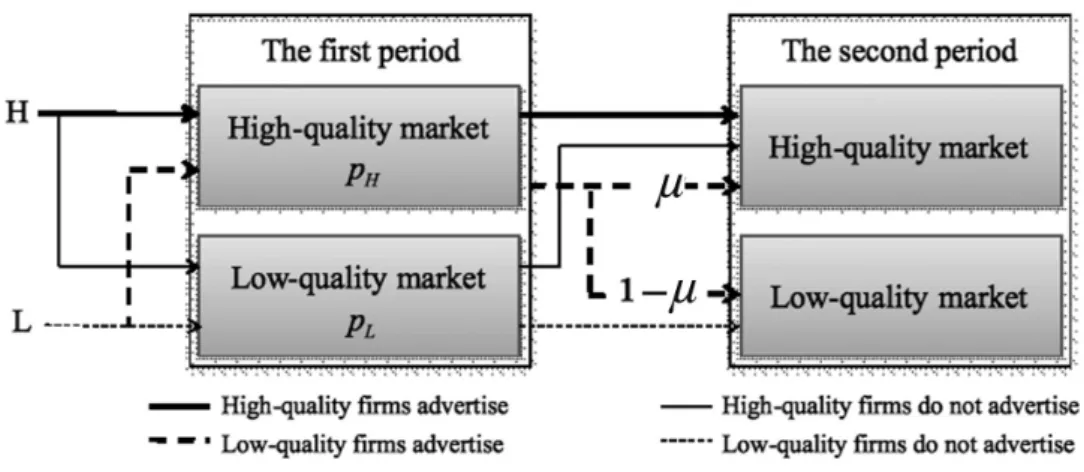
Figure 1 shows the decision-making processes of two types of firms. Both types of firms have to decide whether or not to advertise and fix prices in the first period. Firms with high-quality products have to decide whether or not to spend a certain amount on advertising in order to prevent imitation by firms with low-quality products. Firms with low-quality products must decide whether or not they will spend the same amount on advertising as firms with high-quality products. If high-quality products are advertised, then they will enter the high-quality market in both periods; on the contrary, without advertising, they can only be sold in the low-quality market in the first period, and will only enter the high-quality market via word-of-mouth in the second period. Low-quality products, that are not advertised, can only be sold in the low-Low-quality market in both periods; while if they are advertised during the first period, then they will enter the high-quality market with probability µ and stay in the low-quality market with
probability 1‒µ in the second period. After deciding on advertising strategies, firms will determine the price of low-quality products by a Bertrand competition; once this price is 3 This assumption differs from that in the model of Kihlstrom and Riordan (1984), who assume that
advertising is simply an “admission” to enter the high-quality market in the first period. This study, on the contrary, suggests that advertising is an admission to enter the high-quality market during both periods.
fixed, firms will retain this price in the second period.
First, insofar as pricing is concerned, if there exists one firm with high-quality products and more than one firm with low-quality products in the market, then even though low-quality products are advertised and disguised as high-quality ones in the first period, consumers will not purchase these products in the second period. Thus, the equilibrium of prices in the market are pH and pL. Second, when there is more than
one firm producing two types of products, without considering the horizontal difference between products of the same quality, then there will be one price in the same market; that is, the equilibrium of prices in the market are pH and pL. Since there is more than
one firm, it is difficult for consumers to distinguish between true and false advertising. Given this, firms are motivated to disguise low-quality products as high-quality ones through both advertising and their prices (pH), which will be fixed at the level of
high-quality products. In other words, if the price is higher than pH, then no consumers will
purchase the product; while if the price is lower than pH, then the firm will lose its
profits. Likewise, if high-quality products are not advertised in the first period, then they can only enter the low-quality market and the price will be fixed as pL.
According to the hypotheses above, this study discusses the general models of (1) only one high-quality product in the market, where low-quality products have more than one basic model and (2) more than one firm who produce high-quality and low-quality products, in order to probe into the influence of the number of firms on advertising as quality signaling.
III. Basic model
Here, it is assumed that there is only one high-quality firm and more than one low-quality firm in the market. The gross profit of the firms (including fixed costs) is
, (1)
where p indicates price and x(p , q) indicates the output of maximum gross profit. If high-quality products are advertised in the first period, then net profit will be
, (2)
where δ indicates the discount rate (in the following, we assume that δ>0 ; δ=0 can be
treated as durable goods); and A indicates the lowest advertising cost for entering the high-quality market.
sold in the low-quality market. However, in the second period, they can still enter the high-quality market via word-of-mouth. Therefore, high-quality firms must meet the condition below when deciding on whether or not to advertise
. (3)
Regarding low-quality products, it is assumed that without advertising, the firms are unable to gain profits above their quota. The reason for this is that if low-quality firms obtain profits above their quota without advertising, then there would be no incentive to disguise the quality of their product through advertising and, given this, an advertising equilibrium would not exist. This study sets the profit of low-quality products without advertising at 0, as the criterion of advertising of low-quality products
. (4)
If a low-quality product is advertised in the first period, then the total expected profit will be
, (5)
where µ indicates the probability of low-quality firms entering the high-quality market in
the second period. In this study, we assume that µ is influenced by a consumer’s beliefs
that “firms with advertising are high-quality firms”. If consumers think that advertised products are more likely to be high-quality products, then low-quality products can enter the high-quality market in the second period. In other words, there is a close relationship between µ and a consumer’s belief in product quality (ρ). If consumers realize that all
firms n advertise in the first period, then the probability that they will purchase a high-quality product or a low-high-quality product will both be n–1 ; however, in the second period, a low-quality product will not attract consumers who purchased it in the first period; neither will it attract consumers who purchased a high-quality product ( n–2 in total). Therefore, it is assumed that a consumer’s belief in low-quality products advertised in the first period, can result in high-quality products in the second period, ρ= 1 ––n2 . This is closely related to the number of firms.
In addition, this study also defines the lowest average cost po of high-quality firms without advertising as
where po must be higher than the lowest average production cost p
L of low-quality firms.
With this assumption in place, in both low- and high-quality markets, high-quality firms will provide the products. In other words, when the left of Eq. (5) is positive and satisfies conditional equations (2) - (4), then there will be an advertising equilibrium. In an advertising equilibrium, high-quality products with advertising will bring in more profit than those without advertising. Given this, Eqs. (2) and (3) can yield
( pH, H ) – ( pL, H ) A≥
ϕ ϕ .
Insofar as low-quality products are concerned, Eqs. (4) and (5) can yield
ϕ ϕ
(1+ )δρ
[
( pH, L ) − ( pL, L )]
≤ A. In other words, profits with advertising are lower; thus, the inequality is only supported below, (7)
where (1 +δρ)≥1. Thus, when Eq. (7) is supported, this means that the profits of
high-quality products with advertising will exceed those of low-high-quality products4. Substituting
ρ= 1− n–2into Eq. (7) gives
. (8)
In the first proposition, besides the marginal costs of firms, the number of firms is also a key factor in an advertising equilibrium.
Proposition 1: When δ>0 , if Cx (x, L) ≤ Cx (x, H) for all x, and the weak inequality is replaced by strict inequality for some interval between x ( pL, L) and x ( po, H) or if n > n* , then no advertising equilibrium can exist. If
Cx (x, L)=Cx (x, H) for all x, and n > 2, then there exists no advertising
equilibrium. Besides, when δ=0, as long as Cx (x, L) = Cx (x, H) for all x, even if n≤ n*, no equilibrium can exist.
Proof 1: See Appendix A-1.
Proposition 1 shows some interesting results. First, for an advertising equilibrium to exist, the marginal costs of high-quality products should not exceed that of low-quality products. In other words, when the marginal costs of high-quality products are higher 4 This is similar to the conclusion of Kihlstrom and Riordan (1984). Inequality (7) also shows that
if the marginal costs for producing low-quality products is much lower than that for producing high-quality products, then an advertising equilibrium will not exist. In their study, they develop the inehigh-quality below:ϕ( pH, H ) − ( pϕ L, H ) ( p≥ϕ H, L ) − ( pϕ L, L ).
than those of low-quality products, low-quality products are likely to be disguised by advertising. Second, when low-quality products in the market are few, an advertising equilibrium can exist. In short, once the number of firms exceeds n*, each low-quality product is less likely to attract high-quality consumers in the first period. Consumers will have less negative comments about low-quality products disguised as high-quality products. Therefore, high-quality products cannot use advertising as a signal to transmit quality.
In addition, the existence of an advertising equilibrium n can be influenced by the profits accrued because of a firm’s advertising. Although attaining a balanced condition requires more profit on the part of high-quality firms, the profit gap between high-quality and low-quality firms cannot be significant. When an advertising equilibrium exists, the number of firms must be lower than n*. If the denominator of the right of inequality (8) is lower than 0, n will be negative. Therefore, the profits accrued by low-quality firms from
advertising cannot be low. In addition, there is a positive correlation between n and the advertising profits of high-quality products, and a negative correlation between n and the advertising profits of low-quality products. This means that if high-quality firms are able to acquire higher profits through advertising, then they are able to tolerate more firms entering the market. However, if low-quality firms make more profit then this results in more low-quality firms entering the high-quality market.
Finally, when the marginal costs of two types of products are the same, an advertising equilibrium will exist only when there are two firms left in the market. Otherwise, low-quality firms can acquire more profit through advertising. Notably, when δ=0, apart from
the second period, and firms have the same marginal costs, an advertising equilibrium cannot exist.
According to the results of Proposition 1, if high-quality products are not advantageous in terms of marginal costs, then there an advertising equilibrium will not exist. Moreover, there cannot be too many firms in the market; otherwise, advertising equilibrium will not exist. The following section will examine situations where low-quality firms are not advantaged in terms of cost or where there are only a few firms in the market. When δ>0, we define p− as
, (9)
where p− is the maximum satisfying price in Eq. (3). This means that when high-quality products are sold at this price, profits will be positive even without advertising. In addition, when Eq. (5) is more than 0 and Eq. (2) is supported, Eq. (5) is substituted by Eq. (2):
Likewise, the researcher defines p to make Eq. (11) 0. In other words, p is the lowest price available that prevents low-quality products from imitating high-quality products5
. . (11) Equation (2) is substituted by p− and p to obtain the corresponding advertising level of A− and A, A
=
(1+ ) ( p, H ) − Fδ ϕ H , A=
(1+ ) ( p, H ) − Fδ ϕ H , respectively.As can be seen, an advertising equilibrium only exists when high-quality products are advantageous in terms of marginal costs, and there are only a few firms in the market. Advertising level must be A− ≥ A ≥ A and the price of high-quality products should be p− ≥ pH ≥ p . Proposition 2 will demonstrate that the necessary conditions for an advertising equilibrium include A− ≥ A , p− ≥ p and a restriction on the maximum number of firms.
Proposition 2: When , δ>0,Cx( x , H) <Cx( x , L) for all x, if 2≤ n<n*, then there exists p−
and p , and it must be p− >p. In this case, there exist multiple advertising equilibriums (pH, pL,A) if pL+h > p, where pH∈
[
p , min (pL+ h , p−)]
and A=(1 +δ)ϕ(pH, H) −FH. If n = n*, then p− =p, and there exists a uniqueadvertising equilibrium. When δ >0, and Cx( x , H) =Cx( x , L) for all x,
if n = 2 , then there exists p− and p such as p−=p , and the advertising equilibrium must be unique.
When δ=0 and Cx( x , H) <Cx( x , L) for all x, if p exists and pL+ h > p,
and (2) holds with equality, then there exists an advertising equilibrium (pH, pL, A) , where pH ∈
[
p, pL+ h]
and A =ϕ(pH, H) − FH .Proof 2: See Appendix A-2.
Proposition 2 shows that the number of firms in the market is a key factor in terms of advertising equilibriums. When there are only a few competitors in the market, the market share of low-quality products in the first period will be high; when there are more competitors, their market share will be reduced. Only when there are few competitors, will high-quality consumers realize the low quality of these products in the second period. Given this, the advertising of low-quality firms is less convincing to certain consumers. On the other hand, when there are many firms in the market, only a few high-quality consumers will recognize real quality, and it is less convincing for other consumers. Therefore, other consumers may believe in advertising information. As long as there are a sufficient number of firms, low-quality firms will be able to undertake the cost of advertising because they are more likely to sell their products to high-quality 5 When δ=0, Eq. (11) can be simplified as [ ϕ( p, H ) − F ϕ
consumers.
In order to prevent imitation by low-quality firms, high-quality firms will spend a great amount of money on advertising. On one hand, high-quality firms must set a higher price to fund advertising costs and, on the other hand, they must set a lower price to prevent quality firms from advertising. Within this price range, the profit accrued by low-quality firms will not be enough to support advertising costs, and their disguises will not lead to profit. Therefore, when there are many firms in the market, the lowest price available to high-quality firms in order to prevent imitation will be higher than the price fixed required to fund advertising costs. The above is demonstrated in Proposition 2. When the number of firms exceeds n*, high-quality firms should set their prices above p−
in order to prevent imitation by low-quality firms. However, when this has to be the case, no consumers will purchase their products. For these reasons, an advertising equilibrium will not exist when too many firms are in the market.
When δ=0, high-quality firms will not attract re-consumption. Low-quality firms
cannot attract high-quality consumers in the second period, either. Therefore, only when high-quality firms can undertake a great amount of advertising cost, and gain sufficient profit to fund this advertising cost, will an advertising equilibrium exist. When
δ=0, p exists and pL+ h > p for all x, Cx( x , H) < Cx( x , L) , there will be an advertising
equilibrium.
The following section will compare the number of firms and level of advertising, and demonstrates that with more firms in the market, low-quality firms are able to gain more profit, and that the minimum advertising costs spent by high-quality firms will increase.
Proposition 3: The increase of n will lead to the increase of A. That is, ∂A
>
0n
∂ .
Proof 3: See Appendix A-3.
Proposition 3 suggests that high-quality firms may invite well-known singers or movie stars to endorse their products. However, since low-quality firms can imitate this, high-quality firms have to spend more on advertising costs to invite more celebrated artists or movie stars, which in turn increases the minimum advertising costs spent by high-quality firms.
IV.
General model
The previous section discussed the situation where only one high-quality firm exists, and suggested that one of the conditions required for an advertising equilibrium to exist is that the number of firms must be lower than a certain threshold. However, the number
of high-quality firms was not taken into consideration. Therefore, in this section, we modify the previous model into a general model, and adjust our assumptions regarding the probability of low-quality firms entering the high-quality market.
First, probability α is defined as n H+ nL nH+ 1
=
1 −α , where nH is the number of
high-quality firms; and nL is the number of low-quality firms. It is assumed that nH≥1 and nL≥ 1. The way in which we define α is similar to the way in which we define ρ. It is
assumed that high-quality consumers who purchase low-quality products in the first period will not buy the same products in the second period. Consumers who purchase from high-quality firms in the first period will become loyal customers of those firms. In the second period, high-quality consumers will consider other brands who advertise over the low-quality products they have already tried.
According to the definition of α, this study indicates that with more high-quality firms
in the market, it is more difficult for low-quality firms to enter the high-quality market in the second period. However, when there are more low-quality firms, they will tend to attract high-quality consumers in the second period. In order to demonstrate the statements above, this study conducts one-order differentiation on α by nH and nL. The
result is shown below:
and .
When there is only one low-quality firm in the market, n∂∂αH is 0. This means that the
number of high-quality firms does not influence the probability of low-quality firms entering the high-quality market in the second period. According to the previous assumption, when there is only one low-quality firm, this firm will not attract any high-quality consumers in the second period.
Then, ρ in Eq. (7) is substituted by α. According to the same approach in the previous
section, when
,(12)
an advertising equilibrium will exist. Aside from satisfying more beneficial marginal costs in high-quality firms than low-quality firms, the number of different types of firms must also meet certain conditions in order for an advertising equilibrium to exist. In Proposition 4, the conditions that do not result in an advertising equilibrium will be
elaborated.
Proposition 4: When δ>0, if nL> n*
L , then no advertising equilibrium can exist even if the
marginal cost condition is satisfied. If nL> 1 and Cx( x , L)=Cx( x , H) for
all x, then there exists no advertising equilibrium. Further, when δ=0, as
long as Cx( x , L) = Cx( x , H) for all x, even if nL≤ n*L , no equilibrium can
exist. Proof 4: See Appendix A-4. If nH= 1, n*
L+1 = n* ; the first model is a special case of the second model. Given nL≤ n*
L, the larger nH is, the larger nL will be. High-quality firms can transmit quality
information via advertising. The reason for this is that when there are many high-quality firms in the market, low-quality firms will only attract a few high-quality consumers in the second period.
When the two types of firms have equal marginal costs, if there are more than two low-quality firms in the market (even when there is more than one high-quality firm), then advertising will not be able to transmit quality information. As long as the curve of marginal cost in quality firms is the same as that in high-quality firms, and low-quality firms can attract some high-low-quality consumers in the second period, the firms will be willing to spend money on advertising.
Proposition 4 shows that when there are too many low-quality firms or too few high-quality firms, no advertising equilibrium will exist. When the condition of marginal cost is supported, and the difference in number between the two types of firms satisfies the relevant condition, an advertising equilibrium will exist. In order to demonstrate the statements above, this study defines pH as below:
, (10’) The corresponding advertising level is AH
=
(1+ )δ ϕ( pH,H )− FH. The meaning of pH and AH is similar to that of p and A , respectively. According to the definition of p− and −A in the previous section, the conditions required for an advertising equilibrium are stated in the proposition below.Proposition 5: When δ>0, and Cx( x , H) < Cx( x , L) for all x and nH≤ nL , if nL< n*L , then
there exist p− and pH and it must be p−>p . In this case, if pH L+ h > pH, then
there exist multiple advertising equilibriums (pH, pL, A), where
pH
[
pH,min( pL+ h,p )]
and A=
(1+ ) δ ϕ( pH,H )− FH. If nL=
n*L , then anH> nL , then multiple advertising equilibriums will arise. When Cx( x , H) = Cx( x , L) for all x, if nH≥ nL= 1, then a unique advertising
equilibrium exists.
When δ=0 and Cx( x , H) < Cx( x , L) for all x, if p exists and pLH + h > p , H
and (2) holds with equality, then there exists an advertising equilibrium (pH, pL, A), where pH
[
pH, pL+ h]
and A = ϕ ( pH , H)‒FH.Proof 5: See Appendix A-5.
Proposition 5 suggests how the number of the two types of firms influences the existence of an advertising equilibrium. When there are more high-quality firms than low-quality firms in the market, and when high-quality firms have better marginal costs, low-quality firms will not have the incentive to pay for advertising since, in the second period, they are unlikely to enter the high-quality market and cannot undertake the enormous advertising costs. Moreover, even though there are more low-quality firms than high-quality firms in the market, as long as there are not too many low-quality firms, an advertising equilibrium can exist. If high-quality firms acquire more profit by advertising, then they can set a lower price in order to prevent imitation by low-quality firms. Therefore, when there are not many low-quality firms in the market, it is unlikely that these firms will attract high-quality consumers. And, given this, no imitation will occur.
Next we will discuss the influence of the number of high- and low-quality firms on the minimum amount spent by high-quality firms on advertising to transmit quality signals. The previous section demonstrated that when more firms exist in the market, high-quality firms will spend more money on advertising in order to prevent imitation by low-quality firms. Proposition 6 will examine the influences of the number of different types of firms:
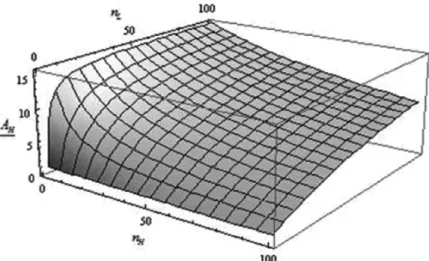
Proposition 6: Increases of nH will lead to a decrease of A , while increases of nLH will lead
to an increase of A . That is, H AH ∂ nH ∂ ≤ and 0 AH ∂ nL ∂
>
0.The result of Proposition 6 is shown in Figure 2. If low-quality firms cannot undertake advertising costs, then high-quality firms will not have to spend enormous amounts on advertising. In other words, the minimum advertising cost spent by high-quality firms depends on the number of low-quality firms in the market. According to the assumption made in this study, while high-quality firms can establish high-quality word-of-mouth after the first period, low-quality firms cannot do the same. When there are many high-quality firms in the market, consumers tend to select products because of positive word-of-mouth. Given this, it is unlikely that they will purchase unfamiliar brands. The influence of advertising would thus be reduced. Therefore, in the second period, it is unlikely for low-quality firms to enter the high-quality market.
However, as suggested in the previous section, if there are more low-quality firms in the market, then they are more likely to sell products to high-quality consumers in the second period. In order to prevent imitation, high-quality firms must increase advertising costs. The conclusion meets the result of Proposition 6.
V. Conclusions
Advertising provides a signal of quality. However, some low-quality firms also advertise. It is expected that when there are more firms in the market, low-quality firms will be motivated to imitate high-quality firms since consumers are unable to distinguish advertising of high-quality products from that of low-quality products. This study aimed to find out whether low-quality firms can acquire profit by advertising when there are many firms in the market. In order to clarify this issue, we constructed a signaling game model, and extended this model into a general model in order to analyze the influence of
different types of firms on the intensity of advertising as quality signaling. According to the results, the following conclusions are drawn.
Even when there are many firms in the market, low-quality firms are not guaranteed to make a profit. When there is only one low-quality firm and many high-quality firms, low-quality firms will not have the opportunity to enter the high-quality market in the second period. However, when there are more low-quality firms than high-quality firms in the market, the existence of an advertising equilibrium is conditional. Only when high-quality products have an advantage in terms of marginal costs, and the number of low-quality firms exceeds a threshold value, are low-low-quality firms able to earn sufficient profit in order to fund high advertising costs. This threshold is also influenced by the profit of both types of firms. When high-quality firms have higher returns from advertising, the threshold value will be higher. On the contrary, when low-quality firms have higher returns from advertising, the threshold value will be lower. In addition, there exists a correlation between the minimum advertising costs of high-quality firms and the number of the two types of firms. When there are more low-quality firms in the market, quality firms must spend more money on advertising. This finding implies that high-quality firms spend too much money on transmitting high-quality information, resulting in a reduction in the level of social welfare.
However, the model adopted in this study has limitations. First, the signaling role of price is not considered. Once price is considered as a mechanism to transmit signaling, the model will become considerably more complicated. Second, this study did not consider situations where consumers purchase only in one period, as this was beyond the scope of the study. Overall, this study should be seen as the first attempt to account for the influence of the number of firms on advertising as the transmission of quality signaling.
Appendix
(A-1) Proof of Proposition 1:
For q = H and q = L , we can easily obtain the output produced by each type of firm by
ϕP(p , q) = x(p , q), and for either q value,
. (A1)
When δ>0, if Cx(x , L) < Cx(x , H) for all x , then
for all p . (A1) and (A2) together imply that
; (A3)
in other words, (7) is impossible to hold.
Nevertheless, in the case of Cx(x,H)≤Cx(x,L) for all x, we cannot jump to the
conclusion that (7) is hold when δ>0 . Given ρ= 1 ‒ n–2 , (7) holds when
. (7’) Obviously, (7’) is hold when n is not too large, that is to say, if (8) is satisfied, then (7’) holds, and so does (7).
In addition, when Cx(x , H) = Cx(x , L) for all x , if there are more than two producers in
the market, that is n > 2, then
[
1 +δ(1‒ n–2 )]
>1 , and (7’) thus cannot hold even if n≤ n*.Hence no advertising equilibrium can exist in this situation.
In the case of δ =0 , when Cx(x , H) = Cx(x , L) for all x , (7) can only hold as an
equality because the inequalities in (A2) and (A3) turn to be equalities. Therefore, even if n≤ n* , in this case, no advertising equilibrium could exist. Q.E.D.
(A-2) Proof of Proposition 2
When δ>0 and Cx(x , H) < Cx(x , L) for all x , if 2≤ n< n*, then (7) will hold with strict
inequality. Below we are going to prove the existence of p− and p . Let
. Then φ' (p) =(1 +δ)x (p ,H)‒ (1 +δp)x (p ,L) . We have proved in proposition 1 that
when Cx(x , H) < Cx(x , L) for all x, x (p , H) is larger than x (p , L) , and because 0≤ δ ≤ 1
and 0≤ ρ ≤ 1 , it can be observed that φ(p) is an increasing function of p . If p exists,
then φ(p)=0 because p is the minimum price satisfying (10). Hence φ(p)≥ 0 if and only
if p≥ p . Since po> p
L, we have
thus p > po> p
ϕ (pL, H) +δϕ (po, H)‒F
H< 0 . When Cx(x , H) < Cx(x , L) and 2≤ n < n* both hold, ϕ (p ,H) will become infinite as p increases to infinity. Hence, we can find a price
satisfying ϕ (pL, H) +δϕ (p ,H) ‒FH> 0, and we can conclude that p− exists since ϕ is
continuous. At the same time, when Cx(x , H)<Cx(x , L) and 2≤ n< n* both hold, then
. (A4) Inequality (A4) is equivalent to
(A5)
Using (4) and subtracting
[
(1+δ)ϕ(p−, H)‒FH]
from both sides of (A4), we obtain(A6)
By the definition of p− , the left part of inequality of (A6) is zero. The expression on the right is ‒φ(p−) . Therefore, (A6) implies that φ(p−) > 0 , so that p− must exceed p. The fact φ(po) < 0 and φ(p−) > 0 imply that p.exists. We can then conclude that when
pL+ h > p , (pH, pL, A) will be an advertising equilibrium, where pH∈
[
( p , min (pL+ h , p−)]
and A = (1 +δ)ϕ(pH, H)‒FH which is in the range between A and A . Since p− −> p , there
exist multiple equlibria in this case.
When δ>0 , and Cx(x , H) < Cx(x , L) for all x, if n = n* , then the inequality of
(A4)-(A6) will turn into an equality. At that time, φ(p−) =φ(p)=0 implies p−= p , so that the advertising equilibrium is unique in this circumstance.
When δ>0 , and Cx(x , H)=Cx(x , L) for all x , if n=2 , then ρ=0 . We can therefore
obtain φ(p−) =φ(p)=0 and p−= p , and there exists unique advertising equilibrium.
If δ=0 , then p may fail to exist even if Cx(x , H) < Cx(x , L) for all x. At this moment, φ (p) =
[
ϕ (p ,H) ‒ϕ (p ,L)]
‒[
FH‒FL]
. If Cx(x , H) < Cx(x , L) for all x and there exists p satisfying φ (p) ≥ 0 , then φ (po) < 0 and the continuity of φ implies that p exists. IfpL+ h > p , then pL< po implies ϕ (pL, H) +δϕ (pH, H)‒FH≤ ϕ (po,H) +δϕ (po,H)‒FH=0 ,
while φ(pH)≥0 for all pH≥p , then ϕ(pH, L) +δ
[
ρϕ(pH, L)+(1‒ρ)ϕ(pL, L)]
‒(FL+ A)≤0if (2) holds with equality. As a result of the conditions mentioned above, any pH on
the interval
[
p , pL+ h]
can be associated with an advertising equilibrium in which(A-3) Proof of Proposition 3
From (5), a low-quality firm can make positive profit if and only if
. (5’)
Given ρ=1‒ n–2 , inequality (5’) is equivalent to
. (A7)
Since A is the minimum advertising level that the high-quality producer can undertake to dissuade low-quality firms from imitating, the maximum advertising costs satisfying (A7) should also be A . Therefore,
. (A8) Take a partial differentiation on A over n yields
. (A9)
Conspicuously, since the expression of the right side of the equation is positive, we can conclude that A∂n
∂ > 0. Q.E.D. (A-4) Proof of Proposition 4
Given n
H+ nL nH+ 1
α=1– and substitute α for ρ in (7), we have
. (7”)
After transformation, we can obtain nL≤ n*L . Therefore, if nL≤ n*L , then (7”) can hold.
When Cx(x , L)=Cx(x , H) for all x, (7”) is equivalent to 1 ≥
[
1+ (1− )δ n]
H+ nLnH+ 1 . If nL> 1, this inequality cannot hold and thus (7”) fails to hold. In this circumstance, no advertising equilibrium is possible.
in equality. Therefore, even if nL≤ n*L , no advertising equilibrium could exist. Q.E.D. (A-5) Proof of Proposition 5
Let γ(p)=
[
(1+δ) ϕ (p,H) ‒FH]
‒{
ϕ (p,L)+δ[
αϕ(p,L)+(1‒α)ϕ(pL, L)‒FL}
. When δ>0 , in the case of Cx(x , H) < Cx(x , L) for all x and nH≤ nL , if nL< n*L , then (7’’) willalso hold with strict inequality. Similar to the proof for proposition 2, in this case, the existence of p− and p is also for sure, and we can obtain γ (pH −) >γ (p ) = 0 . Since γ(p) H
must be an increasing function of p, γ(p−) >γ(pH ) implies that p−> p , and there exist H
multiple equlibria in this circumstance.
When Cx( x , H) < Cx( x , L) for all x and nH≤nL, if nL= nL* , we can obtain that γ (p−) =γ (pH ) = 0 and thus p−= p , so that there exists unique advertising equilibrium. H
When Cx( x , H) < Cx( x , L) for all x , if nH> nL , then nL< n*L, and that implies (7”) must
hold with strict inequality, too. Hence we can obtain γ (p−) >γ (pH ) = 0 and p−> p , and H
conclude that there exist multiple equlibria in this case.
In the case of Cx( x , H) = Cx( x , L) for all x , if nH≥ nL= 1, then (7”) will hold with
equality. We then can obtain that γ (p−) =γ (pH )=0 and thus p−= p , therefore only unique H
advertising equilibrium exists. The situation that δ=0 is the same with what we have
proved in proposition 2, thus we omit here. Q.E.D.
(A-6) Proof of Proposition 6
A low-quality producer can earn more profit when it disseminates advertising if and only if . (5”) Given n H+ nL nH+ 1 α=1– , inequality (5”) is equivalent to . (A12) Similar to the definition of A , the minimum advertising level that high-quality producers have to undertake to dissuade low-quality firms from imitating is now denote by A , H
which is the maximum advertising costs satisfying (A12). Therefore,
. (A13) First we take a partial differentiation on A over nHH yields
. (A14)
Then we take a partial differentiation on A over nLH yields
. (A15)
Conspicuously, the expression on the right side of equation (A14) is negative when
nL>1 and zero when nL=1. We can also observe that the expression on the right side of
equation (A15) is positive when nH> 1. We can conclude that nH AH ∂ ∂ ≤ and 0 nL AH ∂ ∂ > 0. Q.E.D.
References
Chintagunta, P. K., V. R. Rao, and N. J. Vilcassim 1993. “Equilibrium Pricing and Advertising Strategies for Nondurable Experience Products in a Dynamic Duopoly”,
Managerial and Decision Economics, 14, pp.221-234.
Hertzendorf, M. N. and P. B. Overgaard 2001. “Price Competition and Advertising Signals: Signaling by Competing Senders”, Journal of Economics and Management
Strategy, 10, pp.621-662.
Kihlstrom, R. E. and M. H. Riordan 1984. “Advertising as a Signal”, Journal of Political
Economy, 92, pp.427-450.
Linnemer, L. 2012. “Dissipative Advertising Signals Quality: Static Model with a Continuum of Types”, Economics Letters, 114, pp.150-153.
Milgrom, P. and J. Roberts 1986. “Price and Advertising Signals of Product Quality”,
Journal of Political Economy, 94, pp.796-821.
Nelson, P. 1974. “Advertising as Information”, Journal of Political Economy, 82, pp.729-754.
Orzach, R., P. B. Overgaard, and Y. Tauman 2002. “Modest Advertising Signals Strength”,
The RAND Journal of Economics, 33, pp.340-358.
Schmalensee, R. 1978. “A Model of Advertising and Product Quality”, Journal of
Political Economy, 86, pp.485-503.
Zhao, H. 2000. “Raising Awareness and Signaling Quality to Uninformed Consumers: A Price-Advertising Model”, Marketing Science, 19, pp.390-396.