タイトル
Interrogating the relationship between
ideological discourse and Japanese EFL practices
: A social realist perspective
著者
Jérémie, BOUCHARD
引用
北海学園大学学園論集(153): 39-85
Interrogating the relationship between ideological
discourse and Japanese EFL practices:
A social realist perspective
Jeremie B
OUCHARD
Abstract
The body of literature focusing on the Japanese EFL context deals quite extensively with the area of teaching methodologies. However, larger social issues which affect language learning are dealt with in a sporadic and problematic fashion. This paper is concerned with such issues,and specifically with issues of discourse in relation to EFL education. Through-out the following pages, I interrogate the relationship between the ideological discourse of nihonjinron and Japanese EFL practices. Through an extensive literature review,I provide a critical interpretation of both supporters and critics of nihonjinron. I also propose a social realist approach to empirical research which can potentially address the complex nature of the relationship between ideological discourse and educational practices in Japan.
Keywords:Japanese EFL practices, nihonjinron supporters, nihonjinron critics, discourse, structure, culture, agency, social realism, critical discourse analysis
Introduction:framing the discussion
In the English speaking world where the large majority of the population is constituted of non-native speakers of the language,it is increasingly difficult to argue that English is,for countries of the outer and expanding circles (Kachru 1985),a colonizing force from the West. As more and more communities around the world are integrating the language in their cultural realm and everyday social practices,it is safest to define English in the world today as both an entity with a western heritage and one that reflects the local communities which have adopted it. Still, it would be shortsighted to assume that the presence of English in those communities is neutral. Indeed, the debate over the impact of English on local
つなぎのダーシは間違いです
本文中,2行どり 15Qの見出しの前1行アキ無しです
★★全欧文,全露文の時は,柱は欧文になります★★
communities around the world is ongoing.
Since the Meiji period, which marked the beginning of English education in Japan, the presence of English has been interpreted by the local population in many different ways. At times, it has been perceived as a tool for greater internationalization,and at other times as a threat to Japanese culture and society. Even nowadays, these two polarized views often surface simultaneously. This shift between positive and negative perceptions is a product of larger socio-political realities, often with reference to U.S.-Japan relations. Nevertheless, English education in this country has deep roots, and is generally seen by most Japanese people as an educational necessity.
While educators working in the Japanese EFL context are mostly concerned with facilitating learners development of communicative skills in the target language,they must indubitably deal with these larger social issues. Unfortunately, the body of research focus-ing on EFL education in Japan addresses such issues in a sporadic and,I believe,problematic fashion. For the most part,analysts who focus on English education in Japan tend to limit their exploration to methodological questions ― e.g.application of CLT,CALL or TBLT in education policies and school curricula. While language teachers may acknowledge the importance of the social dimension in language learning and teaching,their efforts are mostly invested in more immediate problems, such as how to improve current classroom teaching methodologies within a reasonable timeframe.
However, while greater knowledge of methodology allows teachers to approach their professional practices with more flexibility, it does not always ensure successful language learning. I believe that this is because discussions on methodology tend to place greater emphasis on cognitive aspects of language learning, or as I see it, on language learning as something that takes place in the mind of individual learners. The result is that many language teachers teach the target language without much consideration for the social issues that affect their practice.
I believe that this is an unfortunate pedagogical stance to take. Considering that most reliable contemporary analyses of Japanese EFL education indicate strong evidence that the dominant approaches to EFL education in Japan do not lead Japanese EFL learners to become successful target language users, more attention must be placed on the social
dimension of EFL, and less on language teaching methodology. Sullivan & Schatz (2009) state that,despite the fact that Japan spends enormous sums of money every year to improve English education, it continues to rank among the lowest scoring Asian countries on the TOEFL Test, a fact which Rivers (2011) also underlines. Because the general response to this increasingly apparent failure of the Japanese EFL system has largely emphasized methodological solutions,I suggest that an emphasis on language learning as a social practice is a viable direction for further research.
1. Purpose of this paper
Within the body of academic works devoted to the Japanese EFL context,I have noticed many instances where writers refer to the ideological discourse of nihonjinron. These writers, whom I identify as nihonjinron critics, suggest that the Japanese EFL context is ideologically driven. As an EFL teacher who has been active for almost fifteen years in Japan,I remain skeptical of such argument. The prominence of the nihonjinron argument strikes me as problematic, for it indicates a tendency to define peoples actions as entirely driven by ideology. My central argument in this paper is that the nihonjinron argument in contemporary academia is usually the product of a conflationary approach to the study of human agency,social structure and culture,and almost always formulated without corrobor-ating empirical evidence.
My goal in this paper is to approach Japanese EFL through a social,or discourse-based, perspective,and review the literature on the ideological discourse of nihonjinron,This form of discourse has been defined by many writers as the theory of the Japanese,or the discourse on Japanese uniqueness. I specifically aim to interrogate whether a) the nihonjinron discourse does exist, and b)it directly affects social practices, as many nihonjinron critics suggest. I will discuss issues beyond foreign language learning,but I will attempt to keep the focus on EFL education.
In my exploration of the notion of nihonjinron, I take from a variety of academic sources, both from within and outside Japan. I explore Yoshino s (1992) assertion that a) intellectuals (i.e. academics and the thinking elites)formulate nihonjinron as an ideological discourse centered around the uniqueness of Japanese culture,language and society,and that b)members of the intelligentsia (e.g.politicians,journalists,educated and influential citizens, business people)respond to and help diffuse such discourse both in and outside Japan. I also
consider Befu s (2001)description of nihonjinron as Japan s dominant identity discourse,and Iida s (2002)view of nihonjinron as the product of a reaction against increasing globalization which has triggered a sense of identity loss as a result of Japan s increased contact with the West.
Throughout the following paper, I take a critical approach to the study of ideology (Thompson 2007)by interrogating the idea ― actively promoted by the critics of nihonjinron ― that the Japanese elites create the nihonjinron discourse in order to emphasize the assumed cultural, ethnic and linguistic uniqueness of Japanese society for the purpose of maintaining a certain power structure within Japanese society (Dale 1986, Goodman 1992, Sugimoto 1999, Sugimoto & Mouer 2002, Yoshino 1992). I also review arguments made by many nihonjinron critics that members of the elite construct nihonjinron as both an ideology and a form of nationalist discourse aimed at protecting Japan s sovereignty from outside pressures, highlighting the perceived uniqueness of the nation, and promoting a sense of superiority over other nations. While most nihonjinron supporters and critics agree that the nihonjinron discourse emerged during the Meiji period (Fujimoto-Adamson 2006), I interro-gate the supposed relationship between the nihonjinron discourse and current EFL practices in Japan. The central reason is that,according to most nihonjinron critics,the formulation of the nihonjinron discourse is still a contemporary reality.
The nihonjinron critics include Japanese and non-Japanese writers. These take mostly from Befu (1983),Befu & Manabe (1987),Dale (1986),Goodman (1992)and Yoshino (1992),all pioneers of the genre. They underline what they perceive as the ideological processes within Japanese social practices in the political, scientific, and educational spheres. Goodman (1992)provides a good example of this critical perspective towards ideology by arguing that the nihonjinron discourse serves the Japanese ruling class in their objectives of maintaining particular relations of domination. Throughout my readings, I have noticed that most nihonjinron critics tend to approach the ideology from a similar perspective.
In my analysis of the literature focusing on the Japanese EFL system,and in my proposal of a viable research methodology that could successfully deal with the complexity of the issues at hand, I conceptualize human agency, culture and structure as distinct entities possessing sui generis and emergent properties, while interacting together in a multi-directional relationship. As such, I borrow extensively from realism, as defined by Archer
(1996, 2004), Bhaskar (1998), Maxwell (2012), Sayer (2000) and Sealey & Carter (2004). An empirical research approach that follows a realist perspective requires a variegated approach to enquiry. Therefore, I believe that the study of the (supposed) relationship between nihonjinron and English education in Japan should adopt a stratified approach to social reality by focusing on what goes on at the levels of social structure, culture and especially human agency. I argue that,when each stratum has been extensively accounted for through empirical research,it becomes possible to interpret the full complexity of real world events. Most importantly, accounting for each stratum necessitates a combination of research methodologies, all of which contain shortcomings. Yet, despite these shortcomings, most research methodologies do, on their own, make significant contributions to epistemological kuowledge. It is when they are combined with others that their importance becomes clear.
This paper is an attempt to fill a gap in current studies on Japan and the Japanese EFL context. To my knowledge, while some have focused on educational problems, very few studies have specifically interrogated the notion of nihonjinron in relation to EFL education in Japan. Sullivan & Schatz (2009)observe that almost no empirical research has been done to investigate the relationship between Japanese nationalism and foreign language education, arguing that [t]he paucity of research in this area is even more surprising in light of the sizeable literature investigating relationships between language and national identification in other countries, including research on second language learning (p.489). From a more general perspective, Befu (2001:11)states that we have no adequate empirical or quantita-tive evidence of the extent of[nihonjinron s]effect on the general populace. This lacuna is also underlined by Yoshino (1992), who argues that the nihonjinron critics fail to pay attention to the receptive or consumption side of the nihonjinron (p.4). In Section 3.2,I argue that,instead of providing empirical evidence of nihonjinron s potential effect on social practice, the producers of nihonjinron critiques instead assign agentive properties to the ideology,thereby endowing it with the capacity to directly― and negatively― affect social practice. I believe that this particular strategy complicates a realist understanding of ideological processes.
Perhaps most importantly, this paper is motivated by the need to address some of the issues raised by contemporary analyses of Japanese EFL practices,notably Seargeant (2008), which indicate strong evidence that the dominant pedagogical approaches to EFL education in Japan do not lead Japanese EFL learners to become successful target language users.
Many writers reviewed in this paper specifically underline the nihonjinron discourse as a likely cause for such failure. The following three groups of questions serve as central foci and as structure for this paper:
1. What is nihonjinron, and how has it been conceptualized so far? 2. What are the critiques of nihonjinron,and how have these critiques been
formulated? What relevance do they have to the learning of English as an FL in Japan? What are their strengths and weaknesses?
3. How can an empirical research project avoid these weaknesses, and provide a realistic account of the relationship between nihonjinron and Japanese EFL education,if indeed there is such a relationship? How can this new approach contribute to greater understanding of― and improve-ments in ― the teaching of EFL in Japan?
This paper provides tentative answers to those questions. To begin with,I explore the notion of nihonjinron.
2. Exploring
I begin this section by providing a historical sketch of EFL education in Japan. I follow with an explanation of how academia has conceptualized the ideology theoretically. Finally, I discuss how academics,members of the intelligentsia in and outside Japan,and the Japanese public have received nihonjinron. it is important to state that, as most descriptions of nihonjinron have been provided by critics of the ideology,much of the following is based on a critical perspective into nihonjinron.
2.1 A short history of English education in Japan
In order to interrogate the notion of nihonjinron and its supposed relationship with EFL practices in Japan, it is essential to provide a short account of the history of English education in the country. However, in presenting this historical sketch, I do not wish to imply that the formulation of the nihonjinron ideology emerged solely as a result of the development of the Japanese EFL system.
EFL education in Japan began in the Meiji period, which was a period of great social, economical, political, and educational changes. It also marked the appearance of a new
centralized national education system. Okanao & Tsuchiya (1999)argue that a primary goal for this new education system was to disseminate nationalism in reaction to increasing pressure from the West. Since then, and throughout its approximately 150 year history, Japan s approach to English has been marked by booms, or periods of intense popularity of English, and backlashes, or periods of struggle against perceived Western imperialism (Nishino & Watanabe 2008). At the beginning of its history, English education became a necessary tool for gaining access to superior European and American technologies (Fujimoto-Adamson 2006). In contrast to Japanese, English came to be perceived by educators and politicians as the language of modernity. At the university level, many curricula and subjects were in fact taught in English.
But at the close of the nineteenth century and the early years of the twentieth,Japan had become a powerful nation forging and solidifying its international presence, and a strong nationalistic fervor thrived across the nation (Sullivan & Schatz 2009). This led to a significant decrease in emphasis on English education,since English was no longer seen by the Japanese elite as a necessary tool for maintaining Japanese sovereignty from foreign powers. Soon after this shift,English came to be perceived by the Japanese elite as having a negative influence on Japanese culture and society. For the Meiji Government,the main objective in regards to English education centered on the creation of a select group of Japanese individ-uals who could translate key Western documents. This movement emerged almost in tandem with a new sense of national pride which resulted from Japan s successful military engagements with Russia, Korea and China near the end of the nineteenth and the early decades of the twentieth century.
In the period preceding and during the Second World War,there were repeated attempts within the government to abolish English education (Kubota 1998). Yoshino (1992) and Fujimoto-Adamson (2006) identify this period as the birth of nihonjinron. However, their claim should be questioned to some extent,for it assumes that a)nihonjinron as nationalist ideology emerged only because English came to be perceived as an intrusion in Japanese culture,and that b)the nihonjinron discourse did not exist before World War II. Neverthe-less, it is widely acknowledged that this period was particular fraught with antagonism towards English, which represented the language of the enemy.
(Fujimoto-Adamson 2006). A new Course of Study ― or the National Curriculum for all subjects including English ― was designed with the help of the American forces. It was also at this time that new methodologies emphasizing the development of basic foreign language skills were promoted by the Ministry of Education. The Tokyo Olympics of 1964 further opened Japan s doors to the world,an opportunity which also highlighted the need for English education in the country. Despite these initiatives, however, Japanese educational institu-tions conducted EFL education in a contradictory fashion:by emphasizing modern language teaching methodologies on the one hand,while remaining essentially focused on test-oriented approaches, a pedagogical strategy which Fujimoto-Adamson traces back to early Meiji. 1963 saw the adoption of the STEP Test, and 1979 the adoption of the TOEIC Test. Since then,these two tests have played a central part in Japanese EFL educational practices. The TOEIC Test in particular has provided a means of measuring Japanese learners linguistic competence with reference to international standards. But according to Seargeant (2009), because these two tests mostly require grammatical knowledge,they are merely extensions of the test-driven language teaching policies which are characteristic of Japan s EFL teaching philosophy.
Sullivan & Schatz (2009:488)point out that, in the 1970s and 1980s, the Vietnam War, trade imbalances, and U.S. economic policies towards Japan began to negatively affect U.S.-Japan relations, which facilitated a resurgence of Japanese nationalism. In the 1980s, Prime Minister Nakasone became a strong supporter of a new kind of nationalism. One of his main political stances was that time had come for Japanese people to feel genuine pride in being Japanese,and move beyond the shame of military defeat. This was a reflection of a popular movement which surfaced as a result of Japan s increasing economic success. In other words,success on the economic front and increasing diplomatic tensions between Japan and the West justified resurgent nationalist feelings within Japan. Focusing on general education,Sato (2004)observes that the 1970s and 1980s saw the emergence of two contradic-tory forms of discourse in Japanese educational policies: the nihonjinron discourse which promoted the inculcation of nationalistic values in schools, and the ibunkakan kyouiku (intercultural education) discourse which aimed at sensitizing Japanese students to foreign cultures. She adds that this irreconcilable tension has led to a situation in which the intercultural education discourse has come to be used,in reality,as a tool for promoting the nationalist nihonjinron discourse.
In 1987, however, as the Japanese economic miracle began to fade, more concrete initiatives were taken by the Ministry of Education in regards to English education. The guiding objective behind these initiatives was to improve teaching methodologies so as to encourage the development of learners communicative competence in the L2. This led in part to the creation of the JET Programme, which still welcomes thousands of university-educated native English speakers to work in public junior and senior high schools all over Japan. However, this program, as Cotter (2011) and Nakatsugawa (2011) argue, contains fundamental problems which limit the program s potential benefits to learners. The 2003 plan to cultivate Japanese who can use English (MEXT 2003), which constitutes the most recent and ambitious improvement in Japanese EFL policies, intensified the Ministry of Education s focus on English education in school while promoting the teaching of other subjects in English. It also introduced various teacher training programs.
Despite past and current foreign language teaching initiatives and the massive amounts of money invested, most analysts agree that Japanese EFL practices remain focused on examinations (Fujimoto-Adamson 2006,Nishino & Watanabe 2008,Seargeant 2009,Yoshida 2003). Taking from Fujimoto-Adamson (2006)and Nishino & Watanabe (2008),this contra-dictory approach to English education in Japan ― i.e., English for communication purposes versus English for examination purposes ― is not the product of new developments, but rather one of the most endurable characteristics of the Japanese EFL system. According to Kubota (2011: 248), this emphasis on language testing is characteristic of linguistic in-strumentalism. She summarizes this approach by arguing that Japanese policy makers have oriented EFL education towards meeting utilitarian goals such as economic development and social mobility, as opposed to foreign language learning for communicative purposes. The unfortunate result is that, in language classrooms, Japanese EFL teachers have, for more than a century,been torn between two contradictory pressures from the government:teach-ing English in order to develop learners communicative competence and teachgovernment:teach-ing it for exam purposes (Sakui 2004).
This contradictory stance towards foreign language education is seen by many nihon-jinron critics, namely McVeigh (2002), as an application of the ideological discourse of nihonjinron. Here,I believe it is important to explore the notion of nihonjinron in greater details.
2.2 General content of
The written form of nihonjinron (日本人論) contains four symbols, the first three referring to Japanese people and the suffix ron (論)referring to theory. It is most often translated as a theory of the Japanese. However, the symbol ron (論) can also refer to opinion , view, way of thinking , reasoning , comment , discussion ,and argument (Shoga-kukan 1993). Reischauer (1998:371)defines it as a discussion of being Japanese within the larger discussion of Japan s role in the world. The term also takes on other forms,such as nihonbunkaron (日本文化論)or the theory of Japanese culture ― according to Befu (2001), this is the most popular term in Japanese ― nihonshakairon (日本社会論), or the theory of Japanese society, or simply nihonron (日本論), or theory of Japan .
Befu (1992: 26) holds that the popularity of postwar nihonjinron emerged from Ruth Benedict s 1946 book The chysanthemum and the sword,one of the most popular nihonjinron books in Japan. This book highlighted the uniqueness of Japanese society, culture and language, and came at a time when the postwar cultural mood in Japan was particularly somber and bent towards cultural self-depreciation. Its instant popularity within Japan can therefore be attributed to the fact that the book provided the Japanese public with an intriguing and positive image of itself. Consequently, it became a blue print from which subsequent nihonjinron theories were formulated. Archer (1996: 3) describes Benedict s book as one which is rooted in the strong aesthetic rather than analytical orientation . She adds that Benedict works from the intuitive understanding of cultural configurations[which reveals]an insistence that coherence[is]there to be found. In other words, Benedict s account of Japanese society rests on the pre-supposition that cultures are unified, coherent, and a-temporal social entities. This perspective appears to have been particularly appealing to postwar Japanese society.
Nakamura (1992) suggests four periods in the development of postwar nihonjinron. Accordingly, the period between 1945 and 1954 is characterized by negative views towards Japanese culture and language, which may be attributed to Japan s military defeat and the ensuing sense of national shame. The period between 1955 and 1963,just before the Tokyo Olympics,is marked by a tendency in academia and in popular culture to explain contempo-rary Japanese culture by highlighting its historical roots. The discourse on the uniqueness of Japanese language and culture, which is recognized by many analysts as central to the nihonjinron discourse, emerged during the third phase in the development of nihonjinron,
which extended from 1964 to 1983. Nakamura identifies the last stage of this development in the year 1984, when a move from the discourse of Japanese uniqueness to a more universalistic discourse on Japanese culture and language began to take place. Nakamura s account shows that these shifts in emphases occurred in response to important social changes in Japan, often as attempts to protect Japanese culture and society against perceived pressures from the West.
Dale(1986),Nakamura (1992)and Yoshino s (1992)accounts of nihonjinron are similar in that each underlines the following five types of arguments in the nihonjinron rhetoric. These three writers point out that, in arguing for the uniqueness of the Japanese people, nihonjinron supporters emphasize racial,geographical,climatic,linguistic,and psychological aspects of the Japanese people, culture and nation. First, nihonjinron adherents hold that the Japanese race is distinct from other races. This belief is explained by Yoshino (1992:30-31)as such: Japan s postwar intellectual history has lacked an actively conscious refutation of genetic determinism (see Section 2.2.3 for a discussion on the link between nihonjinron views on race and genetic determinism), a tendency which led nihonjinron supporters to construct a discourse around the notion of a distinct Japanese race.
The second nihonjinron argument underlined by Dale (1986), Nakamura (1992) and Yoshino (1992) ― the unique geography of Japan ― concerns the notion of the Japanese nation as an island country. The implication is that it is geographically improbable for Japanese culture to have been influenced from outside. This also suggests that life on the Japanese archipelago, over time, produced a homogeneous society.
The third nihonjinron argument ― the unique Japanese climate ― is connected to the second in that it proposes that Japanese culture and people are unique because the climate is singular in the world. These two views are rooted in the assumption that there is an inextricable relationship between the natural environment in which a group lives and the perceived essence of the people constituting that group.
The fourth nihonjinron argument is about the uniqueness of the language. With culture and people being direct products of a unique geography and climate,nihonjinron advocates further argue that the Japanese language is incomparable with other languages in the world. This logic is aimed at solidifying the belief that only people of Japanese blood can
compre-hend the subtleties of the Japanese language.
Fifth,nihonjinron writers,notably Doi (1986),Kawai (1984)and Okonogi (1982),refer to the unique psychological structure of the Japanese mind. Their arguments are also attempts at explaining the perceived peculiarities of the language, including its apparent vagueness. Groupism,or the primacy of the community over the individual,is also seen by nihonjinron-influenced psychologists as a genuine Japanese trait. Doi (1986)concludes that this peculiar characteristic of the Japanese comes from the complex and unique notion of amae,which he believes has no real equivalent in any language. Dale (1986) vehemently attacks Dois linguistic approach to psychology. He especially questions his tendency to conveniently overlook actual equivalents in other languages,arguing that words like coaxing , fawning , wheedling , or the behavior of children playing up to their parents to gain their indulgent attention, are indeed appropriate descriptions of amae (ibid:122).
In short, Dale (1986), Nakamura (1992) and Yoshino (1992) show that the nihonjinron writings are rooted in the belief that Japan is a uniquely unique society. Yoshino provides another description of the nihonjinron discourse by delineating two central arguments, one dealing with linguistic and communicative culture, and the other with social culture. Accordingly,nihonjinron writers hold that the Japanese language,unlike other languages,is taciturn,ambivalent,non-logical,situational and emotional. They take from Nakane (1967, 1973)and further argue that Japanese society is unique in that it is vertically structured and rooted in relations of interdependence. In short,the nihonjinron writings are formulated to advance the notion of an essential Japanese uniqueness.
Befu (2001)explains the nihonjinron arguments as emerging from the twin processes of generalization (i.e. overlooking variations within a group) and selectivity (i.e. conscious selection of traits and features of that group which serves the task of differentiating it from other groups). By emphasizing the notion of a Japanese essence, nihonjinron adherents subscribe to a form of cultural relativism by putting emic knowledge(i.e.insiders knowledge) above etic knowledge(i.e.outsiders knowledge). This strategy is seen,for example,in Dois (1986)assertion that Japanese psychology is unique because the Japanese language contains notions that cannot be translated in other languages. Mishima (2000) suggests that this overemphasis on emic knowledge has locked the Japanese people into a discourse on Japanese uniqueness from which it is increasingly difficult to get out of. Personally, I
question whether all Japanese people prioritize emic knowledge. But I appreciate Mishima s argument that an overemphasis on such knowledge can lead to a kind of epistemological paralysis.
2.2.1 as anthropological functionalism
Nihonjinron writers assume that particular behaviors, artifacts, or customs are true reflections of a Japanese essence. This implies that the Japanese population at large acts, behaves, and believes in a unified fashion. It is therefore possible to conceive of the nihonjinron approach to the study of Japan as a product of anthropological functionalism which, according to Yoshino (1992), explains social practices in terms of their contribution to society as a whole (p.24). Proponents of functionalism attempt to explain order in otherwise highly differentiated and dynamic systems such as societies and cultures. They dismiss variations within society as mere exceptions to general rules.
This epistemological approach therefore takes society as a single and fixed unit. As such, a functionalist view of Japanese society sees various patterns of behavior as products of Japanese culture, and common beliefs as essential for the existence and maintenance of that society. According to functionalist approach to Japanese culture,the principal task of Japanese people is to replicate specific Japanese customs, behaviors and rituals in order to affirm their allegiance to the dominant culture. For such approach to retain a certain degree of logical consistency, culture must therefore be conceived of as an unchanging and eternal entity. Consequently,exceptions to the rule are to be overlooked simply because they may contradict the main functionalist narrative.
This approach to the study of Japanese culture and society stands in sharp contrast with a realist approach to social studies, notably the brand advocated by Maxwell (2012), who argues that not only is diversity in society real and fundamental, it raises serious questions about the nature of social solidarity and community, and the roles that similarity and difference play in these (p.49).
2.2.2 as cultural nationalism
From what has been said so far,we can deduce that nihonjinron is a form of nationalist discourse in that it is a belief shared by groups of people that their community is distinct,that it has unique characteristics not found elsewhere, and that this society necessitates both
protection from outside influences and the will to enhance the distinctive traits which are said to characterize it. Kowner (2002: 171) draws on Befu & Manabe (1987), Dale (1986) and Yoshino (1992) in stating that nihonjinron represents the very ideology of contemporary Japanese nationalism. Yoshino (ibid: 1) points out that cultural nationalism aims to regenerate the national community by creating, preserving or strengthening a peoples cultural identity when it is felt to be lacking, inadequate or threatened. Befu (1992, 2001) argues that nihonjinron has effectively replaced other more controversial national symbols, such as the flag,the national anthem and the imperial system. In Section 3.4.3,I expand on Befu s characterization of nihonjinron as adaptable nationalist ideology.
However, it is important to stress that nationalist discourses are not unique to Japan. Focusing on the relationship between nationalist discourse and the construction of national myths, Oguma (2002:348) argues that [n]ot only Japan but almost all nation-states have created myths about their origins[...]The essence of mythologizing the past is to escape from the trouble and fear of facing up to the Other,and to project on to the past categories that people wish to apply to the present. Indeed, the task here is not to distinguish nihonjinron from other forms of nationalist ideologies, but merely to uncover its central tenets. The aim is to be better prepared for the interrogation of the relationship between the ideological discourse of nihonjinron and Japanese EFL practices.
2.2.3 and race
In the following discussion on nihonjinron and race, I wish to stress that while the formulation of ideologies on race for purposes of maintaining relations of power and dominance within society do exist ― the wartime racial discourse of the Nazi regime being a striking example ― I side with Carter (2000) in his rejection of the notion of race as ontological reality. In other words, I do not see race as a valid social category with which to distinguish between people. Here,I also agree with Sayer (2000),Scott (2005)and the view that,not only is the notion of race as ontological entity dubious,the use of race as ontological category is problematic as well. This is because it is an attempt at explaining the behaviour of complex entities,such as people and social groups,by reducing them to,or extrapolating on,only one of their surface characteristics. In contrast,by using the term race,I am simply referring to the discourse on race as ontological reality which is prevalent in the nihonjinron mentality.
As mentioned earlier, nihonjinron supporters share the belief that the Japanese race is ontologically real,and that it is radically distinct from other races. This belief also dictates that members of this racial group possess unique psychological and physical characteristics. This view is typical of genetic determinism, and is an important part of the nihonjinron discourse. Sugimoto (1999)states that nihonjinron writers draw direct connections between race, ethnicity, and nation to solidify the concept of Japaneseness, which is at the heart of nihonjinron thinking. He states that the current anti-immigration rhetoric of Japanese politics is another manifestation of the racial content of nihonjinron.
However, I believe that the racial content of nihonjinron should be distinguished from other forms of racist discourses in history. To say that nihonjinron is an ideological discourse promoted by certain individuals who share the racist agenda of subjugating other racial or ethnic groups within and outside Japan is simply misguided. From my readings on the subject, I have come to see the nihonjinron discourse as a strategy to protect Japanese culture and society from unwanted external influences. While certain extreme versions of nihonjinron may profess a more power-driven rhetoric,I believe that the general nihonjinron literature aims to differentiate Japan from other nations without specifically advocating its superiority. This point is also made by Befu (2001) and Yoshino (1992). However, nihon-jinron does share with racism the doctrine that peoples culture and psychology are biologically determined. Again, what is under focus here is not the notion of race as ontological entity, but rather the discursive construction of the notion of race which is part of the nihonjinron ideology.
2.3 The emergence and reception of in and outside Japan
While Eckstein (1999)sees the nihonjinron discourse as largely self-imposed, the image of Japan as a homogeneous nation has in fact been formulated by both Western and Japanese academic traditions, Benedict (1946) being a famous example of Western nihonjinron. Sugimoto & Mouer (2002), Napier (2007) Yoshino (1992), and Dale (1986) point out that the argument for the uniqueness of Japanese society has both helped define the relationship between the West and Japan,and served the needs of both:the West s need to position Japan as the subordinate, oriental Other ― a notion proposed by Said (1993) in relation to the Middle East ― and Japan s need to assert itself through self-Orientalism (Iwabuchi 1994). Befu (2001)explains the nihonjinron literature as both a self-portrait and a portrait of the
Dale (1986), Kaneko (2010), Nakamura (1992) and Yoshino (1992) agree that such dis-course is often uncritically accepted by the local population. However, Haugh (1998) provides evidence to the contrary. In his study of native Japanese speakers beliefs about nihonjinron and their perceptions of non-native Japanese speakers, he shows that native-speaker beliefs are not simply pro-or anti-nihonjinron, or pro-or anti-non-native-native-speaker using Japanese. In fact,Haugh reveals strong evidence that the majority of Japanese people disagree with the notion that foreigners are essentially unable to use the Japanese language appropriately and fluently. As such, his data contradicts the nihonjinron-type argument about the uniqueness of the Japanese language and about the supposed inability of non-Japanese nationals to fully comprehend the local language and culture. In contrast,he states that a majority of Japanese people have positive attitudes towards foreigners using Japanese. To a certain degree,these findings question the recurring argument within the literature on the critiques of nihonjinron that the ideology is widely and uncritically supported by the Japanese population.
The nihonjinron literature is not a single monolithic entity. In fact, nihonjinron extends to various fields of inquiry,from pop literature to academia,focusing on areas such as politics and society(Benedict 1946,Clark 1977,Hamaguchi 1998,Nakane 1973,Reischauer 1978, Takeuchi 1999, Tsurumi 1997, Umehara 1990), economics and business management (Abegglen 1973,Itagaki 1997,Kagono 1997,Nakane 1967,Vogel 1979),and psychology(Araki 1973, Doi 1986, Nakamura 1973, Tsunoda 1978). Befu (2001) provides perhaps the most complete list of nihonjinron writings. Interestingly,he notes that very few writers adhering to the nihonjinron style are women. He adds that the reason why this fact has never been addressed by either nihonjinron supporters or critics is simply because most of these writers are men.
In education,few writers have explicitly supported nihonjinron arguments in their work, and even fewer have adhered to more orthodox forms of the ideology. However,support for nationalist education in Japan have been suggested,notably by Kageyama (1994),who argues that postwar Japanese education, having been deeply influenced by the Occupation, has neglected the nurturing of a Japanese national spirit. He asserts that,while Japanese myths ― symbolized by the Imperial System ― have always played an important role in the creation of a Japanese national spirit,postwar education has actually led towards the loss of a Japanese essence. His central argument is that Japanese education needs to emphasize
nihonjinron-type approaches to teaching Japanese language and social sciences, especially history. If we consider current and ongoing debates on history books used in Japanese schools, Kageyama s approach to education remains highly controversial.
Befu (1992) argues that the general nihonjinron reached its peak popularity in the mid-1970s because of a shift in academic and political discourse from militaristic nationalism to other,less controversial forms of nationalism. Dale (1986:15)states that in the roughly 30 years from 1946 to 1978,approximately 700 titles were published on the theme of Japanese identity,a remarkable 25% of which were issued between 1976 and 1978. It is important to state that this number does not include articles from periodicals and newspaper articles. If such materials were compiled,Befu (2001)argues that the list would double,even triple. As mentioned earlier, this was a time during which the Japanese economy was expanding very rapidly, which effectively imposed Japan as a legitimate challenger to American economic hegemony. By the end of the 1980s,Befu & Manabe(1987)stated that the list of nihonjinron books extended to a thousand titles.
The popularity of nihonjinron has clearly diminished since. One obvious reason is that, during the 1990s,the burst of the Japanese economic bubble became evident. This motivated some writers to criticize the view of Japan as unique society because the reality of a faltering Japanese economy clearly contradicted the nihonjinron rhetoric. Kubota (1999)points out that since the 1980s the concept of the uniqueness of Japanese culture has come to be understood as serving the interests of the Japanese government and its large corporations (p.19). Since the 1990s, nihonjinron has more or less come to be seen by academics and intellectuals as a dubious approach to the study of Japanese society.
2.3.1 Support for in Japan
In Japan, Befu (2001)argues that the nihonjinron discourse still resonates,especially in certain academic circles and in the media. Similarly, Dale (1986), Kawai (2007) and Sear-geant (2009)argue that many Japanese writers and academics focusing on postwar Japanese social history have constructed their works through a nihonjinron perspective.
The diffusion of the nihonjinron ideology is also said to have spread into popular culture. According to Sugimoto (1999:81),[m]ajor bookshops in Japan have a[n]ihonjinron corner where dozen titles in this area are assembled specifically for avid readers in search of Japan s
quintessence and cultural core. In addition, he refers to an earlier study which estimates that around 20 million Japanese people had read one or more books in this category by the end of the 20 century. From a different angle, in his study of the discourse of English in Japan, Seargeant (2009) argues that English is represented in the media and in the private education market in ways which are consistent with a nihonjinron approach.
Focusing more specifically on the consumers of nihonjinron,Gano (1987)finds that age is a strong indicator of nationalistic attitudes in Japan. His data show that older, middle-class Japanese men and women demonstrate a stronger tendency to agree with nihonjinron tenets. Loveday (1997) complements Gano s findings by stating that Japanese people between the ages of 18 and 29 are more tolerant of foreign cultures in general and of language contact with English. He also points out that higher educational background and higher occupations are markers of nihonjinron adherence. Kowner (2002)echoes these conclusions, arguing that nihonjinron is mostly promulgated by a large number of educated middle-class Japanese individuals.
Of course, these facts are not proof that the Japanese population at large agrees with nihonjinron,nor that they are influenced by it. They simply indicate nihonjinron s relative popularity among certain segments of the Japanese public. However, Befu (2001) argues otherwise,stating that most Japanese are themselves very much interested in their national identity and have articulated their interests in a variety of ways,notably in published media, so much so that Nihonjinron may be called a minor national pastime (p.3). The problem with Befu s view is that it conflates interest towards an ideology with support for that ideology. In contrast, while Manabe, Befu and McConnells (1989) survey uncovers a ten-dency for the Japanese public to have a certain degree of interest in nihonjinron, it also reveals that not all Japanese behave like the nihonjinron writers claim they do. In other words, Befu s arguments about the popularity of, and support for, nihonjinron among the Japanese public are somewhat inconsistent. The fact remains that,while the popularity of nihonjinron within the Japanese population appears to be real,it should not be understood as having a direct influence on actual behaviors of all Japanese people.
This concludes our exploration of the notion of nihonjinron. The following section deals with the critiques of nihonjinron,a body of academic works produced mostly since the end of the 1980s, both within and outside Japan. It is also formulated by academics and
intellectuals, and is aimed as an attack on the ideological discourse of the uniqueness of Japanese culture and society.
3. Critiques of
With the gradual decrescendo of the Japanese economic miracle,a new critical approach to Japanese social studies emerged, notably through Befu (1983, 1992, 2001), Dale (1986), Goodman (1992)and Yoshino s (1992)works. The critics of nihonjinron identify and criticize what they perceive as ideological tendencies in the study of Japanese society. Their works ― the critiques of nihonjinron ― are thereby understood as critiques of ideology. Befu (1983)and Dale (1986)are perhaps the earliest and most recognized writers of that genre,but Yoshino (1992)and Goodman (1992)are more representative of the critical approach to the study of ideology. While some nihonjinron critics adhere to a more neutral perspective on nihonjinron,defining it as a flawed argument and a peculiar form of epistemology,Goodman argues that the nihonjinron discourse serves the Japanese ruling class in their objectives of maintaining particular relations of domination. This view, which parallels Thompson s (2007) approach to the study of ideology, exemplifies the type of argument made by most subsequent critics of nihonjinron.
Below, I underline two common tendencies in the critiques of nihonjinron:the concep-tualization of nihonjinron as ideology aimed at maintaining relations of domination within Japanese society,and the penchant towards assigning agentive properties to that ideology. I also underline the fact that very few nihonjinron critics support their views with actual empirical research on the supposed relationship between the nihonjinron discourse and social practice in Japan. Instead, most of them merely claim that such a relationship exist, and that it negatively affects social practice.
3.1 , ideology and the maintenance of power relations
Goodman (1992)makes the clearest case for identifying nihonjinron as an ideology. He argues that, because there is a general consensus on defining ideology as system of sociopolitical beliefs which aims at emphasizing specific characteristics of a nation or culture,with the goal of social unity,nihonjinron must therefore be an ideology. Goodman then states that such ideological discourse becomes,for many Japanese,and over time,their worldview (ibid: 12), a perspective which leads to Befu s (2001) somewhat questionable suggestion that nihonjinron is the civil religion of Japan. Goodman adds that nihonjinron
serves the maintenance of relations of domination in that
it represents the ideology of the ruling class in Japan ― the leading industri-alists, bureaucrats and politicians ― who wish to promote a sense of nationalism that disguises internal inequalities of age,gender,geographical region and class,and encourages economic growth through propounding the idea that all will benefit equally from Japan s new wealth (ibid:11).
This argument is echoed by Kubota (1998,1999,2002)and many other nihonjinron critics, who share the consensus that nihonjinron supporters project the values and lifestyles of dominant groups within Japanese society ― especially middle class adult males ― and generalize them to all members of that society,thereby making the ideology a discursive tool used to serve the maintenance of relations of domination. Gayle (2003: 147) argues that nihonbunkaron ― or nihonjinron ― was,during the end of the 1960s and onward,a linkage of bourgeois modernity and the nation,especially in the context of high growth policies which had already begun to produce their yield . This means that the values promoted within the discourse on the uniqueness of Japanese culture and society espoused by nihonjinron adher-ents are more characteristic of a powerful minority than of Japanese society at large. In other words,nihonjinron writers do not promote common beliefs and cultural symbols:they project the values and lifestyles of those in positions of power within Japanese society,with the aim of maintaining a particular power structure.
Malesevic (2002:88)points out that this particular approach to the study of ideology is indicative of structuralist Marxism,which holds that the political and social lives of human beings are constituted by ideology. Indeed, nihonjinron critics often highlight the relation-ship between nihonjinron and Japanese political discourse. Sugimoto (1999) argues that nihonjinron has wide-spread political bases,and that its structure changes as a result of the impact of globalization. Likewise, Kowner (2002) defines nihonjinron as the hegemonic ideology in contemporary Japan. According to him, [n]ot only are its tenets endorsed by the political establishment and the economical elite[...]there is virtually no other ideology that competes with[n]ihonjinron (p.172). Further in his argument,Kowner points out that nihonjinron is a vast discourse within Japanese social life which is created by the elite,and is an agent of social control.
Focusing on the Japanese higher education system, McVeigh (2002) holds that the Japanese state is engaged in the active molding of unsuspecting human agents into tools of capitalist greed through institutionalized ideological pressure,this pressure being worded in educational policies. There are, however, more moderate nihonjinron critiques, notably those by Seargeant (2008, 2009)and McKenzie (2010). Seargeant (2009)specifically focuses on the discourse of English in Japan, and does not see the ideological framing of English as the will of a powerful national structure imposed on its human subjects, with the aim of serving capitalist needs. For him, it rather originates from more localized structural processes that are mostly concerned with how the target language is understood by the local population.
3.2 as entity with agentive properties
Throughout my readings, I have noticed a tendency among producers of nihonjinron critiques to displace agentive properties away from the actual agents of social actions ― human beings ― towards nihonjinron as an abstract entity. I argue that this tendency is problematic because, by making ideology the generating force behind actions, we lose sight of actual causal structures (Thompson 2007:121). More significantly, the critics of nihon-jinron, while aiming to criticize ideological discourse, formulate syntactic constructions which are typical of ideological discourse.
Fairclough (1989:27)describes a specific discourse process which leads to the promotion and maintenance of ideological discourse [i]delogy works, as Althusser reminds us, by disguising its ideological nature. It becomes naturalised, automatised ― common sense Similarly,Thompson (2007:36)points out that ideology can effectively dissimulate relations of domination by way of a splitting of the referential domain, meaning that expressions which explicitly refer to one thing may implicitly refer to another. This is made possible with the use of metaphors, metonymies, ambiguities, and other creative turns of phrase. Here, I argue that the positioning of nihonjinron as actor, or agent, in sentences is an example of what Thompson and Fairclough are describing.
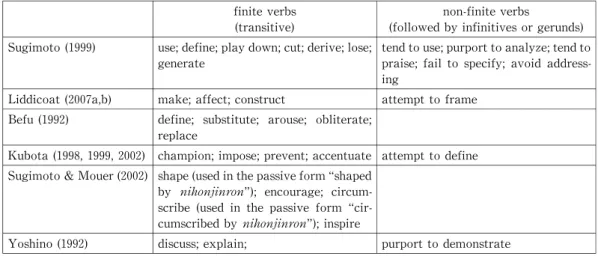
I have selected some examples from a few prominent nihonjinron critics in order to demonstrate how these writers assign agentive properties to the ideology. In Table 1,I list both finite verbs (transitive) ― for example, Nihonjinron cuts across the political divide (Sugimoto 1999) ― and non-finite verbs (followed by infinitives or gerunds)― for example,
Nihonjinron attempts to frame Japanese identity (Liddicoat 2007a)― as examples of this process of mystification of causal structures. In the original texts, the combination of nihonjinron (as subject) + verb ― i.e. active voice ― is most common, while the passive construction ― with the ideology remaining the agent of the action ― are less common. Sometimes,these verbs are inflected in the third person singular (referring to nihonjinron as singular entity)and at other times are in the third person plural (referring to nihonjinron as the sum total of all writings in the genre).
As the above shows,nihonjinron is followed by both finite and non-finite verbs(causative verbs, eliciting verbs, and both factive and non-factive verbs affecting object complements), thereby becoming the subject of specific actions. With the ability to affect the objects of propositions, the ideology becomes the main causal agent of social actions. The result is that readers are misled as to who is performing the action. This is how the nihonjinron critics mystify causal relationships.
From this, I conclude that, by adopting such syntactic constructions, these writers dissolve human agency into a larger,more abstract structural entity. Here,the ideology of nihonjinron embodies this entity. Thompson (2007) explains such discourse process as typical of ideological discourse. Without concluding that the critiques of nihonjinron are themselves ideological, I side with Thompson s view and suggest that the producers of such critiques demonstrate a tendency towards the utilization of discursive strategies which are typical of ideological discourse. While it is possible that these particular syntactic
construc-finite verbs (transitive)
non-finite verbs
(followed by infinitives or gerunds) Sugimoto (1999) use;define;play down;cut;derive;lose;
generate
tend to use;purport to analyze;tend to praise; fail to specify; avoid address ing
-Liddicoat (2007a,b) make;affect;construct attempt to frame
Befu (1992) define; substitute; arouse; obliterate; replace
Kubota (1998, 1999, 2002) champion;impose;prevent;accentuate attempt to define Sugimoto & Mouer (2002) shape(used in the passive form shaped
by nihonjinron ); encourage; circum scribe (used in the passive form cir cumscribed by nihonjinron );inspire
-Yoshino (1992) discuss;explain; purport to demonstrate Table 1 Nihonjinron with agentive properties
tions were formulated by the nihonjinron critics with metaphorical intents, I maintain that a realist discussion on ideological discourse should clarify who is actually doing what .
The following subsection deals with five nihonjinron critics who combine academic discourse with empirical research.
3.3 Empirical studies on
Yoshino (1992) justifies his sociological study of the relationship between educational practices and the consumers of nihonjinron by arguing that research which addresses what occurs, by whom, and to whom within Japanese society is missing in the literature on nihonjinron (p.133). He conducts a qualitative study of the ways in which nihonjinron becomes integrated into social practices. His respondents come from what he calls a fairly large provincial city[...]representative of the nation as a whole (p.104-105). His qualita-tive approach consists of face-to-face and telephone interviews, questionnaires and letters exchanged with educators and businessmen. Following what he calls the conventional view that educators play a central role in cultural nationalism (p.105), Yoshino chooses to limit his pool of respondents to school headmasters. In addition,arguing that age is an important factor to consider in a study of Japanese nationalism,a point which Gano (1987)echoes in his own study of the supporters of Japanese nationalist discourse,Yoshino (1992)concentrates on headmasters aged 55 and above (almost two-third of his respondents). However, he con-cludes that these respondents perceptions of Japanese uniqueness are a reflection of the views held by Japanese society at large. After a lengthy analysis of selected data from respondents,Yoshino reasons that these express in one way or another[the view]that the Japanese are intrinsically different from other peoples (p.115). Yoshino concludes some-what contradictorily by cautioning that the results of his study cannot be generalized to the population at large. Yet he feels confident that these results reflect an ontological reality which influences the Japanese population as one unified bloc. Despite these contradictions, Yoshino s enquiry includes a rich discussion on nihonjinron as ideological discourse,making his study one of the most widely quoted in the critical literature on nihonjinron. Unfortu-nately,many nihonjinron critics have quoted the results of his study as empirical evidence of the impact of nihonjinron on Japanese educational practices.
Befu & Manabe (1987)conduct a questionnaire survey to determine the extent to which Japanese people showed interest in the tenets of nihonjinron. Out of 944 respondents,they
determine that over 80% showed interest in nihonjinron. 38% believed that Japan is a homogeneous nation, 36% believed in the homogeneous society idea, and half believed that Japan is a unique culture. 63% of respondents believed that non-Japanese nationals are incapable of fully understanding Japanese culture. However, this particular finding is to a certain extent contradicted by Haugh s (1998)study referred to earlier,which shows that the majority of Japanese people he surveyed disagree with the notion that foreigners are essentially unable to use the Japanese language appropriately and fluently.
Coming back to Befu & Manabe (1987), the authors uncover a correlation between increasing age and degree of nihonjinron espousal. Also, they find that the level of educa-tion is diametrically opposed to the level of adherence to nihonjinron. Yet, in terms of standard of living, the opposite is the case. Their conclusion is that nihonjinron is largely accepted among older males with a higher standard of living. The researchers conclude that the data collected indicate nihonjinron s negative impact on educational practice.
In sharp contrast,Sullivan & Schatz s (2009)empirical study of rural university students reveals a positive relationship between national identification and English learning attitudes and self-assessed English proficiency. Similar results are found in Rivers (2011)own study which reveals that both nationalism and patriotism are significant indicators of students positive ― not negative ― orientation toward English speaking culture and community. These two studies seem to contradict general assumptions about the link between nationalist feelings and foreign language learning. They will be discussed further in Section 3.4.5.
The studies conducted by Befu & Manabe, Gano and Yoshino are attempts to measure how Japanese people accept, respond to, or consume, the ideology of nihonjinron. The same can also be said about Rivers and Sullivan & Schatz. However,these writers generally under-theorize the concepts under focus (e.g., Befu & Manabes levels of interest in nihon-jinron, and Yoshino s that which cannot be shared by non-Japanese). Also, these authors limit their data collection procedures to questionnaires,and take such data as true reflection of reality. One consequence of adopting this approach to empirical research is that, when such studies are replicated in different contexts, they often yield contrasting results. Haugh s (1998)study is a good example of this. In short,without a critical perspective,the readers of such studies are left to assume that the dissemination and reception of nihonjinron among a very small portion of the public is a reliable measure of the impact of the ideology
on Japanese social practices at large.
3.4 and the construction of academic discourse
The following sub-section expands on the themes that are common to the critiques of nihonjinron. I reiterate that the producers of such critiques show a tendency to draw a direct connection between ideology and social practices without providing corroborating evidence.
3.4.1 located at the unconscious level
Agreeing with the proposition that peoples attention is often diverted away from the language they use and the ideologies which may influence the use of that language (Thomp-son 2007,Fairclough 2010)can,if applied to the Japanese context,lead to the assumption that nihonjinron is the hidden engine behind Japanese social practice,or the unconscious motiva-tion behind peoples acmotiva-tions. McVeigh (2002,2006),a prolific nihonjinron critic,emphasizes this approach to nihonjinron as ideology. He borrows from Befu (1983) the idea that the approach to English language learning in Japan is ideological, and is widely adopted by millions of Japanese because it remains at the unconscious level. McVeigh (2002) then asserts that the ideology permeates through a wide network of social institutions, giving it enough power to infuse a strong sense of national identity among Japanese EFL students. The author rarely uses the word nihonjinron,yet he refers extensively to the existence of an ideology which he calls Japanese identity or Japaneseness. In his words, this is a basic reality for all Japanese (ibid:155),a mythologized view of Japanese culture held by many (p.166), also an essentialized belief system deeply ingrained in the mind of his own students which he has strived in vain to demythologize (p.258). His principal argument is that nihonjinron is institutionalized through educational policies, and works at the unconscious level of unsuspecting human agents. Although he is careful to mention that, within such system,some learners do manage to successfully learn the language (p.149),he clarifies that these are exceptions to the rule,usually belonging to the elite private school network. The authors central message is that the Japanese education system emerges out of nihonjinron, and that the ideology remains hidden from peoples consciousness. If we link McVeigh s view with Goodman s (1992) argument that nihonjinron is a discourse formulated by the Japanese elite to serve the goal of maintaining relations of domination within Japanese society, we can then advance the proposition that the Japanese education system is a very effective engine of social control. This system is,according to their logic,skillfully hidden
by the producers of an uncritically ― i.e. unconsciously ― accepted discourse on Japanese uniqueness.
While I side with Thompson (2007) and Fairclough (2010) in that peoples attention is rarely focused on the language they use and the ideologies they formulate through that language, I am reticent to accept the idea that an abstract entity such as nihonjinron can possess ubiquitous powers of control over Japanese society.
3.4.2 and the socialization of the Japanese
Yoneyama (1999:20)argues in a similar vein to McVeigh (2002),stating that the English discourse on Japanese education has largely been a branch of nihonjinron, focused on the socialization aspect of Japanese society. She suggests that this discourse has long followed a functionalist approach, implying that it reduces human agency to its functions of subser-vience to, and maintenance of, social structure (i.e., the school, the community, the nation). In other words,agency serves institutional needs and does not possess sui generis properties. This stance is in opposition to the realist approach I aim to promote in this paper.
A noticeable shortcoming in Yoneyama s study is her conceptualization of the Japanese school system as a unified social unit. From this platform, she depicts a gloomy, structur-alist world, where educational discourse completely restrains learners sense of agency:
The Japanese high school to which students are bound[...]is a stifling place. Its organisational structure is extremely formal, rigid, and auto-cratic. Not only student―teacher relationships,but relationships between teachers and between students are hierarchical. Student―teacher commu-nication is typically teacher-centred,one-way and top-down,and the student ―teacher relationship is bureaucratic, distant and impersonal. In this milieu,students largely do not expect things like understanding,respect and personal care from teachers. Paternalistic care is nothing but a myth. Students are assigned a subordinate role and expected to remain silent (p. 244).
Here, Yoneyama implies that powerful nihonjinron supporters within the education system are actually successful at fulfilling their objectives of socializing Japanese pupils
through subjugation. The resulting vision is of a world in which the individual is subdued by overwhelming structural forces. Ironically,she achieves this vision partly by constructing a dichotomist contrast between the Australian and the Japanese school systems, putting both at opposite end of an imaginary spectrum.
3.4.3 as discursive tool
One of the central arguments found in the nihonjinron critiques refers to the discursive fluidity of nihonjinron. Most nihonjinron analysts agree that the ideology has taken on different forms throughout Japanese history. Befu (1992) states that nihonjinron, being a less controversial form of nationalism, became popular during the 1970s because of a shift away from militaristic nationalism, which had become highly controversial after the war. Nakamura s (1992) four stages of nihonjinron described in section 2.2 demonstrate the constantly shifting nature of the ideology. Sugimoto (1999) relates one specific instance which demonstrates the flexibility by which nihonjinron has been constructed over the years:
[i]n the 1990s, Japans cultural uniqueness advocates came to realize that they gave critics of Japanese practices ammunition to chide Japanese leaders for falling out of step with internationally accepted norms. In the face of the rising US-based revisionist argument that Japan is unfairly closed and even alien , some Nihonjinron theorists shifted their emphasis away from Japan being portrayed as an isolated unique case and started maintaining that the Japanese model has universal applicability (p.86).
This shift in nihonjinron rhetoric shows how the formulation of the nihonjinron dis-course has come in reaction to specific needs felt at specific times. Kowner (2002)provides an even more revealing account of such process:
[t]he resurgence of the Nihonjinron discourse in recent decades is an outcome of its ability to fulfill much of the needs of both its producers and consumers. Further, the tremendous popularity of Nihonjinron at present suggests that there has been a continuous process of mutual feedback between these two parties, a process that inevitably culminates into a multifunctional discourse (p.176-177).
This argument takes the notion of multifunctional discourse from Befu (2001:63), who defines nihonjinron as a mass culture phenomenon.
The principal argument advanced here is that nihonjinron, like other ideological dis-courses, must remain fluid to deal with social change and retain its popular appeal. Befu (1992) provides a historical account of this by explaining that [t]he popularity of nihon-jinron in postwar Japan is a consequence of Japan s inability to exploit effectively the most important symbols which express national identity and nationalism (p.27). Because certain national symbols ― e.g., the flag, the anthem, the emblem ― are both fixed entities and historically problematic, therefore being largely unappealing to postwar Japanese society, nihonjinron can instead be used as a unifying force because of its porous and adaptable nature(Yoshino 1992). Demonstrating that the nihonjinron discourse of the war years is not the same as that of the 1980s,Befu (1992:43)argues that the convenience of nihonjinron is that its contents can be readily altered. Clammer (1997:96) sides with Yoshino (1992) in arguing that
nationalist ideologies create themselves at least in part through constructs of culture, and this is nowhere truer than in Japan, where the notion of cultural nationalism (which includes the whole nihonjinron phenomenon) well describes this style of identity formation[...]Being Japanese is not an essentialist notion:it is something that requires constant construction and reconstruction,and this is done by a variety of means ― through the media; by intellectuals and producers of reflections on Japaneseness;by politicians, especially those on the right;and through consumption and its expression in a lifestyle― in the purchasing of objects,their use in creating a lifestyle and in their incorporation into a semiotic code.
These perspectives recall Thompson s (2007:26)notion of dissimulation,a process which shows how ideologies are formulated by constantly diversifying and displacing meanings and references in order to sustain and justify the established social order.
Yet, despite the fact that many nihonjinron critics highlight the discursive fluidity of nihonjinron, Befu explains that not everything about nihonjinron is relative: [w]hat is common to the wartime nihonjinron and the postwar neo-nihonjinron is that both rely
heavily on primordial sentiments inherent in the presumed ethnic essence of the Japanese― blood, purity of race, language, mystique ― which are the basic stuff of nihonjinron, pre-and post-war (ibid). Mishima (2000:76)echoes this view in the following way: the argu-ments in the identity discussion (nihonjinron)have accordingly changed considerably[...]the strong belief in ones own uniqueness is hardly shaken but the content of that belief has turned out to be subject to change. From this, I conclude that the critics of nihonjinron tend to conceptualize the ideology in a contradictory fashion:by highlighting its fluid nature on the one hand, and by seeing it as a unified entity which directly impacts social practice on the other. In other words,we can begin to see some similarities in logic between the nihonjinron critics approach toward nihonjinron and the nihonjinron advocates approach toward Japanese culture and society.
3.4.4 and anti-multiculturalism
Dale (1986), Kawai (2007)and Seargeant (2009)hold that nihonjinron supporters project the image of Japan as a monolingual nation. This vision comes with the additional implica-tion that Japanese people are essentially poor foreign language learners. In fact, the myth of the Japanese as poor language learners has been solidified and propagated by many nihonjinron-oriented psychologists, notably Tsunoda (1978).
Reesors (2002) analysis of English teaching policies in Japan also underlines this idea. The author argues that,in their desire to protect the integrity of Japanese national identity, some MEXT policy makers intentionally complicate the creation and implementation of communicatively-oriented policies that would lead Japanese EFL learners to develop commu-nicative abilities in the target language. While this point is somewhat controversial and rather questionable,the underlying argument made by nihonjinron critics is that nihonjinron advocates actively project specific values on the national language ― Japanese ― which are then applied to English to form a negative image of English as the foreign language. In other words, what belongs to English is whatever is not Japanese. The implication is that learning English requires a negation of Japanese linguistic and cultural identity. This apparent ideological process of distancing the learners from the target language is, as Seargeant (2009:55)argues, characteristic of nihonjinron s cultural determinism.
As argued earlier, most nihonjinron critics hold that the current nihonjinron-oriented logic towards English places the target language as a tool used for the Westernization of